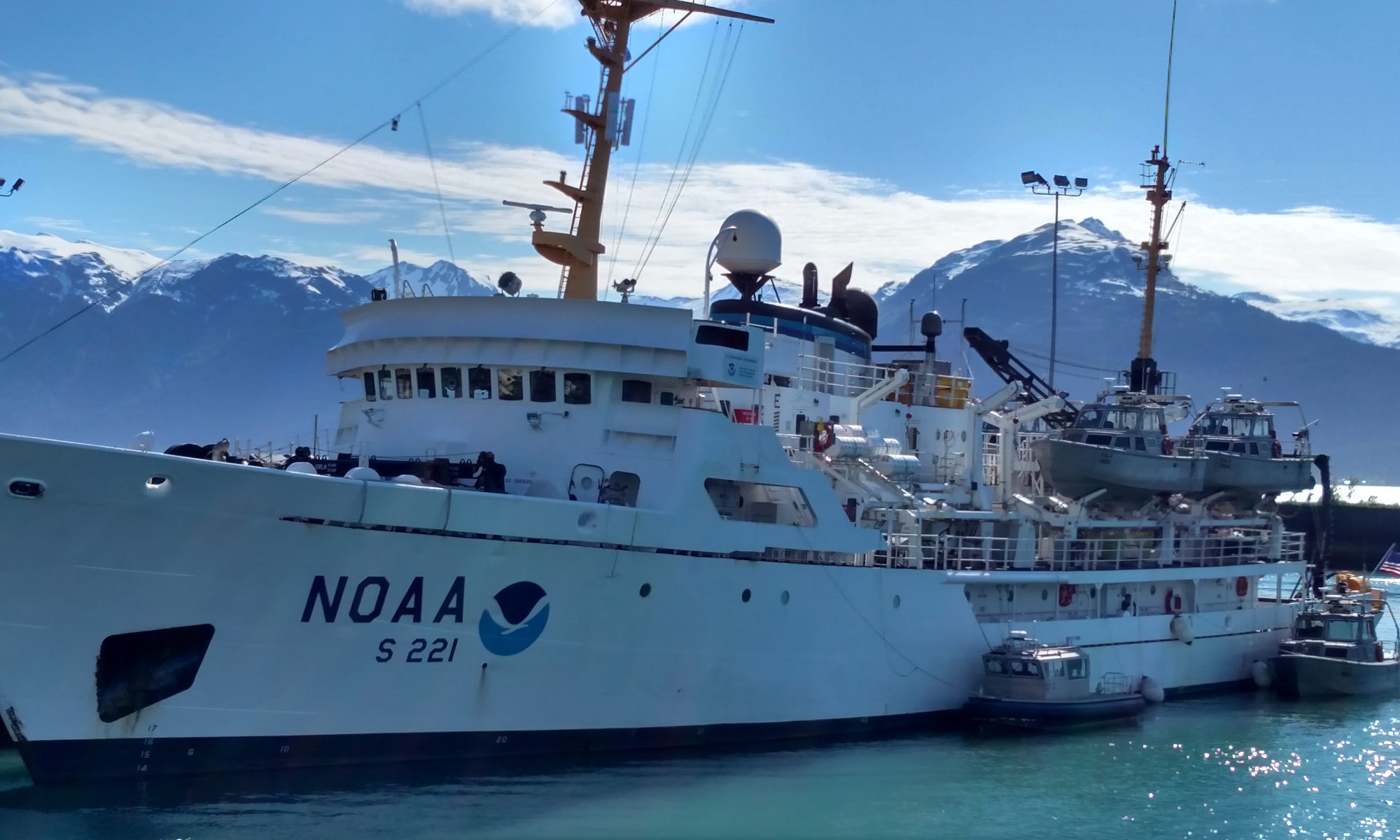
NOAA Teacher at Sea
Jennifer Fry
Onboard NOAA Ship Miller Freeman (tracker)
July 14 – 29, 2009
Mission: 2009 United States/Canada Pacific Hake Acoustic Survey Geographical area of cruise: North Pacific Ocean from Monterey, CA to British Columbia, CA. Date: July 16, 2009
Here is Dr. Chu using a sonar readout to determine where the hake are located.
Weather Data from the Bridge
Wind speed: 20 knots
Wind direction: 358°from the north
Visibility: foggy
Temperature: 15.2°C (dry bulb); 13.4°C (wet bulb)
Science and Technology Log
We conducted several sea trawls for hake and other various fish species. First, the scientists conduct an acoustic survey using 4 different frequencies. Then the nets are lowered and drug at depth. The fun begins when we don our rubber overalls, gloves, and galoshes and count, identify and, weigh the fish. The most numerous fish in the trawls were myctophids (see photo), bioluminescent fish with some species having 2 headlights in front of their eyes to help attract prey.
Here we are sorting the catch.
HAB/ Harmful Algal Blooms Test: Throughout the day we took HAB samples, “harmful algae blooms”, which measures the toxins, domoic acid, and chlorophyll levels in the water (which correspond to the amount of plankton present). The HAB sample entails collecting sea water and putting it through a filtering process. Julia Clemons, a NOAA Oceanographer, and I conducted the HAB survey (pictured below). Fifty milliliters of sea water is measured into a graduated cylinder then filtered.
This is a type of fish called a myctophid. They are bioluminescent.
Sea water is collected at specific times during each transect or line of study. The sea water goes through a filtering process testing domoic acid and chlorophyll levels. These results will be evaluated later in the lab. One thing that strikes me is the importance of careful and accurate measurement in the lab setting. The harmful algal bloom samples are conducted 5-6 times daily and accuracy is essential for precise and definitive results. Later scientists will review and evaluate the data that was collected in the field. It is very important that the scientists use the same measurements and tools so that each experiment is done the same way. Making accurate data collection makes for accurate scientific results.
Animals Seen Today
Numerous albatross circling the stern of the ship, Viper fish, Octopi (approx. 6 inches in length), Squid (approx. 3 inches in length), and Myctophidae (see photo).
ZooplanktonHere I am observing Julia as she filters a HAB sample.
NOAA Teacher at Sea
Ruth S. Meadows
Onboard NOAA Ship Henry B. Bigelow June 12 – July 18, 2009
Mission: Census of Marine Life (MAR-Eco) Geographical Area: Mid- Atlantic Ridge; Charlie- Gibbs Fracture Zone Date: July 3, 2009
Weather Data from the Bridge
Temperature: 6.2oC
Humidity: 81%
Wind: 16.47 kts
This is one of the glass floats encased in plastic that can withstand the pressure of the deep waters.
Science and Technology Log
High winds and high waves put a temporary stop to our fishing with the nets. When the waves are too high, the safety of the crew comes first and we wait for the weather to clear before we can start using the trawl again. The waves finally calmed down enough for the net to be used today. We are using a different type of net to fish the deep bottom (benthic trawling) than was used to fish the mid-water (pelagic trawling). This net is much simpler in design. It is a very large net lowered to the bottom of the ocean and then pulled behind the ship. The top part of the net is held open by floats. These floats were bought specifically for this cruise. The pressure on the bottom of the ocean is so great that normal floats would collapse. The new floats are made of glass spheres with a hard plastic covering. Only glass can withstand the amount of pressure that is found at these depths.
This is the net used for deep bottom trawling that has the yellow floats attached to it.
There are rubber tire-like rollers that move along the bottom to help prevent snags and also to stir up the sea floor and cause the fish and other organisms to move into the net where they are then funneled back into the narrow end of the net (cod-end). There are weights on the bottom section of the net to keep it on the ground.Of course, there are always obstacles on the bottom of the ocean floor and occasionally the net will get caught on one of these. This is a particular problem here because of the mountainous terrain. When the net gets hung up the crew works very carefully to release it from the obstacle. Sometimes the ship moves backwards as the winches try to pull on the net to release it. Sometimes the ship moves in a circle to try and pull the net clear.
The full net after it’s been retrieved on deck.
So far the benthic net has gotten caught twice but the crew successfully retrieved the net without damage. Once the net is on deck, the cod-end is opened and everybody comes out of the lab with foul weather gear (waterproof boots, overalls, jackets, life preserver and hardhats) on to collect the catch. We use lots of baskets to do a quick rough sort of the organisms caught. If the net is full, it takes a while to complete the first sort. Some of the fishes are large and some of the organisms have been torn. The organisms found on the floor of the deep floor are very different from the ones found in the mid-waters. They are much larger in size and very different in coloration.
Personal Log
A bucket with squid and other fishes.
The scientific crew is divided into three groups. We have a “day” shift, called a watch, that works from 12 noon to 12 midnight, and a “night” watch that works from 12 midnight to 12 noon, and then one group that works whenever a net comes up. I am on the day watch and we have all gotten into a pattern of who does what in the lab. My watch chief scientist is Dr. Shannon Devaney from Los Angeles. She works at the Natural History Museum there. Dr. Amy Heger from Luxembourg, Tom Letessier from Norway, CJ Sweetman from Connecticut and Randy Singer from Georgia rounds out our crew. CJ takes DNA samples, Tom takes care of the crustaceans, Randy removes the ototliths (this helps the scientist figure out the age) from the fishes, and Amy and I use the computer to enter the data. With some species we remove the stomach, liver and gonads from the fishes. These body parts are then measured and either frozen or preserved for scientists that are not on the trip. It has been fun relearning how to do some of the procedures.
We spent the day cruising in one of the shallowest regions of the entire expedition. The depth below us is only about 40 meters. We are also getting close to what ice is still present this time of the year. I checked with the National Snow and Ice Data Center to see what the status of the sea ice in the arctic currently is. So far I haven’t seen any ice but I am keeping a look out for it. Of course we cant see anything, we are cruising through a thick fog right now. I am also doing some of my own research on phytoplankton while up here and the edge of the sea ice plays an important part in how productive the phytoplankton actually is. They reported that after a slow start to the melt season, the ice extent declined quickly in May. Scientists are monitoring the ice pack for signs of what will come this summer. The thinness of the ice pack makes it likely that the minimum ice extent will again fall below normal, but how far below normal will depend on atmospheric conditions through the summer.
Worms and Sea Stars from sediment cores
According to the National Snow and Ice Data Center, the sea ice extent over the month of May 2009 averaged 13.39 million square kilometers (5.17 million square miles). This was 81,000 square kilometers (31,000 square miles) above the record low for that month, which occurred in May 2004, and 21,000 square kilometers (8,100 square miles) below the 1979 to 2000 average. So its clear that something unusual is happening up here. At pretty much every station the zooplankton guys set out their nets to see what’s living in the area. Watching them work I can see changes in the zooplankton populations from one location to another. They are finding larval fish, copepods, euphusisds (krill), isopods, amphipods, jellyfish, and the occasional juvenile squid. Some critters are coming out of the sediment cores currently. Maggie Esch, a graduate student from Western Washington University is studying bioturbidation in the sediment. She is looking at how nutrients move through marine sediments as a response to what is burrowing through the ocean bottom. Her last core had some cool worms and young Sea Stars.
I’m hoping to see more marine animals, especially mammals and birds as we approach the Pribilofs, which are the only island on the eastern Bering Sea that are in the proximity of the shelf break. The current sampling line we are on will bring use right between St. Paul and St. George islands. Owing to their position near the shelf break, these islands are home to large populations of marine mammals, seabirds, and fish. The Pribilofs are a famous destination for birdwatchers. There are a reported 240 different species of birds present in the Pribilofs, and “Birders” come from all over the world to see them in the wild. The islands were also once know as the Fur Seal Islands because of the Fur Seal (Callorhinus ursinus) rookeries located there. Today, the fur seals are only subsistence hunted by the Aleuts, and Inuit who live on the islands.
NOAA Teacher at Sea
Ruth S. Meadows
Onboard NOAA Ship Henry B. Bigelow June 12 – July 18, 2009
Mission: Census of Marine Life (MAR-Eco) Geographical Area: Mid- Atlantic Ridge; Charlie- Gibbs Fracture Zone Date: June 19, 2009
Weather Data from the Bridge
Temperature: 9oC
Humidity: 95%
Wind: 4.36 kts
Scientific and Technology Log
We are currently working in the pelagic zone of the ocean. Pelagic refers to the open ocean away from the bottom. The word pelagic comes from a Greek word that means “open ocean”. The pelagic area is divided by depth into subzones. .
The epipelagic , or sunlit zone, is the top layer where there is enough sunlight for photosynthesis to occur. From 0 – about 200 meters (656 feet)deep
The mesopelagic, or twilight zone, receives some light but not enough for plants to grow. From 200 – 1000 meters (3281 feet)
The bathypelagic, or midnight zone, is the deep ocean where no sunlight penetrates. From 1000 – 4000 meters(13,124 feet)
The abyssal zone is pitch black, extremely cold and has very high pressure. From 4000 – 6000 meters.(19,686feet)
Hadalpelagic zone is the deepest part of the ocean. These zones are located at trenches where one tectonic plate is being subducted under another plate. 6,000 meters to over 10,000 meters. (35, 797 feet)
Setting up the net that will collect organisms
Today we are using a special trawling net to capture organisms that live in the mid-water area around 3000 meters deep. The closed net is lowered slowly from the rear of the ship until it arrives at the correct depth. The length of the wire released is measured by the winches as they unwind. A timer is used to open the cod-ends (containers at the end of the net). It is then pulled underwater very slowly. The five cod-ends are set to open and close at different times so there will be samples of organisms from different depths. After a specific amountof time the net is slowly reeled in. It takes about 8 hours to fully deploy and retrieve the trawl. Each cod-end should have samples from different depths. Once the net is back on board the ship, it is very important that the material collected from each cod-end be kept separate and labeled correctly.
All the blue buckets contain various organisms
The second trawl came in around 4:30 in the afternoon. We were really excited to see the organisms that were collected in each of the cod-ends. Each container was emptied into a large bucket and a picture was taken to record the catch. One set of material was left out to begin sorting and the other containers were put into the freezer to remain cold. David Shale, the professional photographer for the cruise, selected the best samples to use for his photographs. Then the actual sorting began. Several of us would do a rough sort, all the crustaceans (different types of shrimp-like animals) in one container, fishes in another, and jellyfishes in another. After the rough sort then the final sort is started (dividing all the organisms into groups by specie or family).
Certain types of organisms were abundant – hundreds of them, others were rarer – only one or two of each species. As soon as we are finished with one species, information about them is entered into the computer (number, length, mass) and then the organism is saved for later investigations by either freezing or placing in a preservative. A printed label is included in all samples so they can be identified by name, depth and location of trawl.
Personal Log
A viperfish
Everyone on board the ship is always interested in any sightings of marine mammals. The officer on the bridge will often announce to the lounge area if he spots any type of animal, “Whales off the bow.” As soon as the announcement comes on, we bolt out of the lounge to the outside as fast as we can. Sometimes you are fast enough and sometimes you aren’t. The dolphins usually are the easiest to spot as they swim in groups and surface frequently as they are swimming. The whales, however, are a little more difficult to see. They are usually far off so the distance makes them difficult to spot. When they surface, the spray from the blowhole is usually your first indication of where they are. After that, most of them dive again and you may not get a second chance to see them. So far the type of whales spotted have been pilot whales, sei whales and a sperm whale. They knew it was a sperm whale because the spray from the blowhole was at an angle. It is much more difficult to see these animals than I thought it would be. It is like trying to find a needle in a haystack – a very big haystack…
The Mola mola is the heaviest known bony fish in the world. It eats primarily jellyfish which doesn’t have a lot of nutrition in is so they have to eat LOTS of them. It looks like a fish with only a head and a tail, no middle part.
Dr. Mike Vecchione took this picture of a Mola mola, a very large ocean sunfish, at the beginning of the cruise off the coast of Rhode Island.
NOAA Teacher at Sea
Mary Anne Pella-Donnelly
Onboard NOAA Ship David Jordan Starr September 8-22, 2008
Mission: Leatherback Use of Temperate Habitats (LUTH) Survey Geographical Area: Pacific Ocean –San Francisco to San Diego Date: September 17, 2008
Weather Data from the Bridge
Latitude: 3614.8661 W Longitude: 12402.7415 N
Wind Direction: 190 (compass reading) SW
Wind Speed: 2.1 knots
Surface Temperature: 15.230
Science and Technology Log
Above is a spreadsheet of some of the Chrysaora fuscescens data that was collected on September 15. The first trawl was at 4:48 pm, the second at 6:39 pm and the third at 8:20 pm. A fourth trawl was deployed at 10:49 pm. A total of 204 jellies were sorted and measured. Of these, the first 7jellies measured from trawl numbers’ 46, 47 and 48 are recorded above. All of the species in this data set are Chrysaora fuscescens. Using the spreadsheet, create a graph that compares mass to length for these 21 animals. When you believe you have completed this, answer the questions listed below.
Questions:
Is your graph complete?
Check to see if you have included; all units-mass in kilograms, length in millimeters; a legend that includes the code of the points; title for each axis(length of jelly in millimeters, mass of jelly in kilograms); title for graph.
Did you make a scatter plot, bar graph or line graph? The best choice would be a scatter plot, this may give an indication of patterns in the relationship between length and mass.
Can you see any pattern? Is there a relationship between mass and length? This would be indicated by a linear pattern in the points?
Do there appear to be any points that do not fit a general pattern? What might cause these points that do not fit the norm to exist?
Compare your graph with the one shown below, generated by the computer.
These Chrysaora fuscescens were caught in “jelly lane”, in the waters near Pacifica, CA that are known to have large jelly populations. It is also an area known for leatherback sightings because of this food source. A great deal of information is known about the oceanographic conditions in this near-shore habitat. The reason the LUTH survey is crisscrossing off the continental shelf, is that much less is known about deeper offshore waters as a potential food source for migrating leatherbacks. The routes they travel on must have some food available, so we are working to find out where that is, and gain information about relationships to oceanographic variables so that researchers will be able to eventually estimate where that food is using satellite images that will be translated into jellyfish habitat.
Chico Gomez and Scott Benson sorting jellies.
Personal Log
There was quite a bit of excitement today up on the flying bridge. Although we were traveling out beyond the continental shelf, we moved over a front of water that had an abundance of moon jellies. It was unexpected and the scientific team became very excited. New plans were made based on this observation and a decision was made to cross back across the front and collect temperature data within the water column every 10 minutes. Quantitative observations were made of all jellies seen port and starboard and a net trawl was deployed at one point along the zone of interest. It was quite a day. We also spotted blue sharks, ocean sunfish, and a swordfish jumping. It was a good day.
Animals Seen Today
Extracting stomach contents from large C. fuscescens
Sooty shearwater Puffinus griseus
Sea nettle jellies Chrysaora fuscescens
Moon jellies Aurelia aurita
Northern Fur seal Callorhinus ursinus
Elephant seal Mirounga angustirostris
Swordfish Xiphias gladius
Blue shark Prionace glauca
Buller’s shearwater Puffinus bulleri
Ocean sunfish Mola mola
Rhinoceros auklet Cererhinca monocerata
Black-footed Albatross
Phoebastria nigripes
Questions of the Day
What might be possible reasons the scientific team was excited at finding jellyfish out beyond the continental shelf?
The weather has been very calm and mostly overcast. One of the officers told me he would much rather have those conditions, than windy and sunny. What effect might wind have on a sturdy, ocean-going ship?
Ocean sunfish seen from flying bridge.Sunset seen from flying bridge, the first sunset we’ve seen on this leg.