NOAA Teacher at Sea
Jennifer Fry
Onboard NOAA Ship Miller Freeman (tracker)
July 14 – 29, 2009
Mission: 2009 United States/Canada Pacific Hake Acoustic Survey Geographical area of cruise: North Pacific Ocean from Monterey, CA to British Columbia, CA. Date: July 15, 2009
Weather Data from the Bridge
Wind Speed: 19 kts.
Wind direction: 355° north
Temperature: 15.4°C (dry bulb); 13.2°C (wet bulb)
Science and Technology Log
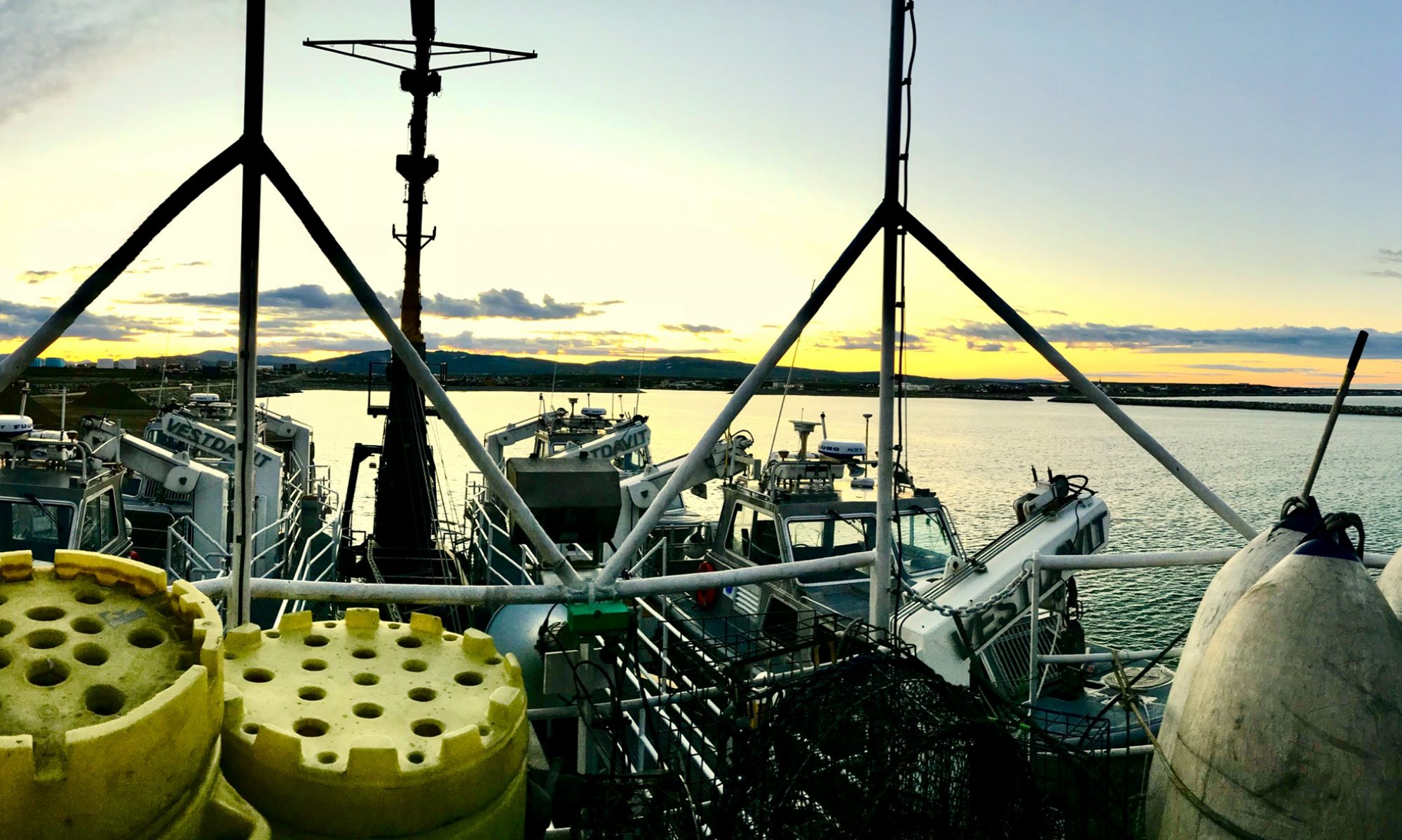
This picture shows the Miller Freeman in Alaskan waters. On our cruise, it’s working off the coast of California.
Our cruise was delayed for a day due to poor weather conditions and heavy seas. We began with a meeting of the scientific team which consists of 8 members all with their specific scientific knowledge and expertise. We will be conducting several types of oceanographic sampling during our cruise: 2-3 hake tows per day, weather permitting, an open net tow where fish are viewed through a camera, XBTs: Expendable Bathythermograph, HABS: Harmful Algal Bloom Sampling, and CTD: Conductivity, Temperature, and Density. The ship conducted Man Overboard and Fire drills.
The research vessel Miller Freeman set sail from Eureka, California on Wednesday, July 15th at approximately 12:30. Each person aboard is assigned a specific job and place to report on the Miller Freeman during such an event. Our assignments are posted on our stateroom door. During a Fire/Emergency Drill the signal is a 10 second blast of the general alarm and/or ship’s whistle. I am to report or muster to the Chemical Lab.
In the event of an Abandon Ship Drill, I am assigned to life raft #2 and muster on the O-1 deck, port (left) side. The Abandon Ship signal is more than 6 short blasts followed by one long blast of the general alarm and/or ship’s whistle. If a Man Overboard Drill is called, we will hear 3 prolonged blasts of the general alarm and/or ship’s whistle. The muster station is the Chemical Lab. If we personally see a person go overboard the ship there are three things to do immediately: Throw a life ring overboard, call the bridge, and keep your eyes on the person.
These things all need to be done as simultaneously as possible to assure the safety and recovery of the person who is in the sea. It is important to conduct these emergency drills so that everyone is ready and prepared in the case of an emergency event.
Personal Log
I am sharing a stateroom with Julia Clemons, an oceanographer on board the Miller Freeman. She works for NOAA Fisheries in Newport, Oregon. Her educational background includes a Bachelors’ degree in Oceanography and a masters’ degree in Geology. The scientists and crew on board are so professional and willing to teach and tell about their job. They are an amazing group of people.
New Term/Phrase/Word
Domoic acid
Questions of the Day?
What does a hake look like in person?
Animals Seen Today
5 Egrets
1 great blue heron
Numerous gulls
NOAA Teacher at Sea
Stacey Klimkosky
Onboard NOAA Ship Rainier
July 7 – 24, 2009
Mission: Hydrographic survey Geographical area of cruise: Pavlov Islands, Alaska Date: July 7, 2009
Weather Data from the Bridge
Position: 57°36969N, 154°41.154W
Weather: Overcast, Foggy
Visibility: 10 nautical miles (nm)
Wind: North 17 knots Swells: 2-3’
Waves: 1-2’
Barometric pressure: 1021.4 mb
Air temperature: Wet bulb=10.6°C; Dry bulb=10.6°C
Science and Technology Log
The Rainier’s a heavy ship!
Finally we are underway, having pushed off of the dock in Seward around 1500 on Monday, July 6. The cruise time to the area where RAINIER and her crew will be conducting hydrographic surveys is approximately 40 hours. The distance is 519 nautical miles. (One mile on land = 0.869 nautical miles, so 1nautical mile = 1.15 statute miles). Thus far, we have traveled approximately 240 nautical miles in a time of 19 hours—just about ready to finish passing Kodiak Island to the port (left) side.
In the meantime, there is plenty to do aboard— learning about the many aspects of safety aboard a working vessel being the most important. NOAA personnel new to the ship and guests watched a variety of safety videos as well as received our safety gear. My closet, which was fairly empty yesterday morning, is now stuffed with a survival suit (a.k.a. The Gumby Suit); a Float Coat (a warm orange coat that provides both buoyancy and warmth if you “go into the drink”, or fall overboard) and an inflatable safety vest that I will wear whenever I am working inside the cabin on one of the launches once the surveys begin. We also had our abandon ship and fire drills. It’s very similar to the fire and safety drills we do in school. Everyone has a specific place to meet (muster) and some have specific jobs to do or items to bring. Like the sign on the fantail of the ship says: TEAMWORK SAFETY FIRST!
Alaska has many jagged volcanic mountains.
I’ve also had time to begin speaking to different members of the crew—their responsibilities, how they arrived on RAINIER, and what the hydrographic surveys will be like. One of the most interesting conversations was with Steve Foye, a Seaman Surveyor. Steve told me that RAINIER is scheduled for a complete mid-life repair after this year’s survey season is completed in September. RAINIER will then go into dry dock and the repairs and changes will begin. The entire inside of the ship will be gutted and remodeled. While all of that is going on, a decision has to be made—where will RAINIER’s homeport be? Steve brought up quite an interesting point: a port that has brackish (part salt/part fresh) water is better for the ship. Why? When a ship is at sea for long periods of time, creatures such as barnacles cement themselves to the hull. It’s essential to remove them; however, the process is costly—both in time and money. Having moving fresh water along the ship’s hull while docked for the “off season” will eliminate the barnacles. But there’s another problem—after a winter docked in fresher water, algae and plant material starts to grow where the barnacles once were. Solution? Begin a new survey season and sail the ship in salt water. The plant material is then eliminated, but guess what starts to come back? An interesting example of a cycle.
Personal Log
It’s great to finally be a Teacher at Sea! Not a Teacher on a Plane, or Teacher on a Train, or Teacher at Port. I’ve been waiting a long time for this to get underway. Thus far, the entire experience has been new. I’ve had the opportunity to see some amazing scenery—the landscape is so different from that of Cape Cod, Massachusetts! Jagged volcanic mountains literally rise up from the water. I’ve also seen some wildlife including bald eagles, otter, Dahl sheep, Arctic terns and a moose on the Alaska Railroad train that I took from Anchorage to Seward. We also passed three glaciers. The glacial melt off causes nearby lakes and streams to take on a milky light green color.
As far as being on the ship, this is my first at sea experience. I’m finding that it really reminds of my first days of college—living in close quarters; trying to get into a routine with a roommate; learning where things are and how schedules operate; figuring out the hierarchy of individuals. The constant movement is also something new. I actually had a couple of fun rides in my bunk during the night! I wonder if that’s what a Nantucket sleigh ride felt like. (A Nantucket sleigh ride, for those who don’t know, is a term from whaling days. After a whale was harpooned, it would often take off, pulling the small boat of men behind it until the whale tired.)
Did You Know?
The NOAA ship RAINIER is 231 feet overall. Her cruising speed is 12.5 knots and she can travel a range of 7000 nautical miles! Medium sized survey ships are customarily named for a prominent geographic feature in the ship’s area. RAINIER’s namesake is Mount Rainier, a volcanic cone that rises 14, 410 feet above sea level in Washington State’s Cascade Range.
Today, sunrise was approximately 0520 and sunset will be at 2314 (that’s 5:20am and 11:14 pm—plus the light lingers for awhile) Imagine falling asleep at 10:00pm when the sun is still shining!
You can follow the ship’s course by taking a look at the NOAA Ship Tracker . Click on RAINIER (RA).
Alaska Fun Facts
Seward, AK is located on Resurrection Bay, the northern-most ice-free bay in the US. It was founded in 1902 by the surveyors of the Alaska Railroad as the ocean terminus of the railroad. Originally a gold rush encampment, the famous Iditarod Trail that miners took into the mountains began here. To the east, Mount Marathon rises up 3,022 feet. Every 4th of July, hundreds of runners scurry up and down Marathon to see who can claim bragging rights for a year.
This year, Alaska celebrates its 50th birthday. One of its original names was Alyeska (AlYES-ka), an Aleut word that means “great land”.
NOAA Teacher at Sea
Jill Stephens
Onboard NOAA Vessel Rainier June 15 – July 2, 2009
Mission: Hydrographic Survey Geographical area of cruise: Pavlov Islands, AK Date: June 23, 2009
Weather Data from the Bridge
Position: 55°08.576’N 161°41.010’W
Visibility: 10 nautical miles
Sky: broken clouds
Wind: 230° @ 10 knots
Sea: 0-1 feet
Pressure: 1009.3 mbar
Temperature: Sea 6.1°C; Dry Bulb 8.9°C; Wet Bulb 7.8°C
The CTD sits near the surface for two minutes to acclimate and begin collecting data.
Science and Technology Log
Ian Colvert, Martha Herzog, and Matt Abraham are my team for today. We are working in area that has not had any survey lines run yet. We are the first to explore what lies beneath the water! The survey that we are conducting today will involve running long lines instead of filling in polygons. The long survey lines provide the survey techs with an idea of what to expect for the area and assist them in planning the polygons that will be covered later. If rocks are known to exist, these first lines go near to them in an effort to determine bottom features at a safe distance.
The Reson froze twice today for some reason, but was able to start right up again. This issue was brought up at the daily meeting and it appears to have happened on another launch as well. (The ship is in frequent contact with the company and will have a solution to this problem quickly.)
The instrument is then lowered to the bottom and retrieved using the winch.
Personal Log
I was able to pilot the launch for a complete line today. I am proud to say that after learning to orient the boat using the information on the screen, I did a good job. After the first cast of the CTD, Martha and Ian let me go ahead and perform the next two casts of the day. The data collected from the casts was good, so we did not have to perform any recasts.
Ian made a couple of movies of the Reson data today that I will be able to take back to my classroom. I went ahead and took pictures of the side scan display to show students. I am going to go ahead and use my digital camera to make a movie of the side scan screen. Hopefully, it will work.
In the area that we surveyed today, there is a huge, interestingly shaped rock. As we passed by the rock, we noticed light colored areas along the rock. These light colored areas were seals. It was an impressive sight!
Animal Sightings
More than 30 seals
The light brown areas near the base of the rock are actually seals.
NOAA Teacher at Sea
Jill Stephens
Onboard NOAA Vessel Rainier June 15 – July 2, 2009
Mission: Hydrographic Survey Geographical area of cruise: Pavlov Islands, AK Date: June 18, 2009
Weather Data from the Bridge
Position 55° 10.089’N 161° 52.801’W
Broken cloud cover
Wind variable and light
Pressure 995.9
Temperature: Sea; 6.1°C; Dry Bulb; 8.3°C; Wet Bulb; 7.8°C
The Reson monitor displays the sonar return captured by the receiver on the bottom of the boat.
Science and Technology Log
The launch leaves the ship every day to go to spots within the survey area to collect data regarding the bottom for depth, possible anchorage sites and potential navigational hazards. Our boat was responsible for covering the long area referred to as the fairway, which is necessary in this uncharted area so that the launches can transit to and from the working areas safely, and move on to another area upon completion.
The chart of the area is “painted” with color depicting the depth of the area based upon the return form the sonar. The goal is to “paint” your assigned area. The numbers in the lower right of the screen indicate the depth in meters.
The inside of the cabin of the launch reminds me of Star Wars. There are pieces of electronic equipment everywhere! One of the survey team members sits in the command center to monitor and control the Reson collection and additional software that displays a 3-D image of the sea floor surface. As the coxswain pilots the boat over the surface of the water, low frequency sonar is emitted from the transducers. The sonar hits the sea floor and is then bounced back to a receiver on the underside of the boat. The pings are recorded by the equipment and stored in the computer.
The CTD is attached to a cable operated by a winch. The CTD acclimates to the water surface temperature before being lowered steadily to the bottom. The equipment is raised to the surface using the winch and then brought aboard. The CTD is connected to the computer for data retrieval.
There are factors that affect the accuracy and quality of the information. Boat speed, conductivity of the water, pitch and roll, yaw, and tides must be accounted for in order obtain usable data. There is equipment on board that collects the pitch, roll, yaw, and geographic position information to correct merge with the data to make corrections. The CTD apparatus is placed into the water while the boat is stopped. The cast of the CTD will collect salinity, temperature, and pressure information at depths from the surface to the bottom. This information is also sent to the computer to provide a more accurate reading of the sonar data received by the Reson system. Casts of the CTD must be made a minimum of every four hours to account for any changes between points in the survey area.
Personal Log
Here I am manning the computers onboard the launch used to collect sonar depth and bottom information in the Pavlof Islands, Alaska.
Shawn, Todd, and Dennis were on my launch today. Once the equipment was powered up and the software programs selected, I was able to sit at command center and control collection and storage of data. The raw data is merged with the corrective information and submitted to Caris, another software program that also creates models of the findings. We were using a laptop to merge the data and begin field processing of the data. I was able to assist with this process too.
Two whales surfaced near the survey launch early in the morning near Bluff Point in the Pavlof Islands.
Animal Sightings
This morning was a great day to see whales!! We spotted 5 blows! We were then able to see the whales breach the surface at a distance. Three of the whales moved closer to us. There were two adults and a juvenile. The juvenile was very playful and kept poking his head above the surface. The two adults came closer to the launch and we were able to get some great shots of their bodies!! On the way back to the ship, we saw four more blows. Total sightings of whales: 9 Puffins as always are out there. They are very strange, somewhat silly birds….
New Vocabulary Gain: how hard an object is listening to the sound emitted by the sonar Sound Speed: speed at which sound is able to travel (This will vary in water depending upon the factors like salinity and temperature.)
Absorption: refers to how much of the sound is absorbed by the medium and varies with the medium’s composition and other factors including temperature.
NOAA Teacher at Sea
Jill Stephens
Onboard NOAA Vessel Rainier June 15 – July 2, 2009
Mission: Hydrographic Survey Geographical area of cruise: Pavlov Islands, AK Date: June 17, 2009
Weather Data from the Bridge
Position: Anchored, Bluff Point, AK; 53° 10.087’ N, 161° 52.801’ W
Visibility 10 nautical miles
Wind 060 at 6 knots
Temperature 8.3° C dry bulb, 7.8° C wet bulb
Barometric pressure 995.7
Sea Temperature 5.6° C
Science and Technology Log
This morning everyone was abuzz with excitement because today we were to send out the launches and begin to survey the area in the Pavlof Islands that has not yet been charted! The data that we will be collecting during this survey, such as depths and hazards to navigation, will eventually end up on nautical charts.
Here I am driving the launch. It is essential to hold a steady course while collecting data for the surveys and tests.
Deploying the launches is a fascinating thing to watch. The davits on our ship rely upon gravity, (Newton’s Laws in action…). The boats are attached with cables and the weight of the launch is used to lower it to the water. As the cable is slowly released, deckhands man lines to assist in guiding the launches slowly toward the water. The crew and their gear are loaded from one of the lower decks and then the launch is lowered the rest of the way to the cold Alaskan water. Once the launch is in the water, the cables are released from the launch.
The launch that I went out on was running patch tests and collecting Reson data. The patch tests are necessary to calibrate the multibeam sonar and measure any physical offsets that may induce errors into the acquired data. In order to accomplish this test, we collected data with the sonar by running lines over an area that was surveyed last year. The sonar that is used to collect information about the depth and underwater objects can be either high or low frequency. It was important for our boat to test both frequencies. The frequency used depends upon factors such as the depth of the water.
Personal Log
Having been on board ship for two days already, I am getting the feel for where everything is located and how meals work. Now, I have also been introduced to the routine of launching and conducting surveys. Our coxswain allowed me to pilot the boat for one of the runs during our testing. My time on boats at home and on sailing excursions is paying off.
When I visited the bridge to write down the weather information, the officer on bridge watch, Ensign Andvick, was preparing to collect the hourly weather information. I assisted in the collection of the required data and was excited to be able to learn where the weather instruments are located on the bridge. I enjoy data collection, so I will time my visits to coincide with the hourly check of the weather, which becomes a part of the ship’s log. While on the bridge, I also learned that there is some difficulty communicating by radio from the ship to launches in this area. The islands in this area are very high and mountainous, but in similar areas this difficulty has not been noticed. One possibility for the communications issue is that the mountains here have a higher concentration of iron that interferes with the signal. (Sounds like an idea for a science fair project….). The launches have other methods to communicate with the ship and other launches such as satellite phones.
I had the opportunity to spend time in the plot room with fellow teacher at sea, Mary Patterson while the night processors were working on the data collected during the day. We continue to meet and work with interesting and fabulous people.
New Vocabulary
Coxswain: boat driver/operator — The coxswain is responsible for the operation of the boat and the safety of all occupants and equipment.