
Karen Grady: Sometimes You Find A Little Something Extra, April 16, 2017

NOAA Teacher at Sea

Karen Grady

Aboard NOAA Ship Oregon II

April 5 – April 20, 2017

Mission: Experimental Longline Survey

Geographic Area of Cruise: Gulf of Mexico

Date: April 16, 2017

 Weather Data

Latitude 2848.37 N
Longitude 09247.66 W
76 degrees
Sunny
No precipitation
Winds at 11 KTS
Waves at 2-4 FT

Science and Technology Log

Sometimes when a shark or fish is brought on board it has a “hitchhiker’ attached. We caught a blacknose shark that had a common remora, often referred to as a sucker fish, or shark sucker, attached to it. Scientist Kevin Rademacher placed this sharksucker (Echeneis naucrates) on my arm. I couldn’t really feel it but he was stuck there until I peeled him off. It was like peeling a piece of tape off. You can see from the photo how he is designed to attach to host species. Their head is actually a modified dorsal fin that has an oval shaped sucking disk with slat-like structures that open and close to create suction and take a firm hold against the skin of its host animal such as a shark, turtle, whale, or ray. By sliding backward, the remora can increase its suction, or it can release itself by swimming forward. They can be small like the one attached to my arm or they can grow to over two feet in length. The remora can move around on the host, removing parasites while at the same time gaining protection provided by the host. This relationship is often looked at as one of commensalism where both the host and the remora benefit.

Photos of the remora that was attached to a black-nosed shark.

When one hears that this is an experimental long-line survey of sharks and reef fish, all you think of is catching these creatures and collecting data. However, scientists are collecting data about the environment as well. It is very useful to obtain information about the water where they catch large numbers of a species and areas where they may not catch anything. One way they can do this is by using a Conductivity Temperature Depth Profiler (CTD).

The CTD gives scientists a profile of the water column where we just put out our line. The CTD has sensors that collects information on oxygen levels, temperature, water clarity, chlorophyll concentration, and salinity. The CTD is placed in the water and allowed to sit for three minutes to let the oxygen sensors soak and adjust from being on the deck and lowered into the water. The crew lowers it to a depth that is decided based upon the depth to the ocean floor. They like to take it as close to the bottom as possible in order for the information they gather to be as complete as possible. It is allowed to settle, run its scans and then is brought back up to the surface and the sensors are flushed with fresh water. The data is automatically loaded into the database. This information is collected at each station. It takes a joint effort of the deck, science and bridge crews to place the CTD in the water. Walkie talkies are utilized for communicating between all the crew involved in the operation.

Personal Log

Being at sea with Easter approaching had its moments when I thought of family and friends. We have our Easter traditions and I would be missing them this year. The Easter Bunny (Field Party Chief, Kristin Hannan) decided we needed an early visit this year. I think she was right. The surprise and the treats perked all the science staff up.

TAS Karen Grady 4-16-17 Easter basket

FPC Kristin Hannan asks me often if I have any questions about what they are doing or anything in general. I will be honest… I have gotten so caught up in what we are doing, trying to do my best at whatever job I am working on, and being in awe that I am actually out here that I forget to ask questions about the details. I love the anticipation of what might be on the next hook, I am mesmerized by the sleek lines of the sharks when we have them on board.
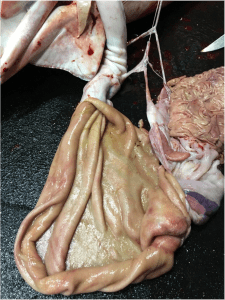
TAS Karen Grady 4-16-17 shark liver
Shark liver

When we had one come onboard that was dead due to low oxygen levels in the water where we caught it, we did a dissection on the deck while we waited to put out another line. The animal science nerd in me came to life!   I had no idea the liver was the largest organ inside a shark. Think about it …these creatures have no body fat and they store their energy in the liver. Then we looked at the intestines. There is not a lot of room in there so the shark we looked at the intestines are rolled up like you would roll a piece of paper. This gives them maximum absorption area but takes up a limited space.


One thing I think of as we are catching these species is that very few people stop and think about the actual research scientists do to help understand what is needed to maintain healthy populations. It is necessary to do these surveys, catch the species, tag some, draw blood, take fin clips, keep whole specimens, and dissect some. On our cruise we were lucky enough to ultrasound a few pregnant sharks and see the pups inside.

TAS Karen Grady 4-16-17 shark ultrasound
Baby sharks visible on ultrasound

Now stop and think about all those things I just listed that we do at times. When a hook comes up and there is a fish or shark on it is handed off to one of the science crew.  It is noted in the computer that there was a something caught. The science crew member will take measurements and weight of the fish or shark. If it is a shark, the sex will be noted and some species may be tagged, have a fin clip taken and blood drawn. While all of these activities are taking place, the next hooks keep being brought up. The deck can get pretty crazy if there are several hooks in a row with something on them. The data collector has to keep tag numbers, species, measurements, samples and weights all written in the correct spot while having two or three people calling them out for different fish and or sharks. I had experience working cattle which would mean filling syringes, writing down tag numbers, filling taggers, etc. But this is even crazier than that could get at times. And everything stops if someone calls “hardhats” because that means we have one big enough for the cradle. Working back writing down data or taking measurements you can’t see what is on the next line so you sneak up for a peak when they say it’s a big one then you get out of the way.   One of the best experiences so far was almost getting a big tiger shark in the cradle. I was lucky enough to get a video of her, so stay tuned! Unfortunately, when the big shark brushed against the cradle she snapped the line and was gone with a huge spray of water.

This second leg of the experimental long-line survey is winding down. There have been long days but they are filled with laughter, giggles, anticipation, excitement, teachable moments (I can finally get the circle hooks out by myself…sometimes) , and the dreaded words “snapper.” I mean nothing against the Red Snapper, they are a bright colorful and tasty fish, but when you are hoping for a shark to be on the hook…. let’s just say the sets where we get 12 snapper and two sharks are not our favorites.

Photos: “Shark!” or “Fish on!” means a busy deck.

TAS Karen Grady 4-16-17 hammerhead cradle
Scalloped hammerhead shark

When the guys at the rail grab the hard hats it means it is time for the cradle and we get to see things like this gorgeous scalloped hammerhead. Things move very quickly when one is in the cradle. Safety for those on deck comes first and everyone is focused on getting measurements, fin clip and a tag on the shark and getting it safely back in the water as quickly as possible.

TAS Karen Grady 4-16-17 baby tiger shark
Baby tiger shark

Baby tiger shark in the cradle. They warned me that they were cute and they were so right. Yes, a shark can be “cute” when your referring to baby tiger sharks and baby hammerheads!

Did You Know

Sharks store energy in their liver. It is the largest organ in their body. The heart on the other hand is extremely small in comparison to the size of the shark.

TAS Karen Grady 4-16-17 hammerhead dissection
Dissected scalloped hammerhead with liver visible

Look at the liver of this scalloped hammerhead. It is amazing how big it is in relation to the body of the shark. This is just one way these amazing creatures are designed to be efficient and survive in their underwater world.

Sharks have a nictitating membrane that they can close over their eye for protection. When a shark is brought on deck you can touch near the eye and the membrane will automatically move to close.

TAS Karen Grady 4-16-17 nictitating membrane
Nictitating membrane partially closed on the eye of a scalloped hammerhead

Karen Grady: One Fish Two Fish Red Fish …… Weird Fish, April 10, 2017

NOAA Teacher at Sea

Karen Grady

Aboard NOAA Ship Oregon II

April 5 – April 20, 2017

Mission: Experimental Longline Survey

Geographic Area of Cruise: Gulf of Mexico

Date: April 10, 2017

Weather Data

Latitude 2827.10
Longitude 09148.6
75 degrees
Sunny
No precipitation
Winds at 10 KTS
Waves at 2-4 FT

Science and Technology Log

We have continued to move between deep stations setting the baited line and hoping to catch deep water fish and sharks. These deep sets require longer soaking time to allow the hooks to reach the bottom.   The downside is that we have been retrieving one set of gear and putting out one set of gear in a 12 hour period of time. Some sets have a few fish and some we get a big goose egg.   There is always anticipation though as the 100 hooks are brought up. Everyone stands in their spots waiting to hear either “fish on,” “shark” or everyone’s favorite, “hard hats!” which means there is a big shark and it’s time for the sling. Below you will see the awesome Great Hammerhead (Sphyrna lewini) we caught.

TAS Karen Grady 4-13-17 great hammerhead
Great Hammerhead Shark

The first few days we have been fishing deep in the Mississippi Canyon. The Mississippi Canyon is a geological formation in the Gulf of Mexico. It is located in an area which is part of the territorial waters of the United States. We put out some deep lines with the deepest at 1900 feet. These lines soaked four hours once fully deployed.  They soak longer because they have so far to sink to get to the depth the scientists want to fish at. When we deploy a line the first thing in the water is the High Flyer, which stands like a beacon and bobs in the water marking the start of our fishing line. The next thing over the side of the ship is a weight that helps carry the line to the desired depth. Halfway through, another weight is deployed, and after the 100th hook, the third weight goes in.   The last thing over is another High Flyer to mark the end of the line. If it is dark outside, the High Flyers have lights attached on top that flash so that they can be seen.

TAS Karen Grady launching high flyer
“High Flyers” mark the beginning and the end of the long line set.

At our last deep station we caught a Mexican Grenadier, Coryphaenoides mexicanus. This fish is very unusual in color and appearance. If you feel the scales on the fish you find that they are very unique. Each scale has tiny sharp, thin spinules. As you run your hand over the fish you can feel these scale modifications. The eyes are bulged due to the pressure change of coming up from such deep depths. The scientists determined the sex of the Grenadier and then it was frozen for future study.

TAS Karen Grady 4-13-17 grenadier
Mexican Grenadier

We also caught two Cutthroat Eels, from the family Synaphobranchidae, that were both females. Synaphobranch means unified gill… the two gill slits join together making it look like a cut throat. They are bottom-dwelling fish, found in deep waters. The eels were weighed, measured, and the scientists determined the sex and maturity of each eel. It is important that they make accurate identification of specimens and collect data. The scientists work together using personal knowledge and books when necessary. There are times on deck when the scientists will stop to examine a species and will take multiple pictures of certain identifying parts so that they can look at them closely later.


Personal Log

One of the great things during a watch is being able to talk with the scientists. I am an avid listener and observer. This is what they do year in and year out and they love what they do. I am a quiet observer a lot of the time. I listen and then ask questions later. It’s not exactly easy to carry around paper and pencil to take notes. But during the transit portions or soak times I ask more questions and gather information to share in my blog posts or for the lesson plan I will be writing when I get home.

The food has been great here on the ship. Our stewards have fresh salads, and menus that include two main course options, a daily soup, dessert and multiple side choices.   There are snacks available 24/7 so you are never hungry. Because the meals are so great you see most people trying to fit in a workout during the day. I have been introduced to the Jacob’s ladder for workouts. I never liked hills and now I can say I don’t like climbing ladder rungs either. That machine is evil!! However, I will continue to do cardio on it as the food is excellent and keeping food in your stomach helps prevent sea sickness. I will happily eat more than I usually do if it means I don’t get seasick. An example of a typical lunch would be today when we had choices of salad, reuben, tuna melt, french fries, sweet potato fries, cookies and several other sides.

Today started with us catching two Cutthroat Eels and a Mexican Grenadier. You can see from the pictures I have posted that they look very different from most fish that you see. They really are that color. It was a shock after the sleek sharks and the bright orange Red Snapper I had seen on previous sets. I was busy watching the scientists using their books and personal knowledge to identify each species accurately.   After we finished the work up on the fish we caught we headed for the next station. Now we are back to shallower fishing and expect to catch sharks, red snapper, and a variety of other fish.

TAS Karen Grady 4-13-17 grenadier and eels
Two cutthroat eels (top) and Mexican grenadier (bottom)

I can honestly say that the 12 hour shifts start wearing you down, and sleeping is not an issue once you climb under the covers. The waves will wake you up now and then. And some mornings I wake up and can smell them cooking breakfast but sleep overrides the smell of food because I know how long it will be till I get to bed again. Walking out on deck each morning to views like this does lead to a smile on your face, that and the music that is playing loudly on the deck. Yesterday it was Hair Nation…. taking me back to the 80’s.

TAS Karen Grady 4-13-17 blue water
View from the deck of NOAA Ship Oregon II

Did You Know?

The Gulf of Mexico is roughly 995 miles along its longer, east-west axis. It has a surface area of about 600,000 square miles.

A wide variety of physical adaptations allow sharks to thrive in the Gulf of Mexico. They have powerful smell receptors. The sensory organs lining their prominent snouts, called ampullae of Lorenzini, can detect movement of potential prey even if the sharks cannot see it. These sensory organs assist in trailing injured marine animals from great distances. They help sharks locate all sort of other things, too– shrimp boats, other sharks, birds, turtles (tiger sharks a big turtle eaters!), even boats that are dumping trash.

The skin on a shark is smooth if you run your hand head to tail and rough like sandpaper if you run your hand from tail to head. At one time, sharks skin was used as a form of sandpaper. The dermal denticles, or skin teeth, can be different from species to species and can sometimes be used as a character to look at when trying to identify one species from another.

Emily Sprowls: Gulpers of the Gulf, March 31, 2017


NOAA Teacher at Sea

Emily Sprowls

Aboard NOAA Ship Oregon II

March 20 – April 3, 2017


Mission: Experimental Longline Survey

Geographic Area of Cruise: Gulf of Mexico

Date: March 31, 2017


Weather Data from the Bridge

12:00 hours

29°36.7’ N, 87°43.7’ W

Visibility 10 nm,

Wind 6 kts 350°N

Sea wave height 2-3 ft.

Seawater temp 22.9°C


Science and Technology Log

GulperEye
Gulper shark from 800 meters under the sea!

On the deep longlines we sampled many gulper sharks (Centrophorus spp.). Gulper sharks have cool anatomical adaptations, including their huge reflective eyes, buccal folds for gulping their food, and the ability to excrete huge amounts of slime from their skin. Gulpers also have very large eggs, which is of particular interest to my crewmate Lydia Crawford, a scientist from Tulane University that is studying shark reproduction and evolution.

LydiaDissects
Lydia dissects a shark specimen to study its eggs.

Lydia is collecting eggs from as many different kinds of sharks as she can in order to understand more about how sharks evolved a variety of reproductive strategies. Oviparous sharks and skates lay egg cases, also knows as “mermaids purses.” Oviviparous sharks let their eggs hatch internally and the babies are born swimming. Some embryos eat other eggs or even their siblings as they develop in their mother! Placental viviparous sharks are also born alive, but the embryos are fed via umbilical cords, similar to us humans.

Lydia will examine the microscopic structures of the shark ovaries she collected when she gets back to her lab. She hypothesizes that certain features of the ovaries have allowed sharks to evolve the ability to give birth to large babies, ready to act like the apex predators they are!


Personal Log

Last night we caught a blacktip shark (Carcharhinus limbatus) that my data sheet says measured 1.4 meters, but my memory says it was MUCH BIGGER because he lunged and snapped at us! Most of the sharks we have collected have been rather stunned by their brief trip out of the ocean onto the deck, but this guy acted like a shark still in the water! He and his biting jaws were clear reminders of what incredible predators sharks are. He put a healthy dose of fear back in me, along with a lot of respect for the science team who managed to measure him despite his aggressive activity!


Kids’ Questions

  • Why don’t sharks have swim bladders?

Sharks maintain neutral buoyancy by having very large, oily livers. We confirmed this by throwing the dissected lobes of the liver overboard and they floated!

  • Is there a shark that glows in the dark?

The eyes of some of the deep sea sharks that what we caught appear to be glowing because they are so big and have very reflective layers (called tapeta lucida) that shines back the boat lights. However some sharks, including the lantern shark, have special organs called photophores that glow!

Lydia Tilefish
Marine biologist Lydia with tilefish (Lopholatilus chamaeleonticeps)
  • How would you recommend reversing the sense of fear people associate with sharks?

Lydia’s response:

As a scientist, you shouldn’t try to reverse people’s fears because you can’t rationalize away a feeling. Also, we should have a respectful fear of sharks. They are amazing predators! Instead we should convince people why sharks are important in the ocean ecosystem as keystone species.

Emily Sprowls: Shark Bait, March 28, 2017

NOAA Teacher at Sea

Emily Sprowls

Aboard NOAA Ship Oregon II

March 20 – April 3, 2017


Mission: Experimental Longline Survey

Geographic Area of Cruise: Gulf of Mexico

Date: March 28, 2017


Weather Data from the Bridge

RedSnapper
Red snapper (Lutjanus campechanus)

13:00 hours

29°09.3’ N 88°35.2’W

Visibility 10 nm, Scattered clouds

Wind 8 kts 170°E

Sea wave height <1 ft.

Seawater temp 22.9°C


Science and Technology Log

In addition to experimenting by sampling deeper, we are varying the fishing gear and using different kinds of bait. We have switched to hooks on a steel leader so that even a strong, big shark cannot bite through the line. We are rotating through squid and mackerel as bait in order to see which species are more attracted to different bait. In addition to many species of sharks, we have also caught and measured eels, large fish and rays.

Nick hooks
Nick prepares hooks for longline gangions.

One of the scientists on board specializes in fishing gear, and helps keep maintain all our gear after it gets twisted by eels or looped up on itself. He also works on turtle exclusion devices for trawling gear.


Personal Log

Last night the line pulled in a huge tangle of “ghost gear.” This was fishing line and hooks that had been lost and sunk. It would have been much easier to just cut the line and let the mess sink back to where it came from, but everybody worked together to haul it out so it won’t sit at the bottom tangling up other animals.

Ghost gear
Lost or “ghost” gear that tangled in our lines.

This is just one example of the dedication the scientists and crew have to ocean stewardship. I have been so impressed by the care and speed with which everybody handles the sharks in order to get them back in the water safely.


Kids’ Questions

  • Is there any bycatch of dolphins?
Deep seastar
A few seastars come up with uneaten bait as bycatch.

Today we saw dolphins for the first time! They were only a few of them pretty far from the boat, so they did not affect our sampling. Had they decided to come play by riding in our wake, we would have postponed our sampling to avoid any interactions between the dolphins and the gear. One of the reasons that we only deploy the fishing gear for one hour is in case an air-breathing turtle or mammal gets tangled (they can hold their breath for over an hour). However, since dolphins hunt live fish, they don’t try to eat the dead bait we are using.

  • Can sharks use echolocation? How do they find their food?

Sharks do not use echolocation like marine mammals, but they do have an “extra” sense to help them find their food. They can detect electrical current using special sense organs called ampullae of Lorenzini.

  • What are the chances of getting hurt? Why don’t they bite?

While there is a chance of the sharks accidentally biting us as we handle them, we are very careful to hold them on the backs of their heads and not to put our fingers near their mouths! “Shark burn” is a more likely injury, which occurs when a shark wiggles and their rough skin scrapes the person handling them. Sharks do not have scales, but are covered in tiny, abrasive denticles that feel like sandpaper.


Emily Sprowls: Tag, you’re it! March 26, 2017

NOAA Teacher at Sea

Emily Sprowls

Aboard NOAA Ship Oregon II

March 20 – April 3, 2017


Mission: Experimental Longline Survey

Geographic Area of Cruise: Gulf of Mexico

Date: March 26, 2017

Weather Data from the Bridge

13:00 hours

28°12.1’ N 89°23.8’W

Visibility 6 nm, Haze

Wind 15 kts 170°E

Sea wave height 4-5 ft.

Seawater temp 23.4°C

Science and Technology Log

MeasureShark.jpg
I learn to measure my first (little) shark!

The ship has completed our deep-water sampling and we are now headed to more shallow areas, where there are likely to be more sharks and hopefully even some that have been tagged in the past.  With each shark we catch, we record in a database their measurements and exactly where they were caught.  If things are going well with the shark out of water, we also take a fin clip, a blood sample, and attach a tag.

Tag-and-recapture is one way for wildlife biologists to estimate population size.  You can compare the number of tagged sharks to newly caught sharks, and then extrapolate using that ratio to the total number of sharks in the area.


P1050255
Volunteers help enter data into the “Toughbook” computer.

Recapturing a tagged shark also helps scientists determine the age of a shark, as well as its rate of growth.  In bony fish, it is possible to examine the otoliths (bony structures in the ear) to determine the age of a fish.  However, since sharks do not have bones, scientists must use other ways to determine their ages and track their growth.  One of the scientists on board (my roommate) is collecting shark vertebrae so that her lab can use growth rings in the vertebrae to assess their age, sort of like counting the rings on a tree stump.


Personal Log

The past few days have put all my seasickness remedies to the test with waves over 6 feet and plenty of rolling on the ship.  The good news is that they have been working pretty well for the most part – I’ve only lost my lunch once so far!  One “cure” for seasickness is to stay busy, which has been difficult to do because the high winds and lightning have made it unsafe to do any sampling.

Fortunately, the crew’s lounge is well-stocked with movies, so I have watched quite a few while we wait for the waves to calm down and the thunderstorm to pass.  The lounge has some cushioned benches long enough to stretch out on, which is key because being horizontal is the best way for me to minimize my seasickness.


Kids’ Questions

  • How do you put the tag on?

    P1050392
    Data collection sheet and shark tagging tool.

The tag for smaller sharks is a bit like a plastic earring, but on the shark’s dorsal fin.  First you have to “pierce” the fin with a tool like a paper hole-punch, and then use another tool to snap in the tag  — making sure that the ID numbers are facing out.  If the shark is a species that will outgrow a plastic roto tag, they get a skinny floating tag inserted just under their dorsal fin.

  • How does the tag stay on the shark?

The shark heals the wound made by the tag, and the scar tissue holds the tag in place. Because the tags are made of plastic and stainless steel, they do not rust or deteriorate in the ocean.

P1050391
Tagged dorsal fin of Mustelus sinusmexicanus.
  • How do they make the tags? 

The NOAA fisheries lab orders tags from manufacturing companies, and are similar to tags used on domestic animals like cows.  Each tag includes a phone number and the word “REWARD,” so that if fishermen catch a tagged shark they can report it.

  • What are they doing with the shark tagging data?

Tagging the sharks in the Gulf of Mexico allows us to figure out how fast they are growing and how far they are traveling.  Measuring all the sharks also helps scientists understand how the populations of different species might be changing.  Some clues to changing populations include catching smaller or fewer sharks of one species.