Susan Brown: And Just Like That, It’s Over, September 19, 2017

NOAA Teacher at Sea

Susan Brown

Aboard NOAA Ship Oregon II

September 3 – 15, 2017


Mission: Snapper/Longline Shark Survey

Geographic Area of Cruise: Gulf of Mexico

Date: September 19, 2017

Latitude: 35.190807
Longitude: -111.65127
Sea wave height: NA
Wind Speed: 7 Mph
Wind Direction: W
Humidity: 21%
Air Temperature: 20 degrees C (68 degrees Fahrenheit)
Barometric Pressure: 29.81″ Steady
Sky:  scattered clouds

IMG_6843
panoramic view from the stern heading home

Personal Log

And just like that, it’s over.  I am back in Flagstaff and have finally stopped feeling the boat rocking while on solid ground.  Students have been working on a shark project in my absence and we are finishing it up this week.  My first day back was a day of show and tell. The students were excited and full of questions about my trip. As I presented to my students, I realized how much I learned and how much more I still want to know! Here are some pictures from Monday.


As I reflect back on my adventure, I have many thoughts and wonder how the fourth and final leg is going.  I think back to last year when I first learned I was selected to be on this adventure and how impossible it was to imagine that I was actually going to work with sharks.  Then, as the date loomed closer, trying to best prepare for something that was a big unknown to me.  And then I was at the dock looking at the Oregon II tied up for the weekend. I recall when I first reached the dock in the evening looking at the ship and thinking wow, pinch me, this is really happening.  I remember being awed and out of my element those first few days just learning to navigate the ship. And then the first haul in!  Now that was a rush as we pulled in not only small sharpnose sharks but larger sandbar sharks that needed to be cradled.  It was unbelievable watching as the team worked and I was thrust into being a viable team member.  After a week, it was a game I had to see if I could bait the hooks as fast as the veteran scientists. I automatically logged the fin clips and helped enter the data we had collected.  Working on the ship became the new normal — knowing what to to do at each station’s deployment of the line and the haul back.  I was feeling competent in my role. Even pulling in some sharks became routine…routine!  Wow, had I come a long way.  And then, just like that, I was on my last haul back and heading back into port.


Here are some of my favorite videos and photos from the adventure.

Below a time lapse of what a haul back at night looks like


IMG_6686
Eye See you (Smooth-Hound shark)


Measuring a sandshark


And a video of my favorite shark- the great hammerhead being released out of the cradle.


And a baby hammy


So here I am, back in Flagstaff, reflecting back on my adventure. Did it really happen?  I have pictures to prove it and stories I am sharing but it does seem like a lifetime ago that I was touching a shark and looking into the doe eyes of a ten foot hammerhead shark.  The more I talk about what I have done, the more I realize how much I learned and how much more I still don’t know.  The two weeks flew by but I am grateful for it. So for those of you out there reading this blog, make time for adventures, get out there and do it, follow your passion and immerse yourself. You might be surprised at what you can do!


IMG_6040
Teacher at Sea Susan Brown


Susan Brown: Let’s Go Fishing, September 4, 2017


NOAA Teacher at Sea

Susan Brown

NOAA Ship Oregon II

September 3 – 15, 2017

Mission: Snapper/Longline Shark Survey

Geographic Area of Cruise: Gulf of Mexico

Date: September 4, 2017

Weather Data from the Bridge

Latitude: 29 43.931N
Longitude: 086 09.617W
Sea wave height: .5 meters
Wind Speed: 2
Wind Direction: 250 degrees
Visibility: good
Air Temperature: 28.3 degrees Celsius
Barometric Pressure: 1016 mb
Sky: partly cloudy

Science and Technology Log

Numbered tags used for each hook
Mackerel used for bait

Today was my first shift. We are using mackerel to bait the 100 hooks that will be places into the water at a specific station. Each hook is numbered so that we can collect data on which hook brought in a fish and entered into the database. There are several jobs out here from baiting the hooks, placing the buoys, flinging the baited hooks out, and recording data in the computer. My job today is the computer.

entering data on the deployment of the baited hooks

The longline is set and left to sit in the ocean for approximately one hour before we start bringing up the line to see if we have a fish on. Out of the 100 hooks we got one fish, a baby tiger shark and a larger juvenile tiger shark coming in at six feet or so. This tiger shark had several hooks in its mouth as well as a tag so when she was brought up on board, all the hooks were removed and the tag replaced with a new one.

IMG_5947
Removing hooks from the tiger shark’s mouth

The tag that was on the tiger shark was opened up to reveal a small scroll of paper with a unique number so that this shark can be tracked from where it was first picked up to when it ended up with us for the brief visit. Below is a short video of us bringing up the shark in the cradle! [no dialogue or narration.]

We will be setting another line tonight at our second station as we continue to motor southeast following the coast of Florida.

Beside recording data on the sharks, a CTD is deployed to collect data on conductivity, temperature and depth. We will use this data in the classroom to look for trends between the abiotic factors that may influence where we are finding certain shark species and the number of overall sharks at any given station.

The CTD that measure conductivity, temperature and depth

Personal Log

There are many different scientists on board researching different things. I am sharing a stateroom with Dani who is on the night shift. She is looking into how different sharks handle stress. I see very little of her since we are on opposite shifts so we get a quick visit at noon when there is a changing of the guards so of say. Brett and Carlos, as mentioned in an earlier post, are looking into parasites that inhabit the various animals we are bringing up. I will do a separate blog on those two and their research later this week to share what they are finding.

Donning the survival suit during abandon ship drill

Today we had a few drills to practice in case of an emergency. One was a fire drill and the other was an abandon ship drill where I had to don a large neoprene suit in less than two minutes. Here I am in that suit! It was quite cumbersome to put on.

Learning new words as I get acclimated to the ship. Here are a few for you:

The head = bathroom

Stateroom = room where I sleep

Muster = to assemble

Bow = the front of the ship

Stern = the back of the ship

Did You Know?

Military time is used on board this ship. See the photo of the clock below.

Question of the Day: Why use military time?

NOAA clock

Susan Brown: Getting Acclimated, September 3, 2017

NOAA Teacher at Sea

Susan Brown

Aboard NOAA Ship Oregon II

September 2 – 15, 2017

Mission: Shark/Red Snapper Longline Survey
Geographic Area of Cruise: Gulf of Mexico
Date: September 3, 2017
Weather Data from the Bridge

Latitude: 30degree06.7N
Longitude: 88degree17.6W
Sea wave height: <1
Wind Speed: LT
Wind Direction: VAR
Visibility: 10NM
Air Temperature:
Barometric Pressure:
Sky: BKN

Incomplete weather data as we were docked.

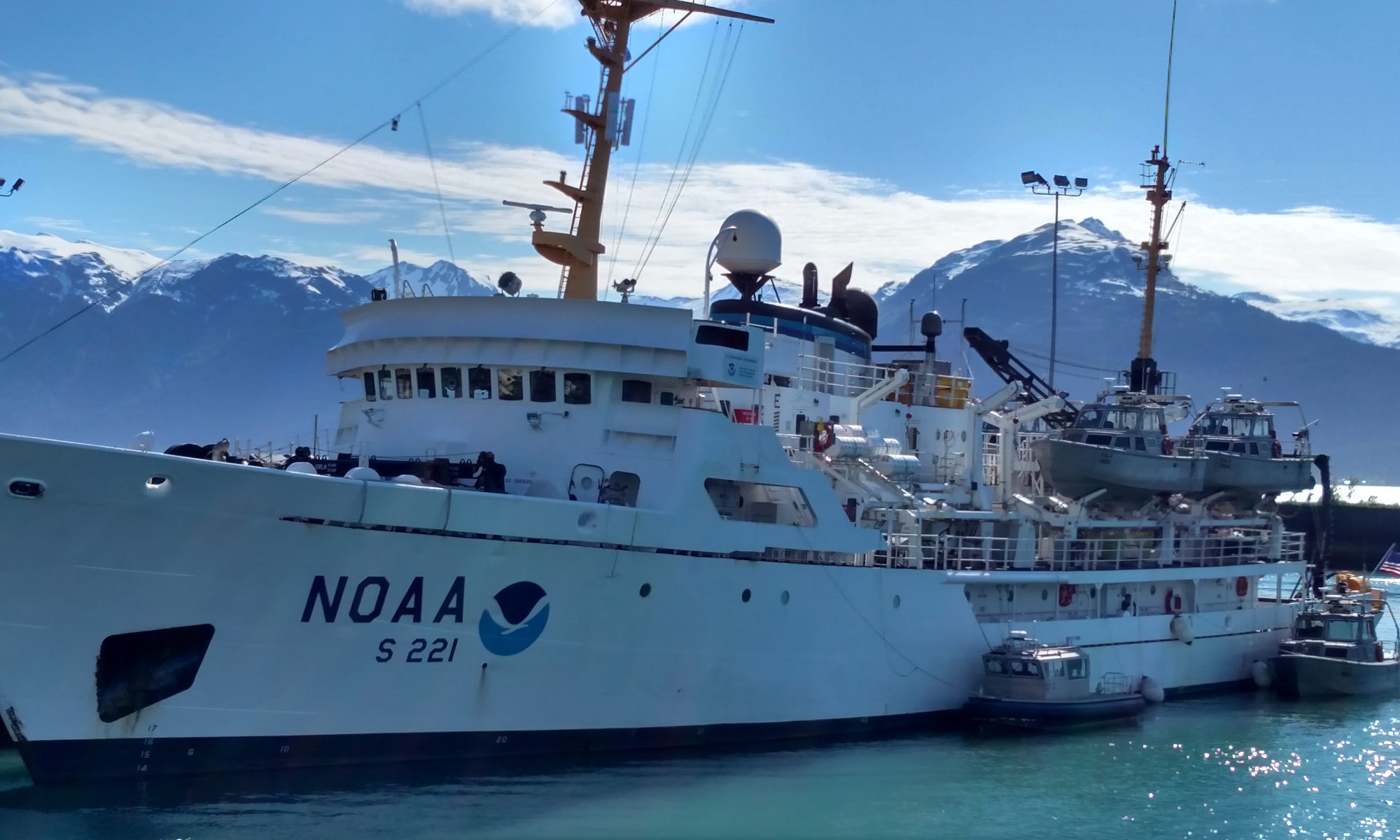
I’m currently sitting on the Oregon II docked in Pascagoula, Mississippi after a long travel day. It’s eerily quiet as the ship disembarks tomorrow at 14:00 and the majority of the crew will arrive tomorrow. I am enjoying the slow introduction to this ship and finding my way around. The OOD (Officer Of the Deck) gave me a tour of the ship that I will be working on for the next two weeks. The majority of crew is on shore for the Labor Day weekend but will return tomorrow as we disembark and head towards Florida. Our plans have changed due to Hurricane Harvey and debris that may be in the waters making the travel in those waters unsafe.

IMG_5813
NOAA Ship Oregon II in dock

Science and Technology Log

Due to Hurricane Harvey, the area being surveyed has changed so that we are heading East instead of West to pick up the third leg of this survey that ended off the coast of Florida last week. I have been assigned the day shift from noon to midnight and will be assisting the science crew. The mission of this survey is to monitor interannual variability of shark populations of the Atlantic coast and the Gulf of Mexico. Additionally aboard are two scientist that are on board are studying parasites that these animals carry. Carlos and Brett, the two parasitologists, were on the second leg right before I joined. Their leg started on the tip of Florida and ended where we will start.

Personal Log

IMG_5855
Wearing “the patch” to keep from getting seasick

Seasick? Felt a little queasy after my first night in dock! Decided the best course of action was to take some medicine, eat a big meal and hydrate to help get my sea legs. Everyone has been friendly and welcoming as we get started. The night crew starts tonight at midnight till noon and the day crew, where I am been placed, will start at noon. Hoping for a good night’s sleep!

IMG_5798
My bed is the bottom one!

Did You Know?

Sharks have been around since the dinosaurs approximately 450 million years ago.

Question of the day

What is NOAA’s mission statement? (Hint: Google NOAA and select “About Our Agency” at the bottom)

Susan Brown: Adventure Awaits, August 24, 2017

NOAA Teacher at Sea

Susan Brown

Aboard NOAA Ship Oregon II

September 2 – 15, 2017


Mission: Shark/Red Snapper Longline Survey

Geographic Area of Cruise: Gulf of Mexico

Date: August 24, 2017


Weather Data from the Bridge

I’m currently at home in Flagstaff, Arizona. It’s a typical, monsoon season morning coming in at 11.6 degrees C (53 degrees F) at 7:12 am with humidity at 92%. I’m about 1,700 miles away from Pascagoula, Mississippi, where I will be joining the team on our ship, NOAA Ship Oregon II, in just a few days!

NOAA Ship Oregon II Sunset_NOAA Photo
NOAA Ship Oregon II. Photo credit: NOAA

NOAA Ship Oregon II Photo Credit: NOAA

Weather Data from my desk at school:

Latitude: 35.190807
Longitude: -111.65127
Sea wave height: NA
Wind Speed: 2 Mph
Wind Direction: NW
Visibility:
Air Temperature: 11. 6 degrees C
Barometric Pressure: 29.84” falling Rapdily
Sky:  scattered clouds


Science and Technology Log

Once on board, I will be assisting the science crew with the third leg of the Shark/Red Snapper Longline Survey and will be fishing from Brownsville, TX to Galveston, TX. The mission of this survey is to monitor interannual variability of shark populations of the Atlantic coast and the Gulf of Mexico.

longline_sampling_area
Map of the survey area: the Atlantic coast and the Gulf of Mexico.

My understanding is that we will be working a 12-hour shift using longline gear to capture specimens and measure the length, weight and sex of the animal. The longline is baited with Atlantic Mackerel and will sit in the water for one hour. Here is what longline gear looks like:


longline_gear_illustration
Illustration of longline gear. Credit: NOAA


The larger animals will require landing slings! I can’t even imagine. The science crew will also be tagging the animals as well as retaining a few for research. Finclips, like taking a nail clipping, will be gathered for DNA analysis. I am most excited to get up and close with these wonderful creatures tagging them to monitor their movement and health.


shark_measure2_small
Measuring a tiger shark. Photo credit: SEFSC


shark_measure1
Measuring a shark. Photo Credit: SEFSC


As part of the survey we will be gathering CTD (Conductivity Temperature Depth) data that provides a surface to bottom profile of temperature, salinity, dissolved oxygen, chlorophyll, turbidity and depth. As a class, we will be learning about these in depth in the classroom when we reach our unit on water quality in relation to our local watershed.

Personal Log

I am getting excited for this adventure and happy to have you along for the journey. I look forward to your questions and can’t wait to learn about these beautiful creatures while working with scientists. Please makes sure to check out the “Question of the Day” and other activities that will be posted on this blog. Your current research on sharks will come in handy while I am out here and will be crucial to learning about ocean food webs and current threats. Remember to check in daily for new posts while you are working on your projects.


Did You Know?

That I have never been to the Gulf of Mexico!


Question of the day

What species of shark live in the Gulf of Mexico?

Karen Grady: Observations and Data Collection Today Leads to Knowledge In The Future, April 25, 2017

NOAA Teacher at Sea

Karen Grady

Aboard NOAA Ship Oregon II

April 5 – April 20, 2017

Mission: Experimental Longline Survey

Geographic Area of Cruise: Gulf of Mexico

Date: April 25, 2017


Weather Data:

I am back settled into the crazy weather that is spring in Arkansas. Supposed to be 90 degrees today and then storms tomorrow.

Science and Technology Log

The second leg of the Oregon II’s experimental longline survey is now complete.  The ship and all the crew are safely back in the harbor.  Fourteen days at sea allows for a lot of data to be gathered by the science crew.

Now, an obvious question would be what do they do with all the data and the samples that  were collected? The largest thing from this experimental survey is looking at catch data and the different bait types that were used to see if there were differences in the species caught/numbers caught etc. They are also able to look at species compositions during a different time frame than the annual survey and different depth ranges with the much deeper sets. Fin clips were taken from certain species of sharks. Each fin clip can be tied to a specific shark that was also tagged.  If anyone ever wanted or needed to they could trace that fin clip back to the specific shark, the latitude and longitude of where it was taken, and the conditions found in the water column on that day.  Everything the scientists do is geared towards collecting data and providing as many details as possible for the big picture.

Occasionally sharks are captured and do not survive, but even these instances provide an opportunity to sample things like vertebrae for ageing studies or to look at reproductive stages. Science is always at work.  With the ultrasound machine on board we were able to use it on a couple of the sharpnose sharks and determine if they were pregnant .


ultrasound
Ultrasounding female Sharp Nose sharks to see how may pups they were carrying.


Parasites… did you know sharks and fish can have parasites on them? Yes, they do and we caught a few on this leg. Sharks or fish caught with parasites were sampled to pass along to other researchers to use for identification purposes. Kristin showed me evidence of a skin parasite on several of the small sharks. It looked like an Etch-A-Sketch drawing.

etchisketch 2
This shark had whole mural on the underside from the parasites
etchisketch 1
Shark underside marred by parasite infection

Red snapper were also sampled at times on the survey to look deeper into their life history  and ecology. Muscle tissue was collected to look at ecotoxicity within the fish (what it has been exposed to throughout out its lifetime); along with otoliths to estimate age. We are using muscle tissue to examine carbon, nitrogen, and sulfur. Each element looks into where that fish lives within the food web. For instance, carbon can help provide information about the basal primary producers, nitrogen can help to estimate the trophic level of the fish within the ecosystem, and sulfur can try to determine if the fish feeds on benthic or pelagic organisms. Otoliths are the ear bones of the fish. There are three different types of ear bones; however, sagittal ear bones (the largest of the three) will be sectioned through the core and read like a tree. Each ring is presumed to represent one year of growth.


red snapper1
Red Snapper caught and used for sample collection
paul red snapper
Paul Felts removing a hook
redsnapper head
Sometimes someone bigger swims by while a fish is on the hook

Personal Log

Now that I am home and settled I still had a few things to share. One it was great to get home to my family, but as I was warned by the science crew it does take a couple of days to adjust to the usual schedule.  It did feel good to go for a jog around town instead of having to face the Jacob’s Ladder again!


Everyone asks me if I had a good time, if it was scary, if we caught any sharks. I just don’t think there are words to express what an amazing experience this was for me.  Of course, seeing the sharks up close was just beyond words, but it was also being made a part of a working science team that are working year-round to monitor the health of the ocean and the species that live there. For me this was a two-week section of my life where I got to live on the ocean and catch sharks while learning a little about the data the science crew collects and how they use it.  The science crew will all be back out on the ocean on different legs over the next few months.

I confess I am not super hi tech, so I am not proficient with a Gopro so I probably missed out on making the best films. However, I did get some excellent photos and some good photos of some impressive sharks.  Thanks to technology I will be able to create slide shows to my K-12 students so they can see the experience through my eyes.  I am looking forward to showing these slide shows to my students. My elementary students were so excited to have me back that they made me feel like a celebrity.  I was gone a little over two weeks and to my younger students it seemed forever.  Many of the teachers shared some of my trip with the students so they would know where I was and what I was doing.

I am settled back into my regular schedule at school. One awesome thing about my job is that I deal with students from kindergarten through seniors.   I started back with my elementary students yesterday.  Let me just say that young people can make you feel like a Rockstar when you have been gone for 15 days.  I knocked on a classroom door and could hear the students yelling “ she’s here! Mrs. Grady is here!” and then there were the hugs. Young kids are so genuine and they have an excitement and love of learning.  I have to get busy on my power point to share with them.  They wanted a list of sharks we caught, how big they were, etc.  I am getting exactly what I hoped, the students want to understand what I did on the ship, why we did these things and what did I actually learn.

For my last blog, I have decided to share some of my favorite photos from my time on the Oregon II.

This slideshow requires JavaScript.