NOAA Teacher at Sea
Adrienne Heim Onboard NOAA Ship Albatross IV August 7 – September 2, 2007
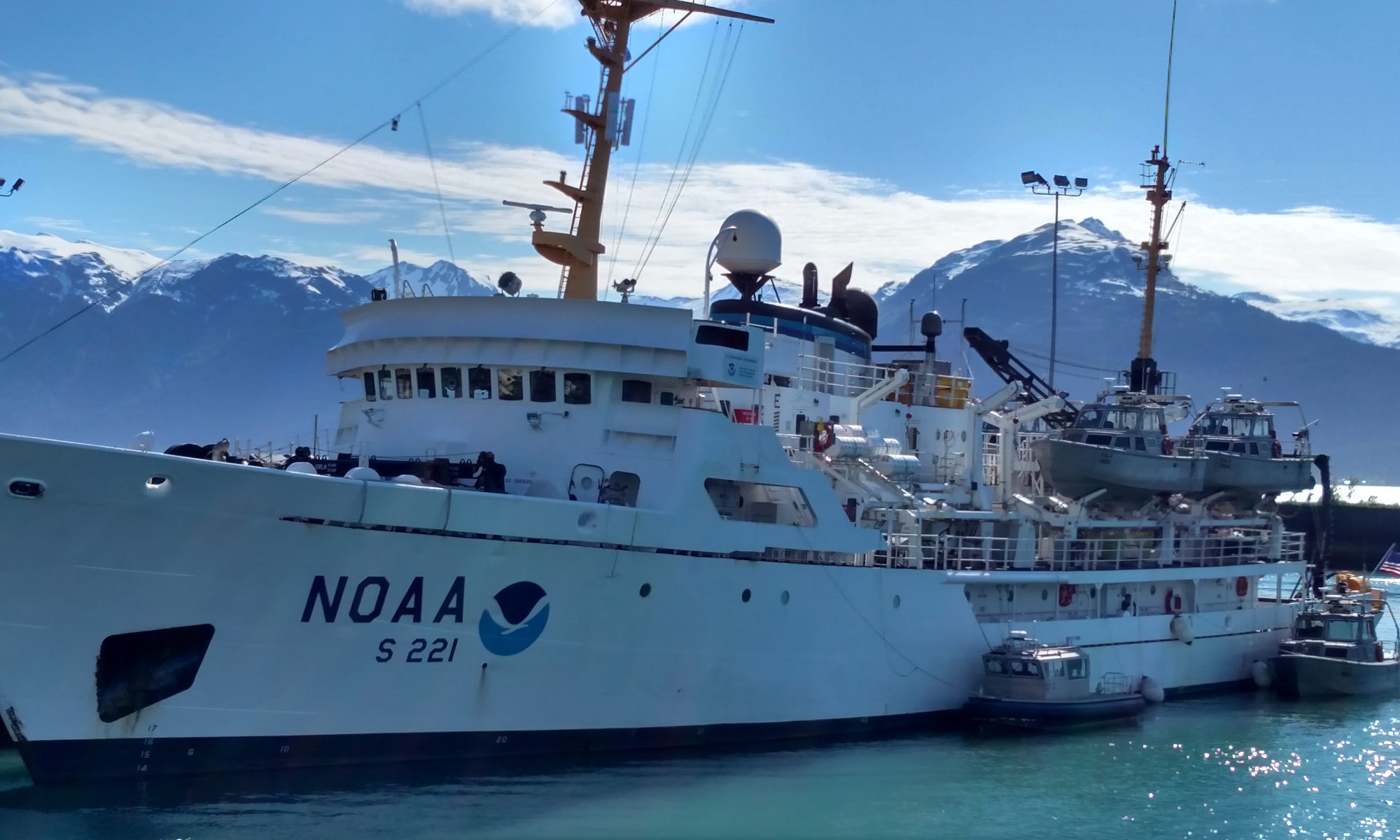
Mission: Sea Scallop Survey Geographic Region: Northeast U.S. Date: August 16, 2007
Science Log: Beautiful Sunsets
The best thing about working 12 hour shifts are the sunsets! Sunsets along the Atlantic Ocean have been positively beautiful.
The weather has shifted drastically while on board the ALBATRSS IV. Initially in the voyage the weather was cold, foggy, damp, and windy. The visibility was difficult, as well as, balancing myself with the continuous rocking of the vessel. Quite a feat! Recently the weather has been gorgeous: fair skies, very warm, with a rewarding breeze. My partner, Shawn McPhee, and I have developed quite a rhythm for measuring the scallops and cleaning up. We have even “graduated” to measuring many other species in order to help expedite the process and allow enough time for our Watch Chiefs to focus, more importantly, on collecting other sorts of data during each tow.
NOAA Teacher at Sea
Elizabeth Martz
Onboard NOAA Ship Albatross IV August 5 – 16, 2007
Mission: Sea Scallop Survey Geographical Area: North Atlantic Ocean Date: August 7, 2007
Weather Data from the Bridge
Visibility = <.2 nautical miles
Cloud cover = Fog
Wind direction = 185 degrees
Wind speed = 5 knots (kts.)
Sea wave height = <1 feet
Swell wave height = 2 feet
Seawater temperature = 15.2 degrees Celsius
Sea level pressure = 1013.8 mb
Science and Technology Log
8:00 a.m.—Breakfast. Yummy! Breakfast is one of the best meals of the day. Great food and selection.
9:30 a.m.—I went to the local post office! I went to the Marine Biological Laboratory. I viewed information on the Alvin launch in 1964. This submersible is amazing! It can withstand such water pressure changes. Science Rules!
11:00 a.m.—Sea Scallop research and information: Presentation by Victor Nordahl: Chief scientist!
The dredge has an 8-ft. wide opening and a sweep chain. This opening moves across the bottom of the ocean floor collecting organisms. The sweep chain is heavy metal that holds the opening … well… open!
The dredge has a net liner and its purpose is to keep fish and scallops in the dredge. The liner is often damaged by rocks & boulders that enter it. These 2 scientists are repairing the ripped netliner on our standard dredge. On a common dredge found on fishing boats, there is no liner. Fishermen finding scallops do not want to catch & analyze fish. They just want the scallop meats. As scientists, we want to study everything. The basic dredge haul provides us with lots to study. It is 7’ wide metal rod covered with rubber disks across the bottom of the dredge. There are dumping chains attached to the clubstick that help with the dumping of materials out of the dredge. The dredge goes out three times the water depth. For example: If the water depth is 100 meters, the dredge will send 300 meters of metal cable out. To calculate the distance of the dredge from the ship, you could use the Pythagorean Theorem (a^2 + b^2 = c^2. BUT the net curves & the equation doesn’t give you the most accurate results. So, you can calculate the amount and make a estimate of the net distance from the ship. In this example, the dredge is about 260 meters away from the ship. The dredge’s bag has an opening where all the organisms enter. The ring bag is built to hold rocks, living organisms, movement on the floor, and store many organisms for study. The dredge sometimes needs to be repaired due to weather conditions or course substrate (items found on the ocean floor).
LOOK at the dredge above. This is showing the longer top side. Try to imagine a metal opening on the other side. This opening is about 6 feet from the top of the dredge. When the dredge is in the water, the longer side is on top. The part with the opening is found underneath. The dredge runs along the bottom floor and collects the organisms. It is amazing how many organisms you can find on the ocean floor. It is incredible how many diverse species are located in the Atlantic Ocean.
More Notes about the Dredge
This dredge collects organisms from the ocean floor. Notice the strong metal cable and metal pulley which help to reel the dredge back onto the ship. The roller helps move the dredge in and out of the water. When the dredge is empty, it weighs 1600 pounds.
We have 5 dredges on board the ship. When we get to the end of the Leg III, we will be conducting surveys in areas with lots of rocks and materials that will harm the dredges. We will determine the strength of the dredges. We will be using different dredges. We will use the standard dredge and the rock- chain dredge. The standard dredge can capture large rocks or boulders during the dredge haul. The rock-chain dredge is designed to stop large rocks from entering the dredge. With the rock-chain dredge, the scientists who analyze the findings from the dredge have fewer rocks to
Sea Scallop Survey = Goals and Information
The Sea Scallop Survey is an important and interesting task for scientists onboard the ALBATROSS IV. Purpose of the scientific expedition of learning:
1. What is range of the scallops? Do you find them in shallow water? Do you find them in deep water? Where do scallops prefer to grow and survive? Do we find more scallops in areas of a smaller rocks, bigger boulders, or small particles of sand?
2. Scientists can estimate how many scallops we will find. Marine biologists would like to learn more about the population of scallops in various areas. Scientists would like to come to an understanding about where most scallops reside on the ocean floor.
3. Scientists have randomly selected stations from Cape Hatteras, NC to Georges Bank (east of Cape Cod). An area close to Nova Scotia is where scientists test to see the existence of scallops.
4. Scientists ask, “How many scallops are out there?”
5. Scientists ask, “How will the scallop population be different in the future?”
I ask: Why will the population be different?
I ask: What makes one species survive and another species not survive in an area?
• I ask: How can science help the scallop population increase? Will helping the scallop population help or hurt the ecosystem? Other questions:
What bottom substrate is most prevalent in areas with large sea scallop harvests? (This year, the scientists found the most scallops on an area with a sandy bottom.)
Why is that bottom substrate a better environment for sea scallop growth? {little scallops = gravel, sand; bigger scallops orientate to areas by the current (moving water)
How long do sea scallops live? (10-15 years)
What temperature is the best for sea scallop survival? (The most important temperature is one that produces the most spawning. When more scallops are born, then more scallops survive.
How much do sea scallops cost to buy in the store? (about $12/pound)
How much do the fisherman make for spending a day at sea catching scallops that they sell to the local restaurant or buyer?
What topics do scientists find interesting about scallops? (Each scientist has their own ideas and opinions.)
It is a gorgeous view of the sunrise from the back deck.
6. How can scientists protect fisheries (the scallops) and those who harvest them (the fishermen)?
7. Various universities, scientists, and government agencies closed water areas around Nantucket in 1994. In this area, no fishing or dredging is allowed. All citizens must not remove anything from the area.
If you have a permit to fish, you need to be knowledgeable of the fishing rules. When water areas are closed for fishing, you need to know where they are and what to do.
When they closed the area, the fish did not return.
The scallop population has greatly increased.
Many areas of the ocean are under a rotational management plan. (This is also called limited access areas). In these areas of the ocean, fishermen are allowed into an area for various times.
Sometimes fishermen are not allowed to capture a specific type of fish.
There are times when fishermen cannot collect any scallops.
These rotational management areas are created due to research and scientific studies that are completed at sea. In other words, all the scientists onboard the ALBATROSS IV are making a difference in the regulations that fishermen adhere to.
Scallops are a resource. They are a biotic (living) thing. Many people spend their lives harvesting this resource from the ocean. Many people spend their lives eating this resource. No matter who you are, you can impact the health of the water and the home to this resource. We all need to make an effort to protect our waterways and care about the resources that benefit our lives.
This was the basic size of a tow. It is incredible how many organisms are found in one dredge tow. It is beautiful to see such amazing animals from our ocean.
8. The ALBATROSS IV has surveyed over 525 randomly- generated locations. The ALBATROSS IV has selected over 25 basic locations to compare studies year after year. The scientists have been collecting data since 1975. (I think that is so outstanding and AWESOME!)
9. Here is a small lesson about how the stations are randomly-generated. First, think of an area in the ocean. Then, divide that area into 100 squares. Next divide those 100 squares into small areas. The randomly-generated stations are determined from all those small areas. Finally, the researchers need to decide the best way to travel to all of those randomly-generated areas.
10. The tow “what you catch” naturally changes year after year. You will never catch all the same organisms every year. You will discover that fish populations change for many reasons. Here is a list of some reasons why a population may be different each year:
Birth rate/death rate
Habitat change
Fish movement
Fish maturity
Number of fish caught by the fishermen
Amount of water in the area
Environmental factors = salinity over time, temperature, rainfall, hurricanes, tsunamis, and more…
13. Sometimes ships are retired and new ships replace them. When a new ship surveys an area, the scientists need to make sure that the new ship’s equipment is consistent with the old equipment. Long-term data is analyzed. The new equipment and old equipment must keep the data valid. Many factors are taken into consideration:
Do ships have the same power, dredge, wire used, and same liner?
If the equipment is different, how can we control bias?
Do the ships test areas with the same water level, salinity, disease, same amount of fishermen in the area, wind, etc.?
There are so many factors to consider and to control!
A few ways to control bias and determine an average number of scallops include: = determine fish mortality: death due to being caught = natural mortality: predation/ death = don’t factor in temperature, salinity, water currents, food availability, recruitment (spawning and growing)
11. The ALBATROSS IV keeps a constant 3.8 knots speed when the dredge is out in the water. The ALBATROSS IV can reach 10- 11 knots when cruising along. I think it is an amazing how it feels on the water.
This is a winter flounder. It is a resource to many fisherman. There were several types of flounder in each dredge tow.
12. The sea scallop study is a great arena to start an ecosystem investigation. We need to know more about other organisms to determine details about ecosystem! Animals help and hurt each other.
13. As a scientist, you map habitat with a multibeam, tow camera, and dredge an area. The dredge validates the information from the tow camera. (The efficiency issue is solved.) The multibeam shows the entire habitat and determines everything there is to validate animal documented.
14. There are so many characteristics about the sea scallops.
Thickness of the sea scallop shell
Weight of the meat
Color of the meat
Shape of the shell
Texture of the shell
Weight of the shell
On the ALBATROSS IV, many procedures are followed for each dredge tow!
There is an inclinometer on the dredge. The inclinometer will show if the dredge flipped.
A photo is taken right when the dredge tow is dumped on the deck. The picture shows the station number, tow number (location), if it is open or closed area, and more. (See picture above.)
When sorting the tow, there are procedures to follow. Always sort what is in front of you. By sorting all animals right in front of you, true randomness and validity of diverse sizes are discovered. Place all fish in one bucket. Put all skates in one bucket. Place all crabs in another (if you need to collect them.) Put all small scallops in a blue bucket. Place all large and medium scallops in another bucket. Put all other animals in another bucket. Place all “habitat” in an orange basket.
What do sea scallops eat? Well, they eat starfish. They eat the Asterias Boreal and Elptarstius Tenera. So neat.
NOAA Teacher at Sea
Miriam Hlawatsch
Onboard NOAA Ship Nancy Foster July 29 – August 10, 2007
Mission: Lionfish Survey Geographical Area: Atlantic Ocean, off the coast of North Carolina Date: August 5, 2007
Crew of the NOAA ship NANCY FOSTER deploys a small boat at a pre-marked dive site.
Weather Data from the Bridge
Visibility: 10 miles
Wind Direction: 0º
Wind Speed: 0
Sea Wave Height: 0 ft.
Swell Wave Height: 2-3 ft.
Seawater Temperature: 29ºC
Sea Level pressure: 1015.5 mb (millibars)
Cloud Cover: 0-1 oktas
Personal Log
The weather continues to be extremely favorable for dive operations and I look forward to assisting as dive tender again tomorrow morning. For the past week, I’ve observed as the NOAA divers and crew of the NANCY FOSTER work together to facilitate the study of lionfish in their watery habitat. Also, I’ve watched with great interest as the divers prepared themselves for their underwater excursions. Having purchased a wet suit in preparation for my Teacher at Sea adventure I thought I had an appreciation for these preparatory activities. Imagine my surprise when Coxswain Leslie Abramson informed me my wetsuit was too big (I couldn’t imagine squeezing into anything smaller). NOAA diver Roger Mays clarified the issue noting, tongue in cheek, that the proper fitting wetsuit should take at least five minutes to put on and the experience should hurt. Obviously there is more to diving than the wetsuit “experience,” so I asked Doug Kesling from NOAA’s Undersea Research Center (NURC) for specific information regarding diver training and specialized equipment.
A team of NOAA divers leaves the NANCY FOSTER. Small boats are used to transport the scientists and their equipment to and from the actual dive sites.
Science Log
Doug Kesling addressed three key components–training, equipment and dive operation procedure. All divers on the NOAA Ship NANCY FOSTER are certified to dive with standard open water SCUBA (Self Contained Underwater Breathing Apparatus) techniques. Additional training in scientific diving research methods is provided by the NOAA Diving Program and the NOAA Undersea Research Program at the University of North Carolina Wilmington. Divers use standard dive equipment that consists of dive mask, fins, snorkel, cylinder, buoyancy compensator, scuba regulator, dive computer and wet suit. Additional tools–tape measures, quadrates, goody bags, video and still photographic equipment–also must be transported by the divers to the sea floor. To conduct their underwater research, the scientists dive to depths of 100 to 120 feet. Prior to each dive, the divers fill their Scuba cylinders with an enriched air nitrox (EANx) mixture to 3500 psig. Each mix must be analyzed to ensure a safe breathing mix for the targeted depth. Compared to tanks of compressed air (21 % oxygen), the enriched mixture enables the scientists to double the amount of time they can spend underwater. In preparation for their dive, divers don wet suits and load their equipment onto the small boats. The boats are lowered from the mother ship onto pre-marked dive sites. Working in buddy teams of two or three, the divers’ underwater work times range from 25 to 30 minutes. To return to the surface divers first ascend to a depth of 20 feet. At this point they conduct a safety stop of three to five minutes to allow off gassing of nitrogen (inert gas) from the body before surfacing. Divers then surface and are recovered by the small boats. The boats return to the mother ship where they are hoisted back on deck and off loaded.
NOAA diver Roger Mays conducts a safety stop to decompress before surfacing.Dive Team A: NOAA divers, Brian Degan, PaulaWhitfield, Doug Kesling, and Wilson FreshwaterDive team B: NOAA Divers Jenny Vander Pluym, Thor Dunmire, and Roldan Muñoz (left) and Dive team C: NOAA divers Brad Teer, Roger Mays, and Tom Potts (right)
NOAA Teacher at Sea
Miriam Hlawatsch
Onboard NOAA Ship Nancy Foster July 29 – August 10, 2007
Mission: Lionfish Survey Geographical Area: Atlantic Ocean, off the coast of North Carolina Date: August 4, 2007
On the Bridge, XO LT. Stephen Meador and CO CDR. James Verlaque plot the course for NOAA ship NANCY FOSTER.
Weather Data from the Bridge
Visibility: 10 miles
Wind Direction: 215º
Wind Speed: 1 knot
Sea Wave Height: 1 ft.
Swell Wave Height: 2-3 ft.
Seawater Temperature: 28.5ºC
Sea Level pressure: 1016.0 mb (millibars)
Cloud Cover: 3-5 oktas, cumulous
Personal Log
While on the Bridge today, Commanding Officer James Verlaque allowed me a brief opportunity to steer the ship and set the course for a new dive location. Activity on the Bridge continues to fascinate me. It takes tremendous attention to detail to keep NANCY FOSTER safe in the water. It is most evident that the success of the scientific mission and the safe efficient operation of the ship are a result of the true spirit of cooperation between the crew and scientists aboard. The fact that everyone (crew and science) shares the mess during meals serves to reinforce the team approach. Certainly, it afforded me an opportunity to get to know many on an individual basis.
NOAA Officers keep NANCY FOSTER safe and on course.
Science Log
Objective #5: Conduct multi-beam sonar transects using RV NANCY FOSTER at multiple locations.
NANCY FOSTER is one of a fleet of research and survey vessels used by NOAA to improve our understanding of the marine environment. She is equipped with sonar technology to conduct hydrographic surveys of the sea floor. Chief Scientist Paula Whitfield explains that, for this mission, specialized multi-beam sonar technology is used to create detailed maps of potential dive areas. Habitat mapping is important because it provides specific information that will allow her to make decisions about where to send divers for sampling; otherwise, there could be a great deal of wasted effort, both in terms of time and resources.Multi-beam Bathymetric Sonar is technology that provides detailed, full-coverage mapping of the sea floor using multiple sonar beams (sound waves) in a fan-shaped pattern or swath. The ship goes back and forth in straight lines over a pre-determined area much like a lawn mower goes back and forth over the grass, making sure the entire area has been covered. In addition to habitat mapping, multi-beam hydrographic surveys have many applications such as navigation safety and civil engineering projects.
Example of a Multi-beam swathMulti-beam survey resultsNOAA scientists Paula Whitfield and Brian Degan compare bottom topography for dive site selection (left) and hydrographic survey technicians Missy Partyka and Mike Stecher (left).
NOAA Teacher at Sea
Miriam Hlawatsch
Onboard NOAA Ship Nancy Foster July 29 – August 10, 2007
Mission: Lionfish Survey Geographical Area: Atlantic Ocean, off the coast of North Carolina Date: August 3, 2007
NOAA Teacher at Sea Miriam Hlawatsch recording weather data on the Bridge of the NANCY FOSTER.
Weather Data from Bridge
Visibility: 10 miles
Wind Direction: 186º
Wind Speed: 11 knots
Sea Wave Height: 1-2 ft.
Swell Wave Height: 2 ft.
Seawater Temperature: 28.6ºC
Sea Level pressure: 1017.3 mb (millibars)
Cloud Cover: 8 oktas, cumulous, cumulonimbus
Personal Log
I’ve been recording weather data for the last two days and spent three hours on the Bridge learning the responsibilities of the watch crew. When NANCY FOSTER began hydrographic multi-beaming at 1500 hours, there were several ships (tankers and small craft) in the area. The NOAA Officers on watch had to keep a careful eye on those vessels and, at times, let them know survey work was going on … so move over, please! Also, I’ve been able to watch as our dive locations were plotted on the nautical chart of Onslow Bay. Ensign Lecia Salerno explained that, as Navigation Officer, one of her duties is to update the nautical charts when NOAA informs her of changes. She must record these updates by hand as new charts are only printed every few years.
NOAA Teacher at Sea Miriam Hlawatsch attempting to read sea swells and sea wave height from the Bridge.
Science Log
Objective #3: Conduct cryptic/prey fish sampling using a special enclosure quadrat net.
In order to collect cryptic (small) prey fish, NOAA scientist Dr. Roldan Muñoz sets up a special enclosure net during his dive rotation. Divers in the next rotation retrieve the net with captured specimens. Dr. Muñoz examines the catch to determine the type and number of prey fishes (what lionfish may be eating) within a square meter. Such data provides a better understanding of the habitat community.
Objective #4: Characterize and quantify habitat and macroalgae with digital still photography and specimen collections.
Currently, not much is known about off shore Hard Bottom habitats where lionfish appear to be thriving. In order to understand the impact an outside force (i.e. lionfish) has upon a marine community, scientists must first examine the community in its original state. In other words, a baseline must be established. When Marine Phycologist Dr. D. Wilson Freshwater dives, his goal is to identify habitat characteristics and existing macroalgae. This is done via still photographs and specimen collections gathered every five meters along the transect line.
Dr. Freshwater’s photo showing seven types of algae.
Back in the lab, Dr. Freshwater processes his samples for species identification and DNA analysis. He reviews the photos, creates a list of everything he sees, then uses the computer to establish the percentage of cover and frequency of occurrence for each species. A comparison of the different sites is made and, from this empirical data, an overall picture of the community structure begins to emerge.
Note: I learned the term Hard Bottom refers the rocky outcrops that cover much of the continental shelf along the southeastern US from Cape Hatteras, NC to Cape Canaveral, FL. Fish are drawn to the hard bottom outcroppings; here, they find a source of food and shelter on what is otherwise a vast sandy sea floor. It explains why recreational fishermen often seek out hard bottom areas.
Dr. D. Wilson Freshwater processing algae specimens in the lab aboard NOAA ship NANCY FOSTER.NOAA scientist Dr. Roldan Muñoz counting cryptic fish collected.Hard Bottom habitat with lionfish invader.

 Mission: Sea Scallop Survey


