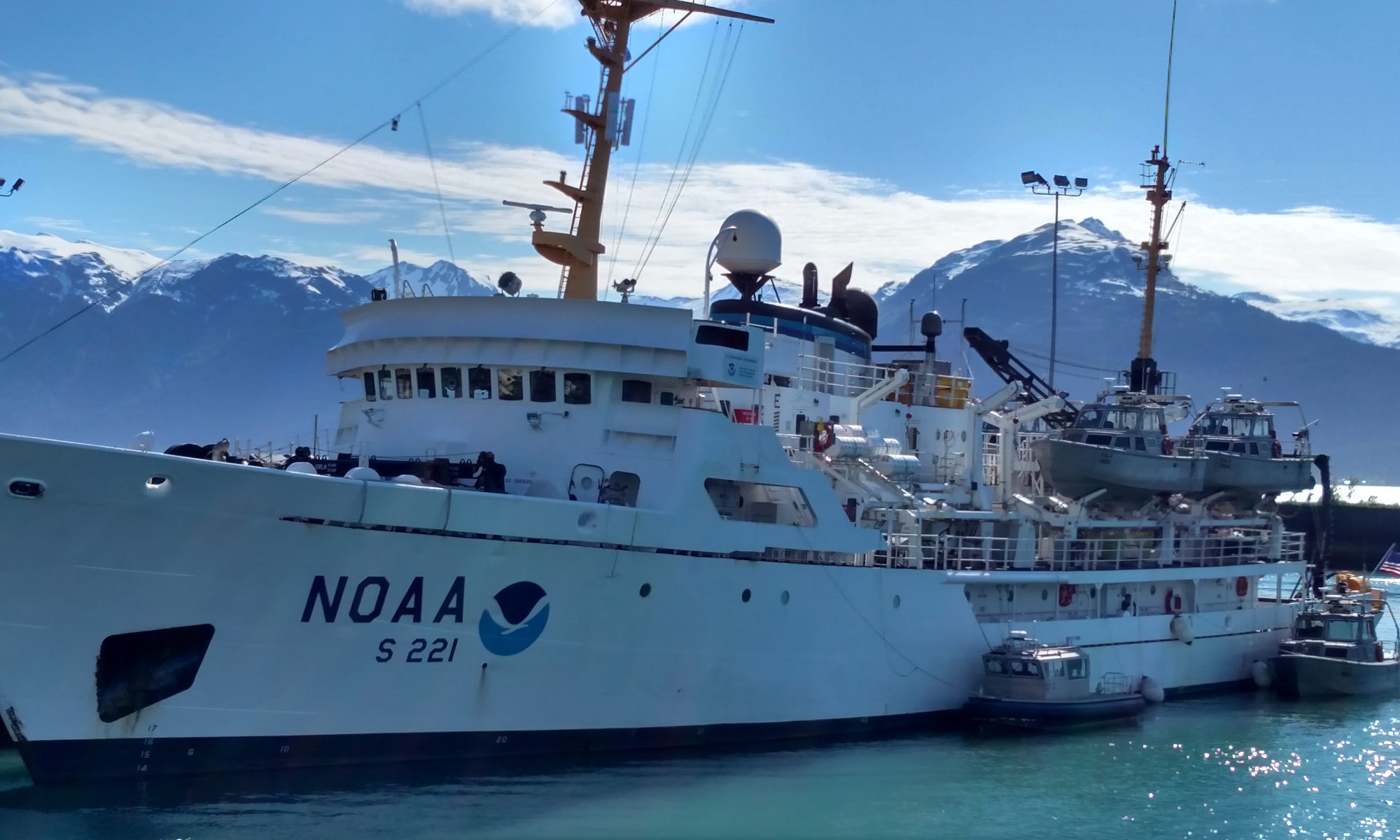
Natalie Macke, September 2, 2010

NOAA Teacher at Sea: Natalie Macke
NOAA Ship: Oscar Dyson
Mission:  BASIS Survey
Geographical area of cruise: Bering Sea
Date: 9/2/2010


Salmon Vampires and Birds…..     
Weather Data from the Bridge :
Visibility :  10+ nautical miles (Wondering what a nautical mile is??)
Wind Direction: From the SE at 12 knots
Sea wave height: 2-3ft
Swell wave direction: 3-4 ft NW
Sea temp:9.9 oC    Sea level
pressure: 1014.4 mb    Air temp:  11.2oC
Science and Technology Log: 
NOAA Fish Biologist Brian Beckman collect blood samples from salmon

NOAA Fish Biologist Brian Beckman is our resident salmon vampire aboard the Oscar Dyson. He’s been diligently collecting salmon blood samples anytime we catch them.  So I finally got a chance near the end of our journey to sit down and talk with Brian about why he want all those samples…

Insulin-like Growth Factor One (IGF1)
This is a ubiquitous protein that is made in the liver which causes calls to divide and grow.  So simply put, it causes growth.  Since the level of IGF1 in the blood is relatively stable, scientists can infer the growth rate of a fish by analyzing for this protein in the blood samples.  The growth rate is not an absolute value, but instead a relative comparison between fish populations.  Brian has been studying IGF1 levels in salmon off the coast of Oregon and is now trying to extrapolate or compare his findings with the salmon in the Bering Sea.  When averaging his finding over the region of coastal Oregon, he has been successful in correlating IGF1 levels in salmon with overall zooplankton abundance in the region.

More food –> healthier juvenile salmon –> higher levels of IGF1 –> greater abundance of adult salmon
Getting a Bit more technical..
IGF1

After the blood samples are collected, Brian first centrifuges them to separate out the plasma.  The IGF1 is contained in the plasma portion of the blood.  (Remember that blood is considered a heterogeneous mixture so the components can be separated by physical means)  The plasma is removed and frozen for analysis.  An immune assay is then completed on the samples back in the lab.

Brian also is concerned about the age of his salmon specimens.  Since bigger fish will be producing a steroid that stimulates the production of IGF1.  Therefore, bigger fish’s IGF1 levels are a consequence of both the effect of the steroid and the fish’s diet.  So, by collecting juvenile fish (no steroid production yet) a direct comparison can be made between the fish’s diet and it’s growth rate.

Birding on the Oscar Dyson

So on Thursday it was apparent to the crew and scientists that our fishing was done.  Troubles with the winch made balancing an open net in the water impossible.  Since our perfect 20 days of weather had us ahead of schedule, our sampling stations for this leg of the BASIS cruise were completed and our job was now done.  The scientists could now rest a bit and enjoy their cruise back to Dutch Harbor.  Except for two….. our colleagues from the Alaska Fish and Wildlife Service.  Tamara Zeller and Aaron Lang are aboard this cruise, not for fish or oceanographic samples; but instead they are here to perform an opportunistic survey about seabirds.  Armed only with a computer, binoculars and their savvy for visual details they collect data only when the ship is cruising so this last sprint to the harbor meant it was time for them to do some birding.

Tamara, Bruce, Aaron and Jeanette (left to right)

The computer pings and Tamara records what she sees from her window on the front starboard side of the bridge.  Indicators of ocean health, the Fish and Wildlife Service collects baseline data on seabird distribution and abundance in the Bering Sea.  Since most seabirds only come to land to breed, when ships like the Oscar Dyson has room aboard, a bird observer will take advantage of the opportunity to collect some data.

When I asked Aaron and Tamara what the most exciting bird this trip was, they had a hard time deciding between the two shown below.

Curlew There’s only about 5,000 left in the world
Horned Lark, Russian breeding flava subspecies Land bird from Russia
Personal Log

The ending to our cruise on the Oscar Dyson will be bitter sweet.  While I’m happy to be on land again, I will certainly miss the camaraderie of all aboard the ship.  I could not have wished for a better group of people and a more professional crew.  Everyone went to extraordinary measures to help me understand all they do AND how they do it.

Sorting Fish
Sorting Fish  
A special thanks to Ed Farley, our Chief Scientist and Jeanette Gann, my bunkmate and friend these past twenty days..   I wonder how many morning I’ll awake dreaming about collecting water samples from Niskin bottles??
Everyone on board and the NOAA crew was amazingly helpful and patient with the paparazzi teacher.  I’ll miss you all and thank you all once again…
Over and out..

Rebecca Himschoot, June 29, 2007

NOAA Teacher at Sea
Rebecca Himschoot
Onboard NOAA Ship Oscar Dyson
June 21 – July 10, 2007

Mission: Summer Pollock Survey
Geographical Area: North Pacific Ocean, Unalaska
Date: June 29, 2007

Pollock from a trawl sample

Weather Data from Bridge 
Visibility: 10 nm (nautical miles)
Wind direction: 307° (NW)
Wind speed: 23 knots
Sea wave height: 5 foot
Swell wave height: 1 feet
Seawater temperature: 5.6°C
Sea level pressure: 1014.7 mb (millibars)
Cloud cover: stratus

Science and Technology Log: Survey Techniques and Data 

When the science team on the summer pollock survey “see” enough fish to warrant trawling, a net is cast and a sample is collected.  The deck crew on the OSCAR DYSON fish the same way commercial fishermen do, just in smaller quantities. The net is placed in the water, and the front end is attached to a “door” on the port and starboard sides. These doors are released into the water and help to open the net. The net is lowered to the depth where the scientists are “seeing” the most fish.  After the net has been dragged long enough it is brought back on board and the sample is processed.  Once the net is on board, the fish are placed in a bin.

The fishing and deck crew of the OSCAR DYSON release the net for a trawl sample.
The fishing and deck crew of the OSCAR DYSON release the net for a trawl sample.

The bin can be slowly emptied onto a conveyor belt, where the science team culls out the bycatch and sorts it by species. Each species is documented and weighed, then returned to the sea. Some of these bycatch fish will survive, most will not due to the trauma of the net and being moved so quickly from depth to the surface.  Some common bycatch in the summer pollock survey are various flatfish, starfish, come cod and some crabs. The pollock are then also weighed and sorted by gender. Data are collected on gender and length for a large sample, and on a smaller sample more detailed information is collected, such as age. To weigh the fish, a large scale is used for the tubs of pollock, and a net weight can be obtained from the fishing crew.  Individual fish are weighed on smaller scales.  To know the gender of the fish, a slit is cut in the gut in order to see the gonads.  For scientists to know the age of the fish, otolith, or ear bone, samples are taken for later analysis. Each bit of data is collected in the processing area using watertight touch screen computer equipment and scales.  Rather than hand writing each fish weight, length and gender, the scientists use a barcode scanner to read each of these data points.

Scientist Sarah Stienessen weighs a sample.

Personal Log 

We have settled into a routine, and the night shift is getting easier. The trawl samples are still unpredictable, but we’re doing more of them. Yesterday was a long shift in the lab, but it’s more interesting to see what we catch than to sit around waiting to fish.  There were some storm petrels today, as well, to add to my Bering Sea bird list.  The seas are getting calmer again, and I’m hoping for a good night’s sleep tonight!

Question of the Day 

Answer to the last question:  (Scientists use Latin names for each animal or plant they find even though Latin is no longer a living language.  How do scientific (Latin) names get selected and why are they important?)

The scientific name for each organism is derived from two Latin names.  The first name is the genus the organism belongs to, and the second is its species; these are the narrowest branches of scientific classification (kingdom, phylum, class, order, family, genus, species). In the case of the walleye pollock, it belongs to the genus Theragra, and within that genus it is the chalcogramma species. There could be many other fishes in the Theragra genus, but only one is the species chalcogramma.

Senior Survey Technician Colleen Peters measures a sample.

A scientific name can be descriptive, or it may indicate a geographical location, or it may even be named for the individual who discovered the species.  In the case of the walleye pollock, Theragra is from the Greek roots ther (beast) and agra (food – of fur seals) and chalcos (brass) and gramma (mark).  The first word in the Latin name is capitalized, the second begins with lower case, and the whole thing is always written in italics.

The scientific name of an organism is important because it is distinctive, so that each organism has only one name (usually).  This way a scientist from Russia can communicate clearly with a scientist from Alaska and know that they are speaking about the same organism.  Common names can be confusing, and there can be many different names for the same organism (for example, there are many kinds of “salmon,” but only the Oncorhynchus tshawytscha is the king, or chinook salmon).  It is important to be aware that scientific names undergo changes as discoveries are made and classifications are refined.

Today’s question: What is an “otolith” and why is it important?

Jillian Worssam, July 9, 2004

NOAA Teacher at Sea
Jillian Worssam
Aboard NOAA Ship Miller Freeman
July 5 – August 1, 2004

Day: Four
Friday July 9th, 2004 21:15

Longitude: 57° Sea Wave Height: 0-1′
Latitude: 172° 44 Swell Wave Height: 0-1′

Visibility: 25 yrds fog Sea Water Temperature: 9.3C
Wind Direction: 69.6 Barometric Pressure: 1022 strong high pressure
Wind Speed: 14.1kts Cloud Cover: complete 100%

Haul Data
Depth of haul: 89 meters
Temperature at depth: 4.1° C
Species breakdown: walleye pollock, chum salmon, smooth lumpsucker, unidentified jellyfish

Science and Technology Log:

First haul of the evening and to our surprise pulled up a smooth lumpsucker (Aptocyclus ventricosus). What an amazing fish quite large in girth, but relatively short( approximately 10 inches). A large globe shaped body with the ventral sucking disk. We placed the fish in water and released it back into the Bering.

As for the rest of the catch, quite a few chum salmon this time, so I anticipate some smoked snacks tomorrow. I am becoming more and more comfortable with the process of slicing the fish to determine gender. Tomorrow will attempt the removal of the otoliths. Amazing the data that can be removed for the preservation of an ecosystem. We are off to complete another haul right now, so I am off to don my rain gear: thick rubber pants, rubber boots, and rubber jacket. I must also wear a hard hat and life jacket when on deck while the cranes are in motion and the ramp is down. With the ramp down it is easy access to the ever cold Bering Sea.

Personal Log:

Well I did it, finally tackled the treadmill, what a treat. My body had wanted to jog for days so in thirty minutes this morning I completed three miles, and for the first time ever I was jogging below sea level as the workout room is toward the bottom of the boat. Amazing the difference between 7000 feet and sea level. The way the treadmill is situated it rocks back and forth not side to side, it is similar to walking rises, with an uphill climb every now and then.

I also spent some more time in the bridge today. I would like to learn all the equipment so tonight I was taught about the EOT (Engine Order Telegraph) The one instrument on the bridge that actually looks familiar as it has probably been in every old war sea movie ever made. You know the big round brass machine with a level and an arrow, and the person on deck moves the arrow to face the command they would like sent to the engine room. The commands vary from full ahead to slow, half even stand by. Now with modern technology this apparatus is obsolete, but still on board in case of emergency and the electronics fail.

I was also introduced to an amazing centrifugal force windshield washer, but those details will have to wait until tomorrow.