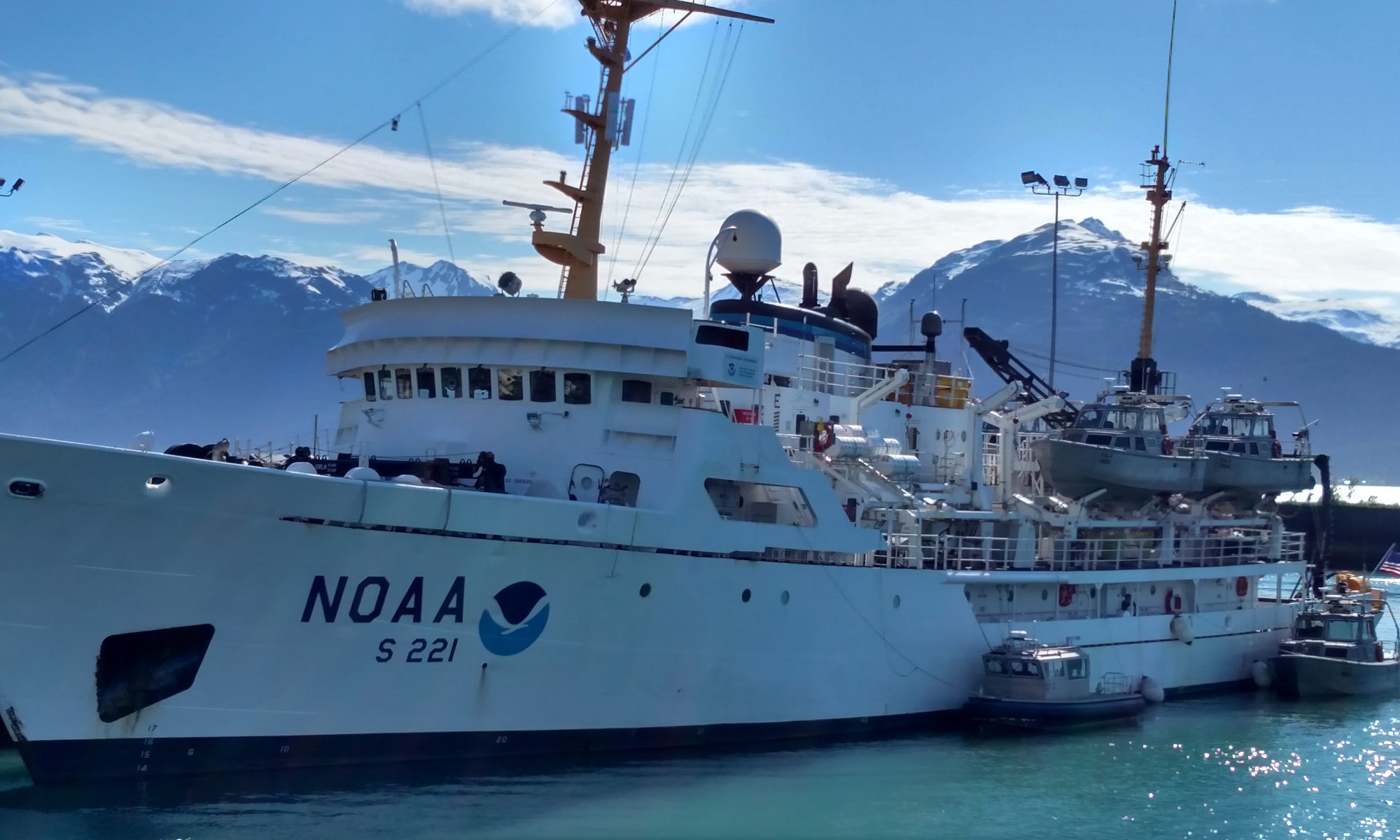
NOAA Teacher at Sea
Bill Henske Aboard NOAA Ship Nancy Foster June 14 – 29, 2015
Mission: Spawning Aggregation Survey
Geographical Area: Florida Keys and Dry Tortugas Date: Monday, June 22, 2015
Weather Data from the Bridge: East winds 10-15 kts. Seas 2-4 ft (1 ft inside reef) Isolated showers and thunderstorms)
Science and Technology Log
Remotely Operated Vehicles (ROVs)
We were talking on board today about the olden days, you know, when Jaques Cousteau and Marlin Perkins could reliably be found on a majority of American televisions. Remember Generation X?
Jeff from FWC at the controls of the ROV searching for signs of spawning aggregations.
Yes- we are in our 40s now. Kids my age had the spirit of scientific adventure to look forward to on Sunday nights. The same generation of kids grew up with monitors and joysticks, interacting with worlds that were somewhere beyond the “real world” on our Ataris and Commodore computers. Our 1980s parents might be incredulous to learn that we are now doing these same things to investigate critical habitat, monitor fish populations, and gather geographic data. I know many futurists predicted it would happen but the grownups I knew were skeptical, to say the least.
NF3 Dive Boat loaded for ROV Miss
The remotely operated vehicle has been a staple of marine research for many years now. Called an ROV for short, these devices are human operated machines that can do many of the same things humans divers can do but in much more difficult circumstances, for much longer periods of time, and at greater depths. ROVs are “employed” by resource managers, marine scientists, construction crews, engineering companies, and just about anyone else who has work to do under water.
Loading ROV gear into dive boat.
We have been using an ROV on our current mission on the Nancy Foster to collect fisheries data. With the ROV we can investigate different areas identified on hydrographic maps and from previous studies without labor intensive dive operations. The ROV does not need to stick to a dive schedule and as long as it has power and a willing operator, it can do its job. The ROV has several components that must all be brought onto our dive boat in order to operate.
The primary need of the ROV is electricity. Rather than running on combustion or cellular respiration, which both require oxygen, the ROV needs a steady supply of electrical current. Because many variables can affect the power demands of an ROV such as speed, depth, wind, and current, the FWC team has chosen to operate a small generator to power their ROV.
ROV being set up for deployment. Note the spool of tether cable and control panel.
The ROV has a specialized cable that carries the electricity from the boat to the motors. This cable, called a tether, also carries the signal from the controller to the motors to tell the ROV where to go. The video input the ROV gathers is relayed through this cable in order to allow the operator to see through the “eyes” of the ROV, and, of course, record what it sees.
Operating the ROV requires a good deal of coordination. The craft is controlled much like a slow, unresponsive airplane. It can move forward, reverse, side to side, up and down, and operate at a tilt. This dizzying array of motions are necessary to track and study the reef fish as they travel through the Florida Keys National Marine Sanctuary.
Jeff from FWC records the coordinates before beginning ROV survey
Jeff Renchen of the Florida Fish and Wildlife Conservation Commission (FWC) is, among many other things, our ROV operator on this cruise. He is using the small ROV to collect data on spawning aggregations of several important fish species. Jeff explained that the ROV allows researchers to explore deeper than divers are able to easily go. ROV camera operations can follow aggregations of fish and provide insights into the behaviors and conditions of spawning fish, as well as structures and locations that are important for spawning behavior.
With the ROV in the water Jeff takes it for a swim away from the boat. Once the ROV’s line has 50 feet of slack, the tether is attached to a drop line. In strong currents, it is possible for smaller ROVs, like the one here, to get carried off. The drop line allows us to raise or lower the ROV in the water column faster, increasing our ability to focus in on fish of interest or specific depths.
ROV swimming away.
Personal Log
There are some things that seem special no matter how many times you have seem them before. I remember a long time student of Appalachian ecology saying that he could not remember what he had for lunch but he could describe every time he had seen a bear. There are some things in our world that have that the ability to mesmerize us, silencing the combating thoughts that often clutter our minds and setting a reset button somewhere in our brain stem.
One of those things that stands out for me, and kindly keep it to yourself if you disagree, is seeing dolphins interact. We came in from some drop camera operations on Wednesday evening and found this pod of dolphins playing in the wash of the Z-Drive motors of the Nancy Foster. There would more footage but if you are taking video rather than living in this moment, you are probably doing it wrong.
Watching dolphins play and interact appeals to so many of us. I think it reminds us of the pleasure of physicality and the joy that can be had as social creatures.
Then there is the thrill of hearing “There’s a shark” from the scientist monitoring the camera you have been steadily lowering below a 17 foot dive boat bobbing in the small but steady waves.
.
The enormities of life at sea give us an awe inspiring sense of scale. Every day at sea there is at least one endless horizon and yesterday they surrounded us on all sides. Just past sunset I caught this small cumulonimbus that had previously drizzled on our afternoon drop camera trip. I thought about the thermal energy required to make such a structure. I wondered at the amount of fresh water it carried. And then my brain quieted down and I just watched it.
Happy Pi Day everyone! The second day on the ship was productive and incredible. The weather was fantastic throughout the entire day, with hardly any wind and a sheet glass ocean. The stillness of the water made it easy to spot wildlife, and during the day we saw multiple pods of dolphins, sea lions, and a variety of sea birds such as cormorants and brown pelicans.
A beautiful day aboard the Bell M. Shimada in the Channel Islands National Marine Sanctuary
Dolphins swimming alongside the Shimada
The beautiful weather also made for smooth conditions to launch the ROV. The ROV took three dives today at different locations and depths each time. Peter and his team picked the locations around the Islands, staying true to spots they had visited in previous years. Part of their research involves looking at the same coral beds over the course of many years and recording what they observe and noting any changes that may have occurred. They are observing how the coral, specifically the species Lophelia pertusa, reacts to changes in pH levels and temperature. This information is important in finding indicators for how our ocean is being affected by warmer temperatures and ocean acidification.
Retrieving the Beagle ROV from its first dive of the day
Santa Cruz Island and the ROV
So what exactly is ocean acidification?
As humans, we release carbon dioxide (CO2) into the atmosphere and have been doing so in large quantities since the Industrial Revolution. Carbon dioxide is released during combustion, when we drive our cars, power our houses and factories, use electricity, burn things, cut down trees, etc.
The ocean acts as a sponge and absorbs about 30 percent of the carbon dioxide from the atmosphere. However, as levels of CO2 rise in the atmosphere, so do the levels of CO2 in the ocean. This is not great news for our ocean or the organisms that make their home there. When CO2 mixes with seawater, a chemical reaction occurs that causes the pH of the seawater to lower and become more acidic. This process is called ocean acidification.
Even slight changes in pH levels can have large affects on marine organisms, such as fish and plankton. Ocean acidification also reduces the amounts of calcium carbonate minerals that are needed by shell-building organisms to build their shells and skeletons. The damage to these shell-building organisms, including many types of plankton, oysters, coral, and sea urchins, can have a negative ripple effect throughout the entire ocean food web. An important part of the mission of this trip is to see how ocean acidification is affecting different types of deep-sea coral, such as Lophelia pertusa, that use calcium carbonate minerals to build their skeletons.
pH scale
The scientists and the MARE team conducted three ROV dives throughout the day. The first dive brought up an outstanding Lophelia sample, and along with it a bizarre deep-sea creature called a basket star. Basket stars are a type of invertebrate that are related to brittle stars. Even though they feed mostly on zooplankton, they have long spindly arms that can reach to over a meter in length. It was astonishing to be able to see this alien looking creature alive and moving!
Chris Caldow and Peter Etnoyer and the basket star
a closer look at the basket star
Basket star
Day 3: Sunday 3/15/15
After long hours and a late night, the MARE team was able to get the manipulator arm on the ROV up and running, after having technical difficulties with it during the first half of our trip. This was perfect timing for the first ROV dive of the day in the waters between Santa Cruz and Anacapa Islands. The goal of this dive was to find scientist Branwen Williams a type coral known as Acanthogorgia. This coral is incredibly beautiful; tall, fan-like and golden in color.
An Acanthogorgia with a cat shark egg case
Bombs Away: Branwen hoped to collect samples of this coral to take back to her lab for testing. She and her team of students and scientists will use these samples to ascertain how old the corals are, how fast they grow and what are they eating. Branwen explained to me that coral, similar to trees, have growth rings that can be used to determine age as well as other factors. She mentioned that when looking at age, she looks for the pattern of the “bomb curve” within the coral rings and that provides scientists with a relative date of how old the corals are. The “bomb curve” is a concentration of radiocarbon (14C) that is found in corals in every ocean in the world. The concentration of radiocarbon is a direct product of the bomb testing that took place starting in the 1950’s and produced large amounts of this radiocarbon into the atmosphere. The ocean absorbed that particular type of carbon, and in turn it was absorbed by the corals, who are suspension feeders. Suspension feeding means that corals eat by stretching their tentacles out to catch tiny particles that are floating by. So scientists identify the start and peak of the bomb testing in the radiocarbon stored in the coral skeleton to determine growth rates and then the ages of the corals. This was very shocking to me that corals in every ocean have this radiocarbon in their bodies, and clear evidence of how much human actions impact the entire globe.
The team looks to see what samples have been collected
The Chief Boatswain prepares to operate the winch that will help lift the ROV out of the water
MARE and NOAA crew work together to make sure the ROV makes it back on board safe and sound
Diving Deep: The ROV was dispatched into the water and soon sunk to around 200 meters. As it cruised along the ocean floor the team watched as a variety of rockfish scuttled by. The ROV has two sets of lasers that shoot out in front of it, each spaced 10 centimeters apart. This gives the scientists an idea of the size of objects or organisms that pass in front of the camera.
The team located the Acanthogorgia habitat and got to work collecting samples using the manipulator arm. The manipulator arm reminds me of the claw game found in most arcades. Andy remotely operated the arm, while Dirk worked simultaneously to control the ROV. Together they were able to collect three exceptional samples, including two Acanthogorgia corals attached to hefty rocks. Each time the manipulator arm reached towards a coral, the whole crew of the Shimada held in their breath in suspense. Would the arm be able to grasp its target? The live footage from the ROV is now being streamed throughout the entire ship; in the lounges and staterooms too, so Andy and Dirk had a quite an audience cheering them on!
Andy and Dirk work the controllers while Peter, Branwen and Leslie watch closely nearby
The samples made it back to the ship safely. Branwen prepared the coral to take back to the Keck Science Department of the Claremont College where she and her students will conduct their research about this little known species of coral.
Thinking about the effort it takes to research deep-sea coral, involving ROVs and commissioning ships to reach their remote locations, it’s no wonder we know little about them and so much more about their shallow water relatives.
Branwen and one of the Acanthogorgia samples
Dirk and Andy after a job well done
Our Chief Survey Tech waits patiently to assist with the next ROV dive.
NOAA Teacher At Sea Amy Orchard Aboard NOAA Ship Nancy Foster September 14 – 27, 2014
Mission: Fish Tagging Geographical area of cruise: Tortugas Ecological Reserve North & South sections: Tortugas Bank Date: September 17, 18, 19, 2014
Weather, September 19, 2014 20:00 hours
Latitude 24° 35’ 07’’N Longitude 83° 01’ 09’’W
Broken clouds, clear.
Humidity 10%.
Wind speed 7 knots.
Air Temperature: 29° Celsius (84° Fahrenheit)
Sea Water Temperature: 30.2° Celsius (86.7°Fahrenheit)
CLICKING ON THE SMALL PHOTOS WILL ENLARGE THEM & REVEAL HIDDEN TEXT.
WEDNESDAY:
Resetting Traps
We did not have great success with the shrimp bait. Guess these fish prefer their shrimp au naturel where as we gave them cooked, peeled and deveined shrimp. This morning we set out again in the small boats so the divers could re-bait the traps with squid instead.
Look up the word coxswain if you don’t know what it means. Here we pronounce it “COXS-UN”. Before each dive, we run through a safety assessment, called the GAR (shown here by Nick) It stands for Green, Amber, Red. We rank the following categories and if our numbers are low enough to fall into the Green category, divers are allowed to dive: Supervision, Planning, Crew Selection, Crew Fitness, Environment, Event Complexity. If we come up with an Amber, we know we need to dive with caution and Red means we won’t be diving that launch. The Commanding Officer (CO) has the ultimate authority to say if divers go out or not.
This was left over from the last science trip and we were glad to have it since our shrimp didn’t lure the fish into our traps.
FWC diver. Taken with my underwater camera from the small boat.
Finally Ariel looks much more like a scientist now that she has a pen in her pocket!
Safety on the ship
Safety always comes first on the Nancy Foster. We have had briefings on safety, we wear hard hats while the cranes are moving, we wear closed toe shoes (except when in the shower) and we have had fire drills & first aid emergency drills. Today we had an abandon ship drill. First we each arrived at our muster stations (our assigned place to meet), then we climbed into our Survival Suits (nicknamed the Gumby suit.) This is made of very thick neoprene, probably 7-9 millimeters thick, and covers you from head to toe to fingertips. It is meant to keep you safe from hypothermia if you were overboard for a long period of time.
Getting into this full body, super heavy neoprene suit is a real chore! I discovered the best way is to jump up and down. Photo by ENS Conor Magnin
It is confirmed. I am not as tall as the average adult. This suit hangs so low that I look like I am kneeling down. Oh well, I would most certainly still be warm in open seas. Photo by ENS Conor Magnin
This is Gumby. Can you see the resemblance? Photo credit: Stock Photo
After wriggling back out, we went to find our assigned life raft. There are 6 rafts which each hold 25 people. There is enough bunk space on the ship for 37 people, so there are plenty of life rafts for all. Three rafts sit on each side of the ship so even if the ship was under water listing to one side, we could still access enough rafts for all.
6 rafts x 25 people each = 150 lives saved. Only 37 on the ship at a time, so I think we are safe.
Inside this capsule is the life raft. It opens upon hitting the water and has a cool tent for shade. Still, I prefer the Nancy Foster and have full faith in our crew to keep her upright.
In addition to the Survival Suit, Nick thought he would be safer being more visible so he wore a few extra items to ensure his safety!
Nick has a horde of awesome hats. Keep your eyes peeled for more.
Dancing with the Remotely Operated Vehicle
Part of each day has been spent looking underwater with the Remotely Operated Vehicle piloted by Lance Horn and Jason White from the University of North Carolina at Wilmington (yet another partner in this 14-day collaboration)
Lance Horn and Jason White are geniuses with the Remotely Operated Vehicle. There are lots of very highly technical parts to this equipment and they do it all – and they do it well.
I will be sharing lots more information about the ROV in an upcoming post. Today I wanted you to see who else besides scientists are curious about the ROV (the large instrument with the yellow top you see in the video here)
THURSDAY:
Fish Surgery
We checked traps again this morning and had success with the squid. The dive teams will perform surgery today! The surgery only takes about 10 minutes, which may seem quick, but since they are underwater at a depth of about 100 feet, they must work quickly so as to not run out of their air supply. One scientist (usually Paul Barbera, FWC Associate Scientist – who they call the Fish Whisperer) will hold the fish steady while another will make the incision, insert the acoustic transmitter and then stitch up the incision. The stitches will dissolve in about a week or two. The acoustic transmitter (fish tag) will last 2-5 years. Life span of the tag is determined by it’s battery life. The smaller tags (for smaller fish) can last 2 years and the larger tags (for larger fish) will work for about 5 years. This allows the scientists to gather information on the same fish for multiple years, giving them a really good idea of their seasonality – or the fish’s movements between different areas, both protected an unprotected.
Acoustic Transmitters – Fish Tags which will be surgically placed in the fish at a depth of about 100 feet. Here you can see the smaller ones are about 4 cm and the larger 6.5 cm
This footage was not shot during our cruise, but Ben Binder, FWC Biological Scientist, shared this video with me describing the surgery process. Here you will see two scientists who are aboard the Nancy Foster with me. Paul is securing the fish and Mike McCallister, FWC Biological Scientist, is performing the surgery. They are working with a Lion Fish here.
Placing the fish tag is just one part of the process of collecting the data the scientists are hoping to gather. The second part is to place an instrument which can read the acoustic transmitter as it swims past (within the fish of course!) Danielle Morley, FWC Assistant Research Scientist, and I worked to prepare some previously used acoustic receivers. Each of the 90 receivers the FWC have placed in the waters off the Florida Keys costs about $2500. Therefore, used receivers are reprogrammed, repainted with anti-fouling paint and used again. Anti-fouling paint makes it very difficult for animals like barnacles to build their calcium carbonate skeletons on the receiver’s exposed top. The receivers are made up of a hydrophone, a circuit board and a battery. I replaced the batteries and cleaned up the O rings. The O rings are extremely important as they ensure the capsule is completely water-proof and can be submerged in ocean water for a year at a time.
The red on the top of the receiver is the anti-fouling paint. It is the only part of the receiver which is exposed to sea water.
Here I am cleaning and lubricating the O rings to ensure a water-tight seal. I tried really hard to find at least one photo of me without a HUGE grin on my face so you can see that we truly are serious about science around here (we are just having a REALLY good time doing it!) Photo by Danielle Morley.
These are the receiver stands, which are allowed under a special permit from the Florida Keys National Marine Sanctuary, will sit on the ocean floor. They have a concrete block on the bottom to weigh them down and then a series of PVC pipes to hold the receiver. If you are wondering why these are sitting on dry land, I snapped this shot during my tour of Scott’s office before we left for sea.
After a year, the batteries need replaced and the data needs retrieved. Today, the divers will retrieve 6 acoustic receivers on Riley’s Hump and replace them with those we reprogrammed. This is footage of our divers (Jeff, Sean and Colin) making the swap. Thanks to Cammy Clark, the Miami Herald reporter, who dived down about 100 feet to capture the action.
FRIDAY:
Trap Retrieval
Over the last 5 days, there have been 65 dives and 3 surgeries performed. The scientists deem this as very successful trip. Additionally, all divers returned safely to the ship after each dive! This morning the divers are retrieving the traps, which like the receiver stands are allowed by a special permit from the FKNMS. Even if conditions did not allow us to get the traps and they needed to stay at the bottom, no fish would be caught for very long. Each trap is closed with a zinc clip that will dissolve after a week or two.
Zinc clips keep the traps closed, but only temporarily. They dissolve after a week or two allowing any fish to escape if a trap has to be abandoned due to weather or other conditions.
The large fish we are trapping can easily stay down in a trap that long. But today, the weather allowed us to retrieve the traps.
Along with the traps, Ben and Ariel brought five Lion Fish Pterois volitans back up.
I was told that if I held the fish way out in front of my body, it would look bigger – but since this was a whopping 42 cm, I didn’t need to hold it out far to make it look large. Photo credit: Florida Fish and Wildlife Conservation Commission
Kissing this invasive species good-bye (well, at least these five) Photo credit: Florida Fish and Wildlife Conservation Commission
Notice the large, wide mouth. This is a voracious predator which is part of the problem with them moving in to the area. Photo by Amy Orchard
Lion Fish are not naturally found here. They are native to the Indo-Pacific. It has not been determined exactly how they got to the area but they are very popular for home aquariums. However, since they are voracious predators, after eating all their other aquarium fish, people have been dumping them in the Atlantic Ocean for decades. It was decided that efforts to eradicate the species would be futile since they are prolific breeders, have no natural predators and have been found in extremely deep waters where it would be unfeasible to reach them. Instead, there are large efforts to manage their populations in certain areas.
One does need to be extremely careful as they have venomous spines – 13 along the top (dorsal spines) and 3 along the bottom (anal spines) The pain they inflict & the reaction people can have when stung sounds very similar to the bark scorpion.
All these teeth are not used for chewing. A Lion Fish swallows it’s prey whole. It uses a striking method to capture its prey, but these teeth help to hold it in once it is caught.
If you look closely along the bottom part of the fish, you can see its anal spines. The 13 spines on the top (dorsal) are easy enough to see.
Once the spine enters, the loose skin covering the spine is pushed down, causing a compression of the venom glands which releases the venom via the grove in the spine. Here the loose skin has been pushed down to reveal the spine.
I found out they are SUPER tasty! Especially since Bob Burroughs, 2nd Cook and Lito LLena, Chief Steward prepared them as ceviche – my favorite.
I have been eating SO WELL! Usually when there is a large group eating together, the cooks cringe when the vegetarians come by, but Bob & Lito are always happy to see me and have made me some DELICIOUS dishes. Thanks Bob & Lito!
So, so good!
Fort Jefferson
In the afternoon we got a special treat. We left the waters of the Florida Keys National Marine Sanctuary and ferried over to Fort Jefferson at the Dry Tortugas National Park for a tour and some snorkeling. One can only reach the fort by boat or sea plane. It was built between the years 1846 and 1875 as a way to claim the main shipping channel between the Gulf of Mexico, the western Caribbean and the Atlantic Ocean. It never saw battle, mostly because it’s fire power was so massive that no one wanted to go up against it!
Me & LTJG Linh Nguyen. NOAA Corps, is hard working, kind, funny and truly awesome. Photo credit: Alejandro Acosta
This huge cannon was on the top tier of the fort and was one of many that protected the fort.. It was brought up by man power. Quite a feat. You can see that it was able to rotate 360 degrees in order to protect the fort from ships coming in any direction.
Lots of restoration work is being done to bring it back to its original state.
Even though I have been able to travel out into the open ocean on the small boats each day, it was SO GOOD to actually get into the water and snorkel around. So many amazing things to see and take photos of.
Christmas Tree Worm (Spirobranchus giganteus) and Brain Coral (Diploria clivosa)
Sargent Major (Abudefduf saxatilis) and Fire Coral (members of the phylum Cnidaria, class Hydrozoa, order Capitata, family Milleporidae)
Snook (Centropomus undecimalis)
There were many jelly fish (mostly Moon Jellies) and we all got stung a lot, but the underwater scenery was well worth it.
Aurelia aurita
Aurelia aurita
Taken while snorkeling
Bonus Points – make a COMMENT and tell me how the LION FISH and the GILA MONSTER are similar!
Answer to my last post: It was a DOLPHIN. The Common Bottlenose Tursiops truncatus
Also, the definition of RECIPROCITY is the practice of exchanging things with others for mutual benefit.
I have been so impressed with the seamless collaboration between the crew & science team as well as the different agencies within the science team. Everyone gives of themselves so freely for the main goal of the scientific mission.
NOAA Teacher at Sea Susan Kaiser Aboard NOAA Ship Nancy Foster July 25 – August 4, 2012
Mission: Florida Keys National Marine Sanctuary Coral Reef Condition, Assessment, Coral Reef Mapping and Fisheries Acoustics Characteristics Geographical area of cruise: Florida Keys National Marine Sanctuary Date: Friday, July 29, 2012
Weather Data from the Bridge
Latitude: 24 deg 36 min N
Longitude: 83 deg 20 min W
Wind Speed: 5.8 kts
Surface Water Temperature: 29.5 C
Air Temperature: 29.5 C
Relative Humidity: 67.0%
Science and Technology Log
Marine Scientist, Danielle Morley, ready for the signal to dive and retrieve a VR2.
Science is messy! Extracting DNA, observing animals in their native habitat or dissecting are just a few examples. On board NOAA Ship Nancy Foster it may even be stinky but only for a little while. That is because the divers are retrieving the Vemco Receivers also called VR2s for short. These devices have been sitting on the ocean floor quietly collecting data on several kinds of grouper and snapper fish. Now it is time to download the VR2s recorded information and give them new batteries before placing them at a new site. So, why are they stinky? Even though the VR2s are enclosed inside another pipe, sea organisms have begun to grow on the top of the VR2. They form a crust that is stinky but can be scraped away with a knife. Any object left in the ocean will soon be colonized by sea creatures such as oysters, algae, and sponges to name a few. These organisms will grow and completely cover the area if they are undisturbed. This crust smells like old seaweed drying on an ocean beach.
Clean VR2 ready to download data and replace batteries.
Really, it isn’t too bad and after a while you don’t notice it so much. Besides this is the only way scientists can get the numbers out of the VR2. These numbers tell scientists which fish have been swimming by and how often. Some of the VR2s have collected over 21,000 data points but most have fewer. This information alone helps scientists understand which areas of the ocean floor each species of grouper and snapper prefer as their home or habitat. These data points can even paint a picture of how these fish use the habitat space over the period of an entire year.
Have you been wondering what the VR2s are listening for? You may be surprised to learn it is a signal called a ping from a tracking device that was surgically implanted while the fish is still underwater! The ping is unique for each individual fish. The surgeries were completed when the study began in 2008. First, the fish are caught in live traps. If the trap is in deep water (>80ft) divers descend to perform the surgery on the ocean floor. The fish’s eyes are covered and it is turned upside down. Then a small incision is made in their abdomen and the tag is inserted below the skin. Stitches that dissolve over time are used to close the incision. Once the fish has recovered a bit it is released. An external tag is also clipped into the dorsal fin so other people will know the fish is part of a scientific study. Fish caught in the upper part of the water column may be brought up to the surface slowly and kept in a holding tank while the surgery performed on the boat. Scientists have noted the fish are less stressed by being caught, handled and tagged using this method. This is a factor for collecting enough data to gain a real understanding of these fishes behavior.
Scientists at the Florida Fish and Wildlife Conservation Commission (FWC) are able to conduct this study with support from a National Oceanic and Atmospheric Administration (NOAA) grant. They have also worked with other agencies on this research including the Florida Keys National Marine Sanctuary (FKNMS) the area where the VR2s are positioned. Since 2008 they have learned a great deal to better understand how grouper and snapper use habitat. Both fish are good for eating and are found on the menu in many restaurants around the world. They are commercially harvested and fished by recreational fishermen like you and me. Fishing is a big industry in all coastal locations and especially in Florida. In fact, commercial fishing alone accounts for between 5-8% of total income or jobs in the local economy of the Florida Keys. Knowledge gained from this study will help FWC and FKNMS guide decisions about fishing and recreation in the FKNMS and be aware of negative impacts to these fish populations in the future. Stinky air is small sacrifice to help preserve populations of groupers and snappers.
Jeff Renchen describes the features of the ROV.
Mrs. Kaiser wearing the virtual reality glasses. Photo by Jeff Renchen
You can see that exploring marine habitats takes time, trained people and resources. Luckily a device has been developed to help scientists explore the ocean floor in an efficient and safe way. This little gem is called a Remotely Operated Vehicle or ROV. It is a cool science tool operated with a joy-stick controller. The ROV can dive and maneuver at the same time it sends images back to the operator who is using a computer or wearing virtual reality glasses. Yes, I said virtual reality glasses! The operator can see what the ROV can “see” in the depths of the ocean. I had the opportunity see the ROV in the lab and then ride with the ROV team as they tested the equipment and built their skills manipulating this tool in dive situations. The beauty of the ROV is that it can dive deeper than is allowed for a human diver (>130 feet) and it can stay down for a longer period of time without stopping to adjust to depth changes like a human. If a dive site has a potential risk due to its location or other factors, the ROV can be sent down instead. Scientists can make decisions based on the ROV images to make a plan for a safe live dive and save time and resources. Science is messy, sometimes, but it is cool too!
Personal Log
The weather has been simply amazing with calm crystal clear seas and very smooth sailing. Still, spending the day in the sun saps your energy. However, that feeling doesn’t last too long after a nice shower and a trip to the mess to enjoy a delicious meal prepared in the galley. There Chief Steward Lito Llena and 2nd Cook Randy Covington work their magic to cook some terrific meals including a BBQ dinner one evening on the upper deck. They have thought of everything, especially dessert! I will be paying for it later by running extra laps when I get back home but it will be worth it.
Mrs. Kaiser’s stateroom on the NOAA Ship Nancy Foster.
My stateroom is a cozy spot with everything one would need and nothing more. A sink is in the room but showers and toilets are down the hall a few doors. One item that is missing is a window. It is so very dark when the lights are off you can’t see your hand in front of your face. It is easy to over sleep! Surprisingly noise has been minimal since the rooms are very well insulated. I share this space with three female scientists but we each have a curtain to turn our bunks into a tiny private space. I enjoy climbing up in my top bunk, closing my little curtain and reading my book Seabiscuit, An American Legend before being rocked to sleep by the ship.
NOAA Ship Nancy Foster officers and crew have been wonderful hosts on this cruise. All have patiently answered my questions and helped me find my way around to do what I need to do. I am curious about their life at sea and the opportunities it affords them to see new places, meet new people and engage in new experiences too. I hope to learn more about their careers as mariners before this voyage ends. The ship truly is a welcome place to call home for these two weeks.
Weather Data from the Bridge Air Temperature: 28.1C (82F)
Wind Speed: 4.5 knots (5.2mph)
Wind Direction: From the SSE
Relative Humidity: 78 %
Barometric Pressure: 1021.1
Surface Water Temperature: 28.1C (82F)
Science and Technology Log
ROV with labels, photo credit UVP
Rather than fishing for multiple samples of each species from every Marine Protected Area (MPA) we stop at, the scientists opted to use a Remotely Operated Vehicle (ROV) to gather their data. This also allows Stacey Harter and Andy David to get real time footage of the animals that inhabit each dive site as well as a more complete picture of the habitat itself. Not only are we collecting data on the fish, but John Reed and Stephanie Farrington are taking data on all of the invertebrates we see such as sponges, corals, hydroids, crinoids, sea stars, urchins, and lobster. The ROV we are using for this expedition is called the Phantom S2. It weighs about 300 pounds when out of the water with the dimensions of 24 inches in height, 55 inches in length and 33 inches in width. The Phantom S2 uses the tether to power the two ½ horizontal horsepower electric motors and the two vertical 1/4 vertical horsepower motors and has a maximum speed of 2 knots (2.3mph) and because of the length of the tether, is limited to a depth of 1000 feet. The ROV is equipped with a high resolution video camera with a 12x zoom as well as a digital still camera with strobe to collect high quality color images of anything the scientists need for their research. On this cruise we are averaging about 450 still images and about seven hours of video daily. Two lasers mounted at 10 cm wide help the scientists measure specimens without bringing them to the surface.
Setting up the ROV onboard the ship takes about a day. This requires the ROV team of Lance Horn and Glenn Taylor from the Undersea Vehicles Program out of University of North Carolina Wilmington to arrive at least 24 hours in advance of departure so that they can have the ship’s crew load all of the ROV equipment with the crane. From there they set up the components in the dry lab and begin running the tether cables from the ROV, which is located on the deck, to the computer, which is located in the dry lab. We also have to run a line up to our GPS device and our VHF radio that are both installed on the flying bridge, and yet another cable to transfer the digital images to the computer, and the power line for the ROV engines. Once the research gets underway, it is not uncommon for Lance and Glenn to spend as many as 12 hours a day working on preparing for the dive, operating the equipment during the dive, and then processing all of the data after the dive. It is hard work and takes great attention to detail.
The hydrophone gets lowered into the water while the ROV is on a dive.
In order to communicate with the ROV while it is underwater the operators deploy a Trackpoint hydrophone over the side of the ship which must be taller than the hull of the ship, which on the Pisces is over 28 feet tall. This hydrophone picks up the X,Y,Z coordinates from the ROV then uses the data from antenna mounted on the fly bridge of the ship to create GPS coordinates for the ROV.
This information is plotted into the Hypack mapping system and is used by both the ROV driver as well as the bridge of the ship. This helps the officer on deck know what heading the ship needs to be traveling so the ROV driver can maneuver the ROV to where the scientists want to go. Depth is calculated by the delay in time that it takes the hydrophone to get a signal from the ROV.
Lance Horn piloting the ROV
Driving the ROV takes great skill and concentration. Not only do you have to watch the ROV display footage to make sure you don’t run into anything, but you also have to constantly be aware of your heading so you don’t get the ROV too far off course. The tether keeping the ROV in communication with the ship also has to be monitored. Getting the tether wrapped around a rock overhang or part of a mast on a shipwreck is of great concern. If the tether is severed or becomes too entwined, the ROV could be lost. The ROV driver is in constant contact with the crew on the back deck who are watching the tether line as well as the bridge so that any necessary course corrections can be made quickly and efficiently. Having too much tether in the water can also lead to tangling, so the tether is marked in 50 foot increments, which allows the deck crew to know how much of the tether line to feed into the water. On our cruise, the longest the ROV has been below the surface has been 3.5 hours. Because of the intense concentration it takes to drive the ROV, four consecutive hours is the limit that a driver can do in one sitting. If the dive needs to be longer than four hours, Lance and Glenn would trade duties, so if Lance was driving, he would rotate out onto the deck to monitor the tether while Glenn takes over at the controls.
The ROV control console
The ROV requires three consoles of components to operate. The first is the ROV control console. This is where the driver controls the ROV itself. On this panel are the two joysticks that control the movement of the ROV through the water. The joystick on the left controls the up, down and side to side motion. The joystick on the right controls the forward, reverse, as well as left and right. There are also control switches to tilt the camera so that it is hanging vertically within the cage to take pictures of the ocean floor.
The scientists on this cruise want a “bottom” shot every two minutes. This is their way of “collecting” random samples of the habitat while we are making our way along the transect line. There are also controls switches to turn on and off the lights, turn on and off the laser, and to switch over from the video camera to the still camera so digital still pictures can be taken. Directly above the control panel is a flat screen monitor showing the live footage from the ROV so the pilot can see where the ROV is below the surface.
A multibeam image with transect lines is loaded into the Hypack software so the ROV can be navigated to where the scientists need to collect their data.
The middle console has all of the navigation components. There is a GPS unit displaying the coordinates of the ship at all times. It also contains a Trackpoint acoustic tracking system that provides position data for the ROV. This is not only helpful to the driver, but the scientists take waypoints throughout the operation to help them match up the data they recorded while watching the live video feed from the ROV with the still images, and the temperature and depth data taken by a small CTD attached to the ROV cage.
Also on this cabinet is a rackmount computer using Hypack software. The scientists can load the multibeam sonar information and the transect coordinates into the navigation computer. This software gathers and logs information from the ROV as well as other navigational electronics so the driver sees a real time image of where the ROV is in relation to the ship and features of interest on the sea floor. This also gives both the driver and the scientists an idea of where we are in relation to the transect line. If multibeam images were available and downloaded into the navigation computer, the chief scientist can use those to adjust our heading off the transect line if she feels the structures they need to study are on a different heading than originally plotted.
The ROV video console
The third console contains the controls for the digital still camera as well as the digital recording devices. Steve Matthews, part of the science team, has been manning the still photography on this cruise. When the scientists see something they want a close up picture of, they ask the driver to stop the ROV and position it so the still camera can be zoomed in for a close up shot. This will help the scientists to make the proper identification of all of the different species we photographed while on this cruise.
For this research trip, video and still images are all the scientists need to assess the efficacy of the MPAs. The Phantom S2 has other tools that can be used depending on how the scientist needs to collect their data. The ROV can be fitted with a sonar device which can be used to located objects, such as ship wrecks or other lost items, at ranges farther away than the video can see. Scientists can also elect to use the claw for sample collection, a plankton net to gather plankton, and a fish collection suction device.
Personal Log
Myself driving the ROV
We sent styrofoam cups to a depth of 250m. The cup on the right is the original size. As you can see my cup, at left, shrank by more than half.
The bottom of the ocean has such incredible diversity! Before being invited to be a part of this research expedition, I had only read about all of the amazing things we have seen in text books. The ROV has allowed us to travel to depths that are inaccessible to recreational scuba divers and to visit sites that not too many other people have been to. Every day we see different species and habitats. It is interesting to compare areas that are inside the MPAs with those that are outside of the MPAs. Even though each day might seem like we are doing the same thing over and over again, I am anxiously awaiting a glimpse of something that I have never seen before. For each depth we dive to, there is a new set of species and habitat to learn about. The deepest dive we have been on so far this cruise was at the Snowy Wreck MPA at about 25 m (833 ft) below the surface. This location was really cool because there is an old ship wreck here that is full of corals and anemones and all sorts of fish species. We also had a little fun while at the depth and shrunk some styrofoam cups. Stephanie Farrington is an amazing artist and designed these fabulous cups for us each to send down to shrink.
Ocean Careers Interview
In this section, I will be interviewing scientists and crew members to give my students ideas for careers they may find interesting and might want to pursue someday. Today I interviewed Lance Horn and Glenn Taylor, ROV operators from University of North Carolina Wilmington (UNCW).
Lance Horn
Mr. Horn, what is your job title? I am the operations director of the Undersea Vehicles Program at University of North Carolina Wilmington. I started at UNCW in 1985 as part of NOAA’s Underwater Research Center (NURC) as a hard hat diver. In 1987, I joined UNCW’s scuba and ROV program which has now become the Undersea Vehicles Program.
What type of responsibilities do you have with this job? As director, I am in charge of lining up jobs for us, maintaining the budget, and finalizing the contracts from each project. I also pilot and maintain the ROV itself.
What type of education did you need to get this job? I graduated from the Florida Institute of Technology with an Associate’s Degree in Underwater Technologies. In this program, we studied compressors, hydraulics, welding, scuba and underwater photography.
What types of experiences have you had with this job? This job has allowed me to travel all over the world and to see some really cool things under the ocean’s surface. My favorite ROV dive so far was when I went to Antarctica to map the trash dumped at the bottom of Winter Quarters Bay. Before people realized what kind of impact indiscriminately dumping their trash overboard was doing to the habitats on the ocean floor, ships used to come into port at Winter Quarters Bay and dispose of their trash in the ocean. This includes very large items such as 55 gallon drums, fire hoses, conex boxes, and even a bulldozer that fell through the ice! My job was to use the ROV to create a map showing the location of the large objects so that it could be determined if it would be possible to recover these items for proper disposal. As part of this project, we also had to take the ROV outside of the bay to have an undamaged habitat to use as a control variable for comparison with the bay. Outside of the bay was amazing. We were diving under six feet of ice and got to see an environment that not many others have seen, including purple worms, white sponges, and anemone. It was beautiful.
What advice do you have for students wanting a career with ROVs? Not every job requires a four year degree. You can still find a good job doing something you love. I have been successful doing what I do with a two year Associate’s Degree. Florida Institute of Technology was not an easy school. I worked hard to earn my degree.
Glen Taylor
Mr. Taylor, what is your job title? I am an ROV pilot and technician with the Undersea Vehicles Program and UNCW.
What type of responsibilities do you have with this job? In addition to piloting the ROV, my primary responsibilities are to maintain the three console units that house all of the digital equipment we need to control the ROV. This includes any rewiring that needs to be done or the replacement of equipment either for repairing broken parts or upgrading to newer electronics.
What type of education did you need to get this job? I earned my Bachelors Degree from Clarkson College of Technology. I went to work for General Electric in New York. I was transferred to GE in Florida after which I decided to retire from GE and become a scuba dive master. I went to work for NURC in St. Croix but was transferred to UNCW when the St. Croix office was closed. This is where I hooked up with Lance in 1993 and learned to operate the ROV.
What types of experiences have you had with this job? I have also been fortunate enough to travel the world with the ROV. Diving at the Edisto MPA this week is probably the highlight of my career in ROV operation. The reef features were fantastic, the water was clear, we had hardly any current, the ship was able to remain on course. It was perfect conditions.
What advice do you have for students wanting a career with ROVs? First and foremost, follow your passion. What do you get excited about? I have been driving ROVs for almost ten years and I still love coming to work each day. To be successful in this field, you need a strong background in computers and technology. You can be trained to drive the ROV, but strong technology skills are essential. Another good skill to have is problem solving and trouble shooting. Things might go wrong in the middle of a dive, you have to be able to figure out a solution right there on the spot to keep the dive going.