NOAA Teacher at Sea
Staci DeSchryver Onboard NOAA Ship Oscar Dyson July 26 – August 12, 2011
Mission: Pollock Survey Geographical area of cruise: Gulf of Alaska
Location: 57°43.287’N,152°28.867’W
Heading: 242.2° (But we are stationary)
Date: July 26, 2011
Weather Data From the Bridge Cloudy and Light Drizzle
Air Temperature: 14.0°C
Relative Humidity: approx 79%
Science and Technology Log
Well, I have arrived safely and soundly on the NOAA Ship Oscar Dyson. For the next three weeks, we will be catching, catching, catching as many walleye pollock as we possibly can to determine the health of the stock. How is that done, you ask? Well, they send the Teachers at Sea out to the stern of the ship where we gently call them over for processing.
“Here, Fishy, Fishy…” Just kidding.
First, the scientists use acoustics to find concentrated masses of walleye pollock beneath the surface. The echoes appear on a computer screen for the scientists to evaluate. Once they determine that the acoustic signature is indeed pollock, they take a direct sample of the fish by dropping a large net, called a trawl, down to the location of the fish. The net then captures the fish and they are brought to the surface. The procedure is more like “hunting” rather than “fishing” in that the scientists have sophisticated equipment to detect the locations of the fish – they aren’t just attaching a worm to a hook and hoping for the best. They actively seek out locations where they know pollock exist – this helps preserve the stock populations because if they can “see” the echoes on the screen, they can be sure they are pulling up the right species. In addition, the sample sizes that are taken are quite small in comparison to the commercial fishing industries – we take only what we need to get accurate data.
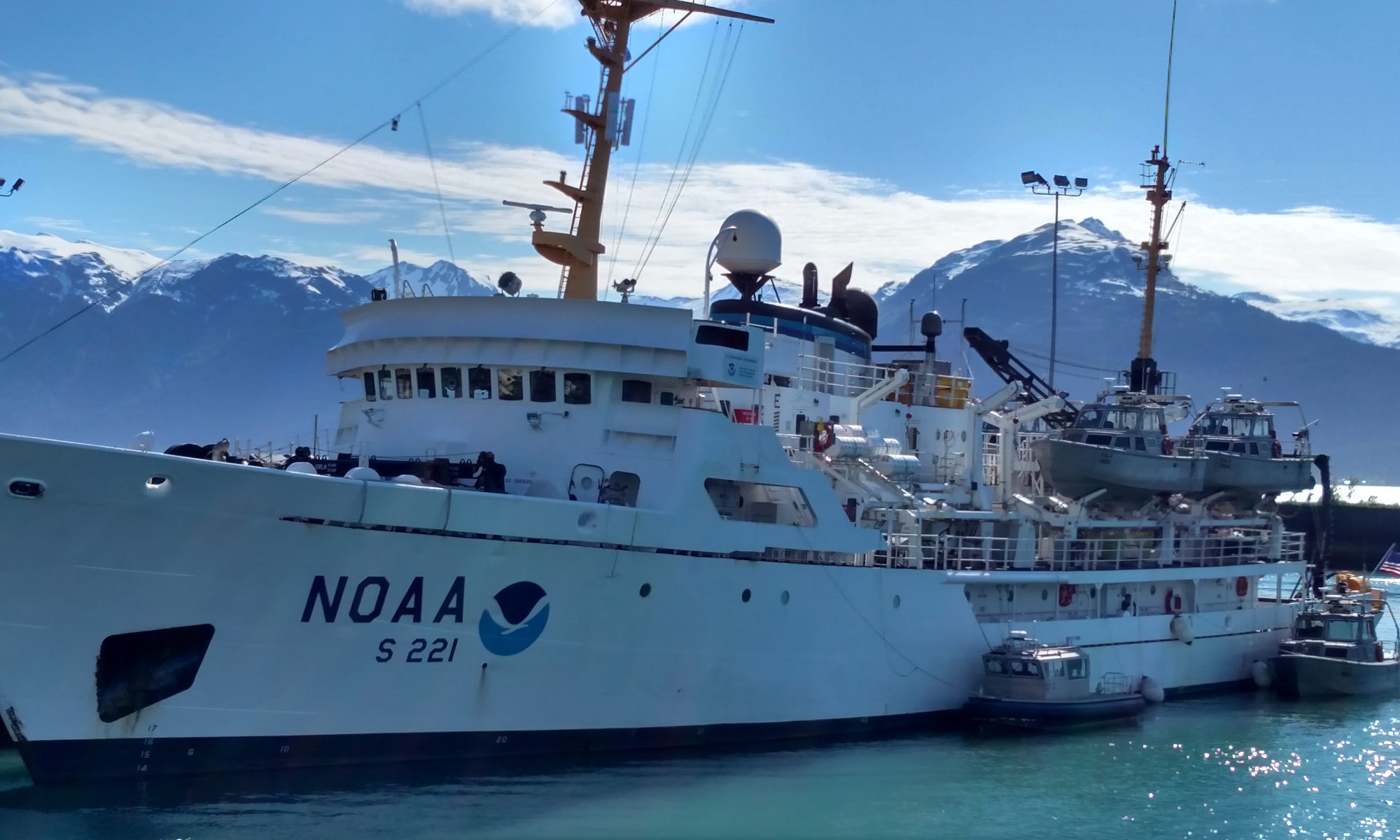
Here I am on the docks getting ready to see my "home away from home" for the first time!
After the fish are caught, they are sent down a ramp for processing. Unfortunately, most of the fish brought to the surface “donate their bodies to science,” as they don’t survive the trip up from depth to the surface. Why don’t the fish survive? Sometimes, it is simply the stress of being caught. But another contributing factor is stress that is put on a special organ in the fish called a gas bladder. It is easily explained using a reverse example.
Remember the video clip from Mythbusters on the “MeatMan?” In the program, the myth claimed that a person’s body would indeed be crushed by the weight of ocean water at a depth of 300 feet. If you recall, the myth was confirmed when “MeatMan’s” helmet caved in after the Mythbusters removed the pressurizing hose from the back of the diver’s suit after the “diver” was lowered to a depth of 300 feet. With pollock, the reverse happens. The pollock’s body is “conditioned” to being at a particular depth. Inside the pollock is a swim bladder that is filled with air that pushes back on the water at the same pressure that the water pushes in on the fish – much like the pressurized diving suit. As long as the pressure remains constant – both pushing outward on the surrounding water and inward on the swim bladder – the fish is fine. When the fish is forced too quickly above a particular depth, the bladder will expand because the outward pressure is no longer strong enough to push in on the bladder – the exact opposite of what happened to the meat man – the bladder expands too quickly, and it can sometimes cause the fish to die. Pollock do have the ability to regulate their swim bladders, but when the are pulled too quickly to the surface by means of say, a net, for example, they can’t adjust to the pressure changes quickly enough. I’ve shortened this complex idea into to a simple and digestible equation:
Person too deep = squish. Fish too shallow = pop.
Despite the fact that the fish usually perish in their journey, they do so to benefit the overall health of the stocks. Researchers gain a wealth of information from the catch. They measure the size, age, sex, and sometimes the stomach contents of each of the fish! As the data gets collected, it is analyzed to determine the overall health of the population so that fishermen know how much is safe to catch and sell for profit without doing harm to the population.
Personal Log
Well, we haven’t left yet. Some complications on the ship have kept us safely in the comfort of our harbor and will most likely keep us there until Friday afternoon or Saturday morning. So, we’ve been keeping busy with tours of the ship, introductions to the ship’s crew, and trips to town to look around and sample the local fare. We are staying on a Coast Guard base, so it’s a secure location that most civilians can’t access. The base is really interesting.
It appears as though a stowaway has made it onboard the Oscar Dyson and overtaken my stateroom! Marshmallow has found his quarters to be comfortable and accommodating. He has also informed me that he would like his bedroom at home to henceforth be referred to as his Stateroom, as it sounds much more prestigious and astute.
I especially enjoy hiking around the peninsula that is attached to the base. All along the road are freshly ripened Salmonberries (which coincidentally do not taste like Salmon. They taste like delicious.) Along the opposite side of the road is a rocky shale beach. About a half a mile down the road is a rotting old dock that is commissioned only by grasses and pony-sized seagulls. It is decaying in the most gorgeous manner – to witness an object simultaneously rusting, collapsing, and growing is a delicious paradox for the imagination.
Like an old World War II veteran, I imagine it not as it appears today, but as a majestic and commanding behemoth – an anchor and a doorway home for the ghosts of a time passed bustling about on its intact surface. It’s a good thing there is no possible way to access it, otherwise I may have found myself out there teasing out the details of its surely magnificent story.
This is the old dock on the peninsula in the harbor. There are trees growing out of it!
When we do leave port, I will be working the night shift. While to some that might seem a bit intimidating, I am actually quite excited. If my shift does not end until 4am, that gives me the luxurious liberty to remain comfortably in my rack until ten am without anyone thinking less of me. Interestingly enough, there are a decent number of people who work nights onboard. This means that there is someone awake at any given hour somewhere on board. It’s hard to feel alone when there is always someone up and about – which is a comfort in the foreign world of a research ship.
For now, there isn’t much to report on other than we are hurrying up and waiting to leave. Hopefully the weather will be friendlier tomorrow for a hike to the top of Mt. Barometer where it is rumored that the view from the top rivals any Hollywood production. Well, maybe except Avatar , but what landscape can compete with an alien land full of glowing trees? I would like to be the judge of that.
NOAA Teacher at Sea Obed Fulcar NOAA Ship Oscar Dyson July 27, 2010 – August 8, 2010
Mission:Summer Pollock survey III Geograpical Area:Bering Sea, Alaska Date: August 7, 2010
Today at 0600 am we finally made it back to Dutch Harbor. We arrived yesterday at the Island of Unalaska, where “Dutch” is located, but we were on the other side of the island, performing a Callibration (adjustment or fine tunning)of the acoustic SONAR.
Fishing during downtime
The ship came to a complete stop, and using shiny metal spheres, tied to lines that were dropped on both sides and under the ship, a “ping” or sound wave was done for fine adjustment. Callibrations are done several times a year in order to for the Sonar to work accurately.
The crew took advantage of the ship been anchored to do some fishing for Halibut fish, but the catch was mostly of Cod fish. We also went out on a boat ride on the Peggy D speed boat, named after Oscar Dyson’s wife, around nearby bays and inlets, where we saw wildlife like sea otters and Puffin seabirds.
Later on the day I was able to see where this sensitive piece of high technology was located when my good friend Robert, 2nd Engineer of the Oscar Dyson, gave a last tour of the “bowels of the beast”. We went through several hatches and steps down to the lowest decks of the ship, where Robert explained the many pieces of heavy duty equipment and machinery that kept the ship on the move.
First we put on Ear Muffs, because the noice level was too high (again safety first) and then we went to see the giant forward thruster in charge of moving the ship left or right, followed by even larger and louder machines: the ship’s four Caterpillar Diesel Engines.These enormous and heavy duty machines were connected to large generators that 24 hours a day supplied the electricity needed to run all of the ship’s electronic systems.
Engine Room
Next we checked out another room containing the large Wastewater Treatment tank, in charge of treating all the grey water or waste water from toilets, showers, and sinks of the ship. The tank utilized a biological process where bacteria broke down all the waste, then the resulting water was treated with with a combination of chemicals and Ultra Violet (UV) light to kill any germs before being safely released into the ocean.
Finally he showed methe Disalinization Plant in charge of producing up to 1,500 gallons of freshwater by Evaporation or boiling of the saltwater and then throughCondensation, where the water vapor is then separate from the salt and then be collected for human consumption. Also was able to see the darn Sonar acoustic antenna at the very bottom of the ship. I was amazed at the sustainability of the Oscar Dyson and how strict were NOAA’s rules concerning reduction of pollution of the oceans.
After thanking Robert and the crew it was time to say goodbye to the Oscar Dyson and to all my new friends that I made during the Summer Pollock cruise. I leave with a lot of memories, a wealth of experience and resources that I hope will have an enormous impact in my students when the new school year starts in September. I know it already have made an impact not only in my students, but in my family,friends and colleagues who had followed my adventures in my Blog these past 3 weeks. I wanted to thank CO Mike Halshyk, XO Sarah Duncan, and NOAA Corps Officers Ensign Russel Pate, Ensign Amber Payne and Ensign David Rodziewicz for their diligence in taking care of us, the scientitsts on board for their patience and wealth of knowledge, as well as all the crew of the Oscar Dyson for feeding me, teaching me about life at sea, and for bringings us back safe and in one piece. I also wanted to thank Elizabeth McMahon, Elizabeth Bullock , and Jennifer Hammond from NOAA for taking care of everything, and to my fellow Teacher at Sea Story Miller. You can check out her bloghttp://storymillernoaa2010.blogspot.com/
Hoy temprano a las 0600 am horas finalmente llegamos de vuelta a Dutch Harbor! Desde el dia de ayer habiamos estado anclados en la isla de Unalaska, al extremo opuesto de Dutch Harbor.
La tripulacion y los cientificos estaban practicando una Calibracion del sonar acustico, usando unas esferas metalicas, con el fin de ajustar las lecturas de este sofisticado instrumento electronico. Estas esferas estaban atadas a unas cuerdas finas de un lado a otro del barco (de Babor a Estribor), y con un “ping” del sonar estas eran grabadas en el monitor.
Tambien fuimos en un paseo por las bahias y ensenadas cercanas en la lancha rapida “Peggy D” nombrada en honor a la esposa de Oscar Dyson, Estuvimos admirando el increible panorama de la isla de Unalaska y su vida silvestre como las Nutrias Marinas y las aves marinas Puffin. Luego en la tarde mi buen amigoRobert, 2do Ingeniero de maquinarias del Oscar Dyson, me dio un tour de la barriga del barco.
Armados de linternas y de protectores de oido, debido al alto ruido de las maquinarias. Bajamos bajo cubierta por varias compuertas y escalinatas que nos llevaron primero a visitar el cuarto del Propulsor de proa, usado para darle vuelta al barco. Luego fuimos a ver los enormesGeneradores de gasoil Caterpilar usados para producir la energia necesaria para mover todos los equipos electronicos abordo del Oscar Dyson 24 horas al dia.Despues fuimos a otro cuarto conteniendo el Tanque de Tratamiento de Aguas Negras de la nave donde toda el agua de desecho de inodoros y lavaderos de cocina, utilizando un proceso biologico dondebacteria descompone el desecho en el agua.
Despues el agua pasaba por una lampara de Rayos Ultravioleta para matar todo germen patogeno, para ser luego descargada inofensivamente en el mar. Finalmente visitamos la maquinaria que mas me interesaba ver: la Planta Desalinizadora de Agua que estaba a cargo de producir 1,200 galones de agua potable usando agua salada del mar.
Por medio de un proceso de Evaporacion la sal era separada del agua de mar, y por medio de Condensacion el agua potable es recuperada para consumo humano en el barco. Me sorprendio mucho la sostenibilidad del Oscar Dyson, donde los desechos son reciclados pues en NOAA son muy estrictos con que ninguna basura solida alcanze el mar, lo cual esta prohibido por ley. Es increible que todavia hoy en dia naves comerciales y cruceros de lujo lanzen sus desechos de aguas negras y basura al mar.
Despues de darle las gracias a Robert llego la hora de decir adios al Oscar Dyson y a su tripulacion que fue mi hogar y mi familia por 3 semanas de mi vida en este verano 2010. Me marcho con muchos recuerdos y conocimientos que no solamente impactaran mis estudiantes en Septiembre sino que ya han hecho un impacto positivo. Le agradesco a todo el personal de NOAA, asi como al Oficial Comandante Mike Helshyck, Oficial Ejecutivo Sarah Duncan y demas oficiales, asi como a todo el personal de abordo por haberme adoptado y compartido tantas informaciones durante el Crucero de Pollock. Tambien le agradesco mucho a todos los cientificos abordo asi como a la Maestra en el Mar, mi colega educadora de Dutch Harbor Story Miller por su ayuda y consejos. Pueden tambien chequear su blog enhttp://storymillernoaa2010.blogspot.com/
NOAA Teacher at Sea: Story Miller NOAA Ship: Oscar Dyson
Mission: Summer Pollock III
Geographical Area: Bering Sea
Date: July 29, 2010
Time: 1922 ADT
Latitude: 59°47N
Longitude:178°14W
Wind: 5 knots (approx. 5.8 mph or 9.3 km/h)
Direction: 9.8° (N)
Sea Temperature: 10.1°C (approx. 50.2°F)
Air Temperature: 8.7°C (approx. 47.7°F)
Barometric Pressure (mb): 1015
Wave Height: 0 – 1 feet
Swell Height: 1 – 2 feet
Scientific Log:
I decided that it would be beneficial to provide some information regarding some of the animals I have seen over the past week.
Short-tailed Albatross (Phoebastria albatrus)
Yesterday morning during breakfast, one of the NOAA Corps Ensigns came down to tell me that there was a Short-tailed Albatross off the port side (left side) of the boat. This was a very special event, especially if you are an avid birder because currently there are about 2000-2500 in the world. The short-tailed albatross is one of three species of albatross living in the North Pacific Ocean and is the largest of all seabirds in this location. This bird has a wingspan of approximately two meters. One could conclude that the bird I saw was younger because young short-tailed albatross have “chocolate brown” feathers when young and as they grow larger they turn white. This bird likes to eat squid, small fishes like pollock, and zooplankton. The albatross population dwindled because the birds were very easy to access due to them only nesting on a couple islands in Japan and they were not afraid of humans. As a result they were really easy to kill and because there was a high market value for their feathers, hunters pursued them to near extinction. In fact it is said that in 1953 there were only about 10 pairs left in the world.
Northern Fulmar (Fulmarus glacialis)
Northern Fulmar
This species of bird has been consistently following our ship since we left Dutch Harbor. They are primarily a pelagic bird which means that unless they are breeding, they are living out at sea throughout the year. The Northern Fulmar can be found in a range of different colors depending on where they were born. Generally, the darker birds are found in the southern parts of Alaska and the white are found farther north. However, if you are on the Atlantic side of the US the pattern is just the opposite with the darker birds originating in the high Arctic and the light are found farther south! These birds typically feed on squid and small fish. One fact that I find fascinating about the Northern Fulmars is that they have the ability to launch their puke up to 6 feet as a defense mechanism! I shall now remember it as the projectile vomiting bird!
Black-legged Kittiwake (Rissa tridactyla)
Black-legged Kittiwake
One interesting fact about this bird is that it has only three functional toes, hence the tri prefix in its scientific name. These birds are white and their wings are gray. Because I grew up in the desert, my untrained eye mistakenly identified them as a seagull but thanks to USFWS scientists Marty Reedy and Liz Labunski, I am now informed of the differences! This bird is also pelagic and their breeding season is during this time. These birds feed on small fish and they are found around the coasts of Alaska, the Bering Sea, and in the northern Canadian Atlantic Coast. When the black-legged Kittiwake feeds, it usually catches its prey on the surface of the ocean but it has been known to plunge underwater. Typically they feed on zoopankton.
Red-legged Kittiwake (Rissa brevirostris)
As stated in its name this bird has bright coral red legs and is typically shorter than the Black-legged Kittiwake. These birds are most commonly found mostly in the Pribilof Islands and there are only about five or six places in the world where they breed, all of which are in the Bering Sea.
Short-tailed Shearwater (Puffinus tenuirostris)
These birds are known to breed off Australia. In the summer they migrate to Alaska, a trip of about 9000, and have been known to take as little as six weeks! In Australia they are important in the Aboriginal culture in Tasmania and are commercially harvested for food, feathers, and oil. These birds usually eat crustaceans but are also known to eat fish and squid. To catch their prey, they will plunge or dive into the water. One interesting adaptation is that they are able to convert their food to oil and the benefit is that oil does not have as much weight as an ingested animal which allows the birds to travel long distances.
Fork-tailed Storm-Petrel (Oceanodroma furcata)
When I first saw these birds I thought a bat was flying over the water due to a slightly more erratic flight pattern than the smooth flights of the other birds I have observed. These birds typically feed at the surface of the water. Fork-tailed Storm-Petrels are also pelagic, living approximately 8 months at sea and when they do return to their breeding grounds in late-spring, they will dig burrows in the soil or find ideal nest locations in rock crevices. The baby chicks are thought to have a unique adaptation for survival. Sometimes the parents leave the baby alone for many days to look for food. During this time the baby’s body head drops into a state of torpor until the parents return and raises its body temperature.
Pomarine Jaeger (Stercorarius pomarinus)
These birds are capable of backward somersaults in the air and take part in acts of piracy as they have been known to harass other birds until the lesser bird gives up its food. The Pomarin Jaegers primarily feed on lemmings and even have a reproductive period that is dependent on the brown lemming! According to the USFWS they are “the only avian predator that digs for lemmings.”
Smooth Lumpsucker (Aptocyclus ventricosus)
Smooth Lumpsucker
Lumpsuckers live in cold waters in the Northern Hemisphere. They have a disk underneath their body that allows them to cling to rocks. “All but a few lumpsuckers have spiny tubercles on the head and body” (2002). There are 27 species of lumpsuckers and 10 are confirmed to occur in Alaska with 3 more species are known to be near Alaska. These fish can be found on the bottom of the sea, usually on the continental shelf.
Personal Log:
The suction disk of the Smooth Lumpsucker
After my shift ended yesterday, I hung out on the bridge and looked at seabirds and tried to find evidence of land (Russia) since we are so close. The day was clear and sure enough, right after supper, Russia was spotted! While I have not been out to sea that long, the idea of land coming into view was an exciting feeling. Perhaps the feeling was because the land belonged to Russia and I had never been there before or that the sighting of land broke up the monotony of the never-ending stretch of moving water. I feel that the feeling was derived from a little bit of both. While I was searching for Russia, I had the opportunity to observe a Fin Whale about one mile (~1.5km) ahead of the boat. A few times, it came out of the water enough so that you could see its total back and dorsal fin! For me, Fin Whales have been the most commonly spotted.
This morning, after repeatedly launching the experimental Cam-Trawl with no results, we finally snagged a picture of a fish early this morning! The picture was very dark and the fish, mostly a blur but it was obvious that the image was a fish! This is yet another example of how a scientist must be patient as it is common in real-life experiments, as opposed to structured labs in the classroom, to have tests fail multiple times before useful results occur!
The first fish photographed by the Cam-Trawl!
In the evening, I decided to spend time on the bridge again and watch for whales. I was in luck yet again as I was able to see two Humpback whales! They were swimming very close to the ship, but not close enough for the zoom on my camera! I was able to watch them for a good twenty minutes before they “fluked” (showed their tail) and dove deep underwater!
Overall it was a very interesting couple of days!
Citations:
Denlinger, L.M. 2006. Alaska Seabird Information Series. Unpubl. Rept., U.S. Fish and Wildl. Serv., Migr. Bird Manage., Nongame Program, Anchorage, AK
Mecklenburg, C.W., Mecklenburg, T.A., & Thorsteinson, L.K. (2002). Fishes of alaska. Bethesda, MD: American Fisheries Society.
USFWS scientists Liz Labunski and Marty Reedy
Animals Viewed:
Walleye Pollock
Pacific Herring
Smooth Lumpsucker
Shrimp (unidentified) but they looked like what I have for dinner!
Jellyfish
Fin Whale
Humpback Whale
Short-tailed Albatross
Northern Fulmar
Something to Consider:
Many people, including myself, enjoy watching animals but never learn what their common names are! We take for granted the wonders of Mother Nature that we see everyday and sometimes disregard them as being “normal.” However, what you see may not be normal for other people, such as seeing high populations of bald eagles in Dutch Harbor and Unalaska! It is never too late to learn and if, for example, you move to a different location with different flora and fauna, you can share with your new friends the environment from which you came! I find when traveling to other countries or other locations in the “Lower 48” that they assume Alaska is always cold, snowy, and that penguins live there (which they don’t)! When I take my pictures with me, it is exciting to see other people’s reactions and the conversations afterward are always engaging!
Now would be a great time to photograph the animals and plants you see inhabiting the land surrounding your home. You never know when you may bump into an avid “birder” or other animal specialist that could tell you their names. Or, if you are feeling particularly enthusiastic on a foul weather day, there are many identification books available in your local library.
Weather from the Bridge: Time:05:56 am Latitude:61.05 N Longitude:178.51 W Wind Direction: 300 N Wind Speed:12.5 knots Sea Temperature:8.0 C (46.4 F) Air Temperature:9.5 C (49.10 F) Barometric Pressure:1008 mb Foggy skies
Foggy Skies
SCIENCE & TECHNOLOGY LOG:
Wednesday, July 28: after a cloudy and foggy day, (Picture of a ship on Russian waters)the weather finally changed and the afternoon became sunny and clear, very pleasant to be on deck. For the past several days we have been navigating in the Russian territorial waters of the Bering Sea, for which we have permission, as testified by a letter in Russian posted on the bridge. Alaska used to be a possession of Russia, until October 18, 1867 it became a territory of the United States.
We can still see Russian Orthodox churches still open today in some islands of Alaska. Pretty soon the direction of the current transect or line course, will bring us as close as 12.6 miles from land. At one point we were close to 14 miles off Cape Navarin, but there was fog in the distance and without notice the beautiful afternoon disappeared and I was not able to see Russia. Later on during the afternoon trawl, while sorting the catch of Pollock, a big fish came out on the conveyor:it was a Chum Salmon or Dog fish” said Dr. Mikhail Stepanenko, a Russian scientists working with his colleague Elena Gritsay, from the Vladivostok School of Fisheries, collaborating in the Walleye Pollock survey to help improve the management of Russian fisheries. According to Mikhail it was most likely that the chum salmon had been born in Japanese waters, and had migrated to spawn near Cape Navarin.
Chum Salmon
After I measured it then I dissected the fish to see if it was male or female. The organs were slightly different in size and location than the Pollock, but basically the same. The pillora seca was very large, engulfing the long stomach and liver, and the kidneys were right behind the swim bladder. The presence of an organ called gonads or testes confirmed that it was a male. I tried to locate the otolith, for my classroom collection bu could not locate it. There was also a very interesting fish in the catch: a Toad Lump sucker, a very cute looking fish that resembled a blow fish because it was swollen like a balloon. It had a suction orifice in the underbelly too.
PERSONAL LOG:
I noticed that in this cruise there is an atmosphere of professional collaboration between scientists and the crew. There is also a sense of collegiate amongst all the scientists working on board the Oscar Dyson. The Pollock Survey is the primary mission, but there are other parallel missions going on: the seabird survey, done by Marty and Liz, and the marine mammal survey, done by Patty, Paula, and Ernesto. To do research on the Bering Sea is very challenging due to the remote locations, and the storms, winds, large waves, and extreme weather. The need for oceangoing vessels to work in these extreme conditions makes it very expensive, so when ships like the Oscar Dyson are deployed, different missions are planned to “piggyback” along. I was very impressed by the international collaboration in the mission, with the two Russian scientists on board conducting research on the Pollock fisheries, since part of the transects done by the Oscar Dyson covered Russian territorial waters as well. The fact the one Mexican scientist, a Filipino cook, and a Dominican teacher at sea were part of this cruise added more countries to the mission. Just like us, fish travel in different waters, local and international, and they too are citizens of the world’s oceans. I wanted to commend NOAA’s administration for providing career opportunities to minorities, Latinos, and women to work as scientists, technicians, Corps officers, and crew.
“Una Cooperacion Internacional” Durante todo el trayecto de este crucero de Monitoreo del Pollock he notado un ambiente de profesionalismo entre el personal cientifico y la tripulacion, asi tambien como un ambiente de colegiatura enter los diferentes cientificos trabajando a bordo del Oscar Dyson. La mision primaria es el Monitoreo del Pollock, pero a su vez hay otras misiones paralelas a la mision principal, como son el Estudio de las Aves Marinas,por Liz y Marty, asi como el Estudio de los Mamiferos Marinos, por Patty,Paula, y Ernesto. Hay que entender que hacer investigacion cientifica en el Estrecho de Bering es una tarea logistica complicada por lo remoto del lugar, lo extremo del clima, asi como gigantescas olas. Solo se pueden usar barcos de navegacion oceanica que son muy costosos, por lo que cuando embarcaciones como el Oscar Dyson son lanzadas, multiples misiones son planeadas al mismo tiempo tambien. Me llamo mucho la atencion la cooperacion internacional, especialmente los dos cientificos rusos a bordo, que tambien relizaban estudios del Pollock, lo cual tiene mucho sentido, debido a que gran parte de la investigacion cubria aguas territoriales rusas. El hecho de que un biologo Mexicano, un filipino (Ray el cocinero), y un Maestro en el Mar dominicano tambien forman parte de este crucero le agregan mas paises a la mision. Yo quiero felicitar a la administracion de NOAA por proveer oportunidades de carreras profesionales tanto a minorias, como a Latinos, y a mujeres para trabajar como cientificos, tecnicos, Cuerpo de Oficiales o como tripulantes. Yo creo que esto es un gran incentivo para que mas jovenes estudiantes de escuela intermedia y secundaria puedan perseguir carreras profesioanles en Conservacion Ambiental.
There are many different groups of people working aboard the ship, Oscar Dyson – Scientists, NOAA Corps officers, Deck Hands, Engineers, Survey Technicians, and Cooks. Within the science department, there are 12 members aboard and two Teachers at Sea which totals to 14 souls. For this third leg of pollock surveys, the chief scientist is Taina Honkalehto. Her job aboard the ship is to plan the scientific activities and make the decisions on how best to carry out that plan. Of the scientist crew, there are two Russian scientists that are conducting their own research in collaboration with NOAA.
This pollock survey, which focuses on determining abundance and distribution, is an important component of the fishing industry in the United States. According to The Bering Sea Project, “The largest concentrations of pollock occur in the eastern Bering Sea,” and more specifically, “Walleye pollock support the largest single commercial fishery in the U.S., producing the largest catch of any one species inhabiting the 200-mile US Exclusive Economic Zone.” Additionally, the pollock industry is incredibly important to the people living in Dutch Harbor and Unalaska because pollock is one of the main fishes processed there and has helped classify Dutch Harbor as America’s #1 fishing port in the USA for fish landed (NOAA, 2009).
View of a spread out group of pollock as seen from the computer screen. Notice in the far right corner a red spot. That shows that at that location, the fish are densely packed. The red, yellow, and green-blue line represent the seafloor.
There are two summer surveys being conducted to estimate the Bering Sea pollock population: Acoustic-Trawl Survey and the Bottom-Trawl Survey. Currently on the Oscar Dyson we are conducting the Acoustic -Trawl Survey. After we catch the fish, we combine the acoustics, fish samples, and CTD deployment data, to draw conclusions that help us estimate population size and ecological factors of pollock. Remember, in order for pollock to live where they do, they need food and so when we extract stomach samples, we are looking for what pollock prey upon (mostly krill). Besides, food, other important aspects of their habitat must be in place for their survival. The CTD data – water temperature, salinity, nutrients, oxygen, and chlorophyll – help us understand how the distribution of pollock has changed in past years and may also provide information about how it could change in the future.
However, not all of the scientists on board are collecting data related to pollock. Currently we have two other subgroups with one observing seabirds and the other observing marine mammals. The crew observing seabirds have a goal of observing species seen during the tour to determine seabird species distribution and abundance. The marine mammal observers are working to obtain current data on cetacean species distribution and abundance.
The Teachers At Sea (TAS), which currently include Obed Fulcar (New York, New York) and myself (Dutch Harbor, AK) have an important role of working under the scientists and other crew members to learn about the research being conducted in an attempt to bring real science into the classrooms.
A large group of fish scattered about from the perspective of the transducer.
Because acoustics is a major tool used in pollock survey, I feel it would be beneficial to provide a few details on how it works. Remember, referring to Blog #2 “the ship has Transducers that send pings of sound energy down through the ocean and when they hit some object, such as the bottom of the ocean or a fish, in this case they are hitting the swim bladders of the fish, some of the energy in the sound ping is returned to the ship and received by our echo sounding system in the acoustics lab of the ship.” It is important to note that the acoustics under the water are different than in the air because the pressure in each location is different. Inside the acoustics lab there are many different screens that display the pings at different frequencies of sound waves. We know that jellyfish tend to show up the best from the low frequencies. Acoustics is a good tool to use to study pollock because pollock is the primary fish species inhabiting the middle-waters of the Bering Sea shelf. For example, bottom fish are difficult to see because the acoustic signals from the seafloor are too strong and tend to hide the bottom fish signals. Acoustic signals that we see on the computer screen rely on the actual physiological make-up of the fish. Also, the behavior of pollock plays a role in how we can see them acoustically. For example, salmon do not swim in large schools like pollock. When we see large schools of pollock on the acoustic screens, density determines the color – blue usually is reflecting a couple fish whereas red represents a high density of fish – and the shape of the schools tend to be typical of pollock. Through acoustics, we are able to survey pollock over a wide area and gain information regarding their distribution and population.
Prior to fishing, we consistently monitor the screens as the ship travels up and down the rectangular transects you can see when you view the ship’s path on ShipTracker. When we observe schools of fish, we need to decide whether they are large enough to sample the fish with the trawl. Because we also want to target certain ages of fish, it is important to be able to estimate their size.
We can estimate size through a method using additional measurements from the acoustic data. We draw a box around an area that is not densely packed with pollock so it is easier to distinguish an individual acoustic image of a fish. The software we have gives us the average intensity of the acoustic pixels. We call this intensity target strength which translates to the size of the echo. Because the size of the swim bladder is proportional to the size of the fish, we can use the intensity of the echo off the swim bladder to estimate the size of the pollock. In short, target strength depends on the size of the swim bladder and features of the swim bladder can be used to predict fish size.
Acoustic image from the bridge. The bottom blue streak is a large group of fish that ducked under the net. The horseshoe shape is the net. The blue inside the horseshoe are the fish.
We can use an equation for calculating decibels to help us estimate the size of the fish in the school we might target. For my friends and students who are math gurus, the equation is TS = 20Log(length cm) + b20. The b20 variable is different for different fish species and so for Walleye Pollock in the Bering Sea, b20 is -66. Therefore, the equation for Walleye Pollock is TSpollock = 20Log(length cm) – 66.
To provide an example of how the equation works, lets say that the average length of a two year-old pollock is 25 cm and that is the size we want to target. We take that 25 centimeters and “plug it” into the section of the equation that stands for length in centimeters. Scientific calculators are wonderful devices for logarithms as they have the Log function already installed, and if you plug in 20Log(25) – 66 into the calculator, the answer -38.4 translates into the target strength that would show up on the screen. So if we find schools of pollock and see that the target strength is close to -38.4, then we know the echosounder is observing two-year old pollock.
Once acoustics have determined that we need to fish, they send the coordinates they want the Officer of the Deck (OOD, a.k.a. the NOAA Corps officer on watch on the bridge) to follow and the officers drive the ship to the location. On the bridge of the ship, the scientists are able to see the acoustic screens and are able to keep an eye on the location of the fish, relative to the transducer underneath. From there the Lead Fisherman or Chief Bosun operates the machinery required to put the trawls in the ocean. After the large mesh net is placed in the ocean, the crew put on a sensor that measures water depth and temperature. They also install a tool, called a headrope unit, that is similar to a mini transducer which makes an image of the mouth of the net and allows the scientists to watch fish entering the net from the bridge.
Senior Survey Technician, Kathy Hough, and Ordinary Seaman, Frank Footman, installing the head-rope unit.
Once the fish are caught, the deck crew will draw the nets back onto the boat using hydraulics. From the stern (back of the boat), the fish go into the fish lab on a conveyer belt where we sort, sex, measure, and extract stomachs and otoliths. Since being on the ship, during my shift we have been averaging two trawls per day.
How is the information we collect used?
On the ship, we are collecting raw data, entering into our computers, and analyzing what we see. From there, we can draw conclusions based on what we have observed from our samples. However, there are other scientists at work here. For example, perhaps you are interested in working with computers and want to be involved with wildlife. Some of the scientists help design the computer programs we use and maintain them. Perhaps boat life is not your “cup of tea.” All the stomach and otolith samples we collect need to be sent into a lab to be analyzed by a stomach or otolith expert. The data they compile from the samples we collect get added into our publication at the end of the survey. There are also scientists that compile our conclusions about what we saw on the ocean and they create models to show population trends and predict future abundance. From that information, a council of scientists, industry representatives, and others of interest, get together and determine things such as fishing quotas. Also, don’t forget that there are teachers, like me, aboard who take some of the scientific information or scientific processes and educate students about real science in the real world.
If you want to obtain a job working in the sciences department of NOAA, some courses of study that will increase your chances of becoming involved include but are not restricted to: Marine Biology, Chemistry, multiple levels of mathematics, Computer Science, Writing. Versatility is another key factor to consider for any job you may want to pursue as the more background information you have, the more information you can “bring to the table.” For example, perhaps you love music. An understanding of decibels and how sound is carried at different frequencies is incredibly useful in acoustical sciences. Foreign Language is always beneficial as you will continually work with people from all over the world and remember, there are two scientists currently on the ship who are from Russia! Therefore, in my opinion, don’t forget about your electives when choosing your courses because the more rounded you are, the greater your chances are for success!
Personal Log:
My morning started off fantastic as I was able to launch an XBT into the water again. By the time I was beginning to type this blog we passed over a school of pollock and decided that we needed to turn around and go fishing. Approximately two hours of sorting commenced before I was able to return. I learned that acoustics is a very difficult concept to explain as there are many factors in mathematics and physics that are complicated to translate into layman’s terms. I ended up spending a lot of time reading a textbook on the research the theories of using acoustics on wild fish. Please do not hesitate to ask in the comment box below this post if you have questions!!!
Overall, there was a good assortment of fish today and I stayed fairly busy in the fish lab collecting pollock sample data!
Me giving the fish a layer of water so that they slide down the chute and onto the conveyor belt easier.
Animals Seen Today:
Walleye Pollock
Silver Salmon
Northern Fulmar
Parakeet Auklet
Short-tailed Shearwater
Least Auklets
Tufted Puffin
Thick-billed Murre
Northern Fur Seal
Something to Ponder:
Life at sea can be an amazing experience but there are many things people may take for granted when living on land. For example, consider the possibility of becoming hurt on the job, or developing a medical condition such as a rash or appendicitis. From the middle of the ocean, it is very difficult to reach a doctor to get a diagnosis. On board the ship, we have some medical supplies but typically there is not a licensed doctor on board the ship. Would you know how to respond to an emergency if it were to happen? If you have taken a First Aid or CPR class, do you remember what you need to do? How would you react? What would you do to reach help? Who could respond to your call?
For the Oscar Dyson we have the following protocols:
1. Contact the medical officer on board for an initial diagnosis.
2. If the condition requires advanced medical care, he or she will contact the medical officer on call at the NOAA Marine Operations Center.
3. In the case of an emergency and when the Marine Center cannot be contacted, he or she will contact the Maritime Medical Assistance (MMA).
4. If needed, we will arrange for a medevac (medical evacuation) which could involve the US Coast Guard and/or head back to port.