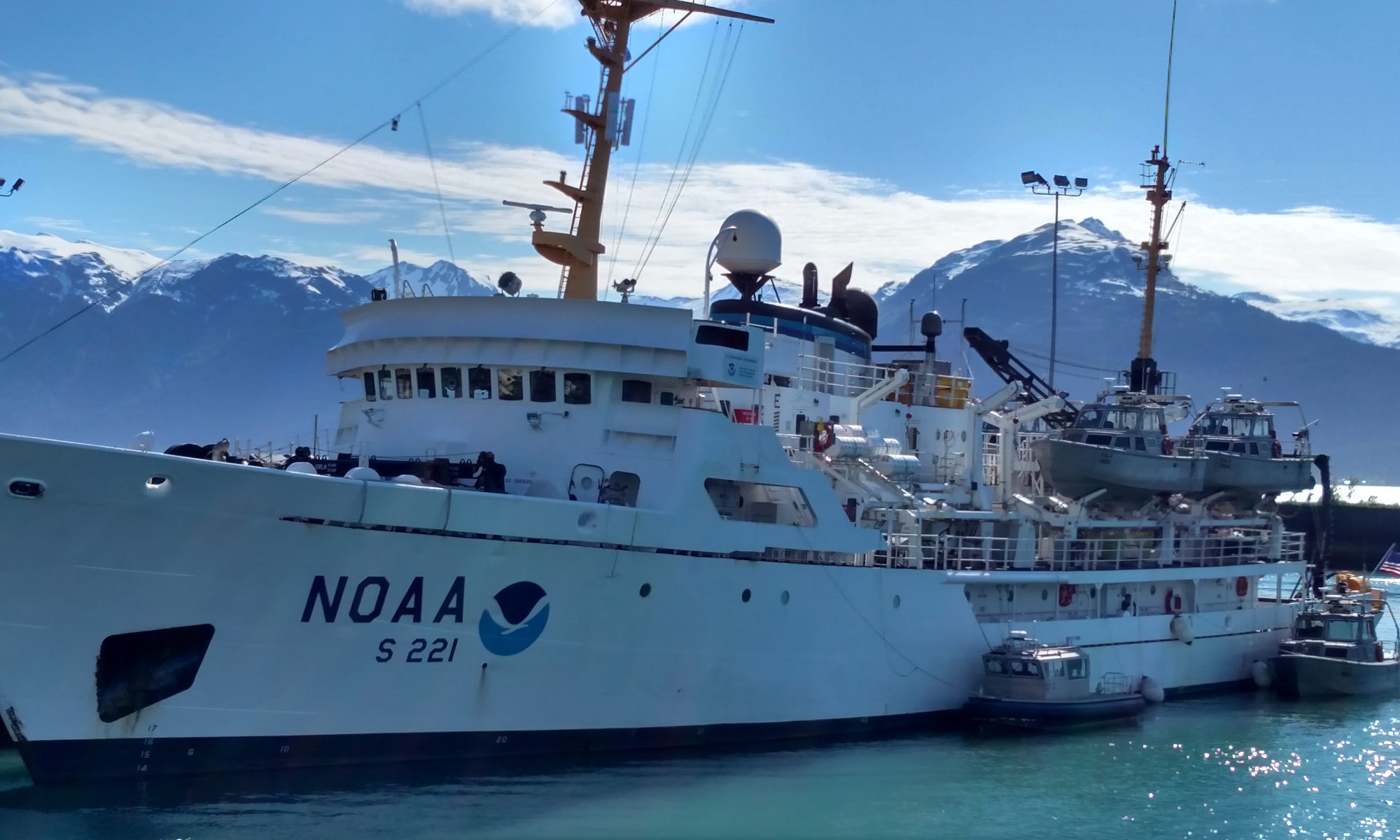
Jennifer Fry, July 27, 2009

NOAA Teacher at Sea
Jennifer Fry
Onboard NOAA Ship Miller Freeman (tracker)
July 14 – 29, 2009 

Mission: 2009 United States/Canada Pacific Hake Acoustic Survey
Geographical area of cruise: North Pacific Ocean from Monterey, CA to British Columbia, CA.
Date: July 27, 2009

The CTD, resembling a giant wedding cake constructed of painted steel, measures the composition of the water, salinity, temperature, oxygen levels, and water pressure.

Weather Data from the Bridge 
Wind speed: 13 knots
Wind direction: 003°from the north
Visibility: clear
Temperature: 13.6°C (dry bulb); 13.2°C (wet bulb)
Sea water temperature: 15.1°C
Wave height: 1-2 ft.
Swell direction: 325°
Swell height: 4-6 ft.

Science and Technology Log 

Each night beginning at around 9:00 p.m. or 21:00, if you refer to the ship’s clock, Dr. Steve Pierce begins his research of the ocean. He is a Physical Oceanographer and this marks his 11th year of conducting CTD, Conductivity, Temperature, and Density tests.

It takes 24 readings per second as it sinks to the seafloor. The CTD only records data as it sinks, insuring the instruments are recording data in undisturbed waters. For the past 11 years Dr. Pierce and his colleagues have been studying density of water by calculating temperature and salinity in different areas of the ocean. By studying the density of water, it helps to determine ocean currents. His data helps us examine what kind of ocean conditions in which the hake live. Using prior data, current CTD data, and acoustic Doppler current profiler, a type of sonar, Dr. Pierce is trying to find a deep water current flowing from south to north along the west coast.  This current may have an effect on fish, especially a species like hake.

This map illustrates part of the area of the hake survey.

Dr. Steve Pierce reminds us, “None of this research is possible without math. Physical oceanography is a cool application of math.” Another testing instrument housed on the CTD apparatus is the VPR, Visual Plankton Recorder.  It is an automatic camera that records plankton, microscopic organisms, at various depths.  The scientists aboard the Miller Freeman collect data about plankton’s feeding habits, diurnal migration, and their position in the water column.  Diurnal migration is when plankton go up and down the water column to feed at different times of day (see illustration below).  Plankton migration patterns vary depending on the species.The scientists aboard the Miller Freeman followed the east to west transect lines conducting fishing trawls. The first one produced 30 small hake averaging 5 inches in length.  The scientists collected marine samples by weighing and measuring them.

Dr. Steve Pierce  at his work station and standing next to the CTD on a bright sunny day in the Northern Pacific Ocean.
Dr. Steve Pierce at his work station and standing next to the CTD on a bright sunny day in the Northern Pacific Ocean.
This illustration depicts the diurnal migration of plankton.

Personal Log 

It was extremely foggy today.  We traversed through the ocean evading many obstacles including crab and fishing buoys and other small boats.  Safety is the number one concern on the Miller Freeman. The NOAA Corps Officers rigorously keep the ship and passengers out of harm’s way.  I am grateful to these dedicated men and women.  LTjg Jennifer King, marine biologist and NOAA Corps officer says, “Science helps understand natural process: how things grow and how nature works. We need to protect it.  Science shows how in an ecosystem, everything depends on one another.”

Jennifer Fry, July 23, 2009

NOAA Teacher at Sea
Jennifer Fry
Onboard NOAA Ship Miller Freeman (tracker)
July 14 – 29, 2009 

Mission: 2009 United States/Canada Pacific Hake Acoustic Survey
Geographical area of cruise: North Pacific Ocean from Monterey, CA to British Columbia, CA.
Date: July 23, 2009

Here I am in the lab helping with the HAB samples.

Weather Data from the Bridge 
Wind speed: 15 knots
Wind direction: 350°from the north
Visibility: clear
Temperature: 12.0°C (dry bulb); 11.8°C (wet bulb)
Sea water temperature: 9.7°C
Wave height: 2 ft.
Swell direction: 000°
Swell height: 4 ft.

Science/Technology Log 

We began the day conducting 2 HAB (Harmful Algal Bloom) sample tests of the ocean. This tests the amount of plankton in the water.  Scientists test this because some plankton can carry harmful toxins that can get into the fish and sea life we eat, such as clams. Later we sighted numerous marine mammals including: 2 humpback whales (breaching), 12 Pacific white-sided dolphins, and California sea lions.

Acoustic data
Acoustic data

We made two trawls which provided plenty of hake for us to observe, measure, and collect data.  Acoustic Judging:  One important aspect of the acoustic hake survey is what scientists do when not trawling.  There is a process called judging that fishery biologist, Steve De Blois spends most of his day doing. While looking at acoustic data, he draws regions around schools of fish or aggregations of other marine organisms and assigns species identification to these regions based on what he sees on the acoustic display and catch information gathered from trawls.  He uses 4 different frequencies to “read” the fish signals—each shows different fish characteristics. Having started at the Alaska Fishery Science Center in 1991, this is Steve’s 19th year of participating in integrated acoustic and trawl surveys and his eighth acoustic survey studying Pacific hake. He’s learned how to read their signs with the use of sonar frequencies and his database. Steve tells us about the importance of science: “Science is a methodology by which we understand the natural world.” 

Pacific white-sided dolphin

New Term/Phrase/Word Pelagic: relating to, living, or occurring in the waters of the ocean opposed to near the shore. In terms of fish, this means primarily living in the water column as opposed to spending most of their time on the sea floor. 

Steve De Blois, NOAA Research Fishery Biologist, shares acoustic datawith Julia Clemons, NOAA Oceanographer, aboard the Miller Freeman.
Steve De Blois, NOAA Research Fishery Biologist, shares acoustic data
with Julia Clemons, NOAA Oceanographer, aboard the Miller Freeman.

Did You Know?
Northern fur seals are pelagic for 7-10 months per year. Pelagic Cormorant birds live in the ocean their entire life.

Humpback whales
Humpback whales

Animals Seen Today 
Humpback whales (2), Pacific white-sided dolphin (12), California sea lions (6), and Northern fur seal.

Humpback whale breaching

In Praise of…Harmful Algal Bloom Samples 
Crystal cold ocean water running through clear plastic pipes
Be patient as containers are carefully rinsed out three times.
The various sized bottles are filled with the elixir of Poseidon
Accurate measuring is essential.
Consistency ensures accurate results.
Once the water is filtered, tweezers gently lift plankton-laden filter papers.
All samples await analysis in the 20°F freezer.
Data from each test is later recorded;
Levels of domoic acid,  Chlorophyll,
And types, populations, and species of phytoplankton and zooplankton.

Megan Woodward, July 7, 2009

NOAA Teacher at Sea
Megan Woodward 
Onboard NOAA Ship Oscar Dyson
July 1 – 18, 2009

Mission: Bering Sea Acoustic Trawl Survey
Geographical Area: Bering Sea/Dutch Harbor
Date: Tuesday, July 7, 2009

This map depicts the path the Miller Freeman will take on our cruise.
This map depicts the path the Miller Freeman will
take on our cruise.

Weather/Location 
Position: N 56.18.292; W 171.46372
Air Temp:  7.3 (deg C)
Water Temp:  6.9 (deg C)
Wind Speed: 17 knots
Weather: Overcast

Science and Technology Log 

We are traveling on designated lines in the north/south direction looking for pollock (travel lines are illustrated above). The samples we pull in are compared to the amount of fish found in the same location over 20+ years.  The process used to “go fishing” is not as easy as one might think.  Several things need to align for a successful trawl to take place. As of today, I have been a part of three successful trawls.  Below is an explanation of the fishing process.

  1. The Fisheries Research Biologist and his team recognize a series of acoustic returns as potential pollock schools while sitting in the acoustics lab. Then they decide if the amount of fish being seen is enough to fish on. If yes, go to step 2.
  2.  Next the team questions if the weather conditions are calm enough, are the fish far enough off the bottom of the sea floor, and have we traveled at least 30 miles from our last fishing point.  If conditions are aligned, move to step 3.
  3. The team contacts the bridge to prepare the crew for fishing. The bridge receives the exact location (longitude/latitude) the nets should enter the water for the best possible fishing.  By now we have traveled over the top of the fish we saw on the acoustic screen.  A decision must be made about the best direction to travel so the nets work properly:  Do we flip a u-turn and fish up the line, or do we circle back to where we saw fish and retrace our path on the line? The water’s current and prevailing winds impact how the nets will function, which are some of the deciding factors in choosing the direction we will tow the nets.  Fishing in motion, continue to step 4.
  4.  Up to the wheelhouse. Here the lead fisherman, the ship’s Officer of the Deck (person in charge of driving the ship) and the fisheries team can work together to create the best fishing scenario. The same acoustic information can be viewed in the wheelhouse as in the acoustic lab.  Based on the depth of the acoustic return, the fisheries team can inform the fisherman how far to lower the nets in the water. Keep going to step 5. We almost have fish…we hope!
  5. Once the net is in the water, there are two acoustic screens closely watched. These are pictured below with the explanation of the information received.  The net is continually raised or lowered based on the depth of the return. A trawl lasts for 20 minutes and covers 1 mile on average. The fisheries team is aiming for 300 fish per trawl.  They are careful to not over fish. Almost done, bring the fish aboard.
  6. The final step is bringing the nets back in and unloading the fish.  If all went as planned, the next few hours will be spent in the fish lab collecting information about the sample. Unfortunately the system is not perfect.  It’s possible to bring in a water haul or a stuffed sausage. Neither one is good news.
This is the acoustics lab. The top screens are displayed in the bottom monitors as needed. The top two left monitors show the acoustic return from the 5 frequencies (pings) sent out.
This is the acoustics lab. The top screens are displayed in the bottom monitors as needed. The top two left monitors show the acoustic return from the 5 frequencies (pings) sent out.

Personal Log 

Now that I have participated in three trawls, I’m feeling much more comfortable with the whole fishing process. Rather than looking at the acoustic screens with a puzzled look, I’m able to recognize what the return from a school of pollock looks like. Jellyfish show up on the screen as blue-green clusters, and have been present in the top 40 meters of water the majority of time we’ve been at sea.  I can only imagine how many of those creatures are down there.

There seems to be a bit of humor in all we do at sea.  There are two awards given out based on the hauls we bring in: The water haul and the stuffed sausage awards.  You really don’t want to be the recipient of either one. The water haul award goes to the team that brings in the haul with the least fish (mostly water). This happened yesterday when we attempted to catch pollock close to the surface.  There wasn’t but a single pollock in the net. Of course there were numerous jellyfish.

This is an acoustic screen showing a return typical of pollock. The several clusters with the trail of return on the left are showing a good fishing opportunity. The dark red across the middle of the screen is the sea floor.
This is an acoustic screen showing a return typical
of pollock. The several clusters with the trail of
return on the left are showing a good fishing
opportunity. The dark red across the middle of the screen is the sea floor.

The stuffed sausage is just the opposite of a water haul. As you may have guessed, the stuffed sausage award goes to the team that brings in the most over-stuffed net.  If we were looking to make money off of our catch, this would be considered a success. However, we really only want a sample of about 300 fish. A stuffed sausage means too many fish were brought in.  It is possible to be the “winner” of both awards.

Animals Seen 

  1. Red-legged kittiwake  
  2. Blacklegged kittiwake
  3. Albatross
  4. Fulmar
  5. Fur Seal
  6. Capelin (they smell like cucumber)
This screen shows the return from a signal that sweeps left to right like a pendulum. The bottom of the net is the ½ circle shape. During a trawl you can see if a school of fish enters the net.
This screen shows the return that sweeps left to right like a pendulum. The bottom of the net is the ½ circle shape. During a trawl you can see if a school of fish enters the net.
When the net is in the water, there is return from the top and bottom of the net. This screen shows a vertical return. We can see we are at the correct depth, but maybe we are too far to the left or right.
There is return from the top and bottom of the net. This screen shows a vertical return. We can see we are at the correct depth, but maybe too far to the side.

New Vocabulary 

Acoustic Lab: AKA “The Cave” because there are no windows.  This is where the Fisheries Research Biologist and his team watch the acoustic return monitors.

Bridge/Wheelhouse:  This is where the officer on duty drives the ship using several navigational tools. Named the wheelhouse because the ship’s steering wheel is found here.  The bridge is located on the top level of the ship. The Methot and trawl nets are also operated from the bridge.

Haul:  This is how the fish are referred to when they are caught in the net.  One might ask, “How was the haul?”  “It was a (big haul, small haul, water haul, stuffed sausage).”

Water Haul:  A net lacking fish following a trawl.

Stuffed Sausage: An overstuffed net, too many fish caught.

Hauling in the net
Hauling in the net
This fur seal followed the boat for about 30 minutes while we were trawling for pollock.  He was hoping for a free dinner.
This fur seal followed the boat for 30 minutes while we were trawling. He was hoping for a free dinner.
The center bird is a blacklegged kittiwake, identified by the black wing tips, white underwing and the light gray color on its back.

Megan Woodward, July 5, 2009

NOAA Teacher at Sea
Megan Woodward 
Onboard NOAA Ship Oscar Dyson
July 1 – 18, 2009

Mission: Bering Sea Acoustic Trawl Survey
Geographical Area: Bering Sea/Dutch Harbor
Date: Tuesday, July 5, 2009

Weather/Location 
Position: N 58.37.239; W 171.05.968
Air Temp:  4.5-6.0 (deg C)
Water Temp:  4.94 (deg C)
Wind Speed: 16 knots
Weather: Overcast and rainy

This is the screen I use to get info about our ship’s location.  The little white speck inside the red oval is our ship.
This is the screen I use to get info about our ship’s location. The little white speck inside the red oval is our ship.

Science and Technology Log 

We have been at sea now for almost five days in search of pollock. The fish had not been spotted on the lines we traveled on until today. We had the opportunity for our first pollock trawl around 02:00, and used the Methot net to bring in two zooplankton samples earlier in my shift. This was by far the most action yet.  I was eager and ready to see what the fishing process was all about. This log will focus on the zooplankton samples.

The Methot net was put in the water and lowered to the desired depth determined by watching the location of the acoustic return. After twenty minutes the net was brought back up and the catch was unloaded.  I was expecting a net full of euphausiids, but the critters were actually collected in a small container on the back end of the net.  The catch was brought into the fish lab and dumped into a bucket so we could separate the other organisms caught in the net (9 jellyfish and 23 tiny pollock in this case). Once the other fish had been removed, we took a sample (a ••• cup scoop) to weigh and count the euphausiids in the sample (sample is shown above). The rest of the catch was also weighed. 

There were 543 euphausiids in the scoop. The weight and number help estimate the amount of euphausiids in the entire catch. We repeated this process again a few hours later. The second sample had almost twice as many euphausiids, 13 jellyfish and fewer than 5 pollock.

The survey tech and skilled fishermen lower the Methot net into the water.

Personal Log 

Until today, the fishing portion of this trip remained a mystery.  However, I was feeling a little sea sick, okay very sea sick, so it was probably a good thing. We encountered some VERY rough seas with sustained winds ranging from 30-40 knots and swells averaging 17 ft. Some of the swells were much larger; one was rumored to be almost 35 ft. high.  Apparently the rough seas are expected to return tonight and tomorrow. My sea legs are securely fastened, so I am ready to take on whatever the sea has to offer.

When we brought in the first haul of pollock last night, my eyes must have looked like they were going to roll out of my head.  I couldn’t believe how many fish were coming across the conveyor belt. This was what I had been waiting for, so I got on my rain gear and started sorting the fish.  Each species was placed into separate crates so a count of all fish caught could be taken.  Of course, pollock made up the majority of the catch.  In the next few weeks, I will become an expert member of the pollock survey team. Everyone on board, both scientists and crew, have been more than willing to answer my

A sample of zooplankton brought up in the Methot net. These are euphausiids, which are also referred to as krill.

Getting used to the 16:00-04:00 (4pm4am) shift has been trying.  Today’s shift was the first that didn’t require a nap.  Due to the odd shift hours, I’ve been waking up at 14:00 (2 pm) and going to bed around 05:00 (5 am).  This makes mealtime tricky.  Dinner is served first, then I eat some breakfast in the middle of the night. My body is thoroughly confused. The ship’s cooks are wonderful, and continually provide a stocked mess hall with loads of choices.  I swear the dessert bar is continually whispering my name. I couldn’t ask for a more kind, welcoming group of people to work questions. One part of this adventure I’m looking forward to is getting to know the wide range of characters who make this important research possible.

It was certainly a thrill to see the first whale of the trip. The pod was spotted just off the bow of the ship andlater seen in the distance.

Animals Seen 

  • Fin Whale
  • Jelly Fish
  • Flathead Sole
  • Northern Flathead Sole
  • Arrow tooth Flounder
  • Pollock
  • Yellow Irish Lord
  • Euphausiids

New Vocabulary 

Zooplankton– A very small or microscopic animal organisms possessing little or no power of locomotion (can’t move themselves), leaving them to merely drift or float in the water.

Euphausiids (eu·phau·si·id) – A type of zooplankton, also known as krill, are tiny shrimp-like crustaceans that form an important part in the diet of many animals including whales, seals, fishes and birds. These are the main food source for pollock.

Methot Net  – Methot is the name of the man who designed the style of plankton net we used to catch the euphausiids.

One of several jellyfish brought up in the nets. This guy is slimy and heavy, but not a stinger
One of several jellyfish brought up in the nets. This guy is slimy and heavy, but not a stinger 

Mark McKay, June 15, 2009

NOAA Teacher at Sea
Mark McKay
Onboard Research Vessel Knorr
June 10 – July 1, 2005

Mission: Ecosystem Survey
Geographical Area: Bering Sea, Alaska
Date: June 15, 2009

Hanging Valley outside of Dutch Harbor

Science Log

We are underway!!! Got up this morning to a flurry of activity as the Knorr was preparing to get underway. I hooked up with my researcher Dr. Ray Sambrotto from Columbia University. His interests are in phytoplankton and the different chlorophylls they produce. There is a lot of plankton work happening on this cruise, as well as some benthic (seafloor) studies and surveying of seabirds. It’s amazing how much science they squeeze into a cruise. One of the things I saw as we were heading out was a very cool example of a Hanging Valley. This geological feature is formed by glaciers. I saw it when we flew into Dutch Harbor but I didnt get a chance to get a picture of it. As we set out on the Knorr we passed right by it so I got my chance.

 Multicore Apparatus
Multicore Apparatus

The day before we departed was spent storing equipment, testing instruments, and getting settled in our quarters. Problems with equipment not arriving on time wont prevent the start of the mission. We got underway right about 11 am Alaska time and headed for our first station over the Bering Canyon.  Safety is everything onboard the Knorr so before anything really gets started we are required to undergo safety training. The ships crew is very concerned with making sure everyone is safe so they go through procedures in detail.

After the safety briefings and getting some of Dr. Sambrotto’s equipment running, I had a chance to play in the mud. Dr. Shull’s group from Western Washington University is looking at cores of sediment taken from the ocean bottom. Their interest is in how nutrients are cycled through deep-water sediments. They drop the sampling device, called a Multicore, which has specialized sampling bottles to the ocean bottom. The device pulls cores from the seafloor and when the sampling device is retrieved, the scientists have a sample of the sea floor.  My job came after the bottles were retrieved. The process was to slice through the cores at specific depths and save the samples for further analysis. Good way to get really dirty.