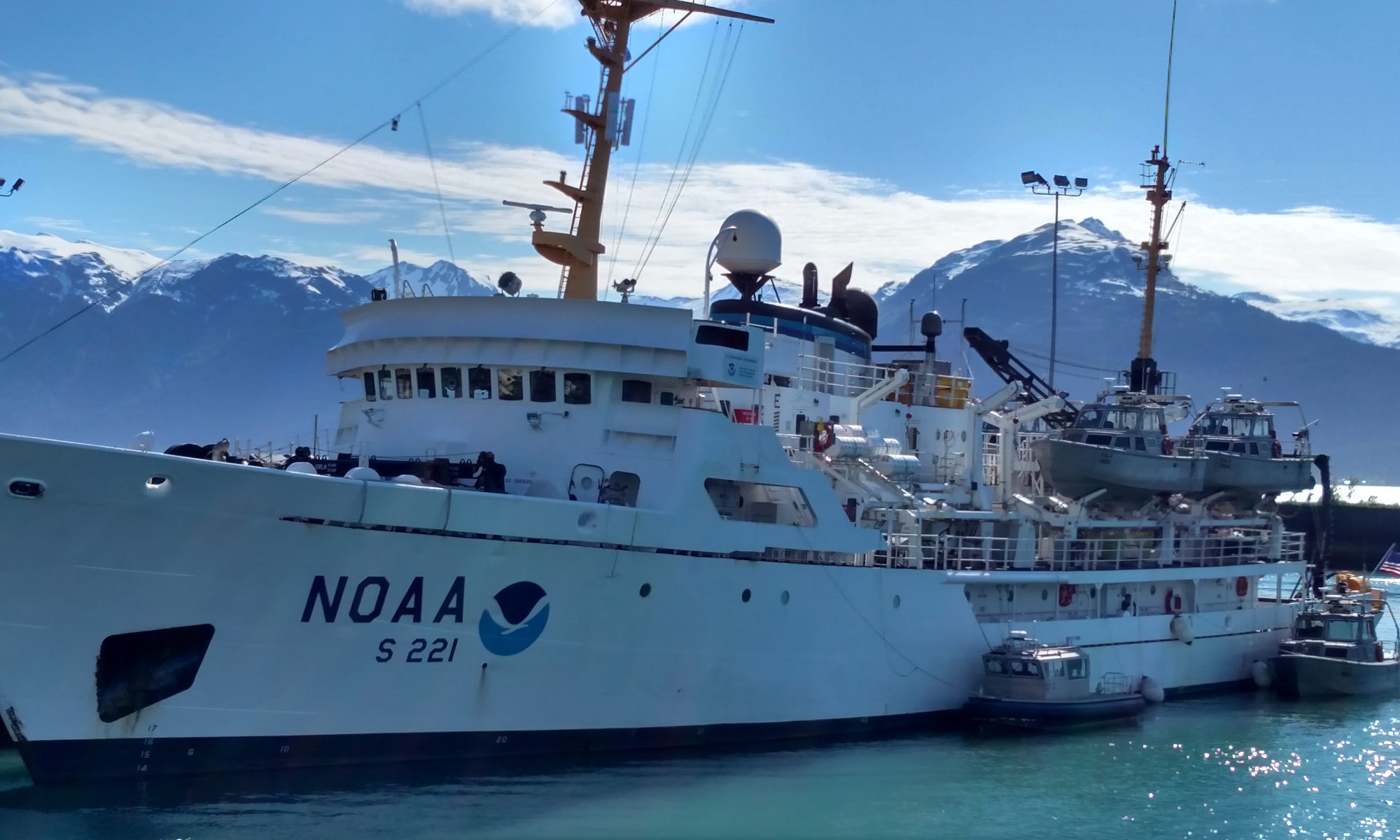
Justin Czarka, August 12, 2009

NOAA Teacher at Sea
Justin Czarka
Onboard NOAA Ship McArthur II (tracker)
August 10 – 19, 2009 

Mission: Hydrographic and Plankton Survey
Geographical area of cruise: North Pacific Ocean from San Francisco, CA to Seattle, WA
Date: August 12, 2009

Weather Data from the Bridge 

Sunrise: 06:25 a.m.
Sunset: 20:03 (8:03 p.m.)
Weather: isolated showers/patchy coastal fog
Sky: partly cloudy
Wind direction and speed: North 10-15 knots (kt)
Visibility: unrestricted to less than 1 nautical mile (nm) in fog
Waves: northwest 4-6 feet
Air Temperature: 17.3 °C
Water Temperature: 16.6 °C

Science and Technology Log 

Justin Czarka collects water samples to use in nutrient and chlorophyll research.  While on the deck during “ops” (operation) all personnel must wear a life jacket and hardhat.
Justin Czarka collects water samples to use in nutrient and chlorophyll research. While on the deck during “ops” (operation) all personnel must wear a life jacket and hardhat.

This log discusses the purpose behind the scientific cruise aboard the McArthur II. The cruise is titled, “Hydrographic and Plankton Survey.” The cruise is part of a larger study by many scientists to, in the words of chief scientist, Bill Peterson, “understand the effects of climate variability and climate change on biological, chemical and physical parameters that affect plankton, krill, fish, bird and mammal populations in Pacific Northwest waters.”  This specific cruise focuses on hydrology, harmful algal blooms, zooplankton, krill, fish eggs, fish larvae, and bird and mammal observations.

I will provide an overview of these aspects of the cruise. The McArthur II is set up with sensors for salinity, temperature, and fluorescence that provide a continuous monitoring of the ocean (hydrology) throughout the cruise.  In addition at various points along the transect lines (see the dots on the diagram of the cruise route on page 2), the CTD is deployed into the water column at specific depths to determine salinity (via measuring conductivity), water temperature, and depth (via pressure), and collect water samples (which we use to measure chlorophyll and nutrient levels at specific depths). The transects (predetermined latitudes that forms a line of sampling stations) have been selected because they have been consistently monitored over time, some since the late 1980s.  This provides a historical record to monitor changes in the ocean environment over time.

The dots represent planned sampling station. Due to sea conditions, these have been slightly modified.

One scientist, Morgaine McKibben from Oregon State University, is researching harmful algal blooms (HAB). HABs occur when certain algae (the small plants in the ocean that are the basis of the food web) produce toxins that concentrate in animals feeding on them.  As these toxins move up the food web through different species, they cause harmful effects in those species, including humans.  Bill Peterson (NOAA/ Northwest Fisheries Science Center) and Jay Peterson (OSU/Hatfield Marine Science Center) are studying copepod reproduction. They are collecting data on how many eggs are laid in a 24 hour period, as well as how the copepod eggs survive in hypoxic (low oxygen) conditions.  Mike Force, the bird and marine mammal observer is keeping a log of all species spotted along the cruise route, which is utilized by scientists studying the species.

Personal Log 

Tiny squid collected in a vertical net and viewed under microscope on Crescent City transect line at 41 deg 54 min North.

Who said you never find the end of the rainbow? All you have to do is go out to sea (or become a leprechaun!). We have been going through patches of fog today, putting the foghorn into action.  When it clears out above, yet is foggy to the horizon, you get these white rainbows which arc down right to the ship. We have become the pot of gold at the end of the rainbow. Who knew it was the McArthur II! If you follow the entire rainbow, you will notice that it makes a complete 360° circle, half on top the ocean and half in the atmosphere near the horizon.

I enjoyed using the dissecting microscope today.

The water collected from the vertical net is stored in a cooler on the deck to be used in experiments.  I was able to collect a sample of the water, which contained a diverse group of organisms, from tiny squids to copepods to euphausiids.  These tiny organisms from the size of a pinhead to a centimeter long are critical to the diets of large fish populations, such as salmon.  Under magnification, one can see so much spectacular detail.  I have learned how essential it is to have an identification guide in order to identify the names of each copepod and euphausiid.  On the other hand the scientists tend to specialize and become very adept at identifying the different species.

Animals Seen Today 

Arrow worms (long clear, with bristles)
Shrimp Copepods
Tiny rockfish (indigo colored eyes)
Fish larvae

Bryan Hirschman, August 10, 2009

NOAA Teacher at Sea
Bryan Hirschman
Onboard NOAA Ship Miller Freeman (tracker)
August 1 – 17, 2009 

Mission: 2009 United States/Canada Pacific Hake Acoustic Survey
Geographical area: North Pacific Ocean; Newport, OR to Port Angeles, WA
Date: August 10, 2009

Weather Data from the Bridge (0800) 
Visibility: 4 nautical miles
Wind: 14 knots
Wave Height: 2 ft
Wave Swell:  5-6 ft
Ocean temperature: 14.40C
Air Temperature: 16.00C

Science and Technology Log 

Image of plankton taken with VPR

Today, John Pohl, one of the fish biologists showed me the VPR (video plankton recorder). The camera is attached to the CTD (Conductivity, Temperature, and Depth), which is operated by Steve Pierce, a physical oceanographer, and Phil White, chief survey technician, who work the night shift. The CTD is a large apparatus which has room for many additional sensors and attachments. The CTD onboard the Miller Freeman has a dissolved oxygen sensor in addition to the VPR.

Image of plankton taken with VPR

Each night Steve sends the CTD down to the seafloor (about 7 times) to collect data. He is most interested in determining the differing densities of water at different depths (depth is based on pressure, which the CTD measures). He then calculates the densities using conductivity and temperature. By measuring conductivity (how easily electric currents pass through the water sample being tested), Steve can get a measurement of that water sample’s salinity.  Density of water is then calculated from measurements of salinity, and temperature. An equation is used which relates the measurements so that density can be found if these other two values are known. Steve records all the data each night, and will use this information to study currents and their movements.

The VPR is a camera which records video as well as still pictures as it descends to the sea floor. The data are recorded, then uploaded to an external hard drive. The file is very large, as it takes about ten minutes to transfer all the data. The pictures and video will be used by biologists (not on board presently) to identify and determine the percentage of plankton (plankton consist of any drifting organisms) floating throughout the water column. Each time before we set out the fish nets, two people go to the bridge to look for marine mammals. If any are present the nets won’t be put into the water. A few tows have been cancelled due to the presence of marine mammals. This is a great step in keeping them safe. It is always special when I see dolphins or whales.

Here I am holding a sleeper shark.

The only fish tow of the day (no marine mammals present) consisted of mainly Humboldt Squid and some Pacific Hake. Today we used a load cell to get a total mass; this is a device which hooks up to the net and crane. The load cell gives a mass of the entire haul. The majority of the load was released back into the water while a smaller sample was retained. The weights of the Hake and squid were then determined using bins and a balance. The scientists can use the subsample data to determine the data for the entire load.  Bycatch, defined as living creatures that are caught unintentionally by fishing gear, are occasionally found in the net. Today a rougheye rockfish was caught, and yesterday a sleeper shark were accidently caught. The scientists do a very good job of limiting bycatch using their acoustic data.

Personal Log 

A rougheye rockfish – what a pretty fish

I am enjoying the long hours of work, and have gotten into quite a rhythm. I also enjoy spending time with the hardworking and intelligent staff here on board. We work together as a team, and everyone enjoys their jobs. NOAA has chosen a great group of officers who set a very positive tone and make the ship a great workplace. I would love to take a sabbatical from teaching and work on a NOAA ship. I’m having a lot of fun and learning a bunch. I will take back a lot of positive experience to share with my students, family, and friends.

I have also learned to appreciate the smells of a load of fish. As we move the fish from the holding cell, to small baskets for weighing we are constantly splashed in the arms, face, mouth, eyes, etc. I find it pretty amusing every time I get splashed, or even better, when I splash John, Melanie, or Jake. It never grows old. The hardest portion of my day is determining what movie to watch while running on the treadmill (I finally mastered the art of the treadmill on a rocking boat and can leave the elliptical trainer alone). The boat has close to 800 movies to choose from.

Animals Seen Today 
Pacific White-Sided Dolphins, Rougheye rockfish, Humboldt Squid, Pacific Hake, Albatross, Sheerwaters, and Murres.

Poem of the Day 
Squid ink, squid ink!
O! How you make me stink!
You stain my face, you stain my clothes;
I must wash you off with a fire hose!

You make me scratch, you make me itch,
You even turn Melanie into a wicked witch!
(which is a horribly difficult thing to do—
She’s as gentle as a lamb in a petting zoo!)

Why not John, allergic to your ink!
Torment HIM with your venomous stink!
But no–not ME! All I want are Hake.
So torment instead “almost” graduate Jake!

But once again, though our dinner hour,
Because of you I must shower!

So I beg you, O squid, to hear my plea:
In the future, stay away from me!
Does that sound good?
Do we have a deal?
If not, well then—you’re my next meal.

Answers to Last Question 
Ribbon Barracudina, Pacific Hatchetfish, Baby Humboldt Squid

Bryan Hirschman, August 6, 2009

NOAA Teacher at Sea
Bryan Hirschman
Onboard NOAA Ship Miller Freeman (tracker)
August 1 – 17, 2009 

Mission: 2009 United States/Canada Pacific Hake Acoustic Survey
Geographical area: North Pacific Ocean; Newport, OR to Port Angeles, WA
Date: August 6, 2009

Weather Data from Bridge (0800) 
Visibility: 6 nautical miles
Wind: light
Wave Height: <1
Wave Swell: 2-3 ft
Ocean temperature: 15.90C
Air Temperature: 15.50C

Science and Technology Log 

John and Melanie sexing and measuring the fish
Melanie sexing and measuring the fish

Today the day started with a fish tow at 8:00 am. The acoustic scientists, Steve, Larry, and Chu, predicted the fish would be mostly myctophids, and wanted to be certain. The fisherman sent the net out and about an hour later the net was brought back. As predicted the net was filled with mostly myctophids. This is an important step in being able to determine the fish type and numbers using acoustic data only. Scientists will then be able to acoustically count fish populations for most schooling fish (Pollock, Pacific Hake, anchovies, and mackerel to name a few), with out using nets. After the nets are brought in the fish biologists (and me) get to work. We separate all the organisms into their own piles. We then count and weigh them, and log this into a computer using their scientific names. It’s amazing how Melanie and John (the fish biologists) can identify and recall the Latin names of these organisms.

Question: Do we just fish in random locations?

Answer: No, the acoustic scientists choose to fish in locations that appear to be different from previous fishing locations. The parameters which make them different are depth, color intensity, or pattern of the markings on their computer screens. The scientists get real-time acoustic pictures as the boat travels along on a pre-determined path (called a transect).  The more they can relate the graphs on the computer screens to the actual catch in the nets the less fishing which needs to be done.

Here is an acoustic image (2 frequencies) as seen on the scientist’s screen. The bottom wavy line is the seafloor, and the colored sections above are organisms located in the water column.
Here is the second tow consisting of Pacific Hake and Humboldt Squid.

The second fish tow of the day produced Pacific Hake and Humboldt Squid. We weighed all the squid first (then quickly returned to the ocean), and 10 were randomly selected for a stomach dissection. The stomachs contained pieces of squid, Pacific Hake, and other unidentifiable fish. Another purpose of this cruise is to determine the effects of the squid on the Hake, and by looking at the stomachs the scientists will be able to determine the relationship between the squid and hake.  The third tow of the day involved an open net with a camera. The camera could record for an hour. The scientists then view the footage to estimate the size and quantity of the hake passing through the net. This is another method the scientists are using to verify their acoustic data.

Here I am holding the delightful meal of tuna.

I also had the chance to launch an XBT (Expendable Bathythermograph). This device is launched at the back of the boat. The sensor is released into the water and is attached by a tiny copper wire. As the sensor travels down the water column it sends the depth and temperature data to the bridge. This data is saved and used by physical oceanographers to better understand temperature profiles found in the ocean.

Personal Log 

Today was a great day. The seas were calm, I slept well last night, and the food was great. I even got to exercise for 1.5 hours. The exercise room has a television hooked up to watch movies, and it made using the elliptical trainer and stationary bike much more enjoyable. I also had a great time working with the fish biologists. We were throwing and catching squid like the professionals who work at Pike Place Market in Seattle.  Best of all was dinner, freshly caught tuna, which I got to filet.

Animals Seen Today 
Dolphin, Mola-mola, Albatross, Sheerwaters, Slender Barracudia, Ribbon Barracudina, Blackbelly Dragonfish, Pacific Hake, Lanternfish (myctophids), Salps, Sunrise Jellyfish, Purple Cone Jellyfish, Wheel Jellyfish, Humboldt Squid, Black-eyed Squid, Pacific Hatchetfish, and Spiny Dogfish shark.

Question of the Day : Can you identify the animals in the photo?

Answer to the last question: Lancetfish

Bryan Hirschman, August 4, 2009

NOAA Teacher at Sea
Bryan Hirschman
Onboard NOAA Ship Miller Freeman (tracker)
August 1 – 17, 2009 

Mission: 2009 United States/Canada Pacific Hake Acoustic Survey
Geographical area: North Pacific Ocean; Newport, OR to Port Angeles, WA
Date: August 4, 2009

hirschman_log1Weather Data from the Bridge (0800) 
Visibility: 10 miles
Wind: 2 knots
Wave Height: <1 ft
Wave Swell: 3 ft
Ocean temperature: 15.50C
Air Temperature: 15.50C

Science and Technology Log 

Here I am holding a Pacific Hake.

We will be conducting several types of oceanographic sampling during our cruise: 2-3 Pacific hake tows per day (weather permitting), an open net tow where fish are viewed through a camera, XBTs: Expendable Bathythermograph (take temperatures at various depths), HABS: Harmful Algal Bloom Sampling, CTD: Conductivity, Temperature, and Density (also at various depths), and a Multiple Opening Plankton Net (collects living organisms at various depths). We will also release a Surface Drifter: floats with currents and sends information about currents via satellite.

The tows, XBTs and HABS are done from 7:00 am to 9:00 pm, while the CTD and plankton net are used during nighttime hours. By working in daytime and nighttime shifts the scientists are maximizing the boat’s usage. I was fortunate enough to help with the plankton net last night. Five samples were collected while I observed. Each sample was labeled and preserved for later use in a laboratory. Observed were amphipods, copepods, shrimp, and crab larvae.

Can you identify the animal I’m holding?

Our first Pacific hake tow came at approximately 8:00 am. The acoustic scientists use four transducers that are attached to the bottom of the boat.  Each transducer sends out pulses of sound at a different frequency toward the bottom of the sea floor. The sound pulse then travels back to the boat and is recorded onto graphs. Fish and other biological organisms also reflect sound pulses. Each type of fish gives off a different signal depending on its size, shape, and orientation. The fish are then identified on a computer using acoustic analysis software. The strength of the sonar signal helps determine the biomass and number of fish. When the chief scientist see an interesting aggregation of fish to tow on, he calls the bridge (the brains of the boat–this is where the boat is controlled) and reports the latitude and longitude of where he wishes to fish. The ship then turns about and the deck hands work to lower the tow net and prepare to collect fish at the depth the scientists observed the fish.

Here, I’ve got a Humboldt Squid.

After the fish are collected, the Pacific hake are weighed and counted.  A sub-sample of about 300 Pacific hake is sexed and lengthed. Another sub-sample of about 50 Pacific hake is weighed, sexed, and lengthed; sexual maturity is determined by observation of the gonads, and ear bones are removed – this will enable scientists to determine the age of the fish.  About 10 Pacific hake have their stomach contents sampled as well. All this information is collected and used by Fishery Biologists to determine the population dynamics of the overall Pacific hake stock. The acoustic scientists also save all their data in an acoustic library. This will help scientists to analyze the Pacific hake biomass (population) while minimizing how many live specimens they need to collect. In total we completed three tows today. That’s a lot of Pacific hake to measure, weigh, and sex.

Personal Log 

The ship is loud. Sleep was hard to come by last night. Living in quiet Vermont has made me a light sleeper. I need to work on adjusting to the constant noise. The food and staff are great. Everyone takes pride in their ship and the work which is done on the ship.

Question of the Day 
Can you identify the beast in the picture to the picture?

Animals Seen Today 
Pacific Hake, Humboldt Squid, Myctophids, Breaching Whale (too far away to identify; most likely a Humpback)

Kathryn Lanouette, July 28, 2009

NOAA Teacher at Sea
Kathryn Lanouette
Onboard NOAA Ship Oscar Dyson
July 21-August 7, 2009 

Here I am sorting different zooplankton species

Mission: Summer Pollock Survey
Geographical area of cruise: Bering Sea, Alaska
Date: July 28, 2009

Weather Data from the Ship’s Bridge 
Visibility: 8 nautical miles
Wind direction:  015 degrees (N, NE)
Wind speed:  7 knots
Sea wave height: 1 foot
Air temperature: 7.6˚C
Seawater temperature: 7.3˚C
Sea level pressure: 29.8 inches Hg and falling
Cloud cover: 8/8, stratus

Science and Technology Log 

In addition to studying walleye pollock, NOAA scientists are also interested in learning about the really tiny plants (phytoplankton) and animals (zooplankton) that live in the Bering Sea.  Plankton is of interest for a two reasons. First, phytoplankton are the backbone of the entire marine food chain. Almost all life in the ocean is directly or indirectly dependent on it. By converting the sun’s energy into food, phytoplankton are the building blocks of the entire marine food web, becoming the food for zooplankton which in turn feed bigger animals like small fish, crustaceans, and marine mammals. Second, zooplankton and small fish are the primary food source for walleye pollock. By collecting, measuring, and weighing these tiny animals, scientists are able to learn more about the food available to walleye pollock. In addition, every time the scientists trawl for walleye pollock, the stomachs of 20 fish are cut out and preserved. Back at a NOAA lab in Seattle, the contents of these fish stomachs will be analyzed, giving scientists a direct connection between walleye pollocks’ diet and specific zooplankton populations found throughout the Bering Sea.

A simplified marine food chain  (Note: A complete marine food web involves hundreds of different species.)
A simplified marine food chain (Note: A complete marine food web involves hundreds of different species.)

Two important zooplankton groups in the Bering Sea are copepods and euphausiids (commonly referred to as krill). Euphausiids are larger and form thick layers in the water column. In order to catch euphausiids and other zooplankton of a similar size, a special net called a Methot is lowered into the water. This fine meshed net is capable of catching animals as small as 1 millimeter. The same sonar generated images that show walleye pollock swimming below the water’s surface are also capable of showing layers of zooplankton. Using these images, the scientists and fishermen work together, lowering the net into the zooplankton layers.

The Methot net is the square shaped net in the background. It was just brought up and is filled with hundreds of zooplankton.

Once the Methot net is back onboard the boat, its contents are poured through fine sieves and rinsed. All species are identified. A smaller sub sample is weighed and counted. This information is applied to the entire catch so if there were 80 krill, 15 jellyfish, and 5 larval fish in a sub sample, then scientists would approximate that 80% of the entire catch was krill, 15% was jellyfish, and 5% was larval fish. Having only seen photos of some of these zooplanktons, it was interesting to hold them in my hands and look at them up close. They seemed better suited for space travel or a science fiction movie than the Bering Sea!

Personal Log 

The day before, I caught my first glimpse of Dall’s porpoises. This pod of porpoises came swimming alongside the boat. It was awesome to see their bodies rise and fall in the water. I was surprised at how quickly they were swimming, darting in and out of the Oscar Dyson’s wake. Today, I also got my first glimpse of a whale! It was a fin whale, a type of baleen whale, about 20 meters from the boat. It was exciting to watch such a large mammal swimming in such a vast expanse of water. I’m hoping to see a few more marine mammal species before we return to port. The seas have been very calm for the last five days, at times as smooth as a mirror. I’m surprised that I’ve gotten used to falling asleep in the early morning hours and waking around midday. Now that I’ve adjusted to the 4pm to 4am shift, I’m wondering how strange it will be to return to my regular schedule back on the east coast.

Answer to July 25th Question of the Day: Why are only some jellyfish species capable of stinging? 
As I picked up my first jellyfish in the wet lab (asking at least twice “Are you sure this won’t sting?”), I wondered why some jellyfish don’t sting.  So I did some reading and asked some of the scientists a few questions. Here is what I found out: All jellyfish (called “gelatinous animals” in the scientific world) have stinging cells (nematocysts) in their bodies. When a nematocyst is touched, a tiny barb inside fires out, injecting toxin into its prey.  It seems that in some jellyfish, the barbs are either too small to pierce human skin or that nematocysts don’t fire when in contact with human skin.

One euphausiid and two different species of hyperiid amphipod (They are between 1-3 cm long)
One euphausiid and two different species of hyperiid amphipod

Animals Seen 
Capelin, Dall’s porpoise, Euphausiid, Fin whale, Hyperiid amphipod, and Slaty-backed gull.

New Vocabulary: Baleen whale – a whale that has plates of baleen in the mouth for straining plankton from the water (includes rorqual, humpback, right, and gray whales). Methot net – a square framed, small meshed net used to sample larval fish and zooplankton. Phytoplankton – plankton consisting of microscopic plants. Plankton – small and microscopic plants and animals drifting or floating in the sea or fresh water. Trawl – to fish by dragging a net behind a boat. Zooplankton – plankton consisting of small animals and the immature stages of larger animals

Question of the Day: How has the walleye pollock biomass changed over time?