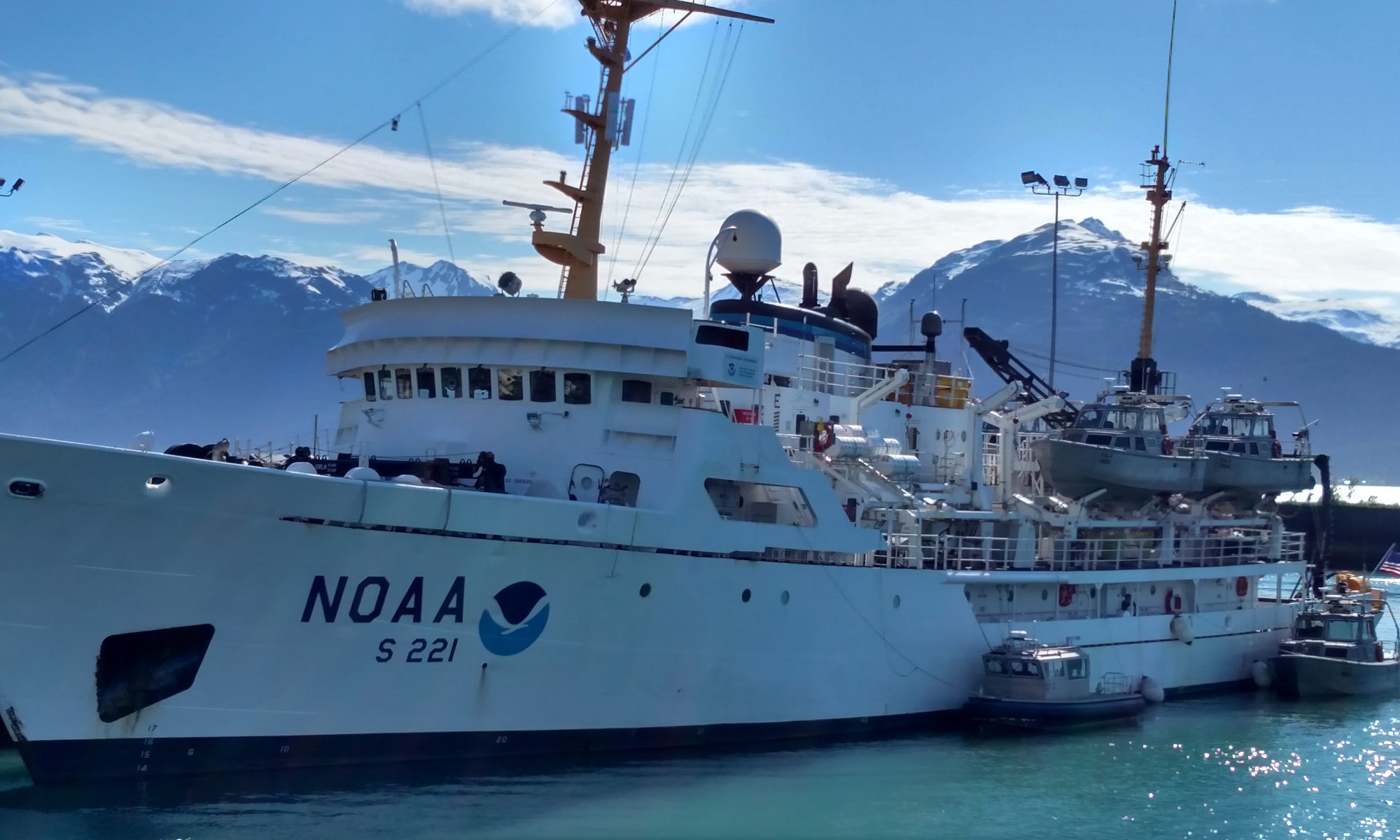
Tara Fogleman, June 1, 2007

NOAA Teacher at Sea
Tara Fogleman
Onboard NOAA Ship John N. Cobb
June 1 – 14, 2007

Mission: Alaskan Harbor Seal Pupping Phenology and Site Monitoring
Geographical Area: Southeast Alaska
Date: June 1, 2007

The boat set sail today as we headed for our first haulout sites.  Because this first day was a traveling day, where no sampling would be conducted, I had a chance to explore the JOHN N. COBB, speak with the crew, and become better acquainted with life at sea.

Our Boat, the JOHN N. COBB— 

The JOHN N. COBB is the oldest vessel and the only wooden ship in NOAA’s research fleet. She was built in 1950 and named after John Nathan Cobb, the first dean of the University of Washington School of Fisheries.  The boat is 93 feet long, has a beam of 26 feet, and a draft of 12 feet. The JOHN N. COBB typically cruises at speeds of around 10 knots, propelled by a 325 hp diesel engine. She has a crew of 8 and can carry up to 4 scientists.

The JOHN N. COBB spends most of her time in the waters of southeast Alaska, supporting the research of the National Marine Fisheries Service (NMFS).  The ship can collect fish and crustacean specimens using a trawl and longline, or sample fish larvae, eggs, and plankton using plankton nets and surface or midwater larval nets.  Marine mammal studies, such as the one that I will be part of, are conducted aboard or by the use of smaller boats stored on the JOHN N. COBB.

Daily Life on the JOHN N. COBB— 

Life on board the JOHN N. COBB is exciting but intimate—the entire crew and scientists must work together to keep the ship clean and in working order so that the scientific research can be done. As mentioned earlier, the ship has several crew members, and each of the crew has important responsibilities that are integral to the proper working of the ship.

  • The Commanding Officer—Our Commanding Officer, Chad, has authority over all other crew members and ship personnel.  He drives the ship on alternating 6-hour shifts and is responsible for medical care in the event that anyone were to get hurt.
  • The Executive Officer—Dan is the Executive Officer (also referred to as the XO) for the JOHN N. COBB on this cruise.  He is the direct representative of the Commanding Officer, and is therefore responsible for executing the policies and orders issued by the Commanding Officer.  He also drives the ship for 6-hour shifts, alternating with the Commanding Officer.
  • The Chief Marine Engineer—Del, or “Chief”, serves as our Chief Marine Engineer.  Because his main responsibilities are to oversee the Engineering Department and fix any problems with the mechanical or electrical systems on the ship, he is usually down below in the engine room.
  • The Chief Steward—Bill, our Chief Steward, is in charge of the galley, or kitchen, of the ship. He provides the crew and scientists with three meals everyday, all cooked on a diesel stove. Because the galley on the JOHN N. COBB is very small, it is very important that those onboard the ship are clean and respect the requests made by the Chief Steward.
Bill, the Chief Steward of the JOHN N. COBB, cooks a delicious dinner for the crew.

There are also other crew members that are responsible for duties such as relieving the Chief Engineer, keeping the boat clean, and driving the skiffs stored on the JOHN N. COBB during scientific operations.  The crew members and scientists sleep in various locations on the boat—though some have it better than others! Most of the crew members, with the exception of the Commanding Officer and Executive Officer, sleep in one large room at the front of the boat. Their room includes bunks, drawers and storage space for their clothing, a small sink, and a couple of benches that also serve as storage units.  Because there is always someone sleeping aboard the ship, curtains can be pulled across each bunk to block light and provide privacy. The scientists are housed in staterooms located just behind the galley, and these rooms provide more space to allow the scientists to work.  Each stateroom has two bunks, a small desk, a sink, and a couple of storage units for clothes and other personal belongings. The bathrooms, or heads, are located in the hallway and are shared by all on board, and there is one community shower for all crew and scientists to use. All of our meals are served in the galley at specific times of the day.  Bill, the Chief Steward, rings a bell when a meal is served, and we each take a designated seat at the table. Meals are served family-style, where the dishes are placed on the table and we serve ourselves. The crew generally consists of some big guys, and so there’s a lot of eating at each meal!  At the end of the meal, we clear our plates, thank the Steward, and head off to do our daily work.

However, life on the JOHN N. COBB isn’t always just about work—the crew enjoy their time off by fishing when the boat is anchored, reading magazines, watching movies, or playing games such as cribbage or solitaire.  There is even a treadmill and rowing machine for those crew members that want to fit a workout into their busy schedule.  Often, the scientists are busy with entering their data and preparing for the next day’s operations. Because there are always some crew members who are sleeping on the boat, it is important that noise is kept to a minimum at all times.

Safety First: Preparing for Emergencies at Sea— 

Tara Fogleman, a NOAA Teacher-at-Sea participant, hangs out in her bottom bunk aboard the JOHN N. COBB.
Tara Fogleman hangs out in her bottom bunk.

It is standard practice for the crew and scientists to perform safety drills during the first 24 hours at sea, and this cruise was no exception.  After lunch, we practiced the “Abandon Ship” drill and the “Fire” drill.  During the “Abandon Ship” drill, everyone aboard was required to report to a life raft and bring (and put on) their survival suit, gloves, and hat. The survival suit is a bright orange outfit intended to cover nearly your entire body (excluding the face), provide insulation from the cold water, and provide floatation. It also has several safety features, including a strobe light and whistle.  During the “Fire” drill, everyone aboard the ship plays a crucial role—many of the crew don protective fire gear and prepare the fire hose, while others assist as needed.  Because everyone plays a role in these emergency situations, it is important that the scientists become familiar with their responsibilities before performing the drills.

Dolphins and Humpbacks and Bears, Oh My!— 

Alaska is beautiful—rugged mountains topped with snow, extensive spruce forests, and dark-blue water that can be so calm in the bays that it appears we’re on a lake.  There were two exciting finds on the way out of Gastineau Channel—we saw the spray of a humpback whale off in the distance (though I can’t truly say I’ve seen a humpback yet) and I saw a group of Dall’s porpoises riding the waves at the bow of the boat.  The Dall’s porpoises are very different from the Atlantic bottlenose dolphins that I commonly see off the coast of Georgia—they are black and white in color (like an orca), they have a smaller dorsal fin, and they are nearly 8 feet in length—but their behavior is similar, as they travel in groups and enjoy riding the waves.  We also spotted two brown bears, most likely a mother and her cub, and several bald eagles while we were anchored in a bay.  Bald eagles are fairly common here, and they are easy to spot because their bright, white heads easily stand out among the dark green of the spruce trees and the grayish-black color of the rocks.

Tomorrow, we’ll begin traveling to haulout sites at low tide (which falls in the morning, between 8 AM and 10 AM) to count harbor seals and their pups.  So with that in mind, I’m off to bed—we have a busy morning tomorrow and I need my rest!

This photo of two brown bears was captured by Chief Scientist Dave Withrow as the JOHN N. COBB anchored in Gut Bay, Alaska.

Tara Fogleman, May 31, 2007

NOAA Teacher at Sea
Tara Fogleman
Onboard NOAA Ship John N. Cobb
June 1 – 14, 2007

Mission: Alaskan Harbor Seal Pupping Phenology and Site Monitoring
Geographical Area: Southeast Alaska
Date: May 31, 2007

Tara Fogleman, a NOAA Teacher-at-Sea participant, sailed on the JOHN N. COBB while taking part in an Alaskan harbor seal study.
Tara Fogleman, a NOAA Teacher-at-Sea, sailed on the JOHN N. COBB for an Alaskan harbor seal study.

Personal Log 

After a long day of plane travel to Juneau, I found the JOHN N. COBB, located my stateroom for the length of the cruise, unpacked, and quickly fell asleep.  It wasn’t until today that I was able to explore Juneau by foot.  Immediately upon leaving the boat, I could tell that I was a long way from Savannah, Georgia!  The weather in June is still cold and unpredictable here—temperatures can fluctuate from 40°F and raining to 75°F and sunny, so it is important to dress in layers.  The sky here is often overcast or partly cloudy, and today was no exception.

The area of Juneau closest to the NOAA boat dock is a tourist-ridden area because it is a popular drop-off site for people sailing on cruise ships—however, I maneuvered around quickly, enjoying the local art shops, murals and statues, and learning about the history of the area at the local historic sites, such as the Governor’s House and the Alaska State Capitol.

Exploring Juneau and its History— 

A view of the town of Juneau, Alaska taken from the JOHN N. COBB as the ship began its journey.

The first residents of Juneau, the Tlingit people, fished and hunted in the Gastineau Channel for centuries. I observed evidence of their culture, including decorative artwork and totems, throughout the city. In the 1870s, a mining engineer named George Pilz offered a reward to anyone who could lead him to gold.  Chief Kowee, of the Auk Tlingit tribe, approached him with samples of gold from the Gastineau Channel, and a search party was sent to investigate.  When the mother lode was found in Silver Bowl Basin, prospectors began to arrive by boat with hopes of finding gold and making it rich.  On October 18, 1880, a 160-acre town site was staked out on the beach, and Juneau was born.  Within a few years, Juneau was transformed from a native fishing village to a large-scale mining industry.

The city of Juneau is located in the middle of the Tongass National Forest, which is the largest temperate rainforest in North America.  This forest, which covers nearly 17million acres, is dominated by the Sitka spruce, which is Alaska’s state tree. The Sitka spruce is identified by its very straight top and sharp-tipped needles, and can reach ages of 200 to 700 years old. The Tongass is a temperate rainforest, which differs from a tropical rainforest in two ways:  temperate forests are much cooler, and they are inhabited by fewer species of plants and animals.  However, though temperate rainforests are less diverse than tropical rainforests, they contain a high amount of biomass.  Animals such as bald eagles, black bears, marmots, and porcupines inhabit the Tongass, and organisms such as harbor seals and salmon can be found in the coastal waters.  After exploring Juneau, I headed back to the boat to speak with Dave Withrow, the Chief Scientist for the mission.  We spoke briefly about the procedures for the study and the major objectives that we will try to achieve while aboard the JOHN N. COBB.

 Mendenhall Glacier is located just outside of Juneau, Alaska.  The glacier is retreating at an alarming rate.
Mendenhall Glacier is located just outside of Juneau, Alaska. The glacier is retreating at an alarming rate.

The Objectives of the Study— 

During this cruise, Dave will be exploring selected areas of southeastern Alaska to: 1) determine population counts of harbor seals, with a special emphasis on which sites are being used for pupping, 2) identify how many pups are born and the approximate age and size of these pups, and 3) identify potential haulout sites for long-term studies, such as sites that are inhabited by large numbers of seals (more than 200).  Identifying critical habitat is an important component of this study, because many of these habitat areas are experiencing a decline.  Harbor seals use the floating ice calved from tidewater glaciers to pup, nurse their young, and molt, because these areas are free from most predators and disturbance. However, these tidewater glaciers are disappearing at an alarming rate; in 1983, there were 52 recorded tidewater glaciers, and in 2004, only 31 of these documented glaciers remained, and all but 5 of them were receding.  This reduction of pupping habitat could have a significant impact on harbor seal populations.

More Sightseeing Around Juneau— 

Prior to setting sail, I ran errands with the crew around Juneau to pick up miscellaneous gear needed for the cruise, and I even stopped at the Alaskan Brewery to take a tour of their facilities. Later that evening, Dave Withrow took me to the Mendenhall Glacier— this is a glacier located just outside of Juneau.  He told me that the glacier has been retreating at an alarming rate during the past years.  I was particularly amazed at the light blue-green color of the glacial ice that floated in the water in front of the glacier—it is unlike anything I have ever seen.

I’m off to bed for now—tomorrow we set sail for our first study sites.

Mike Laird, August 11, 2005

NOAA Teacher at Sea
Mike Laird
Onboard NOAA Ship Rainier
July 24 – August 13, 2005

Mission: Hydrographic Survey
Geographical Area: North Pacific
Date: August 11, 2005

Weather Data

Time: 13:00
Latitude: 55° 53.4 ̍ N
Longitude: 158˚ 50.4 ̍ W
Visibility: 10 nautical miles (nm)
Wind Direction: 225˚
Wind Speed: 10kts
Sea Wave Height: 0-1΄
Swell Wave Height: 0-1΄
Sea Water Temperature: 11.7˚ C
Sea Level Pressure: 1009.5 mb
Cloud Cover: Sky 8/8 covered; Lower level: cumulus Mid-level: altostratus High level: cirrus

Science and Technology Log 

The survey operations being conducted in the waters around Mitrofania have been closed as we begin our transit that leads to the end of an educational and entertaining 22-day voyage onboard the RAINIER. The RAINIER’s reputation as one of the most productive hydrographic survey platforms in the world can be attributed, in large part, to her officers and crew. The people who serve onboard the RAINIER come with different backgrounds, levels of education, and amounts of experience at sea.  They come for different reasons, plan to stay for different periods of time, and have different expectations of where their service on the RAINIER will lead them.  However, each of them takes pride in doing their job well. Not only does the survey and support work require everyone’s contribution but also the safety of the people and ship demands constant teamwork and cooperation.

During the time I spent on the RAINIER, everyone I interacted with was friendly and attempted to involve us in the day-to-day operations of the ship as much as possible.  I felt like a member of the team, not an outsider, and was encouraged to participate in all aspects of ship life.  All ship personnel made themselves available and patiently answered the multitudes of questions sent their way.  As a result, I have learned a lot (admittedly there is a great deal more to learn) during these three weeks about the science and technology behind hydrographic research and the importance of strong support from the following areas: the officer corps, deck, engineering, electronics, the steward’s department, and ship’s yeoman.  Without their support, the survey crew’s work would not happen.

So as we draw closer to Homer, AK and the end of my journey with the RAINIER, I would like to thank the officers and crew of the RAINIER for inviting me along for the ride!

Now – some miscellaneous stuff that didn’t fit anywhere else in my logs:

  • Fuel capacity of the RAINIER: 112,000 gallons
  • Recreational activities available during off duty hours:
  • Fishing: salmon (king, coho, pink); yelloweye rockfish; black rockfish;  lingcod
  • Sea kayaking
  • Shore exploration if a skiff is available
  • Movies – available most hours
  • Exercise area: free weights, weight machine, rowing machine,
  • stationary bike, and treadmills (2)
  • Computer games in the crew library
  • Cribbage
  • Whale watching
  • Electronic newspaper (New York Times Digest) complete with crossword
  • College degrees held by officers and crew (list is not all inclusive):   Marine science Electronic engineering and technology Biology Geographic biology Electrical engineering Environmental studies Anthropology Physics Zoology Oceanographic engineering Shoreline engineering

Personal Log 

We are scheduled to arrive in Homer around 8:00a.m. tomorrow.  The first liberty vehicles will be available in the afternoon, and I’m planning to head into town to do a little gift shopping. I was not home for my wife’s birthday (although I did send a card, and called to wish her happy birthday from Kodiak during our refueling stop), and I have to find something really good.  Planning to go to Alaska Wild Berry Products shop (I received a helpful hint before leaving home that there is one located “right in Homer”).  I also plan to check out the Pratt Museum, a place called the Blackberry Bog – sounded like an interesting shop, and of course the Salty Dog (the local watering hole).  I only have two more nights on the ship. Have to pack up, clean the room, and vacate the premises before the arrival of the next teacher at sea Saturday afternoon. I’ll spend Saturday night at the Bidarka Inn in Homer before flying out Sunday night.  It’s been great – couldn’t ask for a better experience!

Mike Laird, August 8, 2005

NOAA Teacher at Sea
Mike Laird
Onboard NOAA Ship Rainier
July 24 – August 13, 2005

Mission: Hydrographic Survey
Geographical Area: North Pacific
Date: August 8, 2005

Weather Data

Latitude: 55° 53.3 ̍ N
Longitude: 158˚ 50.5 ̍ W
Visibility: 10 nautical miles (nm)
Wind Direction: 230˚
Wind Speed: 13kts
Sea Wave Height: 0-1΄
Swell Wave Height: 0-1΄
Sea Water Temperature: 12.8˚ C
Sea Level Pressure: 1027.2 mb
Cloud Cover: Sky 0/8 covered

Science and Technology Log 

Today is probably the last day that I will be out on a launch, because tomorrow we will be running some survey lines using the ship’s sonar.  The launch I am assigned to (RA-2) is going out to collect bottom samples.  Bottom samples are primarily used to sample the ocean floor in areas that have been identified as potential anchor sites.  The information from the samples will be used to determine the locations of “good” anchor sites (sites that will provide a catch for the anchor, so it won’t just slide around).  These good anchor sites will then be included in the nautical information available for the area around Mitrofania.

A tool called a, clamshell sediment sampler, is used to retrieve the floor samples.  The clamshell is a metal tool about a foot-and-a-half long, weighing between ten and twenty pounds. It has a rounded head, really a set of spring-loaded jaws, mounted to a shaft that is seated on a circular metal plate (picture one half of a Q-tip that’s been cut in half with the cardboard shaft glued to an M&M and you’ll get an of what the sampler looks like).  The plate end of the tool is secured to a line and dropped head first over the side of the launch. When the sampler hits the seafloor, a lever activates the metal jaws (which were cocked open prior to the drop), they snap shut, and bingo a bottom sample.  On the launch, the line is threaded through an electronic pulley system and the sample is raised to the surface.  Most of the time this technique works well; however, sometimes the jaws fail to close, or they pinch shut on a rock allowing the sample to stream out on the way to the surface. In these cases, the procedure must be repeated.

Back on the launch, the sampler’s jaws are pried open and the contents are examined, and finally a record (including notations on the floor sample contents, latitude and longitude, and water depth) is created for the site. Once this is completed, the sampler is rinsed out, the boat moves to the next location, and the process is repeated.  Our team worked twenty-one sample sites and found some (not much) variety in our samples (shells only; shells and gravel; shells and silt; shells, silt and gravel; mud and gravel; and rock – determined after two casts returned with a closed, empty sampler).

Personal Log 

Today an unusual event – a bear sighting! The launch was moving to a new cast location when the coxswain, Carl, spotted three dots moving along a distant shoreline.  A closer look with the binoculars confirmed that the dots were bears (a sow and her two cubs).  The trio jogged along the shore as the cubs darted in and out of the surf frolicking and generally having a good time.  We eventually got too close and momma decided to head inland to the safety of the thick undergrowth.  Very cool!

Mike Laird, August 7, 2005

NOAA Teacher at Sea
Mike Laird
Onboard NOAA Ship Rainier
July 24 – August 13, 2005

Mission: Hydrographic Survey
Geographical Area: North Pacific
Date: August 7, 2005

Weather Data

Time: 13:00
Latitude: 55° 53.4 ̍ N
Longitude: 158˚ 50.4 ̍ W
Visibility: 10 nautical miles (nm)
Wind Direction: 225˚
Wind Speed: 10kts
Sea Wave Height: 0-1΄
Swell Wave Height: 0-1΄
Sea Water Temperature: 11.7˚ C
Sea Level Pressure: 1009.5 mb
Cloud Cover: Sky 8/8 covered; Lower level: cumulus Mid-level: altostratus High level: cirrus

Science and Technology Log 

While running echo soundings on the launch one day, the topic of conversation turned to sailing superstitions.  Since that time, I have informally talked with several crewmembers about superstitions they have heard of or that they personally believe in.  Here is what I have discovered so far.

The most widely believed superstition is that it is bad luck for a ship to leave port and set sail on a Friday. No one I talked to knew the origin of this belief, but everyone I talked to thought it best to stay in port an extra day or two and not tempt fate.  One of the ensigns had even heard a tale of a non-believer trying to prove the superstition was a bunch of bunk. He began construction of a ship on Friday, christened the ship on a Friday, put the ship under the command of a Captain Friday, and began the maiden voyage on a Friday.  The ship was never heard from again, believe it or not!  In any case, most sailors will not happily set sail from port on a Friday.

Another common superstition, observed by most, is that one should not whistle.  I heard a couple of explanations for this. One version is that whistling is not allowed on the bridge, because it will “whistle up an ill wind.”  One coxswain, who has been around the sea and ships, including steamships, for many years, gave a different rational for the whistling ban. On steamships, a whistling noise was an indicator that there was steam escaping from one of the ship’s steam pipes – often a dangerous situation.  Whatever the reason, whistling is discouraged on the ship.  As one ensign said, “I don’t whistle, because it is annoying.”

Having a woman, minister (or other religious figure on board) was at one time considered to be bad luck. None of the people I talked to felt strongly about either of those.

Apparently, having bananas onboard is supposed to be bad luck for racing vessels and fishing boats – no one knew why.

Finally, one ensign who grew up in France shared that it is not good to say the word “rabbit” onboard. Instead, one should say “long ears.”  However, having mice—stuffed, carved, etc.—will keep the real thing away.

An interesting topic!  Remember to avoid sailing from port on Friday and to refrain from whistling while you work – and life should be good!

Personal Log 

Gorgeous weather again today – scattered clouds and lots of sunshine!  This afternoon we changed anchorage locations, moving from Sosbee Bay on the southern side of the island back to Cushing Bay on the northern side. During the transit we saw a sailboat off in the distance.  Haven’t seen much traffic while we’ve been here – two fishing boats motored by, and while on the southern side we saw three tugs pulling barges out in the gulf.  Mitrofania is a pretty peaceful and secluded spot.