Time: 1745 (Later than usual due to busy late afternoon fishing)
Lat: 18 33N
Long: 158 20 W
Sky: Somewhat overcast this morning but a nice sunny day overall.
Air temp: 26.5 C
Barometer: 1013.5
Wind: 90 degrees at 10 knots
Relative humidity: 63.5%
Sea temp: 26.3 C
Depth: (forgot to check)
Sea condition: Good sized swells today kept us rocking and rolling pretty good throughout the afternoon and evening. But it wasn’t discomforting at all.
Scientific and Technical Log
Brought up 3 escolar and one wahoo on the longline this morning — not a very exciting time. The set was about 30 miles NE of Cross seamount. After retrieval we steamed south again through/over Cross and back to the area of success around Swordfish seamount to set the line tonight. Along the way we encountered several so called “bird piles”, congregations of birds on the water, indicative of fish below. Passing over Cross we pulled in 5 mahi mahi, a small yellowfin tuna, and 4 bigeye tunas. It was a busy late afternoon. There’s lots of fish on ice for upcoming meals!
Returning now to the vision studies:
This afternoon Eva gave me the tools and an escolar eye and had me go through the procedures she follows to get what she needs for her studies. (Kylie basically does the same procedure but uses skipjack tunas). I’m not ready for microsurgery yet, but she gave my effort a thumbs up as I successfully secured the materials she needs for later study.
As the eye is taken from the animal marks are made on it with a scalpel to mark its orientation in the animal. After measuring eye cup and pupil size, the cornea and lens are removed and a bit more scraping and cleaning eventually leaves her with optic nerve, retina and vitreous to be preserved. This took me about 45 minutes to do.
Back at her university lab, the retina alone will be used. Sections of the retina will be mounted for microscopic examination. With it she can answer questions such as 1) what do the photoreceptor cells look like? 2) Is there a variety of types of receptors in their eye? 3) What is the density/distribution of receptors across the retina? In another study she makes other preps for microscopic examination to observe density of ganglia in the retina.
Personal Log
I had some ideas for tonight’s entry in this section, but this boat is rocking pretty hard right now and sitting in front of the computer is not particularly pleasant. I’m cutting things short tonight.
Lat: 18 49 N
Long: 158 03 W
Sky: A gray overcast morning with a couple of showers. Brightened through the late morning and stayed mostly(thin)overcast but enough sun to cast shadows and feel pretty intense. 90% cloud cover through most of daylight hours. Tonight the sky is star-filled — beautiful.
Air temp: 26.3 C
Barometer: 1011.9
Wind: 100 degrees at 8 knots
Relative humidity: 66.9%
Sea temp: 26.7 C
Depth: 3333 m
Sea: A bit of chop especially this morning when wind seemed stronger. There were a couple of splashes onto the deck as we brought in the line this morning. Still some whitecaps this afternoon; well settled this evening.
Salinity: 34.4 (I thought some might be wondering; it has been consistent throughout.)
Scientific and Technical Log
This morning we brought in several escolar (none scoring better than 4 as they belly flopped to the surface), a yellowfin tuna which was tagged and released, and three blue sharks (one was kept and two were returned after blood samples and a couple remoras were secured). Shark wrestling is getting to be routine. Since then we have been steaming northeast beyond Cross Seamount. At 2000 we are at Lat 19 10N and Long 157 45 W as we begin the set.
On minor correction: sharks and other big fish brought on board are hoisted by human muscle using a block and tackle (not a mechanical winch as stated previously)
Kerstin Fritsches from the University of Queensland in Brisbane, Australia is working on vision studies of the fish. Her husband, Steven Evill (often affectionately referred to as Dr. Evil) assists as do three graduate students, Rickard and Eva from Sweden, and Kylie, also from Brisbane. It is for these studies that the eyes are taken from the animals. I will attempt to explain some practical applications of their studies and give you a sense of the kinds of work being done on board. I will do this in several editions of the log — not all at once. So to start —
Fishes, depending on species may use a variety of senses to know their environment. Scent, for example, may allow them to home in on prey. While research goes on by others to analyze other sensory structures and abilities, Kerstin’s work is about vision. The attempt is being made to find out just what these different fishes are able to see. Do they see differently and, if so, how so? The practical application for longline fisheries, a very indiscriminate practice, is to eliminate by-catch. This can help protect endangered species and make longlining more cost and time efficient by finding ways to attract only economically valued species.
The water column is visually quite a varied environment. Longer wavelengths of red light are essentially filtered out and gone within the first 50 meters below the surface while shorter wavelengths in the blue range penetrate the depths. But imagine hanging out, living, and hunting at 600 meters as some of these fish do, in daytime light levels the equivalent of a starry night at the surface. Some such as swordfish and bigeye tuna come toward the surface at night keeping their exposure to light levels constant. Imagine your life spent in light levels no greater than that of a starlit night. What adaptations do these animals have to accommodate such a lifestyle? What are different parts of the visual apparatus doing in these animals? In order to help uncover answers to these and other questions, three kinds of projects are going on here.
When a live fish of desired species comes aboard, it is first killed then its eyes are taken. Kerstin and Rickard must have living tissue from the retina for their studies. They have about 20 minutes in which to get the tissue they need into a special oxygen-rich solution in which the tissues will be good for 6-8 hours. Steven works with lenses which do tend to cloud over time, but he is able to easily accomplish his work before that happens. For Eva and Kylie there is no rush as their samples, retinas and eyes with only lenses removed, are destined to be preserved for later study at home. I’ll pick up from here tomorrow with details about specific aspects of the work on vision. In preparation you might look up what the retina and lens of the eye do.
Personal Log
I observed our hitchhiking birds in a new feeding maneuver this morning. A bunch of flying fish took to the air and were happily gliding along. Our friends took after them and approaching from the rear snatched them out of the air.
Filling in the non-fishing time gaps: Last night I interviewed Eva about her part of the vision studies and this afternoon Rickard took me through his experiments. At home in Sweden he does vision studies on insects, moths and butterflies in particular. I am also reading Adam’s Navel which I can recommend to those with an interest in human biology written in an interesting non-technical and often humorous style. And it is often nice to find some shade, a comfortable deck chair and with a beverage in hand stare across that wide, blue expanse of water.
The days pass quickly.
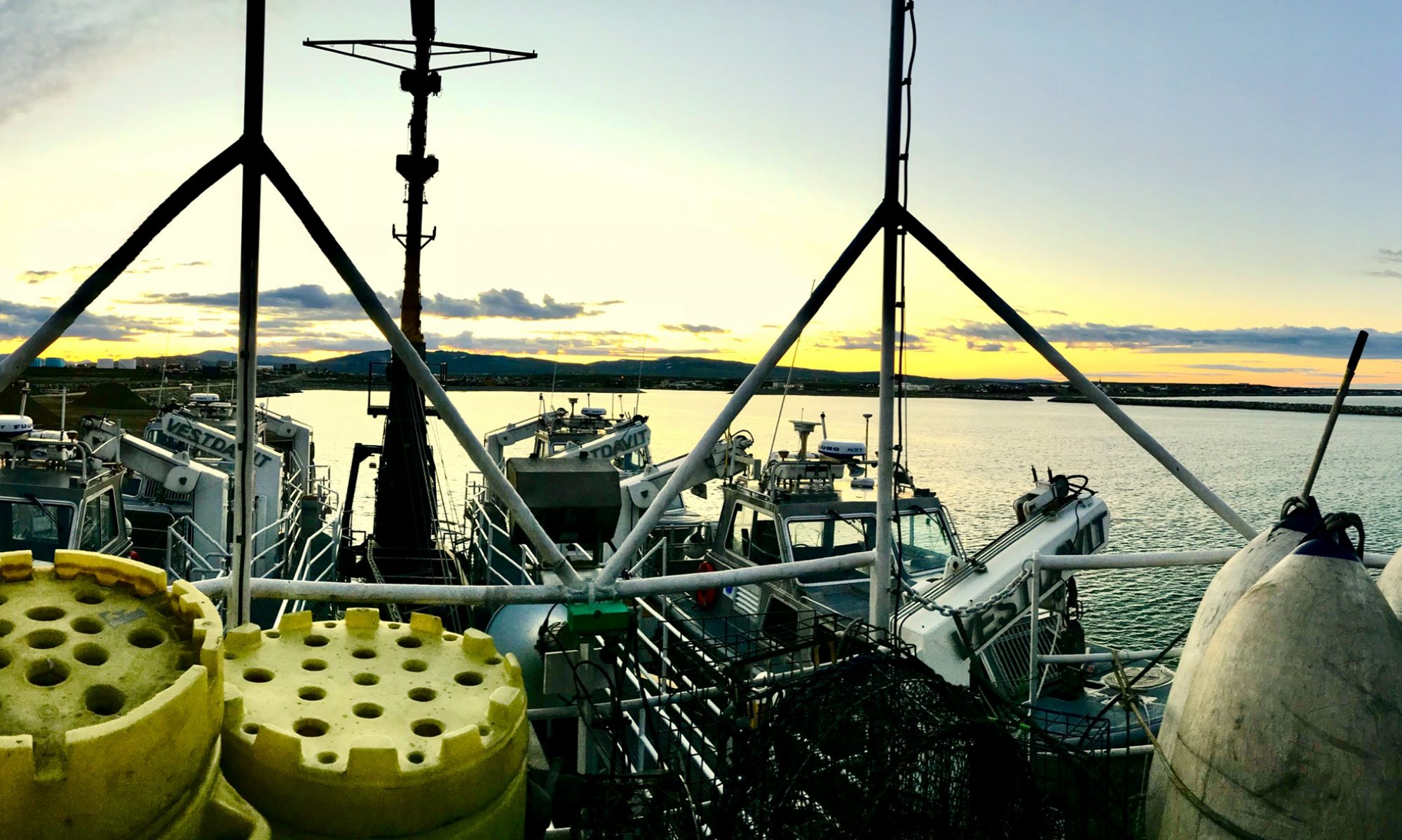
Sunset from NOAA Ship OSCAR ELTON SETTE.
Questions:
I am happy to report that we are eating quite well on our voyage, but that was not the case for early voyagers across the seas. At times they might have had plenty to fill their stomachs, but at the same time lack a balanced diet. Because of this, one condition the mariners suffered was scurvy. What are the symptoms/problems associated with that condition? What can be done to prevent it? See if you can find out when and how the solution to the problem was discovered.
Lat: 18 41 N
Long: 158 19 W
Sky: Sunshine with scattered cumulus; beautiful day.
Air temp: 27.3 C
Barometer: 1010.92
Wind: 68 degrees at 8 Knots
Relative humidity: 47.9%
Sea temp: 27.1 C
Depth: 1674m (at 1800 hours, Lat 18 25N, Long 158 27W)
Sea: A few white caps tonight. What might they foretell?
Science and Technology Log
Pretty good day on the line. We tagged a yellowfin tuna (on board) and a broadbill swordfish (in the water). In the latter case, the tag was attached by sort of harpooning it into the animal from deck. We also pulled in a snakefish (head only), a big eye tuna, 2 escolar, a barracuda (of no interest so simply cut off the line) and 3 blue sharks. One was too large to safely bring aboard; it was cut loose. The two others were brought on board. From one we took blood and fin clips after which it was released. One fish was brought in by trolling today.
As you have noticed water temperature here would be quite comfortable for us (but we are not taking afternoon swims). Rich explained to me that here there is mixing of the surface layers such that the surface temps. I have been reporting would apply to a depth of about 100 meters. Then between there and 400 meters we would see about a 10 degree C drop. While some fish stay in the upper layers others hang in the depths or make regular vertical transgressions across these zones.
Fish are generally regarded as having body temperature at or very near ambient. Any heat produced in the muscles by aerobic respiration is picked up by the blood and circulated through the gills where that heat is dumped efficiently to the environment. Some saltwater fish (no freshwater ones) including tunas and some sharks have developed a kind of heat exchange system. Heat from venous blood is passed to arterial flow in order to keep certain muscles and organs above ambient temp. by as much as 20 degrees C in large fish. This allows body tissues and organs to work more efficiently.
Billfish such as swordfish also have a heat exchange system but it is located only around the eye and brain. Here certain eye muscle is reduced to little more than a container for mitochondria which generate lots of heat. The heat exchange system then only serves this region of the body keeping it above water temp. Still busy at Cross Seamount. The fishermen must be having a big time up there. We are setting at Swordfish again tonight. (Lat 18 17N Long 158 22W at finish of set)
Personal Log
Those oily escolar are not being kept for consumption. This morning we took one’s eyes and made a short incision along the belly just to take some muscle tissue In returning the escolar bodies to the sea I have scored their diving entries 1-10 as in competitive events. Most have been dropped straight in, but this morning I thought of trying something with a higher difficulty factor — a one and half back flip with tail entry. But on its first rotation, a bit of the entrails was ejected shipward striking me on the shoulder before falling to the deck. Unfortunately, this was not captured on film for replay tonight on “Funniest Ship Videos”, but for those present, it provided a good bit of humor to start the morning. Hereafter, we might just stay with the less ambitious dives. Spectators were glad it was I and not they.
Later I made my debut as a shark wrestler. As a rookie I was given the tail end. Even though the blues are comparatively tame once on board, the strength in the animal’s body was very evident as it tried to move – – not so sure I care to deal with the other end of these babies!
TAS Geoff Goodenow and a blue shark.
Questions:
This question relates to paragraph two of the science log. What is the thermocline within a body of water? How would you expect a temperature profile to change through the seasons in a deep lake in central Pennsylvania?
Lat: 18 39 N
Long: 158 17 W
Sky: A few more cumulus clouds around today (40% cover) but they didn’t seem to get in the way of the sun too often. Some thin stratus and cirrus around too.
Air temp: 26 C
Barometer: 1011.5
Wind: 120 degrees at 3.5 Knots
Relative humidity: 56 %
Sea temp: 27.1 C
Depth: 959.3 m
The sea was very,very smooth throughout the day.
Science and Technology Log
The line last night was put out at Swordfish Seamount (500 meters deep), about 35 miles south of Cross. It was a bit longer than usual. Longline retrieval began 0800 and was not complete until 1130. Both the length and our better fortune accounted for the longer effort. We brought in 7 on the line today including 4 sharks. Species included the following: 1 snakefish (Gempylus serpens – 104 cm long and about 7 cm wide with a big eye, pointy snout and lined with very sharp teeth– dead), oceanic white tipped shark (Carcharhinus longimanus) alive, 157 cm and nasty; a blue shark (Prionace glauca), alive, 132 cm and 32.5 kg, rather docile onboard, very pretty coloration — grayish belly softly blending to a blue dorsally; a big eye thresher shark (Alopias superciliosus — love that name) a bit of life in him but not much, 136 cm + tailfin, 51 kg, its curved tail fin nearly the length of his body; a silky shark ( ? ) alive; an ono or wahoo, a dolphinfish and an escolar. I took some samples of blue shark and thresher shark teeth. A pretty exciting and busy morning. For most of these fish their fate in our hands was the same as usual. But the real excitement was bringing on the live sharks. As they are drawn near the ship, netting held in place on a 3 foot by 6 foot rectangular metal frame is lower to the water by a winch. The fish is brought onto it and hoisted aboard. There are a few seconds of near terror as this thrashing animal hits the deck wielding danger at both ends of its body. A mattress like cover is thrown over each end and weighted down by human bodies (mine was not one of them today, but I’ll take my turn eventually; how many people do you know who have ridden a shark?).
The oceanic white and the silky were tagged with the pop ups. To do this a hole is drilled through the base of the dorsal fin. Line looped through that hole attaches the pop up to the animal. Fin clips and blood samples (if possible) are taken as are any remoras attached to the sharks. Then another moment of fear — restraints are withdrawn and animal is sent overboard as quickly as possible. Description of the satellite pop up tags: Each is about 12 inches tall. At the base is a light sensor, above that a cylindrical housing about 1 inch diameter, next a swollen area about 1.75 inch diameter (the pressure sensor) above which is an antenna about 6 inches long. Each costs about $4000.00 including about $300 satellite time to upload data. Since a signal cannot be sent through seawater to the satellite, the units acquire and store data until a preset pop up date (8 months is about max given battery power of the unit). Then they are released automatically, pop to the surface, find a satellite and dump info to it. The system allows us to track fishes vertical movements (by pressure changes) and horizontal movements by measuring ambient light levels. The latter tells us daylength which can be used to estimate latitude to perhaps within a degree and time of dusk and dawn, which when compared to Greenwich can indicate longitude.
But what if the animal dies before the 8 months are passed? If the animal is headed to the depths, at 1200 meters pressure causes release of the pop up. If no vertical change is detected over 4 days (animal has died in shallow water), they release. Other things can happen that disable the pop ups. They might get broken or eaten by other animals. Only about i in 3 tagged swordfish and big eye thresher sharks are heard from if tagged. Those animals go surface to 600 meters often and rapidly subjecting tags to quick temperature and pressure changes that might disrupt operation of the device. In spite of the obstacles, data is gathered from about 60% of the pop up tags deployed. An alternative is small archival tags that get implanted right onto the animal. These cost only $800 and have much greater storage capacity than pop ups so can provide much more data. However, these must be recovered — the fish have to be recaught in order to get the info from the tag. That’s a tough order in this big ocean and recovery rate is indeed low. Setting longline again tonight in same area. At 2042 we are at lat 18 16 N and long 158 27 W.
Personal Log
Last night was spectacular. Brilliant stars horizon to horizon — a star show above, including the Southern Cross, that was equaled in beauty and wonder by the light show in the water. Bioluminescent organisms were ablaze off stern. It looked like the Milky Way in the water but with the stars turning on and off and swirling about in a frenzy. Some were mere points of light, sometimes things flashed as a light bulb going quickly on and off, and once in a while a ghostly basketball sized sphere tumbled through the view. It was hard to know whether to look up or down for fear of missing the next dazzling event.
And yes, there was a small crowd at the bow to admire the moonrise at about 2345. The ship as always held its position near the longline set. As such we are sort of at the mercy of the sea, just rocking and rolling as it moves beneath us. It is to me a very pleasant motion, one that just rocks you gently to sleep. I have never been on a cruise ship, but friends who have tell me there is no (or little) sense of motion to the ship. Perhaps this is comforting to some, but I like the total experience (within reasonable limits, of course) and these last two nights have been perfect in all respects. I am handing off my duties as brake and bait man to others this evening so that I might digest and organize some of the info passed to me by Kerstin and others in the last couple days.
Questions:
Here are a couple relating to ocean currents. Look at a chart that shows ocean currents along the US east coast (southern and mid-Atlantic states) and for the US west coast (Washington to California). What is the general direction of the flow along each coast? Along which coast, especially in summer, would you expect ocean water to be warmer? Why?
I have given you daily temperature readings for the sea water here at about 18 degrees north. The Galapagos Islands straddle the equator far to the east of here off the west coast of South America. You would most likely expect the water there to be warmer on average than around the Hawaiian Islands. Is it? If not, what accounts for the difference?
Lat: 18 12 N
Long: 158 26 W
Sky: beautiful day; blue sky with scattered cumulus
Air temp: 25.9 C
Barometer: 1011.9
Wind: 70 degrees at 6 knots
Relative humidity: 52%
Sea temp: 27 C
Depth: 3571 m
Scientific and Technical Log
The longline brought in just two escolar (Lepidocybium flavobrunneum), an oily tuna (not ones we keep for eating) that tends to live rather deep. It is a dark colored fish unlike the shallower water tunas and mahi we have brought up which are nicely (sometimes brilliantly) colored. Its eye is very large and reflective like a cat’s eye though silvery. It is quite striking. So anyway, a bit of excitement there, and I got to see a species new to me. I don’t think I gave any description of the longline retrieval yet. The ship maintains a course to keep the line perhaps 30-40 degrees off port side. The line comes up midship over a pulley at the spool and is wound onto the spool. As leaders come up they are unclipped at the pulley and passed to others who remove bait and return hooks, leaders and clips to storage barrel. If a fish comes on, the spool is stopped until it is landed and removed from the retrieval area. It is a challenge for crew on the bridge to maintain the proper course for the ship with respect to the line. Because the ship is moving slowly during the process and the process must be stopped for fish or entanglements, recovery of the line takes much longer than the set. I don’t think we’ve done it in less than 2 hours. Nothing came up by trolling today and no plankton tows were done. Tonight we are south of Cross Seamount (at 2000 we are at 18 08 N, 158 27 W) to set the line. Again we are not at Cross because of another boat’s presence. I’m the starter on the bait box tonight. I hope I can fulfill the duties, after all I’m a rookie and used to coming in only as the closer so far. I guess they’ll try anything to change our luck.
Personal Log
After completing my log last night at about 2030 I went to an upper deck where we have strung a hammock. I was a beautiful starry night — the clearest we have had. A warm gentle wind blew over a sea rolling under us as one foot swells. The bright orange waning gibbous moon rose 20 minutes later a cast its long shimmering light across the water as it rose higher. The Big Dipper was easily apparent pointing toward Polaris only 18 degrees or so above the horizon. As new constellations took their place above the eastern horizon a couple of meteors streaked by. I was reluctant to leave the scene for my cabin. I made the mistake of telling folks about it today; there could be some competition for that hammock tonight!
In preparation for upcoming editions of the log I spent an hour or so with Kerstin discussing her work with vision in these pelagic fishes. Wow! I’ll be sorting that out for awhile — very interesting stuff. I finished a book, The Great Biologists, written in 1932. Obviously many more recent greats are not included, but I enjoyed reading about the men included from a 1932 perspective. It is of interest to me to learn more of the impact of particular work at its time in history and of the personalities of the men themselves. It adds some new dimensions to teaching of biology that might captivate a few students as bits and pieces can be appropriately included. We had a small group of dolphins leaping high as they passed the boat. Flying fish are a common sight; crewmen report that often they are found on deck in the morning. We have a pair of birds, a type of booby I believe, hitching a ride with us. They are leaving their mark all over the bow which is not pleasing the crew and have thus been dubbed “John’s nemesis”. But for those of us who don’t have to swab the deck, it is neat to have them around and to watch them feed. From their perch they seem to spot a fish leap from the water and take off. They follow the fish 10-20 feet over the water as it swims and at an instant make a fast dive for it and quickly take flight again. Many of us had our supper on the deck tonight — my first mid-ocean picnic. A clear horizon at sunset gave me another view of the green flash. Venus (I think) set about 2135 just as set of the longline finished. And as predicted, there is a crowd gathering on the bow for moonrise.
Question:
There is no “south pole star” as we think of Polaris as our “north pole star”. How can you use the Southern Cross to point you in the direction of the south pole?