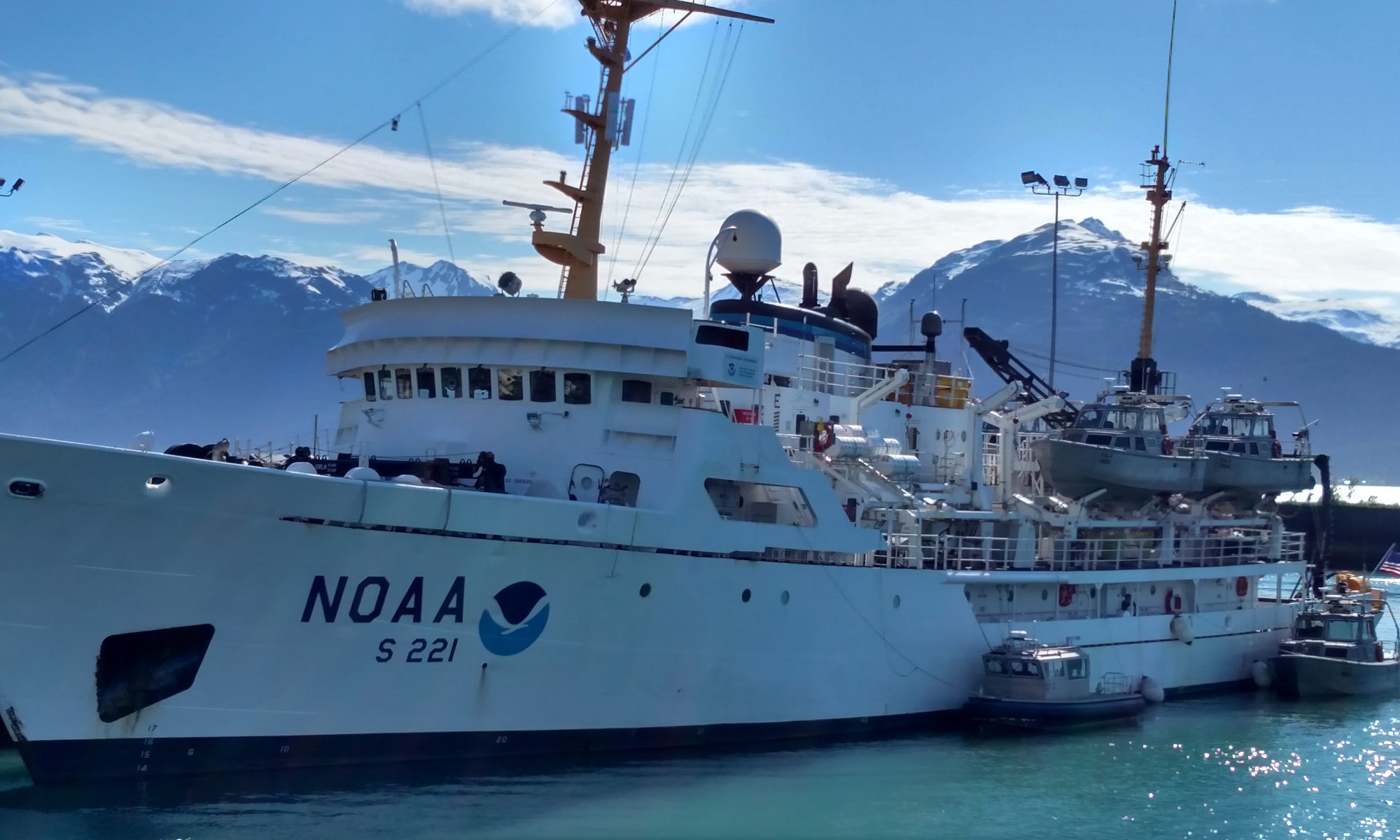
NOAA Teacher at Sea Heidi Wigman Aboard NOAA Ship Pisces May 27 – June 10, 2015
Mission: Reef Fish Surveys on the U.S. Continental Shelf Geographical area of cruise: currently @ 30°22.081’N 088°33.789’W (Pascagoula, MS) Date: May 26, 2015
Weather Data from Bridge: 82°, wind SW @ 10 knots , 90% precipitation, waves 3-5 @ 3 sec.
Science and Technology Log
We are 3 hours from raising anchor, untying from the dock, and heading out to sea. Being aboard the Pisces for 2 days before departure turned out to be a blessing: getting to map out the lay of the 206′ labyrinth, hanging out with the crew, and even getting in a couple of runs around Pascagoula (even in the extreme humidity).
Yesterday was a day of dewatering drills, in case of lower-level compartment flooding. We used the diesel and the electric pumps to run through set-up in the event of a flood in the engine compartment. As the resident TAS, I don’t think that I would necessarily be relied upon to place gear in an emergency, but nevertheless, I wasn’t going to sit out and miss all of the fun.
Today we are running through a series of drills: fire, man overboard, and abandon ship. Each of these events has a series of alerts that indicate what the emergency is, and all hands are to report to their designated muster areas – in the case of an abandon ship, that would be the life rafts. Each of these drills also requires everyone to bring their immersion suits and PFD (Personal Flotation Device), and in my case, to don the suit.
Another training that we did today was to learn how to use the Ocenco EEBD (Emergency Escape Breathing Device) – basically a cool re-breather that fits in a pouch and provides about 10 minutes of fresh oxygen. This would generally be used in case of a fire, not if you are submerged.
So, with all of the drills and trainings, I feel ready for any major disaster that we may encounter while at sea. Thanks NOAA Corps for making sure that I am safe and in good hands!
FRB – Fast-Rescue BoatOscar – waiting to be the star in the man-overboard drillLife rafts awaitingBright safety orange so you won’t miss it
NOAA Teacher at Sea June Teisan Aboard NOAA Ship Oregon II May 1– 15, 2015
Mission: SEAMAP Plankton Study Geographical area of cruise: Gulf of Mexico Date: Friday, May 15, 2015
Science and Technology Log:
Tuna (photo from NOAA Fisheries)
Bluefin tuna are incredible creatures. Remarkably fast predators, they can swim at speeds up to 40 miles per hour and dive deeper than 3000 feet. They hunt smaller fish and invertebrates, and grow to between 6 to 8 feet long and weigh in at 500 pounds on average. Bluefin tuna are prized for their meat in the US and in other countries. Because bluefin tuna are relatively slow-growing, they are more vulnerable to overfishing than species that are faster growing or more productive. Atlantic bluefin tuna spawn in the western Mediterranean and the Gulf of Mexico. Since the early 1980s, NOAA has worked to conserve and manage the stock of bluefin tuna by monitoring stock in the Gulf of Mexico.
The data collected on plankton cruises provides one piece of the complex puzzle of the regulation of commercial and recreational fishing. Ichthyoplankton data is added to findings from trawl teams catching juvenile sizes of certain species, analysis of gonads and spawn from adult fish caught on other cruises, and other stock assessment information. Data analysis and modeling examine these information streams, and serve as the basis of stock assessment recommendations brought to policy makers.
Below is how we collect the plankton:
Hosing down the Neuston net to collect plankton in the codend.Plankton from codend is transferred to sieve.Sieve is tilted and plankton is transferred to sample jars.Transferring plankton to sample jar.Sample jar is topped off with preservative solution.Jars are labeled and boxed for analysis in the lab.
Spring ichthyoplankton surveys have been conducted for over 30 years, and my Teacher at Sea time has been an amazing glimpse behind the scenes of NOAA’s critical work maintaining the health of our fisheries.
SEAMAP Cruise Track May 1 – 15, 2015
Personal Log:
I expanded my career queries beyond the NOAA science team to interview a few of the ship’s crew members aboard the Oregon II and heard some terrific stories about pathways to STEM careers.
ENS Laura Dwyer – Navigation Officer, Oregon II
ENS Laura Dwyer – Navigation Officer, Oregon II
Path to a STEM Career: Laura’s career path began with a bachelor’s degree in International Business. After college she spent time as caretaker for her aging grandmother, then moved to Bali and certified as a scuba instructor. When she returned to the states, Laura investigated the NOAA Corps, and took more university courses for the science credits she needed to apply. In doing so she earned her Master’s in Marine Biology. Laura began her Basic Officer Training in NOAA Corps in January 2013, graduated, and now serves her country as Ensign on the Oregon II.
Best Part of Her Job: Laura knows she has a ‘cool’ job: she gets to pilot a 170 foot vessel.
Favorite Teacher: Mrs. Coppock. Laura’s 3rd grade teacher…She was in her late 60s or early 70s but every year Mrs. Coppock would start the school year by doing a head stand in front of the class. The inspirational lesson behind this gymnastic move was two-fold: Women can do anything they set their mind to, and age is just a number.
LTJG Larry Thomas – Operations Officer, Oregon II
Path to a STEM Career: Larry earned a bachelor’s degree in Marine Biology. He worked as a fisheries observer out of NOAA’s Galveston, Texas lab, and volunteered as a guest biologist on NOAA vessels Gordon Gunter and Oregon II. Larry was raised in a military family with both parents serving in the Army, but had not known about the NOAA Corps until he met Corps officers during his time on NOAA vessels. Larry graduated with BOTC 116 in June 2010 and serves as Lieutenant, Junior Grade (LTJG)on the Oregon II.
Best Part of His Job: Larry appreciates that his work allows him to do and see things most people don’t experience, like being up close with 8-10 foot tiger sharks brought in on long line survey cruises or a rare encounter with sea turtles that have been tagged and released.
Favorite Teachers: Frank Ramano and George Cline, both college professors who were passionate about their work and helpful with any questions, offering guidance when Larry needed it.
Olay Akinsanya – Junior Engineer, Oregon II
Olay Akinsanya – Junior Engineer, Oregon II
Path to a STEM Career: Olay chose a career in the military because it was a great combination of hands on work and potential for training and further education. He served 8 years in the Navy, earning a GSM certification (Gas turbine Systems Mechanic). After his military service, he took exams with the Coast Guard to certify to be able to stand engine watch, which means qualified to be responsible for entire engine room. Olay then found out about NOAA through a friend and now works as a junior engineer on the Oregon II. He enjoys the work and finds it a good fit for his schedule; the shorter trips allow him to visit on shore with his daughter regularly.
Best Part of His Job: The opportunity to continue to build his skills and experience, to advance his career. And the food is good!
Favorite Teacher: Adrian Batchelor, a teacher at Mid-Atlantic Maritime School. “Mr. Batchelor is retired military, holds a GSM, and spent a lot of time with me, explained the job, encouraged me to reach out at any time. He’s been a great mentor.”
Classroom Fish ID Activity:
Correctly identify the “by catch” fish we brought up in our plankton nets. (Hint: we netted Flying Fish, Mahi Mahi, Half Beak, Little Tunny, File Fish, Sargassum Trigger Fish, Chub, Burr Fish, and Sargassum Fish). Enter your answers as a comment to this post!
Specimen ASpecimen BSpecimen CSpecimen DSpecimen ESpecimen F
Specimen G
Shout out to the students in Ms. Meredith Chicklas’ classes at in Troy, Michigan, and in Ms. Kelly Herberholz’s classes at Dakota High School in Macomb, Michigan!
A BIG thank you to the NOAA Fisheries Staff in Pascagoula, Mississippi, to the officers and crew of the Oregon II, and the NOAA Teacher at Sea Program Staff for this incredible adventure.
NOAA Teacher at Sea Julia West Aboard NOAA ship Gordon Gunter March 17 – April 2, 2015
Mission: Winter Plankton Survey Geographic area of cruise: Gulf of Mexico Date: March 25, 2015
Weather Data from the Bridge
Time 0900; mostly sunny, clouds 25% altocumulus; wind 5 knots, 120° (ESE); air 21°C, water 21°C, wave height 1-2 ft.
Science and Technology Log
We continue to zigzag westward on our wild plankton hunt. When we are closer to shore, navigation is tricky, because we are constantly dodging oil platforms, so we can never quite do the straight lines that are drawn on the chart.
Here’s what we have covered through this morning. We’re making good time!
One of our Oak Meadow math teachers, Jacquelyn O’Donohoe, was wondering about math applications in the work that we are doing. The list is long! But don’t let that deter you from science – no need to fear the math! In fact, Commanding Officer Donn Pratt told me that he was never good at math, but when it came to navigating a ship, it all became more visual and much more understandable. I think it’s cool to see math and physics being applied. So, just for fun, I’ll point out the many places where math is used here on the ship – it’s in just about every part of the operations.
Today’s topic is neuston. As soon as we get the bongo nets back on board, the cable gets switched over to the neuston net. This net is a huge pipe rectangle, 1 meter x 2 meters, with a large net extending to the cod end to collect the sample. The mesh of this net is 1mm, much larger than the 0.3mm mesh of the bongo nets. So we aren’t getting the tiniest things in the neuston net, but still pretty small stuff! We lower the net to the surface, using the winch, and let it drag there for ten minutes. The goal is to have the net half in the water, so we have a swept area of 0.5 x 2 meters, or 1 square meter. (See, there’s some math for you!) That’s the goal. Sometimes with big waves, none of the net is in the water, and then all of it is, but it averages out.
Here I am helping to deploy the neuston net. Photo credit: Kim JohnsonNeuston net in the water. Photo credit: Madalyn Meaker
Then we hose the net off thoroughly to get what is stuck to the net into the cod end.
Andy is hosing off the neuston net.
As I mentioned before, neuston is the array of living organisms that live on or just below the surface. Some of it is not plankton, as you can also catch larger fish, but mostly, the sample overlaps with the larger plankton that we catch in the bongos. There tends to be more jellyfish in the neuston net, so we sometimes wear gloves. Pam got stung by a man o’ war on the first day while cleaning out the net!
Pam is sorting an interesting neuston sample. See her smile – she clearly loves plankton!Madalyn funneling the neuston into a jar with ethanol
Sometimes we end up with Sargassum in our nets. Sargassum is a type of brown “macroalgae” (seaweed) that grows in large clumps and floats on the surface. Have you ever heard of the Sargasso Sea? It is a massive collection of Sargassum in the Atlantic Ocean, held in place by the North Atlantic Gyre.
Sargassum taken from a sampleSargassum in the water
Sargassum often collects in our nets. Sometimes we get gallons of Sargassum, and we have to carefully hose the organisms off of it, and throw the weeds back. We get the most interesting variety of life in the Sargassum! It supports entire communities of life that wouldn’t be there without it. If you want to know a little more about Sargassum communities, check out this website.
Here are a few examples of some of the photographable organisms we have collected in the neuston net. I’m working on getting micrographs of the really cool critters that are too small to see well with the naked eye, but they are amazing – stay tuned. All of the fish, except the flying fish, are very young; the adults will be much, much larger. (If you click on one of these, you will see a nice slide show and the full caption.)
Half-beak (Hemiramphidae). The long sword like thing is the lower lip. What could the adaptive value of that possibly be?
Trigger fish (Ballistidae)
Sargassum fish (Histrio histrio)
???? (Let’s call it “Littlush fishus”)
Filefish (Monacanthidae)
Flying Fish! This one was about 8″ long.
Pipefish (Syngnathidae) – in the seahorse family because of their similar long snout
This is either a filefish or a triggerfish.
Baby Portuguese Man o’ war (Physalis physalis)
Aurelia, or moon jelly. These get much larger than this little one, and are usually not seen in winter here.
By-the-wind sailor (Velella velella) – a type of jellyfish. They are so beautiful with their sails! How did they qualify for two such lovely names?
Lastly, here is a really cool neuston sample we got – whale food!
This sample looks like it is almost entirely made up of copepods; this species is a beautiful blue color.
Personal Log
Now let’s turn to the other life form on the ship – the people. There are a total of 26 people on this cruise. Everyone is really great; it’s a community of its own. First, let me introduce the NOAA Corps crew who run the ship.
The NOAA Corps, or NOAA Commissioned Officer Corps, is one of the seven uniformed services of the United States (can you name the others?). It seems that many have never heard of the NOAA Corps, so it’s worth telling you a little bit about them. Officers are trained to take leadership positions in the operation of ships and aircraft, conducting research missions such as this one and much, much more! NOAA Corps has all the career benefits of the U.S. military, without active combat. Our officers all have a degree in some kind of science, often marine science or fisheries biology.
The crew members generally keep 4 hour watches, twice a day. I really enjoy going up to the bridge to hang out with them. It’s a whole different world up there, and they have been gracious enough to explain to me (as best as I can understand it) how they navigate the ship. Conceptually, I get it pretty well, but even if I was allowed to, I wouldn’t dare touch one of the buttons and dials they have up there!
Our XO (Executive Officer) on the Gunter is LCDR Colin Little. Colin has been with NOAA for eleven years now, and his previous assignments include Sea Duty aboard Oregon II and Oscar Elton Sette, and shore assignments in Annapolis, MD and Newport, OR. His background is in fish morphology and evolution. His wife and two sons are currently living in Chicago.
ENS Kristin Johns has been on the Gunter for almost a year. She joined NOAA after getting a biology degree at Rutgers. She is currently being trained to be the next Navigation Officer. Kristin is the safety officer, as well as the MPIC (Medical Person in Charge). Kristin is the one who suggested I use the word “thalassophilia” as the word of the day – something she clearly suffers from!
LCDR Colin Little and ENS Kristin Johns
Or is THIS the real Colin and Kristin? Who is taller?
Our Operations Officer (OPS) is LT Marc Weekley. Marc is in charge of organizing the logistics, and coordinating between the scientists and the crew. He’s been with NOAA for ten years (on the Gunter for two years), and has had some interesting land-based as well as offshore posts, including a year at the South Pole Station (yes, Antarctica) doing clean air and ozone monitoring.
ENS Melissa Mathes is newest officer with NOAA, but spent 6 years in the Army Reserves in college, and then 6 years of active duty with the Navy. Melissa loves archery and motorcycles, and she has been rumored to occasionally dance while on watch.
ENA Melissa Mathes and LT Marc Weekley
ENS (which stands for Ensign, by the way) David Wang, originally from New York City, is our Navigation Officer (NAV). He’s been with NOAA for two years. His job, as he puts it, is “getting us where we gotta go, safely.” He is the one who charts our course, or oversees the other Junior Officers as they do it. Dave used to be a commercial fisherman, and when he’s not on duty, those are his fishing lines extending out from the back deck. He’s also an avid cyclist and ultimate Frisbee player.
ENS Peter Gleichauf has been on the Gunter since November, but finished his training over a year ago. He is also an aviator, musician, and avid outdoors person. In fact, for all of the officers, health, fitness, and active lifestyle is a priority. Pete is in charge of environmental compliance on the ship.
ENS Dave Wang and ENS Pete GleichaufLead fisherman Jorge Barbosa and a king mackerel caught today on Dave’s line! It took 2 deck crew men to pull it in!
Term of the Day: USS Cole – you can look this one up. Next blog post I will explain what in the world it has to do with a plankton research cruise. I promise it will all make sense!
NOAA Teacher at Sea Lauren Wilmoth Aboard NOAA Ship Rainier October 4 – 17, 2014
Mission: Hydrographic Survey Geographical area of cruise: Kodiak Island, Alaska Date: Friday, October 16, 2014
Weather Data from the Bridge Air Temperature: 7.32 °C
Wind Speed: 9.2 knots
Latitude: 57°44.179′ N
Longitude: 152°27.987′ W
Science and Technology Log
ENS Steve Wall collecting a bottom sample.
Wednesday, I went on a launch to do bottom sampling and cross lines. Wednesday was our last day of data acquisition, so the motto on the POD (Plan of the Day) was “LEAVE NO HOLIDAYS! If in doubt, ping it again!” Bottom sampling is pretty straight forward. We drive to designated locations and drop a device that looks a little like a dog poop scooper down into the water after attaching it to a wench. The device has a mechanism that holds the mouth of it open until it is jarred from hitting the bottom. When it hits the bottom, it snaps closed and hopefully snatches up some of the sediment from the bottom. Then, we reel it up with the wench and see what’s inside.
We took 10 bottom samples and most were the same. We had a fine brown sand in most samples. Some samples contained bits of shell, so we documented when that was the case. At one location, we tried for samples three times and every time, we got just water. This happens sometimes if the sea floor is rocky and the device can’t pick up the rocks. If you try three times and get no definitive answer, you label the sample as unknown. Two times we got critters in our samples. One critter we found was an amphipod most likely. The second critter was shrimp/krill-like, but I don’t know for sure. Cross lines are just collecting sonar data in lines that run parallel to the previous data lines. This gives us a better image and checks the data.
Survey Tech Christie and Me on our bottom sampling launch.Amphipod found in bottom sample.Unknown shrimp/krill critter from bottom sample.
Staff observations at Terror Bay.
Thursday, we closed out the tidal station at Terror Bay. This entailed doing staff observations, a tidal gauge leveling check, and then break down everything including completing a dive to remove the orifice. Since I have already taken part in a tidal gauge leveling check, I was assigned to the staff observations and dive party. As I mentioned in an earlier post, for staff observations you just record the level of the water by reading a staff every six minutes for three hours. We did this while on a boat, because the tide was pretty high when we got started, so we wouldn’t be able to read the staff if we were on shore. Again, the reason we do staff observations is so we can compare our results to what the tidal gauge is recording to make sure the tidal gauge is and has been working properly.
While doing staff observations, I saw a small jellyfish looking creature, but it was different. It had bilateral symmetry instead of radial symmetry. Bilateral symmetry is what we have, where one side is more or less the same as the other side. Jellyfish have radial symmetry which means instead of just one possible place you could cut to make two side that are the same, there are multiple places you can cut to make it the same on each side. Also, the critter was moving by flopping its body from side to side which is nothing like a jellyfish. I had to figure out what this was! In between our observations, Jeff, the coxswain, maneuvered the boat so I could scoop this guy into a cup. Once we finished our staff observations, we headed to the ship. I asked around and Adam (the FOO) identified my creature. It’s a hooded nudibranch (Melibe leonina). Nudibranches are sea slugs that come in a beautiful variety of colors and shapes.
Bilateral versus radial symmetry.The hooded nudibranch.ENS Wood and ENS DeCastro diving for the orifice.
After a quick return to the ship, we headed back out with a dive team to remove the orifice from underwater. Quick reminder: the orifice was basically a metal tube that air bubbles are pushed out of. The amount of pressure needed to push out the air bubbles is what tells us the depth of the water. Anyways, the water was crystal clear, so it was really neat, because we could see the divers removing the orifice and orifice tubing. Also, you could see all sorts of jellyfish and sea stars. At this point, I released the hooded nudibranch back where I got him from.
Jellyfish!
Just as we were wrapping up with everything. The master diver Katrina asked another diver Chris if he was alright, because he was just floating on his back in the water. He didn’t respond. It’s another drill! One person called it in on the radio, one of the divers hopped back in the water and checked his vitals, and another person grabbed the backboard. I helped clear the way to pull Chris on board using the backboard, strap him down with the straps, and pull out the oxygen mask. We got him back to the ship where the drill continued and the medical officer took over. It was exciting and fun to take part in this drill. This was a very unexpected drill for many people, and they acted so professional that I am sure if a real emergency occurred, they would be prepared.
Drill: Saving ENS Wood.
Personal Log
Sadly, this was most likely my last adventure for this trip, because I fly out tomorrow afternoon. This trip has really been a one-of-a-kind experience. I have learned and have a great appreciation for what it takes to make a quality nautical chart. I am excited about bringing all that the Rainier and her crew have taught me back to the classroom to illustrate to students the importance of and the excitement involved in doing science and scientific research. Thank you so much to everyone on board Rainier for keeping me safe, helping me learn, keeping me well fed, and making my adventure awesome! Also, thank you to all those people in charge of the NOAA Teacher at Sea program who arranged my travel, published my blogs, provided me training, and allowed me to take part in this phenomenal program. Lastly, thank you to my students, family, and friends for reading my blog, participating in my polls, and asking great questions.
Did You Know?
1 knot is one nautical mile per hour which is equal to approximately 1.151 miles per hour.
Challenge:
Can you figure out what my unknown shrimp/krill critter is?
NOAA Teacher at Sea Lauren Wilmoth Aboard NOAA Ship Rainier October 4 – 17, 2014
Mission: Hydrographic Survey Geographical area of cruise: Kodiak Island, Alaska Date: Wednesday, October 15th, 2014
Weather Data from the Bridge Air Temperature: 4.4 °C
Wind Speed: 5 knots
Latitude: 57°56.9′ N
Longitude: 153°05.8′ W
Science and Technology Log
Thank you all for the comments you all have made. It helps me decide what direction to go in for my next post. One question asked, “How long does it take to map a certain area of sea floor?” That answer, as I responded, is that it depends on a number of factors including, but not limited to, how deep the water is and how flat the floor is in that area.
To make things easier, the crew uses an Excel spreadsheet with mathematical equations already built-in to determine the approximate amount of time it will take to complete an area. That answer is a bit abstract though. I wanted an answer that I could wrap my head around. The area that we are currently surveying is approximately 25 sq nautical miles, and it will take an estimated 10 days to complete the surveying of this area not including a couple of days for setting up tidal stations. To put this in perspective, Jefferson City, TN is approximately 4.077 sq nautical miles. So the area we are currently surveying is more than 6 times bigger than Jefferson City! We can do a little math to determine it would take about 2 days to survey an area the size of Jefferson City, TN assuming the features are similar to those of the area we are currently surveying.
Try to do the math yourself! Were you able to figure out how I got 2 or 3 days?
Since we’re talking numbers, Rainier surveyed an area one half the size of Puerto Rico in 2012 and 2013! We can also look at linear miles. Linear miles is the distance they traveled while surveying. It takes into account all of the lines the ship has completed. In 2012 and 2013, Rainier surveyed the same amount of linear nautical miles that it would take to go from Newport, Oregon to the South Pole Station and back!
Area we are currently surveying (outlined in red) with some depth data we have collected.Casting a CTD (Conductivity, Temperature, and Depth) gauge.
Monday, I went on a launch to collect sonar data. This is my first time to collect sonar data since I started this journey. Before we could get started, we had to cast a CTD (Conductivity, Temperature and Depth) instrument. Sound travels a different velocities in water depending on the salinity, temperature, and pressure (depth), so this instrument is slowly cast down from the boat and measures all of these aspects on its way to the ocean floor. Sound travels faster when there is higher salinity, temperature, and pressure. These factors can vary greatly from place to place and season to season.
Imagine how it might be different in the summertime versus the winter. In the summertime, the snow will be melting from the mountains and glaciers causing a increase in the amount of freshwater. Freshwater is less dense than saltwater, so it mainly stays on top. Also, that glacial runoff is often much colder than the water lower in the water column. Knowing all of this, where do you think sound will travel faster in the summertime? In the top layer of water or a lower layer of water? Now you understand why it is so important to cast a CTD to make sure that our sonar data is accurate. To learn more about how sound travels in water, click here.
I’m driving the boat.
After casting our CTD, we spent the day running the sonar up and down and up and down the areas that needed to be surveyed. Again, this is a little like mowing the lawn. At one point, I was on bow watch. On bow watch, you sit at the front of the boat and look out for hazards. Since this area hasn’t been surveyed since before 1939, it is possible that there could be hazards that are not charted. Also, I worked down in the cabin of the boat with the data acquisition/sonar tuning. Some important things to do below deck including communicating the plan of attack with the coxswain (boat driver), activating the sonar, and adjusting the sonar for the correct depth. I helped adjust the range of the sonar which basically tells the sonar how long to listen. If you are in deeper water, you want the sonar to listen longer, because it takes more time for the ping to come back. I also adjusted the power which controls how loud the sound ping is. Again, if you are surveying a deeper area, you might want your ping to be a little louder.
Eli working the sonar equipment.
Tuesday, I helped Survey Tech Christie Rieser and Physical Scientist Fernando Ortiz with night processing. When the launches come back after acquiring sonar data, someone has to make all that data make sense and apply it to the charts, so we can determine what needs to be completed the following day. Making sense of the data is what night processing is all about. First, we converted the raw data into a form that the program for charting (CARIS) can understand. The computer does the converting, but we have to tell it to do so. Then, we apply all of the correctors that I spoke about in a previous blog in the following order: POS/MV (Position and Orientation Systems for Marine Vessels) corrector, Tides corrector, and CTD (Conductivity, Temperature, and Depth) corrector. POS/MV corrects for the rocking of the boat. For the tides corrector, we use predicted tides for now, and once all the data is collected from our tidal stations, we will add that in as well. Finally, the CTD corrects for the change in sound velocity due to differences in the water as I discussed above.
After applying all of the correctors, we have the computer use an algorithm (basically a complicated formula) to determine, based on the data, where the sea floor is. Basically, when you are collecting sonar data there is always going to be some noise (random data that is meaningless) due to reflection, refraction, kelp, fish, and even the sound from the boat. The algorithm is usually able to recognize this noise and doesn’t include it when calculating the location of the seafloor. The last step is manually cleaning the data. This is where you hide the noise, so you can get a better view of the ocean floor. Also, when you are cleaning, you are double checking the algorithm in a way, because some things that are easy for a human to distinguish as noise may have thrown off the algorithm a bit, so you can manually correct for that. Cleaning the data took the longest amount of time. It took a couple of hours. While processing the data, we did notice a possible ship wreck, but the data we have isn’t detailed enough to say whether it’s a shipwreck or a rock. Senior Tech Jackson noted in the acquisition log that it was “A wreckish looking rock or a rockish looking wreck.” We are going to have the launches go over that area several more times today to get a more clear picture of is going on at that spot.
This is an example of noisy data. In this case, the noise was so great that the algorithm thought the seafloor went down 100 extra meters. Manually cleaning the data can adjust for this so our end product is accurate. The actual seafloor in this case is the relatively straight line at about 100 meters depth.
Personal Log
Monday was the most spectacular day for wildlife viewing! First, I saw a bald eagle. Then, I saw more sea otters. The most amazing experience of my trip so far happened next. Orcas were swimming all around us. They breached (came up for air) less than 6 feet from the boat. They were so beautiful! I got some good pictures, too! As if that wasn’t good enough, we also saw another type of whale from far away. I could see the blow (spray) from the whale and a dorsal fin, but I am not sure if it is was a Humpback Whale or a Fin Whale. Too cool!
Bald Eagle Sighting!Sea otterOrca!Very close orca!
Did You Know?
Killer whales are technically dolphins, because they are more closely related to other dolphins than they are to whales.