Lisa Carlson: Come Out, Come Out, Wherever You Are, Hake! July 6, 2023

NOAA Teacher at Sea

Lisa Carlson

NOAA Ship Bell M. Shimada

July 5, 2023 โ€“ July 19, 2023

Mission: Fisheries: Pacific Hake Survey (More info here)

Geographic Region: Pacific Ocean, off the coast of California

Date: July 6, 2023

Weather Data from the Bridge:

โ€” July 5 Departure
(1800 PT, 2100 EST)

Location: 37ยฐ 44.9โ€™N, 122ยฐ 39.2โ€™W
Docked at Pier 30/32
San Francisco, CA

Visibility: 10 nautical miles
Sky condition: Overcast
Wind: 17 knots from NW 300ยฐ
Barometer: 1012.8 mbar
Sea wave height: 1-2 feet
Swell: 2-4 ft from W 270ยฐ
Sea temperature: 14.2ยฐC (57.6ยฐF)
Air temperature: 14.7ยฐC (58.5ยฐF)
Course Over Ground: (COG): N/A
Speed Over Ground (SOG): N/A

โ€” July 6 (1200 PT, 1500 EST)
Location: 35ยฐ 38.2โ€™ N, 121ยฐ 18.9โ€™ W
16nm (18mi) West of San Simeon, CA

Visibility: 10nm
Wind: 6 knots from 330ยฐ
Barometer: 1013.9
Sea wave height: 1-2ft
Swell: 2-4ft from 280ยฐ
Sea wave temperature: 14.4ยฐC (57.9ยฐF)
Air temperature: 14.9ยฐC (58.8ยฐF)
Course Over Ground: (COG): W 270ยฐ
Speed Over Ground (SOG): 10 knots

โ€“ โ€“ โš“ โ€“ โ€“

Science and Technology Log

On July 6, our first full day at sea, we gathered in the acoustics lab to observe and keep watch on data from various screens. Data includes our current course plotted on a digital chart, a camera showing current sea state, measurements of the wind speed and direction, and displays of the multiple frequencies at which the Simrad EK80 transmitter emits sound. The EK80 is used while traveling on numbered longitudinal east-west lines called transects. NOAA Ship Bell M. Shimada navigates on these lines while collecting acoustic data along the west coast of the U.S. and into Canada, in hopes of finding schools of Hake to collect for surveying.

A topographic map of a portion of the coast of California. The topographies of the both the land (beige and green scales) and water (blue scale) are depicted. Black dots mark the locations of three coastal cities: Crescent City, near the top of the map; San Francisco, a little more than halfway down; and Morro Bay, toward the bottom of the map. Black horizontal lines mark transects extending west from the coast line. The black lines are marked with red or black x's (showing previous sampling locations, perhaps) and a couple have green triangles.
Map showing transects 1-45 off the coast of California. Transect 1 is south of Morro Bay, CA and transect 45 is near Crescent City, CA.
(We hope to survey transects 8-35 by Cape Mendocino, CA before traveling north to dock in Newport, OR.)

โ€œFor acoustic surveys, the ship uses a multibeam echo sounder (MBES) that projects a fan-shaped beam of sound that bounces back to the ship. The shipโ€™s MBESโ€”one of only three systems of its type worldwideโ€”acquires data from both the water column and the sea floor.โ€

NOAA Office of Marine and Aviation Operations (OMAO): โ€œBell M. Shimadaโ€

The Simrad EK80 emits sound waves from the hull of the vessel down to the sea floor. The process is very similar to a dolphin or bat using echolocation to find prey. Any object the signal hits that has a different density and reflectivity than the surrounding water will cause the waves to bounce back to the ship. An image, called an echo gram, is pieced together each time this occurs and the acoustics team is able to use this information to determine if there are enough return signals that suggest fish are present to attempt a trawl.

Fish that have swim bladders, like bony fish, reflect or echo the sound wave back to the vessel very strongly. Other marine life such as myctophids and zooplankton also have a different density than the sea water, and reflect sound, although not as strongly as fish with air-filled swim bladders. The sea floor itself also reflects sound very strongly, because of the density difference between water and rocks, sand, and mud.

Marine life that have swim bladders (represented in blue) reflect or echo the sound wave back to the vessel. Examples of such marine life include bony fish, myctophids, and zooplankton, as well as the sea floor itself, which has a different density than the sea water.

Image: Cross section example of a Black Sea Bass to show a swim bladder.

an illustrated diagram of the internal anatomy of a bony fish (perhaps a black sea bass). Labels mark the locations of the gills, kidney, swim bladder, urine bladder, gonad, intestine, spleen, stomach, liver, and heart.

If the acoustics team determines there is enough marine life (that they are interested in surveying) to attempt a haul, they will notify the bridge deck and officers that they would like to have the fishing net deployed.

Before an attempted haul, the science team conducts a marine mammal watch for ten minutes. In this time window, several pairs of eyes are observing from the bridge deck and stern for any signs of dolphins, whales, sea lions, seals, and any other marine mammals that are within 500 meters of the vessel. If any marine mammals are spotted within the ten minute observation, we will stand down and wait ten minutes before restarting the marine mammal watch. Net deployment cannot occur until the full observation window has completed.

First haul July 6:
1422-1432 Mammal watch, no marine mammals spotted.
The net deployment started, at which time the vessel continues forward at two knots. Vessel speed increases to three knots when the net is fully deployed with doors and weights in the water, which assist in opening the conical shaped net outwards linearly and laterally. During this time the science team watches displays of the EK80 frequencies and observe the linear width and depth of the net. Scientists can compare these displays to determine if the net is in the correct position to have the best chance of collecting fish.

Hauling back the net occurs after several minutes, at which time the vessel returns to a speed of two knots, and we estimate how many fish were collected. The amount of time in which the net is submerged depends on the depth of the water and acoustic information about the size of the school of fish the net is (hopefully) sampling. After recovery, the haul is deposited into a hopper which feeds onto a conveyor belt in the wet lab, then into large baskets and the wet lab team takes over.

During the first attempt, two sea lions were spotted which required the haul attempt to be paused. We restarted the ten minute marine mammal watch from 1500-1510, the deck department retrieved and reset the net, and the vessel was turned around to return to the start of the noted longitudinal transect. With no marine mammals spotted during the observation period, the second attempt was successful and resulted in:

– 1604-1634: 30 minute haul at 350m depth.

– 11 baskets of Hake collected.

– 4 sample baskets kept at random.

– 541 Hake counted and studied in the wet lab.

Photo: Two deck department members about to open the net to allow the sample to drop into a large collection basket.

Two crewmembers, dressed in orange paints and black and neon yellow coats, face away from the camera, toward a large orange net suspended from above. They may be working to empty the net.

โ€“ โ€“ โš“ โ€“ โ€“

Personal Log

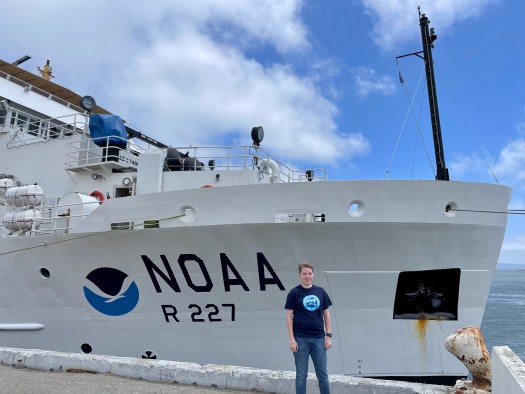
On July 4 I arrived to pier 30/32 in San Francisco, CA to board NOAA Ship Bell M. Shimada. Although I grew up volunteering on the 441โ€™ WWII Liberty Ship SS John W. Brown in Baltimore, MD, seeing a new ship still resulted in a mix of emotions, nervousness, adrenaline, excitement, and everything in between. After five and a half years, finally seeing the 208โ€™ vessel that would become my home for the next two weeks was a core memory and feeling I will always remember.

NOAA Ship Bell M Shimada in port, as seen from a point on the dock beyond the bow. We can see the NOAA logo and read: NOAA R 227. The water is calm and turqoise; the sky is blue with clouds. A portion of what may be the Golden Gate Bridge is visible in the background.
NOAA Ship Bell M. Shimada docked at Pier 30/32 in San Francisco, CA on July 4

Once onboard, I met Chief Scientist Steve de Blois and Wet Lab Lead Ethan Beyer. I was given a tour of the acoustic, chem, and wet labs and shown to my cabin. After dinner ashore, I joined some of the crew on the flying bridge to watch the July 4th fireworks. I met additional science team members and enjoyed a long nightโ€™s rest.

In the morning on July 5, we had a welcome aboard meeting, various trainings, a safety meeting and orientation, fire and abandon ship drills, and a science team meeting. We introduced ourselves, took an official team photo, and soon departed pier 30/32 for our 14 day mission. After passing under the Golden Gate Bridge and heading to the Pacific Ocean, our cold hands were warmed by a wonderful hot dinner of chicken, steak, fresh veggies, salad, and desserts from our galley crew. After dinner, we settled in for our first night at sea, waiting with anticipation for our first trawl on July 6.
โ€“ โ€“ โš“ โ€“ โ€“

Did You Know?

an orange-gloved hand holds a hake (fish) up so that it faces the camera. We can see the another smaller hake hanging limply across its open mouth

– Hake can be cannibalistic!
– Some larger Hake we have collected have had a smaller Hake in their mouth, throat, or stomach!
– Their very sharp teeth often stick to our thick rubber gloves.

โ€“ โ€“ โš“ โ€“ โ€“

New Terms/Phrases:

โ€œSalp: Barrel-shaped, planktonic tunicate in the family Salpidae. It moves by contracting, thereby pumping water through its gelatinous body.โ€

Wikipedia: โ€œSalpโ€

โ€œMyctophid: Lanternfish (or myctophids, from the Greek ฮผฯ…ฮบฯ„ฮฎฯ myktแธ—r, “nose” and ophis, “serpent”) are small mesopelagic fish (โ€ฆ) Lanternfishes are aptly named after their conspicuous use of bioluminescence.โ€

Wikipedia: โ€œMyctophidโ€

Simrad EK80: Multibeam Echo Sounder (MBES) transducer that emits sound waves from the hull of the vessel down to the sea floor. It allows scientists to observe and study returned sound wave signals that may suggest marine life is present.

Transect: Set and numbered longitudinal east-west lines NOAA Ship Bell M. Shimada navigates on while collecting acoustic data.

Lisa Carlson: Anticipationโ€ฆ Does everything happen for a reason? July 3, 2023

NOAA Teacher at Sea

Lisa Carlson

NOAA Ship Bell M. Shimada

July 5, 2023 – July 19, 2023

Mission: Fisheries: Pacific Hake Survey (More info here)

Geographic Region: Pacific Ocean, off the coast of California

Date: July 3, 2023

Introduction and Background

Hello! My name is Lisa Carlson and I am an elementary school teacher in Virginia Beach, Virginia. I have taught third, fourth, and fifth grade general education with Special Education and English as a Second Language (ESL) inclusion. This coming fall I will be a second grade teacher, continuing with ESL inclusion! Although I was surprised to move down from fourth grade, I try to maintain the belief that everything happens for a reason, and the only constant in life is change.

Lisa Carlson on a boat, presumably a sailboat. We can see lines, some navigation equipment, portions of the railing, and water in the background. She's wearing a hat, sunglasses, and a blue life vest.

For example, if I not missed out on previous opportunities to join NOAA as a Teacher at Sea due to the pandemic, a short career change, and other extenuating circumstances; I wouldnโ€™t be writing this blog from a hotel room in San Francisco, California, anticipating boarding and seeing July 4th fireworks from the deck tomorrow.

– – โš“ – –

My introduction to NOAAโ€™s Teacher at Sea program began in the fall of 2017. After student teaching in the fall/winter of 2016 in a third grade class, and permanent subbing in a fifth grade in the winter/spring of 2017, I accepted a position for my own third grade classroom.

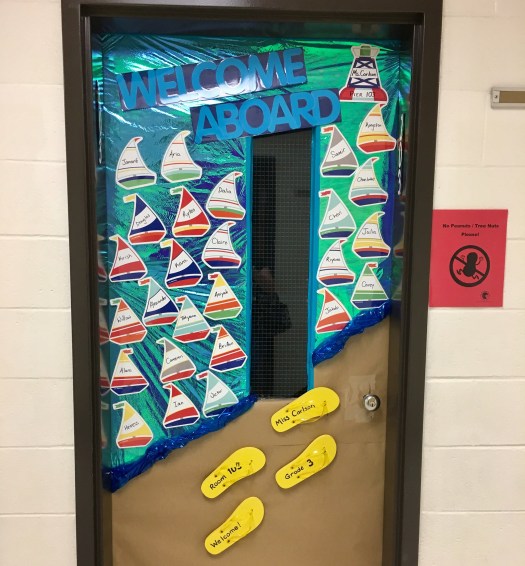
My classroom came together with a nautical theme, shades of blues and calm colors, nautical paintings by my Mom, lots of cleaning and moving by my Dad, sailboat name tags on the door, and our own 3D sailboat in my class library. It soon got around that my room was one to go see!

A closed classroom door papered in shiny blue-green wrap on the top half (representing ocean) and brown on the bottom half (representing sand). Paper sailboats of different colors are taped onto the "ocean;" each has a student's name (not legible). Four yellow flip flops, with more labels, are taped to the "sand." At the top of the door, blue letters on a black paper background say: WELCOME ABOARD.

Door decorations for my first third grade classroom!

Classroom decor: life ring painting, handmade pilings,
fish and life ring pillows, sea creature lights, and 3D sailboat

A corner of a classroom, with shelves, plastic organizer boxes, a small carpet, a nest chair, in nautical theme.

Our Technology Integration Specialist, a NOAA Teacher at Sea Alumnus, visited my room and explained the program to me. The application was due on my birthday, less than a month from when I learned about the opportunity.

– – โš“ – –

So, I applied in November 2017, 2018, and 2019. One year I just wasnโ€™t selected, one year administrative input was not turned in on time, and other hiccups along the way. Then, my 2019 application was accepted, and I was over the moon in January 2020 to learn that I was a finalist. Of course, we all know what happened that March; and the 2020 and subsequent 2021 sailing seasons were canceled. Slowly, a few teachers were able to sail in the summer of 2022, and I was able to read their blogs from afar with the belief of everything happening for a reason.

My 2023 NOAA Teacher at Sea Assignment!

Now, itโ€™s my turn! I will be sailing off the coast of California for two weeks on NOAA Ship Bell M. Shimada with members of the science team as part of the Integrated Ecosystem and Pacific Hake Acoustic Trawl Survey.

โ€œFor three decades, the Teacher at Sea program has helped teachers participate in annual NOAA research surveys conducted by our scientists. Teachers from around the country embark on a two to three week expedition at sea. They gain invaluable on-the-job experience and communicate their journey through a series of blogs and lesson plans.โ€

NOAA Teacher at Sea Blog: โ€œLooking Back on 30 Years of Teachers at Seaโ€

I am so excited for this opportunity and experience after five and a half years of anticipation. So follow along, wish us fair winds and following seas, and as many schools of Pacific Hake as possible to sample from and research!

– From my king sized bed hotel room, and last night ashore:

Temporarily reassigned teacher, and sailor at heart.

Lisa stands at the door of a streetcar, left hand hanging onto a pole. A San Francisco streetscape extends into the distance to the left side of the photo.

Laura Guertin: Personal Log for Acoustic-Trawl Survey, June 22, 2023

NOAA Teacher at Sea

Laura Guertin

Aboard NOAA Ship Oscar Dyson

June 10 โ€“ June 22, 2023


Mission: 2023 Summer Acoustic-Trawl Survey of Walleye Pollock in the Gulf of Alaska

Geographic Area of Cruise: Islands of Four Mountains area, to Shumagin Islands area
Location (in port, Kodiak Island): 57o 47.0200โ€ฒ N, 152o 25.5543โ€ฒ W

Date: June 22, 2023

Laura, wearing a heavy orange rain coat and large yellow gloves, holds a pollock (fish) up for a photo. She is also wearing a blue Teacher at Sea beanie. She's standing in the wet lab, where plastic green sorting baskets are stacked behind her on a long metal table.
TAS Laura Guertin and a pollock!

Iโ€™m wrapping up my time on NOAA Ship Oscar Dyson. There was so much that went in to getting out to sea for this expedition, and so many people that did so much work pulling for me and coordinating all the logistics before I joined Dyson (starting in 2020!), during my time at sea, and Iโ€™m sure after I leave the ship. Thank you to the wonderful people in the NOAA Teacher At Sea Office (Jennifer, Emily, Britta) and for giving me an opportunity to sail as a Teacher At Sea Alumna in 2023.

While waiting to board Oscar Dyson in 2022 during my first trip to Alaska, I prepared several blog posts that provided a background to NOAA, NOAA Fisheries, fisheries surveys, etc. With my undergraduate students in mind as my audience, I wanted to start the posts at the broadest scale and have the content easily utilized in multiple courses that I teach. As I authored these posts from Alaskan hotel rooms in 2022 and in 2023 and not while on the ship, they do not contain personal logs. Again, I thank the Teacher At Sea Program for giving me this flexibility in having one post that captures my personal log from the shortened expedition and keeping the โ€œacademicโ€ focus for the prior content.

Iโ€™m trained as a geoscientist. During and after my studies in marine geology and geophysics, Iโ€™ve had the opportunity to participate in fieldwork in expeditions that have lasted hours to days to weeks to months. Although I think I know what it takes to live/work at sea, Iโ€™m reminded of new challenges on new ships in new ocean basins. It is so important as an educator that I take advantage of opportunities to get out to sea for my own professional development and to remind myself of what to share with students and community members when I present the story of what we did during our time at sea. I know I sound like a broken record โ€“ Iโ€™ve written these same words before. But that doesnโ€™t mean these points are less important!


First topic of reflection โ€“ the people

This expedition had 32 people on board, which included the science party, bridge crew, stewards, engineering, deck, electronics technicians, and survey. The people on Oscar Dyson were born/raised and live in parts across the United States. Some people were sailing on a NOAA ship for the first time, and a few people were working for their first time on the ocean! We all have different backgrounds and training and personalities. In a way, I feel like stepping on to Oscar Dyson was like joining a game of Yahtzee โ€“ put all of these people together, shake us up (by sending us out to sea), and see what rolls out. Fortunately, during this โ€œgameโ€, everybody was a winner. On this 208.6-foot long ship, everyone has a purpose and function, and we must all work together to accomplish our research goals and the mission of the expedition. And to be successful, this group was supportive, understanding, respectful, took the time to listen, and made sure to laugh and smile through everything we faced.


Person standing on a ship on the ocean with clouds and an island in the background
Departing Kodiak aboard NOAA Ship Oscar Dyson

Next topic โ€“ the work

The schedule is very different than one I keep as an instructor. At home, I know the days/times Iโ€™m teaching, and I have a calendar to organize meetings and personal appointments. Iโ€™m pretty much in charge and in control of my own schedule. At sea, itโ€™s not โ€œmeโ€ but โ€œweโ€ when it comes to all day, each and every day. There are no weekends or holidays off. We work 12-hour shifts (mine was 4AM to 4PM) during the entire expedition. Once you leave your room at the start of your shift, you canโ€™t go back to your room until your shift is over (you are sharing a room with someone that works a different shift than you, so the room is theirs during your work time).

But you are plenty busy during your 12 hours! There can be downtime as the ship transits to a site to begin data collection, and the weather can cause a change of plans for where you are headed and what work you can do. High winds, rainstorms, cold air temperatures, the ship rolling and heavingโ€ฆ we faced it all during our 13 days at sea.

And this work is hard! It is a balance of the physical demands faced by the deck crew setting the trawl net, and those working in the fish lab to furiously and accurately process the catch brought on board, and everyone ensuring that safety is a top priority at all times. The Chief Scientist working in the shipโ€™s acoustics laboratory and all the NOAA Corps Officers working on the bridge must balance the scientific mission with the realities of our present situation โ€“ is there too much ship traffic to โ€œgo fishingโ€ and set out the trawl net? Are there whales or other marine mammals in the vicinity? Is the wind speed too high for us to operate safely?

Everything on Oscar Dyson operates at a different pace and schedule from back home. Fortunately, we are able to balance out our time in the laboratories with taking short breaks to view beautiful sunrises and do some whale watching. Again, it is the amazing group of people on this ship, from the seasoned sailors to those doing fisheries work for the first time, that come together to mentor and support one another. They all make the work not seem like โ€œworkโ€ but instead a really enjoyable and exciting time, knowing our efforts are making a difference for sustainable fisheries.


person standing on a ship with a volcanic mountain in the background
TAS Laura Guertin in the Gulf of Alaska

Final topic โ€“ what comes next

My time on Oscar Dyson has provided me an amazing opportunity and wealth of information about a field where I have had no training. Now that Leg 1 of the 2023 Summer Survey has wrapped up, Iโ€™m reminded of a popular saying from one of my graduate school faculty members โ€“ โ€œso what?โ€

โ€œSo what?โ€ stands for a family of questions or an attitude that leads to consideration of the broader significance of specific studies. These kinds of questions are particularly useful in descriptive research because, often, one can get so absorbed in collecting, organizing, and analyzing observations one forgets to consider the implications of the results.  —  Ginsburg (1982), Seeking Answers; suggestions for students

This โ€œso whatโ€ piece is something I will spend even more time in the future thinking about. The โ€œso whatโ€ of the survey is clear โ€“ NOAA does an excellent job explaining what sustainable fisheries are and why it matters (see my previous blog posts). But I still need to do a better job of figuring out how to connect the dots – the endpoints being what we do on the water (and the data we collect) to the production of the annual Status of Stocks and other products NOAA uses to inform the ecosystem management. The Magnuson-Stevens Fishery Conservation and Management Act, the primary law that governs marine fisheries management in federal waters, is also something I want to get up to speed on.

In addition, I need to think about defining the โ€œso whatโ€ for the various audiences I will be sharing my at-sea experience. I have more NOAA resources to explore, such as The NOAA Fisheries Distribution Mapping and Analysis Portal (DisMAP) and The Fisheries One Stop Shop (FOSS) Public Data Portal. I will certainly be looking for other resources to pull in to my materials for students and presentations to the public, ranging from the Food and Agriculture Organization of the United Nations (FAO) to episodes of The Fisheries Podcast. I also look forward to exploring more resources on diversity and representation in fisheries science, with articles catching my eye: Women Leaders Are Essential for Tackling Ocean Sustainability Challenges (Fisheries Magazine, 2023) and Examining Diversity Inequities in Fisheries Science: A Call to Action (BioScience, 2016).

So my learning is not done! The sharing of my adventure and new knowledge is only beginning, and I look forward to sharing my pollock survey stories to not only positively impact the ocean literacy of my audiences, but to show how NOAAโ€™s fishery work helps us address the Ocean Decade Challenges (part of the United Nations Decade of Ocean Science for Sustainable Development).


ship on the sea during sunrise
Sunrise view from Oscar Dyson (June 2023)

Laura Guertin: Ending with a Sea Shanty for Acoustic-Trawling for Walleye Pollock, June 22, 2023

NOAA Teacher at Sea

Laura Guertin

Aboard NOAA Ship Oscar Dyson

June 10 โ€“ June 22, 2023


Mission: 2023 Summer Acoustic-Trawl Survey of Walleye Pollock in the Gulf of Alaska

Geographic Area of Cruise: Islands of Four Mountains area, to Shumagin Islands area
Location (in port, Kodiak Island): 57o 47.0200โ€ฒ N, 152o 25.5543โ€ฒ W

Date: June 22, 2023

Person wearing blue hat on the back of a ship on the ocean
TAS Laura Guertin shows off her Teacher at Sea beanie aboard NOAA Ship Oscar Dyson

As we return to Kodiak, Alaska, for Leg 1 to wrap up and Leg 2 to begin of the 2023 Summer Survey, it’s exciting to know that even during our shortened expedition time at sea, we’ve collected data that is going to inform Alaska walleye pollock stock assessment models and catch allocation. Any/all data are good data to have! I have thoroughly enjoyed my time on Oscar Dyson and met some incredibly smart, passionate, kind, creative, and innovative people. The NOAA community is filled with amazing individuals that are not only dedicated to the NOAA science mission but then sharing that new knowledge with others. I’ve played a small part in this NOAA community during the expedition (while wearing my NOAA hat!), but I hope my future teaching and outreach efforts will shine an even brighter spotlight on the essential work carried out by NOAA Fisheries and the agency as a whole.

Prior to joining the ship, this past academic year was filled with some highs and lows in teaching and student learning. There’s one topic that I’m not quite sure how to classify – and that’s the emergence of Chat GPT, and how AI is being used in higher education. I was joking with the Instructional Designer at my campus (Penn State Brandywine) that I was going to write a sea shanty about this expedition. Turns out, he was able to get AI (Bing, specifically) to write one for me! So as I wrap up my time as a Teacher At Sea Alumna, I leave you with these versus to sing to your favorite shanty rhythm.


A Song of Pollock and Trawls

Oh we are the surveyors of the Gulf so vast and wide
We sail the seas with acoustic gear to find the pollock hide
We use sound waves to scan the depths and mark what we have found
We measure their abundance and their biomass by the pound

(Chorus)

Yo ho ho as we sing this song
On Leg 2 we’ll bring the DriX along
Yo ho ho as we sing this song
We love our job and we love our fish

We work in shifts around the clock to cover all the grounds
We set the course and speed and time to trawl a certain length
We haul the net and sort the catch and check their age and health
We record all the data and we share it with the world

(Chorus)

We do this work for science and for management as well
We help to keep the fishery sustainable and well
We study the pollockโ€™s life history, ecology, and stock
We are proud to be part of this crew and this important work

(Chorus)

Oh we are the surveyors of the Gulf so vast and wide
We sail the seas with acoustic gear to find the pollock hide
We love our job and we love our fish


Laura Guertin: Collecting Data: Icthysticks and Otoliths, June 21, 2023

dead fish laying on measurement board

NOAA Teacher at Sea

Laura Guertin

Aboard NOAA Ship Oscar Dyson

June 10 โ€“ June 22, 2023


Mission: 2023 Summer Acoustic-Trawl Survey of Walleye Pollock in the Gulf of Alaska

Geographic Area of Cruise: Islands of Four Mountains area, to Shumagin Islands area
Location (10:45AM (Alaska Time), June 21): 55o 29.7525โ€ฒ N, 156o 44.7276โ€ฒ W

Data from 10:45AM (Alaska Time), June 21, 2023
Air Temperature: 8.4 oC
Water Temperature (mid-hull): 8.2oC
Wind Speed: 8 knots
Wind Direction: 20 degrees
Course Over Ground (COG): 76 degrees
Speed Over Ground (SOG): 11 knots

Date: June 21, 2023

Once the echo sounder has shown us the position of an aggregation of Alaska walleye pollock (we hope they are pollock and not some other fish species), we lower the trawl net and see what we can catch. This is where the trawl sonar and CamTrawl (see previous blog post) come in handy to give us an idea of what is going into the net. Itโ€™s an amazing coordination of effort between the acoustics lab (who decides where to trawl), the bridge for navigation, and the deck crew for setting/retrieving the haul.

We aim for trawling at the mid-water level, where the pollock are typically found. Pacific Ocean perch (POP, or rockfish) can also be found in the mid-water level in the Gulf of Alaska, especially just off the shelf break. Bottom trawls can yield pollock and other fish (e.g., POP and other rockfish species, various species of flatfish).

Once the trawl net has been brought back on board, the catch is emptied into a bin called a table. There is a door on the side of the table that opens into the fish lab. Once the table door opens, the fish spill into the laboratory where they travel down a conveyor belt for the initial sorting. Our target species is the pollock. We weigh everything that ends up onto the sorting table, either in bulk (by species) or individually.

  • pollock moving along belt
  • pile of dead rockfish
  • dead squid on the deck of a ship

A subset of around 250 pollock are set aside to collect length data. The length of these of each individual pollock are measured on an Ichthystick. This is another invention by Rick Towler and Kresimir Williams (remember the CamTrawl? (see previous blog post)). As described in their article An inexpensive millimeter-accuracy electronic length measuring board, these NOAA scientists describe using magnetic measuring technology that, to millimeter resolution, takes a measurement when you placed a magnet on a sensor that runs the length of the board. For our pollock measurements, we were looking to record the fork length, and a quick placement of the red magnet along the fish tail sends the data to a computer program called CLAMS (Catch Logger for Acoustic Midwater Surveys).

  • green plastic bins containing dead pollock (fish)
  • A close-up view of the end of the measuring board shows the larger sizes on the scale (marked 75, 80, 85). The board's logo reads "Ichthystick" and includes a stylized illustration of a pollock.
  • computer screen with long measuring board
  • illustration of a fish with lines showing the various lengths of measurement. Title: "Measuring Fish Length." labels: "Maximum Standard Length," "Fork Length," and "Maximum Total Length."
  • dead fish laying on measurement board
  • two people in rain gear in a laboratory taking measurements of fish

Another subset of approximately 50 pollock are set aside for additional data collection on individual specimens โ€“ length, weight, sex, maturity, and age. Otoliths (e.g., ear bones) are removed, and sometimes organs are removed and measured (ovaries for maturity development analyses, liver).

a black and white image showing pairs of otoliths from different fish species. Each otolith is white and gray in contrast with the solid black background; lighting reveals the ringed growth pattern
Otolith pairs (two per individual fish) from an assortment of Bering Sea fish species. Walleye pollock is located in the top left. Note: otolith sizes are not on a relative scale. Photo: NOAA Fisheries.

What are otoliths, and why remove them? Otoliths are ear stones, or ear bones, found in fish. To give you an idea of why we remove ear bones, letโ€™s start by thinking about trees and coralsโ€ฆ trees grow a new ring on their structure each year, and corals have differences in their skeletal density between the seasons (both trees and corals are also used to reconstruct past climate conditions (proxy data for paleoclimatology)). By counting the rings on trees and coral, we can calculate the age of that specimen. It turns out that fish also have a way to record their annual growth โ€“ and it occurs in their ear through Fish Otolith Chronologies.

Scientists are very interested in studying otoliths. When otolith data are combined with data on fish size, scientists are able to determine the growth rates of fish, which then combined with the survey work, helps inform annual fish stock assessment reports. We don’t do any of the otolith analyses on the ship, but we do collect the samples with a detailed label and all the corresponding data (fish length, sex, weight, location) that is sent back to the NOAA Fisheries Alaska Fisheries Science Center for analyses and entered into their Fish Otolith Collection Database.

  • Two otoliths in a person's hand
  • close-up view of two otoliths in a person's hand; the growth rings are visible
  • two gloved hands hold up a fish cut open to reveal the otoliths inside the head
  • person holding tweezers and placing object in glass vial

Did you know… More than 30,000 otoliths are read annually by NOAA Fisheries Alaska Fisheries Science Center scientists. So far, the Science Center has collected more than 1.1 million fish otoliths for ageing. (from NOAA Fisheries)


To learn more about the fascinating studies of otoliths and what NOAA Fisheries is doing, check out these websites:

NOAA Fisheries Age and Growth – NOAA Fisheries scientists assess the age and growth rates of fish species and populations to better monitor, assess, and manage stocks. There is also a separate site for Age and Growth Research in Alaska.

NOAA Fisheries Age and Growth Homework: Determining How Old Fish Are

NOAA Fisheries Near-Infrared Technology Identifies Fish Species From Otoliths – NOAA Fisheries scientists are developing ways to use near-infrared spectroscopy (NIRS) analysis of otoliths (fish ear stones) to provide accurate information for sustainable fisheries management faster.

If you are really curious to explore some fish otolith data, check out the Alaska Age And Growth Data Map, an interactive map displays collected specimen information from recent age and growth studies from Alaska Fisheries Science Center.

Screenshot from the Alaska Age and Growth Data Map website. On the left is a map of Alaska with lots of orange, blue, and green circles marking sampling locations. To the right are two graphs plotting lengths (y-axis) against ages (x-axis) for walleye pollock sampled in 2021. Blue circles (or box-and-whisker plots) represent samples from the Western Bering Sea and green circles represent samples from the Eastern Bering Sea.