John Clark, September 25, 2013

NOAA Teacher at Sea John Clark

Aboard NOAA Ship Henry B. Bigelow

September 23 – October 4, 2013

The galley
The galley

Mission: Autumn Bottom Trawl Survey
Geographical Area of Cruise: North Atlantic
Date: September 25, 2013

Science and Technology  Log 

I was  told  that  the  first  12  hour night watch shift was the hardest for staving off sleep and those who spoke were right. Tonight’s  overnight shift seems to be flying by and I’m certainly awake. Lots of trawling and sorting this  evening with four sorts complete by 6am. One was just full of dogfish, the shark looking fish,  and  they  process  quickly  because  other  than  weight  and  length there is little request for other data. The dogfish were sorted at the bucket end of the job so determining sex had already been completed by the time the fish get to my workstation. Again I’m under the mentorship of Jakub who can process fish faster than I can print and place labels on the storage envelopes. The placement of the labels is my weakness as I have no fingernails and removing the paper backing from the sticky label is awkward and time consuming. Still tonight I’m showing speed improvement over last night. Well at least I’m getting the labels on straight most of the time.

Sorting fish
Sorting fish

In  addition  to  the  dogfish,  we  have  processed  large  quantities  of  skate  (the  one  that  looks  like a  sting  ray to me), left  eyed flounders, croakers (no relation to the frog), and sea robins of which there are two types, northern and stripe. The sea robins are  very colorful with the  array of spines just behind the  mouth. And yes it hurts when one of the spines goes through your glove. Sadly for me sorting has been less exciting tonight.  With  the big fish being grabbed off at the front of the line there has been little left for me to sort. I feel like the goal keeper in soccer  – just  don’t let them get past me. To my great surprise, so far I’ve experienced no real fear of touching the fish. The gloves are very nice to work with.

Species in specific buckets

And let us not overlook the squid. There have been pulled in by the hundreds in the runs today. There are two types of squids, long fin (the lolligo) and short fin (the illex). What they both have in common is the ability to make an incredible mess. They are slimy on the outside and  inky on the inside. They remind me of a fishy candy bar with really big eyes. And  for all the fish  that enjoy their squid  treat the species  is,  of  course,  (wait  for  it) just  eye  candy.  The  stories  about  the  inking  are  really  true. When  upset, they give  off ink; lots of ink. And  they are very upset by the time they reach the data collection stations. If you could bottle their ink you would  never need  to  refill your pen  again. They are also  very, very  plentiful which  might explain  why there are no requests to collect additional data beyond  how long they are. I guess they are not eye candy to marine scientists. However, there vastness is also their virtue. As a food source for many larger species of marine life, an absence of large quantities of squid in our trawling nets would be a bad sign for the marine ecosystem below us.

Safety equipment
Safety equipment

When the squid are missing, our friend the Skate (which of  the four  types does not  matter)  is glad to pick up  the slack on  the “messy to work with” front. As this species makes it down the sorting and data collecting line the internal panic button goes  off and they exude this thick, slimy substance  that covers their bodies and makes them very slippery customers at  the weigh stations.  It turns out the small spines on the tails were placed there so that fisheries researchers could have a fighting chance to handle them without dropping. Still, a skate sliding onto the floor is a frequent event and provides comic relief for all working at the data collection stations.

Clark Log 2There was new species in the  nets tonight, the  Coronet fish which looks like  along  drink straw with stripes  and a string attached to the back end. It is  pencil thick and about a foot long without the string. We only caught it twice during the trip. The rest of the hauls replicate past  sorting as dogfish, robins, skates, squid, croakers, and flounder are the bulk of the catch. I’ve been told that the diversity and size of the trawl should  be more abundant as we steam along the coastline heading north  from the lower coast of  New Jersey. Our last trawl of the shift, the nets deployed collect two species new for our voyage, but ones I actually recognized despite my limited knowledge of fish – the Horseshoe Crab and a lobster! I grew up seeing those on the Jersey shore.  We only got one lobster and after measuring  it we let  go  back  to  grow  some  more.  It  only  weighed in at less than two pounds.

Personal Log 

The foul weather suit we wear to work the line does not leave the staging room where they are stored as wearing them around the ship is not  allowed. After  watching others, I have mastered the art  of  pushing the wader pants over the rubber boots and  thus leaving them set-‐up  for quick donning and  removal of  gear  throughout  the shift.

While the work is very interesting on board, the highlight of each  day is meal time. Even though I work the night  shift (which ends at  noon) I take a nap right after my shift so I can  be  up  and  alert in  time  for dinner. My favorite has been  the T-‐bone steaks with Monterey seasoning and  any of the fish cooked up from our trawling like scallops or flounder. The chef, Dennis, and his assistant, Jeremy serve up some really fine cuisine. Not fancy but very tasty. There is a new soup every day at  lunch and so far my favorite has been the cream of tomato. I went back for seconds! Of course, breakfast is the meal all of us on the night watch  look forward  to  as there is no  meal service between midnight and  7am. After 7 hours of just snacking and  coffee, we are ready for  some solid food by the time breakfast  is served.

Seas continue to be  very calm and the  weather sunny and pleasant. That’s quite a surprise for the North Atlantic in the fall. And  the sunrise today was amazing. The Executive Officer, Chad Cary, shared that the weather we are experiencing should continue for at least four more days. I am  grateful  for  the  calm weather – less  chance  to  experience  sea  sickness.  That is something I’m determined to avoid if possible.

John Clark, Hi Ho, Hi Ho It’s Off to Work We Go, September 24, 2013

NOAA Teacher at Sea
John Clark
Aboard NOAA Ship Henry B. Bigelow
September 23 – October 4, 2013

Mission: Autumn Bottom Trawl Survey
Geographical Area of Cruise: North Atlantic
Date: September 24, 2013

Survival suits!
Survival suits!

Science and Technology  Log 

Today is my first full 12 hour shift day. I’m on the night crew working midnight to noon. Since we left port yesterday I’ve been  trying to  adjust my internal clock for pulling daily “all night”ers.  On Monday, after we  left port, safety briefs for all hands occurred once we made it out to sea and I got to complete my initiation into the Teacher at Sea alumni program  – the donning of  the Gumby suit as I call it. It is actually a bright red wet suit that covers your entire body and makes you look like a TV Claymation figure from the old TV show. In actuality it is designed to help you survive if  you need to abandon ship. Pictures are  of course taken to preserve this rite of passage.

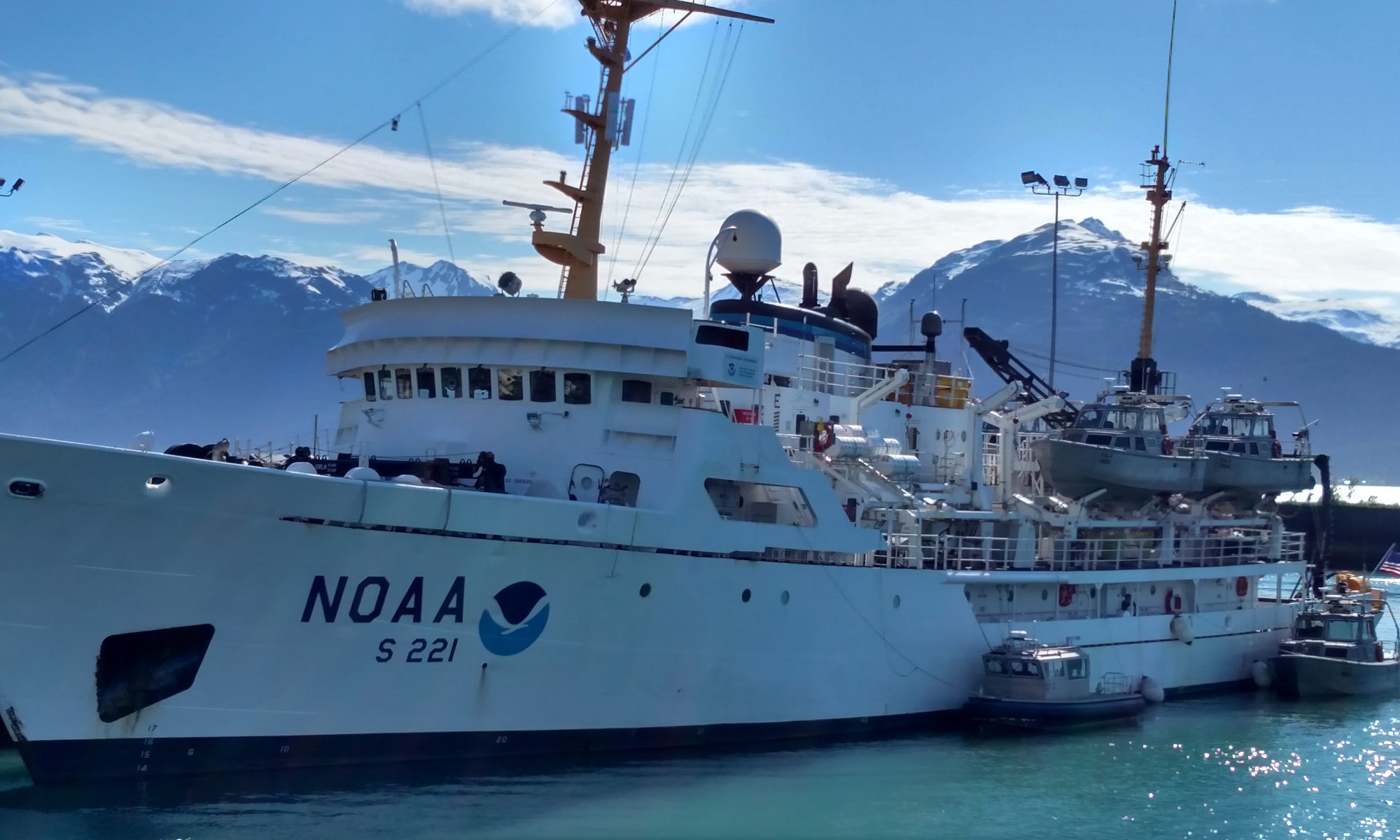
The Henry B. Bigelow is a specially-built NOAA vessel designed to conduct fisheries research at sea.  Its purpose is to collect data that will help scientists assess the health of the Northern Coastal Atlantic Ocean and the fish populations that inhabit it. The work is invaluable to the commercial fishing industry.

The Bigelow in port
The Bigelow in port

Yesterday, I learned how we will go about collecting fisheries data. Our Chief Scientist, Dr. Peter Chase, has selected  locations for sampling the local fish population and the ship officers have developed a sailing plan that will enable the ship to visit all those locations, weather permitting, during the course of the voyage. To me its sounds like a well-‐planned  game of connecting the dots. At each target location, a trawling net  will be deployed and dragged near the bottom of the sea for a 20 minute period at a speed of 3 knots. Hence the reason  this voyage is identified as a bottom trawl survey mission. To drag the bottom without damaging the nets is not easy and there are five spare nets on board in case something goes wrong. To minimize the chance of damaging the net during a tow, the survey technicians use the wide beam sonar equipment to survey the bottom prior to deployment. Their goal is to identify a smooth path for the net to follow. The fish collected in the net are sorted and studied, based on selected criteria, once on board. A  specially designed transport system moves the fish from the net to the sorting and data collection stations inside the wet lab. I’m very excited to see how it actually works during my upcoming shift.

The big net.
The big net.

Work is already underway when our night crew checks in. The ship runs 24/7  and the nets have been down  and trawling since 7pm. Fish sorting and data collection  are  already underway.  I don my foul  weather gear which  looks  like a set of waders used for British fly fishing.  There is also a top jacket  but the weather is pleasant  tonight and the layer is not needed. I just need to sport some gloves and get to work. I’m involved with processing  two trawls of fish right away. I’m assigned to work with an experienced member of the science team, Jakub. We will be collecting information on the species of fish caught on each trawl.  Jakub carries out the role as cutter, collecting the physical  information or fish parts needed by the scientists. My role is recorder and  I enter data about the particular fish  being evaluated  as well package up  and  store the parts of the fish  being retained  for future study.

Ship equipment
Ship equipment

Data collection on each fish harvest is a very detailed. Fish are sorted by species as they come down the moving sorting line where they arrive after coming up the conveyer belt system from the “dump”  tank, so  named  because that is where the full nets deposit their  bounty. Everybody on the line sorts fish. Big fish get  pulled off  first  by the experienced scientists at  the start  of  belt  and then volunteers such as I pull off the smaller fish. Each  fish  is placed  into  a bucket by type of fish. There are three types of buckets and each bucket has a  bar code  tag. The  big laundry  looking  baskets  hold  the  big  fish,  five  gallon  paint buckets hold  the smaller fish, and  one gallon  buckets (placed  above the sorting line) hold  the unexpected  or small species. On  each  run  there is generally one fish  that is not sorted  and  goes all the way to the end untouched and unceremoniously ends up in the catch-‐all container at the  end of the  line. The watch leader weighs the buckets and then links the bar code on the bucket to the type of fish in it. From there  the  buckets are  ready for data  collection.

Clark Log 1d
The sorting line

After sorting the fish, individual data collection begins “by the bucket” where simultaneously at three different stations the sizing, weighing, and computer requested activities  occur. By  random sample certain work  is  performed on that fish. It  gets weighed and usually opened up to retrieve something from inside the fish. Today, I’ve observed several types of  data collection. Frequently requested are removal of  the otolith, two small bones in the head that  are used to help determine the age of  the fish. For bigger fish with vertebra,  such  as  the  goose  fish,  there  are periodic  requests  to  remove a  part  of  the backbone and  ship  it off for testing. Determining sex is recorded  for many computer tagged  fish  and  several are checked stomach contents.

Of the tools used to record data from the fish, the magic magnetized measuring system is the neatest. It’s  rapid  fire  data  collecting  at  its  finest.  The  fish  goes  flat  on  the measuring  board;  head  at  the  zero point, and  then a quick touch  with  a magnetized block at the end  of the fish  records the length  and  weight. Sadly, it marks the end of tall tales about the big  one that got  away and keeps getting bigger as the story is retold. The length of  the specimen is accurately recorded for  posterity in an instant.


clark 1e

Personal Log

Flying into Providence  over the  end of Long Island and the  New England coast line  is breath taking. A jagged,  sandy  coast  line  dotted  with  summer  homes  just  beyond  the  sand dunes. To line  up  for  final  approach we  fly right over Newport where  the  Henry B. Bigelow is berthed at the  Navy base  there. However, I  am  not  able  to  spot  the  NOAA  fisheries  vessel that  will be my home for the next two weeks from the air.Clark Log 4b

I arrive a day prior  to sailing so I have half a day to see the sites of Newport, Rhode Island  and  I know exactly where  I’m headed – the Tennis Hall of  Fame. My father was a first class tennis player who invested  many  hours  attempting  to  teach  his  son  the  game.  Despite  the  passion in  our  home  for  the great sport we  never made  it to the  Tennis Hall of Fame in Newport. Today I fulfilled that bucket  list  goal. I still remember being  court side  as a  young boy at The  Philadelphia  Indoor Championship watching the likes of  Charlie Pasarell, Arthur  Ashe, and Pancho Gonzales playing  on the canvas tennis court that was stretched out over the basketball arena. Also  in  the museum, to  my surprise, was a picture of the grass court lawn of the  Germantown Cricket Club from its days as a USTA championship venue. I  grew up playing on  those  grass tennis courts as my father  belonged to that  club. After seeing that picture, I left the museum knowing my father  got  as much out  of  the visit  as I did.

Sue Cullumber: Hooray, We Are Finally on Our Way! June 10, 2013

NOAA Teacher at Sea
Sue Cullumber
Onboard NOAA Ship Gordon Gunter
June 5–24, 2013

Mission: Ecosystem Monitoring Survey
Date: 6/10/13
Geographical area of cruise:  The continental shelf from north of Cape Hatteras, NC, including Georges Bank and the Gulf of Maine, to the Nova Scotia Shelf

Weather Data from the Bridge:
Time:  21:30 (9:30 pm)
Longitude/latitude: 40.50289N, 68.76736W
Temperature  14.1ºC
Barrometer 1017.35 mb
Knots  10.2

sueleavingport
Leaving Newport – photo by Chris Melrose.

Science and Technology Log:

After several ship issues, we were able to finally head out from Newport, RI on June 9th after 4 extra days in dock.  We have started the survey and are using two main types of equipment that we will deploy at the various stations: CTD/Bongo Nets and CTD Rosette Stations.  We were originally scheduled to visit about 160 stations, but due to the unforeseen ship issues, these may have to be scaled back.  Some of the stations will just be the Bongo and others only the Rosette, but some will include both sets of equipment.

Bongos
Bongo and baby bongos being deployed during the survey.

A bongo net is a two net system that basically, looks like a bongo drum.  It is used to bring up various types of plankton while a CTD is mounted above it on the tow wire to test for temperature, conductivity and depth during the tow. The two nets may have different sizes of mesh so that it will only  filter the various types of plankton based on the size of the holes.  The small mesh is able to capture the smaller phytoplankton, but the larger zooplankton (animals) can dart out of the way and avoid being captured. The larger mesh is able to catch the zooplankton but allows the phytoplankton to go through the openings. There are regular bongo nets and also baby bongo nets that may be launched at the same time to catch different types of plankton.

rosetteinwater
Rosette CTD returning to the surface.

The Rosette CTD equipment is a series of 10 cylinders that can capture water from different depths to test for nutrient levels and dissolved inorganic carbon, which provides a measure of acidity in the ocean. These are fired remotely via an electronic trigger that is programed by a computer program where each cylinder can be fired seperately to get 10 samples from different depths.  It also has several sensors on it to measure oxygen, light and chlorophyll levels, as well as temperature and salinity (salt) from the surface to the bottom of the water column.

plankton
Copepods and Krill from one of the bongo net catches.

Our first station was about 3 1/2 hours east of Newport, RI and it was a Bongo Station.  I am on the noon to midnight shift each day.  So on our first day, during my watch, we made four Bongo stops and two CTD Rosettes. Today we completed more of the Bongos on my watch.  We are bringing up a variety of zooplankton like copepods, ctenophores, krill, and some fish larvae.  We have also seen quite a bit of phytoplankton on the surface of the water.

sueinsurvivalw
Wearing the survival suit – photo by Cathleen Turner.

Personal Log:

Being on a ship, I have to get used to the swaying and moving about.  It is constantly rocking, so it can be a little challenging to walk around.  I have been told that I will get used to this and it is actually great when you want to go to sleep!  Luckily I have not had any sea sickness yet and I hope that continues!  We completed several safety drills that included a fire drill and abandon ship drill where we had to put on our survival suits – now I look like a New England Lobster!

dolphinsfav
Common dolphins swimming off the ship’s bow.
blueshark
Blue shark swimming beside the Gordon Gunter.

Today was an amazing day – was able to see Right Whales, Blue Sharks and Common Dolphins – with the dolphins surfing off the ship’s bow!  The Northern Right Whale is one of the most endangered species on the planet with only 300 left in the wild.  One of the reasons there are so few left is that swim on the surface and were excessively hunted and there feeding areas were within the Boston shipping lanes, so they were frequently hit by ships. Recently these shipping lanes have been moved to help protect these animals.  So I feel very privileged to have been able to see one!

Did you know? Plankton are the basis for the ocean food web.  They are plentiful, small, and free floating (they do not swim). The word plankton comes from the Greek word “planktos” which means drifting. “Plankton” from the TV show SpongeBob is actually a Copepod – a type of zooplankton.

Copepod
Copepod

Question of the day:  Why do you think it is important that the scientists study plankton?

Anne Byford, June 11, 2010

NOAA Teacher at Sea
Anne Byford
Aboard R/V Hugh R. Sharp
June 8 – 15, 2010

Mission: Sea Scallop Survey
Geographic Location:  off the coast of New England
June 11, 2010

Weather Data at 1:35pm
EDT: Clear, 14.4˚C
Location at 1:35pm
EDT: Lat: 40 30.07 N
Long: 69 08.66 W
Water Depth: 77.5 m
4th Day at Sea

Why Count Sea Scallops?

That had to be the most common question I got asked before coming on this trip. Much of the information below is from the NOAA FishWatch website (www.nmfs.noaa.gov/fishwatch/species/atl_sea_scallop.htm).

Economically, sea scallops are an important species; in 2008 the scallop harvest was about 53.5 million pounds and was worth about $370 million. The population is not currently considered to be overfished and has been above minimum sustainable levels since 2001. Formal management began in 1982 with the Atlantic Sea Scallop Fisheries Management Plan. The management plan includes limiting new permits, restrictions on gear and on the number of crew on a boat. Since about 2000, the biomass of scallops has been increasing. Biomass is estimated by using the weight of scallops per tow on cruises like this one. Combinations of biomass estimates and estimates of the commercial catch are used to update and adjust the management plan.

Sea Scallops (Placopecten magellanicus) are filter feeders. They can live up to 20 years and begin reproducing at about 2 years, with maximum fertility reached at 4 years. A single female scallop can produce up to 270 million eggs in her life. This high reproductive capacity has helped the scallop population recover relatively quickly. Gender can be determined by the color of the gonad; females are orange while the male gonad is white. Adult scallops average between 6 and 7 inches from hinge to tip (called height) but can be as big as 9 inches. Age can be estimated by counting the rings on the shell. Scallops can “swim” by opening and closing the two shells. This is a useful adaptation for escaping from predators, including flounder, cod, lobsters, crabs, and sea stars. Scallops are harvested for the adductor muscle (the one that opens and closes the shell). There is no commercial aquaculture of scallops in the US as of August 2009.

scallop dorsal and ventral

Personal Log

A storm moved through beginning on Wed. evening (day 2) and stayed with us most of Thursday. By the end of shift on Wednesday, we were working on deck in full foul weather gear and life jackets. Thursday we had an 8 hour steam between dredge sites and by the end of shift on Thursday, the seas had begun to smooth out. Friday was quite nice, weather-wise.

I am learning to shuck scallops, though I am about half the speed of many on the boat. I am also learning to tell the various types of flounder and other fish apart as well. It’s not always obvious which type of founder or hake is which.

New Species

Goose fish (aka monk fish), several more varieties of flounder, sea urchins, sea cucumbers, eel pout, some very large skates, 3 types of sea stars and 1 type of brittle star.

Barbara Koch, October 3, 2010

NOAA Teacher at Sea Barbara Koch
NOAA Ship Henry B. Bigelow
September 20-October 5, 2010

Mission: Autumn Bottom Trawl Survey Leg II
Geographical area of cruise: Southern New England
Date: Tuesday, October 3, 2010

Weather from the Bridge
Latitude 39.72
Longitude -72.16
Speed 11.30 kts
Course 289.00
Wind Speed 25.11 kts
Wind Dir. 69.68 º
Surf. Water Temp. 19.78 ºC
Surf. Water Sal. 33.94 PSU
Air Temperature 16.40 ºC
Relative Humidity 71.00 %
Barometric Pres. 1016.80 mb
Water Depth 121.67 m
Cruise Start Date 10/02/2010

Science and Technology Log

Safety is very important on NOAA Ship Henry B. Bigelow. We participated in a Fire Drill and an Abandon Ship drill today. Each person on board is assigned a location to “muster” (gather) in case of emergencies. For a fire drill, all scientists are to carry their life vest and survival suit and muster in the lounge directly across from my stateroom. Life vests and survival suits are kept in the staterooms, so we are to grab those and get to the lounge as quickly as possible.

Fire drill
Fire drill

The fire drill began while the day watch was in the wet lab, one level below my stateroom. The scenario was that there was a “fire” on the 01 deck beside the lounge. That was right where my stateroom and the lounge were! Since we couldn’t get to our staterooms to gather our survival suits and life vests or muster in the lounge, due to the “fire,” we grabbed extra life vests and suits from the wet lab and mustered in the mess hall, which is near the wet lab.

Once everyone was accounted for during the fire drill, we moved out to the back deck of the ship for our Abandon Ship drill. Each person on board was assigned a life boat, and that is where we mustered for the Abandon Ship drill. First, we put on our life vests and made sure they were secured tightly. Next, we took off the life vests and put on our survival suits, which are often called “Gumby Suits” because they are large and look a lot like the animated Gumby character from the 1960’s. The survival suit is bright orange and is made out of neoprene. This makes the suit waterproof and very warm. The zipper and face flap are designed to keep water out, as well. Other features of the suits include reflective tape for greater visibility in the ocean, a whi8stle, a water-activated strobe light, a buddy line to attach to others, and an inflatable bladder behind the head to lift one’s head out of the water.

In my 'Gumby' suit
In my ‘Gumby’ suit

Boots and mittens are attached so that all one has to do is jump into the suit and zip it up. It’s not that easy, however. The arm cuffs are very tight, so it takes some strength to push your hands through. It also takes strength to pull the zipper all the way up to the center of your face. All personnel aboard the ship must be able to put this suit on and abandon ship in one minute. I was able to put my suit on in the allotted time, but we didn’t have to abandon the ship during the drill.

My stateroom
My stateroom

Personal Log

Living on a ship is an interesting experience. Space is at a premium, but the Henry B. Bigelow is actually quite comfortable. The scientists told me that this ship has a lot more amenities than some of the other research ships. My stateroom is small and narrow, but roommates are normally working on separate watches, so no one feels cramped or without personal space. You can see in this photo that the room has two bunk beds. Mine is on top, and it has been a fun challenge trying to get in and out of bed when the ship is rocking! I haven’t fallen yet! Each bunk has a curtain that can be pulled closed to darken your sleeping area, if you are sleeping during daylight hours. There is also a desk with latched drawers, so they don’t fly open when the ship is in rough waters. Bungee cords are attached to the walls and desks to hold chairs and large items in place, too. It’s important to keep everything tied down and in the locker so it doesn’t role around and get damaged, or make noise. I learned the importance of that my first night on rough seas when hangers were banging in my locker.

The Head
The Head

My stateroom also has its own “head” (bathroom). The term “head” comes from long ago when boats were powered by the wind. Sailors had a grated area at the front or “bow” of the boat where they could use the bathroom. It was at the front of the boat so bad odors would blow away from the rest of the ship. The figurehead was also attached at the front, so it became common practice to refer to that area as the “head.” The head in my room has a toilet that flushes, and is much nicer than the heads of days gone by, thank goodness!

These are all great amenities, but the best part of my stateroom is the view! First thing every morning, I pull back the curtain to see what’s going on outside. One morning I saw several dolphins jumping out of the water as they moved swiftly toward our ship. Most days, I’ve seen fog, rain, and roiling waves, but I still enjoy looking out and seeing nothing but water as far as the eye can see, and sometimes, a beautiful sunset.

Sunset
Sunset