Emily Whalen: Looking at Lobsters, Moving a 208-foot Boat, and Favorite Creatures, May 5, 2015

NOAA Teacher at Sea
Emily Whalen
Aboard NOAA Ship Henry B. Bigelow
April 27 – May 10, 2015

Mission: Spring Bottom Trawl Survey, Leg IV
Geographical Area of Cruise: Gulf of Maine

Date: May 5, 2015

Weather Data:
Air Temperature:  8.4°C
Water Temperature: 5.1ºC
Wind:  15 knots NW
Seas:  1-2 feet

Science and Technology Log:

Lobsters!

This is a large female lobster.  The claw on the right is called the crusher and the claw on the left is called the ripper.  For scale, consider that this lobster is inside a standard 5-gallon bucket!
This is a large female lobster. The claw on the right is called the crusher and the claw on the left is called the pincer. For scale, consider that this lobster is inside a standard 5-gallon bucket!

Not everything that comes up in the net is a fish.  One of the things that we have caught many of on this trip is Homarus americanus, commonly known as the lobster.  Lobsters are invertebrates, which means they don’t have a backbone or an internal skeleton.  Instead, they have a hard outer shell called an exoskeleton to give their body structure and protect their inner organs.  Because their exoskeleton cannot expand as the lobster grows, a lobster must molt, or shed its shell periodically as it gets bigger.  In the first few years of their lives, lobsters need to molt frequently because they are growing quickly.  More mature lobsters only molt yearly or even every few years.

Another interesting fact about lobsters can regenerate lost body parts.  After a claw or leg is lost, the cells near the damaged area will start to divide to form a new appendage.  The developing structure is delicate and essentially useless while it is growing, but after a few molts, it will be fully functional.

This lobster lost a claw and is in the early stages of regenerating it.  What challenges do you think a single-clawed lobster might face?
This lobster lost a claw and is in the early stages of regenerating it. What challenges do you think a single-clawed lobster might face?
This is a lobster  that has almost completed regenerating a lost claw.
This is a lobster that has almost completed regenerating a lost claw.
This is a lobster with two fully functional claws.  Why do you think each claw has a different shape?
This is a lobster with two fully functional claws. Why do you think each claw has a different shape?

When we catch lobsters, we measure and record the distance from their eye cavity to the posterior end of the carapace.  Many of the lobsters we have caught are similar in size to those you would find at the grocery store, which typically weigh about a little more than pound.  Commercial fishermen can only keep male lobsters that are over 101 millimeters.  Can you guess why?  We have seen some smaller lobsters that measure about 50 millimeters, and also some much larger lobsters that measure as much as 150 millimeters!

These are the calipers used to measure the carapace of each lobster.
This is one of the larger lobsters that we have seen.  Some lobsters can live to be over a hundred, although everyone's best estimate for this one was about 20 years.  I put my hand next to the claw for scale.
This is one of the larger lobsters that we have seen. Some lobsters can live to be over a hundred, although everyone’s best estimate for this one was about 20 years. I put my hand next to the claw so that you could see how big it is!  I wasn’t brave enough to put my hand any closer!

One of the members of my watch is Dr. Joe Kunkel, who is doing something called ‘landmark analysis’ on some of the lobsters that we have caught.  This process involves recording the exact location of 12 specific points on the carapace or shell of each lobster.  Then he compares the relative geometry different lobsters to look for trends and patterns.  In order to do this, he uses a machine called a digitizer.  The machine has a small stylus and a button.  When you push the button, it records the x, y and z position of the stylus.  Once the x,y and z position of all 12 points has been recorded, they are imported into a graphing program that creates an individual profile for each lobster.

Here I am using a digitizer to pinpoint 12 different landmarks on this lobsters carapace, or shell.   So far, the offshore lobsters seem to have different geometry than the onshore lobsters, even though they are the same species.
Here I am using a digitizer to pinpoint 12 different landmarks on this lobsters carapace, or shell. So far, the offshore lobsters seem to have different geometry than the onshore lobsters, even though they are the same species.

So far, it appears that lobsters that are caught inshore have different geometry than lobsters that are caught further offshore.  Typically, an organism’s shape is determined by its genes.  Physical variations between organisms can be the result of different genes, environmental factors or physiological factors like diet or activity.  Dr. Kunkel doesn’t have a certain explanation for the differences between these two groups of lobsters, but it may suggest that lobsters have different activity levels or diet depending on whether they live near the shore our out in deeper waters.  In recent years, a shell disease has decimated lobster populations south of Cape Cod.  This study may give us clues about the cause of this disease, which could someday affect the lobster fishery.

This is a grid that represents the digitization of a lobster.
This is a grid that represents the digitization of a lobster.  The single point on the right hand side represents the rostrum, which is analogous to the nose, and the two points furthest to the left represent the place where the carapace or shell meets the tail.

Moving Forward

In order to move from station to station as we complete our survey, the Bigelow has a powerful propulsion system different from most other types of ships.  Typically, a ship has an engine that burns diesel fuel in order to turn a shaft.  To make the ship move forward (ahead) or backward (astern), the clutch is engaged, which causes the shaft to spin the propeller.  The throttle can then be used to make the shaft spin faster or slower, which speeds up or slows down the boat.   Throttling up and down like this affects the amount of fuel burned.  For those of you who are new drivers, this is similar to how your car gets better or worse gas mileage depending on what type of driving you are doing.

Like this class of ship, the Bigelow has a giant propeller at the stern which is 14 feet across and has 5 blades.  However, the unlike most ships, the propeller on the Bigelow is powered by electricity instead of a combustion engine.  There are four electricity-producing generators on the ship, two large and two small.  The generators burn diesel fuel and convert the stored energy into electricity.  The electricity powers two electric motors, which turn the propeller. While the electricity produced powers the propeller, it is also used for lights, computers, pumps, freezers, radar and everything else on the ship.  There are several benefits to this type of system.  One is that the generators can run independently of each other. Running two or three generators at a time means the ship makes only as much electricity as it needs based on what is happening at the time, so fuel isn’t wasted.  Since the ship can speed up or slow down without revving the engine up or down, the generators can always run at their maximum efficiency.
Also, there is much finer control of the ship’s speed with this system.  In fact, the ship’s speed can be controlled to one tenth of a knot, which would be similar to being able to drive your car at exactly 30.6 or 30.7 mph.  Finally, an added benefit is that the whole system runs quietly, which is an advantage when you are scouting for marine mammals or other living things that are sensitive to sound.

Personal Log

I have seen a lot of fish on this trip, but it would be a lie to say that I don’t have some favorites.  Here are a few of them.  Which one do you think is the coolest?

This is a sea raven.  Most of them are brown and green, but this one was a brilliant yellow.
This is a sea raven. Most of the ones we have seen are  brown and green, but this one was a brilliant yellow
Windowpane flounder.  We have seen many types of flounder, but I think these look the coolest.
Windowpane flounder. We have seen many types of flounder, but I think these are the coolest.
Last night we caught 1,700 kilograms of mackerel like these on the Scotian Shelf!
I find the pattern on this cod particularly striking.
How can you not love this little spoonarm octopus?
This is a particularly colorful four-beard rockling!
This immature cusk eel will lose these colors and eventually grow to be a dull grey color.
These squid have chromatophores, which are cells that can change color.  You can see them in this picture as the reddish purple dots.
These squid have chromatophores, which are cells that can change color. You can see them in this picture as the reddish purple dots.
This lamprey eel has circular rasping teeth that it uses to burrow into its prey.  Even as they ride along the conveyor belt, they are trying to bite into an unsuspecting fish!
This Atlantic hagfish has circular rasping teeth that it uses to burrow into its prey. Even as they ride along the conveyor belt, they are trying to bite into an unsuspecting fish!
You can see the gills of this goosefish by looking deep into its mouth.  This fish has a giant mouth that allows it to each huge meals.  Some of the goosefish we catch have stomachs that are larger than their whole bodies!
You can see the gills of this goosefish by looking deep into its mouth. This fish has a giant mouth that allows it to each huge meals. Some of the goosefish we catch have stomachs that are larger than their whole bodies!
We have only seen one of these little blue lumpfish.  While most fish feel slippery and slimy, this one has a rough skin.
We have only seen one of these little blue lumpfish. While most fish feel slippery and slimy, this one has a rough skin.

Emily Whalen: Station 381–Cashes Ledge, May 1, 2015

NOAA Teacher at Sea
Emily Whalen
Aboard NOAA Ship Henry B. Bigelow
April 27 – May 10, 2015

Mission: Spring Bottom Trawl Survey, Leg IV
Geographical Area of Cruise: Gulf of Maine

Date: May 1, 2015

Weather Data from the Bridge:
Winds:  Light and variable
Seas: 1-2ft
Air Temperature:   6.2○ C
Water Temperature:  5.8○ C

Science and Technology Log:

Earlier today I had planned to write about all of the safety features on board the Bigelow and explain how safe they make me feel while I am on board.  However, that was before our first sampling station turned out to be a monster haul!  For most stations I have done so far, it takes about an hour from the time that the net comes back on board to the time that we are cleaning up the wetlab.  At station 381, it took us one minute shy of three hours! So explaining the EEBD and the EPIRB will have to wait so that I can describe the awesome sampling we did at station 381, Cashes Ledge.

This is a screen that shows the boats track around the Gulf of Maine.  The colored lines represent the sea floor as determined by the Olex multibeam.  This information will be stored year after year until we have a complete picture of the sea floor in this area!
This is a screen that shows the boats track around the Gulf of Maine. The colored lines represent the sea floor as determined by the Olex multibeam. This information will be stored year after year until we have a complete picture of the sea floor in this area!

Before I get to describing the actual catch, I want to give you an idea of all of the work that has to be done in the acoustics lab and on the bridge long before the net even gets into the water.

The bridge is the highest enclosed deck on the boat, and it is where the officers work to navigate the ship.  To this end, it is full of nautical charts, screens that give information about the ship’s location and speed, the engine, generators, other ships, radios for communication, weather data and other technical equipment.  After arriving at the latitude and longitude of each sampling station, the officer’s attention turns to the screen that displays information from the Olex Realtime Bathymetry Program, which collects data using a ME70 multibeam sonar device attached to bottom of the hull of the ship .

Traditionally, one of the biggest challenges in trawling has been getting the net caught on the bottom of the ocean.  This is often called getting ‘hung’ and it can happen when the net snags on a big rock, sunken debris, or anything else resting on the sea floor.  The consequences can range from losing a few minutes time working the net free, to tearing or even losing the net. The Olex data is extremely useful because it can essentially paint a picture of the sea floor to ensure that the net doesn’t encounter any obstacles.  Upon arrival at a site, the boat will cruise looking for a clear path that is about a mile long and 300 yards wide.  Only after finding a suitable spot will the net go into the water.

Check out this view of the seafloor.  On the upper half of the screen, there is a dark blue channel that goes between two brightly colored ridges.  That's where we dragged the net and caught all of the fish!
Check out this view of the seafloor. On the upper half of the screen, there is a dark blue channel that goes between two brightly colored ridges. We trawled right between the ridges and caught a lot of really big fish!

The ME70 Multibeam uses sound waves to determine the depth of the ocean at specific points.  It is similar to a simpler, single stream sonar in that it shoots a wave of sound down to the seafloor, waits for it to bounce back up to the ship and then calculates the distance the wave traveled based on the time and the speed of sound through the water, which depends on temperature.  The advantage to using the multibeam is that it shoots out 200 beams of sound at once instead of just one.  This means that with each ‘ping’, or burst of sound energy, we know the depth at many points under the ship instead of just one.  Considering that the multibeam pings at a rate of 2 Hertz to 0.5 Herts, which is once every 0.5 seconds to 2 seconds, that’s a lot of information about the sea floor contour!

This is what the nautical chart for Cashes Ledge looks like. The numbers represent depth in fathoms.  The light blue lines are contour lines.  The places where they are close together represent steep cliffs.  The red line represents the Bigelow’s track. You can see where we trawled as a short jag between the L and the E in the word Ledge

The stations that we sample are randomly selected by a computer program that was written by one of the scientists in the Northeast Fisheries Science Center, who happens to be on board this trip.  Just by chance, station number 381 was on Cashes Ledge, which is an underwater geographical feature that includes jagged cliffs and underwater mountains.  The area has been fished very little because all of the bottom features present many hazards for trawl nets.  In fact, it is currently a protected area, which means the commercial fishing isn’t allowed there.  As a research vessel, we have permission to sample there because we are working to collect data that will provide useful information for stock assessments.

My watch came on duty at noon, at which time the Bigelow was scouting out the bottom and looking for a spot to sample within 1 nautical mile of the latitude and longitude of station 381.  Shortly before 1pm, the CTD dropped and then the net went in the water.  By 1:30, the net was coming back on board the ship, and there was a buzz going around about how big the catch was predicted to be.  As it turns out, the catch was huge!  Once on board, the net empties into the checker, which is usually plenty big enough to hold everything.  This time though, it was overflowing with big, beautiful cod, pollock and haddock.  You can see that one of the deck crew is using a shovel to fill the orange baskets with fish so that they can be taken into the lab and sorted!

You can see the crew working to handling all of the fish we caught at Cashes Ledge.  How many different kinds of fish can you see?
You can see the crew working to handling all of the fish we caught at Cashes Ledge. How many different kinds of fish can you see? Photo by fellow volunteer Joe Warren


At this point, I was standing at the conveyor belt, grabbing slippery fish as quickly as I could and sorting them into baskets.  Big haddock, little haddock, big cod, little cod, pollock, pollock, pollock.  As fast as I could sort, the fish kept coming!  Every basket in the lab was full and everyone was working at top speed to process fish so that we could empty the baskets and fill them up with more fish!  One of the things that was interesting to notice was the variation within each species.  When you see pictures of fish, or just a few fish at a time, they don’t look that different.  But looking at so many all at once, I really saw how some have brighter colors, or fatter bodies or bigger spots.  But only for a moment, because the fish just kept coming and coming and coming!

Finally, the fish were sorted and I headed to my station, where TK, the cutter that I have been working with, had already started processing some of the huge pollock that we had caught.  I helped him maneuver them up onto the lengthing board so that he could measure them and take samples, and we fell into a fish-measuring groove that lasted for two hours.  Grab a fish, take the length, print a label and put it on an envelope, slip the otolith into the envelope, examine the stomach contents, repeat.

Cod, pollock and haddock in baskets
Cod, pollock and haddock in baskets waiting to get counted and measured. Photo by Watch Chief Adam Poquette.

Some of you have asked about the fish that we have seen and so here is a list of the species that we saw at just this one site:

  • Pollock
  • Haddock
  • Atlantic wolffish
  • Cod
  • Goosefish
  • Herring
  • Mackerel
  • Alewife
  • Acadian redfish
  • Alligator fish
  • White hake
  • Red hake
  • American plaice
  • Little skate
  • American lobster
  • Sea raven
  • Thorny skate
  • Red deepsea crab


I think it’s human nature to try to draw conclusions about what we see and do.  If all we knew about the state of our fish populations was based on the data from this one catch, then we might conclude that there are tons of healthy fish stocks in the sea.  However, I know that this is just one small data point in a literal sea of data points and it cannot be considered independently of the others.  Just because this is data that I was able to see, touch and smell doesn’t give it any more validity than other data that I can only see as a point on a map or numbers on a screen.  Eventually, every measurement and sample will be compiled into reports, and it’s that big picture over a long period of time that will really allow give us a better understanding of the state of affairs in the ocean.

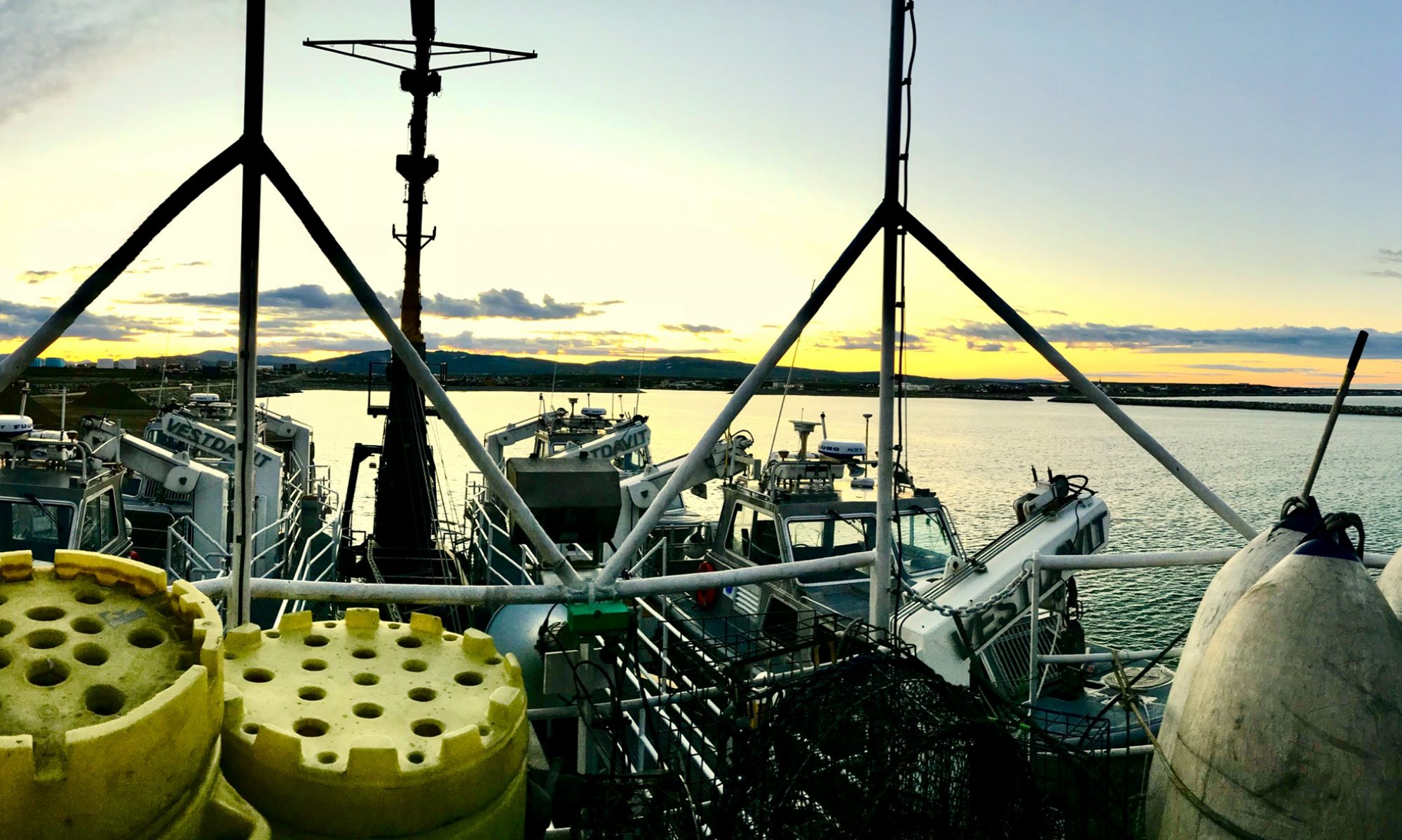
Sunset from the deck of the Henry B. Bigelow

Personal Log

Lunges are a bit more challenging on the rocking deck of a ship!

It seems like time is passing faster and faster on board the Bigelow.  I have been getting up each morning and doing a Hero’s Journey workout up on the flying bridge.  One of my shipmates let me borrow a book that is about all of the people who have died trying to climb Mount Washington.  Today I did laundry, and to quote Olaf, putting on my warm and clean sweatshirt fresh out of the dryer was like a warm hug!  I am getting to know the crew and learning how they all ended up here, working on a NOAA ship.  It’s tough to believe but a week from today, I will be wrapping up and getting ready to go back to school!

Emily Whalen: Trawling in Cape Cod Bay, April 29, 2015

NOAA Teacher at Sea
Emily Whalen
Aboard NOAA Ship Henry B. Bigelow
April 27 – May 10, 2015

Mission: Spring Bottom Trawl Survey, Leg IV
Geographical Area of Cruise: Gulf of Maine

Date: April 29, 2015

Weather Data:
GPS location:  4251.770’N, 07043.695’W
Sky condition:  Cloudy
Wind: 10 kts NNW
Wave height: 1-2 feet
Water temperature:  6.2○ C
Air temperature:  8.1○ C

Science and Technology Log:

On board the Henry B. Bigelow we are working to complete the fourth and final leg of the spring bottom trawl survey. Since 1948, NOAA has sent ships along the east coast from Cape Hatteras to the Scotian Shelf to catch, identify, measure and collect the fish and invertebrates from the sea floor. Scientists and fishermen use this data to assess the health of the ocean and make management decisions about fish stocks.

What do you recognize on this chart?  Do you know where Derry, NH is on the map?
This is the area that we will be trawling. Each blue circle represents one of the sites that we will sample. We are covering a LOT of ground! Image courtesy of NOAA.

Today I am going to give you a rundown of the small role that I play in this process. I am on the noon to midnight watch with a crew of six other scientists, which means that we are responsible for processing everything caught in the giant trawl net on board during those hours. During the first three legs of the survey, the Bigelow has sampled over 300 sites. We are working to finish the survey by completing the remaining sites, which are scattered throughout Cape Cod Bay and the Gulf of Maine.  The data collected on this trip will be added to data from similar trips that NOAA has taken each spring for almost 60 years.  These huge sets of data allow scientists to track species that are dwindling, recovering, thriving or shifting habitats.

The CTD ready to deploy.

At each sampling station, the ship first drops a man-sized piece of equipment called a CTD to the sea floor. The CTD measures conductivity, temperature and depth, hence its name.  Using the conductivity measurement, the CTD software also calculates salinity, which is the amount of dissolved salt in the water.  It also has light sensors that are used to measure how much light is penetrating through the water.

While the CTD is in the water,  the deck crew prepares the trawl net and streams it from the back of the ship.  The net is towed by a set of hydraulic winches that are controlled by a sophisticated autotrawl system.  The system senses the tension on each trawl warp and will pay out or reel in cable to ensure that the net is fishing properly.

Once deployed, the net sinks to the bottom and the ship tows it for twenty minutes, which is a little more than one nautical mile. The mouth of the net is rectangular so that it can open up wide and catch the most fish.  The bottom edge of the mouth has something called a rockhopper sweep on it, which is made of a series of heavy disks that roll along the rocky bottom instead of getting hung up or tangled.  The top edge of the net has floats along it to hold it wide open.   There are sensors positioned throughout the net that send data back to the ship about the shape of the net’s mouth, the water temperature on the bottom, the amount of contact with the bottom, the speed of water through the net and the direction that the water is flowing through the net.  It is important that each tow is standardized like this so that the fish populations in the sample areas aren’t misrepresented by the catch.   For example, if the net was twisted or didn’t open properly, the catch might be very small, even in an area that is teaming with fish.

Do you think this is what trawl nets looked like in 1948?
This is what the net looks like when it is coming back on board. The deck hands are guiding the trawl warps onto the big black spools. The whole process is powered by two hydraulic winches.

After twenty minutes, the net is hauled back onto the boat using heavy-duty winches.  The science crew changes into brightly colored foul weather gear and heads to the wet lab, where we wait to see what we’ve caught in the net. The watch chief turns the music up and everyone goes to their station along a conveyor belt the transports the fish from outside on the deck to inside the lab. We sort the catch by species into baskets and buckets, working at a slow, comfortable pace when the catch is small, or at a rapid fire, breakneck speed when the catch is large.

If you guessed 'sponges', then you are correct!
This is the conveyor belt that transports the catch from the deck into the wetlab. The crew works to sort things into buckets. Do you know what these chunky yellow blobs that we caught this time are?

After that, the species and weight of each container is recorded into the Fisheries Scientific Computing System (FSCS), which is an amazing software system that allows our team of seven people to collect an enormous amount of data very quickly. Then we work in teams of two to process each fish at work stations using a barcode scanner, magnetic lengthing board, digital scale, fillet knives, tweezers, two touch screen monitors, a freshwater hose, scannable stickers, envelopes, baggies, jars and finally a conveyor belt that leads to a chute that returns the catch back to the ocean.  To picture what this looks like, imagine a grocery store checkout line crossed with an arcade crossed with a water park crossed with an operating room.  Add in some music playing from an ipod and it’s a pretty raucous scene!

The data that we collect for each fish varies.  At a bare minimum, we will measure the length of the fish, which is electronically transmitted into FSCS.  For some fish, we also record the weight, sex and stage of maturity.  This also often includes taking tissue samples and packaging them up so that they can be studied back at the lab.  Fortunately, for each fish, the FSCS screen automatically prompts us about which measurements need to be taken and samples need to be kept.  For some fish, we cut out and label a small piece of gonad or some scales.  We collect the otoliths, or ear bones from many fish.

It does not look this neat and tidy when we are working!
These are the work stations in the wet lab. The cutters stand on the left processing the fish, and the recorders stand on the right.These bones can be used to determine the age of each fish because they are made of rings of calcium carbonate that accumulate over time.

Most of the samples will got back to the Northeast Fisheries Science Center where they will be processed by NOAA scientists.  Some of them will go to other scientists from universities and other labs who have requested special sampling from the Bigelow.  It’s like we are working on a dozen different research projects all at once!


Something to Think About:

Below are two pictures that I took from the flying bridge as we departed from the Coast Guard Station in Boston. They were taken just moments apart from each other. Why do you think that the area in the first picture has been built up with beautiful skyscrapers while the area in the second picture is filled with shipping containers and industry? Which area do you think is more important to the city? Post your thoughts in the comment section below.

Rows of shipping containers. What do you think is inside them?
Downtown Boston.  Just a mile from the shipping containers.  Why do you think this area is so different from the previous picture?
Downtown Boston. Just a mile from the shipping containers. Why do you think this area is so different from the previous picture?


Personal Log

Believe it or not, I actually feel very relaxed on board the Bigelow!  The food is excellent, my stateroom is comfortable and all I have to do is follow the instructions of the crew and the FSCS.  The internet is fast enough to occasionally check my email, but not fast enough to stream music or obsessively read articles I find on Twitter.  The gentle rocking of the boat is relaxing, and there is a constant supply of coffee and yogurt.  I have already read one whole book (Paper Towns by John Greene) and later tonight I will go to the onboard library and choose another.  That said, I do miss my family and my dog and I’m sure that in a few days I will start to miss my students too!

If the description above doesn’t make you want to consider volunteering on a NOAA cruise, maybe the radical outfits will.  On the left, you can see me trying on my Mustang Suit, which is designed to keep me safe in the unlikely event that the ship sinks.  On the right, you can see me in my stylish yellow foul weather pants.  They look even better when they are covered in sparkling fish scales!

Seriously, they keep me totally dry!
Banana Yellow Pants: SO 2015! Photo taken by fellow volunteer Megan Plourde.
Seriously, do I look awesome, or what?
This is a Mustang Suit. If you owned one of these, where would you most like to wear it? Photo taken by IT Specialist Heidi Marotta.

That’s it for now!  What topics would you like to hear more about?  If you post your questions in the comment section below, I will try to answer them in my next blog post.

John Clark,Headed Home Early, October 1, 2014

NOAA Teacher at Sea
John Clark
Aboard NOAA Ship Henry B. Bigelow
September 23 – October 4, 2013

Mission: Autumn Bottom Trawl Survey
Geographical Area of Cruise: North Atlantic
Date: October 1, 2013

Science and Technology  Log 

A few hours into our shift midnight we get the word we have been expecting for several days – government shutdown. Our mission will be cut a few days short. That reality means the Bigelow has 24 hours to return to its homeport of Newport,  R.I.  It takes us 10 hours and we dock around 1 in the afternoon. With our fisheries operations suddenly declared over comes clean-up time, and we spend the next 6 hours of our shift cleaning up the on‐board fish lab. It is a time consuming but important process. The lab needs to be spotless and “fish scent” free before we can call our work finished on this cruise.  The lab is literally solid stainless steel and every surface gets washed and suds downed so there is no residue remaining.

Eau de fishes
Fish scales hiding under a flap!

Our work is inspected by a member of the crew. If it were the military, the officer would have had white gloves on I believe, just like in the old movies, rolling his finger over a remote spot looking for the dust we missed. But this is a shining stainless steel fish lab so there are two simultaneous inspections going on at once – the one with the eyes and the one with the nose.  It takes us twice to pass the visual inspection as small collections of fish scales are spotted in a few out-of‐the way areas. It takes us one more pass to clear the smell inspection. Up and down the line we walk, we can all smell the faint lingering perfume of “eau de fishes,” but we are having trouble finding it. We keep following our noses and there it is. Hiding under a black rubber flap at the end of the fish sorting line we find a small collection of fish scales revealed  when the flap is removed for inspection.  With that little section cleaned up and sprayed down the lab is declared done! There is a smile of satisfaction from the team. It is that attention to detail that explains why the lab never smelled of fish when I first boarded the ship 10 days ago nor has it smelled of fish at any time during our voyage. There is a personal pride in leaving the lab in the same shape we found  it. Super clean, all gear and samples stowed, and ready for the next crew to come on board – whenever that turns out to be.

The abrupt and unexpected end to the cruise leaves me scrambling to change my travel plans. Like the ship, I have a limited amount of time to make it home on my government travel orders. The NOAA Teacher at Sea team goes above and beyond to rebook my flights and find me a room for the night.

Personal Log 

On the serendipitous side, the change in plans gives me a little time to see Newport, a town famous for its mansions and the Tennis Hall of Fame.  My first  stop is  the Tennis  Hall  of  Fame.  My father was a first class  tennis  player who invested many  hours  attempting to

teach his  son the game. Despite the passion in  our  home  for  the  great  sport  we  never  made it  to  the  Tennis  Hall  of  Fame in  Newport.  Today I get the  chance to fulfill that  bucket  list  goal. I still remember being court side as a young boy at The  Philadelphia Indoor Championships watching the likes of Charlie Pasarell, Arthur Ashe, and Pancho Gonzales playing on the canvas tennis court that was stretched out over the basketball arena. There was even a picture of the grass court lawn of the Germantown Cricket Club from its days a USTA championship venue before the move to Forest Hill, NY. I grew up playing on those tennis courts as my father belonged to that  club. Good memories.

Clark Log 4b

There was also a  “court tennis” court, the game believed to be the precursor  to outdoor  tennis. Court  tennis derived from playing a  tennis  type  game  inside a walled‐in  court yard.  Using  the  roof and  the  wall and the open side windows to beat your opponent is all part of the game. I played court tennis as a  young teen. It’s a very unique game that is only played in a few spots now. There are only 38 court tennis courts in the world and Newport has two of them. If you like tennis, give court tennis a go if  you ever get the  chance.

The tennis court

Thoughts of a leisurely stroll evolve into a brisk walk as I head toward the ultimate and most famous Newport mansion: The Breakers, the 100,000 plus square foot summer home of the Vanderbilt family. This house has to be toured to understand the conspicuous consumption as a  pastime of the then super rich. My 2000 square foot  home would fit entirely inside  the  grand  hall  of  the  Breakers.  In  fact you could stack my home three high and they would still be below the Breaker’s ceiling. A ceiling inspired by Paris, a billiard room with walls of solid marble overlooking the ocean, a floor of thousands of mosaic floor tiles all put  down by hand one by one, a stair case from Gone With the Wind, and 20 bathrooms to choose from all speak  to the wealth and pursuit of elegance enjoyed by  the Vanderbilt clan. It is a lifestyle of a bye–gone era often referred to as the “Gilded Age.” It is  an apt description.

Clark Log 4dClark Log 4e

Clark Log 4g

After sightseeing, it’s off to the bus stop for my shuttle to the Newport Airport where I take off at dawn the next morning to head for  home. I’m  leaving  so  early that the complementary coffee isn’t out yet! After an uneventful flight comes the end to an amazing adventure. Nothing left now except laundry and memories. And lots of great ideas for lesson plans to work into my classes. Thank you NOAA Teacher at Sea Program for offering me the learning experience of a lifetime. I cannot wait to get back and share the experiences with my students.

Clark Log 4h

John Clark, September 27, 2013

NOAA Teacher at Sea John Clark

Aboard NOAA Ship Henry B. Bigelow

September 23 – October 4, 2013

Clark Log 3gMission: Autumn Bottom Trawl Survey
Geographical Area of Cruise: North Atlantic
Date: September 27, 2013

Science and Technology  Log 

It’s going to be a busy night trawling and processing our catch.  Yippee. I like  being busy as the time passes more quickly and I learn about more fish. A large number of trawling areas are all clustered together for our shift. For the most part that means the time needed to collect data on one trawl is close to the amount of time needed for the ship to reach the next trawling area. The first trawl was a highlight for me as we collected, for the first time,  a few puffer fish and one managed to stay inflated so I had a picture taken with that one.

We found a puffer
We found a puffer

However, on this night there was more than just puffer fish to be photographed with. On this night we caught the big one that didn’t get away. One trawl brings in an amazing catch of 6 very large striped bass and among them is a new record: The largest striped bass ever hauled in by NOAA Fisheries! The crew let me hold it up. It was very heavy and  I kept hoping it would not start flopping around. I could just see myself letting go and watching it slip off the deck and back into the sea. Fortunately, our newly caught prize reacted passively to my photo op. I felt very lucky that the big fish was processed at the station I was working at. When Jakub put the big fish on the scale it was like a game show – special sounds were emitted from our speakers and out came the printed label confirming our prize  – “FREEZ – biggest fish ever “-‐-‐the largest Morone Saxatilis (striped bass) ever caught by a NOAA Fisheries research ship.  It was four feet long. I kept  waiting for the balloons to come down from the ceiling.

Catch of the day
Catch of the day

Every member of the science team sorts fish but at the  data  collection tables my role  in the  fish lab is one of “recorder”. I’m teamed  with  another scientist who serves  as  the “cutter”, in this  case Jakub. That person collects the information I enter into the computer. The amount of data collected  depends on  the quantity and  type of fish  caught in  the net. I help  record  data on length, weight, sex, sexual development, diet, and scales. Sometimes fish specimens or parts of a fish, like the backbone of a goose fish, are preserved. On other occasions, fish, often the small ones are frozen for further study. Not every scientist can make it on to the Bigelow to be directly part of the trip so species data and samples are collected in accordance with their requests.

Collecting data from a fish as large as our striped bass is not easy. It is as big as the processing sink at our data collection  station and it takes Jakub’s skill with a hacksaw-‐-‐yes I said hacksaw-‐-‐to open up the back of the head  of the striped  bass and retrieve  the  otolith, the  two small bones  found behind the head that are  studied to determine  age. When we  were  done, the fish was bagged and placed in the deep freeze for  further  study upon our return. On the good side we only froze one of the six striped bass that we caught so we got to enjoy some great seafood for dinner. The team filleted over 18 pounds of striped bass for the chef to cook up.

Too big for the basket

More Going On: 

Processing the  trawl is not the  only data  collection activity taking place on the  Bigelow.  Before most trawls begin the command comes down to “deploy the bongos”. They are actually a pair  of  closed end nets similar to nets used to catch butterflies only much longer. The name bongo comes from the deployment apparatus that holds the pair of nets. The top resembles a set of bongo drums with one net attached to each one. Their purpose, once deployed, is to collect plankton samples for further study. Many fish live off plankton until they are themselves eaten by a predator farther up the food chain so the health of plankton is critical to the success of  the ecological food chain in the oceans.

Processing
Processing

Before some other trawls, comes the command to deploy the CTD device. When submerged to a target  depth  and  running in  the water as the ship  steams forward, this long fire extinguisher sized  device measures conductivity and temperature at specified depths of the ocean. It is another tool for measuring the health of the ocean and how current water conditions can impact the health  of the marine life and also the food chain in the area.

Personal Log 

On a personal note, I filleted a fish for the first time today – a  flounder. Tanya, one  of the science crew taught me how to do it. I was so excited about the outcome that I did another one!

Processing fish
Processing fish

Clark Log 3gg

A mix of fish
A mix of fish
Paired trawl
Paired trawl
Learning to fillet
Learning to fillet