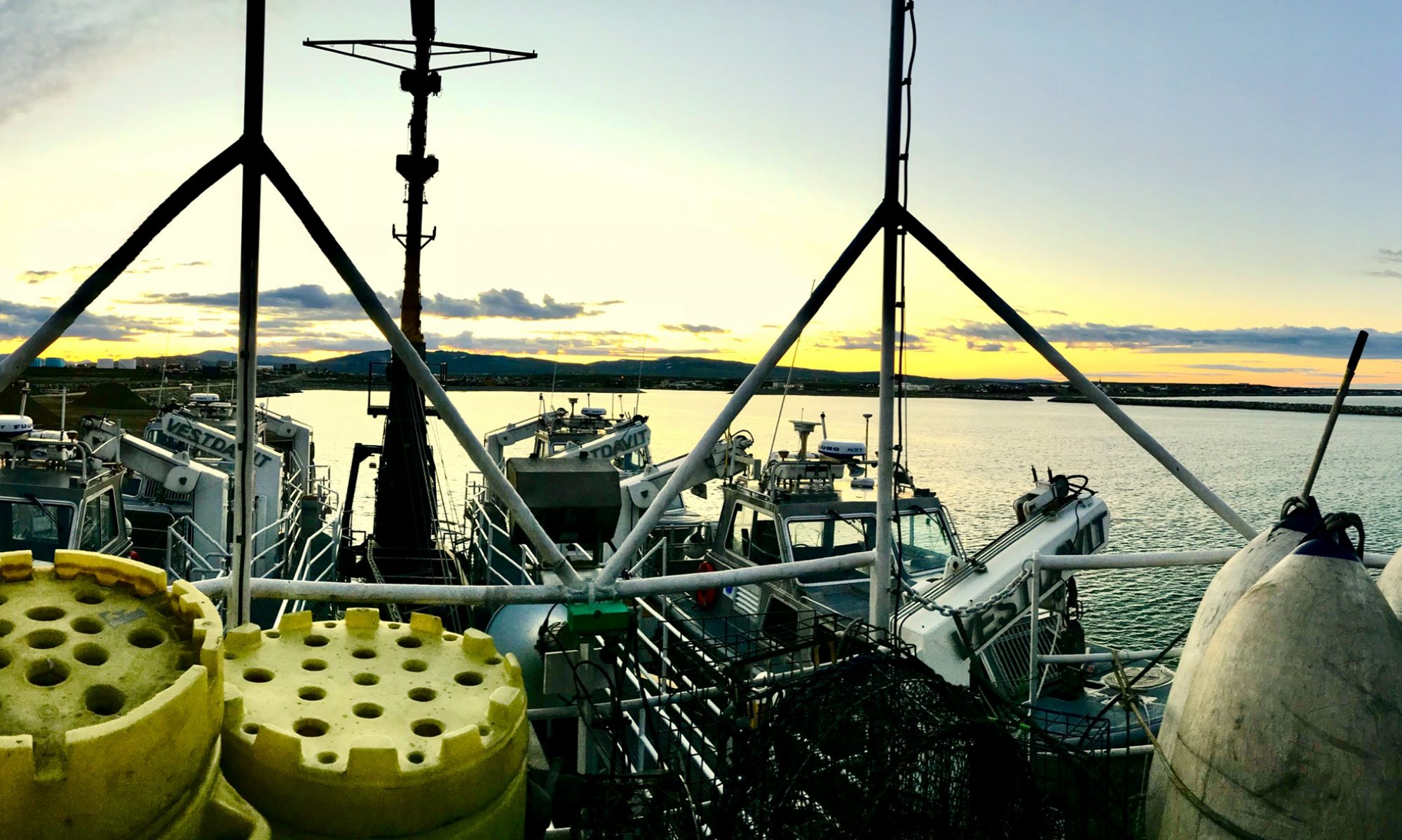
The Oregon II has two sets of crew – the ship’s crew headed by Captain Dave Nelson and the science crew headed by Lisa Jones. Captain Dave and Lisa work closely together making decisions that impact the survey. The ship’s crew keeps us afloat, fed and ultimately determines where we go based on weather. The science crew, well you guessed it, is focused on the science and collected data at predetermined sampling sites.
This post will look at some of the science happening on board. On board are four NOAA scientists as well as other volunteers and researchers that are helping with this survey. NOAA’s focus on this survey is all about sharks and snapper. We are collecting data on what we haul up from the longlines as well as abiotic factors including temperature, depth of line, dissolved oxygen, and salinity of the water. The data is entered into a computer and becomes part of a larger data set.
NOAA parasitologists Carlos and Brett
Two researchers on board working as volunteers are Brett Warren and Carlos Ruiz. They are parasitologists meaning they study parasites that sharks and other organisms carry. A parasite is an organism that lives off other organisms (a host) in order to survive. They are finding all sorts of worms and copepods embedded in the nose, gills and hearts of fish and sharks. These two spend much of their time using microscopes to look at tissue samples collected.
Brett looking for parasites
In speaking with Brett, the life cycle of parasite can be simple or complex. The simple direct life cycle is when the parasite spends its entire life on the host organism. A complex indirect life cycle for a parasite is when the parasite reproduce, the young hatch and swim to an intermediary host, usually a snail, mollusk or polychaete. This is where it gets really cool, according to Brett. It’s the intermediate host where the parasites asexually reproduce by cloning themselves. Next, the parasite leaves the intermediate host and swim to their final host and the process starts all over again. From a parasite perspective, you can see how difficult it would be for an indirect life cycle to be completed, because all the conditions need to be right. Brett is studying flatworms that have complex lifecycles and Carlos is studying copepods that have direct life cycles.
Can you guess what this is? Answer in the comments and first right answer gets a prize!
Their main focus on this survey is to discover new species of parasites and understand the host- parasite relationship.
Personal Log
The past few days have been slow with only a few stations a shift. We have hauled up some sharks, eels and even a sharksucker fish. One station had nothing on the 100 hooks set! Talk about getting skunked. As we move west I am hoping we get to see more sharks as well as more variety. Other wildlife spotted include dolphins, jellyfish and birds.
Finding the length of a sharpnose sharksize of hooks we are using
Did You Know?
Just because it’s a parasite doesn’t mean it harms the host. Some just live off of another organism without harming it.
Question of the day:
What are the two types of life cycles a parasite can have? (hint: read the blog)
Latitude 2827.10
Longitude 09148.6
75 degrees
Sunny
No precipitation
Winds at 10 KTS
Waves at 2-4 FT
Science and Technology Log
There are always many things happening on a research vessel. As we moved from station to station, scientists Paul Felts and Kevin Rademacher have been deploying a trolling camera with a lure attached. I asked Kevin about the camera and he explained what they are trying to accomplish. The ultimate goal of this experimental camera system is to help develop an index of abundance for pelagic species (billfish, dolphinfish, King mackerel, tunas, etc) to be used in stock assessments for those species. Currently, there are no fishery independent indices for adults of these species. We are trying to achieve this by attaching a camera in front of a hook-less trolling lure. If it is successful, the plan is to deploy it when running between stations on all of our surveys. This would give us enough samples to hopefully create an annual index for these species.
This trip they have taken the system from the idea and initial system build back at the lab, and are trying it in the real world; modifying portions that are not working to get it to work. What is desired is towing the system to where the lure is acting as potential prey, is not being negatively affected by the vessel’s propeller wash or bubbles from the vessel or waves, at a vessel’s transit speed, and is depth adjustable.
The scientists were working opposite watches and during watch changes they would share what they had observed and discuss small changes that they wanted to make to obtain better results. The camera allowed them to watch video footage to assess how clearly the lure could be viewed under the water as it traveled behind the ship. The ship’s crew up in the bridge worked with the scientists requests for the changes in speed they needed for short periods of time while the trolling camera was in the water during a transit to another station.
The longline hooks often yield other species besides sharks. On one set we caught 3 king snake eels, Ophichthus rex, that have long bodies, that are very stoutly built. Instead of a tail fin they have a fleshy nub. One of them was almost as long as scientist Paul Felts is tall. This species is distributed in the Gulf of Mexico. It is often caught around oil rigs. The species is consumed on a very small scale and is prepared and sold in Florida as “keoghfish”. This a burrowing species that inhabits mud, sand and clay between 15-366 meters deep. King snake eels may reach sizes up to 11 feet.
Paul Felts weighs a large King Snake eel
King Snake eels don’t like to stretch out for measurements. It took a few extra hands to get this large one to cooperate.
Personal Log
What is a day in the life of this NOAA Teacher at Sea like?
We are on the downhill side of this cruise. It has been full of so many amazing things. I miss my family and will be ready to see them, but am so thankful for this experience. Life on the ship is quite a unique experience. There are 29 of us on this cruise. But because of working 12-12 approximately half are working while the others are sleeping and having some down time. This means we don’t see each other except around shift changes. You are very aware of not banging things, or accidentally letting the motion of the boat slam a door because someone is always sleeping. The berths are small but functional. I am sharing a berth with the XO, LCDR Lecia Salerno, who is also on day watch. You can see from the photo below that the space in any of the berths is limited. I have the top bunk which is kind of scary for those who know how graceful I am, but as of yet I haven’t had any mishaps.
This is a typical berth on the Oregon II. Usually one crew member has it for 12 hours then they switch. This allows for uninterrupted sleep and a little privacy on a small ship with 29 crew members onboard.
What is a day like onboard the Oregon II for me? I wake up around 8 am and try to convince myself to do a few minutes on the Jacob’s Ladder and a few weights for upper body. Breakfast for me is a power bar, each watch usually eats two meals in the galley and mine are lunch and dinner. There is time to do laundry if the washer is available. Twenty-nine people using one washer and dryer calls for everyone to be courteous and remember to get your laundry done and out of the way. I usually spend about an hour reading or working on blogs and even some new plans for my students next year. I am lucky that the boat has wifi that bounces in and out so I can use I-message and stay in touch with some of my family and friends as well as facebook, and email.
Crew’s lounge where we watched the occasional movie, and I wrote all my blogs.
Lunch is at 11 and our watch eats and gets out of the way because we are on at noon and need to let the other watch get into the galley for their lunch. Did I mention the galley only has 12 seats and that courtesy is the big thing that makes life on the ship work? When we aren’t baiting hooks, setting out the line, or pulling in the line we hang out in the dry lab. There are computers in the dry lab and the scientists are able to work on emails, and data that is being gathered. There is also a television and we have watched some random things over the long shifts. Lots of laughter happens in this room, especially the more tired we get. I will also admit that we joined the rest of the internet world in stalking April the Giraffe until she had that baby!!! There is time between sets to go do a little bit of a workout and sometimes I take advantage of this. An important activity is hydration. You do not realize how the warm weather on the deck depletes your system. There are notes posted reminding us to stay hydrated. It is also important for me to keep a little food in my stomach to ward off any seasick feelings. I try not to snack at home, but dry cereal or a piece of toast have become my friends on this cruise. Other than the first night at sea I have not had any real queasy moments so I am going to continue this pattern as long as we are moving. One thing is that I tend to snack and drink a lot of water. Dinner is at 5 and occasionally it falls about the time we have to set out a line or pull in a line. This means we eat really fast and get back to work.
The stewards cook three meals a day out of this small galley kitchen. They did a great job of giving us menus with lots of options.
When it is time to set a line we all go out on deck and we bait 100 hooks. The hooks will be baited with either chunks of mackerel or squid. There is nothing glamorous about this at all. If you aren’t paying attention you can even take a shot of squid or mackerel juice to the face. When it is time to get the line in the water there are jobs for each of us. One person puts the high flyer in the water, this marks the start and end of the line of hooks and has a flashing light for night time. One person attaches a number to each hook’s line and hands it to the slinger who puts the hook over the side and hands the line to one of the fisherman to attach to the line and send it on its way. One person mans the computer and inputs when the high flyer, three different weights and each hook go over the side. The computer records the bait used, the wave height, cloud cover, precipitation, longitude and latitude of each hook. I told you the scientists’ collect a lot of data on these cruises. The last person scrubs the barrels clean and places them up front on the bow for the haul back. The deck gets washed down. The crew works hard to keep the ship clean.
I had no idea how much squid ink or juice one person could get on them until I learned to bait a hook with squid for long-line. Mackerel is SOOOO much better!
Putting the high flyer over the rail. One marked the beginning and end of each line we put out.
When the crew on the bridge gives us the 10 minute call we all dawn our life jackets, grab our gloves and head to the bow to see what we might have caught. The deck crew is getting ready to pull in the high flyer, the computer gets set up and all the necessary equipment for collecting data is laid out. We have two measuring boards, a small sling for weighing bigger sharks on deck, two types of taggers, scales, scissors, tubes for fin clips, pliers, measuring tape, bolt cutters, data sheet, and hard hats for all. One person works the computer, recording if we caught a fish, or whether or not there was any bait left on the hook, another person takes the line and hook and places it in a barrel ready to be baited next time, the number is removed and placed on a cable, two people are ready to “play” with the sharks and fish, meaning they will do the measurements, weights and any tagging, and one person fills out the data sheet. It all works very quickly and efficiently. Sometimes it gets a little crazy when we have fish and sharks on several hooks in a row. I spent most of my time doing the data recording and I must say my experience working the chutes with tagging and vaccinating cattle sure came in handy when it came to keeping the information straight.
Science team works check if a female bull shark is pregnant using an ultrasound machineMeasuring a sharp nose sharkSometimes the more active sharks took more than one person to remove the hook so we could release them.
The day watch comes on shift at midnight, but they usually show up around 11:30 to visit and see what has happened on our shift. By midnight we are free to go. I stop in the galley for a quick sandwich made of toast and ham. Next up is the much needed shower. We use mackerel and squid for bait and let’s just say the juice and squid ink tends to fly around the deck when we are baiting hooks. Then you get the salty sea air, handling sharks, red snapper, king snake eels, and it makes a hot shower is much anticipated. Lastly, I crawl into my top rack (bed) and adjust to the pitch and roll of the ship.
Did You Know
Typically, biologists can age sharks by examining cross sections of shark’s vertebra and counting the calcified bands, much like you can count the rings on a cross section of a tree trunk. The deep-water sharks we are looking for are trickier to age because their vertebra do not become as calcified as sharks found in shallower depths.
This is the second leg of the Oregon II’s experimental longline survey. A longline is a type of fishing gear that will deploy one fishing line that is very long and very thick and has many hooks attached to it. We will be doing a survey by collecting systematic samplings to assess fish populations. This mission is an experimental one because the longline is being placed at depths deeper than they fish during the annual longline survey and are able to alter the bait type and leader material to see how it could affect catch rates.
The longlines are baited with pieces of squid. Squid live in deep water so it makes sense to use them to attract deep-sea sharks. Squid also stays on the hooks better than the mackerel and these hooks have to make it a LONG way down on this survey. The lines are placed in the water and then allowed to soak for several hours. This allows the squid bait to settle down into the deep water (aided by the weights attached) and for sharks to find the bait. The fishing line with the hooks is a mile long, but the total line put out can be up to 3 miles long because of the scope needed to allow the 1 mile of gear to reach the deep bottom depths.
Scientist Kevin Rademacher baiting hooks with squid
As we bring in the catch we will be gathering data on the species caught, sex, maturity stage for male sharks, and certain sharks will be tagged. There are different tags for different sizes of sharks and a small piece of fin is collected on all tagged sharks for genetic purposes. The weight and three or four different measurements will be taken on the all species. Photos of any uncommon species are also taken if time allows to help with identification processes in the future, and so everyone can see them if they weren’t on the watch when the catch occurred.
On my dayshift team is James Sulikowski, a scientist from the University of New England in Maine, who will be using an ultrasound on larger female sharks that we bring on board. Ideally, he and Trey Driggers, the night watchleader from the NOAA MS Labs, would like to catch some large female hammerhead or dusky sharks. James will use the ultrasound to determine if the large females are pregnant. If they are pregnant, a satellite tag will be placed on the sharks that will stay on for approximately 30 days. This is perfect as females could be giving birth over this time frame. The tags will be used to track the sharks with the hope that important habitats where the adults give birth can be identified. James (and Neil Hammerschlag) has conducted similar research on tiger sharks, but linking pregnancy to specific movements has not been conducted with sharks captured in the Gulf of Mexico. Our experimental longline survey is happening at a perfect time to gather data for this research.
James Sulikowski ultra sounding some small pregnant sharks.How many baby sharks do you see? We saw THREE!
Personal Log
We are at sea now but since getting somewhere is half the fun…..isn’t that what they always say….I wanted to tell you a little about my trip to the ship. On Tuesday night as I was packing we had a storm and lost power for a few hours. No big deal since I was on the ball and pretty much packed at this point. Wednesday morning, I leave for the airport and about 15 miles down the road I realize I left something I had to have. So, I made a quick turn around and retrieved it. It was a nice drizzling rain and some fog for the drive to the airport. Now my luck continued when I arrived at airport. Long term parking was full so I had to park at the BACK of the economy lot. I don’t mind a walk normally but it was raining and that made THREE parking lots to walk through. Luckily the airport has a little shuttle van to pick up travelers in just such situations. Oh wait…. This one just drove past us all and kept circling but never actually picked anyone up. Hmmm. I had a very bumpy ride to Dallas due to the weather and was relieved to make it to my gate for my connection in Dallas. Then comes the announcement that they need to change a tire on our plane. I was completely ok with this hour wait since I see the value in having tires when we land in Gulfport! So only an hour late I made it safely to my destination.
I had a great visit with the scientist who picked me up at the airport. I found out that he and his family intend a vacation in the future to canoe on the Buffalo River. I forget what an amazing state I live in sometimes when it comes to our state parks and outdoor adventures. One of his areas of focus is Cownose Rays and we discussed how he uses networking to find opportunities to gather data. My students know how important I feel networking can be. You never know when that person you meet can help answer a question, provide guidance or solve a problem for you somewhere down the road. He told me how he took the time just this week to meet some folks who are at NOAA from other countries and ask them to share his contact information because it could help him fill in some needed data for his research.
Arriving at the Oregon II! Ready to get this adventure started.
Arriving the day before most everyone else made my first night a little bit of an adventure. I had a short tour of the boat and then was on my own. I was talking with my son on the phone and he asked if it felt like an episode of Scooby Doo where they are on an abandoned ship. Well.. a little like that. There were lots of new noises to get used to. And for such a small ship there are lots of doors and rooms. It is a definite culture shock from the cruise ship I was on during spring break just two weeks ago.
My students all wanted to know what the ship would be like. I will be posting some pics so you can get an idea of what it’s like. I will be sharing my cabin with someone else. We will basically take turns using it about 12 hours apiece each day. I knew it would be small but let’s just say I won’t be doing any workouts in my room. But it has a place for everything and my bunk is comfortable. There are metal stairs from level to level on the ship. These are an adventure with my tri-level glasses. One hand for the rail and I am good. For those that know me well one of their concerns was that I wouldn’t be able to make it without going for a run. Crisis averted…there is a rowing machine, weights, a stationary bike etc. onboard. So I guess I will not have to resort to running in place as some people thought.
The stairs require you to pay attention and use a hand rail..especially if your wearing tri-level glasses like I amA boat deck is a busy place with lots of equipment.
The first day onboard was spent getting ready to sail. I just stayed out of the way and introduced myself to the crew as they passed by. We were underway in the early afternoon and it was an adjustment getting used to the motion of the boat. We had some very informative safety meetings and I got an overview of what we would be doing the next day. Had a great dinner, our stewards really will keep us fed well! Then we spent the evening talking and getting to know one another, watching tv, catching up on emails, going through data collection and trying to stay up till midnight so we could get our bodies started on our new schedule.
Day two and we are ready to rock and roll. I slept amazing and woke up to calmer seas. I was up on deck enjoying the sunshine and getting to watch James ultrasound a few smaller sharks. I have participated in ultrasounds on dogs, cows, and horses but never a shark. It was a lot of fun trying to identify how many babies were inside and the best way to use the ultrasound on these smaller sharks.
The day continued to be gorgeous. We pulled one set and caught several sharks, red snapper, and a few eels. After pulling one set we had several hours of downtime as we head to our next station. The timing looks like we will get the next set out for the night crew to pull. The downtime allows everyone to catch up on computer work, and emails. You can also just sit out on the deck and enjoy the sunset.
Gorgeous sunset our first full day at sea. Like working 12pm-12am because sunsets are my favorites.
Did You Know
The Gulf of Mexico has a broad range of ocean ecosystems from shallow reefs to sea forests and has both shallow coastlines and deep ocean waters reaching as deep as 14,300. There is an ample food supply and the perfect habitat for several species of sharks.
Sharks do not have swim bladders like bony fish.
Sharks store energy in their liver in the form of a viscous oil. This means their liver is very large.
I live in Arkansas and the weather is probably changing as I am typing this! It is Spring so that means our weather is unpredictable. Today we woke up to red creepy skies and predictions of severe thunderstorms. As I am writing this it is 75 and we are still waiting to see if any storms pop up. I am fine with storms, just keep the tornadoes away!
Introduction
Checking out the local wildlife in one of my favorite places… Daytona Beach
Hi all! My Name is Karen and I am the K-12 Gifted and Talented teacher for the Lavaca School District in Lavaca, Arkansas. I have the best job because I am on the move all day working with students from all grade levels. I have an BSA in Animal Science, Master’s degrees in Teaching and Gifted, Talented and Creativity. I am able to utilize my degrees and my personal background to create activities for my students that keep them moving and their brains working. I feel that my participation in the NOAA Teacher at Sea program is setting an important example for my students about stepping out of one’s comfort zone to chase a dream.
Science and Technology Log
In just a few days I will join the crew of the Oregon II for the start of their second research trip of 2017. You’ll notice that this trip is referred to as an “experimental” longline survey. This is because our trip is happening earlier in the year than the normal longline surveys. The scientists will be experimenting with some different methods and its earlier in the year so everyone will be anxious and excited to see what types of sharks and fish are brought on board over the two weeks at sea…
Personal Log
I have only been a teacher for 5 years. I spent several years as a Water Quality Technician working with farmers and poultry growers to manage the nutrient content in their soil and protect water sources. I then was blessed with some great adventures working for the National Wild Turkey Federation’s Women in the Outdoors Program in Arkansas, Louisiana, Mississippi and Alabama. I also spent many years as a poultry farmer. I went back to school in 2011 and began teaching in 2012 while finishing my Masters of Art in Teaching. I taught seventh and eighth grade science for three years and then was chosen to fill an opening for Gifted and Talented teacher in the district. I completed my Master’s in Gifted and Talented and Creativity this past December.
My past job experiences have provided me many great ideas that I use in my classroom. I also believe in the power of networking and I use my network of contacts to gather information, activities or speakers for my classes. I have always been interested in biology and had a love of animals. As a teacher I continue to lean towards professional development that focuses on science and then I add other components to make some very creative lessons for my students.
It was during a professional development session 4 years ago that I first learned about the NOAA Teacher at Sea program. I looked at the application process and considered applying, but my oldest son was in high school sports, my youngest wasn’t quite old enough for me to want to be gone that long, I just got married….there was always an excuse. Each year I looked and considered and I waited. This past November I talked to my family and if filled out the application. I remember sitting and deciding whether to hit submit when it was all done. I took a deep breath and submitted! Then I tried not to think about it.
Spending time exploring helped take my mind off the wait!
Fast forward to February 1 of this year… I walk into my classroom and turn on my computer and there is an email from NOAA. I was afraid to open it. When I saw the message that I had been selected I think I sat with my mouth hanging open. I kept reading it thinking surely the wording was going to change and they were going to let me down easy. I remember texting my husband and telling him I had been chosen and asking him what I was going to do and his response was “ You’re going to go, of course!” It really did take a week for it to sink in that I was going to be a part of the class of 2017.
I completed all of the requirements as quickly as possible because I couldn’t wait to see which research trip I would be matched with. Within just a few weeks I was matched with a research cruise heading into the Gulf of Mexico and we would be doing studies with sharks. I realized I had just under 4 weeks to get everything in order and report to the ship. Of course I had to make it more complicated by having a huge networking event at school with 38 speakers and a SKYPE with NOAA Teacher at Sea Program to pull off, a 7 day cruise for spring break that we had already had on the calendar, a couple Quiz Bowl tournaments with my students plus squaring away things at home. Did I mention our mare is due to foal any day and that one of the dogs is diabetic and has to have insulin twice a day? Let’s just say the weeks have flown by. Thank goodness my husband and kids are awesome and my friends rock because it will all be lined out before I leave next week.
I cannot even find words to express my appreciation to NOAA for offering me as an educator this opportunity. I am excited that I will get to share my time with the scientists and the things I learn with not only my students but with many schools in my area. One more week and I will be setting foot on the Oregon II and praying for calm seas!
Did You Know?
Fish supply the greatest percentage of the world’s protein consumed by humans. This makes the health of our ocean vitally important even if you do not live near the ocean.
I asked Kevin Rademacher, Research Fisheries Biologist at the Pascagoula, Mississippi Lab, what fish I could eat and still support sustainable fisheries. He answered with a question, “Have you read the book Four Fish?” When I finished reading the book by Paul Greenberg, I spoke to Kevin again. “What do you think now?” He asked.
I said “There is something about wild fish that makes me want to catch and eat them, but I worry about whether we are eating wild fish out of existence.”
Yellowedge grouper (Epinephelus itajara). Photo: Matt Ellis/NOAA Fisheries
“Have you talked with Adam? He’s the numbers guy,” Kevin said. It seems like the good teachers are always sending students away in search of their own answers.
Adam Pollack is a contract Fisheries Biologist with Riverside Technology, Inc., and works on the night crew. We sometimes cross paths at midnight or noon. Catching him wouldn’t be easy.
Here, Adam measures a shark too large to bring on deck. Photo: NOAA Fisheries
During one of these transition times, we had a moment to talk. I asked Adam about his earliest fish memory. He smiled. “At about five, I went fishing with my dad. We had a house in the mountains surrounded by a bunch of lakes.” Adam and his dad would sit by the lake with their lines in the water “watching the bobber disappear.” He smiles again. These little largemouth bass changed his life.
Adam takes a selfie with a red drum (Sciaenops ocellatus).
At first, he was set on becoming a professional bass fisherman but made a practical switch to marine biology. He took all the science electives and the hardest math classes he could. He went on to Southampton College on Long Island, New York, where he got lots of hands-on experiences beginning in his freshman year. He believes a good education should include lots of opportunities, as early as possible, for interactive learning in a real world environment.
Once he graduated, Adam got his dream job: working in the Gulf of Mexico during the field season and then crunching numbers the rest of the year. He takes the data scientists collect to the SouthEast Data, Assessment, and Review (SEDAR). SEDAR is a cooperative process through which scientists, fishermen, and policy makers look at the life history, abundance trends, and other data to determine how many fish we can catch sustainably.
Adam, and many others, also look at how catastrophic events like Hurricane Katrina and the Deepwater Horizon oil spill affect marine species in the Gulf of Mexico. After Hurricane Katrina, he said, shrimping efforts died down by about 40%. The effects of the oil spill are still a little murky. Many of the biologists on board initially predicted dire and immediate effects. Yet unlike the spill in Alaska, the warm Gulf of Mexico water is host to bacteria, plants, and other living things that might be eating up the oil. Many questions, such as whether these living things will mitigate the effects of a spill, are still being asked. “Deepwater Horizon is always on our minds,” Adam says. There are also naturally occurring events like harmful algal blooms and long term issues like climate change that affect fish populations.
Oil rigs dot the horizon as Tim Martin, Chief Boatswain, gets ready to retrieve the longline. Photo: Matt Ellis/NOAA Fisheries
Here, Paul Felts, Fisheries Biologist, weighs a yellowedge grouper (Hyporthodus flavolimbatus). Photo Matt Ellis/NOAA Fisheries
“Can you tell me about snapper?” I asked Adam. Red snapper (Lutjanus campechanus), assessed every other year, is a hot button topic for commercial and recreational fishermen alike in the Gulf. The species was in decline. Recreational fishermen went from a 180 day season to catch fish to an 8 day season and from 10 to 2 fish a day per person. Commercial fishermen weren’t happy either: they could only take 49% of the year’s quota for red snapper, while the recreational fishermen get to catch 51% of the quota. Fairness is not just a second grade concern, it is a major sticking point in regulating fisheries world wide.
Snapper is as tasty as it is beautiful. Photo: Matt Ellis/NOAA Fisheries
Red snapper is a vulnerable species. Snapper settle to the bottom of the water column from larvae. They are at high risk of mortality from ages 0-5, the same time when they are close to human activity such as oil rigs, shrimping grounds and easy to access fishing areas. Those who manage the fisheries are trying to get the snapper through that vulnerable stage. Like money in the bank accruing interest, a 10 year old snapper can produce more eggs than a five year old. Before we take snapper from the sea, we must make sure a healthy older population remains to reproduce.
TAS Denise Harrington holds up two red snapper. Photo: Matt Ellis/NOAA Fisheries.
Once an assessment is complete, scientists determine a maximum sustainable yield: how many fish can be taken from the population and still keep enough around to make more fish for the future. Take a look at a shark assessment and a snapper assessment. Looking at these long and complicated assessments, I am glad we have people like Adam who is willing to patiently work with the numbers.
Gathering the best data and making it available to people who collaborate to make informed decisions is an important part of Adam’s job. We all want fish and NOAA fisheries biologists are doing their best to make that happen for us, and for generations to come.
Personal Log
My time aboard the Oregon II has come to an end. Bundled up in my winter clothes, I look out over a rainy Oregon landscape filled with fishermen hoping to catch a fall Chinook salmon. Two places with different weather and many different fish species. Yet many of our challenges are the same.
Back at school, students and teachers welcome me enthusiastically. Instead of measuring desks and books as part of our Engage NY curriculum, we measured sharks and their jaws. Many of these students have never been out of Oregon, many have not been to the beach, even though it is only 4 miles away. With NOAA, South Prairie Elementary students were able to learn about faraway places and careers that inspire them.
Soon these seven year old children will be in charge. I am thankful to the NOAA crews and the Teacher at Sea program staff, as they’ve prepared generations of students of all ages to collaborate and creatively face the task that lies ahead.