Kate Schafer: Setting off for Brownsville, TX, September 18, 2017

NOAA Teacher at Sea

Kate Schafer

Aboard NOAA Ship Oregon II

September 17 – 30, 2017


Mission: Shark/Red Snapper Longline Survey

Geographic Area of Cruise: Gulf of Mexico

Date: September 18, 2017


Weather Data from the Bridge:

Latitude: 27o 02.5’ N
Longitude: 94o 32.6’ W

Scattered clouds

Visibility 14 nautical miles

Wind speed 10 knots

Sea wave height 1 foot

Temperature Seawater 29.9 o Celsius


Personal log

Sunday afternoon, September 17

I arrived in Pascagoula, Mississippi in the late afternoon on Saturday after a long day of travel.  Things were so quiet on the ship that evening as most of the crew had gone home during the break between legs of the survey.  It was great to be met and shown around by a friendly face, the Officer on Duty (OOD) David Reymore.  I definitely was feeling a bit like a fish out of water, even though we hadn’t even left the dock yet. As people start to arrive back on the ship, they all know their role and are busy getting ready for our departure later on today. It’s a good experience to feel like you’re out of your element every now and again and I guess a small part of why I decided to apply for a Teacher at Sea position in the first place.

NOAA

As I was preparing to depart on this adventure and was explaining that I was going to be a NOAA Teacher at Sea, I had a number of people ask me what NOAA stood for, so I thought I’d provide a bit of information about what they are and what they do.  First, NOAA stands for the National Oceanic and Atmospheric Administration, and the name definitely suggests the broad mission that the agency has.  Their mission involves striving to understand the oceans, atmosphere, climate, coastlines and weather and making predictions about how the interactions between these different entities might change over time.

That is a tall order, and the agency is divided up into different offices that focus on different aspects of their mission.  The National Weather Service, for example, is focused on forecasting the weather and makes predictions about things like where hurricanes will travel and how intense they will be when they get there.  The National Marine Fisheries Service is tasked with studying the ocean resources and habitats in U.S. waters and to use that understanding to create sustainable fisheries.

So far, I’ve met many people that I’ll be sharing the boat with over the next two weeks.  They have all taken time to introduce themselves and talk for a bit, even though I know that they’ve got tons to do before we sail.

Sunday evening

Well, we’re underway towards our first sampling sites off the coast of Brownsville, Texas.  The seas are really calm, and I’m sitting up on the deck enjoying the light breeze and digesting the delicious dinner of jambalaya, vegetables and blackberry cobbler.  On our way out from Pascagoula, we saw a few dolphins, beautiful white sand barrier islands and mile after mile of moon jellies, but now we’re no longer in sight of land.

P1030600
Barrier island off the coast of Mississippi

We’ve passed an occasional oil rig off in the distance but haven’t seen much else.  The sun just set behind just enough clouds to make the colors spectacular and then as I was climbing down the stairs, I saw a handful of dolphins playing in the boat’s wake.

IMG_3919
Sunset over the Gulf of Mexico

Monday, September 18

Today will be a full day of travel to reach our fishing grounds.  Assuming we continue to make steady progress, we should arrive in the late afternoon or early evening on Tuesday to begin fishing.  We will be baiting 100 hooks that, once deployed, will remain in the water for an hour before we pull them back in.  We’ll be fishing in a variety of depths while working our way back towards Pascagoula.  We practiced some drills this afternoon, including a “man overboard” simulation, using a couple of orange buoys.  They deployed a rescue boat and had retrieved the buoys in a matter of minutes.  I have to admit that watching them get out there with such speed and skill put me at ease.

IMG_3927
Rescue boat deployed during the “man overboard” drill


Kate Schafer: Off to the Gulf, September 16, 2017

NOAA Teacher at Sea

Kate Schafer

Aboard NOAA Ship Oregon II

September 17 – 30, 2017

Mission: Shark/Red Snapper Longline Survey

Geographic Area of Cruise: Gulf of Mexico

Date: September 16, 2017

Introduction

Welcome to my Teacher at Sea blog!  My name is Kate Schafer, and I am a teacher at the Upper School at the Harker School in San Jose, California, right in the middle of Silicon Valley.  I teach biology, marine biology and food science to mostly juniors and seniors.  This may seem like an odd mix of courses, but I am so fortunate to be able to teach students about all my favorite topics.  I have heard that the food is delicious on the Oregon II, and I’m interested in learning more about the challenges of keeping a crew fed when you can’t pop down to the corner grocery store when you realize that you forgot to order that crucial ingredient.  I have spent many hours on the ocean, and spent six years studying coral reefs in Belize, Central America, but I’ve never been to sea on a research vessel.  I’m thrilled to have that opportunity and to share it with my students.

My husband, daughter and I ready to tour the Atlantis in Woods Hole, MA this summer

Weather Data

The weather has been a big topic of conversation of late here in San Jose.  Two weekends ago set all-time record high temperatures throughout the Bay Area, even along the coast.  Living in close proximity to the ocean, we expect relief from that rare hot day to come rather quickly, but the heat lingered for days.  We’re back to normal fall weather as I head off, though.  This morning is cool and seasonable.  I know from growing up in Atlanta, Georgia, that I’m heading to warm and humid conditions on the other end of my travels.

Science and Technology Log

On this research cruise, we will be conducting long line surveys, looking at shark and red snapper populations in the Gulf of Mexico.  I will report more on where we are going and what we’re studying once the leg of the survey begins. There are multiple legs to the survey, and I’ll be joining in for the fourth and final leg.  It has been a tumultuous time in the Gulf over the past few weeks, and it will be interesting to learn about how this has impacted the coastal waters in the area we will be surveying.

Personal Log

I am sitting in the airport in San Jose, ready to board my flight to Dallas, en route to Gulfport and my final destination of Pascagoula, Mississippi.  Wow! It’s been a frantic week of getting all sorts of last minute pieces put together to allow things to, hopefully, run smoothly in my absence.  It’s early morning, so I’m still in a bit of a groggy cloud, making the fact that I’m actually heading off on this adventure all the more unreal.

Even the grogginess cannot stifle my excitement, though, as I head off for two weeks of working with scientists and collecting data.  As I was packing last night, I couldn’t help but be reminded of all the previous trips I packed for more than 15 years ago to conduct field research on coral reefs in Belize.  I was studying a type of crustacean called the stomatopod and learning about the role that they play in coral reef ecosystems, how they interact with other species like pygmy octopus and crabs, their main source of prey.

I am thrilled to be heading out on this research trip and feel so fortunate for the opportunity.  I look forward to questions from you about what we are doing and learning on our voyage.  Check in frequently for updated blog posts once the trip commences.

Did You Know?

That the Oregon II has been part of the NOAA fleet since 1977?

Susan Brown: Who Needs Sharks Anyway? September 13, 2017


NOAA Teacher at Sea

Susan Brown

Aboard NOAA Ship Oregon II

September 3 – 15, 2017


Mission: Snapper/Longline Shark Survey

Geographic Area of Cruise: Gulf of Mexico

Date: September 13, 2017

IMG_6406
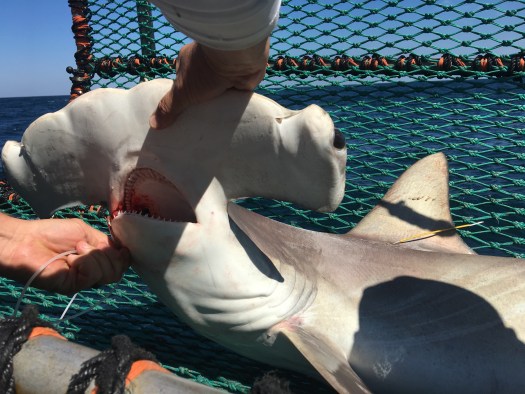
sunset through jaws of a blacktip shark


Science and Technology Log

We have been sampling along the coast of Florida, Alabama, Mississippi, Louisiana, and Texas at varying depths – “A” stations ( 5- 30 fathoms), “B” stations (30 -100 fathoms) and “C” stations (100 – 200 fathoms). A fathom is six feet or approximately 2 meters. The longlines are baited the same – mackerel on 100 hooks spread out across one nautical mile and then set on the bottom of the ocean. As we reel in the long line, the click and whine of the line as it’s being spooled, we wait in anticipation of what it may bring. Each station yields something different and you never know what you are going to get. Below is a list of some of the animals we have encountered.


IMG_6286
baby hammerhead

Shark species: blacktip, sharpnose, blacknose, scalloped hammerhead, great hammerhead, bull, tiger, spinner and bonnet head (to learn more about each of these species, select it for a NOAA fact sheet).

IMG_6273.jpg
Scallop Hammerhead in cradle

Other animals: southern ray, cownose ray, roughtail stingray, red snapper, black drum, sharksuckers, catfish, red drum, yellowedge grouper, king snake eels and even some blue crabs.

So why survey sharks? Did you know that people are one of only a few species that prey on sharks — killer whales and other sharks are the others– killing over a hundred million per year?* Sharks are apex or top predators in an ocean food web and play a vital role in keeping this food web in balance. With the hunting of sharks as well as over fishing the prey that sharks eat we are disturbing the natural balance. This survey is used determine the number of sharks and other species that are present in the Atlantic Ocean including the Caribbean Sea and the Gulf of Mexico. With these numbers, the National Marine Fisheries Service (NOAA Fisheries) regulate how many sharks, swordfish and tuna can be harvested without impacting the total population. In the Pacific Ocean, NOAA fisheries work with fisheries in developing how to best manage sharks.

IMG_6731
red snapper

Apex predators in any ecosystem are vital to the health of that ecosystem. These top predators keep numbers down on the more abundant prey species and keep their numbers in check. Here is a simplified illustration of what happens when we lose apex (top) predators in an ocean ecosystem.

If the number of sharks goes down then the food the sharks eat goes up (forage fish) because they are not being eaten by the sharks. With more of those forage fish around their need for food – the zooplankton – increase. With more forage fish eating the zooplankton there are less zooplankton and their numbers begin to decrease. If there are less zooplankton then the phytoplankton numbers increase because the zooplankton aren’t around the eat them. Removing top predators from any ecosystem can have an impact on the entire food web and this phenomena is called a trophic cascade.

IMG_6489
Removing Hook

Personal Log

When people think of sharks, they think of the movie Jaws. Unfortunately this has given sharks a bad reputation and has vilified these animals that are essential to the ocean food webs. Sure, there have been shark attacks, but did you know that more people are killed each year by electrocution by Christmas tree lights than by shark attacks? When people imagine sharks, they think of enormous sharks that eat everything in sight. The reality is that sharks come in all sizes and shapes. A mature Atlantic sharpnose shark will only get to be 3.5 feet long with the world’s smallest shark being the dwarf lantern shark that can fit in the palm of your hand. The largest shark is the harmless-to-human whale sharks that feeds primarily on plankton and can grow up to 60 feet!

IMG_6084
Smooth-hound (Mustelus Sinusmexicalis)

Did You Know?

Scientists can tell the age of a shark by counting the rings on its vertebrae (similar to how they can tell how old a tree is by counting its rings!)

Question of the day:

What is an example of a terrestrial (land) apex predator that has been over hunted impacting the entire ecosystem?

hint: watch this video clip: https://www.youtube.com/watch?v=ysa5OBhXz-Q


Susan Brown: Weather or Not, September 9, 2017

NOAA Teacher at Sea

Susan Brown

NOAA Ship Oregon II

September 3 – 15, 2017


Mission: Snapper/Longline Shark Survey

Geographic Area of Cruise: Gulf of Mexico

Date: September 7, 2017

Weather Data from the Bridge

Latitude: 2095.92N
Longitude: 08825.06W
Sea wave height: 1.2 m
Wind Speed: 20.3kt
Wind Direction: 50 degrees
Visibility: (how far you can see)
Air Temperature: 025.6 degrees Celsius

Barometric Pressure: 1018.36 mb
Sky: cloudy

Science and Technology Log

The weather has been a big topic of conversation on this survey and for good reason. The original plan was to fish off the coast of Texas from Brownsville to Galveston. Due to Hurricane Harvey and possible debris in those waters, the survey changed course to sample off the coast of Florida. As we motored east, Irma was building up to a category 5 hurricane.

IMG_6031
Captain Dave


Captain Dave has been keeping a keen eye on the weather and after a few days of fishing off the coast of Florida, we headed back toward Pascagoula, Mississippi to pick up a crew member and let another off to tend to his family in Florida which is in the current path of Irma. We have been looking at the various computer modeling showing where Irma will land and this determining our path. Fortunately, a cold front to the west of us is pushing Irma east which will allows to stay out instead of docking and ending the survey early. This cold front is unusual for this time of year according to the Captain. Earlier models showed Hurricane Irma hitting the west side of Florida into the Gulf of Mexico where we are which would end our survey. Now, with the updated weather, we may get to stay out as planned but staying close to Mississippi and then heading West to work off the coast of Texas and Louisiana.

IMG_6331
Daily updates and rerouting due to weather

This ship is part of the Ship of Opportunity Program (SOOP). This program enlists ships to collect weather data that is sent to the National Weather Service (a line office of NOAA) every hour. This is the data that supplies information to weather forecasters! Information that is gathered includes wind speed and direction, barometer reading, trend in pressure over the past few hours, as well as wind, wave and swell information. Have you every noticed on TV that the weather reports have a notification that states the data is coming from NOAA? Weather forecasters get weather information from ships out in the ocean like the one I am on.

IMG_6323
another beautiful sunset from the top deck

This morning I headed up to the bridge to chat with Captain Dave. Here are some of the questions I asked.

Q: How long have you been a captain?

CD: 9 years

Q: What got you interested in this type of work?

CD:I grew up in Mississippi where you hunt and fish so when I got out of high school I always wanted to work on the water due to my upbringing. We were always taking out the boat to hunt or fish growing up. It’s in my blood.

Q: What is your schooling? What advice would you give someone that is interested in this as a career?

CD: I graduated high school in 1980 and made my living on the water commercial fishing and working on the oil rigs until January 4, 1993. I started as a deck hand and worked my way up to Commanding Officer (CO). I’ve been on the Oregon II 25 years. The hardest thing was taking the test to be a Master.

Captain Dave is a civilian Master which is rare – there are only two in the NOAA fleet. Most NOAA ships are run by NOAA Corps Officers. 

Q: What is the biggest storm you have seen?

CD: East of Miami, Florida in the gulf stream we were seeing 12-15 foot seas. The engine room calls the bridge regarding a busted intake valve. The boat was sinking. The engineers were in knee deep water and were able to find the broken valve and stop the flooding. In another 7 minutes the generator would have been under water and we would have lost power and would be forced to abandon ship in 12-15 foot waves.

Q: Is this weather unusual for this area this time of year?

CD: We never get a NE wind bringing in cooler weather which is probably what is turning Hurricane Irma. Normally it’s blazing hot here with southwest winds at 10 miles. This cold front is the reason we are not going in.

Check out this cool animated site for wind patterns. You can see how the hurricanes impact the flow of air.

https://www.windy.com/?47.680,-122.121,5

Personal Log

So far the seas have been calm and I keep expecting things to pick up because of all the weather happening around us. Sleeping pretty good with slow rocking of the ship and we will see how I do with some bigger swells. The crew has been super helpful in doling out advice from how keep from getting seasick ranging from eating, drinking and even how best to walk! I’m listening to all this advice and so far so good. I do wonder how much of Hurricane Irma we will feel now that we are heading west a few hundred miles.

IMG_6341
The one that got away!
IMG_6357
baiting the line with Mackerel
IMG_6393
Spinner shark

We have caught a few sharks and I am excited to catch some more. Other critters we have caught were a bunch of eels and a suckerfish. On yesterday’s shift I learned how to tag one of the big sandbar sharks. She was about 6’ long. The night crew caught a 10’ tiger shark! Maybe we will get lucky on today’s shift as I would love to see more sharks and handle some of the smaller ones.

IMG_6103
suckerfish

Update: Last night our shift brought in 16 sharpnose sharks so things were busy. These sharks don’t get much bigger than 3 ½ feet. All of the ones we pulled in last night were female. The oceans have gotten a bit rougher with swells 4-5 feet! I have gained a new appreciation for all the rails available along the corridors of the ship and have learned to make sure my door is clicked shut as well as all the cabinets and drawers. Nothing like waking up to drawers slamming open and shut in the middle of the night!

Did You Know?

A Captain of the ship can be ranked as a Captain or a Commander within the NOAA Corps but a civilian does not hold a commissioned rank because they are not in the NOAA Corps and is called a Captain since he holds a Master license gained by taking extensive coursework and an intensive exam through the United States Coast Guard.

Question of the day:

What is the difference between a category 5 hurricane and lesser hurricanes? (hint: check out the link below)

http://abcnews.go.com/US/hurricanes-form-explained-abc-news-chief-meteorologist-ginger/story?id=49650211


Susan Brown: So You Want To Study Sharks? September 6, 2017


 NOAA Teacher at Sea

Susan Brown

Aboard NOAA Ship Oregon II

September 3 – 15, 2017


Mission: Snapper/Longline Shark Survey

Geographic Area of Cruise: Gulf of Mexico

Date: September 6, 2017


Weather Data from the Bridge

Latitude: 29 51.066 N
Longitude: 088 38.983W
Sea wave height: .3 m
Wind Speed: 11.6
Wind Direction: 5.3 degrees starboard
Visibility: (ask bridge)
Air Temperature: 27.5 degrees Celsius

Barometric Pressure: 1014.88 mb
Sky: cloudy


Science and Technology Log

Lisa Jones is a fisheries biologist and the field party chief responsible for planning and logistics, manning the survey and the day to day operations. She is in charge of the science team. The Captain, Captain Dave Nelson, is charge of the ship. These two work together on the Oregon II making decisions on where we go.

Lisa has been doing this for 20 years and has been to locations including the Gulf of Mexico, Cuba, California, the western north Atlantic, and Mexico. The research has varied from a focus on shark/snapper like the one we are on to marine mammals, plankton, aeriel surveys, and harbor seals. Here are some of the questions I asked. 

Q: What is the most interesting thing you have brought up from the ocean?

L: As far as sharks are concerned, one year off the Florida panhandle, we caught a sixgill shark so big we couldn’t even tag it.

Q: How big do you estimate the size of that shark?

L: Approximately fifteen feet

Q: What got you interested in sharks?

L: When I was working for the Cal Fish and Game, radio tagging and doing aerial surveys for harbor seals, we would see shark bitten seals as well as sharks during the aerial surveys. One of the coolest things we ever saw off the Channel Islands was a blue whale. 

Q: Those are big, right? How big do you think it was?

L: I don’t know but it looked liked a small building in the water.

Q: What is your training?

L: My undergraduate degree is in geology. I took a lot of oceanography classes during that time. Later, in my 30s, I went back to graduate school for a degree in biology in Tennessee. It’s a long story but I knew I wanted to study sharks. Land locked in Tennessee, I attended a national conference that included many shark specialists. I introduced myself to get connected – basically anyone who would talk to me.

Lisa Jones explains a career in shark research, part 1:

Lisa Jones explains a career in shark research, part 2:

What questions do you have for Lisa? Post them in the comment section. She is happy to answer them!

Personal Log

I am adjusting to life on the ship and the 12-hour shifts. It’s been fun learning all the different jobs we have as we rotate through different stations. I have now baited hooks, recorded data on the computer as we deploy baited hooks and retrieve the longline to record what we catch, a slinger where I get the baited line ready to be attached to the longline, the high flyer pushing the buoy out that marks the start and end of the longline, and even tagged a large sandbar shark.

Check out this video of me slinging the bait:

There have been several questions regarding our route. The survey area has changed due to both Hurricane Harvey and Hurricane Irma. The next post will be all about weather so you can see how this has impacted our trip. I am wondering how much these hurricanes have impacted what and how much we catch.


Did You Know?

Salinity and dissolved oxygen in the water impacts what we catch.


Question of the day:

What advice did Lisa give for anyone interested in doing the kind of work she does? (hint: watch the video embedded in this post)