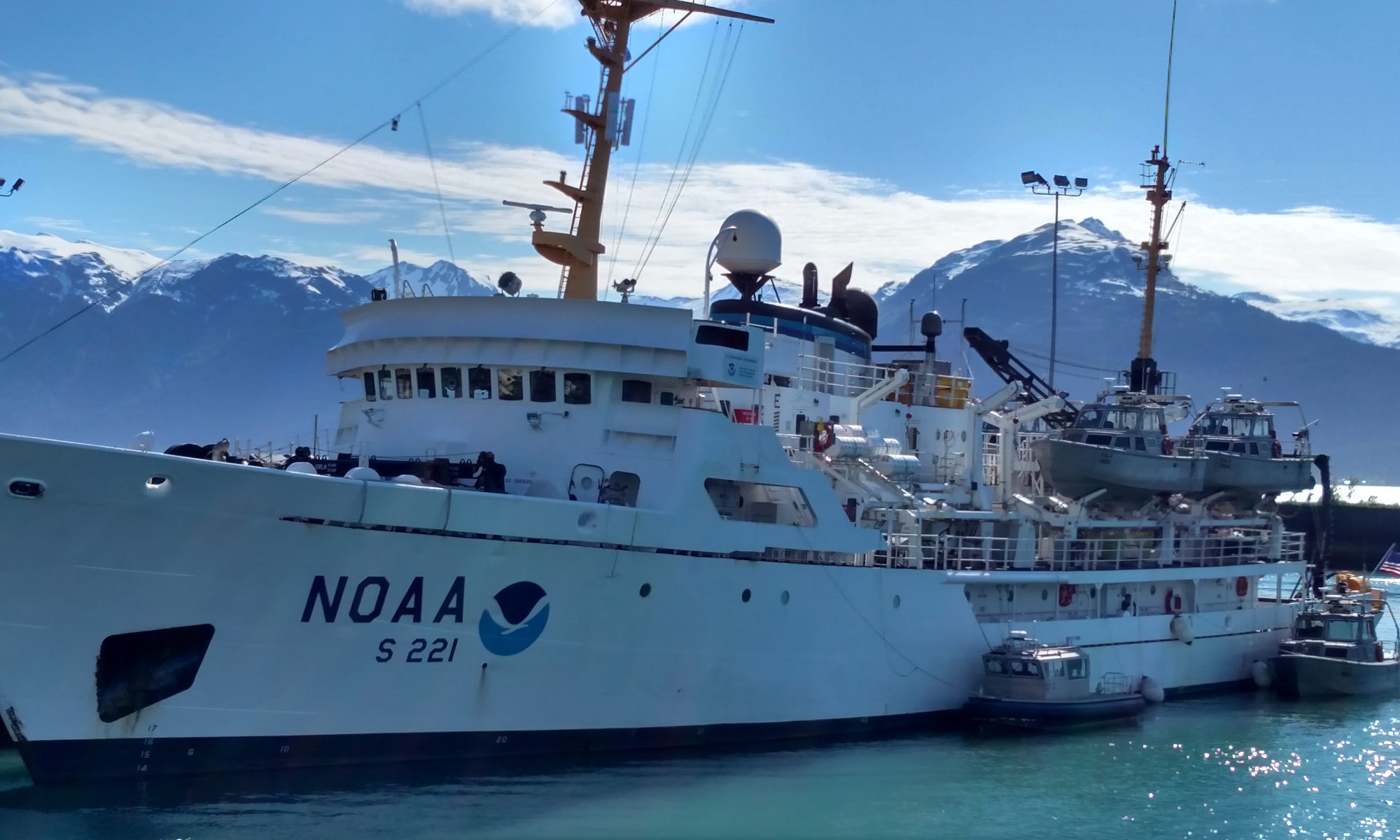
Lesley Urasky: Get that fish outta here! The invasive lionfish, June 24, 2012

NOAA Teacher at Sea
Lesley Urasky
Aboard the NOAA ship Pisces
June 16 – June 29, 2012

Mission:  SEAMAP Caribbean Reef Fish Survey
Geographical area of cruise: St. Croix, U.S. Virgin Islands
Date: June 24, 2012

Location:
Latitude: 19.8584
Longitude: -66.4717

Weather Data from the Bridge:

Air Temperature: 29°C (84°F)
Wind Speed:   16 knots (18 mph), Beaufort scale:  4
Wind Direction: from SE
Relative Humidity: 76%
Barometric Pressure:   1,015.3 mb
Surface Water Temperature: 28°C (82°F)

Lionfish in its native habitat. ( Source: National Geographic; Photograph by Wolcott Henry)
Science and Technology Log

One of the species the scientists are continually scanning for in their videos is the appearance of the Lionfish (Pterois volitans/miles); this is one fish they’re hoping not to see.  It is not native to these waters and is what is known as an invasive or exotic  species.

An invasive species is one that is not indigenous (native) to an ecosystem or area.  Many times these organisms are able to exponentially increase their populations because they may have no natural predators, competition for resources, or they may be able to utilize those resources not used by native organisms.  Most invasions are caused by human actions.  This may involve intentional introduction (many invasive plant species were brought in to create a familiar environment or crop/foraging source), accidentally (rats travelling on ships to distant ports), or unintentionally (people releasing pets that they can no longer take care of). Invasive organisms are problematic because:

  • They can reduce natural biodiversity and native species.
    • Push other species to extinction
    • Interbreed, producing hybrids
  • Degrade or change ecosystem functions
  • Economically:
    • They can be expensive to manage
    • Affect locally produced products causing a decline in revenue (decline of honey bees due to a mite infestation which, in turn, decreases pollination rates)

Within its native habitat, the Indo-Pacific region, the Lionfish  (Pterois volitans/miles) is not a problem because that is where they evolved.  It is in the family Family Scorpaenidae (Scorpionfishes). They inhabit reef systems between depths of 10 m – 175 m.  During the day, they generally can be found within crevices along the reef; at night they emerge to forage in deeper waters, feeding upon smaller fish and crustaceans.

Native range of the Lionfish

Lionfish are venomous and when a person is “stung” by the spines on the dorsal fin, they experience extreme pain, nausea, and can have breathing difficulties.  However, a sting is rarely fatal.  Despite the hazards of the spines, Lionfish are a popular aquarium species.  The problem arises when pet owners irresponsibly get rid of the fish in their aquariums.  Instead of giving them away to pet shops, schools, organizations, or other fish enthusiasts, or contacting a local veterinarian about how to humanely dispose of them, they release them into a nearby marine body of water.  It’s important to realize that even the smallest, seemingly isolated act can have such large consequences.  Remember, if one person is doing it, chances are, others are too. The responsibility of owning an organism is also knowing how to manage it; we need to realize how to protect our marine habitats.

This is where the problem in the Atlantic began.  The occurrence of Lionfish was first noticed along the southeastern coast of Florida in 1985.  An invasive species is considered established when a breeding population develops.  Since their establishment in the waters off of Florida, they have rapidly spread throughout the Atlantic as far north as Rhode Island/Massachusetts , throughout the Caribbean, and into the Gulf of Mexico.

Animated map depicting the spread of the Lionfish

While on our cruise every sighting of a Lionfish was cause for further examination.  There was one Lionfish that exhibited a behavior that Kevin Rademacher (Chief Scientist) had never seen before.  The fish was on the bottom and moving himself along instead of freely swimming.  Videos like this are instrumental in helping scientists figure out Lionfish behavior in their “new” environment as well as their interactions with the surrounding organisms and environment.  Hopefully, as this database continues to grow, scientists will develop new understandings of the Lionfish and its effect on the waters of the Atlantic, Caribbean, and Gulf of Mexico.

Divers are encouraged to kill any Lionfish they encounter.  The only safe way to do this is from a distance (remember, their dorsal spines are venomous); usually, this is accomplished by using a spear gun.  The Commander of the Pisces, Peter Fischel,  was doing a final dive off the pier before we left St. Croix.  He saw three Lionfish, speared them, and brought them to the scientific crew for data collection.  These were frozen and placed in a Ziploc back for preservation.  They will be examined back at the lab in Pascagoula, Mississippi.

Three Lionfish caught along the Frederickstad, St. Croix pier. (Notice the 6″ ruler for scale.)

Personal Log

The science portion of the cruise is coming to a close. Today was our last day of sampling.  As with yesterday, no fish were caught by the day crew, so we were able to begin cleaning and packing throughout the day instead of waiting until the end.  A few days after we arrive in Mayport, Florida, the Pisces will be going out on another cruise along the east coast.  On Sunday, July 1st, Joey Salisbury will be arriving in Mayport with a trailer to unload all the scientific equipment and personal gear from this research cruise.

Bandit reel with St. Thomas in the background

In addition to packing, the wet lab and deck have to be cleaned.  This entails scrubbing down the tables, coolers, and rails along the deck where we baited our hooks to remove all the fish “scum” that has accumulated over the past three weeks.  Between the four of us, we were able to make quick work of the job.  There is only one task left for me to do, and that is to take all of our leftover bait, Atlantic Mackerel, and throw it overboard once we are away from the islands.  (The bait has been used over the course of the past two years, and has essentially outlived its freshness.)

Day operations crew on the Pisces Caribbean Reef Fish Survey (left to right: Ariane Frappier, Kevin Rademacher (Chief Scientist), Joey Salisbury, and myself).


I want to thank all the scientists on the day operations crew and the deck hands for making me feel so welcome, being ever so patient as I learned how to bait hook, load the bandit reel, remove otoliths, sex  the fish, and answer every type of question I had.  They’re all amazing people and are passionate about their jobs.  Kevin was not only great at thoroughly answering any and all questions, but anticipated those I might have and brought interesting things to my attention.  Thank you everyone for an amazing experience that I’ll never forget!

Another incredible person that helped make my trip memorable is my roommate, NOAA Operations Officer, Kelly Schill.  She was very welcoming and made me feel immediately at home on the ship.  She gave me a thorough tour and introduced me to the crew.  I interviewed her briefly about her job in the NOAA Corps.

Kelly Schill, Operations Officer aboard the NOAA ship Pisces. (Source: http://www.noaacorps.noaa.gov)

LU: Kelly, what is your job title and what do you do?

KS: I am a Lieutenant junior grade in the NOAA Corps.  The NOAA Corps is one of the 7 uniformed services and I serve as the Operations Officer aboard the NOAA Ship Pisces.

LU: How long have you been working with NOAA?

KS: I have worked for NOAA a total of 4 years; 3 of which were aboard the NOAA Ship Pisces as a NOAA Corps Officer. My first year, I was a physical scientist and developed geospatial visualizations to assist in the generation of navigational warnings and maritime safety information for Dangers to Navigation for the NOAA and contractor surveys.  I assisted NOAA Ship Thomas Jefferson in the field with the acquisition, converting and cleaning of multi-beam and side-scan sonar data.

Aboard the NOAA Ship Pisces, my responsibility is to be the liaison between the ship’s crew and scientific party to ensure the mission is carried out smoothly and efficiently.  A big part of my job is to handle the logistics and transportation, such as project planning and setting up dockage at different ports from Texas to the Caribbean up to Massachusetts. Most importantly, to continue to learn the intricacies of the ship, effectively operate, and practice safe navigation at all times.

LU: What background and skills are necessary for your job?

KS:  A Bachelors Degree of sciences.  You must complete a year of chemistry, physics and calculus.  Geographic information System (GIS) is equally important. To be well-rounded, internships or field research experience is highly recommended.

Kelly Schill showing off the otolith she just extracted from a Red Hind.

LU: What type(s) of training have you been through for your job?

KS: Being in the uniform service, I was sent to Basic Officer Training Course (BOTC) to learn military etiquette, terrestrial and celestial navigation, safety aboard ships, search and rescue, fire prevention, hands on experience in driving small boats up to larger vessels, etc.  Once out of BOTC and on an assigned ship, I was able to attend further training:  hazardous material courses, dive school, rescue swimming, and medical. There are many more opportunities that were offered. I have only touched on a few.

LU: Have you worked on other ships not associated with scientific research?  If so, what was your job and what type of ship was it?

KS: No, all my experiences were on ships regarding scientific research:  NOAA Ship Thomas Jefferson (hydrographic ship) and the NOAA Ship Pisces (fisheries ship).

LU: Does being on a science research ship bring any specific/different expectations than being on another type of merchant ship?

KS: I am unfamiliar with the expectations on a merchant ship.  Generally, the research vessels are used to support studies intended to increase the public’s understanding of the world’s oceans and climate. Research vessels are not set on a point A to point B system. Various operations are conducted from fisheries, bathymetry, oceanographic, to marine mammal data collection.   These various research projects dictate operation area.  Contrary to research vessels, merchant ships usually have a set destination, from point A to point B transporting cargo of one type or another.

LU:  We are in the middle of a huge ocean, and our destination – a specific sampling site – is a pinpoint on a map. What has to be considered to make sure you get to the exact location?

NOAA ship Pisces ECDIS map. This is a nautical map that is updated monthly.
Closeup of navigational maps showing the location of our sampling sites.

KS:  We use a number of tools: ECDIS, Rosepoint, paper charts, GPS, Dynamic Positioning, and of course manual operation. The scientists will provide a location where they want the ship to be for operations to take place. We use all navigational tools to navigate to that position by creating a route, based on a good GPS feed. Navigational tools include: ECDIS (shows an electronic vector chart), Rosepoint (shows an electronic raster chart), and paper charts.  Multiple navigational tools are for redundancy to ensure safe navigation.

All routes are created on the side of safety to avoid collision with shoals, wrecks, land, neighboring ships, platforms, buoys, obstructions, etc. Once, we are close to our sampling station, the ship is set up into the wind or the current (whichever force is stronger), reduce propulsion, turn rudder hard over to one side to assist in the reduction of propulsion and to line up on a heading in favor of wind or current. The bow thruster can assist in turns as well. Depending on how strict the mission is to hold an exact coordinate, the dynamic position is dialed in and activated.  Otherwise, the watch stander will manually control the engine speed, bow thruster, and rudder to maintain position utilizing outside forces, such as wind, swell, wave state, and currents.

The ship’s radar. The yellow objects at the bottom are St. Thomas and its surrounding small islands, while other vessels will appear in green.

LU: Once we reach a site, what do you need to do to maintain that position during the sampling process?

KS: Every ship has its perks and not all are the same in maintaining a position during the sampling process. Our ship has dynamic positioning (DPS) which uses the rudder, propulsion, and a bow thruster simultaneously to hold position. However, just like any software system, it only works as well as the operator.  The parameters have to be just right to accomplish this goal.  Parameters are set up based on wind speed, swells, sea state, and currents.  All must jive for a positive outcome. Our ship works more efficiently facing into the wind or current; whichever force is the strongest. If both are strong, we split the difference. Should either the bow thruster, main engine, or steering fail, the dynamic position will not properly compensate.

Dynamic Positioning System (DPS) screen. This instrument helps hold the ship at a precise location.

Kelly, thanks for the interview as well as being a great role model for women!  Remember, girls, if you want it, go get it!

Lesley Urasky: Smile and say, “Squid!”, June 20, 2012

 NOAA Teacher at Sea
Lesley Urasky
Aboard the NOAA ship Pisces
June 16 – June 29, 2012

 Mission:  SEAMAP Caribbean Reef Fish Survey
Geographical area of cruise: St. Croix, U.S. Virgin Islands
Date: June 20, 2012

Location:
Latitude: 18.1937
Longitude: -64.7737

Weather Data from the Bridge:

Air Temperature: 28°C (83°F)
Wind Speed:  19 knots (22 mph), Beaufort scale: 5
Wind Direction: from N
Relative Humidity: 80%
Barometric Pressure: 1,014.90  mb
Surface Water Temperature: 28°C (83°F)

Science and Technology Log

The cameras are a very important aspect of the abundance survey the cruise is conducting.  Since catching fish is an iffy prospect (you may catch some, you may not) the cameras are extremely important in determining the abundance and variety of reef fish.  At every site sampled during daylight hours, we deploy the camera array.  The cameras can only be utilized during the daytime because there are no lights – video relies on the ambient light filtering down from the surface.

Camera array – the lens of one of the cameras is facing forward.

Deployment of the array at a site begins once the Bridge verifies we are over the sampling site. The camera array is turned on and is raised over the rail of the ship and lowered to the water’s surface on a line from a winch that has a ‘quick release’ attached to the array.  Once over the surface, a deck hand pulls on the line to the quick release allowing the array to free fall to the bottom of the ocean. Attached to the array is enough line with buoys attached. The buoys mark the array at the surface and give the deck hands something to aim for with the grappling hook when it is time for the array to be retrieved.  Once the buoys are on deck, a hydraulic pot hauler is used to raise the array from the sea floor to the side of the ship.  From there,  another winch is used to bring the array on board.

Vic, Jordan, Joey, and Joe deploying the camera array.

When the array is deployed, a scientist starts a computer program that collects the time, position and depth the array was dropped at. The array is allowed to “soak” on the bottom for about 38 minutes. The initial 3-5 minutes are for the cameras to power up and allow any sediment or debris on the bottom to settle after the array displaces it. The cameras are only actually recording for 25 of those minutes. The final 3-5 minutes are when the computers are powering down.  At one point in time, the cameras on the array were actual video cameras sealed in waterproof, seawater-rated cases. With this system, after each deployment, every individual case had to be physically removed from the array, opened up, and the DV tape switched out.  With the new system, there are a series of four digital cameras that communicate wirelessly with the computers inside the dry lab.

We did have a short-lived problem with one of the digital cameras — it quit working and the electronics technician that takes care of the cameras, Kenny Wilkinson, took a couple of nights to trouble shoot and repair it.  During this time period, we reverted back to the original standard video camera.  Throughout the cruise, Kenny uploads the videos taken during the day and repairs the cameras at night so they will be ready for the next day’s deployments.

Squid (before being cut into pieces) used for bait on the camera array

Besides the structure of the camera array which is designed to attract reef fish, the array is baited with squid.  A bag of frozen, cut squid hangs down near the middle.  The squid is replaced at every site.

Adding bait to the camera array.

In addition to the bait bag, a Temperature Depth  Recorder (TDR) is attached near the center, hanging downward near the bottom third of the array. The purpose of the TDR is to measure the temperature of the water at various depths.  It is also used to verify that the depth where the camera comes to rest on the ocean bottom and is roughly equivalent to what the acoustic sounding reports at the site.  This is important because the camera generally doesn’t settle directly beneath the ship.  Its location is ultimately determined by the drift as it falls through the water column and current.  The actual TDR instrument is very small and is attached to the array near the bait bag.  After retrieving the array at each site, the TDR is removed from the array and brought inside to download the information.  To download, there is a small magnet that is used to tap the instrument (once) and then a stylus attached to the computer is used to read a flash of light emitted by an LED.  The magnet is then tapped four times on the instrument to clear the previous run’s data.  The data actually records the pressure exerted by the overlying water column in pounds per square inch (psi) which is then converted to a depth.

TDR instrument
Computer screen showing the data downloaded from the TDR.

The video from each day is uploaded to the computer system during the night shift.  The following day, Kevin Rademacher (chief scientist), views the videos and quickly annotates the “highlights”.  The following things are noted:  visual clarity (turbidity [cloudiness due to suspended materials], what the lighting is like [backlit], and possible focusing issues), substrate (what the bottom is made of), commercially viable fish, fish with specific management plans, presence of lionfish (an invasive species), and fish behavior.  Of the four cameras, the one with the best available image is noted for later viewing.

Computer data entry form for camera array image logs

Once back at the lab, the videos are more completely analyzed.  A typical 20-minute video will take anywhere from 30 minutes to three days to complete. This is highly dependent upon density and diversity of fish species seen; the greater the density and diversity, the longer or more viewing events it will take.  The experience of the reader is also an important factor. Depending upon the level of expertise, a review system is in place to “back read” or verify species identification. The resulting data is entered into a database which is then used to assign yearly data points for trend analysis. The final database is submitted to the various management councils.  From there, management or fisheries rebuilding plans are developed and hopefully, implemented.

Spotted moray eel viewed from the camera array.  He’s well camouflaged; can you find him?
Coney with a parasitic isopod attached below its eye.
Two Lionfish – an invasive species

Personal Log

Today, we are off the coast of St. Thomas and St. John in the U.S. Virgin Islands.  We traveled from the southern coast of  St. Croix, went around the western tip of the island and across the straight.  When I woke up I could see not only St. Thomas and St. John, but a host of smaller islands located off their coastline.

Map of the Virgin Islands. St. Croix and St. Thomas are separated by 35 miles of ocean. It took us about 3 hours to cross to our next set of sampling sites.

Around dinner time last night we had an interesting event happen on board.  They announced over the radio system that there was a leak in the water line and asked  us not to use the heads (toilets).  A while later, they announced no unnecessary use of water (showers, etc.); following that they shut off all water.  It didn’t take long for the repairs to occur, and soon the water was returned.  However, when I went to dinner, I discovered that the stateroom I’m sharing with Kelly Schill, the Ops Officer, had flooded.  Fortunately, the effects of the flooding were not nearly as bad as I had feared.  Only a small portion of the room had been affected.  The crew did a great job of rapidly assessing the problem and fixing it in a timely manner.  After this, I have absolutely no fear about any problems on board because I know the crew will react swiftly, maintain safety, and be professional all the while.

Last night was the first sunset I’ve seen since I’ve been on board.  Up until this point, it has been too hazy and cloudy.  The current haze is caused by dust/sand storms in the Sahara Desert blowing minute particles across the Atlantic Ocean.

St. Thomas sunset

Today has been a slow day with almost nary a fish caught.  We did catch one fish, but by default.  It was near the surface and hooked onto our bait.  We immediately reeled in the line and extracted it.  It was necessary to remove it because it would have skewed our data since it was caught at the surface and not near the reef.  This fish was a really exciting one for me to see, because it was a Shark Sucker (Echeneis naucrates).  These are the fish you may have seen that hang on to sharks waiting for tasty tidbits to float by.  They are always on the lookout for a free meal.

Shark sucker on measuring board

One of the most interesting aspects of the shark sucker is that they have a suction device called laminae on top of their heads that looks a little like a grooved Venetian blind system.  In order to attach to the shark (or other organism), they “open the blinds” and then close them creating a suction-like connection.

The “sucker” structure on the Shark Sucker. Don’t they look like Venetian blinds?

I got to not only see and feel this structure on the fish, but also let it attach itself to my arm!  It was the neatest feeling ever! The laminae are actually a modified dorsal spines; these spines are needed because of the roughness of shark’s skin. When the shark sucker detached itself from me, it left a red, slightly irritated mark on my arm that disappeared after a couple of hours.

Look, Ma, No Hands! Shark sucker attached to my arm.

Tomorrow we’ll be helping place a buoy in between St. Croix and St. Thomas.  It will be interesting to see the process and how the anchor is attached.

With all the weird and wonderful animals we’re retrieving, I can’t wait to see what another day of fishing brings.

Marian Wagner: My Final Words and Hurricane Irene’s in Charge, August 23, 2011

NOAA Teacher at Sea
Marian Wagner
Aboard R/V Savannah
August 16 — 26, 2011

Mission: Reef Fish Survey
Geographical Area: Atlantic Ocean (Off the Georgia and Florida Coasts)
Date: Tuesday, August 23, 2011

A Fine Bunch to Live with at Sea: Front: Katie Rowe (Scientist), Sarah Goldman (Scientist Watch Chief, Night), Stephen Long (Scientist), Warren Mitchell (Lead Scientist). Middle: Marian Wagner (Teacher-at-Sea), Shelly Falk (Scientist), Christina Schobernd (Scientist, Video). Back: John Bichy (Marine Technician), Richard Huguley (Engineer), Harry Carter (2nd Mate), Raymond Sweatte (Captain), Michael Richter (1st Mate), David Berrane (Scientist Watch Chief, Day), Mike Burton (Scientist). Missing: Joel Formby (Master of the Galley)

Weather Data from the Bridge (the wheelhouse, where the controls of the ship are)

E-NE Wind at 10 knots  (This means wind is travelling 10 nautical miles per hour,
1.15 statute miles = 1 nautical mile)

Sea depth where we traveled today ranged from 33 meters to 74 meters

Seas 2-4 feet (measure of the height of the back of the waves, lower the number = calmer seas and steadier boat)

Science and Technology Log

IRENE: On Tuesday evening, we discussed the impact of Hurricane Irene on our cruise plans, and scientists and crew needed to make a decision about when we should return to dock. Originally, the plan was to return in the morning on Friday, August 26, but due to projections of Irene, they predicted that the seas would be too rough for us to lay traps beyond Wednesday (8/24).  When the seas are too rough, the traps bounce around and cameras do not pick up a steady, reliable picture.  When seas get to be 6-7 feet+ on a boat the size of the R/V Savannah (92 feet long), it also makes our work (and life) on the boat very difficult. Additionally, with Irene’s landfall projected in North Carolina, where half of the scientists live, they would need to get home in time to secure their homes and potentially evacuate.  Not in the case of Irene, but if a hurricane was expected to hit Savannah/Skidaway, where the boat moors, the ship’s crew would need to prepare for a hurricane-mooring.  To do this, they would run the ship up the Savannah River and put on a navy anchor that weighs 3,000 pounds.  Even with the use of the electric crane, it’s not an easy task to pull a 3,000 pound anchor onboard.  This would not be done unless a direct hit to the area was expected.  It has been done once before to the Savannah in the 10 years of her existence.  The forecast did not project Savannah to be affected by Irene, so we did not need to prepare for a hurricane mooring.

After difficult deliberation on Tuesday night about hurricane Irene’s potential Category (see how hurricanes are ranked here), and considering the success of the research accomplished on the trip already, scientists decided the most practical and reasonable decision was to dock Tuesday night, unpack Wednesday morning, and allow North Carolina scientists to return to their homes by Wednesday night.  (From reports I received post-Irene, there was landfall of the hurricane eye over their houses, but the storm weakened between Wednesday night and Saturday and was Category 1 when it came ashore.  None of them sustained significant loss.  Many downed trees and three days without power, but no floods or structure damage. Phew!)

NOAA’s National Weather Service is the sole official voice of the U.S. government for issuing warnings during life-threatening weather situations.  Follow Seattle’s “Weather Story” at NOAA’s National Weather Service.

OUR RESEARCH PROCESS…A STORY CONCLUDED

Here on my final blog entry, I want to finish the story of our research process.  Here’s the story I’ve told so far, in outline form:

  1. research begins with baiting fish traps and attaching cameras, and we stand-by on deck
  2. when we arrive at a research location with reef fish habitat (as observed via depth sounder and GPS), we drop the trap to the bottom and it sits for 90 minutes; buoys float above each trap so we can find and retrieve them near where traps were deployed, we run the Conductivity, Temperature, and Depth Profiler (CTD) to get information about abiotic conditions at each sampling site. The CTD takes vertical water column profiles, measuring: Pressure, Temperature, Conductivity/Salinity, Chlorophyll fluorometer, Color dissolved organic matter fluorometer (CDOM), Photosynthetic Active Radiation (PAR), Backscatter, Dissolved oxygen, and Transmissometer -10 and 25 cm path lengths
  3. after 90 minutes have passed, we return to the traps and pick them up, and secure the fish caught
  4. we identify each fish, measure length, weight, and frequency (how many fish were      caught), and then keep the fish that our research is targeting
  5. in the wet lab, we dissect target fish, removing parts of fish that are sent back to the lab for further research

AT THIS POINT, WE ARE DONE with our research with the bodies of the fish, but we have 99% OF THE FISH’S BODY LEFT! What should we do?

I was very impressed with the compassionate and humane action the scientists do with the fish after research.  Scientific research guidelines don’t dictate what a research study should do with edible fish flesh. We could have just discarded fish back into the ocean. However, scientists see an opportunity to provide food to people in need of  nutritional support in our communities, and they coordinated with a regional food bank in Savannah to do just that. Despite the work and time it takes to process the fish for donation, it did not seem to be considered a burden at all by any of the scientists.

I am perfecting my fillet!
Fresh fish fillets ready for food bank distribution

To process the fish for donation, we cut fish into fillets, wrap the fillets in butcher paper, and freeze them onboard the ship.

When we reached land, Warren
contacted the regional food bank, who came out to the dock with a refrigerated truck to pick up fish.  Within a few days the fish was distributed through charitable organizations in the region to people who were most in need.

These scientists are not just natural scientists but social scientists too! (just as I fancy myself!)

Personal Log

Captain Raymond Sweatte and First Mate Michael Richter

Interview with Raymond Sweatte, captain of R/V Savannah

Marian: What  makes a good crew?

Raymond: A crew that sees things that need to be done and does them because they know it all goes smoother when they do.


M: Have you ever run into or had a close call running into another ship?

Raymond: No, but the closest I came was when I was passing under the bridge at the Skidaway when a barge was coming through at the same time. Because it was easier for me to maneuver, I pulled over to side to let the barge use the majority of the channel. But the barge stayed on my side of the channel and was coming right at me. My boat was leaning upon the bank so there was no where for me to go.  I got him on the horn and asked, “What’s going on?”  He pulled over right away. He was new and very apologetic. 

M: Have you ever been in a terrible storm before?

Raymond: A few times we’ve had 15-16 foot seas coming back from the Gulf. When you have a north wind at 35 knots [strong wind coming from the North] and north-going current opposing the wind, the seas get very rough. Waves were coming up over the ship. [picture Marian’s eyes VERY wide at this point in the conversation] When seas are really rough, you get lifted up out of bed and down again. I remember trying to sleep one night in rough seas when my head kept hitting against the wall, so I turned around so my feet were up hitting against the wall.

M: What were things like before radar, satellite, and so many electronic navigation tools
you use today?

Raymond: Things were not as accurate. Communication was on a single sideband, navigation was with Loran-C, though VHF radio was somewhat the same as now.  To follow ships and determine their speed we had radar on dash but we had to use an eye cup we looked into to correlate with the radar, and then go over to the chart to plot them.  Then, we did it again six minutes later and multiplied by 10 to find their speed.  Now we have an automatic identification system [we can click on a ship on the radar] that tells us where they are, who they are, where they came from, where they are going, and what they are doing.  

M: What are the right-of-ways when vessels are crossing paths; who moves when two vessels are in course to collide?

Raymond: [On ships, aircraft and piloted spacecraft] a red light is on the left or port side of the craft and a green is on the right or starboard side. When two vessels have crossing paths, each will see a red or green light. If you’re looking at another vessel’s port side you see red, and it’s his right-of-way. If you are on their starboard side, you see the green light, and the right is yours.

Also, right-of-way rules give priority to vessels with the most difficulty maneuvering. The ranks in right-of-way, starting with the highest are:

1)Not under command

2)Restricted in ability to maneuver

3)Constrained by draft (stay away from shallower water to avoid running aground)

4)Fishing

5)Sail

6)Power

7)Sea Plane

Remember this mnemonic: New Reels Catch Fish So Purchase Some.

M: Who’s easier to talk to, a Navy Sub Captain or a Coast Guard Helicopter Pilot?

Raymond: I don’t have a problem talking with any of them. Coast Guard generally would call you first. Navy sub pilots I’ve found to be very cordial. They have changed their course when we had traps out.

M: What message would you say to students interested in being a captain?

Raymond: All kids have to follow their own heart. If they like water and this environment, they should follow their heart and become a captain.

Thank you Captain Raymond! It was a genuine pleasure to talk to you and experience life at sea under your command and with such a stellar crew. It is no wonder you are revered by everyone you work with.  Read more about Captain Raymond Sweatte in the Savannah Morning News!

The powerful significance of this trip for me was that I did not just study a science lesson from a book or lab, but I was essentially given a chance to live a different life, that of a fisheries field biologist.  I did not dabble in the work; it was a full explosion into the curiosities, reasonings, and daily routines of working with live fish and fish guts while sharing friendship, humor and stories with scientists and crew aboard a boat that was a small bounded island of rich human culture within a vast ocean of life and scientific questions waiting to be answered.  I loved it.  If only I didn’t love teaching more…I could definitely live that life.  Thanks NOAA, thanks NC SEFIS folks, thanks SC DNR folks, and thanks Skidaway Institute of Oceanography folks.  You are all in my heart and in my classroom!

FASCINATING EXTRAS!

Flying fish!

At night especially, when looking out at the seascape, I noticed flying, bug-looking specimens scurrying out of and into the ocean’s surface.  WHAT WERE THEY?! I wondered. So I asked and learned they were FLYING FISH! A few of them flew right up on the vessel’s work deck.  Their wings are modifications of the pectoral fins.  They are so fascinating and their coloring was greenish/blue iridescence, a stunningly beautiful color!

RED SNAPPER: PROTECTED STATUS

“The Gulf and South Atlantic red snapper populations are currently at very low levels (overfished), and both red snapper populations are being harvested at too high a rate (overfishing).” See more where this quote came from at Fish Watch: US Seafood Facts.

It was clear to me how significant the concern for the red snapper population was when I learned that funding for this fisheries survey was drastically increased following the recent determination that red snapper were overfished and overfishing was occurring.  Fisheries managers, field biologists and members of the general public all want to see the red snapper population improve.  This cruise provided scientific data that will be useful when the status of the U.S. South Atlantic red snapper population is assessed again.

The lionfish's spines are so poisonous the only way to hold them is placing fingers in their mouths.

History of measuring speed in NAUTICAL MILES:

Wonder how a vessel’s speed was measured hundreds of years ago? Log Lines, knotted ropes with a log tied to one end and knots every nautical mile and one-tenth of a nautical mile, were tossed off the end of the ship while the knotted rope unraveled behind it. When the sand on a minute sand glass ran out, the rope was reeled back in and the knots counted to determine ship’s speed in knots-per-minute.

 LIONFISH: INVASIVE SPECIES

In its native waters of the Indian and Pacific Oceans, the lionfish population is not a problem. There it has natural predators and natural parasites to keep it from overpopulating, yet it can survive well enough to maintain a healthy sustainable population. However, in the Caribbean waters and along the Eastern Coast of the United States, the lionfish has recently been introduced, and the effects are alarming. “Lionfish have the potential to become the most disastrous marine invasion in history by drastically reducing the abundance of coral reef fishes and leaving behind a devastated ecosystem.”  See more where this quote came from at NOAA’s research on invasive lionfish here. In the U.S. south Atlantic, they consume large quantities of reef fish and have no natural predators or parasites. Their population is thriving in large numbers, and it is devastating other fish species.  Mark Hixon, Oregon State University zoology professor, co-authored a study in 2008 with Mark Albins that showed “a lionfish can kill three-quarters of a reef’s fish population in just five weeks.” Read NPR story here. This is a cool way to view an environmental problem: see this animated map of the lionfish invasion! Red Snapper

Chris Imhof, November 19, 2009

NOAA Teacher at Sea
Chris Imhof
Onboard NOAA Ship Pisces
November 7 – 19, 2009

Mission: Coral Survey
Geographic Region: Southeast U.S.
Date: November 19, 2009

Science Log

After 3 days and many hours in front of computer screens and monitors I almost forgot I was on a boat. Tonight is my last night on the Pisces, and although at times it has been rough, I have started to get used to the rocking of the ship and know every crew member by name. I ran about the ship when I have had a second, to take in things knowing I will have chance tomorrow . I will miss looking across the open sea and having opportunities to catch a glimpse of a shark fin near the side of the ship and a huge sea turtle making its way across the waves. I will miss talking to the crew and the scientists, and working with Jeannine Foucault the other Teacher at Sea. I’ll probably write another log tomorrow to sum up the experience, but its hard

to rally up for a science log when you are tired and many of have to pack to disembark at Jacksonville tomorrow morning. As for the Pisces and her crew, they will make their way back to Pascagoula for the Holidays.

Chris Imhof, November 18, 2009

NOAA Teacher at Sea
Chris Imhof
Onboard NOAA Ship Pisces
November 7 – 19, 2009

Mission: Coral Survey
Geographic Region: Southeast U.S.
Date: November 18, 2009

Science Log

NOAA’s mission is to “protect, restore and manage the use of coastal and ocean resources.” The way NOAA does this is through science – a voyage like this may seem like moving from point to point and placing a really cool piece of technology in the water to see what’s on the bottom – but these are all tools that are being used to be able to carry out the tenets of protect, restore and manage.

We have visited half our sites now and have surveyed different environments in and out of Marine Protected Areas. Different environments, yet with commonalities – all the sites are near exposed “hard-bottom” or exposed limestone on the shelf bottom. There may be miles of sand waves and algae – but theses exposed, complex and bio-encrusted features are “oasis’s” for all sorts of ocean life – especially fish. As the ROV maneuvers across the sandy waves, it is usually the glint of a school of fish or reflection of a fish eye that provides a beacon to a feature. If these features are “oasis” habitats then they should be protected. Granted, these limestone blocks can do more damage to fishing line and gear, evident in the amount of line found in the high relief areas – but in the case of some of the North Florida MPA, we encountered the fragile deep water Occulina Coral which is vulnerable especially when nets are being dragged across these areas.

Another commonality noticed is the growing presence of the beautiful Lion Fish (Pterois volitans) – this native of Pacific waters was released intentionally or unintentionally in the early 1990’s around Florida and have since spread to areas above North Carolina and south to the Caribbean, especially along reefs and rocky outcrops. They join an infamous ranks of other invasive species including the European Green Crab, Asian Eel and Zebra Mussel. The Lion-Fish, besides having an array of venomous spines. has a keen strategy of “corralling” prey with their fins and eating them in one gulp. This will impact the small fish and crustaceans in these habitats as well as the added competition with indigenous or native predators such as snappers and grouper fish – which are currently commercially fished. This is where “manage” comes in – here is a “new” invasive species in that is growing in population and spreading geographically, impacting the habitat by out-competing, in some cases, the established predators – how can it be managed.

Especially when the Lion-fish has few natural enemies. The Lion Fish is a tricky one – as an invasive species, missions like this one help to understand the long-term impact the Lion-Fish is having on these habitats. Using technology like multi-beam mapping and ROV technology can provide data for scientists and in turn give councils, commissions and government the knowledge to manage these areas through smart-solution-based policy.

References:

coastalscience.noaa.gov/documents/factsheet_lionfish.pdf

http://www.magazine.noaa.gov/stories/mag135.htm