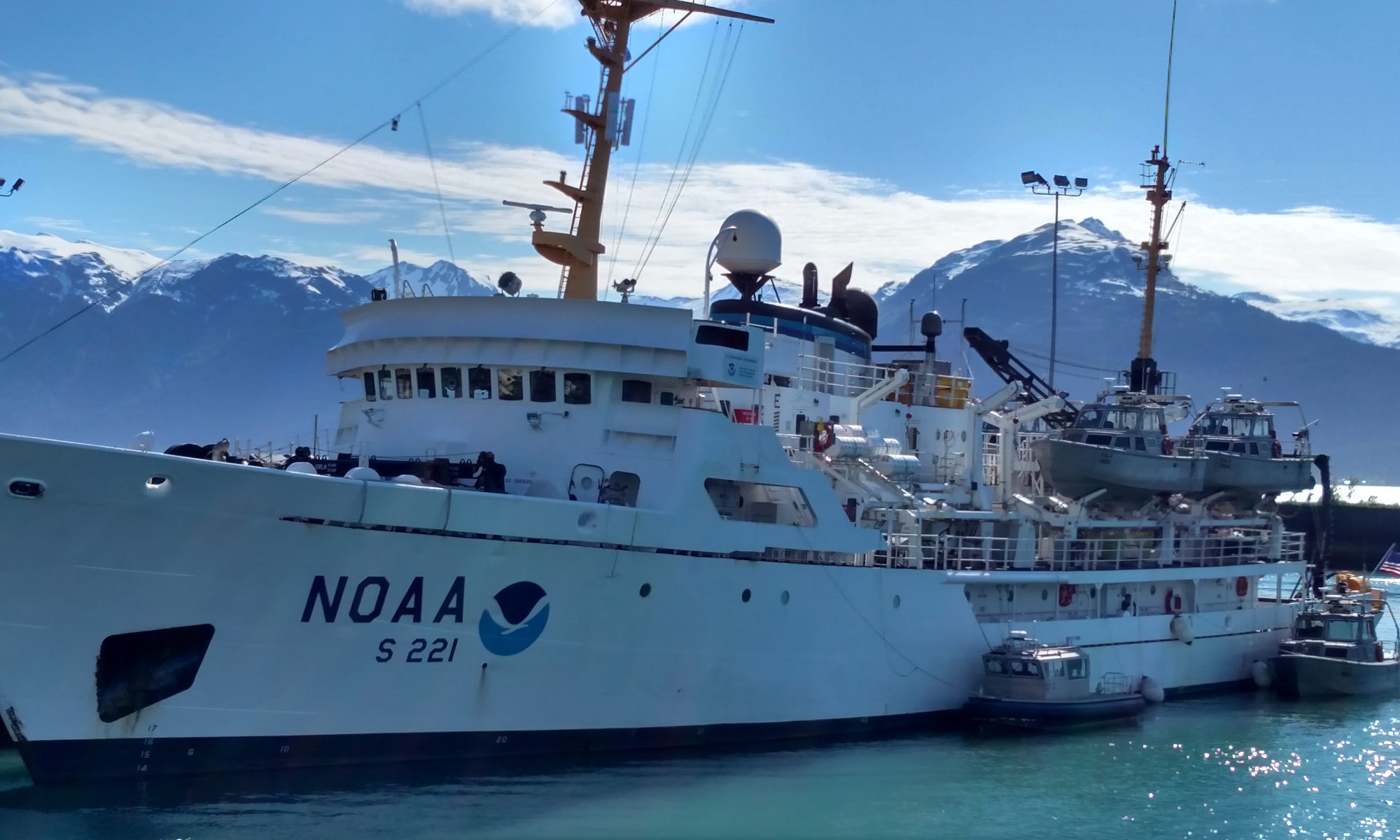
Weather Data Snapshot: 12:23pm, Pacific Daylight Time
Currently, the air temperature is 65°F (18°C) with a wind speed of 10 knots and a wave height of 5 feet. I was finally able to witness a sunrise this morning during my working hours, thanks to clear skies, and I am staying up a little bit past my “bedtime” to enjoy today’s sunshine.
Science and Technology Log
Trawling operations are in full swing here on the ship! Please enjoy this image of me in front of our two trawling nets, which we pull behind the boat at different depths to target different species of fish.
Photo of me with our fishing nets, which we use for surface and midwater trawling.
In these first few days, we are seeing many anchovy! I have quickly become an expert at identifying the differences between anchovy and other fishes that may be brought up with our net. In addition to fish species, we see quite a few small squid and some other invertebrates known as pyrosomes in our net. (See the Did You Know? section below for more information.)
Photo of a basket of anchovy, with one being held by someone’s hand for a size reference.
After sorting our catch, we measure and weigh a certain number of the target species (sardine, anchovy, and mackerel) to collect data that helps us characterize their species and size distributions. In addition, some specimens are selected for dissection, where we determine the fish’s sex, reproductive stage, and health; collect tissue samples for genetic analysis; and extract otoliths for estimating age.(For more about otoliths, which are also known as ear stones or ear bones, click here.) This information helps scientists monitor fish health through their life history stages. It’s not possible to catch every fish in the ocean, so scientists study a smaller representative group instead, like we are doing aboard NOAA Ship Bell M. Shimada. This age data, along with other information like length, weight, and sex, is used to create computer-generated models of the fish population. When combined with acoustic data, these models help estimate how many fish are in the wild and predict what might happen if people keep fishing.
Photo of me measuring a very small fish with a digital tool called an Ichythystick.
In the picture above, you can see that I am using a special tool called an Ichthystick to digitally measure the length of each fish in a specific subset from our catch. I have discovered that, although I do not normally consider myself squeamish when it comes to science, I am not a fan of dissecting fish for otoliths. Instead, I do a lot of the measuring and weighing of the fish, as well as additional tasks to support my teammates while they work on extracting otoliths.
In addition to trawling for fish, NOAA Ship Bell M. Shimada has a special piece of technology known as a CTD. A CTD is a scientific instrument used in marine science to study the properties of seawater. CTD stands for Conductivity, Temperature, and Depth. These three measurements help scientists understand what the ocean is like at different levels. The CTD device is usually attached to a metal frame and lowered into the ocean from a research ship. As it goes down, it collects data about the water’s temperature, how salty it is (measured by conductivity), and how deep it is. This information helps scientists learn about ocean currents, climate, and marine life. CTDs can also carry bottles that collect water samples from specific depths. Scientists use these samples to test for oxygen, nutrients, or tiny organisms. CTD data is very important for studying how the ocean changes over time. (I have not yet seen the CTD in action, but I pass by it every day on the side deck and am hoping that it will be deployed sometime soon during my working hours.)
Photo of me next to a CTD (Conductivity, Temperature, Depth) device for size reference.
Personal Log
Adjusting to life at sea is an ongoing process. I experienced a bit of seasickness yesterday right after lunch, but I was able to go to my stateroom at noon (which is the end of my night shift) and sleep it off until my next shift began at midnight. As a person who traditionally struggles with sleep, I am so exhausted after each shift that I am sleeping much better on the ship than I do at home, which I did not expect! In addition, I am eating much better on the ship than I do at home, thanks to our amazing Chief Steward who has been cooking fabulous meals for us. I have learned that mealtimes are very important on the ship, because sitting with your colleagues while enjoying good food is a boost for team morale and helps everyone stay energized.
Did You Know?
A lot of different animals can become caught in a trawling net while fishing, but pyrosomes are some of the most common animals we see during night trawls (aside from our target species of anchovy, mackerel, and sardine). What are pyrosomes? NOAA’s website tells us that pyrosomes are pelagic tunicates, which are part of the phylum Chordata. In other words, pyrosomes are tough, bumpy, gelatinous tube-like animals that gather in large clusters at the ocean’s surface. Like many jelly-like animals in the ocean, we still don’t know a lot about pyrosomes and how they live. This makes it hard to understand how they might be affecting ocean ecosystems. For example, pyrosomes can grow quickly and filter large amounts of water, which could have a big effect on phytoplankton blooms. Before this experience, I had never even heard of a pyrosome, and now, I feel like I am part of a pyrosome party every night!
A basket full of pyrosomes (the pink gelatinous tubes) mixed with fish.
Mission: Fisheries: Pacific Hake Survey (More info here)
Geographic Region: Pacific Ocean, off the coast of California
Date: July 10, 2023
– – ⚓ – –
Weather Data from the bridge:
July 7 (1200 PT, 1500 EST) Location: 36° 00.4’ N, 122° 05.9’ W 16nm (21mi) West of Big Sur, CA
Visibility: 10 nautical miles Sky condition: Overcast Wind: 20 knots from NW 330° Barometer: 1013.1 mbar Sea wave height: 3-4 feet Swell: 6-7 ft from NW 320° Sea temperature: 14.0°C (57.2°F) Air temperature: 14.4°C (57.9°F) Course Over Ground: (COG): 323° Speed Over Ground (SOG): 10 knots
July 8 (1200 PT, 1500 EST) Location: 36° 34.5’ N, 122° 05.3’ W 17nm (20mi) Southwest of Monterey, CA
Visibility: 10 nautical miles Sky condition: Few clouds Wind: 19 knots from NW 330° Barometer: 1013.8 mbar Sea wave height: 5-6 feet Swell: 6-7 ft from NW 330° Sea temperature: 14.0°C (57.2°F) 13.7 Air temperature: 14.4°C (57.9°F) 14.3 Course Over Ground: (COG): 089° Speed Over Ground (SOG): 10 knots
July 9 (1200 PT, 1500 EST) Location: 37° 06.8’ N, 123° 00.5’ W 30nm (35mi) West of Pigeon Point Light Station, Pescadero, CA
Visibility: 10 nautical miles Sky condition: Overcast Wind: 13 knots from NW 332° Barometer: 1016.0 mbar Sea wave height: 2-3 feet Swell: 4-5 ft from NW 310° 4-5 Sea temperature: 14.3°C (57.7°F) Air temperature: 15.2°C (59.4°F) Course Over Ground: (COG): 093° Speed Over Ground (SOG): 10 knots
July 10 (1200 PT, 1500 EST) Location: 37° 26.7’ N, 123° 06.4’ W 32nm (37mi) West of Pescadero, CA
Visibility: 8 nautical miles Sky condition: Overcast, fog in vicinity Wind: 20 knots from NW 330° Barometer: 1015.9 mbar Sea wave height: 2-3 feet Swell: 3-4 ft from NW 320° Sea temperature: 14.5°C (58.1°F) Air temperature: 13.6°C (56.5°F) Course Over Ground: (COG): 314° Speed Over Ground (SOG): 3 knots
– – ⚓ – –
Science and Technology Log
Me holding a Hake before sorting. After observation, we determined this was a developmentally mature female, measuring 50cm (20in) long!
In my July 6 blog post, I explained how NOAA Ship Bell M. Shimada is equipped to collect acoustic data in the form of echo grams. The acoustics team uses the data to determine if there are enough return signals to suggest fish are present and attempt a trawl. In this blog post, I will explain how we get the fish onboard, and what we do with the sample of marine life once it is collected from the net.
One question I had after learning about the acoustics and environmental DNA (eDNA) pieces of the survey mission was, “How does physically collecting and researching Hake samples fit into the puzzle of understanding their ecosystem and supporting sustainable fisheries?” (NOAA Fisheries quick facts and video here)
“While echosounders are useful, they do not provide certain quantitative data that researchers need to understand the ecology of these organisms and the midwater zone. To collect quantitative data, such as biomass, length and weight, and age class distributions, researchers must gather representational samples and take direct measurements of them. The best way to do this is by employing trawls.”
So, although acoustics and eDNA research is important to the overall survey, they are only pieces of the puzzle, and the puzzle is not complete without conducting trawls and physically researching samples. NOAA Ship Bell M. Shimada uses a midwater trawl net that is deployed from the stern over the transom, and towed behind the vessel. As the name suggests, midwater trawls occur in the middle section of the water column, versus surface and bottom trawls. The net is conical in shape and uses two metal Fishbuster Trawl Doors, and two sets of heavy chain links called Tom weights, in order to keep the trawl in the middle of the water column.
“The midwater region is especially important because the creatures that inhabit it constitute the majority of the world’s seafood. Understanding the ecology of midwater organisms and their vast environment can provide us with better information to manage these important natural resources and prevent their overexploitation.”
Deck department assisting in recovering the trawl net after a successful deployment.
Once the net is onboard, the net is emptied one of two ways depending on the size of the sample. For large samples, marine life is deposited into a hopper and subsequent conveyor belt. For smaller samples, the Hake will be put into a large basket then divided into smaller baskets of approximately 100 Hake each. Any other marine life like Salps, Myctophids, Pyrosomes, Rockfish, King of the Salmon, and small bony fish, etc. are recorded in the database and returned to the ocean.
“The ship’s wet lab allows scientists to sort, weigh, measure and examine fish. The data is entered directly into the ship’s scientific computer network.”
NOAA Office of Marine and Aviation Operations (OMAO): “Bell M. Shimada”
Large basket containing a sample of Hake with a few (red) Splitnose Rockfish.
NOAA Ship Bell M. Shimada’s Wet Lab with multiple scales, Ichtystick electronic measuring boards, trawl camera, vials for otolith (ear) bones, disposal chute, and tools including scalpels, tweezers, and knives.Wet Lab team member Maddie Reifsteck holding a Hake sample.Hake coming down the hopper ramp and onto the conveyor belt. Also in photo: Pinkish-brown Sea Pickle (Pyrosome) and translucent Salp.Basket of freshly caught Hake waiting to be sexed, sorted and have their length measured.Chemistry Lab team member Abi Wells using a scalpel to remove an organ sample from a Hake for further research of RNA.
With our boots and bright orange rubber pants and gloves on, our first task is to distribute the sample of Hake into baskets of about 100 each. Based on how many baskets we fill, a random selection of baskets will be kept, and the others will be returned to the ocean. With the remaining groups of Hake, we determine their sex and length.
In order to do this, we use a scalpel to make an incision on the underside/belly of the Hake. Once open, we are able to examine their organs, including the gonads to determine if the fish is male or female, and if they are developmentally immature or mature. Young Hake are difficult to sex, and it takes practice to get over any initial fears of cutting into an animal; let alone being able to locate and identify the gonads. Hake usually spawn in early winter, so many of the smaller Hake we sample from during the summer are age one or younger.
Our largest Hake thus far was a developmentally mature female, measuring 50cm (20in). In order to accurately and consistently measure the length of the sample, we use a waterproof, magnetic plastic board with metric (centimeter and millimeter) markings called an Ichthystick (think: high-tech meter stick). The fish is placed on the board with its mouth touching the black board at 0cm, then a magnetic stylus is placed at the fork of the fish’s tail. Once the magnetic stylus is placed on the board, the length to the nearest millimeter is displayed on the LCD screen and automatically entered into the database program. The length data is grouped with the date, time, and identified sex for later observation and comparison.
Additional information, abstracts and outline about Ichthystick here
Ichthystick’s LCD display, motherboard, magnetic board, and magnetic stylus. Digital scale in background.
An even smaller subgroup is then selected and examined to record weights of individual Hake, collect ear bones called Otoliths for aging, stomach samples for diet, liver for RNA, and ovaries for maturity development. Otolith bones help determine the age of the Hake because they grow a new “layer” of bone each year, similar to coral structures and annual tree rings. Organs and bones removed from the Hake are sent to NOAA Fisheries centers for analysis and included in databases with the date, identified sex, length, weight, and location in which they were collected.
This data is used to build more of the puzzle, along with acoustical information, water samples, and eDNA data in order to further understand the ecosystem, biomass, diet, and
“support sustainable populations of Pacific hake on the West Coast.” (…) “It provides vital data to help manage the migratory coastal stock of Pacific hake. The hake survey, officially called the Joint U.S.-Canada Integrated Ecosystem and Pacific Hake Acoustic Trawl Survey, occurs every odd-numbered year.”
Although this subtopic of explaining the Integrated Ecosystem and Pacific Hake Acoustic Trawl Survey is a bit easier to understand than my July 6 Acoustics Lab post, it certainly does not mean it’s an easy task!
When I had a tour on July 4, I remarked how clean and organized the Wet Lab is. I hadn’t see it in action yet, but noticed how everything had its place and use. On July 6 we conducted our first trawl and collected a sample of 11 baskets of Hake (approximately 1,100 Hake since we group about 100 Hake together in each basket.) From that sample, we kept four baskets and counted, sexed, and measured 541 Hake.
Five of us were working together in the Wet Lab for that haul. I’ll admit I probably didn’t sex 100+ Hake. It took a few minutes of watching the others carefully and swiftly cut into the underside of a fish, open the two sides, and know what to look for to determine the sex of very young Hake. Eventually I found the courage to slice in and take a look. By the fourth or fifth Hake, the uneasiness had subsided and I found the process very interesting and educational. Although young samples are hard to sex as they are often undeveloped, the others encouraged me and answered my questions and guesses with enthusiasm and support.
While working on measuring the lengths of our samples, one Science Team member paused and remarked how beautiful he found the fish. Although they do not have vibrant, bold colors, shimmering scales, or anything else particularly remarkable, he found the beauty in them. He digressed into a conversation of their role in the ecosystem, how they are living and breathing creatures, and how they probably all have their own personalities and slight physical differences. I noticed some of their eyes were shiny and sparkling, and how their faces and expressions were noticeably unique the more you looked. That “down to earth”, heartfelt discussion was very special and demonstrated how the crew respects the process of catching and sampling Hake, while keeping each other and marine mammals safe.
From the NOAA Corps Officers, to the deck department, to the engineers, electronics, science team, survey team, galley crew, volunteers, and everyone in between; the crew on NOAA Ship Bell M. Shimada is special. They take pride in their vessel and job, and always seem to have a smile and kind greeting. Being away from land and loved ones for weeks and months at a time will certainly take a toll on the body and mind, but this team is there for each other. To all of the crew, thank you for making me feel so welcomed and appreciated. We’re almost halfway through the mission, and as tired as I may get after (sometimes) 12+ hour days, I sleep well knowing the crew trusts their vessel and each other; and look forward to learning and becoming more and more acquainted each day with the people that make this mission possible. Thank you!
– – ⚓ – –
Did You Know? (FAQs)
1. Are you finding schools of them?
We’ve had seven successful trawls out of nine attempts for Pacific Hake fish. They often come with pyrosomes (Sea Pickle) myctophids (Lanternfish), and salps in the net too. Some trawl attempts are successful without a hitch, but more often than not we have to restart our Marine Mammal watches a few times before deploying in order to keep our ocean life safe and not get tangled in the net. Two trawl attempts have been abandoned because of the amount of persistent marine mammal life and playfulness near the ship. (I think they know we’re watching and show off for our cameras.)
2. What’s your average depth?
The transects (Set and numbered longitudinal east-west lines NOAA Ship Bell M. Shimada navigates on while collecting acoustic data) usually range from 50m – 1,500m (164ft – 4,921ft) in depth.
However, right now one of the displays in the Acoustics Lab, the depth reading is 3,240m which is about 10,630ft or just over two miles deep!
This depth is only 1,870ft shallower than the wreck of the RMS Titanic!
(We were on a long transect, we do not often see depths this great.)
3. Have you gotten seasick? Seasickness should subside after about 3 days.
I’ve never gotten seasick thankfully! Knock on wood and all the other premonitions, please.
4. What is the Hake role in the ecosystem?
More info on this coming in later posts after explaining our Chemistry lab and technology aboard!
However, as predators, they can be cannibalistic towards their own kind.
As far as their role in human consumption: They are often used as a substitute for Cod and Haddock, and in fish sticks and imitation crab meat.
Mission: 2023 Summer Acoustic-Trawl Survey of Walleye Pollock in the Gulf of Alaska
Geographic Area of Cruise: Islands of Four Mountains area, to Shumagin Islands area Location (10:45AM (Alaska Time), June 21): 55o 29.7525′ N, 156o 44.7276′ W
Data from 10:45AM (Alaska Time), June 21, 2023 Air Temperature: 8.4 oC Water Temperature (mid-hull): 8.2oC Wind Speed: 8 knots Wind Direction: 20 degrees Course Over Ground (COG): 76 degrees Speed Over Ground (SOG): 11 knots
Date: June 21, 2023
Once the echo sounder has shown us the position of an aggregation of Alaska walleye pollock (we hope they are pollock and not some other fish species), we lower the trawl net and see what we can catch. This is where the trawl sonar and CamTrawl (see previous blog post) come in handy to give us an idea of what is going into the net. It’s an amazing coordination of effort between the acoustics lab (who decides where to trawl), the bridge for navigation, and the deck crew for setting/retrieving the haul.
We aim for trawling at the mid-water level, where the pollock are typically found. Pacific Ocean perch (POP, or rockfish) can also be found in the mid-water level in the Gulf of Alaska, especially just off the shelf break. Bottom trawls can yield pollock and other fish (e.g., POP and other rockfish species, various species of flatfish).
Once the trawl net has been brought back on board, the catch is emptied into a bin called a table. There is a door on the side of the table that opens into the fish lab. Once the table door opens, the fish spill into the laboratory where they travel down a conveyor belt for the initial sorting. Our target species is the pollock. We weigh everything that ends up onto the sorting table, either in bulk (by species) or individually.
Pollock moving along the sorting belt
Pile of Pacific Ocean perch (rockfish) after being hauled on the ship
Small squid that fell out of the trawl net on deck.
A subset of around 250 pollock are set aside to collect length data. The length of these of each individual pollock are measured on an Ichthystick. This is another invention by Rick Towler and Kresimir Williams (remember the CamTrawl? (see previous blog post)). As described in their article An inexpensive millimeter-accuracy electronic length measuring board, these NOAA scientists describe using magnetic measuring technology that, to millimeter resolution, takes a measurement when you placed a magnet on a sensor that runs the length of the board. For our pollock measurements, we were looking to record the fork length, and a quick placement of the red magnet along the fish tail sends the data to a computer program called CLAMS (Catch Logger for Acoustic Midwater Surveys).
Bins of pollock waiting to be measured on the Ichthystick
Ichthystick logo with a pollock sketch
Computer end of Ichthystick, which digitally shows the value of fish length and is written to CLAMS
Sketch showing what is measured for the fork length of a fish. From Corvallis Forestry Research Community.
Pollock lying on Ichthystick getting its fork length being measured
Two scientists measuring pollock fork length on Ichthystick
Another subset of approximately 50 pollock are set aside for additional data collection on individual specimens – length, weight, sex, maturity, and age. Otoliths (e.g., ear bones) are removed, and sometimes organs are removed and measured (ovaries for maturity development analyses, liver).
Otolith pairs (two per individual fish) from an assortment of Bering Sea fish species. Walleye pollock is located in the top left. Note: otolith sizes are not on a relative scale. Photo: NOAA Fisheries.
What are otoliths, and why remove them? Otoliths are ear stones, or ear bones, found in fish. To give you an idea of why we remove ear bones, let’s start by thinking about trees and corals… trees grow a new ring on their structure each year, and corals have differences in their skeletal density between the seasons (both trees and corals are also used to reconstruct past climate conditions (proxy data for paleoclimatology)). By counting the rings on trees and coral, we can calculate the age of that specimen. It turns out that fish also have a way to record their annual growth – and it occurs in their ear through Fish Otolith Chronologies.
Scientists are very interested in studying otoliths. When otolith data are combined with data on fish size, scientists are able to determine the growth rates of fish, which then combined with the survey work, helps inform annual fish stock assessment reports. We don’t do any of the otolith analyses on the ship, but we do collect the samples with a detailed label and all the corresponding data (fish length, sex, weight, location) that is sent back to the NOAA Fisheries Alaska Fisheries Science Center for analyses and entered into their Fish Otolith Collection Database.
Rockfish otoliths
Zoom of rockfish otoliths
Otoliths still inside a pollock
Placing an otolith cleaned in freshwater into a vial for storage and shipment for analysis
Did you know… More than 30,000 otoliths are read annually by NOAA Fisheries Alaska Fisheries Science Center scientists. So far, the Science Center has collected more than 1.1 million fish otoliths for ageing. (from NOAA Fisheries)
To learn more about the fascinating studies of otoliths and what NOAA Fisheries is doing, check out these websites:
NOAA Fisheries Age and Growth – NOAA Fisheries scientists assess the age and growth rates of fish species and populations to better monitor, assess, and manage stocks. There is also a separate site for Age and Growth Research in Alaska.
NOAA Fisheries Near-Infrared Technology Identifies Fish Species From Otoliths – NOAA Fisheries scientists are developing ways to use near-infrared spectroscopy (NIRS) analysis of otoliths (fish ear stones) to provide accurate information for sustainable fisheries management faster.
If you are really curious to explore some fish otolith data, check out the Alaska Age And Growth Data Map, an interactive map displays collected specimen information from recent age and growth studies from Alaska Fisheries Science Center.
Date: August 8, 2014 Weather information from the Bridge:
Air Temperature: 11° C
Wind Speed: 27 knots
Wind Direction: 30°
Weather Conditions: High winds and high seas
Latitude: 60° 35.97 N
Longitude: 178° 56.08 W Science and Technology Log:
If you recall from my last post we left off with fish on the table ready to be sorted and processed. Before we go into the Wet Lab/Fish Lab we need to get geared up. Go ahead and put on your boots, bibs, gloves and a jacket if you’re cold. You should look like this when you’re ready for work…
This is the gear you’ll need in the Wet Lab. It can get pretty slimy in there! (Photo Credit: Emily)
The first order of business is sorting the catch. We don’t have a magic net that only catches Pollock. Sometimes we pick up other treats along the way. Some of the cool things we’ve brought in are crabs, squid, many types of jellyfish and the occasional salmon. One person stands on each side of the conveyor belt and picks these other species out so they aren’t weighed in with our Pollock catch. It is very important that we only weigh Pollock as we sort so our data are valid. After all the Pollock have been weighed, we then weigh the other items from the haul. Here are some shots from the conveyor belt.
Kacey lifts the door on the table so the fish will slide down onto the conveyor belt. This is when other species are pulled out. (Photo Credit: Sandi)
At the end of the conveyor belt, Pollock are put into baskets, weighed and put into the sorting bin. (Photo Credit: Sandi)
Not every single fish in our net is put into the sorting bin. Only random selection from the catch goes to the sorting bin. The remaining fish from the haul are returned back to the sea. Those fish who find themselves in the sorting bin are cut open to determine their sex. You can’t tell the sex of the fish just by looking at the outside. You have to cut them open, slide the liver to the side and look for the reproductive organs. Males have a rope-like strand as testes. Females have ovaries, which are sacs similar to the stomach but are a distinctly different color.
This is the sorting bin. Can you guess what Blokes and Sheilas means?
The white, rope-like structure is the male reproductive organ.
The pinkish colored sac is one of the female’s ovaries. It contains thousands of eggs!
Kacey uses a scalpel to cut the fish. She slides the liver out and looks for the reproductive organs. Is it a male or female? (Photo Credit: Darin)
Okay, no more slicing open fish. For now! The next step is to measure the length of all the fish we just separated by sex. One of the scientists goes to the blokes side and another goes to the sheilas side. We have a handy-dandy tool used to measure and record the lengths called an Ichthystick. I can’t imagine processing fish without it!
The Ichthystick is used to record the length of fish. A special tool held in the hand has a magnet inside that makes a connection with a magnet strip inside the board. It automatically registers a length and records it in a computer program called Clams
Kacey measures the length of a male with the Ichthystick. She holds the tool in her right hand and places it at the fork in the fish’s tail. A special sound alerts her when the data is recorded. (Photo Credit: Darin)
That is the end of the line for those Pollock but we still have a basket waiting for us. A random sample is pulled off the conveyor belt and set to the side for another type of data collection. The Pollock in this special basket will be individually weighed, lengths will be taken and a scientist will determine if it is a male or female. Then we remove the otoliths. What are otoliths? They are small bones inside a fish’s skull that can tell us the age of the fish. Think of a tree and how we can count the rings of a tree to know how old it is. This is the same concept. For this special sample we remove the otoliths, which are labeled and given to a lab on land where a scientist will carefully examine them under a microscope. The scientist will be able to connect the vial containing the otoliths to the other data collected on that fish (length, weight, sex) because each fish in this sample is given a unique specimen number. This is all part of our mission, which is analyzing the health and population of Pollock in the Bering Sea!
Kacey scans a barcode placed on an otolith vial. Robert is removing the otoliths from each fish and Kacey places them in the vial. It is important to make sure the otoliths are placed in the vial that corresponds to the fish Robert measured. (Photo Credit: Emily)
Kacey removes an otolith from a fish Robert cut open. The otoliths are placed in the vial Kacey is holding. (Photo Credit: Emily)
At this point we have just about collected all the data we need for this haul. Each time we haul in a catch this process is completed. As of today, our survey has completed 28 hauls. Thank goodness we have a day shift and a night shift to share the responsibility. That would be a lot of fish for one crew to process! For our next topic we’ll take a look at how the data is recorded and what happens after we’ve completed our mission. By the way, “blokes” are males and “sheilas” are females. Now please excuse us while we go wash fish scales off of every surface in the Wet Lab, including ourselves!
Personal Log:
Just so you know, we’re not starving out here. In fact, we’re stuffed to the gills – pun completely intended. Our Chief Steward Ava and her assistant Adam whip up some delicious meals. Since I am on night shift I do miss the traditional breakfast served each morning. Sometimes, like today, I am up for lunch. I’m really glad I was or I would have missed out on enchiladas. That would have been a terrible crisis! Most people who know me realize there is never enough Mexican food in my life! Tacos (hard and soft), rice and beans were served along with the enchiladas. Each meal is quite a spread! If I have missed lunch I’ll grab a bowl of cereal to hold me over until supper. I bet you’ll never guess we eat a lot of seafood on board. There is usually a fish dish at supper. We even had crab legs one night and fried shrimp another. Some other supper dishes include pork chops, BBQ ribs, baked steak, turkey, rice, mashed potatoes, and macaroni and cheese plus there are always a couple vegetable dishes to choose from. We can’t forget about dessert, either. Cookies, cakes, brownies or pies are served at nearly every meal. It didn’t take long for me to find the ice cream cooler, either. What else would one eat at midnight?!
Ava and Adam are always open to suggestions as well. Someone told Ava the night shift Science Crew was really missing breakfast foods so a few days ago we had breakfast for supper. Not only did they make a traditional supper meal, they made a complete breakfast meal, too! We had pancakes, waffles, bacon, eggs, and hashbrowns. It was so thoughtful of them to do that for us, especially on top of making a full meal for the rest of the crew. Thanks Ava and Adam!
There are situations where a crew member might not be able to make it to the Mess during our set serving schedule. Deck Crew could be putting a net in or taking it out or Science Crew could be processing a catch. We never have to worry, though. Another great thing about Ava and Adam is they will make you a plate, wrap it up and put it in the fridge so you have a meal for later.
Like I said, we’re not going hungry any time soon! Here are some shots from the Mess Deck (dining room).
Mess Deck on the Oscar Dyson.
Mess Deck on the Oscar Dyson. Can you guess why there are tennis balls on the legs of the chairs?
There are always multiple options for every meal. If you’re hungry on this ship you must be the pickiest eater on Earth!
Did you know?
Not only are otoliths useful to scientists during stock assessment, they help the fish with balance, movement and hearing.
NOAA Teacher at Sea Johanna Mendillo Aboard NOAA Ship Oscar Dyson July 23 – August 10, 2012
Mission: Pollock Survey Geographical area of the cruise: Bering Sea Date: Wednesday, August 1, 2012
Location Data from the Bridge: Latitude: 62○ 18’ N
Longitude: 178○ 51’ W
Ship speed: 2.5 knots (2.9 mph)
Weather Data from the Bridge:
Air temperature: 9.5○C (49.1ºF)
Surface water temperature: 8.5○C (47.3ºF)
Wind speed: 9.1 knots (10.5 mph)
Wind direction: 270○T
Barometric pressure: 1001 millibar (0.99 atm)
Science and Technology Log:
In the last few days, we have crossed into the Russian Exclusive Economic Zone, sampled, and are now back on the U.S. side! Unfortunately, students, there was no way for my passport to get stamped. There was no formal ceremony, and we will cross back and forth many times in the next two weeks as we do our science transects, collecting Pollock, but the science team took a moment to celebrate— and I snapped a quick picture of the computer screen.
Crossing into the Russian Exclusive Economic Zone!
I would now like to introduce you to one of the most simple and valuable tools we use on board to measure a sample of Pollock- the Ichthystick.
The one… the only… Ichthystick!
First, some background. Each day we “go fishing” 2-4 times with our mid-water and bottom trawls. “Trawling” simply means dragging a large net through the water to collect fish (and you will learn more about the different types of nets we use quite soon). After the trawl, we bring the net back on board and see what we have caught!
There are many types of data we collect from each catch- first and foremost, the total weight of the catch and the numbers and masses of any species we catch in addition to pollock. So far, we have collected salmon, herring, cod, lumpsuckers, rock sole, arrowtooth flounder, Greenland turbot, and jellyfish on my shifts! Our focus, though, of course, is pollock. For pollock-specific data, we keep a sub-sample of the catch, usually 300-500 fish, for further analysis, and we release the rest back into the ocean.
From this sub-sample, I help the scientists collect gender and length data. As I mentioned in my last post, we also collect otoliths from the sub-samples so that the age structure of the population can be studied back in Seattle. The most straightforward and obvious data, though, is simply measuring the length of the fish, which takes us back to the wonderful contraption known as the Ichthystick!
Now, scientists cannot determines the age of a pollock simply from measuring its length- there are many factors that determine how fast a fish can grow, such as access to food, space, its overall health, environmental conditions, etc. But, by collecting length data and combining it with age data from otoliths, scientists can begin to see the length ranges at each age class and the overall “big picture” for the population emerges.
And again, once the age structure and population size of pollock in the Bering Sea are determined for a certain year, management decisions can be made, commercial fish quotas are set for the upcoming fishing season, and there will still be a suitable population of fish left in the ocean to reproduce and keep the stocks at sustainable levels for upcoming years.
The Ichthystick logo… designed by scientist Kresimir!
So, it clearly does not make much sense to measure pollock with a ruler, paper, and pencil. To measure hundreds of fish at a time, the NOAA team has developed a simple yet ingenious measuring tool, powered by magnets, and transmitted electronically back to their computers for easy analysis- the Ichthystick!
The Ichthystick may simply look like a large ruler, but it consists of a sensor and electronic processing board mounted in a protective (& waterproof!) container. Inside, the sensor processes, formats and transmits the measurement values of each fish to an external computer that collects and stores the data.
Here I am…measuring away!
Interestingly, the board works with magnets and makes use of the property of magnetostriction.
With magnetostriction, magnetic materials change shape when exposed to a magnetic field. Magnetostrictive sensors can use this property to measure distances by calculating the “time of flight” for a sonic pulse generated in a magnetic filament when a measurement magnet is placed close to the sensor. Here, in the picture, I am placing the fish along the sensor and holding the measurement magnet in my right hand.
Do you see stylus (containing the magnet) in my right hand?
To determine the distance to the measurement magnet, the elapsed time between when I touch the magnet to the board to generate the ultrasonic pulse and when the pulse is detected by the sensor is recorded– and that time is converted to a distance (using the speed of sound in that material), which is equal to the fish’s length!
Now, the “measurement magnet” is referred to as the “stylus”, and it is a little white plastic piece, the size of a magic marker cap, which contains the magnet embedded into the bottom. You simply strap the stylus onto your index finger with velcro (so that the north pole of the magnet is facing down toward the sensor) and are ready to begin measuring! The magnet inside is a small neodymium magnet, chosen because it has a very strong magnetic field. Each time a measurement is recorded, a chime sounds, and I know I can go on to measuring my next fish! At this point, I have measured a few thousand fish!
Personal Log:
Let’s continue our tour aboard the Oscar Dyson! I think it is fair to say that scientific research makes one hungry! I have enjoyed meeting Tim and Adam, the stewards (chefs) onboard the Dyson, devouring their delicious meals, and spending time talking with the officers and crew in the galley (kitchen) and mess (dining hall). As you can see from my picture, the first thing you notice are the tennis balls on the bottoms of the chairs! Why do you think they are there?
Look on the floor…
As in most things related to ship design, planning for rough seas is paramount! So, in addition to tennis balls, which stop the chairs from sliding around, there are bungee cords that attach the chairs to the floor. The dishes are also strapped down and most items are in boxes, bins, or behind closed doors. But do not let that fool you— there is a LOT of food in there! I have enjoyed many a midnight snack- fruit, yogurt, ice cream bars, cereal bars, cookies, and soup to name just a few. In addition, there is a salad bar and a selection of leftover dinner items available to reheat each night. Since I am on the 4pm-4am shift, I have been missing breakfast, and I have been told I must have at least one hot cooked-to-order meal before I depart!
Don’t be late… or you will go hungry!
The Mess rules!
I was a little surprised to see a mini-Starbucks on board too! It is quite a setup, complete with pictures and directions on how to make each concoction:
Which kind would you order?
Dennis, one of the Survey Technicians who works on the overnight shift with me, promised to make me a hazelnut latte if I could correctly predict the number of pollock in a trawl, Price-Is-Right style. I finally won a few nights ago….
Interestingly, there are no mechanisms in place to help the stewards cook in rough seas, but Adam assured me that he has never had a dinner for thirty slide off the grill and onto the floor! Adam has been working in the NOAA fleet for over 10 yrs., including 7 yrs on the Miller Freeman, the precursor to the Oscar Dyson. He has been onboard the Dyson for almost a year. Tim has just joined the Dyson on this cruise and was previously in our home state— aboard the Delaware out of Woods Hole, Massachusetts! Before joining NOAA, he worked on several supply ships that sailed across the world. Each has been quite friendly and helpful as I learn to navigate my way around both the ship and my new schedule. One of our frequent conversations is menu planning and the all-important-dessert on the schedule for each night. So far, I have enjoyed apple cobbler, pineapple upside down cake, snickers cake, carrot cake, brownie sundaes, oatmeal raisin cookies, and… Boston cream pie!
Assistant Steward Adam
Chief Steward Tim
Tim and Adam’s domain… the Galley!
One last Q: How many dozens of eggs do you think Tim and Adam will go through on our 19-day cruise with 30 people on board? Write your guess in the comment section and I will announce the answer in my next post…