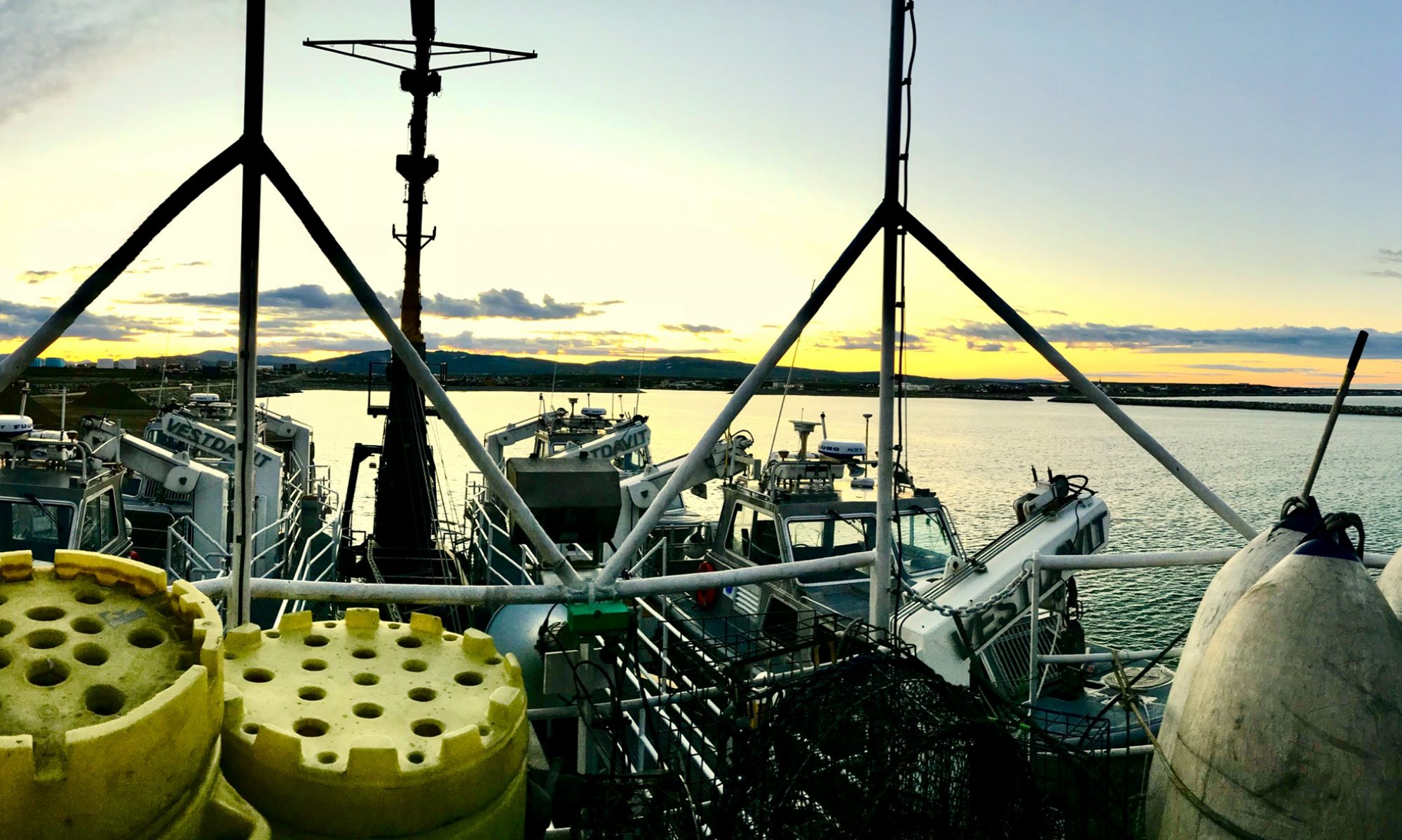
Mission: 2023 Summer Acoustic-Trawl Survey of Walleye Pollock in the Gulf of Alaska
Geographic Area of Cruise: Islands of Four Mountains area, Western Gulf of Alaska Location (2PM (Alaska Time), June 13): 54o 19.3929′ N, 161o 35.5129′ W
Data from 2PM (Alaska Time), June 13, 2023 Air Temperature: 7.2 oC Water Temperature (mid-hull): 6.5oC Wind Speed: 9.25 knots Wind Direction: 144.73 degrees Course Over Ground (COG): 254.48 degrees Speed Over Ground (SOG): 11.34 knots
Date: June 14, 2023
As a trained scientist and educator who is passionate about communicating science, I’m always thinking of different ways we can tell stories and share our data with non-scientists and students. I have been crocheting temperature data since 2017 and sharing my temperature scarves that record daily maximum temperature values for a location. In 2018, I began a journey of quilting science stories (see my blog post on the Teacher At Sea Alumni Association (TASAA) blog, Sharing Stories of the Louisiana Coast Through Quilts). While I’m on Oscar Dyson, I’m going to be creating another type of story/data visualization, based upon the observations I make looking up at the sky – and I hope you will join me!
A full description of my Stitch the Sky At Sea project is available on the TASAA blog. But note that you can do any variation, use any colors, select any style of stitching… the project is yours to create! I started the project with my visual observations back home (Philadelphia, PA) on June 1, before I flew to Alaska. This is the color scale I’m using and selecting which yarn matches what I’m seeing in the sky. It has been overcast my entire time in Kodiak (AK) so far – you can see the jump in color!
Photos: Announcing the Stitch The Sky At Sea Project (top left); Photos of blue skies at my home (Philadelphia) and where I had a one-night layover during travel (Seattle) with rows stitched onto the beginning edge (top middle); Photo of what the sky has looked like every day I was in Kodiak before sailing – completely clouded over (top right); The five colors of yarn I’m using for the five shades of the sky I’m observing the same time each day (bottom center).The yarn is from The Tempestry Project and in the colors of Aurora (top left), Downpour (top right), Cumulus (middle), Nimbus (lower left), Nebula (lower right).
This table will include my recorded observations. Again, you can stitch what I’m seeing, stitch what you are seeing in your location on the same date – or stitch both data for comparison! I’ll continue stitching through the end of the month to see what I can learn from my observations between these locations.
I’m excited to be able to wear so many hats while at sea – scientist, educator, communicator, and crafter! If you decide to stitch along, please share your work!
Completed stitching, as of June 13. The top two rows are in a non-project color to mark the beginning. Each row is a double-crochet in the color I’m observing as I look to the sky each day at approximately the same time (~10:30AM Alaska Time).
Mission: 2023 Summer Acoustic-Trawl Survey of Walleye Pollock in the Gulf of Alaska Geographic Area of Cruise: Islands of Four Mountains area, Western Gulf of Alaska Location (in transit, location recorded on June 12 at 2PM (Alaska Time)): 56o 45.1227′ N, 155o 38.3353′ W
Data from 2PM (Alaska Time), June 12, 2023 Air Temperature: 7.72 oC Water Temperature (mid-hull): 6.8oC Wind Speed: 18.71 knots Wind Direction: 201.27 degrees Course Over Ground (COG): 207.53 degrees Speed Over Ground (SOG): 11.46 knots
Date: June 13, 2023
NOAA Ship Oscar Dyson as it docked in Kodiak, Alaska, on February 6, 2022
The journey of NOAA Ship Oscar Dyson begins as we are underway from Kodiak Island and head out along the Aleutian Islands.
Every NOAA ship has a name – but who is behind the name? I dedicate this blog post to Oscar Dyson (both Oscar Dysons, actually!)
Launched in 2003 and commissioned in 2005, the ship is named after Alaskan fisherman Oscar Dyson, a pioneer in Alaska’s fishing industry for half a century before his death in 1995. A well-known fishing activist and an industry advisor to government, Dyson was dedicated to improving the industry for the many Alaskans who make their living at sea. The ship is homeported in Kodiak, Alaska.
Peggy Dyson, wife of Oscar, christened the ship at its launch on October 17, 2003, in the VT Halter Marine shipyard in Moss Point, Mississippi. The first commanding officer was Commander Frank Wood.
Oscar Dyson (and Peggy!)
Oscar Dyson made an impact in Kodiak and across Alaska. I found a transcript of a Congressional Record read in 1995 less than two weeks after his passing with a detailed biography. There is a scholarship named for Oscar and his wife Peggy managed by the University of Alaska Fairbanks with a description I found online in 2022 that reads:
Oscar Dyson was a dedicated fisherman who turned his hobby into a business and his life’s work for 50 years. A Kodiak resident, Oscar had ample opportunity to partake in Alaska’s expansive fishing opportunities, but he also pioneered the crab fishing industry in Alaska. Oscar co-founded All Alaskan Seafoods (one of the largest seafood processing companies in the state) and built military bases during World War II …. The Oscar Dyson Memorial Scholarship was created in his honor and funded by numerous fishing and seafood companies within Alaska — a fitting homage to a man who did so much to develop Alaska’s marine economy. Oscar thought of himself — first, last and always — as a fisherman.
There is a dock in Kodiak named after Oscar Dyson with a marker to note his contributions and achievements (*photos taken by me as I spent some time exploring Kodiak in 2022)
Entrance sign for Oscar’s Dock
View of the dock
Memorial plaque for Oscar Dyson
View beyond Oscar’s Dock
And I’d like to give a shout-out to his wife Peggy, who made significant contributions of her own to the fishing community. Between 1965 and 2000, Peggy Dyson broadcast the marine weather from her house in Kodiak, twice a day over single sideband radio. She also reported sports scores and election results! The Kodiak Maritime Museum has a wonderful description of Peggy, including an audio clip of her voice, on their webpage, Peggy Dyson, Voice of the North Pacific. And NOAA Ship Oscar Dyson has a launch named Peggy D!
The launch Peggy D on NOAA Ship Oscar Dyson
NOAA Ship Oscar Dyson
The NOAA Oscar Dyson pulled into the Port yesterday. Homeported in Kodiak, Alaska, Oscar Dyson is the first in a class of ultra-quiet fisheries survey vessels built to collect data on fish populations, conduct marine mammal and seabird surveys, and study marine ecosystems. pic.twitter.com/zZ2gGzuYvd
NOAA Ship Oscar Dyson plays a major role in collecting data used in the management of Alaska pollock, one of the world’s largest commercial fisheries. At 208-feet in length with a cruising speed of 12 knots and an endurance of 40 days at sea, Oscar Dyson can support 24 crew and 15 scientists (*see additional Specifications). The six onboard laboratory spaces include: a wet lab, dry lab, electronics/computer lab, bio lab, acoustics lab and hydrographics lab. Oscar Dyson sails primarily in the Gulf of Alaska and Bering Sea.
I look forward to sharing more information about the ship and stories from my time at sea. But I don’t want to repeat the incredible work done by educators that sailed before me. Here are some excellent recent blog posts by other educators that have sailed on Oscar Dyson that describes everything from the facilities to the work involved on a fisheries survey:
View of NOAA Ship Oscar Dyson just as she docked in Kodiak, Alaska, on February 6, 2022
Old Ships, New Ships
The first NOAA ship I sailed on, Thomas Jefferson, started its life as US Naval Ship Littlehales. From January 1992 to January 2003, Littlehales recorded 85,018 hydrographic survey miles along the coast of Africa and in the Red Sea and Mediterranean Sea. Littlehales ended its time with the Navy and then renamed Thomas Jefferson and officially entered the NOAA fleet on July 8, 2003 (*see About Thomas Jefferson which also explains why the ship was named after the former U.S. president).
Oscar Dyson was new construction, the first of four planned 208-foot NOAA fisheries survey vessels.
In my first post, I mentioned how I’m reflecting upon this year being the 150+-year celebration of H.M.S. Challengerexpedition. Launched in 1858, Challenger was a small warship with cannons assigned to coastal patrols and to support larger ships in the British naval fleet, not built for a science expedition. Modifications to Challenger were funded by the British government through the navy to include laboratories and accommodations for six civilian scientists to join the 250 British Royal Navy sailors and officers for the 3+ year journey at sea. I could not find information on why the navy chose “Challenger” as the name of the ship – but this ship’s name was the inspiration for the NASA space shuttle, the lunar module on the Apollo 17 mission, the scientific ocean drilling vessel Glomar Challenger, and even Sir Author Conan Doyle is said to have named his recurring character Professor Challenger after this ship. (*information from Macdougall, 2019)
Geographic Area of
Cruise: Gulf of Alaska (Kodiak – Aleutian Islands)
Date: September 22, 2019
Weather Data from Richmond, Virginia
Latitude: 37 44.36 N Longitude: 77 58.26 W Wind Speed: 5 knots Wind Direction: 195 degrees Air Temperature: 31 C Barometric Pressure: 1018 mBar Sky: Clear
Conclusion
Wow, it’s hard to believe that my time on the waters of Alaska aboard the Oscar Dyson are over. It was an experience I will never forget. I just hope that I can instill in my students the idea that all kinds of things are possible when you follow your interests.
It has taken me several days to reacclimatize to life on land. Standing in front of my class, I have caught myself swaying. It also took several days to readjust my sleep schedule. (I don’t get rocked to sleep anymore and my hours are completely different.)
There were so many things I will miss and never forget: all of the unique experiences and sights I got to see, starting with my side trip to Barrow and swimming in the Arctic Ocean before the start of the expedition, getting to explore some of Kodiak before we left port, all of the open sea and species that were part of the random samples, the little coves we snuck into when storms were approaching, getting a “close-up” of the Pavlof volcano, and getting to explore the native land around Dutch Harbor where we were able to watch Salmon spawning and Bald Eagles doing their thing.
Arctic Ocean swimming partners
Spires marking the opening of Castle Bay where we hid out from the storm.
Pavlof Volcano and Pavlof’s Sister
Shelikof Strait
Bald Eagle fishing near Dutch Harbor
Bald Eagles were common site. This one perched on a Russian Orthodox Steeple.
It was also interesting talking to and learning from the ship crew. There are some interesting stories there about how they got to NOAA and what they have experienced since then.
Oscar Dyson crew preparing the nets for the next trawl.
Survey crew, Megan Shapiro checking out a smooth lumpsucker.
Ensign Lexee Andonian and 1AE Alan Currie managing the trawling equipment off the ship stern.
Survey Chief Phil White and Megan Shapiro monitoring the trawl nets in the water.
Engineer crewmember Gavan Roddey showing me the water purification system.
Scientists and Survey Crew working together.
At the top of the list though would have to be the connections I made with the scientists I spent almost three weeks with. Being able to go out into the field with them and talking about what they have seen and learned over years of research has really reenergized my love for science in general. Starting my shift looking forward to seeing what each Bongo station would bring up or what each trawl would bring to the sorting table, made for an expedition that went much too quickly. It was interesting listening to my fellow scientists comparing how the numbers and ages of pollock caught at the various stations compared to what they had found in the Spring and in previous years.
The science crew all had the chance for one last meal together at the Anchorage airport before parting ways. I am very thankful for being accepted so well and for everything I have learned.
Overall, this has been an experience I will never forget. I have learned so much about Alaska, the ocean, marine species, global warming, and scientific technology. My time as a Teacher at Sea aboard the Oscar Dyson is something I will never forget and hope I can pass the excitement and experiences on to my students.
Geographic Area of Cruise: Gulf of Alaska (Kodiak – Aleutian Islands)
Date: September 12, 2019
Weather Data from the Bridge
Latitude: 57 35.35 N Longitude: 153 57.71 W Sea wave height: 1 ft Wind Speed: 14 knots Wind Direction: 208 degrees Visibility: 8 nautical miles Air Temperature: 15.4 C Barometric Pressure: 1002.58 mBar Sky: Overcast
Science and Technology Log
Well, we only have a few days left on this trip and it looks like mother nature is going to force us to head for Dutch Harbor a little early. I thought this might be a good time to spend some time sharing some information on some of the species we have been pulling out of the ocean. This is far from a complete list, but just the ones that made “the cut”.
Pollock Age 3
Pollock Age 0
At the top of the list has to be the Pollock. After all, this is the primary objective of this study. On the left is an adult three-year-old pollock and on the right is an age-0 pollock. The sampling of age-0 pollocks is a good indicator of the abundance of the future population.
Coho Salmon
Pink Salmon
There were several species of salmon caught on our trawls. On the left is a Coho Salmon and on the right is a Pink Salmon. These fish are very similar, but are classified as separately Coho Salmon are larger and have larger scales. Coho also has a richer, fuller flavor with darker red meat while the Pink Salmon has a milder flavor and a softer texture.
Another important part of this survey is the collection and measurement of zooplankton as this is a primary food source and the amount and health of the zooplankton will have a lasting impact on the ecology of the fish population in the area.
Capelin is another common fish caught in our trawls. This fish eats krill and other crustaceans and in turn is preyed upon by whales, seals, cod, squid, and seabirds.
The Pacific Saury was a fish that wasn’t expected to be found in our trawls. Also called the knifefish, this species always seemed to be found in substantial quantities when they were collected – as if the trawl net came across a school of them. They are found in the top one meter of the water column.
The Prowfish was another interesting find. This fish is very malleable and slimy. Adults tend to stay close to the ocean floor while young prowfish can be found higher up in the water column where they feed on jellyfish. As with the saury, the prowfish was not kept for future study. It was weighed, recorded, and returned to the water.
Jellyfish were abundant on our hauls. Here are the five most common species that we found.
The Bubble Jellyfish, Aequorea sp., is clear with a rim around it. This jellyfish is fragile and most of them are broken into pieces by the time we get them from the trawl net and onto the sorting table.
The Moon Jellyfish, Aurelia labiata, is translucent and when the sun or moon shines on them, they look like the moon all lit up.
The White Cross Jellyfish, Staurophora mertensi, was another mostly clear jelly that was very fragile. Very few made it to the sorting table in one piece. You have to look close it is so clear, but they can be identified by their clear bell with a distinctive X across the top of the bell.
The Lion’s Mane Jellyfish, Cyanea capillata, are the largest known species of jellyfish. These guys can become giants. They are typically a crimson red but could appear faded to a light brown.
The Sunrise Jellyfish, Chrysaora melanaster, was the most common jelly that we found. It is also arguably the least fragile. Almost all made it to the sorting table intact where they were counted, weighed, recorded, and returned to the water. It lives at depths of up to 100 meters, where it feeds on copepods, larvaceans, small fish, zooplankton, and other jellyfish.
Arrowtooth flounder are a relatively large, brownish colored flatfish with a large mouth. Just one look at its mouth and you can tell how it got its name. Their eyes migrate so that they are both on the right side and lie on the ocean floor on their left side.
Eulachons, sometimes called candlefish, were another common find on the sorting table. Throughout recent history, eulachons have been harvested for their rich oil. Their name, candlefish, was derived from it being so fat during spawning that if caught, dried, and strung on a wick, it can be burned as a candle. They are also an important food source for many ocean and shore predators.
The Vermilion Rockfish – This guy was the only non-larval rockfish that we caught. Most can be found between the Bering Sea and Washington State.
Smooth lumpsucker
Spiny lumpsucker
While the Smooth Lumpsucker is significantly larger than the Spiny Lumpsucker, both have unique faces. The Smooth Lumpsucker is also found in deeper water than the smaller Spiny Lumpsucker.
Squid
Squid
Most of the squid caught and recorded were larval. Here are a couple of the larger ones caught in a trawl.
Seabirds
Black-footed Albatross
There were a
variety of seabirds following us around looking for an easy meal. The Black-footed Albatross on the right was
one of several that joined the group one day.
And of course, I couldn’t leave out the great view we got of Pavlof Volcano! Standing snow capped above the clouds at 8,251 feet above sea level, it is flanked on the right by Pavlof’s Sister. Pavlof last erupted in March of 2016 and remains with a threat of future eruptions considered high. Pavlof’s Sister last erupted in 1786. This picture was taken from 50 miles away.
Personal Log
In keeping with the admiration I have for the scientists and
crew I am working with, I will continue here with my interview with Rob
Suryan.
Robert Suryan is a National Oceanic and Atmospheric Administration Scientist. He is currently a Research Ecologist and Auke Bay Laboratories, Science Coordinator, working on the Gulf Watch Alaska Long-term Ecosystem Monitoring Program.
How long have you been
working with NOAA? What did you do
before joining NOAA?
One and a half years.
Prior to that, I was a professor at Oregon State University
Where do you do most
of your work?
In the Gulf of Alaska
What do you enjoy
about your work?
I really enjoy giving presentations to the general public, where we have to describe why we are conducting studies and results to an audience with a non-science background. It teaches you a lot about messaging! I also like working with writers, reporters, and journalists in conducting press releases for our scientific publications. I also use Twitter for science communication.
Why is your work
important?
Having detailed knowledge about our
surroundings, especially the natural environment and the ocean. Finding
patterns in what sometimes seems like chaos in natural systems. Being able to
provide answers to questions about the marine environment.
How do you help wider
audiences understand and appreciate NOAA science?
I provide information and expertise to make
well informed resource management decisions, I inform the general public about
how our changing climate if affecting marine life, and I train (and hopefully
inspire) future generations of marine scientists
When did you know you
wanted to pursue a career in science an ocean career?
During middle school
What tool do you use
in your work that you could not live without?
Computer! So much of our instrumentation and sampling equipment
are controlled by software interfaces. Also, much of my research involves data
assimilation, analysis, creating graphs, and writing scientific papers.
Although, at the very beginning of my career, most of our data collection was
hand written, as were our scientific papers before typing the final version
with a typewriter. So glad those days are gone!
If you could invent
one tool to make your work easier, what would it be?
For in the office: a computer program that
would scan all of my emails, extract the important info that I need to know and
respond to, and populate my calendar with meetings/events. For the field: a
nano-power source that provided unlimited continuous power for instruments AND
global cell phone or wireless connectivity.
What part of your job
with NOAA did you least expect to be doing?
I joined NOAA later in my career and had
collaborated with NOAA scientists for many years, so everything was what I
expected for the most part.
What classes would you
recommend for a student interested in a career in Marine Science?
Biology, math, chemistry, and physics are good foundation
courses. If you have an opportunity to take a class in marine biology at your
school or during a summer program, that would be ideal. But keep in mind that
almost any field of study can be involved in marine science; including
engineering, economics, computer science, business, geology, microbiology,
genetics, literature, etc.
What’s at the top of
your recommended reading list for a student exploring ocean or science as a
career option?
I originally studied wildlife biology before marine science and one of my favorite books initially was A Sand County Almanac, by Aldo Leopold. For marine biology, I would recommend The Log from the Sea of Cortez, by John Steinbeck.
What do you think you
would be doing if you were not working for NOAA?
I would probably work at a university again –
I was a professor at Oregon State University before working for NOAA.
Do you have any
outside hobbies?
Pretty much any type of outdoor adventure, most frequently kayaking, mountain biking, hiking, camping, and beachcombing with my family and our dogs.
Geographic Area of Cruise: Gulf of Alaska (Kodiak to Yakutat Bay)
Date: 8/1/2019
Weather Data from the Gulf of Alaska: Lat: 59º 18.59’ N Long: 146º 06.18W
Air Temp: 14.8º C
Personal Log
We made it to Prince William Sound the other day, but I was asleep by the time we got all the way up. The part I did see, near the entrance, was pretty, but fog and clouds blocked the majority of the view. One of the beaches we attempted to fish by had what looked like an old red train car washed up on it. We wondered where it came from and how it got there!
Sunrise the day before we headed into Prince William Sound.
We are sailing the last few transects of the trip now and headed towards a small bay, called Broken Oar Bay, near Yakutat. Once we arrive, we need to calibrate the instruments used for collecting data and compare the results to the start of the trip. This will let the scientists know that their instruments are stable and making consistent measurements.
While calibrating we may have an opportunity to get a glimpse of the Hubbard Glacier at the head Yakutat Bay. The Hubbard Glacier is approximately 6 miles wide and when it calves, makes icebergs 3-4 stories tall. Fingers crossed we get to see it!
On a side note, I have been drawing while on the boat. Here are some photos!
One of the squids we caught… it was just a tiny little guy, about 2 cm.
Gus Beck, lead night fisherman, sat down with me yesterday and explained the main types of commercial fishing methods. Now I won’t get them mixed up.
This is my favorite one! Abigail’s drawing of a prowl fish. They have the best facial expressions.
Science and Technology Log:
The majority of my time has been spent above deck with the science and deck crews. Yesterday, I took the opportunity to head down below and learn some of the ways Oscar Dyson is kept running smoothly.
Some of the deck crew that are responsible for putting the nets out. Danielle, one of our senior survey techs, is up top and controls the movement of the net.
There are several areas/rooms that hold different types of equipment below deck. One of the largest rooms is the engine room, where not 2 or 3, but 4 engines are located. At night, 2 of the engines are needed since the ship sails slowly for camera drops. During the day, when traveling along the transects and fishing, 3 engines are used. Engines 1 and 2 are larger with 12 cylinders and 3 and 4 are smaller with 8 cylinders. These engines are attached to generators. The engines give moving force to the generators, which they then convert into kilowatts/power and as a result, power everything on board. Also, I learned that the boat has at least 2 of every major piece of equipment, just in case!
Two of the engineers, Kyle Mulkerin and Evan Brooks, who gave me a tour below deck. They are standing in front of engine #1.
The engine room also stores the water purification system, which Darin had mentioned to me the other day. He knew the ship converted seawater into potable water, but wasn’t exactly sure how the process worked. Here is a brief summary.
Seawater is pumped onto the boat and is boiled using heat from the engine.
Seawater is evaporated and leaves behind brine, which gets pumped off of the ship.
Water vapor moves through cooling lines and condenses into another tank producing fresh water.
The water is then run through a chemical bromide solution to filter out any left over unwanted particles.
The finely filtered water is stored in potable water holding tanks.
The last step before consumption is for the water to pass through a UV system that kills any remaining bacteria or harmful chemicals in the water.
Notes from Evan Brooks on how to convert seawater into potable water. I wish all my student’s notes were this neat and organized!
After the engine room, Kyle and Evan took me one level deeper into the lower engine room. There are a few other lower areas but, being a bit claustrophobic, I was happy we didn’t explore those. The lower engine room (or shaft alley) holds the large rotating shaft which connects directly to the propeller and moves the ship. It was neat to see!
Heading down into the lower engine area.
We rounded out the tour in a workshop that holds most of the tools on board. The engineers help fix things from engines to air conditioners to plumbing. This week I may even be able to see them do some welding work.
Did you know?
If a large piece of equipment needs to be replaced, they do not take it apart and lug it to the upper deck and off the boat. Instead, they cut a giant hole in the side of the ship and get the parts in and out that way. I had no idea!