NOAA Teacher at Sea
Carmen Andrews Aboard R/V Savannah July 7 – July 18, 2012
Mission: SEFIS Reef Fish Survey Geographical Location: Atlantic Ocean, off the coasts of Georgia and Florida Date: July 9, 2012
Location Data: Latitude: 30 ° 54.55’ N
Longitude: 80 ° 37.36’ W
Weather Data: Air Temperature: 28.5°C (approx. 84°F)
Wind Speed: 6 knots
Wind Direction: from SW
Surface Water Temperature: 28.16 °C (approx. 83°F)
Weather conditions: Sunny and fair
Science and Technology Log
Purpose of the research cruise and background information
The Research Vessel, or R/V Savannah is currently sampling several species of fish that live in the bottom or benthic habitats off the coasts of Georgia and Florida.
The coastal zone of Georgia and Florida and the Atlantic Ocean area where the R/V Savannah is currently surveying reef fish
These important reef habitats are a series of rocky areas that are referred to as hard bottom or “live” bottom areas by marine scientists. The reef area includes ledges or cliff-like formations that occur near the continental shelf of the southeast coast. They are called ‘reefs’ because of their topography – not because they are formed by large coral colonies, as in warmer waters. These zones can be envisioned as strings of rocky undersea islands that lie between softer areas of silt and sand. They are highly productive areas that are rich in marine organism diversity. Several species of snapper, grouper, sea bass, porgy, as well as moray eels, and other fish inhabit this hard benthic habitat.
Hard bottom of reef habitat, showing benthic fish — black sea bass is on left and gray trigger fish is on right side of image.
It is also home to many invertebrate species of coral, bryozoans, echinoderms, arthropods and mollusks.
Bottom-dwelling organisms, pulled up with fish traps deployed in the reef zone.
The rock material, or substrate of the sea bottom, is thought to be limestone — similar to that found in most of Florida. There are places where ancient rivers once flowed to a more distant ocean shoreline than now. Scientists think that these are remnants of old coastlines that are now submerged beneath the Atlantic Ocean. Researchers still have much to discover about this little known ocean region that lies so close to where so many people live and work.
The biological research of this voyage focuses primarily on two kinds of popular fish – snappers and groupers. These are generic terms for a number of species that are sought by commercial and sports fishing interests. The two varieties of fish are so popular with consumers who purchase them in supermarkets, fish markets and restaurants, that their populations may be in decline.
Red snapper in its reef habitat
At this time, all red snapper fishing is banned in the southeast Atlantic fishery because the fish populations, also known as stocks, are so low.
How the fish are collected for study
The fish are caught in wire chevron traps. Six baited traps are dropped, one by one from the stern of the R/V Savannah. The traps are laid in water depths ranging from 40 to 250 feet in designated reef areas. Each trap is equipped with a high definition underwater video camera to monitor and record the comings and goings of fish around and within the traps, as well as a second camera that records the adjacent habitat.
Fish swimming in and out of a chevron fish trap
I will provide the details of the fish trapping and data capture methods in a future blog.
Who is doing the research?
When not at sea, the R/V Savannah is docked at the Skidaway Institute of Oceanography (SKIO)on Skidaway Island, south of Savannah, Georgia. The institute is part of the University of Georgia. The SKIO complex is also the headquarters of the Gray’s Reef National Marine Sanctuary. The facility there has a small aquarium and the regional NOAA office.
The fisheries research being done on this cruise is a cooperative effort between federal and state agencies. The reef fish survey is one of several that are done annually as part of SEFIS, the Southeast Fisheries Independent Survey. The people who work to conduct this survey are located in Beaufort, North Carolina. SEFIS is part of NOAA.
Mrs. Andrews, on deck near the stern of the R/V Savannah, getting ready to unload fish traps
NOAA also allows “civilians” like me — one of the Teachers at Sea– as well as university undergraduate and graduate students to actively participate in this research.
Weather Data from the Bridge Air Temperature: 29.2C (84.5F)
Wind Speed: 6.07 knots
Wind Direction: from the SSW
Relative Humidity: 76%
Barometric Pressure: 1016.8
Surface Water Temperature: 30.82C (87F)
Science and Technology Log
North Florida MPA
Today we made our way about 50 nautical miles off shore to the North Florida Marine Protected Area (MPA) accompanied by dolphins and flying fish. The North Florida MPAs were closed by the South Atlantic Fishery Management Council to bottom fishing in order to sustain and repopulate the following species of fish: snowy grouper, yellowedge grouper, Warsaw grouper, speckled hind grouper, misty grouper as well as golden and blueline tilefish. A second part of our science team is looking at the benthic invertebrates such as corals and sponges as they provide a habitat for the grouper and tilefish to live in. The types of corals and sponges we expect to see in this area include: black coral, whip coral, purple gorgonian, Tanacetipathes, and the stink sponge.
Pisces deck hands launch the ROV
We did three Remotely Operated Vehicle (ROV) dives with the Phantom S II. Each dive was between one and two hours long depending on the bottom conditions. The winch from the Pisces would lower the ROV to the bottom of the ocean approximately 50-60 meters deep (164 to 196 feet). The area in the MPA we were looking at had been mapped the night before using the ship’s Multibeam Sonar to give the scientists a better idea of where to look and what type of bottom features they will see. The current at the bottom for a couple of the dives was about 1.5 knots. This made it pretty difficult to spend quality time looking at the species. The Scientists will take this data back to the lab where they can spend more time with each video to fully catalog each species we saw today.
Stephanie Farrington and myself are logging data.
Once the ROV’s cameras were rolling, the science team was able to begin logging all of the different species that they saw. Each part of the transect line is carefully documented with a date and time stamp as well as a latitude, longitude and depth. Also mounted on the ROV is a small CTD to collect the temperature and depth every 15 seconds. This will help the scientists match up all of the details for each habitat that we saw with the video on the ROV. While the ROV is at the bottom collecting data, there are several different stations going on in the lab at the time.
John Reed and Stephanie Farrington are looking mostly at the benthic invertebrates, Stacey Harter and Andy David are cataloging all of the fish they are able to see and identify, and Lance Horn and Glenn Taylor are manning the ROV. There is also a fourth station where one of the scientists uses a microphone to annotate the video as it is being recorded onto a DVD. Today John, Stacey and Andy all took turns at the video annotation station. Basically they are verbally describing the bottom features and habitat they see as well as all the different species of fish and corals. This will make it easier for the scientists when they get back into their home labs as they process their data. For each one hour of video taken it will take Stacey between four and eight hours to catalog each fish found as the ROV passed by. This information is compiled into a report that will be shared with the South Atlantic Council to show if the targeted species are actually making a comeback in these MPAs.
The snowy grouper is one of the targeted species. We found this one using the ROV swimming back into his burrow.
Today some of the species we saw include reef butterflyfish, vermillion snapper, filogena coral, blue angelfish, purple gorgonian,yellowtail reef fish, black corals, bigeye fish, squirrelfish, wire corals, scamp grouper, hogfish, ircinia sponges as well as a couple of lobsters and a loggerback sea turtle.
Tomorrow we will make several more dives at another site outside the North Florida MPA so we can compare this data with the data taken today inside the MPA.
Personal Log
As part of the abandon ship drill, we had to be able to don our immersion suit in less than three minutes.
Life on the ship is really different in some ways compared to life on land. There is the constant rocking of the ship, which my inner ears are not very fond of. The bedrooms are not the biggest and we each share with one other person. I am rooming with Stephanie Farrington and she is very easy to get along with. The food has been great — it would be very easy to gain weight while working on the Pisces. The stewards do a fantastic job preparing meals for everyone on the ship. Meal times are the same each day, breakfast is from 7-8 am, lunch is from 11am to noon, and dinner is from 5-6pm. If someone is working the night shift, they can request that a meal be set aside for them so they can eat later.
Ocean Careers Interview
Stacey Harter
In this section, I will be interviewing scientists and crew members to give my students ideas for careers they may find interesting and might want to pursue someday. Today I interviewed Stacey Harter, the Chief Scientist for this mission.
What is your job title? I am a Research Ecologist at NOAA Fisheries Panama City Lab.
What type of responsibilities do you have with this job? My responsibilities are to acquire funding for my research, as well as plan the trips, go on the cruise to gather the data, and analyze the data when I get back. I am also collaborating on other projects with NOAA Beaufort in North Carolina and St. Andrew Bay studying the juvenile snapper and grouper populations in the sea grass found at this location.
What type of education did you need to get this job? I got my Bachelors degree in Biology from Florida State University and my Masters degree in Marine Biology from University of Alabama.
What types of experiences have you had with this job? My best experience I’ve had was getting to go down in a manned submersible to a depth of 2,500 feet to study deep water corals and the fish that live there.
What is your best advice for a student wanting to become a marine biologist? Do internships! This is the best way to get your name out there and to make connections with people who might be able to get you a job after college. I had an internship at the NOAA Panama City Lab while I was in graduate school which helped me to get my job with NOAA when I graduated.
NOAA Teacher at Sea Carmen Andrews Aboard R/V Savannah July 6 – 18, 2012
Carmen Andrews
Hello!
Happy Summer Solstice Day! I am Carmen Andrews. I work as a science specialist at Six to Six Interdistrict Magnet School in Bridgeport, CT. I have just finished my 5th year at this school. I create science curriculum for grades pre-K through 8. I also teach many classes to help teachers improve their understanding of science concepts and inquiry methods.
Six to Six Interdistrict Magnet School, Bridgeport, CT
Our school has a unique academic program that incorporates partnerships with the Maritime Aquarium in Norwalk, CT and the Eli Whitney Museum in Hamden, CT. Our students visit many other places, including the Yale Peabody Museum and Yale Leitner Family Planetarium and Observatory in New Haven. We also allow our students to remotely operate the Gold Apple Valley Radio Telescope in California. My favorite places to teach classes are the unspoiled outdoor sites in Connecticut where we take our students for field studies.
4th Graders on a Marsh Field StudyKindergarteners Investigating Marine Invertebrates6th Graders Counting Intertidal Organisms Using a Quadrat
I love research!
One of my passions as an educator is creating opportunities for students to investigate real world problems using science inquiry. This year my 6th and 7th graders took on a big environmental research project. They were asked to research bioremediation and to develop a creative solution to a major problem in their community — toxic oil spills. The work was funded by a NSTA/Toyota Tapestry Grant award, which enabled us to find out about blue and gray oyster mushrooms’ ability to metabolize oil spills in soil. Our project is called Going Green in Brownfields: A New Diet for Mushrooms. You can see our blog here: mushroomdiet.info
A 7th Grader Massing Blue Oyster Mushrooms Grown in Motor Oil
My Teacher at Sea Adventure
TheNOAA Teacher at Sea program was created to provide teachers with experiences in science research. We share our knowledge with our school communities using blogs, teaching and writing articles when we return from our Teacher at Sea assignment. I am very excited to learn about the work of NOAA in monitoring fisheries in U.S. coastal waters. I am eager to share this scientific research with students. I also want to expose students to the variety of maritime and marine science careers that they can consider pursuing in later life.
I will be departing on the R/V Savannah in about 2 weeks to participate in a reef fish survey. The next time I write, I will most likely be somewhere near Skidaway Island, GA. My target audience for my blogs while I am at sea, are students, colleagues and friends of all ages. Please feel free to post your comments and questions about this important science research.
NOAA Teacher at Sea Lesley Urasky Aboard the NOAA ship Pisces June 16 – June 29, 2012
Mission: SEAMAP Caribbean Reef Fish Survey Geographical area of cruise: St. Croix, U.S. Virgin Islands Date: June 18, 2012
Location: Latitude: 17.6568
Longitude: -64.9281
Weather Data from the Bridge:
Air Temperature: 28.5°C (83.3°F)
Wind Speed: 17.1 knots (19.7 mph), Beaufort scale: 5
Wind Direction: from SE
Relative Humidity: 75%
Barometric Pressure: 1,014.80 mb
Surface Water Temperature:28.97 °C (84.1°F)
Science and Technology Log
Alright, so I’ve promised to talk about the fish. Throughout the science portions of the cruise, the scientists have not been catching the anticipated quantities of fish. There are several lines of thought as to why: maybe the region has experienced overfishing; possibly the sampling sites are too shallow and deeper water fish may be more likely to bite; or they might not like the bait (North Atlantic mackerel) since it is not an endemic species/prey they would normally eat.
So far, the night shift has caught more fish than the day shift that I’m on. Today, we have caught five and a half fish. The half fish was exactly that – we retrieved only the head and it looked like the rest of the body had been consumed by a barracuda! These fish were in the grouper family and the snapper family.
Coney (Cephalopholis fulvus)Blackfin snapper (Lutjanus buccanella). This little guy was wily enough to sneak into the camera array and steal some squid out of the bait bag! The contents of his stomach – cut up squid – can be seen to the left between the forceps and his head.
Once the fish have been caught, there are several measurements that must be made. To begin, the fish is weighed to the nearest thousandth (three decimal places) of a kilogram. In order to make sure the weight of the fish is accurate, the scale must be periodically calibrated.
Then there are several length measurements that are made: standard length (SL), total length (TL) and depending on the type of fish, fork length (FL). To make these measurements, the fish is laid so that it facing toward the left and placed on a fish board. The board is simply a long plank with a tape measure running down the center. It insures that the fish is laid out flat and allows for consistent measurement.
Standard length does not measure the caudal fin, or tail. It is measured from the tip of the fish’s head and stops at the end of the last vertebra; in other words, if the fish is laying on its side, and you were to lift the tail up slightly, a crease will form at the base of the backbone. This is where the standard length measurement would end. Total length is just as it sounds – it is a measurement of the entire length (straight line) of the fish. Fork length is only measured if the type of fish caught has a forked tail. If it does, the measurement begins at the fish’s snout and ends at the v-notch in the tail.
How to measure the three types of lengths: standard, fork, and total. (Source: Australian Government: Department of Sustainability, Environment, Water, Population, and Communities)Red hind (Epinephelus guttatus) on the fish board being measured for standard length. Ariane’s thumb is on the crease marking the end of its backbone.
Once the physical measurements are made, the otoliths must be extracted and the fish sexed. You’re probably anxious to learn if you selected the right answer on the previous post’s poll – “What do you think an otolith is?” An otolith can be thought of as a fish’s “ear bone”. It is actually a structure composed of calcium carbonate and located within the inner ear. All vertebrates (organisms with backbones) have similar structures. They function as gravity, balance, movement, and directional indicators. Their presence helps a fish sense changes in horizontal motion and acceleration.
In order to extract the otoliths, the fish must be killed. Once the fish has been killed, the brain case is exposed and peeled back. The otoliths are in little slits located in the underside of the brain. It takes a delicate touch to remove them with a pair of forceps (tweezers) because they can easily break or slip beyond the “point of no return” (drop into the brain cavity where they cannot be extracted).
Otoliths are important scientifically because they can tell many important things about a fish’s life. Their age and growth throughout the first year of life can be determined. Otoliths record this information just like tree ring record summer/winter cycles. More complex measurements can be used to determine the date of hatch, once there are a collected series of measurements, spawning times can be calculated.
A cross-section of an otolith under a microscope. The rings are used to determine age and other life events. Source: Otolith Research Laboratory, Bedford Institute of Oceanography, Dartmouth, Nova Scotia, Canada.
Because they are composed of calcium carbonate (CaCO3), the oxygen component of the chemical compound can be used to measure stable oxygen isotopes; this is useful for reconstructing temperatures of the waters the fish has lived in. Scientists are also able to look at other trace elements and isotopes to determine various environmental factors.
Extracted otoliths. Often they are around 1 cm long, although the larger the fish, the slightly larger the otolith.
The final step we take in measurement/data collection is determining the sex and maturity of the fish. To do this, the fish is slit open just as if you were going to clean the fish to filet and eat it. The air bladder must be deflated if it isn’t already and the intestines moved out of the way. Then we begin to search for the gonads (ovaries and testes). Once the gonads are found, we know if it is female or male and the next step is to determine its stage or maturity. This is quite a process, especially since groupers can be hermaphroditic. The maturity can be classified with a series of codes:
U = undetermined
1 = immature virgin (gonads are barely visible)
2 = resting (empty gonads – in between reproductive events)
3 = enlarging/developing (eggs/sperm are beginning to be produced)
4 = running ripe (gonads are full of eggs/sperm and are ready to spawn)
5 = spent (spawning has already occurred)
Ovaries of a coney (grouper family). These are the pair of flesh colored tubular structures running down the center of the fish.
Personal Log
Today is my birthday, and I can’t think of a better place to spend it! What a treat to be having such an adventure in the Caribbean! This morning, we were on our first bandit reel survey of the day, and the captain came on over the radio system, announced my birthday and sang Happy Birthday to me. Unbeknownst to me, my husband, Dave, had emailed the CO of the Pisces asking him to wish me a happy birthday.
We’ve had a very successful day (compared to the past two days) and have caught many more fish – 5 1/2 to be exact. The most exciting part was that I caught two fish on my bandit reel! They were a red hind and blackfin snapper (see the photos above). What a great birthday present!
Father’s Day surf and turf dinnerMy birthday fish! The blackfin snapper is on the left and the red hind on the right.I even got a birthday kiss from the red hind!
Last night (6/17) for Father’s Day, we had an amazing dinner: filet mignon, lobster, asparagus, sweet plantains, and sweet potato pie for dessert! Since it was my birthday the following day (6/18), and one of the scientists doesn’t like lobster, I had two tails! What a treat!
Our best catch of the day came on the last bandit reel cast. Joey Salisbury (one of the scientists) caught 5 fish: 4 blackfin snapper and 1 almaco jack; while Ariane Frappier (another scientist) caught 3 – 2 blackfin and 1 almaco jack. This happened right before dinner, so we developed a pretty good assembly line system to work them up in time to eat.
Dinner was a nice Chinese meal, but between the ship beginning to travel to the South coast of St. Thomas and working on the computer, I began to feel a touch seasick (not the best feeling after a large meal!). I took a couple of meclazine (motion sickness medication) and still felt unwell (most likely because you’re supposed to take it before the motion begins). My roommate, Kelly Schill, the Operations Officer, made me go to bed (I’m in the top bunk – yikes!), gave me a plastic bag (just in case!), and some saltine crackers. After 10 hours of sleep, I felt much, much better!
I had some time in between running bandit reels, baiting the hooks, and entering data into the computers,to interview a member of the science team that joined us at the last-minute from St. Croix. Roy Pemberton, Jr. is the Director of Fish and Wildlife for the Department of Planning and Natural Resources of the U.S. Virgin Islands. The following is a snippet of our conversation:
LU: What are your job duties as the Director of Fish and Wildlife?
RP: I manage fisheries/wildlife resources and try to educate the population on how to better manage these resources to preserve them for future generations of the U.S. Virgin Islands.
LU: When did you first become interested in oceanography?
RP: I’m not really an oceanographer, but more of a marine scientist and wildlife biologist. I got interested in this around 5-6 years old when I learned to swim and then snorkel for the first time. I really enjoyed observing the marine environment and my interest prompted me to want to see and learn more about it.
LU: It’s such a broad field, how did you narrow your focus down to what you’re currently doing?
RP: I took a marine science class in high school and I enjoyed it tremendously. It made me seek it out as a career by pursuing a degree in Marine Science at Hampton University.
LU: If you were to go into another area of ocean research, what would it be?
RP: Oceanography – Marine Spatial Planning
Roy Pemberton holding a recently caught coney.
LU: What is the biggest challenge in your job?
RP: It is a challenge to manage fisheries and wildlife resources with respect to the socioeconomic and cultural nuances of the people.
LU: What do you think is the biggest issue of contention in your field, and how do you imagine it will resolve?
RP: Fisheries and coral reef management. We need to have enough time to see if the federal management efforts work to ensure healthier ecosystems for future generations.
LU: What are some effects of climate change that you’ve witnessed in the reef systems of the U.S. Virgin Islands?
RP: Temperatures have become warmer and the prevalence of disease among corals has increased.
LU: In what areas of Marine Science do you foresee a lot of a career paths and job opportunities?
RP: Fisheries management, ecosystem management, coral reef diseases, and the study of coral reef restoration.
LU: Is there an area of Marine Science that you think is currently being overlooked, and why?
RP: Marine Science management that takes into account cultural and economic issues.
LU: What are some ideas a layperson could take from your work?
RP: One tries to balance resource protection and management with the cultural and heritage needs of the population in the territory of the U.S. Virgin Islands.
LU: If a high school student wanted to go into the fish/wildlife division of planning and natural resources, what kinds of courses would you recommend they take?
RP: Biology, Marine Science, History, Botany, and Math
LU: Do you recommend students interested in your field pursue original research as high school students or undergraduate students? If so, what kind?
RP: I would suggest they study a variety of life sciences so they can see what they want to pursue. Then they can do an internship in a particular life science they find interesting to determine if they would like to pursue it as a career.
Too many interesting people on the ship and so little time! I’m going to interview scientists as we continue on to San Juan, Puerto Rico. Once they leave, I’m continuing on to Mayport, Florida with the ship. During this time, I’ll explore other careers with NOAA.
NOAA Teacher at Sea
Marsha Skoczek
Soon to be Aboard NOAA Ship Pisces
July 6 – 19, 2012
Mission: Marine Protected Areas Survey Geographic area of cruise: Subtropical North Atlantic, off the east coast of Florida Date: June 5, 2012
Personal Log
Me at our saltwater touch tank.
Greetings from Olathe, Kansas! My name is Marsha Skoczek and I am an instructor in the Geoscience Program at Olathe North High School. High school students from all over Olathe apply to be a part of the Geoscience Program because they have a passion for the earth sciences. Many of my students want to become a marine biologist or some type of ocean research scientist. I teach Marine Biology and Oceanography, yes from the middle of the country, so in order to have a better understanding of the material I teach I applied to and was accepted for the NOAA Teacher at Sea Program. I am fortunate enough to be preparing to set sail aboard the NOAA Ship Pisces as part of a research team investigating the Marine Protected Areas (MPA) off the Southeastern Atlantic states.
In 2009 The National Oceanic and Atmospheric Administration (NOAA) established eight Marine Protected Areas to protect the spawning grounds for several species of Grouper, Snapper, and Tilefish. These reef dwelling species are slow growing fish often not spawning until they are four or five years old. Some species such as the Yellowedge Grouper can live to be as much as 80 years old! Several other species such as the Snowy Grouper and the Speckled Hind Grouper are all born as females and do not change into males until they are older, making it a high priority that we protect their habitat so these species can live long enough to reproduce.
As fish are being harvested from the water beyond many of the species’ maximum sustainable yield, it is imperative that the natural habitats of these species are protected, not only so the fish populations can continue to thrive, but also so that scientists can have the time to research the life cycles of these fish in order to establish yearly limits based on scientific data before they are fished to extinction.
I am fortunate enough to be a part of a research expedition doing just that, we will be studying the habitat and fish population of five Marine Protected Areas (MPAs) to see if closing these areas to bottom fishing is a beneficial step in preventing the extinction of these species.
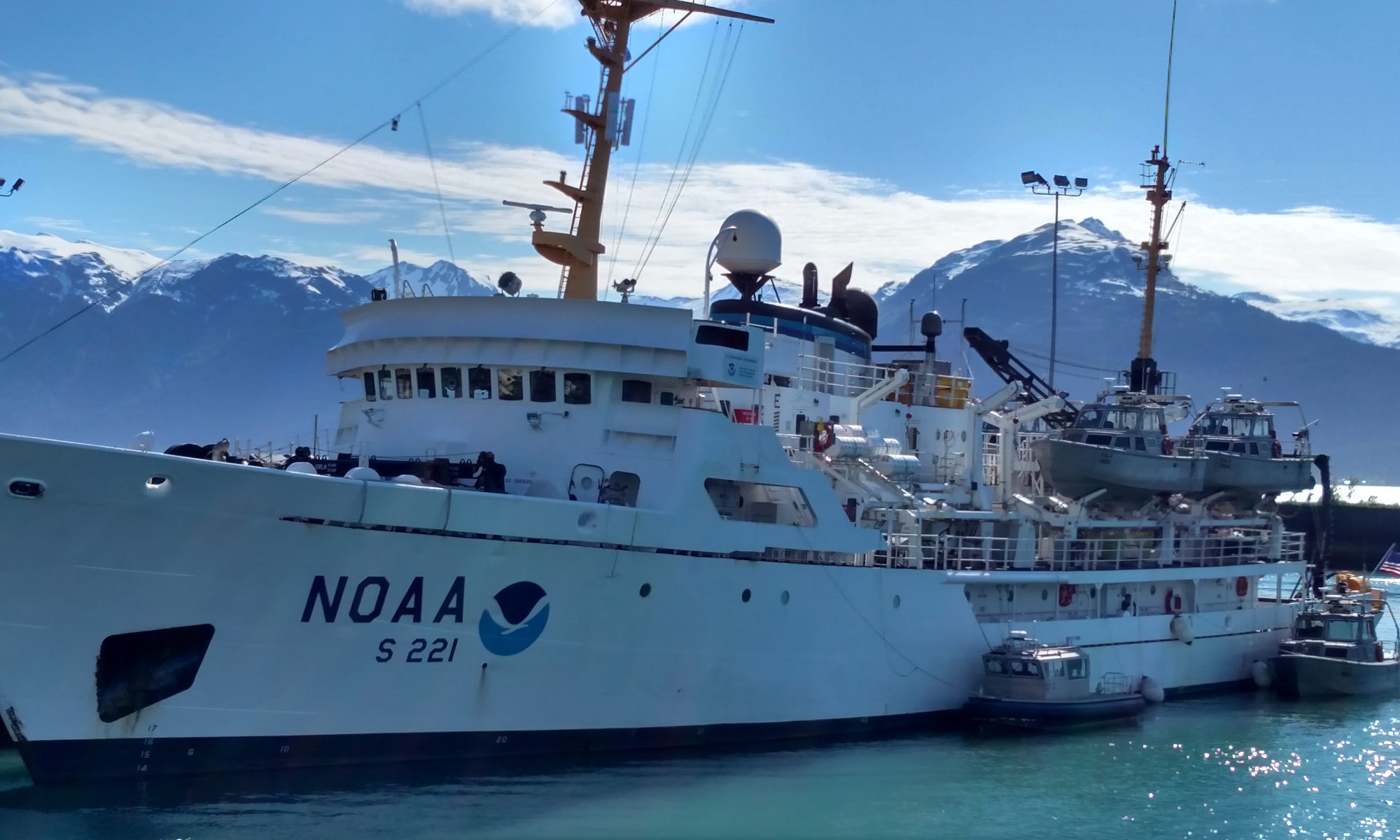
NOAA Ship Pisces
The team I will be working with is made up of scientists from the Panama City NOAA Fisheries Lab, the Harbor Branch Oceanographic Institute, University of North Carolina Wilmington, and the National Centers for Coastal Ocean Science. Preparations for this research expedition began over a year ago when the scientists had to begin writing their proposal to fund this trip. As you can imagine, working with scientists from multiple institutions takes time and careful planning. Conference calls were made with the crew of the Pisces so details could be discussed about the operations needed to be performed, as well as other long distance communications with the Remotely Operated Vehicle (ROV) pilots and the mapping scientist from Charleston, South Carolina.
Data on our expedition will be collected by ROV to capture on video the fish and invertebrate populations in each MPA; water column data on temperature, pressure and conductivity will be collected by CTD profiling; and night time sonar mapping will be used to determine the most beneficial areas to launch the ROV on the following day.
As you can see, there is a lot of work to do during our two weeks at sea. I am anxiously awaiting our departure next month so that I can witness first hand real ocean research. This information will be invaluable as I prepare my students for their future careers as marine biologist and oceanographers! Please follow along as we set sail on this most important adventure!