Chris Henricksen: Doing Science at Sea, May 12, 2014

NOAA Teacher at Sea

Christopher Henricksen

Aboard NOAA Ship Henry B. Bigelow

May 6 – May 16, 2014

Geographical area of cruise: Georges Bank
Mission: Spring Bottom Trawl & Acoustic Survey
Date: May 11, 2014
Air Temp: 11.2°C (52.16°F)
Relative Humidity: 100%
Wind Speed: 21.9mph
Barometer: 1010.5mb

Science and Technology Log

Here’s what a typical watch aboard the Henry B. Bigelow looks like.  Upon assuming the watch, which in my case means beginning work at midnight, the science team gets a rundown of what happened during the previous watch.  When the ship nears its next station (where it will drop the net and begin trawling), the area is surveyed to ensure that it is clear of lobster traps and large rocks before readying the nets for trawling.  Think of the trawl nets in terms of really large butterfly nets, except these nets also contain a set of sensors that tell the science team and the Officer of the Deck (the officer in charge of driving the ship) information about how deep the net is, how fast it’s traveling, etc..  The ship’s deckhands lower the nets from the aft (rear) deck of the ship into the water and then closely monitor them until reaching a specified depth.  With the trawl nets in place, the ship steams at 3 knots for about twenty minutes, pulling the nets along and catching fish and other marine life.  Once the trawl is complete, the net is hauled aboard and it’s time for the scientists to get involved.

picture of trawl net
Hauling the trawl net aboard the Henry B. bigelow
checker
Chris Henricksen

Using a crane, the net is swung over a large stainless steel hopper called the checker.  A scientist working the checker, then pushes the captured organisms onto a conveyor belt, which moves them inside the ship to the wet lab.  In the wet lab, scientists and volunteers (like me) stand along a long conveyor, sorting the catch by species and, sometimes, by sex or size, into a set of buckets.  After the catch is sorted, the buckets are consolidated and placed on another conveyor belt, which moves the buckets to the Watch Chief’s station.  The Watch Chief scans a barcode on the side of each bucket, and uses a computer to assign a species to that barcode.  The barcoded buckets are each filled with a different organism then moved to any one of three cutter stations for processing. The Cutter scans the barcode of an available bucket, which tells the computer at his or her station some basic information about the organism, such as its scientific and common names, and how much the bucket weighs.  The computer also tells the Cutter what sorts of protocols need to occur on that organisms (weighing, measuring, checking stomach contents, determining sex).  As the Cutter processes the organism, the Recorder, standing at a computer screen next to the Cutter,  assists the Cutter by inputting measurement and other data into the computer system.  Often, extra instructions pop up on the screen, instructing the Cutter that a scientist has requested that we collect specimens from an organism.  Otoliths (ear bones from fish) are collected frequently, but sometimes a request is made to freeze or preserve an organism.  Some organisms even go in a live holding tank so the scientist can have a living specimen when the ship returns to port.  This entire process can take anywhere from one hour to several, depending on the amount fish and the types of processing required.

pic of sorting line
Scientists sorting organisms for survey

Personal Log

Well, yesterday (Saturday) was a rough one for yours truly.  We ran into some higher seas, and the ship’s rocking and rolling made me sick as a dog.  So much for that Navy experience helping me in this regard…  Oh, well, that’s part of life at sea.  Everyone was very kind about it. one of my watchmates even fetched some crackers for me, which helped.  Feeling much better today. Here are a few pictures representing life aboard the Henry B. Bigelow (at least as I live it):

pic of galley
The Galley
pic of menu
Dinner menu – good food!
pic of stateroom
My stateroom. I sleep in the bunk with the open curtains
pic of head
The Head (bathroom) in my stateroom

Sue Cullumber: Reflections – From the Atlantic to Arizona, June 26, 2013

NOAA Teacher at Sea
Sue Cullumber
Onboard NOAA Ship Gordon Gunter
June 5–24, 2013

Mission: Ecosystem Monitoring Survey
Date: 6/26/2013
Geographical area of cruise:  The continental shelf from north of Cape Hatteras, NC, including Georges Bank and the Gulf of Maine, to the Nova Scotia Shelf

1stgroup
Our first group for the EcoMon Survey. Kat, Kevin, Holly, Chris, Tom, Sue, Chris, and Cristina.

Personal Log: Well I’m back in my home state of Arizona.  It is really hot, the forecast is for it to be above 110º, and I miss the cool breezes of the Atlantic Ocean.  I am happy to be back in Arizona, but I will miss all the people, the marine creatures and the beauty of the Atlantic Ocean.  I will remember  this experience for the rest of my life and look forward to sharing this exciting adventure with my students, friends and family.

2ndgroup2
Our 2nd group for the EcoMon Survey. Tom, Kris, Cristina, David, Sue, Chris, Kevin and Sarah.

On the last two days onboard we finished up our EcoMon Survey and had time to add 23 more Bongo Stations.  These were completed in two areas with the first just east of Maryland and the second off the coast of North Carolina. As we headed east of North Carolina we went into the Gulf Stream and the water temperature started to increase. At these stations our samples contained more larval fish than previously. We even brought up some deep-sea fish in two of these samples. One was a species of Gonostoma and the second a Hatchet fish. Both were fairly small and black with iridescent colors and had large mouths with many teeth.

deepseafish6_22
A fish, from the species Gonostoma, that was brought up in our Bongo net.
deepseahatchet6_22
A Hatchet fish in our Bongo net sample.

Our drifter buoy, WMO # 44932,  has been showing some movement since being deployed (to track movement, put GTS buoy for data set and WMO # for platform ID).  Currently it is at latitude/ longitude:  38.73ºN, 73.61ºW.  It does appear to be moving inland, but hopefully it will catch the current and start moving further into the Atlantic.  We will be tracking it at Howard Gray over the next year.

margaretcrablegs
Margaret Coyle, our chief steward, serving Alaskan crab legs.

Last day on the Gordon Gunter, Margaret, the chief steward, prepared a special meal for all of us.  The spread included: Alaskan crab legs, roast duck with plum sauce, NY loin strip Oscar, grilled salmon, asparagus, red potatoes, Italian rolls, cream of potato and bacon soup (which I had at lunch, delicious) and cranberry cheesecake.  I choose the crab, duck, asparagus, potatoes, and cheesecake – heavenly!!!  I probably shouldn’t have had the cheesecake as well,  but it was just delicious!  Margaret always had so many great choices it was really hard to make up your mind.

dolphinbottlenose
Bottlenose Dolphin at the bow of the Gordon Gunter.

Our last night on the Gordon Gunter was amazing. We had another unbelievable sunset with fantastic colors.  A friend of mine from Arizona said, “It makes our Arizona sunsets look very bland and I think they are some of the best I’ve seen.”  Then a group of Bottlenose dolphins visited the bow of the ship, so it was truly a remarkable night I will always remember.

sunsetfinal
Our final sunset on the Gordon Gunter.
sueongunter6_24
Enjoying the cool breezes of the Atlantic Ocean.

Question of the day? :  Why do you think the deep-sea fish have such large mouths?

Sue Cullumber: Drifting Away, June 21, 2013

NOAA Teacher at Sea
Sue Cullumber
Onboard NOAA Ship Gordon Gunter
June 5–24, 2013

Mission: Ecosystem Monitoring Survey
Date: 6/21/2013
Geographical area of cruise:  The continental shelf from north of Cape Hatteras, NC, including Georges Bank and the Gulf of Maine, to the Nova Scotia Shelf

Weather Data from the Bridge:  Time:  21.00 (9 pm)
Latitude/longitude:  3734.171ºN, 7507.538ºW
Temperature: 20.1ºC
Barrometer: 1023.73 mb
Speed: 9.6 knots

IMG_0878
Getting ready to launch the buoy – photo by Chris Taylor.
launchingdrifter
Launching the buoy from the ship’s stern – photo by Chris Taylor.

Science and Technology Log: 

This week we launched a Global Drifter Buoy (GDB) from the stern of the Gordon Gunter.  So what is a GDB? Basically it is a satellite tracked surface drifter buoy.  The drifter consists of a surface buoy, about the size of a beach ball, a drogue, which acts like a sea anchor and is attached underwater to the buoy  by a 15 meter long tether.

Drifter tracking: The drifter has a transmitter that sends data to passing satellites which provides the latitude/longitude of the drifter’s location. The location is determined from 16-20 satellite fixes per day.  The surface buoy contains 4 to 5  battery packs that each have 7-9 alkaline D-cell batteries, a transmitter, a thermistor to measure sea surface temperature, and some even have other instruments  to measure barometric pressure, wind speed and direction, salinity, and/or ocean color. It also has a submergence sensor to verify the drogue’s presence. Since the drogue is centered 15 meters underwater it  is able to measure mixed layer currents in the upper ocean. The drifter has a battery life of about 400 days before ending transmission.

buoy
Stickers from students at Howard Gray School.
decoratingdrifter
Attaching the stickers to the buoy – photo by Kris Winiarski.

Students at the Howard Gray School in Scottsdale, Arizona designed stickers that were used to decorate the buoy. The stickers have messages about the school, Arizona and NOAA so that if the buoy is ever retrieved this will provide information on who launched it.  In the upcoming year students at Howard Gray will be tracking the buoy from the satellite-based system  Argos that is used to collect and process the drifter data. You can follow our drifter here, by putting in the data set for the GTS buoy with a Platform ID of 44932 and select June 19, 2013 as the initial date of the deployment.

Why are drifter buoys deployed?

In 1982 the World Climate Research Program (WCRP) determined that worldwide drifter buoys (“drifters”) would be extremely important for oceanographic and climate research. Since then drifters have been placed throughout the world’s oceans to obtain information on ocean dynamics, climate variations and meteorological conditions.

IMG_0886
The Howard Gray School drifter on its ocean voyage.

NOAA’s Global Drifter Program (GDP) is the main part of the Global Surface Drifting Buoy Array, NOAA’s branch of the Global Ocean Observing System (GOOS).  It has two main objectives:

1. Maintain a 5×5 worldwide degree array (every 5 degrees of the latitude/longitude of world’s oceans) of the 1250 satellite-tracked surface drifting buoys to maintain an accurate and globally set of on-site observations that include:  mixed layer currents, sea surface temperature, atmospheric pressure, winds and salinity.

2. Provide a data processing system of this data for scientific use.

bongossunset
Bongo nets going out for the plankton samples.
meshsamples
Plankton from the different mesh sizes. The left is from the smaller mesh and contains much more sample. Photo by Paula Rychtar.

EcoMon survey: We are continuing to take plankton samples and this week we started taking two different Bongo samples at the same station. Bongo mesh size (size of the holes in the net) was changed several years ago to a smaller mesh size of .33 mm. However, they need comparison samples for the previous nets that were used and had a mesh size of about .5 mm.  They had switched to the smaller net size because they felt that they were losing a large part of the plankton sample (basically plankton were able to escape through the larger holes). We are actually able to see this visually in the amount of samples that we obtain from the different sized mesh.

dolphinflying
Common Dolphins were frequent visitors to the Gordon Gunter.

Personal Log:

It’s hard to believe that my Teacher at Sea days are coming to a close. I have learned so much about life at sea, the ocean ecosystem, the importance of plankton, data collection, and the science behind it all.  I will miss the people, the ocean and beautiful sunsets and the ship, but I’m ready to get back to Arizona to share my adventure with my students, friends and family. I want to thank all the people that helped me during this trip including: the scientists and NOAA personnel, the NOAA Corps and ship personnel, the bird observers and all others on the trip.

Did you know? Drifters have even been placed in many remote locations that are infrequently visited or difficult to get to through air deployment.  They are invaluable tools in tracking and predicting the intensity of hurricanes, as well.

Question of the day?  What information would you like to see recorded by a Global Drifter Buoy and why?

shipsunset-2
Another beautiful sunset at sea.

Sue Cullumber: Testing the Water and More, June 19, 2013

NOAA Teacher at Sea
Sue Cullumber
Onboard NOAA Ship Gordon Gunter
June 5–24, 2013

Mission: Ecosystem Monitoring Survey
Date: 6/19/2013
Geographical area of cruise: The continental shelf from north of Cape Hatteras, NC, including Georges Bank and the Gulf of Maine, to the Nova Scotia Shelf

Weather Data from the Bridge:
Latitude/longitude: 3853.256 N, 7356.669W
Temperature: 18.6ºC
Barometer: 1014.67 mb
Speed: 9.7 knots

CTDscreen
CTD reading on the computer. Blue is density, red is salinity, green is temperature and black indicates the depth.

Science and Technology Log:

Even before the plankton samples are brought onboard, scientists start recording many types of data when the equipment is launched. The bongos are fitted with an electronic CTD (conductivity, temperature and density) and as they are lowered into the ocean the temperature, density and salinity (salt content) are recorded on a computer. This helps scientists with habitat modeling and determining the causes for changes in the zooplankton communities. Each bongo net also has a flow-through meter which records how much water is moving through the net during the launch and can is used to estimate the number of plankton found in one cubic meter of water.

ZIplankton
Zooplankton (Z) and Icthyoplankton (I) samples.

The plankton collected from the two bongo nets are separated into two main samples that will be tested for zooplankton and icthyoplankton (fish larvae and eggs). These get stored in a glass jars with either ethanol or formalin to preserve them. The formalin samples are sent to a lab in Poland for counting and identification. Formalin is good for preserving the shape of the organism, makes for easy identification, and is not flammable, so it can be sent abroad.  However, formalin destroys the genetics (DNA) of the organisms, which is why ethanol is used with some of the samples and these are tested at the NOAA lab in Narragansett, Rhode Island.

sueplankton
Holding one of our zooplankton samples – photo by Paula Rychtar.

When the samples are returned from Poland, the icthyoplankton samples are used by scientists to determine changes in the abundance of the different fish species. Whereas, the zooplankton samples are often used in studies on climate change. Scientists have found from current and historic research (over a span of about 40 years) that there are changes in the distribution of different species and increases in temperature of the ocean water.

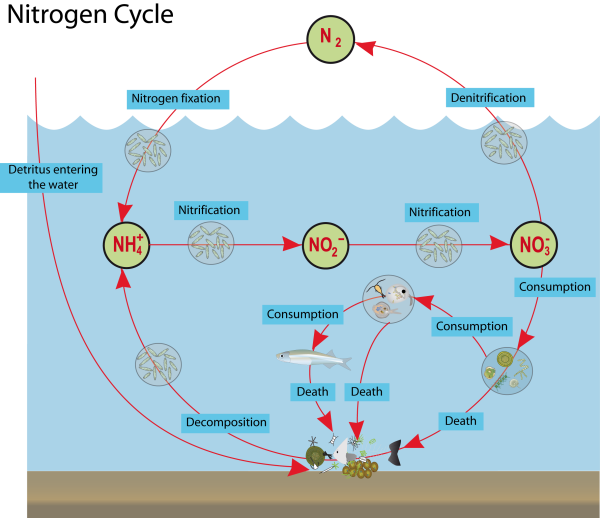
At the Rosette stations we take nutrient samples from the different water depths. They are testing for nitrates, phosphates and silicates. Nutrient samples are an important indicator of zooplankton productivity. These nutrients get used up quickly near the surface by phytoplankton during the process of photosynthesis (remember phytoplankton are at the base of the food chain and are producers). As the nutrients pass through the food chain (zooplankton eating phytoplankton and then on up the chain) they are returned to the deeper areas by the oxidation of the sinking organic matter. Therefore, as you go deeper into the ocean these nutrients tend to build up.  The Rosettes also have a CTD attached to record conductivity, temperature and density at the different depths.

Chris-DICtests
Scientist, Chris Taylor, completing the dissolved inorganic carbon test.
CO2test
The dissolved inorganic carbon test uses chemicals to stop any further biological processes and suspend the CO2 in “time”.

Another test that is conducted on the Rosettes is for the amount of dissolved inorganic carbon. This test is an indicator of the amount of carbon dioxide that the ocean uptakes from outside sources (such as cars, factories or other man-made sources). Scientists want to know how atmospheric carbon is affecting ocean chemistry  and marine ecosystems and changing the PH (acids and bases) of the ocean water. One thing they are interested in is how this may be affecting the formation of calcium in marine organisms such as clams, oysters, and coral.

New word: oxidation – the chemical combination of a substance with oxygen.

canal
Cape Cod canal.

Personal Log:

This week we headed back south and went through the Cape Cod canal outside of Plymouth, Massachusetts. I had to get up a little earlier to see it, but it was well worth it.  The area is beautiful and there were many small boats and people enjoying the great weather.

smallboat
Small boat bringing in a new group to the Gordon Gunter.

We also did a small boat transfer to bring five new people onboard, while three others left at the same time. It was hard to say goodbye, but it will be nice to get to know all the new faces.

dolphinsthree
Common Dolphins swimming next to the Gordon Gunter.

So now that we are heading south the weather is warming up. I have been told that we may start seeing Loggerhead turtles as the waters warm up – that would be so cool.  We had a visit by another group of Common Dolphins the other day. They were swimming along the side of the ship and then went up to the bow. They are just so fun to watch and photograph.

We have been seeing a lot of balloons (mylar and rubber) on the ocean surface. These are released into the air by people, often on cruise ships, and then land on the surface. Sea turtles, dolphins, whales and sea birds often mistake these for jelly fish and eat them.  They can choke on the balloons or get tangled in the string, frequently leading to death. Today, we actually saw more balloons than sea birds!!! A good rule is to never release balloons into the air no matter where you live!

balloon
A mylar balloon seen in the water by our ship.

Did you know?  A humpback whale will eat about 5000 pounds of krill in a day. While a blue whale eats about 8000 pounds of krill daily.

Question of the day?  If 1000 krill = 2 pounds, then together how many krill does a humpback and blue whale consume on a daily basis.

Blue Whale, Balaenoptera Musculus

Sue Cullumber: Navigating for Plankton – It’s a Team Effort! June 15, 2013

NOAA Teacher at Sea
Sue Cullumber
Onboard NOAA Ship Gordon Gunter
June 5–24, 2013

Mission: Ecosystem Monitoring Survey
Date:  6/15/2013
Geographical area of cruise:  The continental shelf from north of Cape Hatteras, NC, including Georges Bank and the Gulf of Maine, to the Nova Scotia Shelf

Weather Data from the Bridge:
Latitude/longitude:  4234.645N, 6946.914W
Temperature: 15.4ºC, 60ºF
Barometer: 1011.48 mb
Speed: 9.4 knots

Science and Technology Log:

Plankton is everywhere throughout the ocean, so how are the stations chosen and mapped?

IMG_9715
Looking over the map of our strata – photo by Cristina Bascuñán

Scientists first decide on a specific region or strata that they want to sample.  Then within this strata a specific number of stations is determined for sampling.  NOAA has developed a computer program that then randomly selects stations in the strata.  After these stations are generated, scientists play “connect the dots” to find the best route to get to all the stations. Once the route is generated adjustments are made based on time, weather and the team’s needs. These are plotted on a map and sent to the ship to see if further adjustments will need to be made.

IMG_9716
Map of our area of strata. We are currently following the red line. Many of the original stations to the east were dropped from the survey.

When the ship receives the map from the science party, they plot all the stations and make a track line to determine the shortest navigable route that they can take. Frequently the map that is originally provided has to be adjusted due to weather, navigation issues (if there is a shoal, or low area, the route may have to be changed), or ship problems. Once they come up with a plan, this has to be re-evaluated on a daily basis. For example during our survey we left four days later than planned, so many of the stations had to be taken out. Furthermore a large storm was coming in, so the route was changed again to avoid this weather. The Operation’s Officer onboard (Marc Weekley on the Gordon Gunter) speaks with the science party on a daily basis to keep the plan up to date and maintain a safe route throughout the survey.

IMG_9343
The Gyro Compass on the Gordon Gunter.
IMG_9642
The Sperry Marine – shows the location of vessels near the Gordon Gunter.
IMG_9700
Commanding Officer, Jeff Taylor, at the bridge with Ops Officer, Marc Weekley at the watch.

Ship Technology: The Gordon Gunter and all other NOAA vessels use many types of equipment to navigate the ship.  They have an electronic Gyro Compass which is constantly spinning to point to True North (not magnetic north).  This is accurate to a 10th of a degree and allows for other navigation systems on the ship to know with great accuracy what direction the ship is pointing. It also is used to steer the ship in auto pilot. When needed they can switch to manual control and hand steer the ship. They also have a magnetic compass onboard, if all electronics were to go out on the ship.  Also on the bridge are two radars, which provides position of all boats in the area and is used for collision avoidance. Underway, the Captain requires the ship to stay at least 1 nautical mile from other vessels unless he gives commands otherwise.

Once a station is reached the ship has to position itself so it will not go over the wire that is attached to the survey equipment.  Taking into consideration all of  the elements, which includes the wind speed, current weather conditions and the speed of the current, they usually try to position the boat so that the wind is on its port side.  In this way the wind is on the same side as the gear and it will not hit the propellors or the hull. The ship’s sonars determine the depth of the ocean floor and the scientists use this information to lower their equipment to a distance just above this depth.

IMG_9738
Cathleen Turner and Kevin Ryan take water samples from the Rosette.

Vocabulary:

Bow – front of the ship

Stern – back of the ship

Port – left of bow

Starboard – right of bow

Personal Log: 

Brrr… it’s cold!  To avoid the big storm we headed north to the Bay of Fundy that is located between Maine and Nova Scotia.  Seas were fairly calm, but was it cold at 9º C (48ºF), but with the wind chill it was probably closer to 5.5ºC (42ºF)!  We are now heading south so it is starting to warm up, but luckily it won’t be as hot as Arizona!

Loggerheadshark - tom
Loggerhead turtle being tracked by a Blue Shark – photo by Tom Johnson
readyfortakeoff
Shearwater trying to take off.


Trying to take photos of animals in the ocean is very difficult.  You have to be in the right place, at the right time, and be ready. Today we saw several sightings of whales, but they were in the distance and only lasted a second.  During this trip, there was also a sighting of a shark attacking a Loggerhead turtle, but by the time I got to the bridge we had passed it by.  Lately we have seen a great variety of sea birds including:  shearwaters, puffins, sea gulls, and about twenty fiver other types. Even though it can be a little frustrating at times, it is still very calming to look out over the ocean and the sunsets are always amazing!

shipinpinkandbluew
Sailing into a beautiful sunset

I can’t believe that there is only one week left for the survey.  Time has gone so fast and I have learned so much.  Tomorrow we are doing a boat exchange and some people are leaving while others will come onboard.  I will miss those people that are leaving the ship, but look forward to meeting new people that will join our team.

Did you know?  The ratio of different salts (ions) in the ocean water are the about same in all of the world’s oceans.

puffin
One of the pufffins we saw up by Maine.