Tom Savage: What is Life Like aboard the Fairweather? August 17, 2018

NOAA Teacher at Sea

Tom Savage

Aboard NOAA Ship Fairweather

August 6 – 23, 2018


Mission: Arctic Access Hydrographic Survey

Geographic Area of Cruise: Point Hope, northwest Alaska

Date: August 17, 2018

Weather Data from the Bridge

Latitude  64   42.8 N
Longitude – 171  16.8  W
Air temperature: 6.2 C
Dry bulb   6.2 C
Wet bulb  6.1 C
Visibility: 0 Nautical Miles
Wind speed: 26 knots
Wind direction: east
Barometer: 1000.4  millibars
Cloud Height: 0 K feet
Waves: 4 feet

Sunrise: 6:33 am
Sunset: 11:45 pm


Personal Log

I was asked yesterday by one of my students what life is like aboard the NOAA Ship Fairweather?  So I thought I would dedicate this entry to address this and some of the other commonly asked questions from my students.

Life on board the ship is best described as a working village and everyone on board has many specific jobs to ensure the success of its mission; check my “Meet the Crew” blog.  The ship operates in a twenty four hour schedule with the officers rotating shifts and responsibilities. When the ship is collecting ocean floor data, the hydrographers will work rotating shifts 24 hours a day. With so much happening at once on a working research vessel, prevention of incidents is priority which leads to the ship’s success. A safety department head meeting is held daily by the XO (executive officer of the ship) to review any safety issues.

During times when the weather is not conducive for data collection, special training sessions are held. For instance, a few days ago, the officers conducted man over board drills.  Here, NOAA Officers practice navigating the ship and coordinating with deck hands to successfully rescue the victim; in this case it’s the ship’s mascot, “Oscar.”

(Fun fact:  at sea, ships use signal flags to communicate messages back and forth [obviously, this was more prevalent before the advent of radio].  For example:  the “A” or “Alpha” flag means divers are working under the surface; the “B” or “Bravo” flag means I am taking on dangerous cargo [i.e. fueling]; and the “O” flag means I have a man overboard.  The phonetic name for “O” is, you guessed it, “Oscar” … hence the name.  You can read about other messages here: https://en.wikipedia.org/wiki/International_maritime_signal_flags).

Precision and speed is the goal and it is not easy when the officer is maneuvering 1,591 tons of steel;  the best time was 6:24. This takes a lot skill, practice and the ability to communicate effectively to the many crew members on the bridge, stern (back of boat), and the breezeways on both port and starboard sides of the ship.  Navigating the ship becomes even more challenging when fog rolls in as the officers rely on their navigation instruments. Training can also come in the form of good entertainment. With expired rescue flares and smoke grenades, the whole crew practiced firing flares and activating the smoke canisters.  These devices are used to send distress signals in the event of a major ship emergency. I had the opportunity of firing one of the flares !


Flares
Practicing the release of emergency smoke canisters ~ photo by Tom Savage


What are the working conditions like on board? 

At sea, the working environment constantly changes due to the weather and the current state of the seas. Being flexible and adaptive is important and jobs and tasks for the day often change Yesterday, we experienced the first rough day at sea with wave heights close to ten feet.  Walking up a flight of stairs takes a bit more dexterity and getting used to.  At times the floor beneath will become not trustworthy, and the walls become your support in preventing accidents.

NavigatingFog
View from the Bridge in fog. ~ photo by Tom Savage


Where do you sleep? 

Each crew member is assigned a stateroom and some are shared quarters. Each stateroom has the comforts from home a bed, desk, head (bathroom & shower) sink and a port hole (window) in most cases. The most challenging component of sleeping is sunlight, it does not set until 11:30 pm. No worries, the “port holes” have a metal plate that can be lowered. It is definitely interesting looking through the window when the seas are rough and watching the waves spin by.  Seabirds will occasionally fly by late at night and I wonder why are they so far out to sea ?

Stateroom
My stateroom – photo by Tom

Generally, when sharing a stateroom,  roommates will have different working shifts.

Meals are served in the galley and it is amazing! It is prepared daily by our Chief Steward Tyrone; he worked for the Navy for 20 years and comes with a lot of skills and talents !  When asking the crew what they enjoy the most on board the ship, a lot of them mention the great food and not having to cook.

Fairweather's Galley
Fairweather’s Galley ~ photo by Tom


Are there any activities? 

Keeping in good physical shape aboard any vessel out at sea is important. The Fairweather has a gym that can be used 24 hours a day. The gym has treadmills, elliptical, weights and a stair climber.

ExerciseRoom
The exercise room – photo by Tom


There is the lounge where movies are shown in the evening. Interestingly, the seats glide with the motions of the waves. Meetings are also held here daily, mostly safety briefings.

The lounge
The lounge


What are the working hours like?

During any cruise with NOAA, there is always things that come up that were not planned, staff and schedules are adjusted accordingly. On this leg of the trip during our transit back to Kodiak Island, we stopped by Nome, Alaska, to pick up a scientist from NOAA’s Pacific Marine Environmental Lab PMEL office.  One of their research buoys separated from its mooring and went adrift in the Bering Sea (it drifted over 100 miles before we were able to catch up to it.  The Fairweather was dispatched to collect and store the buoy aboard, after which it will eventually be returned to PMEL’s lab in Seattle Washington.


Buoy Retrieval
Retrieval of NOAA’s PMEL (Pacific Marine Environmental Lab) buoy. photo by NOAA


The place with the most noise is definitely the engine room.  Here, two sixteen piston engines built by General Motors powers the ship;  the same engine power in one train engine ! It is extremely difficult to navigate in the engine room as there is so many valves, pipes, pumps, switches and wires.  Did I mention that it is very warm in the room; according to the chief engineer, Tommy, to maintain a healthy engine is to ensure that the engine is constantly warm even during times when the ship is docked.

Tom in Engine Room
Navigating the engine room …… I did not push any buttons, promise! Photo by Kyle


Until next time,  happy sailing !

~ Tom

Tom Jenkins: A Day in the Life of a Teacher at Sea, April 15, 2018

NOAA Teacher at Sea
Tom Jenkins
Aboard NOAA Ship Henry B. Bigelow
April 10 – 27, 2018

Mission: Spring Bottom Trawl Survey
Geographic Area: Northeastern U.S. Coast
Date: April 15, 2018

Personal Log

Stairwell
A ladder well on Henry B. Bigelow

The ladder wells.  On the Henry B. Bigelow these sets of steps will take you everywhere that you need to go throughout the day.  Life on a ship is interesting in the fact you don’t ever leave while on your mission.  This is where you sleep, where you eat, where you work and where you hang out with your friends.

One of the most frequently received questions from my students back home is about life on the ship.  Since the past couple of days have been relatively slow in terms of fishing (due to inclement weather), I have decided to highlight the areas of the ship where I spend the most of my time.

My room (likely about the size of your own room at home) happens to be a quad which means I share my room with 3 other people.  In addition to two bunk beds, we have a work area (w/a small TV) and a compact bathroom.  While it is definitely a bit cramped, the 4 of us are split between the 2 shifts (My shift is 12am-12pm.).   The end result is that there are no more than 2 people in the room at any time, so it ends up working out quite well.  Notice the handle in the shower.  This comes in handy when you are trying to clean up and not wipe out as sometimes the ship can move around quite a bit!  You may also notice the emergency billet  on the door.  This tells each member of the crew where to go and also what to do during emergency situations.


The food on the ship has been amazing.  As students in my classroom will attest, I swore I was going to go on a diet during this cruise .  While that would be possible, given there are always tons of healthy options, it’s not everyday when there is a BBQ spare rib option for lunch!  Additionally, when you are working off and on over the course of your 12 hour shift, eating food is sometimes a good way to pass the time.  While I don’t think I have gained weight, I definitely do not think I will lose weight over the final 12 days of the cruise.


The labs where the scientists work are obviously where we spend a large part of our day (or my case, night).  The picture to the left is where many of the fish are cataloged and processed.  The photo in the top right are where some of the specimens are preserved for later examination in not only NOAA facilities, but also other other research facilities around the world.  The area in the bottom is a planning/observation space where the science team goes to gather, plan and share information related to their research mission.


Finally, there is the lounge and fitness area.  The lounge is really nice with large recliners which are a wonderful way to relax after a long shift.  There is Direct TV which is nice for both sports and news and the ship also has an impressive collection of movies for the crew to enjoy.  The fitness area in the bottom right is my favorite space on the ship.  While neither expansive nor pretty, it is a great place to go to burn off steam.  There is a TV and enough equipment to break a sweat.  Although I must admit, its extremely challenging to use an elliptical during a storm with rough seas.  Especially with low ceilings! 🙂


Thank you for taking the time to read my blog.  As always, if you have any questions and/or comments, please feel free to post them below.

Sam Northern: Welcome Aboard NOAA Ship Gordon Gunter! May 29, 2017

NOAA Teacher at Sea

Sam Northern

Aboard NOAA ship Gordon Gunter

May 28 – June 7, 2017

Mission: Spring Ecosystem Monitoring (EcoMon) Survey (Plankton and Hydrographic Data)

Geographic Area of Cruise: Atlantic Ocean

Date: May 29, 2017

Weather Data from the Bridge:

Latitude: 41°31.8’N

Longitude: -71°18.9’W

Sky: 8/8 (Fully Cloudy, Overcast)

Wind Direction: NE

Wind Speed: 13 Knots

Barometric Pressure: 1005 Millibars

Humidity: 88%

Air Temperature: 11.5°C

Personal Log

In Port in Newport, Rhode Island (Sunday, May 28)

IMG_8455.JPG
The 224-foot Gordon Gunter at Pier 2 at the Naval Station Newport on the morning of sailing Leg 2 of the Survey.

Greetings from NOAA Ship Gordon Gunter! On my flight into Providence, Rhode Island (the Ocean State) I was met with lengthy coastlines and beautiful blue skies. Jerry Prezioso, (one of NOAA’s oceanographers), picked me up from the airport. We made our way to the ship, Gordon Gunter, at Pier 2 at the Naval Station Newport. To get there, we drove 37 miles southeast of Providence and crossed the Jamestown Verrazzano Bridge and the Newport Bridge. Both bridges offered stunning scenes of shorelines that separated the picturesque sailboats from the majestic beach side houses. Newport, also known as City by the Sea, was a major 18th-century port city which is evident from the high number of surviving buildings from the colonial era.

2.JPG
NOAA Ship Gordon Gunter

Upon arrival at the pier, I passed two immense U.S. Coast Guard ships before laying eyes on what would be by new home for the next ten days—NOAA Ship Gordon Gunter. Several members of the crew were already there to welcome me aboard. The crew’s hospitality and Jerry’s tour of the ship eased my anxiety while at the same time, intensifying my excitement for the adventure that awaits.

After the tour, Jerry showed me to my stateroom. I was surprised to find out that I have my own cabin! There is a refrigerator, closet, desk, recliner, my very own sink, and a shared bathroom with the room next door. It also has a TV to watch any of the movies available on the ship.

After unpacking my luggage, I decided I would spend some time exploring the ship. I took photographs and captured 360-degree images of the ship’s many spaces. I intend to use my footage as a way to give my students a virtual tour of Gordon Gunter. When Jerry showed us the ship, he effortlessly moved from one place to the next. I, on the other hand, could not…at first. I felt as if I was stuck in a labyrinth. Yet, with the amount of time I will be spending on board Gordon Gunter, I am sure it will not take long to get the “lay of the land”.

This slideshow requires JavaScript.

IMG_8509
The Galley (Kitchen)

Getting lost is not always a bad thing. I can admit that I was not too upset when I took a wrong turn and ended up in the galley (the kitchen). I could tell right away from the appetizing aroma and the fresh fruits and vegetables that the meals were going to be amazing.

After Leg 1 of the Spring Ecosystem Monitoring (EcoMon) Survey which concluded on Friday, May 26. Prior to the ship’s departure at 1400 hours on Memorial Day, the crew was busy with important maintenance and upkeep. With the adventure of a lifetime so close at hand, I could only hope that my excitement would give me at least a few hours of sleep.

Preparing for Departure (Monday, May 29)

img_8507.jpg
My first dinner on board ship Gordon Gunter.

To keep everyone happy when they are living in such close quarters, working strange shifts, and so far from home, good food is vital. Isn’t it always? Gordon Gunter is well known in the NOAA community for its fantastic food. The person responsible for our delicious and abundant food is Margaret Coyle, Chief Steward and her trusted comrade, Paul Acob, Second Cook. I first experienced their culinary skills at my first 6:30 a.m. breakfast. Remarkable! I could not wait for the meals to come.

Margaret has worked on NOAA Ship Gordon Gunter for 13 years! Before NOAA, Margaret was in the Coast Guard for four years and her husband retired from the Coast Guard with 21 years of service. Margaret makes almost every dish from scratch—from juices to hummus. She is dedicated to providing a variety of meals that not only fill bellies but satisfy taste buds. You never quite know what to expect one meal to the next, and that my friends is the spice of life! Paul has spent 14 years with NOAA and 20 years in the Navy—that’s 34 years at sea! I greatly admire both Paul and Margaret for their service and continued commitment.

IMG_8493.JPGAs a Teacher at Sea, I am an active member of the science team. I have been assigned the day shift, which means I work from 12 noon to 12 midnight. I am happy with this shift because it is a little more of a regular schedule compared to beginning work at midnight and then sleeping during the daylight hours. However, it will definitely take time for me to adjust my eating and sleeping schedules with that of my work shift.

In preparation for our work at sea, we spent the afternoon reviewing guidelines and proper procedures. Safety is crucial on any ship, and I feel much better having gone through the welcome orientation. Now, I am prepared when it is time to perform any of the three emergency drills: fire, abandon ship, and man overboard. One can never be too cautious.

Gulf of Maine Pic
The Gulf of Maine. Photo courtesy of NOAA.

The second leg of the 2017 Spring EcoMon Survey consists of research at oceanography stations in the Georges Bank and the Gulf of Maine. These stations are randomly distributed and progress of the survey will depend on transit time, sea state, and water depth of the stations. Our research will calculate the spatial distribution of the following factors: water currents, water properties, phytoplankton, microzooplankton, mesozooplankton, sea turtles, and marine mammals.

IMG_6333 - Copy
NOAA Flag

At 2:07 p.m. (our scheduled departure time), Gordon Gunter cast off from Coddington Cove at the Naval Station Newport. As we approached the Newport Bridge I took photos of the NAVY War College, Herring gulls nesting on a small island, passing ski boats, and the ocean view cottages. On the flying bridge an expert in magnetic compasses calibrated the ship’s mechanism and cleared the compass of excess debris.

IMG_6341.JPG
Compass Adjustment/Calibration

During a personnel transfer using the Fast Rescue Boat (FRB), a mechanical issue was identified and the ship needed to head back to the pier. The Commanding Officer, Lieutenant Commander Lindsay Kurelja, informed us that we would begin our journey at 9:00 a.m. the next day, May 30.

Science and Technology Log

My head has been spinning with the different types of equipment and technology on board Gordon Gunter. I have a lot to learn! I would like to share a small bit of information about two important pieces of equipment that will be essential to our research in the coming days.

IMG_6286.JPG
Bongo Nets

1.) Since the majority of plankton is too small to see with the naked eye, these organisms must be viewed through a microscope. To do this, plankton must be collected from the ocean. You might be thinking, “But how? They are too small to catch.” That’s why we use bongo nets! Bongo nets allow scientists to strain plankton from the water using the bongo’s mesh net. Plankton and other matter from the sea will be deposited into a bucket at the end of the net which is called a cod-end. Different sized nets are used to capture different types of plankton. The bongo nets will be towed slowly through the water at each oceanography station we come to. I am looking forward to using the ship’s bongo nets to investigate marine life in Georges Bank and the Gulf of Maine.

IMG_6285
CTD (Conductivity, Temperature, and Depth)

2.) At each station of this leg of the EcoMon survey, we will use a CTD device to determine the Conductivity, Temperature, and Depth of the ocean. On Gordon Gunter, the CTD is incorporated into a rosette, or carousel. This allows us to collect water samples from various depths at the same location. The CTD will give scientists a broad picture of the marine environment in the Northeast Atlantic.

New Terms/Phrases

Parts of a Ship (Source — Macmillan Dictionary):

  • Aft Deck: the part of the deck towards the back of the ship.
  • Bow: the front of the ship.
  • Bridge: the part of the ship from which it is controlled. (This is where the captain controls the ship.)
  • Deck: the outside top part of the ship that you can walk on.
  • Forward Deck: the part of the deck towards the front of the ship.
  • Port: the side of the ship that is on your left when you are looking forwards.
  • Starboard: the side of the ship that is on your right when you are looking forwards.
  • Stern: the back part of the ship.
gunter3_fullsize.jpg
Source — NOAA Official Website

Did You Know?

IMG_8444.JPGAt Pier 2 at Naval Station Newport were gigantic buoys the Coast Guard had recently cleaned and re-painted. Do you know why some are green and some are red? The colors help aid the navigation of ships. The red buoys are on the right/starboard side of the ship, and the green buoys should be on the left/port side of the vessel when heading upstream. I guess ships have their own rules of navigation just like vehicles on the road.

Cathrine Prenot: Sea Speak. July 25, 2016

NOAA Teacher at Sea
Cathrine Prenot
Aboard Bell M. Shimada
July 17-July 30, 2016


Mission: 2016 California Current Ecosystem: Investigations of hake survey methods, life history, and associated ecosystem

Geographical area of cruise: Pacific Coast from Newport, OR to Seattle, WA

Date: Sunday, July 24, 2016

Weather Data from the Bridge

Lat: 47º32.20 N
Lon: 125º11.21 W
Speed: 10.4 knots
Windspeed: 19.01 deg/knots
Barometer: 1020.26 mBars
Air Temp: 16.3 degrees Celsius
Water Temp: 17.09 degrees Celsius


Science and Technology Log

Typical evening view from the flying bridge of the Bell M. Shimada

We have been cruising along watching fish on our transects and trawling 2-4 times a day. Most of the trawls are predominantly hake, but I have gotten to see a few different species of rockfish too—Widow rockfish, Yellowtail rockfish, and Pacific Ocean Perch (everyone calls them P.O.P.)—and took their lengths, weights, sexes, stomachs, ovaries, and otoliths…

…but you probably don’t know what all that means.

The science team sorts all of the catch down to Genus species, and randomly select smaller sub-samples of each type of organism. We weigh the total mass of each species. Sometimes we save whole physical samples—for example, a researcher back on shore wants samples of fish under 30cm, or all squid, or herring, so we bag and freeze whole fish or the squid.

For the “sub samples” (1-350 fish, ish) we do some pretty intense data collection. We determine the sex of the fish by cutting them open and looking for ovaries or testes. We identify and preserve all prey we find in the stomachs of Yellowtail Rockfish, and preserve the ovaries of this species’ females and others as well. We measure fish individual lengths and masses, take photos of lamprey scars, and then collect their otoliths.

Fish Otolith showing concentric growth rings from here.

Otoliths are hard bones in the skull of fish right behind the brain. Fish use them for balance in the water; scientists can use them to determine a fish’s age by counting the number of rings. Otoliths can also be used to identify the species of fish.

Here is how you remove them: it’s a bit gross.

Otolith instructions from here.
Cod, Redfish, and Hake otoliths from here.


A bigger fish species does not necessarily mean a larger otolith. From here.

If you want to check out an amazing database of otoliths, or if you decide to collect a few and want to see what species or age of fish you caught, or if you are an anthropologist and want to see what fish people ate a long time ago? Check out the Alaska Fisheries Science Center—they will be a good starting spot.  You can even run a play a little game to age fish bones!

Pacific Ocean Perch, or P.O.P.


Personal Log

I haven’t had a lot of spare time since we’ve been fishing, but I did manage to finagle my way into the galley (kitchen) to work with Chief Steward Larry and Second Cook Arlene. They graciously let me ask a lot of questions and help make donuts and fish tacos!  No, not donut fish tacos.  Gross.

How to make friends and influence people

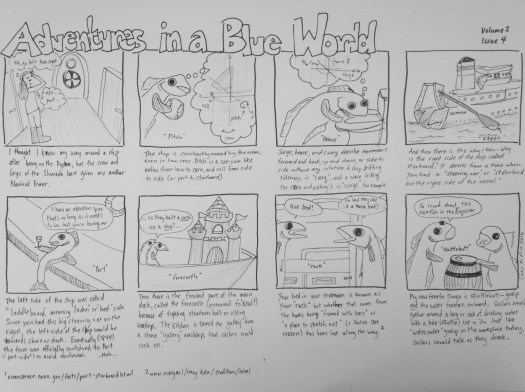
Working in the galley got me thinking of “ship jargon,” and I spent this morning reading all sorts of etymology.  I was interested to learn that the term crow’s nest came from the times of the Vikings when they used crows or raven to aid navigation for land.  Or that in the days of the tall ships, a boat that lost a captain or officer at sea would fly blue flags and paint a blue band on the hull—hence why we say we are “feeling blue.”  There are a lot more, and you can read some interesting ones here.

You can also click on Adventures in a Blue World below (cartoon citations 1 and 2).

TAS Cat Prenot 2016 cartoon4 v2

And here is a nautical primer from Adventures in a Blue World Volume 1:

A Nautical Primer part I from 2011 aboard the Oscar Dyson
A Nautical Primer from 2011 aboard the Oscar Dyson


Did You Know?

Working in the wet lab can be, well, wet and gross. We process hundreds of fish for data, and then have hoses from the ceiling to spray off fish parts, and two huge hoses to blast off the conveyor belt and floors when we are done. But… …I kind of love it.

Yay Science!
Yay Science!

Resources

Etymology navy terms: http://www.navy.mil/navydata/traditions/html/navyterm.html

Interestingly enough, the very words “Sea Speak” have a meaning.  When an Officer of the Deck radios other ships in the surrounding water, they typically use a predetermined way of speaking, to avoid confusion.  For example, the number 324 would be said three-two-four.


Nichia Huxtable: Life on board, you won’t be bored!, May 6, 2016

NOAA Teacher at Sea

Nichia Huxtable

Aboard NOAA Ship Bell M. Shimada

April 28-May 9, 2016

Mission: Mapping CINMS                                                                                                           Geographical area of cruise: Channel Islands, California                                                 Date: May 6, 2016

Weather Data from the Bridge: 2-3 ft swells; storm clouds over land, clear at sea

Science and Technology Log

Dismantling the REMUS 600 AUV for its trip home
Goodbye, AUV. Until we meet again.

The AUV is no longer my favorite thing on Shimada. As I write this, it is being dismantled and packed into shipping boxes for its return trip home to Maryland. To keep a long, sad story short, the AUV had a big electrical problem that was fixed, but when the scientists turned it on for a test run, a tiny $6 lithium battery broke open and oozed all over the motherboard. Game over for the AUV. So now my favorite thing on Shimada is the ice cream.

Personal Log

Enough about science and technology for now. I bet you’re really wondering what it’s like day in and day out on board Shimada. Well, my intrepid future NOAA crew members, this blog post is for you! We’ll start what’s most important: the food.

Breakfast, lunch, and dinner are all served at the same time everyday. The food is prepared in the galley and everyone eats in the mess. Beverages, cereal, yogurt, fruit, snacks, the salad bar, and ice cream are available 24 hours a day, so there is no need to ever be hungry. Not all ships are the same, however. In one of the many anecdotes told to me by master storyteller Fabio Campanella, an Italian research ship he once worked on served fresh bread and authentic pizza everyday…sign me up for that cruise!

DSC_0470[1]
Unlike the AUV, the ice cream freezer never disappoints

Next, you’re probably wondering where everyone sleeps. Sleeping quarters are called staterooms and most commonly sleep two people, although larger staterooms might sleep four. Each stateroom has its own television and a bathroom, which is called a head. As you can see in the photo, the bunks have these neat curtains that keep out the light in case your roommate needs to get up at 1 a.m. for the night-shift.

"Working
Working in the Acoustics Lab on Shimada

The Shimada has lots and lots of work and storage rooms, each serving a different function. There is a wet lab, dry lab, chem lab, and acoustics lab for doing SCIENCE (woohoo!), as well as a tech room for the computer specialist (called an ET), storage lockers for paint, cleaning supplies, and linens, plus other rooms full of gear and machinery. There’s also a laundry room, so you can take care of your stinky socks before your roommate starts to complain!

Trash on board is separated into recyclable bottles and cans, food waste, and trash. The food waste is ground up into tiny pieces and dumped in the ocean outside of the sanctuary, while the trash is INCINERATED! That’s right, it’s set on fire…a really, really, hot fire. Ash from the incinerator is disposed of onshore.

"<em
Shimada‘s incinerator

Another important part of the ship is the bridge. Operations occur 24 hours a day, so the ship never sleeps. Officers on the bridge must know what is happening on the ship, what the weather and traffic is like around the ship, and they must make sure to properly pass down this information between watches. The bridge has radar to spot obstacles and other ships, a radio to communicate with other ships, and a radio to communicate with the crew and scientists.

"Looking
Looking for wildlife on the NOAA Ship Bell M. Shimada
"Bride
Bridge on the Shimada

Last, but not least, is the lounge that comes complete with surround-sound, a big screen TV, super-comfy recliners, and about 700 movies, including the newest of the new releases.

"Lounge
Wish this was my living room!

Did you know? 

A female elephant seal was once recorded diving underwater for two continuous hours (they usually stay underwater for 1/2 hour); the deepest recorded dive was by a male and was 5,141ft.

Stay tuned for the next post: Multibeam? You Mean Multi-AWESOME!