Caitlin Fine: Chemistry Is All Around Us, August 4, 2011

NOAA Teacher at Sea
Caitlin Fine
Aboard University of Miami Ship R/V Walton Smith
August 2 – 6, 2011

Mission: South Florida Bimonthly Regional Survey
Geographical Area: South Florida Coast and Gulf of Mexico
Date: August 4, 2011

Weather Data from the Bridge
Time: 10:32pm
Air Temperature: 30°C
Water Temperature: 30.8°C
Wind Direction: Southeast
Wind Speed:  7.7knots
Seawave Height: calm
Visibility: good/unlimited
Clouds: clear
Barometer: 1012 nb
Relative Humidity: 65%

Science and Technology Log

As I said yesterday, the oceanographic work on the boat basically falls into three categories: physical, chemical and biological. Today I will talk a bit more about the chemistry component of the work on the R/V Walton Smith. The information that the scientists are gathering from the ocean water is related to everything that we learn in science at Key – water, weather, ecosystems, habitats, the age of the water on Earth, erosion, pollution, etc.

First of all, we are using a CTD (a special oceanographic instrument) to measure salinity, temperature, light, chlorophyll, and depth of the water. The instrument on this boat is very large (it weights about 1,000 lbs!) so we use a hydraulic system to raise it, place it in the water, and lower it down into the water.

CTD
Lindsey takes a CO2 sample from the CTD

The CTD is surrounded by special niskin bottles that we can close at different depths in the water in order to get a pure sample of water from different specific depths. Nelson usually closes several bottles at the bottom of the ocean and at the surface and sometimes he closes others in the middle of the ocean if he is interested in getting specific information. For each layer, he closes at least 2 bottles in case one of them does not work properly. The Capitan lowers the CTD from a control booth on 01deck (the top deck of the boat), and two people wearing a hard hat and a life vest have to help guide the CTD into and out of the water. Safety first!

Once the CTD is back on the boat, the chemistry team (on the day shift, Lindsey and I are the chemistry team!) fills plastic bottles with water from each depth and takes them to the wet lab for processing. Throughout the entire process, it is very important to keep good records of the longitude and latitude, station #, depth of each sample, time, etc, and most importantly, which sample corresponds to which depth and station.

We are taking samples for 6 different types of analyses on this cruise: nutrient analysis, chlorophyll analysis, carbon analysis, microbiology analysis, water mass tracers analysis and CDOM analysis.

The nutrient analysis is to understand how much of each nutrient is in the water. This tells us about the availability of nutrients for phytoplankton. Phytoplankton need water, CO2, light and nutrients in order to live. The more nutrients there are in the water, the more phytoplankton can live in the water. This is important, because as I wrote yesterday – phytoplankton are the base of the food chain – they turn the sun’s energy into food.

Carbon
Sampling dissolved inorganic carbon

That said, too many nutrients can cause a sudden rise in phytoplankton. If this occurs, two things can happen: one is called a harmful algal bloom.  Too much phytoplankton (algae) can release toxins into the water, harming fish and shellfish, and sometimes humans who are swimming when this occurs.  Another consequence is that this large amount of plankton die and fall to the seafloor where bacteria decompose the dead phytoplankton.  Bacteria need oxygen to survive so they use up all of the available oxygen in the water. Lack of oxygen causes the fish and other animals to either die or move to a different area. The zone then becomes a “dead zone” that cannot support life. There is a very large dead zone at the mouth of the Mississippi River. So we want to find a good balance of nutrients – not too many and not too few.

The chlorophyll analysis serves a similar purpose. In the wet lab, we filter the phytoplankton onto a filter.

chlorophyll
I am running a chlorophyll analysis of one of the water samples

Each phytoplankton has chloroplasts that contain chlorophyll. Do you remember from 4th grade science that plants use chlorophyll in order to undergo photosynthesis to make their own food? If scientists know the amount of chlorophyll in the ocean, they can estimate the amount of phytoplankton in the ocean.

Carbon can be found in the form of carbon dioxide (CO2) or in the cells of organisms. Do you remember from 2nd and 4th grade science that plants use CO2 in order to grow? Phytoplankton also need CO2 in order to grow. The carbon dioxide analysis is useful because it tells us the amount of CO2 in the ocean so we can understand if there is enough CO2 to support phytoplankton, algae and other plant life. The carbon analysis can tell us about the carbon cycle – the circulation of CO2 between the ocean and the air and this has an impact on climate change.

The microbiology analysis looks for DNA (the building-blocks of all living organisms – kind of like a recipe or a blueprint). All living things are created with different patterns or codes of DNA. This analysis tells us whose DNA is present in the ocean water – which specific types of fish, bacteria, zooplankton, etc.

The water mass tracers analysis (on this boat we are testing N15 – an isotope of Nitrogen, and also Tritium – a radioactive isotope of Hydrogen) helps scientists understand where the water here came from. These analyses will help us verify if the Mississippi River water is running through the Florida Coast right now. From a global viewpoint, this type of test is important because it helps us understand about the circulation of ocean water around the world. If the ocean water drastically changes its current “conveyor belt” circulation patterns, there could be real impact on the global climate. (Remember from 2nd and 3rd grade that the water cycle and oceans control the climate of Earth.) For example, Europe could become a lot colder and parts of the United States could become much hotter.
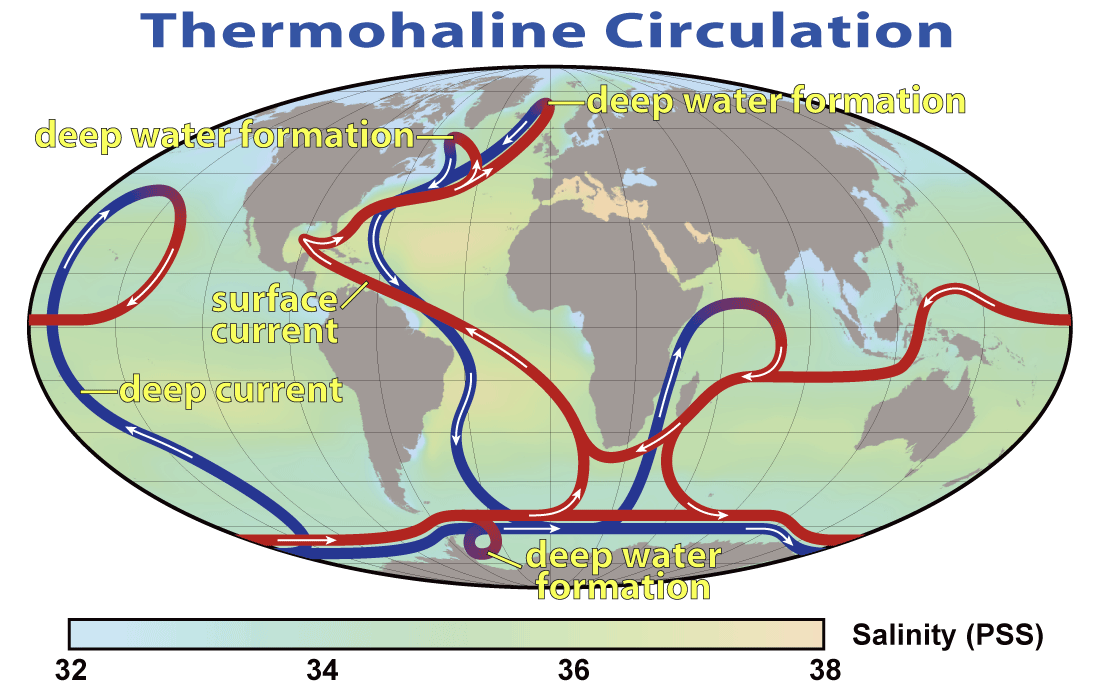
This is an image of the conveyor belt movement of ocean currents

The last type of analysis we prepared for was the CDOM (colored dissolved organic matter) analysis. This is important because like the water mass tracers, it tells us where this water came from. For example, did the water come from the Caribbean Sea, or did it come from freshwater rivers?

I am coming to understand that the main mission of this NOAA bimonthly survey cruise on the R/V Walton Smith is to monitor the waters of the Florida Coast and Florida Bay for changes in water chemistry. The Florida Bay has been receiving less fresh water runoff from the Everglades because many new housing developments have been built and fresh water is being sent along pipes to peoples’ houses. Because of this, the salinity of the Bay is getting higher and sea grass, fish, and other organisms are dying or leaving because they cannot live in such salty water. The Bay is very important for the marine ecosystem here because it provides a safe place for small fish and sea turtles to have babies and grow-up before heading out to the open ocean.

Personal Log

This cruise has provided me great opportunities to see real science in action. It really reinforces everything I tell my students about being a scientist: teamwork, flexibility, patience, listening and critical thinking skills are all very important. It is also important to always keep your lab space clean and organized. It is important to keep accurate records of everything that you do on the correct data sheet. It can be easy to get excited about a fish or algae discovery and forget to keep a record of it, but that is not practicing good science.

It is important to keep organized records

It is also important to stay safe – every time we are outside on the deck with the safety lines down, we must wear a life vest and if we are working with something that is overhead, we must wear a helmet.

I have been interviewing the scientists and crew aboard the ship and I cannot wait to return to Arlington and begin to edit the video clips. I really want to help my students understand the variety of science/engineering and technology jobs and skills that are related to marine science, oceanography, and ships. I have also been capturing videos of the ship and scientists in action so students can take a virtual fieldtrip on the R/V Walton Smith. I have been taking so many photos and videos, that the scientists and crew almost run away from me when they see me pick up my cameras!

Captain Shawn Lake mans the winch

The food continues to be wonderful, the sunsets spectacular, and my fellow shipmates entertaining. Tomorrow I hope to see dolphins swimming alongside the ship at sunrise! I will keep you posted!!

Did you know?

The scientists and crew are working 12-hour shifts. I am lucky to have the “day shift” which is from 8am to 8pm. But some unlucky people are working the “night shift” from 8pm to 8am. They wake-up just as the sun is setting and go to sleep right when it rises again.

Animals seen today…

zooplankton under the dissecting microscope

–       Many jellyfish

–       Two small crabs

–       Lots of plankton

A sampling of zooplankton

–       Flying fish flying across the ocean at sunset

–       A very small larval sportfish (some sort of bluerunner or jack fish)

Some moon jellyfish that we collected in the tow net

Caitlin Fine: Mississippi River Chasers! August 3, 2011

NOAA Teacher at Sea
Caitlin Fine
Onboard University of Miami Ship R/V Walton Smith
August 2 – 6, 2011

Mission: South Florida Bimonthly Regional Survey
Geographical Area: South Florida Coast and Gulf of Mexico
Date: August 3, 2011

Weather Data from the Bridge

Time: 10:18pm
Air Temperature: 29.5°C
Water Temperature: 31.59°C
Wind Direction: North
Wind Speed: 3 knots
Seawave Height: calm
Visibility: good/unlimited
Clouds: Partially cloudy (cumulos and cirrus)
Barometer: 1011.0mb
Relative Humidity: 72%

Science and Technology Log

The oceanographic work on the boat can be divided into three categories: physical, chemical, and biological. In this log, I will explain a little bit about the part of the research related to the physics of light. Upcoming 5th graders – pay attention! We will be learning a lot about light in January/February and it all relates to this research project.

Brian and Maria are two PhD students who are working with the physical components. They are using several optical instruments: the SPECTRIX, the GER 1500, the Profiling Reflectance Radiometer (PRR), and the Profiling Ultraviolet Radiometer (PUV).

Bryan and Maria
Brian and Maria take optic measurements with the SPECTRIX and GER 1500

The SPECTRIX is a type of spectroradiometer that measures the light coming out of the water in order to understand what is in the water. For example, we can measure the amount of green light that is reflected and red and blue light that is absorbed in order to get an idea about the amount of chlorophyll in the water. This is important because chlorophyll is the biggest part of phytoplankton and phytoplankton are tiny plant-like algae that form the base of the food chain on Earth.

PUV
Brian lowers PRR into the water

The PRR and the PUV measure light at different depths to also understand what is in the water and at what depth you will find each thing in the water. The light becomes less bright the further down you go in the water. Most of light is between 0-200 meters of depth. The light that hits the water also becomes less bright based upon what is in the water. For example, you might find that chlorophyll live at 10 meters below the surface. It is important to understand at what depth each thing is in the water because that tells you where the life is within the ocean. Most of the ocean is pitch-black because it is so deep that light cannot penetrate it. Anything that lives below the light level has to be able to either swim up to get food, or survive on “extras” that fall below to them.

Personal Log

These few days have been very fun and action-packed! I arrived on the ship on Sunday afternoon and helped Nelson and the crew get organized and set-up the stations for the cruise. Several other people had also arrived early – two graduate students who are studying the optics of the water as part of their PhD program, one college student and one observer from the Dominican Republic who are like me – trying to learn about what NOAA does and how scientists conduct experiments related to oceanography.

On Monday morning, we gathered for a team meeting to discuss the mission of the cruise, introduce ourselves, and get an updated report on the status of the Mississippi River water. It turns out that the water is going in a bit of a different direction than previously projected, so we will be changing the cruise path of the ship in order to try to intersect it and collect water samples.

CTD
I am helping lower the CTD into the water

Monday we all learned how to use the CTD (a machine that we use to collect samples of water from different depths of the ocean) and other stations at the first several stops. It was a bit confusing at the beginning because there is so much to learn and so many things to keep in mind in order to stay safe! We then ate lunch (delicious!) and had a long 4-hour ride to the next section of stops. When we arrived, it was low tide (only 2 ft. of water in some places) so we could not do the sampling that we wanted to do. We continued on to the next section of stops (another 3 hour ride away!), watched a safety presentation and ate another delicious meal. By this time, it was time for the night shift to start working and for the day shift to go to bed. Since I am in the day shift, I was able to sleep while the night shift worked all night long.

Today I woke up, took a shower in the very small shower and ate breakfast just as we arrived at another section of stops. I immediately started working with the CTD and on the water chemistry sampling. We drove through some sea grass and the optics team was excited to take optical measurements of the sea grass because it has a very similar optical profile to oil. The satellites from space see either oil or sea grass and report it as being the same thing. So scientists are working to better differentiate between the two so that we can tell sea grass from oil on the satellite images. The images that Maria and Brian took today are maybe some of the first images to be recorded! Everyone on the ship is very excited!

Several hours later, we came to a part of the open ocean within the Florida Current near Key West where we believe water from the Mississippi River has reached. Nelson and the scientific team believe this because the salinity (the amount of dissolved salt) of the surface water is much lower than it normally is at this time of year in these waters. Normally the salinity is about 36-36.5 PSUs in the first 20 meters and today we found it at 35.7 PSUs in the first 20 meters. This may not seem like a big difference, but it is.

The water from the Mississippi River is fresh water and the water in the Florida Keys is salt water. There is always a bit of fresh water mixing with the salt water, but usually it is not enough to really cause a change in the salinity. This time, there is enough fresh water entering the ocean to really change the salinity. This change can have an impact on the animals and other organisms that live in the Florida Keys.

Additionally, the water from the Mississippi River contains a lot of nutrients – for example, fertilizers that run off from farms and lawns into gutters and streams and rivers – and those nutrients also impact the sea life and the water in the area. Nelson says that this type of activity (fresh water from the Mississippi River entering the Florida Current) occurs so infrequently (only about ever 6 years), scientists are interested in documenting it so they can be prepared for any changes in the marine biology of the area.

For all of these reasons and more, we took a lot of extra samples at this station. And it took almost 2 hours to process them!

In the evening, we stopped outside of Key West and the director of this program for NOAA, Michelle Wood, took a small boat into the harbor because she cannot be with us for the entire cruise.

Key West
Sunset over Key West - a beautiful way to end the day

She asked me if I’d like to go along with the small boat to see Key West, since I have never been there before, and of course I agreed! I got some great pictures of the R/V Walton Smith from the water and we saw a great sunset on the way back to the ship after dropping her off with Jimmy Buffet blasting from the tourist boats on their own sunset cruises.

We will be in the Mississippi River plume for most of tonight. Everyone is very excited and things are pretty crazy with the CTD sampling because we are doing extra special tests while we are in the Mississippi River plume. We might not get much sleep tonight. I will explain in my next blog all about the chemistry sampling that we are doing with the CTD instrument and why it is so important.

Did you know?

On a ship, they call the kitchen the “galley,” the bathroom is the “head,” and the bedrooms are called “staterooms.”

One interesting thing about the ship is that it does not have regular toilets. The ship has a special marine toilet system that functions with a vacuum and very thin pipes. If one of the vacuums on one of the toilets is not closed, none of the toilets work!

Animals seen today…

  • Zooplankton that live in the sargassum (a type of seaweed that usually floats on the water) –baby crab, baby shrimp, and other zooplankton. The sargassum is a great habitat for baby crab, baby shrimp, and baby sea turtles.
  • Baby flying fish
  • Two juvenile Triggerfish

    Triggerfish
    We caught a young triggerfish in our tow net

Walter Charuba: Red Skies at Night: July 21st, 2011

NOAA Teacher at Sea
Walter Charuba
Aboard R/V Savannah
July 18 — 29, 2011

Mission: Reef Fish Survey
Geographical Area: Southeast Atlantic Ocean
Date: July 21, 2011

Science and Technology Log

There is an old sailor’s proverb: “Red Sky at night, it will be bright” or “sailors take flight“ or something like that. I just know that I live by this saying and it has caused many a captain to throw away their weather charts. There was a beautiful red sunset last night and I stood at the bow or stern (I am down to two boat locations now) in complete admiration. However, when I started my shift in the morning there was a front moving in with rain clouds and lightning. I must admit I have been pretty calm most of the trip and this has not been due to the Dramamine. Seeing these clouds caused my imagination to get the better part of me, which of course would be the part that includes my brain.  I had images of “The Great Wave” by Hokausai racing in my head.  This outlook was ridiculous because there weren’t even white caps on the waves. The storm never hit us and the day turned out to be excellent.

Dolphins chasing flying fish at night

Another reason last night was special was because I was able to view some dolphins at a very close distance.  First Mate, Michael Richter, made it quite clear that no one was supposed to walk around the boat alone at night, especially the dark upper deck , and especially on the railings. So after daylight, we are limited to the lighted lower deck.  As I was reviewing my constellations, the light seemed to attract these flying fishes. I do not know if this is true, because correlation isn’t always causation, but it looked true.  As I was staring at the flying fishes, a large splash startled everyone. It was a spotted dolphin and a calf jumping for the flying fishes. The dolphins jumped around for about twenty minutes until we took off to our next destination. It was kind of like our own little Sea World, except natural. It was a perfect way to end the night.

Here I am (right) preparing to help with the trap collection

Morning was the time to not only see, but capture, new creatures. My last blog described the deployment of traps, but now I will write about the retrieval of traps. Science Watch Chief, David Berrane termed this “action time.”  The two flotation buoys we drop are significant because, after “soaking” a trap for 90 minutes, the boat returns to these devices and a crew member has to throw a grappling hook at a line between the buoys. We then quickly pull the buoys in next to the boat.  The buoys are lifted up, the line is connected to a “hauler,” and a trap is pulled on board. This may sound simple but it is actually a five person task. The task is very intense and focused because people may trip over the buoys or ropes, or the trap’s line can snap due to weight or current. Hopefully the trap will be filled with fish and the cameras will record useful data from depths ranging from 25 to 83 meters. As soon as the trap is brought on board, the fish are collected and the cameras are disconnected.

The cameras used on the fish traps

The video survey of the reef is just as important as capturing fish, as cameras can assess the population of species that do not go in traps. Zeb Schobernd, the video watch commander, and I do salute him, downloads all the data on board for further viewing during the off season. Imagine all the viewing that has to be done? For instance fifteen videos were taken in one day of our ten day cruise, and there are four or five missions a year. To avoid reef video insanity, the data is viewed in thirty second intervals which is still a great deal of work.

Fish brought on board are immediately classified to species, and then measured individually. Measurement data are called “length frequency,” and hundreds of fish could be measured from one trap. According to a random tally sheet, certain fish are kept to collect “age and growth” data. Again, this could be hundreds of fish. In the ship’s “wet lab,” fish are then dissected. Most fish have a pair of “otolith” bones (i.e., ear stones) in their head.  Otoliths are collected at sea, but sent to a lab where they will be examined under a microscope.  When otoliths are cut by a delicate saw, visible rings tell the age of a fish, similar to how the rings visible on a tree stump can tell the age of a tree. Fish are further dissected to check the condition of their reproductive systems.

In the next blog I will I write about the “CTD” device.

Sue Zupko: 4 Winning Answer #1

The first creature I saw when I boarded the Pisces was the Laughing Gull.  Almost everyone who answered this survey said Sea Gull would be the first creature I would see.  Good job!  The gulls were flying all over the harbor.  Ironically, this is the picture I chose to use in my first entry to this blog.  Later that day I saw Dolphins, Mullet, a Brown Pelican, Sargassum, a Loggerhead Sea TurtleFlying Fish, and Moon Jellies.  Still waiting on a whale and the Lophelia.  We have only been out a short time.

Gull silhouette landing on a ship stair in the evening
Gull landing at dusk

New survey.  What do you think these are?

pink and yellow rods lying side by side
What is this #2?

Annmarie Babicki, August 15, 2010

NOAA Teacher at Sea: Annmarie Babicki

NOAA Ship Name: Oregon II
Mission: Shark and Red Snapper Bottom Longlining Survey
Geographical area of cruise: Gulf of Mexico
Date: August 15, 2010

Weather Data from the Bridge

Latitude:  26.96 degrees North
Longitude: 83.18 degrees West
Clouds: scattered clouds
Winds:  6.13 kts.
Air Temperature:  33.5 C or
Barometric Pressure:  1014.93

Science and Technology:

Today was another fantastic day of seeing biology at its best.  I had the opportunity to observe the dissection of a sharpnose shark.  It is a small shark (about 2′ long) and rather docile, so it has been a good shark for me to practice on learning how to handle sharks.  The Chief Scientist works with many other scientists who are researching the  reproduction of a variety of sharks in the Gulf.  Although this species of  shark is not the one that he is researching (he is researching the blacknose shark), shark colleagues throughout the Gulf work together in order to obtain as much data as possible, and therefore collect data for one another.  Scientists look at the reproductive stages by observing and performing tests on the reproductive organs.  The shark dissected was a female in advanced puberty, but was in the process of collecting developing eggs. The samples taken on this shark were the follicles, where the eggs are stored, a piece of tissue and a blood sample. They will be taken to the NOAA lab in Pascagoula for examination.

A sharpnose shark
Yellow follicles where eggs are stored.

One recent finding on the blacknose shark study is that it was thought to reproduce annually. The Shark Scientist has recently found samples of blacknose sharks that show some reproduce biennially and some annually.  This came about by looking at the physical features and chemical makeup of the sharks.  The Chief Scientist stated that they will need to go back and review all of the data they have collected on these sharks over the many seasons they have been conducting the bottom longline survey.  The reason why this is so important is that the federal regulation of the catch is based in part on this data.  The outcome could be that the shark population is being depleted at a faster rate than was expected or the population is larger than anticipated, which means the catch regulations could be changed to reflect that. The shark biologist and the shark endocrinologist ( researching the hormonal makeup of sharks) were both sure that their data was accurate and valid, yet their results contradicted one another.  As you would hope, these scientists are open-minded enough to review their findings again and will try to solve this unexpected puzzle.

There is a great deal of data that is collected during these types of surveys.  Some data is recorded with pencil/paper, other data, such as that collected with a piece of equipment called a CTD (for “conductivity”, “temperature”, and “depth”), is recorded with computers.  The actual measurements of sharks are written with pencil/paper, but once each station is done, the information is entered into one of the computers that are in the dry lab.  There are six computers in the dry lab, 2 of which are laptop computers  called Toughbooks.  The Toughbooks are used when the hi-flyers, weights and numbered tags are put out on the fishing line and when they are hauled in. They are recording the position and time each twelve foot line is being dropped into the water.
CTD lowered into the water.
The CTD is an extremely expensive and sensitive piece of equipment that is placed in the water immediately after the crew and scientists have finished setting the longline.  The CTD sits below the surface for 3 minutes and is then lowered nearly to the ocean floor.  The crew needs to be careful not to let it touch bottom because it can damage the sensors causing the unit to fail. All of the data from this equipment is analyzed by the Chief Scientist when he returns to the lab.  There are also computers in many offices on the ship.  As of this writing, I have not had the opportunity to explore what their functions are.  That is for another day.

Personal Log

 It is incredibly hot here today and I have not adapted very well this week.  For a person who is always cold and who rarely sweats, it is quite a surprise to have sweat dripping from everywhere.  I even had sweat dripping from my forehead into my eyes! That is not fun. Although I do not generally drink Gatorade, I am drinking a lot of it on this trip!  I really am not complaining, just making a statement. I am really having such a great time on board this ship. It truly is a once in a life time experience.
 In the past couple of days I have had the opportunity to interview the five scientists (which includes the shark scientist) that I work with, and the captain of the ship. Their backgrounds are very different, but they all agreed that their love for the ocean has always been there.  The also all stated that while in high school, there were not marine biology classes.  It was not until they were at the college level that there were course offerings in their area of interest. The shark scientist has a PhD., but the other crew members do not.  They are planning to work on their master’s degree in the future. All of the crew have set goals for themselves and I am sure they will achieve them.  Each one gave advice to my fifth graders and that is do what you love. I really enjoyed spending time with all of them and have a lot to share with my students and teachers when we are back in school.
“Answer to the Question of the Day:
A flying fish caught in the night.
The answer is yes.  There is this wonderful little fish that swims very fast under water, but will fly or skip like a rock over the water.  It is a great adaptation that helps it to survive because the dolphins just love to feast on them.  Often times where there are flying fish, there are dolphins.  The other evening a flying fish flew out of the water and bounced off one of the crew members who was walking to the bow.  One of the volunteers, who happens to be from UNE, caught it.  That was so amazing in itself and getting to see it upfront was even better. Another example of the wonders of the ocean.
“Question of the Day”
How do captains and crew members communicate with ships that are far away?
“Animals Seen Today” a pale spotted eel that has very sharp teeth and bites.
A pale spotted eel