Linda Tatreau, MARCH 12, 2010

NOAA Teacher at Sea: Linda Tatreau
Onboard NOAA Ship Oscar Elton Sette

Mission: Fisheries Surveys
Geographical Area of Cruise: Equatorial Pacific
Date: March 12, 2010

Shark! and HARP

Tiger Shark
Tiger Shark
We are into the last day of work before returning to Guam. The first set of BRUVs is being recovered as I write. We will have time for one more set (8) and then we’ll secure the equipment and head for home (home for me anyway―everyone else will still be far from home). Steve is getting great data on the fish populations on the west side of Saipan. As much as we like watching the fish, we got more excited to see a turtle checking the bait, a moray eel chewing on the bait bag, and yesterday, a large tiger shark cruising back and forth nudging the bait bag. Unfortunately, the video ended while the shark was still at the BRUV. When we brought it up, the bait bag was gone.
E paraancora
E paraancora

John and Viv deploy the TOAD each night and make 3 or 4 passes over the reef to assess coral coverage and other bottom features. They were particularly happy to have found several areas of reef with the coral Euphyllia paraancora. This coral is found in the tropical Western Pacific and the Indian Ocean, but it is not common. It is heavily harvested for the aquarium trade and more susceptible to bleaching than more robust coral species. It is listed as vulnerable and is further threatened by the predicted threats of climate change and ocean acidification. It was put on the IUCN Red List and is protected via CITES, both as of October, 2009.

Above: HARP Diagram
Above: HARP Diagram

One night we deployed a HARP, a High-Frequency Acoustic Recording Package used to study cetaceans (whales and dolphins). The scientist in charge of this equipment was not onboard but had arranged with the Chief Scientist to put out this equipment near Saipan. This HARP will sit on the seafloor for 2 years collecting sounds. HARPs record ambient ocean noise including low-frequency baleen whale calls, high-frequency dolphin clicks, sounds in between and man-made sounds from ships, sonar, and seismic exploration. When the HARP is retrieved, the sounds can be analyzed and we will learn more about the cetacean populations of the Mariana Islands.

Engine Room
Engine Room

A few days ago, Glen gave me a great tour of the engine room. It is beyond the scope of this blog to describe it here, but I can’t resist including a few pictures. I am always amazed by what it takes to keep a ship like this running. They call it an “unmanned engine room” because an alarm will ring if something needs attention like overheating or low oil pressure. It may be called “unmanned” but it takes a lot of man-hours to keep it that way. The engine room and machine shop are really clean and well organized―I didn’t see a drip of oil or a smudge of grease.

Right: One of 4 diesel engines that provided the electricity for the ship and run the electric motors that drive the propellers.

Engine Room
Engine Room
Engine Room
Engine Room

Right: Glen, first assistant engineer and my tour guide.

Glen, First Assistant Engineer

Jeannine Foucault, November 14, 2009

NOAA Teacher at Sea
Jeannine Foucault
Onboard NOAA Ship Pisces
November 7 – 19, 2009

Mission: Ecosystem Survey
Geographic Region: Southeast U.S.
Date: November 14, 2009

Science Log

Of the many things I have learned so far there are three things that are standing out in my mind right now that I can share…..1) there is so much ionization in the ocean (salinity) that if it’s not neutralized it can cause many rusting/electrical problems on the ship 2) water on the ship is purified by passing through a UV light before it is sent for drinking and using on the ship 3) plank owners are called the very first crew members on a new ship!

When I went on the tour of the engine room or should I say rooms. The engineer pointed to a sign that read “cathode”. Well, I know my physical science students remember that a cathode is an electrode where an electric current flows out of a polarized electrical device. Anyway, the ship has all this salt water flowing in (lots of NACL) that has an electric charge so it has to be neutralized using the cathode so the water doesn’t cause any high electrical charges that can be dangerous with so much high voltage already running on the ship. Cool, huh?

Then the engineer explained the process of making water. The ship goes through about 1800 gallons of water per day. Through the process of purifying the water at the final stage is a tiny box with a long rectangular tin attached to a long thick wire. Above this box water flows through another tube flowing across the rectangular box. It reads ‘CAUTION: UV radition light’. As the water flows across the UV light it is emitting short wavelengths of ionizing radiation to rid of any living microorganisms in the water making it suitable to drink.

Finally, another crew member discussed the aspect of the ‘plank owners’. This is an individual who was a member of the crew of a ship when that ship was placed in commission. So since PISCES was commission on November 6, 2009 and the entire crew that is with me now on the ship was a member of the crew then they are all the plank owners of PISCES and I am the office plank owner Teacher at Sea!

John Schneider, August 4-6, 2009

NOAA Teacher at Sea
John Schneider
Onboard NOAA Ship Fairweather 
July 7 – August 8, 2009 

Mission: FISHPAC
Geographical Area: Bering Sea
Date: August 4-6, 2009

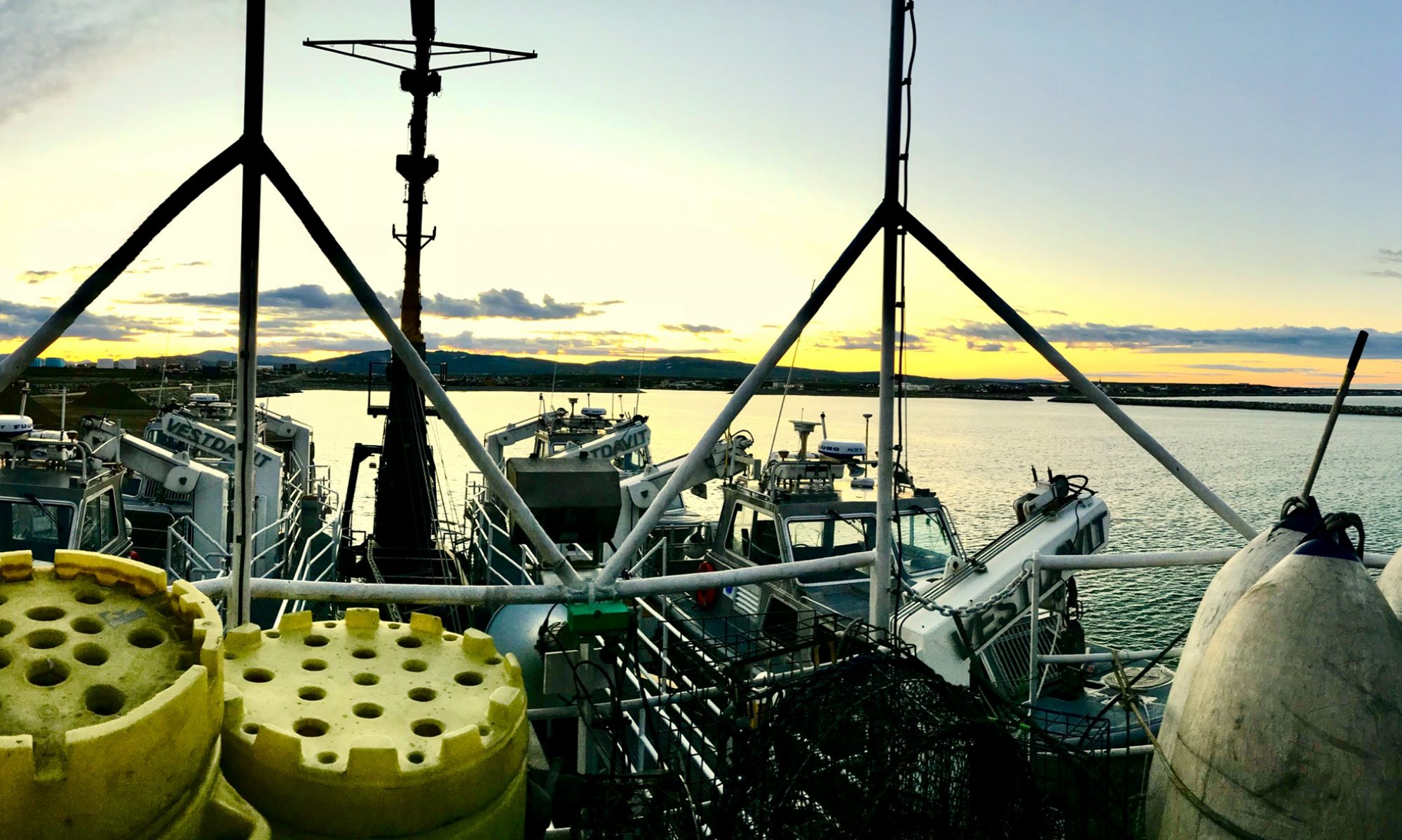
That’s 11:00 – PM!  Almost sunset
That’s 11:00 – PM! Almost sunset

Position
Bering Sea, AK

Weather Data from the Bridge 
Weather System: Nice
Barometer: Steady (falling slightly on the 6th after we were already close enough to Dutch to not feel the unsettled weather.)
Wind: light and variable
Temperature: 8.6º C
Sea State: < 3 feet

Personal Note 

For about half an hour after the photo above, I just sat on E-Deck and watched the sun set. As I write this and look at the picture, I’m sadly realizing that this incredible month is rapidly drawing to a close. While I miss my sons and dog, this has been one of the most rewarding experiences of my life and I wish it could continue.

Science and Technology Log 

Sunset on the Bering Sea

While we were anchored up behind Hagemeister Island near Hagemeister Strait, I learned this island is named after Captain Leonty Andrianovich Gagemeister, a Russian Naval Commander in the early 1800’s. The island is undeveloped and has no permanent residents. It would have been fantastic to take a launch over to it, but there was a lot of work to be done on board the Fairweather. At 1400 hrs on the 4th, Dr. McConnaughey gave a one-hour briefing on the FISHPAC and EFH work his team has been working on. The briefing was voluntary, but as you can see, almost everyone on board was there.

The crew listens to Dr. McConnaughey’s presentation about the FISHPAC research.

Actually, Dr. McConnaughey could have finished in an hour, but the crew had so many questions – really good questions – that the ensuing discussions lasted another hour. Even afterwards, conversations at dinner were reflective of the seminar.  Once again, the collegial atmosphere on board the Fairweather was evident.  It was great to listen to and watch the physical scientists going back and forth with the biology folks in interpreting each others’ results and parameters. At 1000 hours on the 5th, we weighed anchor and got under way.  It took a few hours to get back to where we had ceased survey and sampling operations two days earlier and we picked right up where we left off. The weather was quite nice and we got the remaining samples done in just a couple of hours.

Electronics Technician Mike Hilton

When we had finished that part of the work, there was enough time left on the mission to resurvey some anomalies that had been observed several years ago. The Fairweather had documented several “mud volcanoes” or “mud plumes” in Bristol Bay and the CO wanted to verify their presence. In order to do so, Launch 1018 was deployed for several hours to try to find the anomalies with the Multi-Beam sounder on board, knowing, however, that bottom structures like this are sometimes transient in nature. They were looking for a 3 meter high “cone-shaped” mound, but instead found a depression about two meters deep.  Perhaps the previous party had misinterpreted the side-scan data.  This is the type of ambiguity that calls for continued surveying, research and the development of new technologies.

E.T. Phone Home 
This leg has been a real busy one for Electronics Technician Mike Hilton. When we first arrived in Dutch prior to the leg, he had to go up into the satellite dome and reconfigure some of the internal settings in order to get internet and satellite access for the ship.  We had actually lost that capacity during the rough night on the last day of the Shumagin leg. When we first lost internet (all the computers aboard are connected to a LAN) and folks were a little impatient, there was an announcement on board something like this, “Attention on the Fairweather, for those of you suffering acute internet withdrawal symptoms, the ET recommends you lay to the lounge and take out a couple of books and read them!”  Without Mike, the ship would be severely handicapped.

Andy in the control room

Motorin’ 
During my time on the Fairweather, I was privileged to be given an under way tour of the engine room by Andy Medina (you remember Andy – with that big halibut!)  Fairweather’s main propulsion plant is a pair of General Motors Electro Motive Division 12-567 CLR engines. I realize this sounds long winded, but what the model designation indicates is that the engine (remember, we have 2 mains– port and starboard) has 12 cylinders each of which is 567 cubic inches in size. In comparison, a 2009 Mustang has an option for a 282 cubic inch V-8. That means that EACH of Fairweather’s cylinders is about double the size of the whole engine in a new Mustang! Further translation – Fairweather’s main engines have the equivalent of 48 Mustangs of engines!!! They are HUGE!  By the way, the Electro Motive Division is the division of GM that makes engines for Locomotives! 

That’s me next to the port main engine

Fairweather also has two generators, each putting out 330 kilowatts of electricity and an additional diesel engine just for the bow thruster. Also, four more small diesels on the launches and a few outboards for the skiff and we have a pretty complex engineering need.  Not only do they keep the engines running, but they are responsible for heating and cooling, waste water and sewage treatment (there’s a treatment system on board) and making fresh water. To keep all this running smoothly – as our mission is dependent on them all running flawlessly – two engineers stand each watch in a “4 and 8” rotation meaning they work for 4 hours and are off for 8 and we sail with a minimum of 8 members in the engineering department. (This is the standard watch schedule for officers and survey techs also.) There needs to be a member of the engineering department in the control room at all times while we are under way.

When I arrived in the control room for Andy to give me my tour, we could not leave because the other engineer on watch was on a short break and he was not permitted to leave the control room.  After we chatted for 3 or 4 minutes, Mitchell came down and we went through the engine department.  It took about half an hour and my eyes glazed over after only the first few minutes!  There is SO MUCH stuff going on in there that it’s amazing the guys can keep track of it all.

Personal Log 

As we headed back towards Dutch Harbor, I was again treated to a “whale show.”  I wish there had been someone on E-Deck with me to take pictures because although I had both my still and video cameras, I could only use one at a time.  In any event, I shot almost an hour of video and hope I got some good footage.  I think I may have even gotten a breach!  If so I’ll post it on my blog or perhaps NOAA will allow me one extra post as an “epilogue.”

I may be smiling on the outside . . .

Mary Patterson, June 28, 2009

NOAA Teacher at Sea
Mary Patterson
Onboard NOAA Vessel Rainier 
June 15 – July 2, 2009 

Mission: Hydrographic Survey
Geographical area of cruise: Pavlov Islands, AK
Date: June 28, 2009

Weather Data from the Bridge 
Few clouds
Wind 10 kts
10 mi visibility
Pressure 1024 mb
Dry Bulb Temp 8.3˚ C, 47˚f Wet bulb 6.7˚ C, 44˚f
Seas 0-1 ft.
Water temp 7.8˚C

Science and Technology Log 

One of two main diesel engines

Today, I got to take a tour of the engine room. The first thing I noticed was how amazingly clean the forty-year old engines are kept. This is definitely a crew that takes pride in keeping their ship shipshape! There are two diesel engines. Each engine is about the size of a small car. There are twenty fuel tanks scattered throughout the ship. The Rainier does not carry any extra ballast, so the fuel tanks are often leveled and balanced for ballast. The Rainier can hold up to 107,000 gallons of fuel. Whew! I definitely would not want to pay that fuel bill! The ship can go through 120 gallons of fuel an hour. Oil is recycled using an oily water separator that can hold 1,700 gallons.  

Electrical control panel
Evaporator distiller

The engineering department also maintains the water evaporative distillers. These two evaporators can produce up to 7,000 gallons of freshwater (from saltwater) a day. The saltwater is heated to its boiling point and the evaporating freshwater is then cooled and collected. Normal consumption of freshwater for the ship is 3,500 gallons a day. Everyone tries to take quick showers. Toilets are flushed using saltwater. Faucets on the sink limit water usage by having to be held in the on position. You can’t just let water run from the faucet.  All of the electrical systems for the ship are monitored in the engineering control room. In an emergency, they can even control the steering of the ship.

An incinerator on the ship also takes care of some of the wastes produced. In the mess hall areas, there are labeled bins for recycling plastics, mixed paper and burnables. Those items that are burnable get incinerated while we are out at sea. Not only does the engineering crew take care of the ship’s main engines, they also maintain and troubleshoot the six launch engines as well.

Personal Log 

Electrical control panel

One of the first things I noticed in the engine room was the safety signs and equipment. No one could enter the area without hearing protection and I spotted several eye wash stations like ones we use at school. There were handrails and clear walkways and everything had labels. It’s great to see things we emphasize at school about safety are in the “real world” too.

Thought of the Day 

For this 18 day voyage, how much freshwater was consumed?

Eye wash station
Eye wash station


Jacob Tanenbaum, October 9, 2008

NOAA Teacher at Sea
Jacob Tanenbaum
Onboard NOAA Ship Henry Bigelow
October 5 – 16, 2008

Mission: Survey
Geographic Region: Northeast U.S.
Date: October 9, 2008

DSCN3867-789283Science Log

Hello everyone. I hope you are all enjoying your day off today. Since you have time off from school, I bet many of you are spending time observing these sea creatures…

Can you guess what they all have in common? Post your answers on the blog.

Need a hint? That crab is standing right by a sand dollar. Money. Hmmm.

This angler fish is an interesting character. It sits on the bottom of the water and blends in with its surroundings. It has a small hair that sticks out of its face that is use to lure prey closer to its mouth (just like its cousin from deeper waters, the angler fish). When the prey get close by it strikes. With all of those rows of sharp teeth it makes short work of smaller fish. Can you imagine a fish with a built in fishing rod. Very interesting. We came across a dead whale floating in the open sea. What an amazing sight (and smell). Yuk. Look how big it is next to the ship. The barnacles on its face were the size of baseballs.

A lot of you have asked what my stateroom looks like. Here are Snuggy and Zee in my “rack.” That’s what we call a bed. Do I have a roommate? Yes. Sean is very nice. I’ve only met him once or twice because he sleeps when I work and I sleep when he works, so we don’t run into each other much. That’s often how things work on a ship like this. The second picture is the door to the corridor. The locker to the right is where I keep my gear. The door on the left leads to the “head,” which is what we call the bathroom on a ship.

Many of you asked what the engine room is like. Joe Deltorto, our Chief Engineer, was kind enough to give me a tour. The Bigelow has an interesting engine room. Huge diesel generators make electricity. Lots of it. Enough to power all of our computers, sensors, lights, and even the ship itself. The propeller is turned by large electric motors. This makes the Bigelow one of the most quiet research ships anywhere. Why is that important? Sound is often used to see what is below the surface of the water. Sonars push sound through the water and listen when it echos back. That’s often how boats see what is under them. The Bigelow has a more sophisticated version of this called an echosounder. It can see much more, but still uses sound to see. So the engines have to be super quiet.

Today we will deploy our Drifter Buoy. This is an instrument that we are adopting. It will float in the open sea for the next 14 months or so and tell us where is has gone and what the temperature of the water around it is. Drifters are an important way that scientists measure. Keep watching here. I will update the blog when I deploy the drifter.

~~~~~~~~~~~~~~~~

Here are some answers to your wonderful questions and comments.

Have I gotten sea-sick? No. So far, the water has been very calm. I feel very luck. The ship has hardly moved at all.

Does it smell on board because of all the fish? Surprisingly, no. even the fish labs have lots of fresh ocean air coming through. There is no bad smell. When we came across a rotten whale floating in the ocean, then there was a smell! Oy!

The whales we have seen so far were all humpback. Even the dead one.

Have I seen fish that were new to me. Oh yes. Most of what we have seen has been new to me! That’s what makes these trips so much fun! I love learning new things.

What do I want to see that I have not seen yet? Dolphins.

In answer to so many of your questions, no, I have not fallen in yet. Either has anyone else. The Bigelow is a very safe ship. Everyone is well trained and very concerned for the saftey of themselves and all the others on board. I feel very safe here.

Hello to Ms. Farry and classes in TZE. I’m glad you are looking at the blog.

Hi Turtle. Nice to hear from you. Yes, I think we can work that out. We are on the shelf, so our deepest CTD deployment will be only be about 300 meters. Will that do?

FD and JEGB, thanks for your questions. No, so far we have not seen any 6 pack rings on any creatures. I did see some garbage float by many dozens of miles from shore. It was right where the whales were swimming. Sad.

IJ, cool idea, though I wonder, though if the water would carry toxins from the smoke into the streams rivers and oceans? Keep thinking maybe you will discover a way to solve this problem someday.

Mi Mrs. Bolte’s class. I’ll get you engine room photos very soon, and there is a photo of my stateroom for you today. I’m glad you like the blog.

MS, the people here are friendly, very professional and so helpful with everything I have needed for all my projects.

MH, yes I do miss my family.

MJ, we see lots of ships out here. Yes. It has been fun to see.

Several of you asked about cell phones. They do not work out here. We are way too far from land. All the crew were on deck as we left port making their last calls to their families. So was I.

Hello to Mrs. Ochman’s class, Mrs. De Vissers’s class, Mrs. Sheehy’s and TN’s class. I hope the pictures in the last few days answered lots of your questions.

Mrs. Christie Blick’s class, here are some answers to your questions: No, the clothes just keep you dry (and comfortable) when you are working. You get used to them. I am adjusting well to the time change. It is a little like going to New Zealand like Mrs. Christie-Blick did recently. I wake up at about 8:00 PM, go to work at midnight and then go to sleep in the early afternoon. Our time, that is. If I were in New Zealand, I would be on a normal schedule. I’ll post pictures for your soon for my stateroom. It is very relaxing here. There is not a whole lot to worry about. There is a lot of work, but it is not hard.

The zig in our course, by the way is probably where we stopped for a trawl. We sometimes circle around when we do that.

Hello Mrs. Benson. Thanks for checking out the blog. No artists here at the moment. I enjoy amature photography and what subjects there are out here!

Hello Guy D. Thanks for following the blog. I appreciate your support.