Jojo Chang: Let’s Drink Some Salt Water! July 14, 2025

Jojo poses for a photo at the rail of NOAA Ship Bell M. Shimada. She wears a Teacher at Sea beanie, a long-sleeved Bell M. Shimada shirt, and she flashes a peace sign. In the background, we see the Golden Gate Bridge.

NOAA Teacher at Sea

Jojo Chang

Aboard NOAA Ship  Bell M. Shimada

June 30 – July 15, 2025

Mission: Integrated West Coast Pelagics Survey (Leg 2)

Geographic Area of Cruise: Pacific Ocean, California Coast

Date: July 14, 2025

a group photo of 11 people on the flying bridge of NOAA Ship Bell M. Shimada. we can see the mountains and fog bank in the distance; the water reflects a white, cloudy sky.
Science team group photo
Jojo poses for a photo at the rail of NOAA Ship Bell M. Shimada. She wears a Teacher at Sea beanie, a long-sleeved Bell M. Shimada shirt, and she flashes a peace sign. In the background, we see the Golden Gate Bridge.
Jojo and the Golden Gate Bridge

Weather Data from the Bridge

It is our last full day at sea, and the visibility is minimal.  Currently, the bridge is reporting a temperature of 57.2ยฐF and a wind speed of 19 knots. Our sky condition is OVC, with the entire sky filled with clouds; additionally, there is a lot of fog.  Our OPS officer, Brandon Schleiger, emptied the mess hall of every human soul eating lunch when he reported over the loudspeaker, โ€œThere is a blue whale spotted port side, very closeโ€ฆmaybe about 100 yards.โ€

Blue whale spotted port side of NOAA Ship Bell M. Shimada

Surrounded by Salt Water

The number three is an important one for human survival.  It has been said that humans will die after three minutes without oxygen, three days without water, and three weeks without food.  On the Shimada, both oxygen and food have been plentiful, but the water situation is an interesting story.  For a human stranded at sea, the ocean becomes a desert, and finding freshwater might require some unpleasant alternatives like eating fish eyeballs or drinking turtle bloodโ€”definitely (and thankfully) not on Chef Philโ€™s menu. Drinking salt water is generally a bad idea, as it can lead to further dehydration.

First Assistant Engineer Matt Swanson

On board NOAA Ship Bell M. Shimada, desalination is happening all the timeโ€”like magic, but with a lot more plumbing.  I interviewed Matt Swanson (First Assistant Engineer) about how this salt-to-sip transformation happens.  The ship has two methods for converting salt water into freshwater: flash evaporators and reverse osmosis.  Let’s talk about flash evaporation, which sounds like a superhero skill, but itโ€™s just advanced engineering.   First, there are two types of water involved with this: jacket water and salt water. Jacket water is water thatโ€™s purchased on land.  It is dyed traffic-cone orange and used to cool down the shipโ€™s engines, which get much hotter than an August car seat in Arizona. 

Using saltwater for this function would be a one-way ticket to Rustville for the engineโ€™s metal parts, so itโ€™s 100% jacket water for Shimadaโ€™s engines.  As it circulates through, it absorbs engine heat, becoming hot enough to help boil the nearby saltwaterโ€”but donโ€™t worry, the two waters never actually touch. Theyโ€™re separated by titanium plates like awkward dance partners at a middle school dance. When the steam turns back into water, voila! Shimadaโ€™s got distilled water that can be used for drinking, showering, and flushing toilets.

a blue water bottle placed into a water filling station mounted in the wall; it is being filled with water.
Desalinated water station

Home for me is on the island of Oสปahu.  Here, weโ€™re surrounded by saltwater on all sidesโ€”but surprisingly, we donโ€™t have a way to convert seawater to drinkable water on a large scale. Hopefully, at some point in the future, this situation may change. Improvements in Hawaii happen slowly.  Twenty years ago, a seawater desalination facility was approved by Congress. With a projected cost of $204 million, the Kalaeloa Seawater Desalination Facility is designed to produce 1.7 million gallons of freshwater per day, drawn and desalinated straight from the ocean. Oahu desperately needs this important resource for fresh water, but unfortunately, the project is still awaiting permit approval.

Science: Environmental DNA

the conductivity, temperature, and depth rosette rests on a black plastic mat on deck
The Conductivity, Temperature, and Depth (CTD) rosette includes a ring of water sampling bottles.

Environmental DNA, or eDNA, is natureโ€™s version of leaving fingerprintsโ€”except instead of prints, organisms leave behind tiny traces of genetic material in the water. Fish, mammals, birdsโ€ฆ theyโ€™re all unknowingly contributing to a floating soup of clues. By collecting just a bit of water, scientists can discover the species that have recently passed through, like detectives reading the guest list to an underwater party. 

Why take eDNA samples? NOAA reports that eDNA can identify species and characterize their role in the areaโ€™s food web and ecosystem. Also, it offers a powerful, non-invasive way to monitor marine life without disturbing itโ€”no giant nets, no hake fish hauls mixed in with baby sharks called spiny dogfish. This new technology allows scientists to gather information without bycatch.

Jojo, in a Teacher at Sea beanie, orange coat and overalls, and black gloves, holds up a small shark for a photo. a woman in orange overalls stands next to her, smiling.
Jojo holds a spiny dogfish
Spiny dogfish are sticky! This large haul of hake fish was so stuck together with the dogfish that we had to pull out the fire hose to get them out of the hopper.

Maddy and Sam are eDNA NOAA scientists. According to Sam, there are about 100 specific sampling stations along the U.S. West Coast (excluding Alaska), where water is collected and sampled for ocean species each year. In 2024 alone, the Pacific NOAA team took approximately 2,500 water samples

portrait photo of two women dressed in warm jackets leaning toward one another and smiling for the camera; words superimposed on the image read Sam and Maddy, Environmental DNA
NOAA scientists Sam and Maddy study environmental DNA.

Despite being a non-invasive way to sample species,  there are a few drawbacks to this research method.  According to Maddy, there is no way to currently assess the age or sex of the fish being surveyed through eDNA methods. This limits a scientist’s ability to know the health and future of a species.  As eDNA improves, it may be possible to create a full picture of a fish population.  For now, eDNA and fish trawling surveys are working together to get a better picture of what is happening under the sea.

Visual Art and Music in Seafloor Mapping and Acoustics:

Oceantransect lines

During a โ€œlegโ€ at sea, NOAA scientist Rebecca Thomas (respectfully called โ€œRTโ€ by her science crew) calls herself a โ€œfancy fish finder.โ€  She is not only using sound equipment to locate hake fish underwater, but she is also presenting this information in both visual and musical forms.  

Take her ocean floor maps, for example. Mapping the depths of the ocean floor is a remarkable human accomplishment, and knowledge of these depths is important to Rebeccaโ€™s work. Rebecca even customized the color palette to match her mental map of the seaโ€”deeper water in darker tones, shallower areas in lighter ones. As she puts it, โ€œIt just made more sense.โ€ And it worksโ€”the color gradient helps her instantly read depth and spot the elusive โ€œhake snake,โ€ the long, wriggly trail of fish sheโ€™s after.

photo of a computer screen displaying a bathymetric map of Monterey Bay. the map is color coded by depth, ranging from dark blue or purple at the deepest to white at the shallowest. the map counters reveal Monterey Submarine Canyon.
Bathymetric map of the seafloor in Monterey Bay
photo of a computer screen showing backscatter from acoustic survey
This is an example of what the “hake snake” looks like on the sonar data. The green wavey line represents what the scientists are looking for. When they see this, they will make a decision on deploying the huge nets to fish.

But she didnโ€™t stop there. Rebeccaโ€™s also experimenting with turning sonar data into sound, essentially making music out of marine science. Here she explains a composition she created that includes music for a CTD going down into the ocean, an alarm clock waking her up, and a sunrise.  While itโ€™s not the catchy tune of Alan Menkenโ€™s, Under the Sea, it is a helpful way to form a greater understanding of an elaborate water world that is challenging for us, land animals, to understand.

Rebecca Thomas is explaining the sound and music she’s added to her sonar data.

Animals Seen Today:  Humpback whales, blue whale, Pacific whiteside dolphins,  hookarm squid, chili pepper rockfish, tiny octopus, hake, anchovy, purple striped jellyfish, lamprey, seabugs

If possible, it was important to me to help our tiny creatures stay alive.
This octopus is an example of one of my favorite wet lab buddies.

Personal

Another thingโ€”sleeping on this boat? Itโ€™s pretty great! In Hawaii, I opt for the ocean breeze over air conditioning, but out here, the cabin turns into an arctic tundra every night. So naturally, Iโ€™ve assembled a fortress of five blanketsโ€”a Shimada sea cocoon. Sometimes it feels like Iโ€™m gently swaying on a waterbed. Other times, itโ€™s a full-blown rolling magic carpet ride through the waves. Either way, Iโ€™m snoozing like a champion, beneath a sky full of Pacific fog off the coast of California. 

view of bunk beds (berths) in stateroom. they each have heavy sliding curtains. there is a line of drawers beneath the lower berth.
Stateroom

Works Cited

NOAA Ocean Exploration. โ€œEnvironmental DNA (eDNA).โ€ NOAA Ocean Exploration, 13 Sept. 2022, https://oceanexplorer.noaa.gov/technology/edna/edna.html. Accessed 12 July 2025.

Sinh Nguyen: Larval Bluefin Tuna Watch Continues! July 22, 2025

NOAA Teacher at Sea

Sinh Nguyen

Aboard NOAA Ship Pisces

July 7, 2025 โ€“ July 24, 2025

Mission: Larval Bluefin Tuna Slope Survey

Geographic Area of Cruise: North Atlantic Ocean, Slope Sea

Date: July 23, 2025

Weather Data:

9:14 AM Eastern Time

A view of this morning. The water and breeze are calm. NOAA Ship Pisces is sailing at a speed of 10 knot (just about 12 mph).

The current temperature is 23ยฐC (ยฐ73F). 

The wind speed is 11 knots (13 mph).  Source: Windy app.

map of the area around Newport, Rhode Island, showing a blue dot just south of the port. this map is oriented with East pointing up.
We’re close to Newport, where Pisces will dock! She’ll dock at Naval Station Newport.
A view of Rhode Island.

Science Log

Uplift Education, Mighty Primary scholars: Thereโ€™s been a lot of science work lately!  Last time, I wrote about the four tasks for our science mission. 

Letโ€™s recall: Can you think, share, and then act out these tasks with your parents?

Iโ€™ve just finished another sunset shift (3 PM โ€“ 3 AM watch) so Iโ€™m feeling more tired than usual.  But itโ€™s been exciting sampling bluefin tuna larvae and seeing lots of planktons! Here are some updates on each task:

Sinh sits at a computer desk next to a woman in a blue sweatshirt. Sinh writes in a notebook. Words on top of the image read "Computers for CTD data"

Computers for CTD data

Fun: Watching the computer screens as the CTD instrument goes deep into the ocean felt like playing a video game.

Challenge: Staying focused while recording (writing down) numbers carefully.  Thereโ€™s a lot of data!  This task was the most challenging for me.  It requires understanding CTD data well so all crews know how to control it.

*Note to self:  Donโ€™t forget to hit โ€œsaveโ€ and “backup” buttons!

Learned: Have a sticky note or notepad handy!  Just like taking notes in class, I was always recording numbers on paper and double-checking the numbers.  They can be easy to forget with so much going on. 

a woman sits at a computer, watching the CTD data feed. she holds an intercom in her left hand
It was awesome seeing how conductivity, temperature, and data really can tell us the best conditions to sample larval bluefin tuna.
notebooks are strewn around two computer keyboards at a desk with multiple monitors
Have your notes handy!
view of multiple computer screens needed to display the CTD feed; we see hands writing on a datasheet and holding open a small notebook
This task requires paying close to how temperature, conductivity, and depth interact.
a woman is seated at a computer, surrounded by four more science team members looking on with interest; they are all facing the camera, which is behind the computer monitor.
Data is fun. For me, the CTD is still a but confusing but I’m a lot more confident using it now. I’m still learning more about it, but it was a great time learning from everyone.
The CTD, live in action! Can you try reading and analyzing (studying) these numbers?

crewmembers rinse down bongo nets on the deck of the ship. the sky is mostly clear and the ocean is very blue. words atop the image read: Washing Bongo nets

Washing Bongo nets

Fun: Spraying the nets with the water hose was like a mini water fight.  This is my favorite task.  Once emptied out from the nets, seeing all the planktons caught is super interesting.

Challenge: The nets are heavy when theyโ€™re full of seawater and plankton.  Plankton are also so small, so I was constantly worried about spraying the nets down too hard.  I didnโ€™t want to hurt them, especially when trying to spray down the corners. 

Learned: We wash the nets carefully to make sure we collect every tiny creature for research. 

two crewmembers on deck; a woman in orange overalls holds up the codend of the bongo net resting on deck
The โ€œsprayโ€ function was the best because water wasnโ€™t projected too strongly.
Sinh, wearing orange overalls, stands in front of a rack of life vests, foul weather gear, and hard hats
It’s important to wear protective gear. I had to learn how to put it on and off quickly before this task.
Bongo nets being retrieved. This is a view from the bridge, where NOAA Corps Officers are supporting with ship controls during net pick up and drop off.
Inside the bridge while during this task. Red light is used so that it doesn’t distract your eyes and focus from seeing other lights. It is dark and very quiet inside during night time. NOAA Corps officers explained to me what’s happening inside the bridge during this task.
Sinh, wearing his Teacher at Sea t shirt and orange overalls, poses on deck at night with a sieve full of plankton rinsed out of the nearby bongo net
After they’ve been washed down into trays, it felt great looking at different types of planktons!
Sinh, wearing orange overalls, kneels on deck next to bongo nets resting flat on deck. he smiles for the camera. the ocean is fairly calm and vivid blue.
We had to make sure the deck was clean and clear before the next station, or stop, for deploying the bongo nets,
a woman in a hard hat and life vest kneels on deck at night next to a small plankton net, a sieve, and a drifter.

Drifter Traps

a woman in a hard hat, life vest, and orange overalls poses for a photo with a larval fish trap hanging from a peg on the wall
Scientist Kristen with the drifter traps before their deployment. Do you remember them from one of the earlier posts? Photo credit: Sarah Glancy
A few days into starting our missions, we began deploying them into the waters at night and then recovering them in morning. Photo Credit: Amanda Jacobsen
close up view of a sieve containing larval fish
Some collected samples. Photo credit: Amanda Jacobsen

two women stand in the wet lab at the metal table looking down at sampled larvae

Preserving samples

Fun: Using science tools made me feel like a real marine scientist.

Challenge: Itโ€™s tricky to label each sample correctly and handle them gently. 

Learned: Preserving the samples keeps them safe so scientists can study them later under microscopes.

a woman wearing large orange overalls stands at a metal table in the wet lab, an empty sample jar in her hands.
Plankton samples were stored in bottles filled with ethanol, to help preserve (protect) DNA and genetic properties.
in the wet lab, Dave holds up a sample jar for two other science team members to look at. we see two additional people in the background, facing away from the camera.
We had to be careful to use the right solution when preparing bottles for storage.  We donโ€™t want them preserved in seawater!
close up view of a fish preserved in a glass sample jar
Did you know: Storing planktons in ethanol (a special kind of alcohol) keeps them from rotting. Ethanol acts like a superhero freeze so scientists can study them later. Without it, samples would break down and weโ€™d lose all their important properties. Photo credit: Amanda Jacobson

a man stands at a table in the wet lab, labeling sample vials; words on top read "Identification (ID)"

Identification (ID)

Fun: Looking at different sea creatures under the microscope is like exploring a new world.

Challenge: It takes patience and practice to tell tiny fish and plankton apart.  Even years of practice and studying! 

Learned: Looking into the microscope lenses, it helped to take off my glasses for better focus. 

two science team members look through adjacent microscopes
Observing planktons under a microscope requires close attention to details.
a man looks through a microscope
Dave was excited to have identified bluefin tuna larvae!
Sinh, wearing his Teacher at Sea t shirt, looks through a microscope and uses tweezers to adjust the plankton that he is viewing
Because the ship can get rocky, both my feet and my hands had to be as still as they can be. 
two women look through microscopes at plankton samples
Scientists Kristen and Sarah are trying to stay still while observing samples. Imagine trying to take a picture while youโ€™re rocking back and forth!
Sinh, in his Teacher at Sea t shirt and a backwards baseball cap, holds up a small sample vial and smiles for the camera
Once identified, we made sure samples are ok to be stored.
close-up view of a square cardboard box filled almost completely with small capped sample vials, each with a number handwritten on top. There is a space for one absent vial.
Samples of larval bluefin tuna were stored in these vials, or small sample bottles!

Here are some planktons I saw under the microscope… We will describe and then identify them once we’re back to school!

Activity: Microscope Sample Fun!
We will look at real microscope pictures and become scientists! Students, if you’d like: draw, label, and describe what you see in each photo. Zoom into each photo if possible. Use adjectives to describe color, shape, and texture when talking about each sample. Don’t forget the small details! We will discuss these samples once back to school.


Crew members aboard NOAA Ship Pisces.

It really does take a team to make the โ€œscienceโ€ work. 

at night, three crewmembers wearing life vests lean over the railing. one holds a purple line (rope) attached to buoys and feeds it over the rail.
Even though crew members on NOAA Ship Pisces are in different teams, everything on the ship and throughout this mission requires collaboration, understanding, and patience. 

Can you tell your parents a time when you had to work in a group with different classmates?  What was it like?  Did you get along with everyone?  What happened when you didnโ€™t?  How did everyone work together to get the task done?

These four tasks wouldnโ€™t have been possible without the hard work of these crews: Steward, NOAA Corps, engineer, electronics, survey, and deck.

Personal Log

My days at sea are long, just like a school day might be for you.  Once I finish my shifts at 3 AM, Iโ€™ve been going to straight to my stateroom for a shower and then bedtime.  Because my roommate wakes up at 4 AM for his ship work, I must stay quiet, just like you would at home sharing a room with a brother or sister.

Iโ€™ve been waking up at 11 AM, just in time to get ready and then eat lunch.  Until 3 PM, I have time to take care of my personal needs.

view of exercise equipment in the workout room
Staying active while sailing is important! Thereโ€™s fitness equipment for exercising.  Rooms are available throughout the day and night for crew members to use.  Because theyโ€™re small spaces, we try to keep them clean, tidy, and to a small number of people.
treadmill
Running on the treadmill feels like doing the wobble line dance! You have to remain balanced with the shop rocking back and forth.
stacked washing machines in the laundry room
Fishery work can get messy. I’ve been able to do laundry during free time every few days.
two men pose for a photo near an open locker full of t-shirts. the man on the right wears a NOAA Corps uniform and a radio.
Pictured: Survey Technician Ian and Ensign Cheney,. There were times when I ran out of clean shirts to wear after a watch. But, no problem! There’s a store in the lounge area with shirts, sweaters, and hats that can be purchased. They have awesome NOAA Ship Pisces designs on them. Buying them supports crew members through awesome events and activities.

NOAA Ship Pisces online store
If you’re interested in seeing or buying, here is the store link: https://stores.inksoft.com/NOAAShipPisces

photo of a printed page displayed on a wall; as seen in red lighting for some reason. the page is titled "Your Healthiest Self: Emotional Wellness Checklist"
It’s also important to take care of our overall health, just like we do throughout the school day with brain breaks or with visits to the nurse. There’s a medical room I’ve been going to for medicine, including pills for seasickness or body pain. I’ve also been reminded of ways to keep both my body and mind healthy. These reminders are posted all over NOAA Ship Pisces because when you’re away from family and friends, it can feel difficult.

photo of Sinh, wearing his Teacher at Sea t shirt, posing near the railing on the flying bridge of NOAA Ship Pisces

To learn more about crew members and what they do, there was time to tour different parts of NOAA Ship Pisces

view inside the bridge. a woman sits, arms folded, at a desk with papers and a radio intercom. a pillar on the wall is painted with four nautical flags and NOAA Ship Pisces' hull number: R-226. Beyond, we can see the windows that line the front of the bridge, and the control panels.
Autumn and I were taking photos outside when we decided to go into the bridge and learn more about its operations.


We also learned that the engines of a ship are equally as important.

a photo collage of the engineering department, with each photo individually pinned to a bulletin board. a nautical map covers the bulletin board as a background. there are 8 photos, labeled: ACMB Butters, Second Assistant Engineer Drew Barth, Fountain, 2AE Bill Bierwirth, Electrical Engineering Technician Glen "Sparky" Burton, Lewis, Karla, Junior Engineer Travis Martin.
The engineer crew.

Below was a tour of important engines needed for the ship to sail safely.  The machines were incredible!  It was amazing to see how hard the engineering team works to make sure the mission was possible for us. 

It got loud and hot in the engine room! We had to wear earplugs to protect our ears.
Sinh, wearing his Teacher at Sea t shirt, poses for a photo in front of the engines and flashes a shaka sign
It was fascinating to learn so much about ship engines. These engines help the ship move through the ocean, just like your legs help you walk. They burn fuel to make power, turning giant propellers under the water to push the ship forward.

Next up was a tour of the Acoustic Room. Inside, scientists and technicians use sound waves (through special computers and instruments) to hear all sorts of sounds underwater. These sounds help them find the ocean floor, see how deep the water is, and spot sea animals.

Sinh and Ian stand on either side of the CTD rosette on deck, hands extended as if presenting it
In our mission, we collaborated with an awesome survey technician, Ian!
Ian makes sure our machines, especially CTD, works correctly and safely. He can help fix them if goes wrong.

With Ian, I also learned about special tools used to map the ocean floor. This is called hydrography. Itโ€™s like making a giant map of whatโ€™s under the sea! Here’s a tour the Acoustic Lab.

Disco ball with red and green lights
There’s even a disco ball there!

Of course, we can’t forget our electronics technician, Alex!

Now, itโ€™s your turn to be scientistsโ€ฆ

Uplift Education, Mighty K-12 students: My time on seaโ€™s coming to an end. Iโ€™m returning soon to Texas, so this isnโ€™t goodbye…

View of ocean and blue sky from ship

Itโ€™s a โ€œSEAโ€ you later! 

Howeverโ€ฆ I now pass this adventure to you:

Reflection questions for you:

What do you think would happen if we didnโ€™t collect ocean data using tools like the CTD?

Why do you think itโ€™s important to study larval bluefin tuna?

Even if scientists complete this mission, what do you think you could discover or protect when you become a scientist one day?

Science crew aboard ship
The amazing science crew! They look forward to seeing you at sea and working with you, future Mighty scientists!
Man wearing glasses, a NOAA Teacher at Sea t shirt, and backwards yellow baseball hat, stands on the ship with his hand on the ledge looking out to the ocean, with blue sky in the background

The text overlay says "As I'm about to sail back...I can't help but wonder...could one of you be the next ocean explorer?"

As Iโ€™m about to sail backโ€ฆ I canโ€™t help but wonderโ€ฆ could one of you be the next ocean explorer?

To family, friends, community, NOAA Ship Pisces crew members, readers, and supporters of NOAAโ€™s work & cause:  Once back in Texas, I look forward to sharing my experiences with you in an upcoming conclusion post.  Please stay tuned!

Jenny Gapp: โ€œLhuk xaa-ghii-laโ€ (I found a fish), August 1, 2023

NOAA Teacher at Sea

Jenny Gapp (she/her)

Aboard NOAA Ship Bell M. Shimada

July 23, 2023 – August 5, 2023

Mission: Pacific hake (Merluccius productus) Survey (Leg 3 of 5)
Geographic Area of Cruise: Pacific Ocean off the Northern California Coast working north back toward coastal waters off Oregon.
Date: Tuesday, August 1, 2023

Weather Data from the Bridge
Sunrise 0613 | Sunset 2034
Current Time:  0900 (9:00 am Pacific Daylight Time)
Lat  42 32.8 N, Lon 125 00.9 W
Visibility: <1 nm (nautical miles)
Sky condition: Overcast
Present weather: Fog
Wind Speed:  15 knots
Wind Direction: 350ยฐ
Barometer: 1017.9 mb
Sea Wave height: 2 ft | Swell: 340ยฐ, 3 ft
Sea temp: 16.6ยฐC | Air Temp: 16ยฐC
Course Over Ground (COG): 090.2ยฐ
Speed Over Ground (SOG): 9.9 knots

Science and Technology Log

Second Engineer Justin Halle provided a tour yesterday of the engine room and associated machinery kept running smoothly by the Engineering Department. Four Caterpillar brand diesel engines use about 1,800 gallons of fuel per day, although that number fluctuates depending on operations and weather. There are multiple fuel tanks in reserve that hold 5 – 15,000 gallons. A fuel manifold regulates fluid intake and a camera is fixed on fuel levels so the engineers can monitor them. Two valves per tank allow for filling or suction. Water evaporators separate sludge and water to keep fuel clean and bacteria free. We also looked up the exhaust shaft which vents out the top of the ship above the level of the flying bridge. 

We viewed the propellor shaft that drives the main propulsion of the ship. A secondary means of propulsion is the bow thruster, but it is primarily used in close quarters situations such as docking and undocking. We did not view the bow thruster on our tour. 

Thereโ€™s a whole water treatment system. The sewage part has a macerator that blends up, er, things just like the Ninja blender in your kitchen. Treated wastewater is vented to the ocean every few days, but cannot be pumped within three miles offshore or within marine sanctuaries. We consume approximately 1,400 gallons of water per day, and the ship can make potable water from seawater through reverse osmosis, evaporators, and water brought aboard from port. Water is treated with bromine, which is often used as an alternative to chlorine in swimming pools.

Workbenches and tools are kept tidy, with some tools and parts kept in a veritable library of large metal cabinets. An impressive control panel allows the engineers to look at the status of various systems at a glance. Performance logic controllers enable engineers to turn things on or off in the engine room from the control panel. Additional screens show a camera feed of potable water levels, the propulsion system, and the fire pump (only accessible down a hatch in the bow thruster space), which are all prone to flooding. 
Additional specifications for NOAA Ship Bell M. Shimada can be viewed here

Career feature

Matt, wearing sunglasses and an orange apron, stands at a cutting board mounted on deck near a railing; we can see whitecap waves just beyond the cutting board. He wears a glove on his left hand and holds a fish steady, cutting with his right to fillet the fish. To his right is a pile of filets. He appears engrossed in his work.
Matt fillets rockfish caught in the bycatch for a special lunchtime treat.

Matt McFarland, Chief Bosun

Give us a brief job description of what you do on NOAA Ship Bell M. Shimada.

We do a lot of fishing operations and I run all the gear. I run the nets and the winches. I put the nets out wherever the scientists are seeing the fish and weโ€™ll go down to that depth. Iโ€™m responsible for the efficiency of the operation and safety of the six deck hands I have underneath me.

Note: Matt is also a โ€œplank ownerโ€ meaning he was a member of the shipโ€™s crew prior to the vessel being placed in commission. So, he has been with the Shimada before it was owned by NOAA and still belonged to the shipyard. The ship was built in Moss Point, Mississippi and Matt was a part of the crew when it was taken through the Panama Canal to serve in research operations on the West Coast.

Whatโ€™s your educational background?

I grew up commercial fishing.  After high school I went to a technical college for marine technology. So I can work at marinas, on boats and motors and this and that. After school I went back to commercial fishing for a while along with carpentry to supplement. Then about 2008 I decided I wanted to be a professional mariner and get my U.S. Coast Guard license. From there I found out about NOAA, joined in 2009 and have been here ever since. The Coast Guard license is about a three-week course; they teach you basic seamanship.  In order to be in my position out on the ocean you need an AB, meaning able bodied seaman. The Ordinary Seaman (OS) is entry-level and I worked my way up over the years. So on the fishing boats we have different levels: general vessel assistant (OS), fisherman (the equivalent of an AB), the next step is skilled fisherman, then lead fisherman, then Chief Bosun is the leader of the Deck Department.

What do you enjoy most about your work?

I enjoy the ocean. I love being out here. Growing up in commercial fishing, you work really hard and thereโ€™s no guarantee youโ€™re going to get paid: if you donโ€™t catch fish you donโ€™t get a paycheck. So being here with NOAA means I get to continue to do what I love and if we donโ€™t catch fish I still get paid. Itโ€™s a secure job. I have a passion for getting the science right and making sure things are getting done the way they should be done. Weโ€™re making regulations for the commercial industry and if our science is faulty, if we arenโ€™t being efficient, then thatโ€™s not fair to them. I have family in commercial fishing, so itโ€™s important to me. A lot of these guys are new to sailing and have never fished, so Iโ€™m passing on that knowledge. This isnโ€™t as grueling as commercial fishing. Itโ€™s important to me to keep the industry going and get the science right. 

What advice do you have for a young person interested in ocean-related careers?

Start with small trips. Make sure you like it. Itโ€™s not always beautiful out here. Some days there are rough seas, some people get sick, and for some people itโ€™s just not for them. I would encourage youth to pursue it though. Itโ€™s a good way to get away from the newsโ€“youโ€™re in your own little world out here. Itโ€™s a nice alternative lifestyle. 

Do you have a favorite book?

Iโ€™d say Captains Courageous, by Rudyard Kipling. The 1937 film version was actually done in my hometown of Gloucester, Massachusetts. Gloucester is the oldest commercial fishing seaport in the United States. (The link will take you to some oral histories of Gloucester residents.)

Laura, wearing a navy blue NOAA Corps uniform, stands at a map table on the bridge. She holds a protractor in her right hand and looks down at a nautical chart spread out across the table.
XO Gibson considers a route using the nautical charts.

Laura Gibson, XO

Give us a brief job description of what you do on NOAA Ship Bell M. Shimada.

My job is the administrative side of the ship which includes staffing, budget, and spending a lot of time at my desk.

Whatโ€™s your educational background?

I went to college in Myrtle Beach, South Carolina. I have a Bachelorโ€™s in Science with a Geology focus.

What do you enjoy most about your work?

I enjoy the camaraderie of the crew. Sometimes weโ€™ll play games. I have a good time and feel like Iโ€™m doing a fine job when they are having a good time. 

What advice do you have for a young person interested in ocean-related careers?

If youโ€™re not opposed to sailing, check it out; thereโ€™s a high demand. Itโ€™s not the easiest lifestyle for everyone. You could be very successful at a young age in a maritime career. Thereโ€™s a clear path forward. I was a merchant mariner before sailing with NOAA. They call it coming up the hawse pipe when you learn on deck how a ship works. I didnโ€™t go to an academy but learned on the job. I accepted a commission with NOAA as a junior officer and started on NOAA Ship Pisces in Mississippi 14 years ago. While on the Pisces I helped with the cleanup of the Deepwater Horizon oil rig disaster. I was proud to be a part of the fleet of vessels that supported the aftermath of that event.  

Do you have a favorite book?

The Gunslinger or Misery, by Steven King. Iโ€™m a King fan. 

Taxonomy of Sights

Apparently there are more marine mammal sightings in Southern California and fewer as you head north. However, there have been whale spouts sighted every day. Our Chief Scientist says the humpback sightings pick up near Vancouver Island and waters northโ€“although Leg 3 doesnโ€™t extend that far..

Day 8. Bycatch highlights: splitnose rockfish, a 43-lb squid, the egg case of a skate, and a single lamprey. In the evening: whale spouts from the flying deck, and an aerial show from a brown booby (a seabird not normally seen this far north; it may have been a sub-species called Brewsterโ€™s brown booby) attempting to land on the jack staff and then on the bowโ€“with limited success in a 24 knot wind
Day 9. Saw Humpback flukes as they dove.
Day 10. Beautiful shades of ocean blueโ€ฆ

a brown bird in flight over the water; it has a white face and a narrow bill
Brewster’s brown booby
photo taken by Nick, OSU Marine Mammal & Bird Observer

You Might Be Wonderingโ€ฆ

Howโ€™s the food?

I am told our Chief Steward, Ronnie Pimentel, is one of the best in the NOAA fleet.
Ronnie and Rich Lynch (Second Cook) tirelessly serve up breakfast, lunch and dinner every day. Creamy breakfast grits, blueberry pancakes, pulled pork sandwiches, soups, peanut butter cookies, lamb chops, taco Tuesdays, pizza night, yuuuum. Ronnie has been with NOAA for a year, and prior to that served the Navy 21 years as a Steward. Ronnie spends about $15,000 a month on food, which varies depending on the length of the voyage. Food is stored in two freezers (one large, one small) and two chill boxes (one large, one small). He typically uses about 300lbs of frozen vegetables, and has about one case of each type of food, like one of apples, one of bananas, etc. Depending on the size and tastes of the crew heโ€™ll pack 60lbs of bacon, and various cakes for tempting treats.  

plated meal of some sort of meat, fish topped with lemon slices, oyster, rice
tasty dinner
plated meal of scrambled eggs with ham, cut fruit, and probably French toast
tasty breakfast

Floating Facts

NOAA Corps is the eighth uniformed service in the United States, although it is not an armed forceโ€”Army, Navy, Air Force, Marines, Coast Guard, Space Forceโ€”and falls under the Department of Commerce, not the Department of Defense (DOD). Interestingly, the U.S. Coast Guard is not under the DOD either, but acts as a military branch and federal law enforcement agency within the Department of Homeland Security. The Public Health Service is the other unarmed, but uniformed service. 

NOAA Corps has the same benefits and rank system as the military. Currently NOAA Corps has three admirals. Read more about one of the admirals here. Officers are โ€œactive dutyโ€ meaning they have full-time employment and may be directed to go where they are needed. The term โ€œbilletโ€ refers to the current job in which an officer is placed. Members of the Corps do a rotation of two years at sea and three years on land. 

Personal Log

I have clean clothes! While using the washer and dryer machines on Sunday I saw why cleaning the lint traps is taken so seriously.

A photo of a laminated image of a container ship on fire, with this message printed on top of the image: July 27, 1996 - Fire aboard cruise ship Universe Explorer, Pacific Ocean off Alaska. Estimated damage to vessel: $1.5 million, serious/minor injuries: 56, deaths: 5. Location of Fire: Main Laundry Room. July 20, 1998 - Fire aboard M/S Ecstasy off Miami, Florida. Onboard: 2516 passengers and 916 crew. Estimated damage: $17 million. Location of fire: Laundry room. Feb 26, 2008 - Fire aboardย F/V Pacific Glacier of Glacier Fish Company, Bering Sea. Firefighters: 16. Lifeboats deployed: all of them. Fire burn time: 6:30 pm to 11:30 pm local time (that's FIVE hours of fighting a fire!). Location of Fire: Forward Laundry Room. The leading cause of fire on a boat is dirty lint traps in dryers. Don't be the chump who gets caught with clothes in the dryer when the lint trap catches on fire. Clean out the lint trap BEFORE AND AFTER you use the dryer. Clean the lint trap, save lives. Go on, be a hero.
Clean the lint trap, save lives
three columns of dryers stacked on washing machines in the laundry room
Washing machines and dryers

Humor is the best medicine, and a great way to reckon with being cooped up on a ship for two weeks with 33 people. While reading through some posted protocols in the acoustics lab I came across this gem in the last row of โ€œShimada Sonar Frequencies.โ€

A printed table of sonar frequency protocols, affixed to a metal surface (perhaps a cabinet) by a magnet that reads: Do Not Disturb, Already disturbed. The table has columns labeled: Sounder, Freq, Purpose, Mounting Location, Beam Angle (Degrees), Power (Watts.) Most of the entries read something like: Sounder - EX-60, Freq - 18 khz, Purpose - Quantitative Biomass Survey, Mounting Location - Center Board, Beam Angle - 11 degrees, Power - 2000 watts. The last entry reads: Sounder - ST Screaming, Freq - 30-21000 Hz, Purpose - Catharsis, Mounting Location - Entire Ship, Beam Angle - 180 degrees, Power - situation dependent.
Shimada Sonar Frequencies

Another bit of humor comes from the bridge, where there used to be eight camera buttons. For the record, there are NO torpedo tubes aboard NOAA Ship Bell M. Shimada.

photo of a computer monitor on the bridge. above the screen is a row of eight square buttons, numbered 1-8. above those buttons is a label, from a label maker, reading FIRE TORPEDO
Repurposed camera buttons

I am attempting to collect permissible items from the catch, such as hake young-of-the-year, to take back to my classroom and incorporate in lessons for students. In doing so, Iโ€™m getting a crash course in properly preparing wet specimens. My first lesson was that freezing is the best route until items can be processed. This site was helpful to me in figuring out what additional tools I needed to do it properly. While I brought several glass vials for collecting, I did not bring formalin, isopropyl alcohol, or needles. So, for the duration of the research cruise my specimens are in the freezer. I live close to my port of return and so have a personal vehicle to transport items home. For future Teachers at Sea: If you are flying, there are limits in checked baggage. There are also strict rules for shipping. Start your research about shipping hazardous fluids here with FedEx, or here in a publication from Oregon State University.

Librarian at Sea

Librarians specialize in acquiring, organizing, and disseminating information for their target populations. The NOAA Central Library provides access to seminars, journals, NOAA publications, and daily weather maps to name a few. Then thereโ€™s NOAAโ€™s Photo Library, which has over 80,000 searchable images in its online database. If you type in โ€œhakeโ€ there are 114 results. I anticipate incorporating both databases into future lessons for my students. 

Jenny, in full wet gear - overalls, boots, jacket, gloves - lies on her back on the floor of the wet lab next to a squid longer than she is. The squid is definitely not contemplating life.
A squid and I contemplate life in the Wet Lab.
view of the front half of a lamprey on a metal surface.
Lamprey
a shark swimming in calm waters. only its dorsal fin just barely breaks the surface and leaves a small wave.  we can see the outline the shark's body underwater.
Porbeagle shark photo taken by Nick, OSU Marine Mammal & Bird Observer

Hook, Line and Thinker

The title of todayโ€™s post comes from Siletz Nee-Di, an endangered language spoken by some of Oregonโ€™s First People. In 1977, The Confederated Tribes of Siletz were second in the nation and first in Oregon to regain federal recognition. What is now Newport, Oregon was originally home to villages and family groups of the confederationโ€”whose descendants still live in the area.

NOAA Fisheries includes tribal, indigenous, and underserved communities in their strategic priorities for 2023. (See strategy 1.5 in the document available here.) Oregonโ€™s Senate Bill 13 (Tribal History/Shared History) directs educators to include curriculum about contemporary indigenous communities. I am interested in knowing more how NOAA Fisheries partners with local stakeholders in Oregon. 

If access to your familyโ€™s traditional fishing groundsโ€”a primary source of food and revenueโ€”were suddenly cut off, what would you do to regain entry to those waters?

Read about a Washington state tribal leader who fought for fishing rights and will soon have a U.S. Navy ship named after him. 

quote superimposed on a photo of Pyramid Lake: "What's good for the fish is what's good for the people." Attributed to Norm Harry, Former Chairman of the Pyramid Lake Paiute Tribe.
“What’s good for the fish is what’s good for the people.”
Map of the Confederated Tribes of Siletz Indians Ancestral Tribes and Homelands, extending from the Pacific Ocean to the Cascade Mountains, and from the Columbia River south a bit past the Oregon/California border
Map of Ancestral Tribal Homelands along the Oregon Coast
flag of the confederated tribes of Siletz Indians: mostly white, with a circle in the center that contains images of a mountain, a stream, a salmon
Flag of the Confederated Tribes of Siletz Indians

A Bobbing Bibliography
Favorite books among the science crew:

Nick – The Earthsea Saga, by Ursula K. LeGuin
Ethan – The Snowball: Warren Buffett and the Business of Life, by Alice Schroeder
Liz – A Sand County Almanac, by Aldo Leopold
Jake – In the Name of the Wind, by Patrick Rothfuss
Sam – Where the Crawdads Sing, by Delia Owens

sunset over the ocean: a narrow band of red sky between glassy gray ocean and billowing gray clouds
Sunset meditation.

Elli Simonen: Geology, Engineering and Mapping, July 19, 2023

NOAA Teacher at Sea

Elli Simonen (she/her)

Aboard NOAA Ship Fairweather

July 10, 2023 – July 28, 2023

Mission:  Hydrographic Survey of the Pribilof Islands 

Geographic Area of Cruise: Pribilof Islands, Alaska

Date: July 19, 2023
Weather DataLocation: 57ยฐ11.82โ€™N, 170ยฐ27.52โ€™W

Outside temperature: 13ยฐC

Water temperature: 11ยฐC

True Winds: Direction 242.4ยฐ, 13.7 kn

Skies: Overcast and Foggy

Visibility: 2 nm

Sea Wave: 2 ft

Swell Wave:  Direction 240ยฐ, 4 feet height

Science and Technology Log

We have arrived at the Pribilof Islands after being en route from Kodiak for 3 days.  We are currently surveying.

Geology of the Aleutian Islands

The Aleutian islands stretch from North America into the Pacific and contain 40 active volcanoes.  This string of islands is where the Pacific Plate sinks under the North American Plate causing some of the largest earthquakes of the last 100 years.  NOAA Ship Fairweather often receives alerts about Volcanic Eruptions including information about ash in the water when sailing around the Aleutian Islands.


On July 15th at 10:48 pm, at a depth of 13 miles, a 7.2 magnitude earthquake struck just south of the Aleutian Peninsula, triggering a tsunami watch and then warning.  NOAA Ship Fairweather was in the direct vicinity, but did not feel a noticeable shake. Luckily the tsunami watch and warning were canceled shortly after, and the earthquake did not cause significant wave heights.  Investigation of observed water levels at the Sand Point, AK tide station showed some variability when compared to the tide predictions.

a photo of a graph displayed on a computer screen. The graph is titled NOAA/NOS/CO-OPS Observed Water Levels at 9459450, Sand Point AK from 2023/07/15 12:00 LST_LDT to 2023/07/16 23:59 LST_LDT. We can see that the x-axis displays time - starting at 18:00 hours on July 15, with grid marks every 3 hours until 09:00 hours on July 16. the y-axis is out of view. A dotted blue line labeled "predictions" rises smoothly to a high point around 01:30 on July 16, and then dips again. A solid red line, labeled "water levels," mostly tracks the "predictions" line but is visibly wobbly around midnight on on July 16.

Observed water levels the night of the earthquake and tsunami warning.

Video showing the Bow of NOAA Ship Fairweather sailing just south of the Aleutian Peninsula

Engineering On Board

The engineering team on NOAA Ship Fairweather consists of 8 engineers.  They are in charge of maintaining the engine, all power and water on board.  They typically work in 4-8 hour shifts, 24-hours per day, to ensure everything is running smoothly.  The shipโ€™s two main engines power shafts that are connected to controllable pitch propellers.  To move a boat forward, both the pitch of the propellers and Revolutions Per Minute (RPM) are adjusted.  Pitch is the angle of the propeller blades and RPM is how many times the propellers rotate per minute. 

The engine room also supplies clean potable water for the entire ship.  Through the process of reverse osmosis, sea water is compressed in cylinders and salt is filtered out.  The water then goes through multi-stage and UV filters to ensure safe sanitation. 

Power is supplied by three generators and one emergency generator.  These generators power all electric, navigational and satellite receiver systems.

an engine in the engine room

One of the Engines

a tank, pipes of different sizes, a control panel

Reverse Osmosis Unit, used to make potable water from seawater

Elli, wearing her Teacher at Sea hat, stands in front of a large floor-to-ceiling control panel. Behind her there is a closed door with a yellow sign cautioning people to wear ear protection beyond that point.

TAS Elli Simonen in the Engine Room

Surveying with NOAA Ship Fairweather

We have been surveying at the Pribilof Islands for the last 1-2 days.  We are surveying using the ship and the team is on a 24 hour rotation.  The survey area is divided up into polygons, or smaller areas, of which we completely cover one at a time.  The ship drives back and forth in overlapping lines over the designated polygon.  In addition to the MBES data, we gather both backscatter and water column data as well.

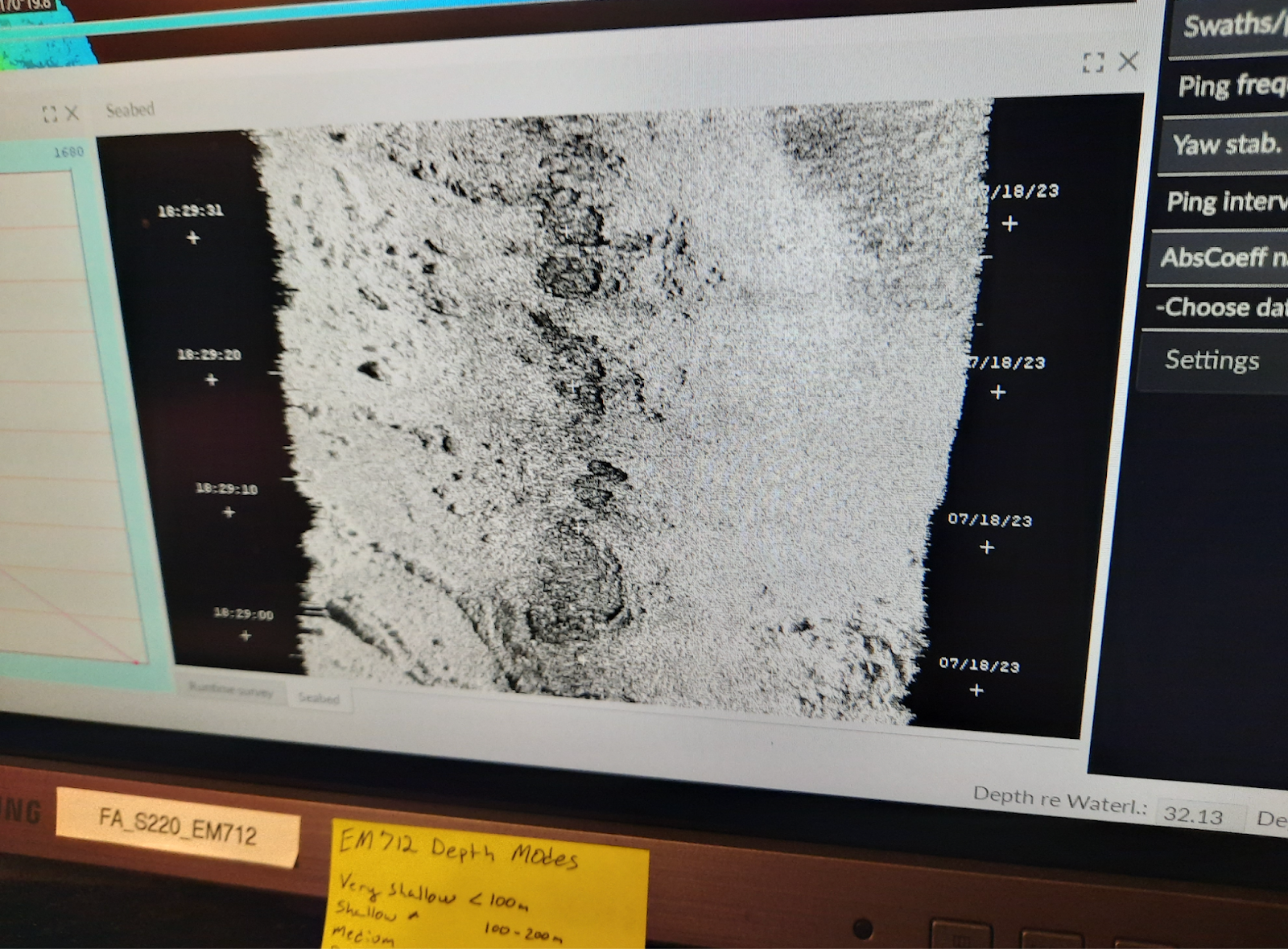
Backscatter is a visual representation of the surface of the seafloor.  Backscatter provides information about the intensity of the returned echos, from which the โ€œhardnessโ€ of the bottom as well as other characteristics can be used to differentiate between different types of seafloor composition.  Darker colors represent harder surfaces such as rocks and hard coral and lighter colors represent softer surfaces such as sand and mud.  This information is important for ships to know for anchoring purposes, as well as benthic habitat characteristics.

The water column data shows us what is under the ship throughout the water columnโ€“ from the surface of the water to the seafloor.  It detects bubbles, objects protruding from the seafloor, fish, or even a whale or a seal.

a triangular swath of echosounder data in different colors (red, green, blue) indicating the intensity of the returned echoes

Water column Data

photo of a computer screen displaying seafloor bathymetry (in black and white) from backscatter

Backscatter showing a representation of the seafloor

Finnegan and Elli sit in desk chairs in front of an array of computer monitors. There's a bookshelf filled with binders, an electrical box mounted to the wall, papers clipped to another wall. Finnegan and Elli are both wearing navy-colored NOAA logo-ed apparel.

TAS Elli Simonen with Survey Technician Finnegan Sougioultzoglou

Personal Log

Safety and Routine Checks

Before coming on board, I did not realize all the preemptive safety measures that need to be taken to ensure the health and safety of everyone on board.  The staff and crew need to be self-sustaining on all accounts; another person, equipment or supplies cannot be added mid-sail.  There are cooks onboard as well as medical staff.  There are 3 drills and situations that the entire crew participates in, including myself โ€“ Fire, Mariner Overboard and Abandon Ship.  You need to know the pattern of alarms for each, as well as where to go and what to do.  For example, for Mariner Overboard I go to the fantail of the ship, with others, and point at the person in the water until a small boat can go out and rescue them.  Each one of these drills is practiced periodically. Additionally there are two sets of rounds every hour, 24 hours a day โ€“ a deck round and engine rounds.  Deck rounds check all public spaces for anything abnormal.  Engine rounds check the engine room to see if everything is working properly.  Every week, refrigerators are checked for correct temperatures and water is checked for potential bacteria.

New Terms/Phrases

Iโ€™ve learned several acronyms and initials since I have been on board NOAA Ship Fairweather.  Sometimes I feel two consecutive sentences cannot be said without some type of abbreviation.  These are some that have become part of my vocabulary: 

  • HIC: Hydrographer in Charge
  • POD: Plan of the Day
  • SOP: Standard Operating Procedure
  • NM: Nautical Miles
  • CO: Commanding Officer

Maronda Hastie: Depart Cape Canaveral & Student Interviews, August 31, 2022

NOAA Teacher at Sea

Maronda Hastie

Aboard NOAA Ship Oregon II

August 28 โ€“ September 14, 2022

Date: Wednesday, August 31 – Thursday, September 12, 2022

Mission: Shark/Red Snapper Bottom Longline Survey

Geographic Area of Cruise: Gulf of Mexico

Weather Data:

Lows/Highs = 75 degrees โ€“ 90 degrees Fahrenheit
Wave Height = 1โ€™6โ€ณ โ€“ 1โ€™8โ€ณ Northeast
Wind Speed = 6.2 mph
Humidity = 77%
Barometric Pressure = 29.97โ€ณ HG
Sky = Partly Cloudy & Scattered Showers

  • A collage of three photos: at left, a close-up of the captured wahoo on deck, its mouth open to reveal tiny, sharp teeth. At right, two photos of fisherman Josh Cooper standing on deck, holding the captured wahoo at different angles. The fish appears to be about 4 feet long.
  • Jade poses for a photo on the deck of the ship wearing an orange survival suit that covers her head to foot. An empty orange storage bag lies unzipped near her feet. In the background, another crewmember bends to remove or return his survival suit to its storage bag.
  • Maronda, wearing a Teacher at Sea hat, pauses halfway through donning an orange survival suit to hold her gloved right hand up for a photo.
  • Maronda, wearing her Teacher at Sea hat and shirt, stands with Jade on the back deck of NOAA Ship Oregon II. It's a bright day with blue skies, white clouds, and fairly calm seas. In the background we can see a longline with gangions (hooks), a bucket, and a Yeti cooler.
  • Maronda, wearing her Teacher at Sea hat and shirt, sits next to biologist Jim Patterson in an interior room of the ship. They both look at something (presumably a computer screen) out of frame. On the wall behind them are framed photos and a plaque about NOAA Ship Oregon II.
  • Maronda, wearing her Teacher at Sea hat and shirt, sits next to researcher Heather Moncrief-Cox in an interior room of the ship. They both look at something (presumably a computer screen) out of frame. Heather, mid-sentence, gestures with her hands near her face. On the wall behind them are framed photos and a plaque about NOAA Ship Oregon II, plus a ship's bell mounted on a wooden background.
  • View of the sunset over the water; the wake of the ship is visible in the foreground
  • Maronda stands with her arms on the taffrail in front of a sunset over the ocean. Backlit from the sunset, we can only just make out her smile. The bright blue and white NOAA Teacher at Sea logo on her navy-colored t-shirt stands out.

Now that we have departed Cape Canaveral, I’m enjoying the Florida coastline! It didn’t take long for Fisherman Josh Cooper to catch a Wahoo. He must have read my mind about plans for dinner.

Science Log

On Wednesday, August 31, 2022, NOAA Ship Oregon II departed Cape Canaveral and started a path along the Florida coastline headed to the Gulf of Mexico. All of us took another Covid-19 test before departure to keep everyone safe. We had to wait for 17,000 gallons of diesel fuel to load the vessel. I was surprised about the amount of fuel needed for our journey! Although my shift begins at 12pm, I have time to get adjusted since we haven’t made it to the 1st location. I included my students in the interviews with several shipmates. Heather Moncrief-Cox, Senior Research Associate, and Jim Patterson, Fisheries Biologist, sat with me while I logged into Google Meet during my 9th grade Algebra Math class. They seemed happy to answer the questions shown below and were patient with the students. Mrs. Ashanti Raymond, teacher at McNair High School, did an excellent job monitoring the students working while they took their turn asking questions in front of the screen.

On Thursday, September 1, 2022, the students from my Coordinate Algebra & Pre-Calculus classes interviewed Chuck Godwin, Lead Fisherman, and Collin Lynch, Chief Electronics Technician. Their careers & lives are quite interesting! We found out more information about the logistics of fisheries surveys, different careers, education & certifications. I appreciate them taking the time to talk to us! This experience helps me and others understand the purpose of research, safety rules, and how everyone’s part is important!

Table titled: Interview Questions for Teacher at Sea Program: Chuck Godwin, Jim Patterson, or Heather Moncrief-Cox. Table includes 18 questions, such as "When did you realize you wanted to pursue a career in science or an ocean career?" and "What are your normal job duties?"
Interview Question suggestions for the students at McNair High School

The carousel of pictures was taken while students logged into Google Meet to interview my shipmates. Many of the students took notes & emailed me their summary.

  • This slide features the photo of Maronda and Jim Patterson during Jim's video interview. A box caption reads: McNair High Students Interview Jim Patterson: NOAA Fisheries Biologist aboard the ship Oregon II. Part of the NOAA logo is visible as the slide's background.
  • Slide titled "McNair High Students Interview Jim Patterson: NOAA Fisheries Biologist." On the left, there's a photo of Jim wearing a hard hat and life vest, weight a (barely visible) shark. On the right, he leans over a captured fish (maybe wahoo) near a measuring board. The slide includes three bubbles of questions and answers from the interview.
  • On this slide, Jim Patterson, wearing a hard hat and gloves, lines gangions up along the side of a barrel to prepare for the next longline sampling. A box caption reads: McNair High Students Interview Jim Patterson: NOAA Fisheries Biologist. Text bubbles include two

McNair High Students Interview Jim Patterson, NOAA Fisheries Biologist aboard NOAA Ship Oregon II:

What was your most memorable moment at sea?

While I was doing my job a sperm whale came up from the water! It rolled over to the point where you could see its eye and we just stared at each other. It was so remarkable to me that I forgot to turn on my camera.

How does being at sea affect your family life?

I don’t have my own family so therefore that’s not a problem for me. I talk to and meet new amazing people all the time.

What advice can you give students?

Do whatever you are interested in and the work you do in the end will all be worth it! You’ll be happy that you did it.

What is rewarding about your job?

There’s so much that I’ve discovered over the years and new things that I’ve learned. The experience also is something that’s worth it, along with the view of the ocean and sights of the creatures.

How are environmental issues related to STEAM (Science, Technology, Engineering, Arts, and Math)?

STEAM applies to just about everything in life.


  • This slide features a photo of three people on deck carrying a large hose; one, wearing a hat, turns to face the camera and flash a peace sign as he hoists the hose on his right shoulder. This slide is titled "McNair High Students of Dekalb County Georgia Interview Chuck Godwin: NOAA Lead Fisherman." It includes two question and answer text boxes. The NOAA logo is partially visible as the slide background.
  • This slide features a photo of Chuck, wearing a life vest, resting his right hand on another crewmembers' shoulder and pointing excitedly with his left to something out of frame.

McNair High Students of Dekalb County, Georgia, interview Chuck Godwin, NOAA Lead Fisherman:

What certificates or degrees do you have?

I have a Wildlife Management Ecology degree and Multi-Management Certification.

How does your job affect your family?

When my kids were younger this would affect them because I would be gone 2 weeks to 2 months. They are grown now so not so much.

What was your most memorable moment at sea?

We caught a 27 foot basking shark.

What are some of the rewards with your job?

I like the long-lasting friendships and my shipmates are like a second family to me.

What are you looking forward to aboard NOAA Ship Oregon II?

I’m hoping to catch a record-winning great white shark.

Why is your research important?

I protect species and keep them going. I make sure they are okay.


  • This slide is titled "McNair High Students of Dekalb County Georgia Interview Heather Moncrief-Cox: NOAA Senior Research Associate." It features a photo of Heather clipping the fin of a sampled grouper. There's a smaller screenshot of three students smiling at the camera during the video chat. There's one question and answer text bubble set.
  • This slide features a photo of Heather and Jade loading sample tissues into envelopes or vials on deck at night. There's also a screenshot of Heather and Maronda looking at the camera during the video chat. There are three more text boxes.

McNair High Students of Dekalb County, Georgia, Interview Heather Moncrief-Cox, NOAA Senior Research Associate:

When did you realize you wanted to pursue a career in science or ocean care?

I’ve always wanted to do this ever since 3rd grade when I dressed up as a Marine Biologist. At 13, I started shark diving.

Why is your research important?

It’s important to do research because it allows you to learn information you might not have known before. You can also gather evidence or proof to contribute to the information you learned.

Heather makes sure data is recorded and tissue samples are stored properly for later research.


On Friday, September 2nd, 2022, the students in my Analytic Geometry class interviewed Fisherman Josh Cooper. He was very helpful with different positions on the deck. He explained his life at sea & talked about some of the fish he recently caught. Later during the week, he prepared ceviche for everyone with the fresh catch of the day.

  • A slide titled "McNair High Students of Dekalb County Georgia Interview Josh Cooper: NOAA Fisherman." It features a photo of Josh showing off his captured wahoo (from earlier slide show) plus a small screenshot of Marond and Josh during the video interview. It has one question/answer box.
  • A slide titled "McNair High Students of Dekalb County Georgia Interview Colin Lynch: NOAA Chief Electronics Technician." It features a small screenshot of Maronda and Colin during the video chat. There's a text box with a question and answer, and another text bubble that reads: the Wi-FI works on your devices because of my job.

McNair High Students of Dekalb County, Georgia, interview Josh Cooper: NOAA Fisherman

What are your normal duties?

I maintain the deck, catch fish, and work where I’m needed.

McNair High Students of Dekalb County, Georgia, interview Colin Lynch: NOAA Chief Electronics Technician

How does your job affect your social life?

You have to know what you are getting into. I’ve been on the vessel for about 2 months. It’s a challenge and it’s all about knowing how to manage your time. NOAA is really good about giving time off.


On Thursday, September 8th, 2022, I interviewed my supervisor Trey Driggers & Fisherman Chris Love. I was able to use a Voice Recorder APP & my phone to capture the moments. Trey was very detailed with explaining the purpose of collecting the data & helped me increase my marine life vocabulary. Chris shared lots of sunrise pictures & we often compared photos between shifts.

  • A slide titled "McNair High Math Teacher of Dekalb County Georgia interviews William Driggers aka "Trey": NOAA Research Fishery Biologist (Field Party Chief.) It features a photo of Trey on deck holding a high flyer buoy over his shoulder.
  • A slide titled "McNair High Math Teacher of Dekalb County Georgia Interviews Chris Love: NOAA Able Bodied Seaman/Fisherman." It features a portait photo of Chris seated at a table, with his hands clasped and elbows resting at the table, arching an eyebrow as he looks toward the camera. There is one question and answer box on this slide, plus the NOAA logo.
  • A slide titled "McNair High Math Teacher of Dekalb County Georgia Interviews Chris Love: NOAA Able Bodied Seaman/Fisherman." It features Chris, wearing gloves and a life vest, standing on deck near the railing perhaps controlling a winch. There is one question/answer box on this slide, and the NOAA logo is partially visible as the slide's background.

McNair High Math Teacher of Dekalb County, Georgia, Interviews Trey Driggers: Supervisor and Chief Scientist:

“We collect otoliths (inner ear bones) from bony fish species that help the fish navigate near reefs. Then we send the samples to the Panama City Lab to determine the age of the fish. They compare the age & length to see how fast they grow.”

How do you keep the bait organized?

You have to go in order so the lines don’t get crossed. We put a total of 50 hooks with bait in each barrel. The last one in is the first one out. Make sure you put the hooks in the Mackerel bait twice to be more secure. Sometimes you’ll get pieces of the bait back or none at all. If we’re lucky, then we’ll catch a few fish. The numbers on the hooks help us stay organized too.

McNair High Math Teacher of Dekalb County, Georgia, Interviews Chris Love: NOAA Able-Bodied Seaman/Fisherman:

What challenges do you face?

Being away from home. Sometimes you miss out on things. If you play around and don’t pay attention, then you can get seriously hurt.

Do you have any memorable moments?

You get to go to different places and experience things away from home. You meet new people on the ships and ports you visit.


On Friday, September 9th, 2022, my students interviewed Lieutenant Commander, Aaron Colohan. He has a lot of responsibilities & made sure we were safe on the ship. He has a large budget of 1.2 million dollars with many factors to consider.

  • A slide titled "McNair High Students of Dekalb County Georgia interview Aaron Colohan, NOAA Lieutenant Commander." It features an image of LCDR Colohan in his blue NOAA Corps uniform, seated, with his arms crossed. His blue baseball cap reads "NOAA Ship Oregon II," though in reverse, suggesting the image has been flipped. This slide includes one question and answer text box and the NOAA logo as the background of the slide.
  • A slide titled "McNair High Students of Dekalb County Georgia interview Aaron Colohan, NOAA Lieutenant Commander." This slide features one question and answer and a small, darkly lit screenshot of LCDR Colohan and Maronda looking at the screen during the video chat.

McNair High Students of Dekalb County, Georgia, interview Aaron Colohan, NOAA Lieutenant Commander:

What are some rewards you get from your job?

I believe in what I’m doing. My reward is doing something for my country, the world, and the planet. This is an opportunity to work outside of the military for public good.

I have to work with 23-30 people a day and make sure they are happy in their environment along with me. I make sure they are well fed and safe with a $1.2 million budget.


On Monday, September 12th, 2022, I interviewed James McDade, Junior Engineer. I had to use ear plugs because the noise level is very loud on the bottom of the ship where the engine & equipment is located. It was very hot & the space was tight.

  • This slide is titled, "McNair High Math Teacher of Dekalb County Georgia Interviews James McDade: NOAA Junior Engineer." It features a photo of James in the engine room wearing large ear muffs for protection. There is also a close-up photo of dozens of wrenches hanging from pegs above a tool bench. There is one question/answer on this slide.
  • This slide is titled, "McNair High Math Teacher of Dekalb County Georgia Interviews James McDade: NOAA Junior Engineer." This slide features another photo of James (wearing ear protection, and smiling) standing in the engine room; there's also another view of equipment (pipes, hoses) in the engine room. There is one question/answer

McNair High Math Teacher of Dekalb County, Georgia, Interviews James McDade: NOAA Junior Engineer:

What made you choose this career?

I got lucky because I was supposed to only work for 60 days, but I was offered a permanent position over 20 years ago. I had no idea. I’ve been able to travel and see beautiful places all around the Hawaiian Islands.

What challenges do you face?

What I do is maintenance. If anything breaks down, I repair it. I check the refrigeration, water leaks, engines, change filters, and pipe system. Before, it was easy to save money while at sea, but now due to online services I spend more.

Can you describe a memorable moment?

When I worked in Hawaii it was fun going to all the different islands and meeting new people. I also visited Taipan China & Guam. I enjoyed having fun in those places. The atmosphere is nice with everyone getting along.

Do you need a degree or certification for your career?

Yes, I went to training at SIU Piney Point Maryland. That’s where I picked up my last endorsement. I need one more license to be an official engineer. I have to study on my own & take the test.

What advice would you give students?

Check out the different careers. Keep a clean record because you are dealing with the government. You want to make sure you can travel, get a passport so you can see the world. I would also say learn how to work with people. You don’t have to like everybody but be respectful & know how to work together.


Personal Log

I am glad we are on our way to the Gulf of Mexico! The shoreline is gorgeous & the skyline is ever changing into patterns of colorful art. Soon I will no longer see land & view the ever-changing skyline. I’m excited that I get to share this experience with my students & colleagues while sailing. My shipmates work well together & are willing to pitch in wherever they are needed.