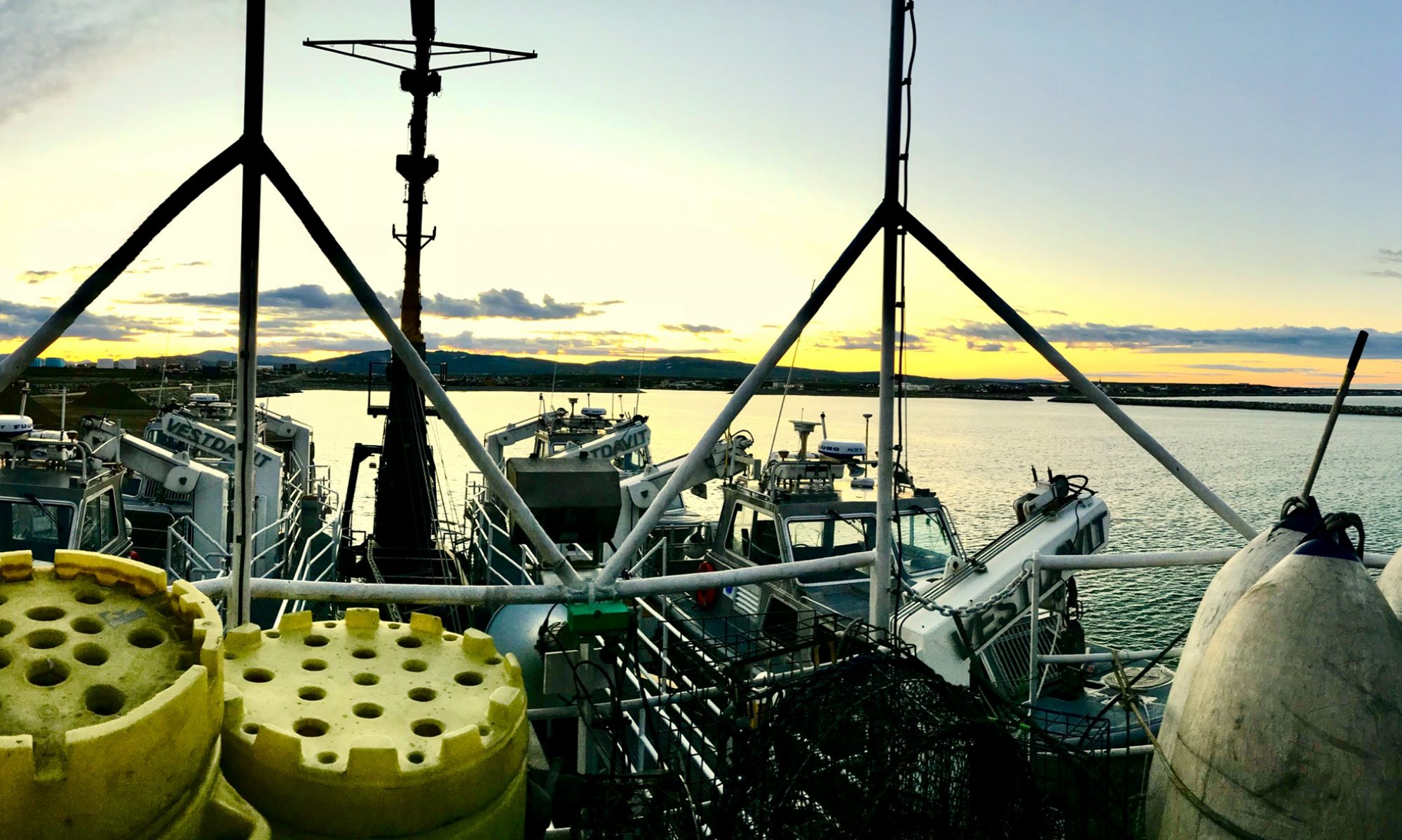
Made it safely to Dutch Harbor yesterday. I have seen so many bald eagles I have lost count. They are so beautiful. Also saw an Arctic Fox today. We are leaving here tonight (a day early) at 9pm. There has been a lot of ice up north so we are hoping the ice has moved so the scientists can do their work. Saw a couple ships from the show “The Deadliest Catch.” There are so many crab traps everywhere you look. They are stacked and ready to go for next crab season. I spent the early afternoon tying down everything in the labs. Bill said there is a storm out there and we should have 30 foot waves. Still getting to know the ship. My room is on the lower deck. There are bunk beds that I am sharing with Amber. Her’s is the top! 🙂 I will spend a lot of time on my laptop on the desk in my room and in the science labs. I look forward to bringing back samples for everyone to see. Once we depart in 6 hours I will be at sea until May 18th. Thanks for all the messages! Happy Cinco de Mayo!
Thank you for following me on my journey to Dutch Harbor, Alaska. I will do my best to post pictures as often as I can (hopefully daily), so check back often. 🙂 I begin my journey on the morning of May 3rdwhen I fly from Miami to Seattle and then overnight in Anchorage, Alaska. I have my morning free to sight see and then fly three hours to Dutch Harbor in the Aleutian Islands of Alaska.
Yes, this is the Dutch Harbor where they film the show “The Deadliest Catch.” On board the ship the Oscar Dyson I will be working with 15 crewmen and 8 scientists. We will board the 208 foot ship on the morning of the 5th to go through Federal Inspection, fire drills, man overboard drills, etc. The ship will disembark the following morning and return the morning of the 18th. Talk to you soon, Love, Ms. Schroeder
NOAA Teacher at Sea
John Schneider
Onboard NOAA Ship Fairweather July 7 – August 8, 2009
Mission: Hydrographic Survey Geographical Area: Kodiak, AK to Dutch Harbor, AK Date: July 18-20, 2009
Position
Shumagin Islands, in transit to Dutch Harbor
Weather Data from the Bridge
Weather System:
(July 18th) Low system approaching from the South
(July 19th) Fog, gusty wind in the morning, clear afternoon, but getting windier; Wind: southwesterly at 4-6 kts; Sea State: 1-2 feet
Weather System: Projected for the July 20-21 overnight
Barometer: falling rapidly (a warning sign of unsettled weather) Wind: sustained at 30-40 kts, gusting to 55 kts (This would qualify as a “gale”)
Sea State: Predicted wave height next 24-36 hrs – 18 feet!
Andy and lunch—a nice halibut!
Science and Technology Log
On the 18th and 19th, the launches went out (including me on the 19th) to clean up some holidays and get more near-shore data. When we got back on the 19th, we found out that a major low pressure system was building to the south and expected to be in our area within a day and a half. A major low system can reach out a couple of hundred miles and the CO decided that we would leave the Shumagins about 18 hours earlier than originally planned. I discussed this with him (he is remarkably approachable) and he reiterates to me what I had already believed: his responsibilities are in three priorities – 1. His crew. 2. His ship. 3. The mission. Our research in the Shumagins does not represent life-or-death, it represents the continuing quest for knowledge and the expansion of our understanding of the Earth. I’m sure you’ve realized it already, but Captain Baird and his officers have earned my highest regard.
We are in the center of the radar screen and two other ships described below – with their courses projected from the boxes that represent them – are behind us. The green line is our track ahead.
On board the Fairweather is a phenomenal array of electronics. Our positioning equipment is able to determine our position with just a couple of meters and when we are on a course it can tell if the course error is as little as a decimeter! Operating in Alaska, where fog is a way of life, RADAR (Radio Direction And Ranging) is an absolute must, and we have redundant systems in the event one breaks down. Probably the coolest thing about the radar is the use of ARPA technology. ARPA (Automated Radar Plotting Aid) is a system that not only identifies other vessels on the water, but diagrams their projected course and speed vectors on the screen. It does this from as far as 64 miles away!
The tail of the halibut and some crabs found in its stomach
By looking at the screen, you can see the lines of other ships relative to your own and navigate accordingly. Furthermore, the system includes ECDIS, which is an Electronic Chart Display and Information System that identifies other ships as to their name, size, destination, and cargo! So when you see on the radar that you are in a situation where you will be passing near to another vessel, you can call them on the radio by name! This technology is essential, especially going through Unimak Pass. Unimak Pass is about 15 miles wide and is a critical point in commercial shipping traffic between the Americas and Asia. As we were transiting Unimak Pass, We were passed by an 800 foot long container ship that was en route to Yokohama, Japan and going the other way was a 750 foot ship going to Panama. This is a critical area due to what is called “Great Circle” navigation. I’ll address this point when in Dutch Harbor next week.
Eat your hearts out!
Personal Log
Last night, after the beach party, Andy Medina (who has been on board for almost 200 days this year) was fishing off the fantail and caught a nice halibut. The crew who hail from Alaska all have fishing permits and when the day is done, if we’re anchored they get to use their free time for fishing. They even got a freezer to keep their filets in. Earlier in the cruise, we actually had halibut tacos made with about the freshest Alaskan halibut you can find (less than 12 hours from catch to lunch!) Of course, with me being a bio guy, I asked for two things: 1 – to keep and freeze the head (I For the last night of the leg before making port in Dutch Harbor (home of the World’s Deadliest Catch boats) the stewards, Cathy Brandts, Joe Lefstein and Mike Smith really outdid themselves. I sure hope you can read the menu board, but if you can’t, dinner was Grilled NY Strip Steak and Steamed Crab legs with Butter!
We went through about 10 trays like this!!!
After dinner, everybody secured as much equipment as possible in the labs, galley and cabins as possible in anticipation of the run ahead of the weather into Dutch Harbor. We ran through the night and got to Unimak pass in the middle of the day on the 20th. About half way through the pass was an unusual announcement, “Attention on the Fairweather, there are a lot of whales feeding off to starboard!” It’s the only time whales were announced and it was worth the announcement. For about 2 to 3 miles, we were surrounded by literally MILLIONS of seabirds and a score or more of whales. Comments from everybody were that they had never seen anything like it. I kept thinking of the old Hitchcock film The Birds and the scenes in Moby Dick where Ahab says to “watch the birds.” We were all agog at the sight.
Fifteen minutes of this! Incredible!
With the collective 200-300 years of at-sea experience, no one had ever seen anything like it. After 2.5 weeks that seems like 2.5 days, we approach Dutch Harbor and are secured to the pier by 1700 hours. Tonight we’ll head into town, but if not for the news in the next paragraph, this would be the worst time of the trip, however . . .
The Best news of the trip: I’ve requested and been approved to stay on board the Fairweather for the next leg! WOO-HOO!!! It’s called FISHPAC and deals with integrating bottom characteristics to commercially viable fish populations! I’m going to the Bering Sea!!!
Questions for You to Investigate
When did the Andrea Doria and Stockholm collide? Where? In what conditions?
What was the D.E.W. Line in the Cold War?
Why did the Japanese want bases in the Aleutians in WWII?
Why did we pass a ship going from North America to Yokohama well over 1000 miles north of both ends of the trip?
What are Great Circles?
Did You Know?
That almost 10% of all commercial fishing catch in the United States comes through Unalaska and Dutch Harbor?
NOAA Teacher at Sea
Jacob Tanenbaum Onboard NOAA Ship Miller Freeman June 1 – 30, 2006
Mission: Bering Sea Fisheries Research Geographic Region: Bering Sea Date: June 20, 2006
Personal Log
Click here if you would like to look at the results from the Pollock Study.
This will be my last blog entry for the trip. As the project draws to a close, I would like to evaluate how effective it was. There is a link to an electronic survey. I would like to ask students, teachers, parents, and other visitors to the site to take a few moments to let me know what you think of this idea. The survey is all electronic and only takes a minute or two to complete. Thank you in advance for your time. Click here to access the survey.
Wild horses
Today we arrived in the port of Dutch Harbor, Alaska early this morning. Dutch Harbor is a fishing village full of interesting sites to see and people to meet. It is also where the fishing vessels featured in the TV show “Deadliest Catch” are based, so a lot of you may have heard of it. The highlights of an incredible included a herd of wild horses. Their ancestors were released here by US soldiers stationed here after World War 2. We couldn’t figure out what they ate until… 🙂
Climbing in mountains full of wildflowers.Standing on the glacier
An incredible end to an incredible journey. Thanks all of you for sharing it with me.
Final Thoughts:
I would like to express my profound appreciation to everyone on board NOAA Ship MILLER FREEMAN. Every single person on board the ship welcomed me and helped me in every possible way with this project. The scientists and ships personnel answered every one of mine and your thousands of questions and opened the entire ship up to us all. Many of the people on board shared the blog with their families back home, and the notes I have gotten back from them touched me deeply.
To Commander Gallagher, Lieutenant Commander Boland, Dr. Paul Walline and the everyone on board, thank you for making this project possible and for all you have done to welcome me on board the ship these past weeks.
Thank you as well to the Jennifer Hammond, Elizabeth McMahon and everyone at the Teacher At Sea program for creating this wonderful opportunity and for all of your support before and during the project.
Thank you as well to all of you back home for taking part in this experiment. Teaching and learning with you from the Bering Sea has been one of the most rewarding experiences of my 19 years as an educator.
The above data is from 0800 this morning. Last night the weather came up but we continued out to Amukta pass to try and recover 4 buoys. Unfortunately the waves and wind were too big for operations. This morning we are hiding on the lee of a small Aleutian island tucked in between 3 volcanoes (see attached photo) waiting to see if the weather subsides. We are scheduled to arrive in Dutch Harbor on April 21 or 22 so we can wait here for a couple days in the hopes we can grab those buoys because that is our priority at this point. So, no CTD’s were done and no buoys recovered
Personal Log
Right before bed last night I made my nightly visit up to the bridge. The waves were pretty big and it was fun riding them way up high on the bridge with the knowledge that this boat has been in much worse conditions during is decades of service. After I left the bridge the captain did report seeing “green” water which happens when the waves get so big that they hit the windshield of the bridge so far down from the peak that you see green water.