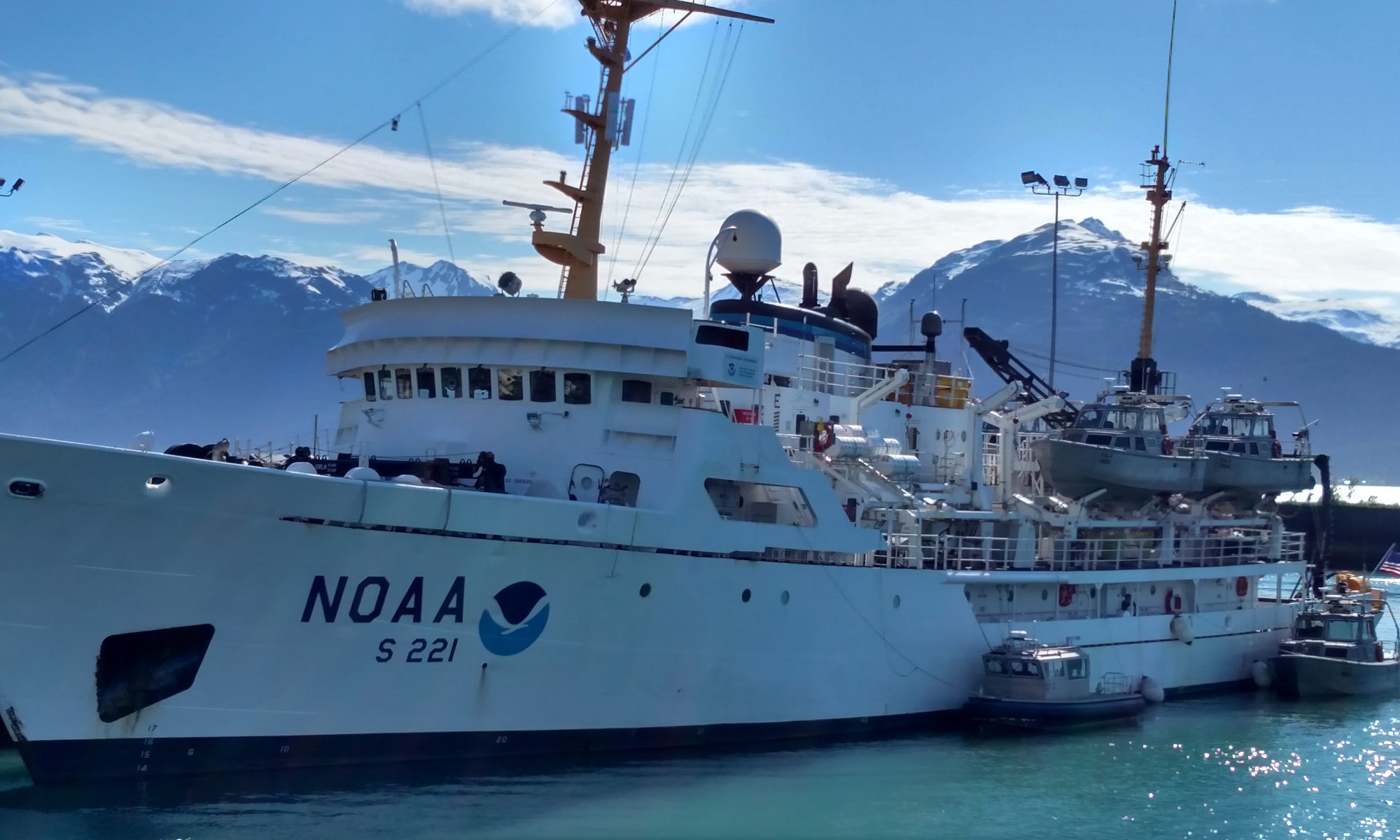
Richard Chewning, June 23rd, 2010

NOAA Teacher at Sea
Richard Chewning
Onboard NOAA Ship Oscar Dyson
June 4 – 24, 2010

NOAA Ship Oscar Dyson
Mission: Pollock Survey
Geographical area of cruise: Gulf of Alaska (Kodiak) to eastern Bering Sea (Dutch Harbor)
Date: June 23rd, 2010

Weather Data from the Bridge

Position: Bering Sea, east of St. George Island
Time: 0450
Latitude: N 56 38.000
Longitude: W 168 28.030
Cloud Cover: overcast with patchy fog
Wind: 14.0 knots from the east
Temperature: 5.8 C
Barometric Pressure: 1006.6 mbar

Science and Technology Log

Combining science, technology, and leadership, NOAA Commissioned Officer Corps provides skilled leaders for NOAA’s diverse programs. Numbering around 300 individuals, this group of dedicated professionals has a wide range of duties and responsibilities including operating NOAA’s ship and aircraft, managing research projects around the world, conducting diving operations, and manning staff positions on the shore. Officers are rotated every 2-3 years between ship-based and land-based positions. Before joining the Dyson as the Executive Officer for instance, Lieutenant Jeffrey Shoup worked with a satellite-based international search and rescue system as his NOAA shore assignment.

NOAA Corps emblem

All of these officers have completed rigorous training and have degrees in various fields of study relating to NOAA science such as physical oceanography, marine biology, chemistry, fisheries science, engineering, and meteorology. For example, the Dyson’s Commanding Officer, CDR Mike Hoshlyk, studied biology and geology at the University of Rochester.

Part of the U.S. Department of Commerce, NOAA Corps is one of the nation’s seven uniformed services of the United States. You are undoubtedly familiar with the other six: U.S. Public Health Service, Army, Navy, Coast Guard, Air Force, and Marines. During times of war or national emergency, NOAA Corps officers can assume duties with the Armed Forces. NOAA Corps officers have leadership and command positions on NOAA’s various vessels, aircraft, and instillations and manage programs and research efforts.

Personal Log

I wish to extend a heartfelt thank you to all the NOAA Corps officers, crew, and scientists of the NOAA ship Oscar Dyson for their support of my Teacher at Sea experience. I greatly appreciate their time and efforts making my stay comfortable and informative. I recognize that they not only allowed me to observe and learn about their workplace, but they also welcomed me into their home.

Ensign Russell Pate performing a safety demonstration

I have been continuously impressed by the professionalism and dedication of the Dyson’s NOAA Corps officers. Ensuring a safe and successful cruise for all onboard, I am grateful for the many efforts of CO Mike Hoshlyk, XO Jeff Shoup, Field Operations/Acting XO Officer Sarah Duncan, Navigation Officer Nathan Witherly, Safety Officer Russell Pate, and Medical Officer Amber Payne. I credit the entire engineering and electronics departments for their hard work ensuring that the Dyson remained in fine working order throughout the cruise. Jerry, Fred, Jim, Bob, Walter, Dave, Terry, and Steve comprised the Dyson’s engineering and electronics departments. The deck crew deserves recognition for always being ready to fish anytime day or night and for keeping the Dyson in ship shape over the last three weeks. The deck crew included Willie, Dennis, Joel, Glen, Mike, and Buddy. Special thanks to the scientists for sharing their passion for maritime research and for welcoming me as a part of their team. Paul, Patrick, Darin, Rick, Misha, Bill, Liz, Patti, Yin, Paula, and Ernesto each demonstrated personal dedication to better understanding our world’s seas and oceans. Gathering data and assisting the deck crew during the Dyson’s many deployments, Kathy and Jonathan deserve recognition for their many efforts as members of the survey department. Finally, I wish to express a word of thanks to the Dyson’s two stewards, Rick and Floyd, for keeping the crew well fed.

LTjg Nathan Witherly working on a chart

I wish to say a final word of thanks to the NOAA Teacher At Sea staff whose many efforts on my behalf made this experience possible. NOAA’s TAS program director is Jennifer Hammond. Elizabeth McMahon is the deputy director, and Elizabeth Bullock is the program support specialist. Thank you for bringing this amazing experience to life for so many teachers and students around the country.

Richard holding a Chinook salmon

Kodiak and Dutch Harbor As my TAS experience draws to a close, I reflect on where our cruise began and will conclude. Kodiak and Dutch Harbor are regular stops for the Oscar Dyson as she conducts research in the Bering Sea and Gulf of Alaska. Each community has a unique history and serves as a vital link to the outside world for the crew of Dyson.

St Paul Harbor, Kodiak, Alaska
Gray whale skeleton on display at Kodiak National Wildlife Refudge Visitor Center

Kodiak is the main city on Kodiak Island and is the home port of the Oscar Dyson. Carved by retreating glaciers during the last ice age, Kodiak’s most famous resident is the massive Kodiak brown bear. The Alutiiq called this area home for thousands of years before the Russian fur traders arrived in the early 1700s. Kodiak was the capital of Russian Alaska before becoming a US territory in 1867. In 1964, Kodiak suffered a devastating tsunami from the powerful 9.2 magnitude Good Friday Earthquake. Today Kodiak is a quaint commercial fishing community surrounded by beautiful untamed wilderness.

Priest Rock marking the entrance to Dutch Harbor
Church of The Holy Ascension, Dutch Harbor

Located on the on the island of Amaknak in the Aleutian Islands, Dutch Harbor is an industrial fishing outpost on the outskirts of the city of Unalaska. Dutch Harbor is a major industrial seaport serving fishing vessels of every description. Dutch Harbor is steeped in history. Hunting, fishing, and gathering for many generations, the Aleuts lived here long before Russian fur traders arrived in the mid 1700s. The Church of the Holy Ascension was built Dutch Harbor in 1825 and is the oldest Russian Orthodox church in the United States. Japanese and American military forces fought over the Aleutian Islands during the early months of the United States entry into World War II. Many concrete pill boxes and gun emplacements can still be seen along the surrounding hillsides. Dutch Harbor is defined by fishing and at one time was the largest fishing port in the US. Most people today recognize Dutch Harbor as the home of the crab fishermen portrayed in the Discovery Channel’s popular show, The Deadliest Catch.

Sunset in the Bering Sea

Laura Rodriguez, May 20, 2010

NOAA Teacher at Sea
Laura Rodriguez
Aboard NOAA Ship Oscar Dyson
May 24 – June 2, 2012

Mission: Fisheries Surveys
Geographical Area: Eastern Bering Sea
Date: May 20, 2010

Dutch Harbor/Unalaska

Bridge to Dutch Harbor
Fuel Pier View of Captain’s bay
Church of The Holy Ascension, Unalaska
Bald Eagles are like Pigeons here
The Oscar Dyson at dock in Dutch Harbor

Thursday morning I left Anchorage for Dutch Harbor. The flight was only 3 hours long, but we stopped to refuel in King Salmon. (Find the route on Google maps.) In Dutch Harbor, I was met by a junior officer of the NOAA corps, Ensign Amber Payne. Amber’s job is on the bridge piloting the ship. She is originally from Michigan, but went to college in Florida studying marine biology. Once on board, Amber gave me a tour of my home for the next 10 days.

After settling in, I took the “Liberty Van” to downtown Unalaska to sightsee a little.  A Liberty Van is simply a van that goes into town every hour to ferry people back and forth to the ship. In Unalaska, I saw the Church of the Holy Ascension, a Russian Orthodox Church built in 1826 by the Russian American Fur Company. I went down to the beach to touch the water; very cold!! The van driver, Kerri, estimated that the temperature is probably around 2°C or just a little above freezing; colder than I want to swim in. I also walked past the 3 schools in Unalaska, the community center and aquatic center. They are all beautiful new buildings. After the Liberty Van brought me back to the ship, I took a walk down the road the other way and saw many bald eagles, oystercatchers, harlequin ducks and black guillemots. I also spotted a bald eagle building a nest. The bald eagles around here are kind of like pigeons. They are everywhere.

When I got back to the ship, the scientists had arrived. We went into Dutch Harbor together to get dinner at a very nice Mexican restaurant called Amelia’s. One thing on the menu I found very interesting was a Louisiana sandwich which was made with reindeer sausage. ( I don’t remember any reindeer in New Orleans during my Earthwatch trip.) The scientists all live in the Seattle area and are oceanographers or fisheries biologists. They work at the NOAA headquarters in Seattle.

Friday I woke early and went to the mess for a delicious cheese omelette breakfast. After breakfast, we spent the morning organizing the labs by moving crates and boxes from previous research cruises. We then went into town to do a little last minute shopping. I also got to visit the Museum of the Aleutians. The museum details the prehistory and history of the Aleutian Islands. Very Cool Fact – The Unangun or Aleuts made parkas from the guts and esophagi of any large sea mammal. Second Very Cool fact – The Japanese invaded Dutch Harbor during World War II. To learn more about the Unangans and the history of the Aleutians visit the museums website:http://www.aleutians.org/.

We shoved off from Fuel Pier in Captain’s Bay around 4PM and headed out to sea.

Now, I’ll answer some of your questions. If I don’t answer your question at this time, be patient I’ll try to answer all of them by the end of the cruise.

Kevin M and Kate – There are 27 people on board the ship for this cruise. There are the 4 scientists, me and 22 crew members.

Trisha – The crew all work together on the ship for each cruise. The group of scientists are different each cruise. The three oceanography/fisheries scientists work as a team and do this particular cruise each year. Tiffany, the IT specialist was hired by the team to help with this cruise. They work together in Seattle and seem to know each other well.

Devin and Becca – The sleeping quarters are very nice. I share a room with Amber Payne. We have bunkbeds. I have the lower bed which is usually Sara Duncan’s, but she’s not on board for this trip. We have a small head (bathroom) with a very small shower. (Lots of hot water, though and that’s important!!) Overall the ship is very comfortable. There is a large mess (dining hall) and a lounge area with a large screen TV. They have a collection of movies that you can watch in the lounge or on computer monitors in your room. Last night, Amber was watching Shrek in our room while I was reading through your blog entries. (I have to admit I watched some of it, too)

Bryant  and Lucas McC– The food so far has been delicious. I had an omelette for breakfast yesterday, today I had yogurt and fresh fruit (cantaloupe, papaya and strawberries.) For dinner last night, we had our choice of Cornish hens or spare ribs. I’ll keep you updated on the future cuisine. Yesterday, the last thing brought on board was the food, so we have some very fresh food. The food is kept in the galley, in large refrigerators and pantry areas.

Hannah D. – I asked Amber why she came up here after having lived in Florida where it is much warmer. She said that Florida was actually too warm and they have different, cooler (pun), marine animals up here. She wanted to see whales and sea lions, etc. You don’t get that in warmer waters. She also said that on her last cruise they saw killer whales or Orcas – very cool!

Ben – The water where we are sampling is on the continental shelf and doesn’t go much below 100 meters deep. We will always sample from at least 10 m off the bottom. Further off the islands (south) the bottom drops sharply to a trench. The deepest part of the trench is 7,679 meters (25,194 ft).

Chris – The Oscar Dyson is not an icebreaker, but it can go through ice to a point. On the last cruise they had to go through the ice pack to get a scientist to the Pribilof Islands in the Bering Sea. The XO, Jeff Shoup told me they could only go so far and then they had to back up. The bow is reinforced for ice, but not the keel which could be damaged if they went too far.

Now it’s your turn – Find out about the types of marine animals that live in the waters of the Aleutian Islands. Then, describe one kind of animal in detail – Include information such as where they are found, what they eat and/or what eats them, their importance to humans and anything else you find interesting.


Please remember to include the website URL of where you got your information. And write in complete sentences including as much detail as you can.

Kathy Schroeder, May 18, 2010

NOAA Teacher at Sea
Kathy Schroeder
Aboard NOAA Ship Oscar Dyson
May 5 – May 18, 2010

Mission: Fisheries Surveys
Geographical Area: Eastern Bering Sea
Date: May 18, 2010

5/18 Goodbye Dutch Harbor

Wild Horses
Wild Horses
I was able to spend time on the bridge as we pulled into port. It was great seeing the officers work together to get us to Dutch Harbor safely. Today was my last night in Dutch Harbor.Amber and I spent some time running errands and later cutting out fish out of fire hose and spray painting them for the local middle school’s tour of the ship the next day. There are not a lot of options while in port, so we headed to the Airport.
Oscar Dyson bridge
Oscar Dyson bridge
I was able to see the Coast Guard helicopter practicing maneuvers.We made our way to the Grand Aleutian Hotel, and then to the UniSea for some pool and pizza.Ms. Miller is the middle school science teacher on Dutch, and she took us on a bumpy but beautiful ride to see the wild horses.
Bonfire
Bonfire
We ended up having a bonfire on the beach thanks to Amber’s coordination, not to mention all of the people that it took to get the fire started. It ended up being a fantastic evening at the end of our trip together! I enjoyed my experiences and everything I learned on the ship. I look forward to bringing back what I have learned into my classroom.
Thank you and goodbye Oscar Dyson!
Oscar Dyson in port
Oscar Dyson in port

Laura Rodriguez, May 10, 2010

NOAA Teacher at Sea
Laura Rodriguez
Aboard NOAA Ship Oscar Dyson
May 24 – June 2, 2012

Mission: Fisheries Surveys
Geographical Area: Eastern Bering Sea
Date: May 10, 2010

Getting Ready to go to sea

I leave for Dutch Harbor, Alaska in 9 days for my adventure on board the Oscar Dyson. I need to start getting ready. First I have to find out what the weather is like around Dutch Harbor. To help me, find the answers to the following questions and post in the comment section. 1. What is the latitude and longitude of Dutch Harbor, Alaska? 2. What is the average high and low temperature in May and June? 3. What is the average rainfall? 4. when will the sun rise on May 20th and when will it set?

Kathy Schroeder, May 6, 2010

NOAA Teacher at Sea
Kathy Schroeder
Aboard NOAA Ship Oscar Dyson
May 5 – May 18, 2010

Mission: Fisheries Surveys
Geographical Area: Eastern Bering Sea
Date: May 6, 2010

Out at Sea!


We left Dutch Harbor at 9pm on May 5th. I went to the bridge (where the Captain pilots the ship), which is 4 decks higher than where I sleep, and watched us depart. On our way out through the pass we passed a volcano. A scientist, Brian, works on the bridge watching birds. He has great binoculars and let me borrow them. I got to see my first Puffin! The sunset at 1030pm was gorgeous! Woke up 7 hours later to get to work. My shift will change, but for now it will be 7a-7p or 9a-9m. Began the day with a fire drill! Got to put on my survival suit! Now it was time to get back to work. I put on my orange suit (called a float coat) and went on the starboard side of the ship to help with releasing the tows. The first is the Neuston tow. It looks like a rectangular metal box with a net attached and a cylinder tube at the end. It collects plankton from the surface of the ocean. The tow stays at a 45 degree angle for 10 minutes and then is pulled onboard. We take the collection and put it in a quart size glass jar. On average, it is not very full. We then add sea water and formalin to preserve the specimens. Then we release the Bongo nets. They look just like two pairs of bongo drums, one large and one small.There are four circles (two different sizes) attached to nets and then connected to the collection containers (cups at the bottom of the net). They go down 300 meters or 10 feet off the bottom, and are then pulled back up. This takes over 30 minutes. (During this time a Laysan Albatross came along side the ship, and just wanted to hang out with us!) Once the nets are pulled in, three containers are preserved. We take the last container and sift through it using tweezers to pull out any larval fish (mostly pollock) and put them in a glass petri dish on ice. They are then taken to the microscopes and looked at closely for classification. Some are flash frozen on slides, others are individually preserved in alcohol. My best find last night was a squid the size of a tic-tac! After 14 hours of work it was time for me to go to bed. It was great waking up to so many messages and emails. Keep them coming. And for the questions-NO! I have not been sick 🙂