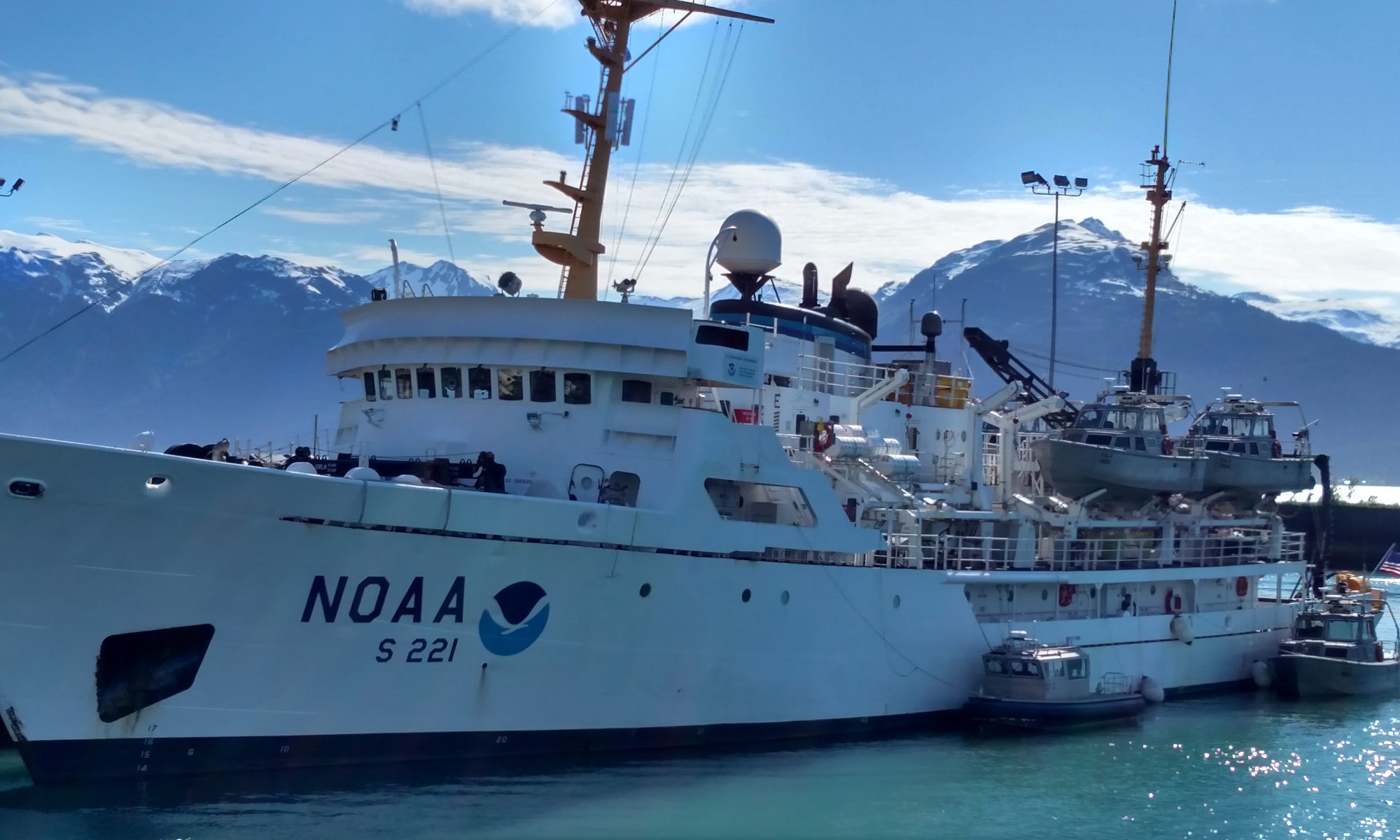
Julianne Mueller-Northcott, May 12, 2010

NOAA Teacher at Sea
Julianne Mueller-Northcott
Onboard R/V Hugh R. Sharp
May 11 – 22, 2010

NOAA Teacher at Sea: Julianne Mueller-Northcott
University of Delaware R/V Hugh R. Sharp
Mission:  Sea Scallop Survey: Leg III
Port of Departure: Lewes, Delaware
Location: Off the coast of Virginia
Date: May 12, 2010

Weather Data from the Bridge

Air temp: 13.72⁰C, 85% humidity, overcast

Science and Technology Log
When the dredge gets pulled up the ramp of the ship, I always strain to try to see past the chain and netting to see what amazing creatures might have gotten caught in the dredge.  I can see the pale-as–a-ghost face on the underside of skates and flounders.  The sea stars fall to the table in a big mound and you can see the crabs trying to climb the net.  And of course the scallops!  They get dumped out onto the table in a wave.  The pile of creatures undulates as organisms try to right themselves and seek cover.  Each dredge so far has been different.  Some are chock full of sea stars such as Asterias forbesii and Asterias vulgaris which we have at home, but by far the most abundant sea star species is Astropectin sp.   There was one dredge that was all sand dollars and they tumbled out onto to the deck, like hundreds of poker chips, hockey pucks and small frisbees.  I noticed that all of the fish in the dredge were green and then everything else started turning green. Apparently, sand dollars turn everything green! No one was quite sure why—this will be something to investigate once I get home.

So you can imagine how exciting it is to see hundreds (in some cases maybe thousands) of your sea friends, dumped out in front of you to examine!  I think about all the hours toiling at Odiorne Point with my students searching under rocks and peeling back algae in the intertidal zone looking for a hidden gem.  Here on the sorting table at the back of the boat there are so many species, so many things waiting to be discovered.  I think about my marine biologists at home and how excited they would be to have some of these critters for our tank!  (And while the thought has crossed my mind to try to kidnap some, that might be a difficult situation to explain going through security at the airport—a cooler full of crabs, sand dollars, sea stars and scallops!) The object here is not to study all the cool creatures for hours under a microscope which is what I would love to do (there isn’t even a microscope on the ship!) but instead, to sort.  My job, with 5 other people, is put out all the scallops and fish.  Those get measured and counted and everything else goes back into the water.  It all happens very quickly.  Because the goal is to do so many dredges in a relatively short amount of time, the faster you process everything the faster we can move on to our next sampling location, which means the more data that can be collected.  Also time is money on this high tech ship we are on.  For the scientists to use the R/V Hugh R. Sharp it costs $12,000 a day.  So it is imperative to work quickly to get the job done. But I am learning some tricks so that I can spend a little more time with the creatures I really want to check out.  I usually sneak a couple of neat things to photograph off to the side and after we are finished with the work at hand take a few minutes to study them.  And the scientists have figured out that when they have an organism that we haven’t seen yet, they have to show it to me before it gets tossed back overboard!

We were just pulling up a dredge last night when Ben pointed to the starboard side of the ship.  There in the starlight were about eight dolphins riding in the wake of the boat.  They were porpoising in and out of the water.  They were gray, with speckled black dots—we don’t have a mammal field guide on board—so I am not sure which species it was.  It was the first night that we could see stars, other than the sea star variety. I thought of Kat S. who was the first person who got me excited about the prospect of seeing stars at night from the boat.  Between the starlight and the spotlights on the ship, the sea below sparkled.  Even in the dark water you could see the water shimmer and change to a light green color, letting you know where the dolphins were just before they surfaced.  I have a list of top wildlife encounters in my life (swimming with whale sharks and eagle rays, saving stranded pilot whales in the keys, viewing humpbacks breech in a storm in the Bay of Fundy, nesting sea turtles Mexico, watching baby orcas play in the San Juan Islands, etc) but even with this list, watching the dolphins at night beneath the stars was pretty magical!

Captain Bill nonchalantly mentioned that he had seen an ocean sunfish (Mola mola) yesterday morning.  “What?!” I guess I hadn’t made it clear that I wanted to witness any such animal encounters.  I had told my students that the ocean sunfish was the one species I was really looking forward to seeing on this trip.  I had seen them in various aquariums but never in the wild. The ocean sunfish has always seemed to me a freak of natural selection.  How could something so big, clumsy and awkward looking have survived evolution?  Something about the way it lazes around without a care in the world has always appealed to me.  This morning, I took my usual watch on the bow of the boat (as I do every morning before my watch begins at 12:00). There, about 50 ft from the boat, I saw two large fins, flopping this way and that without an apparent purpose.  It was Mola mola! We didn’t get very close and our boat was traveling fast but through my binos I at least got a glimpse of its round, disc body.  And a couple of hours later, I saw another—this one a little further away.  So I know there are lots out there—now the goal is to get an up-close view and hopefully a photo!

Personal Log
It is pretty awesome now that the weather is brightening and we are seeing some beautiful species!  I love being on the top decks watching the sunlight dance on the water.  I love that everywhere I look all I see is ocean.  Yesterday we saw many other ships on the water—but today it is really just us steaming along. At first it was a little hard to get used to seeing lots of dead fish in the dredge and lots of animals that don’t survive the sampling.  There is a lot more by catch than I would have expected. It is going to take a little more time for me to process my thoughts about it all, but I am starting to understand that for now this is the best way for the data to be collected.  While it might not be the best thing for individual organisms, these sampling techniques are important for protecting the fisheries and ultimately the ecosystem.

Megan Woodward, July 12, 2009

NOAA Teacher at Sea
Megan Woodward 
Onboard NOAA Ship Oscar Dyson
July 1 – 18, 2009

Mission: Bering Sea Acoustic Trawl Survey
Geographical Area: Bering Sea/Dutch Harbor
Date: Tuesday, July 12, 2009

Any bycatch in a haul has to be measured and weighed if there are more than 25 of the same species caught.
Any bycatch in a haul has to be measured and weighed if there are more than 25 of the same species.

Weather/Location 
Position: N 60.35.172; W 174.08.187
Air Temp: 6.1 (deg C)
Water Temp: 5.24 (deg C)
Wind Speed: 25 knots
Weather: Overcast, rain

Science and Technology Log 

How is all the data collected from a trawl and acoustic lab used?  By collecting data about weight and length from a sample, scientists are able to connect the size of fish caught to the amount of return seen in the acoustic lab. The return is assigned a name (PK1, PK2, etc.) and all schools showing a similar acoustic pattern are given the same name.  In the end, scientists can estimate the number of fish and their size for a given area based on the acoustic and fish lab data collected.  This is repeated throughout the survey resulting in an estimate for the total number of fish in the survey area.  

Both during and after the survey estimates of abundance in the same location over the past several years are compared.  Scientists evaluate the data and determine if the pollock population in the survey area is increasing, declining or stable.  Their conclusions are used to make a recommendation about pollock fishing limits for the upcoming year. In the past few years the pollock population has been lower than in previous years.  Due to the decline, the fishing quota has been reduced.  However, the 2006 year-class is proving to be strong. At 4 years of age pollock are considered mature and fishable.  Therefore, the fishing quota is predicted to rise in the next year or two.

Screen shot 2013-03-24 at 11.32.34 PM

Personal Log 

While discussing the acoustic survey project with the scientists on board, I was quite surprised to hear the pollock survey had been going since 1979.  Acoustic technology has changed and improved, but in essence the project has remained the same. Modern computer technology has allowed collection and analysis of enormous data sets and greatly reduced the amount of paper work needed for the project’s success.

The concept of strong vs. weak year-class is also quite interesting.  There doesn’t seem to be a direct connection between a year-class’ success and environmental factors.  Environmental factors that are potentially influential are water temperature, available zooplankton, ice cover, storms and predators.  The fish currently being caught by commercial fisherman are 5-7 years old. Can you figure out which year classes those fish are from?

We continue to spot plenty of seabirds and a few more minke whale pods.  I was able to watch a group of Dall’s porpoises play in the wake of the bow for half an hour yesterday.  There haven’t been any new animal sightings during the past few days.
We continue to spot plenty of seabirds and a few more minke whale pods. I was able to watch a group of Dall’s porpoises play in the wake of the bow for half an hour yesterday. There haven’t been any new animal sightings during the past few days.

Although we are out here working in the best interest of pollock, I have found it difficult to watch thousands of pollock come through the fish lab.  I have to remind myself that sampling the fish is truly for the good of the order. In addition, after being measured the fish are sent back into the ocean where they become food for other organisms such as crab or birds. One of their natural predators is having a good meal, something that was likely to happen anyway.

Animal Sightings 

  • Seabirds
  • Dall’s porpoises

New Vocabulary 

Bycatch  – Anytime something is caught during a trawl other than pollock it is labeled bycatch.  Jellyfish has been the most common form of bycatch.

Year-class – All the fish born in a given year are members of that year-class.  We have caught a lot fish from the 2008 year-class (1 year old fish).

Nicole Macias, June 1, 2009

NOAA Teacher at Sea
Nicole Macias
Onboard NOAA Vessel Oscar Elton Sette 
May 31-June 28, 2009 

Mission: Lobster Survey
Geographical area of cruise: Northwestern Hawaiian Islands
Date: June 1, 2009

Weather Data from the Bridge 
Location: 22° 35.7’ N, 162° 32.4’ W
Wind Speed: 5 kts.
Swell waves: 2-4 ft.
Water Temperature: 26.7°C
Air Temperature: 26°C

This is "the pit" where the lobster traps are pulled into the ship. My job setting up was to bolt the legs together.
This is “the pit” where the lobster traps are pulled into the ship. My job setting up was to bolt the legs together.

Science and Technology Log 

Since the ship is still in transit to our first location the science team did not have much to do today. All we did was set the tables up in the “pit”. This is the section of the boat where the traps, or “pods”, are pulled up out of the water. Once they are pulled out of the water they are cracked open and everything is placed in a corresponding bucket to be taken to the wet lab to be measured and recorded. Everything in pod 1 would be placed in bucket one and so on. The only organism that does not go into the buckets are eels. My job today was to bolt the tables in the pit together. They needed to be bolted together in case we hit rough seas. While half of us were working on the tables the other half was inflating buoys that will be used to mark the beginning and end of a set of traps.

I also was able to release a message in a bottle that another teacher had sent to me before my trip asking if I would release it for him. The man, Jay Little, has had over 225 message bottles released all over the world. His goal is to raise awareness for the global efforts needed to preserve the integrity of oceans and inspire people to take action. The message in the bottle explains his goal and also asks that whoever finds the bottle to send him back artifacts from the location it ended up in. He uses these artifacts to make sculptures that reflect the contributions of people from around the world. Out of the 225 bottles released to date 21 have been found. The 19th bottle found had an incredible journey having circumnavigated the world in 23,000 miles. The latest discovery was in Matrouh City on the Mediterranean coast of Northern Egypt in 2007. Hopefully our bottle number 285 will land somewhere new and deliver an important message.

Here I am throwing the message in the bottle over the stern of the boat.

Personal Log 

One of the perks of being out to see are the incredible sunrises and sunsets that happen every day and the wild life that comes with it. In the morning a huge pod of either Pacific white-sided dolphins or Dusky dolphins, passed by the ship. They are very similar and some scientists believe that they might be the same species. In the evening, while on top of the bridge to watch the sunset, two red-footed booby birds decided to perch on the weather vain to watch too. They are the smallest of all the booby species and nest on land, but feed at sea. They are strong flyers and can travel up to 93 miles at a time and can dive up to 98 ft. to pursue prey.

The food is really good. Last night the cook made chocolate cake with a pecan and coconut frosting. It was very delicious. It is a good thing the boat has an exercise room so I can burn off the calories from three full meals a day. They also have a freezer that is stocked with ice cream and available 24 hours a day.

A beautiful sunset on the Pacific

“Did You Know?” 

Prior to the Revolutionary War, dockworkers in Boston went on strike protesting that they had to eat lobster more than 3 times a week!

“Animals Seen Today” 

The Red Footed Booby (Sula sula) Pacific White-sided Dolphin: (Lagenorhynchus obliquidens) 

Jacob Tanenbaum, October 14, 2008

NOAA Teacher at Sea
Jacob Tanenbaum
Onboard NOAA Ship Henry Bigelow
October 5 – 16, 2008

Mission: Survey
Geographic Region: Northeast U.S.
Date: October 14 2008

Here is Doctor Kunkel collecting samples with Watch Chief Mel Underwood.

Science Log

Dr. Joseph Kunkel from the University of Massachusetts at Amherst is investigating a mystery on board our ship. In the last few years, fisherman and biologists have all noticed that lobsters are disappearing from waters south of cape cod near shore. This includes Narragansett Bay and our own Long Island Sound. Why? Thats’ what Dr. Kunkel is trying to find out.

He and other scientists have found that the lobsters are infected with a bacteria. Dr. Kunkel has a hypothesis. He believes that some lobsters get the bacteria because their shells are not as strong as other lobsters and don’t protect them as well. He is here collecting samples to test his hypothesis.

Shellfish are affected by acid rain

He has even made a discovery. He and another scientist, named Dr. Jercinovic, discovered that this shell fish actually has boney material in certain places in the shell. The boney material helps make the lobster strong enough to resist the bacteria. Effected lobsters may not have as much bone, so their shells are weaker. Why are the shells weaker? There may be a few reasons. The water South of Cape Cod is warmer than it normally is. Climate change may be to blame. The water has a lot of pollution from cities like New York and Boston. There are many streams and rivers pouring into the area that are Affected by acid rain. All of these things may effect the lobsters in the sea. They may effect other creatures in the sea as well. Can you think of things that are happening in our neighborhood that may contribute to this problem? Post your ideas on the blog and I will share them with Dr. Kunkel. What does shell disease look like? Can you see the red spots on the photo on the right? That is shell disease. It can get much worse. Thanks Dr. Kunkel for sharing your work and your photograph.

Cups are ready!
Cups are ready!

The art teachers, Mrs. Bensen in CLE and Mrs. Piteo in WOS had groups of students decorate Styrofoam cups for an experiment on the ship involving technology, water pressure in science and perspective in art. You probably have felt water pressure. When you swim to the bottom of the deep end of a pool, you may have felt your ears pop. This is water pressure. It is caused by the weight of the water on top of you pushing down on you. Well, a pool is only 10 or 12 feet deep. Just imagine the pressure at 600 feet down. We wanted to do an experiment with water pressure. Since Styrofoam is has a lot of air in it, we wanted to see what happened when we sent the decorated cups to the bottom of the sea. Click here for a video and see for yourself. If you decorated a cup, you will get it back when I come in next week.

Here are some more interesting creatures that came up in our nets overnight. We have been in deeper water and some some of the creatures have been quite interesting.

This “sea pen” is a type of soft coral.
Two sea-hags
Two sea-hags

This is a sea-hag. It is a snake-like fish that has some amazing teeth. We put one inside a plastic bag for a few minutes to watch it try to eat its way out. Take a look at this video to see what happened.

Spoon Arm Octopi
Spoon Arm Octopi

Here are three Spoon Arm Octopi. Each octopi has three hearts, not one. One pumps blood through the body and the other two pump blood through the gills. There are three octopi in this photo. How many hearts to they have in all?

Red fish
Redfish

This redfish are also an interesting criters. When they lay eggs, you can see the babies inside. They live in deep water. We caught this one at a depth of 300 meters. How many feet is that?

Squid and sea star
Squid and sea star

Here is a bobtail squid and a sea-start. The squid looks like an octopus, but it is not.

Skate case with a baby skate inside

This skate case had a baby skate inside. Here is what it looked like as the tiny creature emerged.

Crab and eggs
Crab and eggs

Finally, the red on the underside of this crab are the eggs. Biologists call them roe.

Zee and Snuggy paid a visit to the ship’s hospital to take a look around. The hospital is amazing. They are able to treat a wide variety of injuries and ailments without having to call for help. They can even put in stiches if they need to. In cases of serious injury, however, the Coast Guard would have to take the patient to land with the helicopter or fast boat. Zee and Snuggy had a great time touring the hospital, and all three of us are just fine.

IMG_6859-737787

Jacob Tanenbaum, October 10, 2008

NOAA Teacher at Sea
Jacob Tanenbaum
Onboard NOAA Ship Henry Bigelow
October 5 – 16, 2008

Mission: Survey
Geographic Region: Northeast U.S.
Date: October 10, 2008

IMG_6354-743446Science Log

Did you figure out the answer to yesterday’s question? Those creatures were the real cast of Sponge Bob Square Pants TV Show. We saw a sponge, like Sponge Bob, and sea stars like Patrick, plankton, like Sheldon Plankton, some squid like Squidward, a crab like Mr. Krabs next to a sand dollar (because Mr. Krabs loves money), a lobster like Larry the Lobster and a snail like Gary. All the creatures in the program actually exist in the sea, except for squirrels, and we have seen them all on this adventure. Amazing creatures keep coming up in our nets day after day. Let’s take a look at a creature called a skate. The skate makes those funny black rectangles that you find on beaches. Take a look at where those rectangles come from and what is inside of them. Click here for a video!

Skates also have interesting faces. They live along the bottom of the sea. Their eyes are on top of their head to spot predators and their mouthes are below to eat what is on the bottom. They have two nostril -like openings above their mouth called spiracles. They look just like eyes but actually help the skate breathe. Here are a few interesting skate faces.

IMG_6247-720301

This sea robin uses three separate parts of its pectoral fin, called fin-rays to move, almost like its walking along the bottom of the sea as it looks for food. This helps is move very quietly, making it able to sneak up on prey unobserved.

Sea Robin
Sea Robin

These two baby dog-fish show different stages of development. This one is still connected to an egg sack. The other has broken loose from it, but you can still see where it was attached just below the mouth. Usually in this species, just like most fish in the shark family has eggs that develop inside the mother’s body. She gives birth to the pups when they have hatched from their eggs and are ready for the open sea.

Dogfish egg sack
Dogfish egg sack

IMG_6374-789593Many people have asked me about garbage. Here is some of what we have found so far. We caught part of someone else’s fishing net. Here is a Styrofoam cup and here is a plastic bag, which we caught 140 miles from the nearest land. How do you think it got here?

Finally, we were visited by some dolphins last night. They were eating smaller fish and as they came in for their attack, you can see the smaller fish jumping straight out of the water into the air to try to avoid being caught. Click here for a video.

IMG_6125-731150

IMG_6383-764446Snuggy and Zee decided to visit the kitchen today. Here are Zee and Snuggy with our chief Steward Dennis M. Carey and our 2nd cook, Alexander Williams. The food here is fantastic. See how large the kitchen is? We have a lot of people to feed on this ship, and the cooks here work hard. You have seen a few of the many different jobs that people can do on a ship like this. You have seen the scientists at work in the labs, you have seen the engineers who make the engine go. You have been to the bridge where the NOAA Corp officers run the ship. You have been to the kitchen where the cooks keep us so well fed. Tomorrow, you will see how the deck crew trawl our sample nets through the water. Keep checking the blog this weekend. There will be lots to see.

~~~~~~~~~~~~~~~~~

Now, some answers to your questions and comments:

Hi to KD and to Derek Jeter. We are staying safe. Thanks for writing.

Hello to St. Mark School in Florida. I’m glad you are enjoying the blog. I really enjoyed your thoughts about what these fish have in common. Great work. Here are some answers:

If a ship hit a drifter, the drifter would probably be broken. But the ocean is a big place, and that does not happen very often.

Can your school adopt a drifter? Of course! Take a look here: http://www.adoptadrifter.noaa.gov/. In the mean time, you are welcome to follow the adventures of our buoy. Keep checking this website!

I have Snuggy because some of my kindergarten classes asked me to take a bear with me to sea. So I did!

How heavy are the drifters? It weight 30 pounds or so, I would guess. Enough to make me work to pick it up.

I knew the whale was dead because part of it was decomposing. We could see it and we could smell it. Yuck.

Did any fish try to bite me? Yes. One scallop closed its shell on my finger. I had to be quick to get my hand out of the way in time. Other than that, no.

At 8 knots per hour, the ship could travel 192 knots, or about 220 miles in a day.

Congratulations to all who calculated correctly. The truth is that we have to stop for sample trawls every hour or two, so we seldom make our top cruising speed when we do work like this. So, we usually travel less than we could.

Oh, and to all those who asked, so far I have not gotten sick. Yet.

Thanks all for writing. Keep checking the blog!