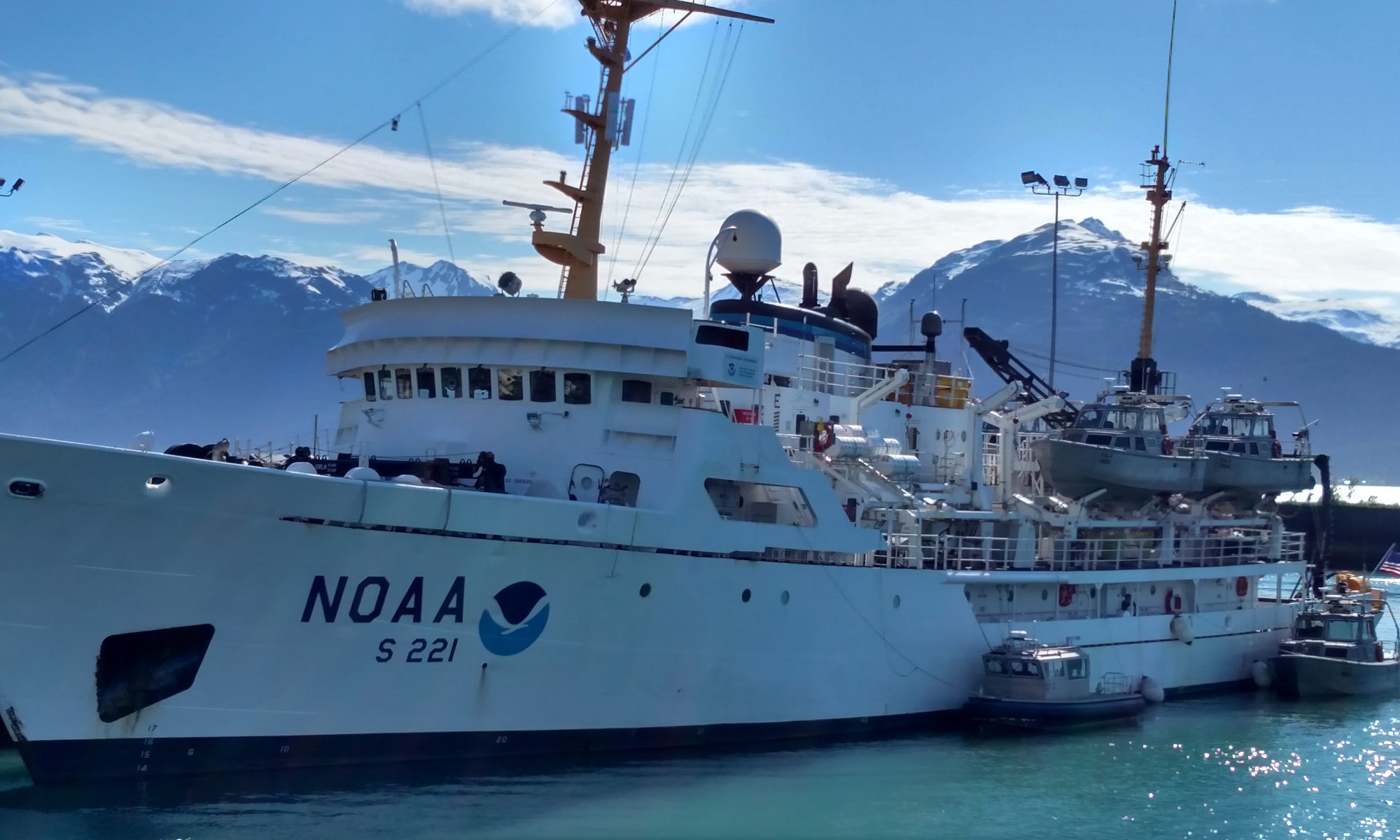
NOAA Teacher at Sea Log:Deborah Moraga NOAA Ship: Fulmar Date: July 20‐28, 2010
Mission: ACCESS (Applied California Current Ecosystem Studies) Geographical area of cruise: Cordell Bank, Gulf of the Farallones and Monterey Bay National Marine Sanctuaries
Date: June 27,2010
Weather Data from the Bridge Start Time: 0700 (7:00 am) End Time: 1600 (4:00 pm) Position:
Line 10 start on western end: Latitude = 37o 20.6852 N; Longitude = 122o 56.5215 W
Line 10 end on eastern end: Latitude = 37 o 21.3466 N; Longitude = 122o 27.5634 W Present Weather: Started with full could cover and cleared to no cloud cover by mid day Visibility: greater than 10 nautical miles Wind Speed: 5 knots Wave Height: 0.5 meters Sea Water Temp: 14.72 C Air Temperature: Dry bulb = 14 C Barometric Pressure: 1013.2 mb
Science and Technology Log
We left Half Moon Bay at 0700 (7:00 am) to survey line 10. We traveled out to about 30 miles offshore then deployed the Tucker trawl.
Tucker Trawl
When the team deploys the Tucker trawl the goal is to collect krill. They are relying on the echo‐sounder to determine where the krill are located in the water column. The echo‐sounder sends out sound waves that bounce off objects in the water and works much like a sophisticated fish finder. Dolphins hunt for their prey in much the same way. A computer connected to the echo‐sounder is used to display the image of the water column as the sound waves travel back to the boat. By reading the colors on the screen the team can determine the depth of krill.
Collecting krillCollecting krillCollecting krill
The scientists send weights (called messengers) down a cable that is attached to the Tucker trawl as it is towed behind the boat. Once the messenger reaches the end of the line where the net is located, it triggers one of the three nets to close. Triggering the nets this way allows for the researchers to sample zooplankton at three different depths.
Image of water column on computer screenWhen the cod‐ends of the nets were brought onboard Jaime Jahncke (scientist for PRBO Conservation Science) examined the contents. Some of the organisms that were collected were.
• Thysanoessa spinifera – a species of krill
• Crab megalopa larvae
Euphausia pacifica – a species of krill
NOAA Teacher at Sea Log:Deborah Moraga NOAA Ship: Fulmar Date: July 20‐28, 2010
Mission: ACCESS (Applied California Current Ecosystem Studies) Geographical area of cruise: Cordell Bank, Gulf of the Farallones and Monterey Bay National Marine Sanctuaries
Date: June 25,2010
Weather Data from the Bridge
Start Time: 0610 (6:10 am) End Time: 1630 (4:30 pm) Position:
Line 5 start on eastern end: Latitude = 37o 48.87 N; Longitude = 122o 52.74 W
Line 5 end on western end: Latitude =37o 48.078 N; Longitude = 123o 23.04 W Present Weather: Cloud cover 100% Visibility: greater than 10 nautical miles Wind Speed: 5‐10 knots Wave Height: 0.5‐1 meters Sea Water Temp: 12.86 C Air Temperature: Dry bulb = 11 C Barometric Pressure: 1014.0 mb
Science and Technology Log
Imagine standing next to an animal that is 12 times the length of you. It happened to us aboard the R/V Fulmar. Today, humpback whales where milling around our 67 foot boat. We were able to take some great pictures and some video.
Humpback Whale
The humpback consumes krill and small fish. Krill is a small (1.5 inches in average length) shrimp like organism. Krill is a primary consumer. They feed on phytoplankton. Phytoplankton is a producer in the ocean ecosystem. These small “plants” absorb light energy from the sun and through the process of photosynthesis they make energy for the consumers to ingest and use. Krill feed on this phytoplankton at night just below the surface of the ocean. During the day the krill swim to deeper parts of the water column to avoid predators like the humpback whale.
Humpback Whale
Other organisms observed today, included a pod of Pacific white‐sided dolphins, a Tufted puffin, and South Polar Skuas.
NOAA Teacher at Sea Log:Deborah Moraga NOAA Ship: Fulmar Date: July 20‐28, 2010
Mission: ACCESS (Applied California Current Ecosystem Studies) Geographical area of cruise: Cordell Bank, Gulf of the Farallones and Monterey Bay National Marine Sanctuaries
Date: June 24,2010
Weather Data from the Bridge Start Time: 0705 (7:05 am) End Time: 1658 (4:58 pm) Position:
CBOMP Line 6 start on eastern end: Latitude = 38o 6.6066 N; Longitude = 123o 24.804 W
CBOMP Line 1 end on eastern end: Latitude = 37o 56.1066 N; Longitude = 123o 18.7206 W
Nearshore line 1 start on western end: Latitude = 38o 8.5369 N; Longitude = 123o 5.8019 W
Nearshore line 1 end on eastern end: Latitude = 38o 8.7436 N; Longitude = 122o 57.5893 W Present Weather: Cloud cover 100% Visibility: 3‐5 nautical miles Wind Speed: light, variable winds 5 knots or less Wave Height: 0 to 1.1 meters Sea Water Temp: 11.6 C Air Temperature: Dry bulb = 11 C Barometric Pressure: 1014.0 mb
We saw Dall’s porpoises riding the bow wake. Riding the bow means the porpoises were using the energy of the wave that is created by the front of the boat to body surf. It is a treat to watch them weave back and forth then leap up out of the water.
Science and Technology Log
Today we worked the Cordell Bank transect lines (COMP). We finished all six lines of bird and marine mammal observations
Marine mammals that were spotted were…
• Blue whale
• Humpbacks‐ adult & calf
• Killer whale – male & female
• Dall’s porpoises
• Harbor porpoises
• Harbor seal
• California sea lion
• Stellar sea lion
Today, the seas were very calm. This was a good thing because we had guests on board. We also surveyed near shore line one. Near shore lines take about 40 minutes traveling at 10 knots. The offshore lines take more time to survey because they are longer and we deploy the CTD and nets. On our off shore lines today we deployed the CTD seven times and took seven water samples and one of our visitors helped by collecting the last water sample of the day.
NOAA Teacher at Sea Log:Deborah Moraga NOAA Ship: Fulmar Date: July 20‐28, 2010
Mission: ACCESS (Applied California Current Ecosystem Studies) Geographical area of cruise: Cordell Bank, Gulf of the Farallones and Monterey Bay National Marine Sanctuaries
Date: June 23,2010
Weather Data from the Bridge
Start time: 0705 (7:05am) End Time: 1708 (5:08 pm) Position:
Line 2 start on eastern end: Latitude = 38o 3.4080 N; Longitude = 123o 10.9800 W
Line 2 end on western end: Latitude = 38o 2.7660 N; Longitude = 123o 33.7800 W
Line 1 start on western end: Latitude = 38o 7.8240 N; Longitude = 123o 31.9200 W
Line 1 end on eastern end: Latitude = 38o 8.3940 N; Longitude = 123o 11.5200 W Present Weather: Cloud cover 100% Visibility: 3‐10 nautical miles Wind Speed: light, variable winds 5 knots or less Wave Height: 0.25 ‐ 1 meter Sea Water Temp: 11.5 C Air Temperature: Dry bulb = 12.1 C Barometric Pressure: 1013.5 mb
Science and Technology Log
From the flying bridge…It was noted that there are unusually high numbers of some animals from Alaska ‐ such as Northern Fulmars. There were also many sightings of humpback whales, one blue whale, numerous California sea lions and Dall’s porpoises. Today was the first sighting of a fin whale recorded on an ACCESS survey. the CTD
Krill
The seas were so calm… with a swell height of 0.25 meters, you could say the ocean looked as calm as a bathtub right before you get in.
With the seas being so calm it was great to work on the back deck (stern) of the boat. Today while working line 2 we deployed the CTD six times and took hoop net samples of zooplankton at 50 meters below the surface. The Tucker trawl was also deployed (put into the water and towed behind the boat) to 200 meters. In the jars of organisms that we sampled from line 2 we found adult and juvenile krill. We found some krill with chlorophyll still in their stomachs.
Sending out the CTD
Two small fish found their way into the hoop net. Myctophid ‐ these fish live deeper during the day and come up towards the surface at night. The scales on the myctophid looked like a colored mirror and are iridescent.
Myctophid
I had the chance to do the water samples today as the CTD was deployed. To do a water sample you throw a bucket over board (attached to the boat with a line). Pull the bucket out of the water and “clean it out” by swirling the water around. Drop the bucket back into the ocean and bring it up to the deck. You then take a small vial that is labeled with the sampling location and rinse it out several times before capping with a lid. It is then placed in the freezer to be analyzed for nutrients by another agency. I was just about to cap the sample and I heard this ‘poof’ sound. I looked over and two humpback whales surfaced just meters away from me. I knew they were humpbacks, a type of baleen whale, because their blow hole is actually two holes. They started to swim off and fluked (raised their tales above the water before diving) just as I was finishing the water sample, how lucky I am to be here!
Humpback Whale
Personal Log Getting My Sea Legs
Okay, I will admit I was seasick the first day. I mean really sick. The sea was rough… 9 foot swell and even with a patch on to combat seas sickness…breakfast came up. I have not been sick again! But tomorrow is another day out at sea!
NOAA Teacher at Sea
Beth Lancaster
Onboard NOAA Ship McArthur II April 6 – 14, 2008
Mission: Examine the spatial and temporal relationships between zooplankton, top predators, and oceanographic processes Geographical area of cruise: Cordell Bank Nat’l Marine Sanctuary & Farallones Escarpment, CA Date: April 13, 2008
Reported surface sea water temps for the CA coast from satellite data. The region of sampling is indicated by the box.
Weather Data from the Bridge
April 11, 2008
Wind – Northwest 4-17 knots
Swell Waves – 3-8 Feet
Surface Sea Water Temperature – 9.3-11.9oC
April 12, 2008
Wind – Light Swell Waves –1 to less than 1 foot
Surface Sea Water Temp – 9.2-12.5oC
Science & Technology Log April 13, 2008
At the onset of this cruise, ocean winds and swells kept scientists on alert for the next rock of the boat or wave crashing over the side, and into the fantail work area. These winds play an important role in delivering nutrient rich cold waters to the Cordell Bank and the Gulf of Farallones marine areas – this process is referred to as upwelling. Conditions on Thursday April 11 marked a noticeable change in the weather for this research cruise. Winds hit a low of 4 knots and swells of three feet were reported from the bridge for the majority of the day. On April 12 it was hard to believe that we were conducting research out on the ocean. Conditions were magnificent. Winds were light and swells were less than one foot. This change in conditions is termed a period of “relaxation.”
The term relaxation refers to a period when winds decrease, allowing for conditions that promote a boost in primary productivity. These conditions include decreased turbulence and the presence of sun and nutrients. The nutrients are readily available from the upwelling and phytoplankton are retained in the well-lit surface waters due to the decrease in wind mixing and the resulting stratification (layering) of the surface waters – thus, providing the optimal conditions for photosynthesis to take place. Figure one shows surface water temperatures from April 12, 2008. There was a visible change over the course of the research cruise in surface temperatures with the decrease in winds and swells indicating conditions suitable for primary productivity.
Left to Right: Beth Lancaster, Rachel Fontana (Grad Student, UC Davis), and Caymin Ackerman (Lab Assistant, PRBO) enjoy the sun and calm waters while waiting for a sample to return off the McARTHUR II.
Continuous samples of plankton were taken during the day-time throughout the course of the research cruise. My observations suggest that samples collected early in the trip revealed little macroscopic (visible to the eye) plankton, while samples collected later in the trip during the relaxation event are more diverse and robust. Samples will be examined following the research cruise to draw conclusions based upon quantitative data. Night-time operations included targeted sampling for krill to look at species composition, overall abundance, age and sex. Krill feed on phytoplankton, and will at times appear green after feeding. The optimal conditions for phytoplankton growth during a period of relaxation will result in a feast for krill that migrate up the water column at night to feed. A large portion of many resident and migratory bird and mammal diets consists of krill, indicating their importance to this marine ecosystem.
Weather conditions over the last few days also provided great visibility for mammal and bird observers. Nevertheless, there were still very few sightings of birds and mammals during this time period. One sighting of importance was of a short-tailed albatross, an endangered species that is an infrequent visitor to the California Current ecosystem. The short-tailed albatross population is estimated at 2000, and is currently recovering from feather harvesting in the late nineteenth century and loss of breeding grounds to a natural disaster. For more information on the short-tailed albatross visit here.
Putting it all together…..
All of the sampling done over the course of this cruise will allow scientists to look at the dynamics of the food chain during the early springtime. This is just a small piece of a larger puzzle. The same sampling protocol has been utilized at different times of year in the same research area since the projects beginning in 2004. This will allow researchers to look at the entire ecosystem, its health, and the interdependence of species to drive management decisions.
Laysan Albatross.
Personal Log
As the trip comes to an end I’m grateful to both the scientists and crew members onboard the McARTHUR II. I now have a better understanding of physical oceanography, and the Cordell Bank and Farallones Escarpment ecosystem which I am looking forward to sharing with students for years to come. The McArthur crew has been kind enough to answer every one of my many questions, made me feel welcome, and given me an idea of what life is like at sea. Thank you! This was truly an experience I will remember and look forward to sharing with others.