Jennifer Fry: March 23, 2012 Oscar Elton Sette

NOAA Teacher at Sea
Jennifer Fry
Onboard NOAA Ship Oscar Elton Sette
March 12 – March 26, 2012

Mission: Fisheries Study
Geographical area of cruise: American Samoa
Date: March 23, 2012

Pictured here is a copepod (right) and a jelly (left) found in the plankton net.
Copepod comprise approximately 85 % of the plankton population
Copepod comprise approximately 85 % of the plankton population.
These copepods images taken with a high-powered microscope with an internal camera.

 Plankton Net Operation

11:00 p.m.

Learning how to work with the plankton net was so interesting.  It required careful, meticulous, and orderly work.  Emily Norton, University of Hawaii at Manoa, Biological Oceanography, is conducting daytime and nighttime tows targeting plankton.  She’s particularly interested in collecting and studying copepods, a type of small crustacean which comprise ~80-90% of the plankton. Plankton is a name for a variety of plants and animals that live in the water column and are found throughout the world’s oceans.  Plankton are important because they are an integral part of the food chain, and they can help scientists better understand currents and transport in the oceans.  Helping with the plankton tow is Megan Duncan, oceanography participant, Joint Institute for Marine and Atmospheric Research at the University of Hawaii.  Together we deployed the net starting around 11:00 p.m.  Due to migration patterns known as diel vertical migration, plankton can be collected more easily at night.

  1. The net consists of a 1 meter metal ring with a fine mesh (200 um) net attached to collect the plankton.
  2.   At the end of the long, conical net is a collection filter tube or “codend.”  This is the final collection point for all of the specimens funneled into the mouth of the net.
  3.   The flowmeter is then connected across the diameter of the metal ring, which measures the amount of water flowing past it.
  4. With a crane operator’s help the net is lowered into the sea with 230 feet wire out which calculates to approximately 200 feet deep.  This is called an “oblique tow” method.
  5. The net remains in the water for 30 minutes.
  6. Once brought to the surface, the net is rinsed with sea water multiple times to ensure all of the plankton are completely  flushed down  into the cod end.
  7. The next step is filtering the plankton-rich seawater through a very fine sieve.
  8. The plankton are either observed under a microscope or immediately preserved using an ethanol solution, 95% ethanol 5% water.
  9. Labels are then placed inside the jar written in pencil on waterproof paper, and outside the jar using indelible marker.
  10. The plankton will be processed at a later date in the lab for quantitative analysis.
  11. In the lab, scientists study the plankton further, making observations and studying the DNA, Deoxyribonucleic Acid using PCR, Polymerase Chain Reaction, and sequencing.  Similarities and differences (i.e. mutations) in the DNA sequences are used by scientists to determine how closely related populations of copepods are.  This helps scientists infer how currents affect connectivity in the ocean.

Animals seen:

Copepods

Pteropods

Baby giant squid

juvenile fish, various species

Euphausiid

 Q:What fish have you had the most interest in and why?

A: The most common fish caught in the net is the lanternfish or myctohid.  They represent nearly 85%  of the ocean’s biomass.  One interesting feature is their photophores which produce light that emit from their bodies.

The myctophid pictured on the top is seen with its scales, compared to the bottom that shows them rubbed off due to being in the Cobb trawl net.

This tray of myctophids or lantern fish make up nearly 85% of the ocean’s biomass. They were the most common fish in our night Cobb Trawl nets.

Q: Have you gone scuba diving?

A:  No, I didn’t do any S.C.U.B.A. (self-contained underwater breathing apparatus) diving on this trip.  There are NOAA ships that focus on research that require diving as their method of collecting data.  We visited the NOAA ship Hi’ialakai that researches the coral reef biome in the American Samoa waters.

The NOAA ship Hi’ialakai conducts S.C.U.B.A. operations researching the coral reefs of American Samoa.

Jason Moeller: June 21-22, 2011

NOAA TEACHER AT SEA
JASON MOELLER
ONBOARD NOAA SHIP OSCAR DYSON
JUNE 11 – JUNE 30, 2011

NOAA Teacher at Sea: Jason Moeller
Ship: Oscar Dyson
Mission: Walleye Pollock Survey
Geographic Location: Gulf of Alaska
Dates: June 21-22, 2011

Ship Data
Latitude: 55.03N
Longitude: -163.08W
Wind: 17.81 knots
Surface Water Temperature: 6.7 degrees celsius
Air Temperature: 10.10 degrees celsius
Humidity: 85%
Depth: 82.03 meters

Personal Log
Welcome back, explorers!

June 21
Today has been the calmest evening since I boarded the Oscar Dyson. The night shift did not fish at all, which meant that I basically had an evening off! Even the evenings we have fished have been relatively calm. It takes us about an hour to an hour and a half to process a haul of fish, and up to this point we average about one haul per night. That gives me quite a bit of down time! When I am on shift, that down time is usually spent in one of two places.

computer lab
The first spot is the computer lab in the acoustics room. This is the room where we wait for the haul to be brought in. I write the logs, lesson plan, check emails, and surf the web during quiet times.
lounge
This is the lounge. The cabinet under the TV has over 500 movies, and a movie is usually playing when I walk in. Behind the couch is a large bookshelf with several hundred books, so I have done a fair amount of pleasure reading as well.

When I am not sitting in one of these two places, I am usually running around the ship with my camera taking nature photos. Below are the best nature photos of the past three days.

Volcano
One of the coolest things about the Aleutian islands has to be the number of volcanoes that can be seen. This is the one on Unimak Island.
volcano2
A second picture of the same volcano.
coast
This is just a cool rock formation off of the coast. The Oscar Dyson has been hugging the coast the entire trip, which has been great for scenery.
gull
A gull skims the water by the Oscar Dyson.
gull2
A gull wings toward the Oscar Dyson

June 22
We resumed fishing today! These trawls brought in quite a few species that I had not seen before, along with the ever plentiful pollock.

Net
The net, filled with fish!
Jason by belt
Jason waits for the net to load the fish onto the conveyor belt.
Jason with flounder
Here, I am separating the arrowtooth flounder from the pollock.
skate
We managed to catch a skate in the net! Skates are very close relatives to sharks. We quickly measured it and then released it into the ocean.
skate 2
A second photograph of the skate.
lumpsucker
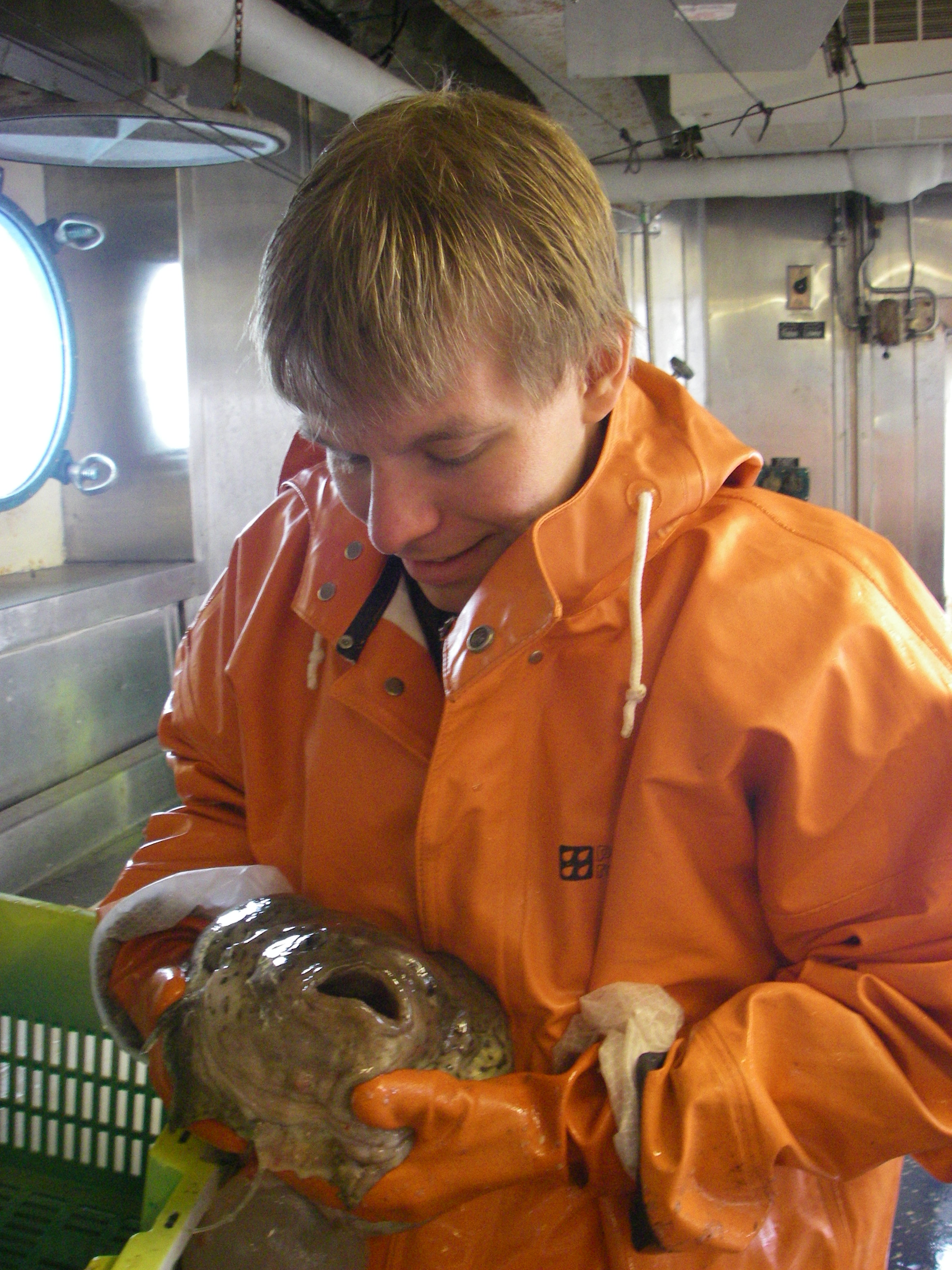
Do you remember the little lumpsucker from a few posts back? This is what an adult looks like!
lumpsucker2
The lumpsucker was slimy! I tried to pick it up with my bare hands, and the slime gummed up my hands so that I couldn't pick it up! Even with gloves designed for gripping fish I had trouble holding on.
lumpsucker3
A closeup of the lumpsucker
sculpin
This fish is called a sculpin.
crab
I finally saw a crab! None of us know what was attached to it, but the scientists believe that it was an anemone.
starfish
This is a starfish the net pulled up.

Science and Technology Log
There is no Science and Technology Log with this post.

Species Seen
Humpback Whales
Northern Fulmar
Gulls
Rockfish
Walleye Pollock
Lumpsucker
Arrowtooth Flounder
Atka Makerel
Salmon
Sculpin
Copepods
Isopods
Skate
Crab!!!

Reader Question(s) of the Day!

Today’s question comes from James and David Segrest, who are two of my homeschool students!

Q. What do you eat while you are on your adventures? Do you get to catch and eat fish?

The food is great! Our chef has a degree in culinary arts, and has made some amazing meals!

I wake up at 2:30 pm for my 4 pm to 4 am night shift, and usually start my day with a small bowl of oatmeal and a toasted bagel. At 5 pm, about two hours after breakfast, dinner is served, and I will eat a huge meal then too. Every meal has two main courses, a vegetable, a bread, and dessert. We have had a wide variety of main courses which have included bratwurst, steak, gumbo with king crab, fish, chicken parmesan, spaghetti with meatballs, and others!

We will often eat some of the fish we catch, usually salmon and rockfish since those provide the  best eating. The salmon disappears to the kitchen so quickly that I have not actually been able to get a photo of one! We have not caught a halibut in the trawl net yet, otherwise we would likely have eaten that as well. Yum! We have not yet eaten pollock, as it is viewed as being a much lower quality fish compared with the rockfish and salmon.

I’m out of questions, so please email me at jmoeller@knoxville-zoo.org with those questions please!

Natalie Macke, August 28, 2010

NOAA Teacher at Sea: Natalie Macke
NOAA Ship: Oscar Dyson

Mission:  BASIS Survey
Geographical area of cruise: Bering Sea
Date: 8/28/2010
It’s Fish Feeding Time…
Weather Data from the Bridge :
Visibility :  <0.5 nautical miles  (Wondering what a nautical mile is??)
Wind Direction: From the W at 20 knots
Sea wave height: 2-3ft
Swell waves: WSW, 4ft
Sea temp:9.1 oC
Sea level pressure: 1013.0 mb
Air temp: 9.7 oC
Science and Technology Log:
Euphausiid Specimens (zooplankton)

We’re up to station #40 now and everyone certainly has their routine down.  One type of sampling I have yet to cover is the microscopic life; the base of the food web.  A look at the marine fisheries food web quickly reveals that in order to support the commercial fisheries as well as the vast number of marine mammals and ocean birds, there must be an abundance of phytoplankton and zooplankton available in the Bering Sea.  Evidence of this food chain is demonstrated by dissecting the stomach of a salmon.  The sample (in the picture below) revealed that the salmon had recently dined on euphaussids (commonly known as krill).   Before getting into how the zooplankton samples are collected, first let me go back and touch on the base of the food web; phytoplankton.  These samples are collected from the Niskin bottles on the CTD each cast.  The samples are preserved with formalin and will be brought back to the lab for further analysis.  Now, back to the critters..

Dissecting a salmon stomach

At every sampling station on the side deck and immediately after each CTD cast, zooplankton net tows are completed.  There are three different tows being used for the BASIS survey. The first two are vertical tows where nets that are weighted are dropped to the seafloor and then brought back to the surface thus sampling a vertical water column. The pairovet, named from the fact that is was designed as a “pair of vertical egg tows” (designed to collect pelagic egg samples) has a netting mesh size of 150 microns.  The net is simply deployed with a weight on the bottom.  When it reaches the deepest part of the water column it is brought back to the surface collecting its’ sample.  Another similar net with a 168 micron mesh size is named the Juday.  Once either of these nets is brought to the deck, it is washed down and anything caught is captured in the cod end (the name for the PVC bucket at the bottom of the net).

Cod end for Bongo
Deploying the Bongo nets off the starboard side

The last type of tow that is completed for the BASIS survey uses the Bongo nets.  This tow is considered an oblique tow since the nets essentially are lowered to about 5m from the ocean bottom and towed for a certain length of time.  If you remember from the acoustics, in daylight hours the zooplankton migrate to the ocean bottom to hide from their prey.  Since our sampling is done in daylight hours, the deep sampling depth is where we expect to find the highest density of zooplankton sample.  The mesh sizes on the two nets of the Bongo are 335 and 505 microns.  This allows for sampling of zooplankton of different sizes.   The samples are collected on board and then taken back to the lab for analysis.  They are separated by species, counted and weighed.  Biomass and species composition is determined for each sample.  The majority of the zooplankton we have seen this cruise have been euphaussids and copepods of varying types.

Oh where, oh where does the Internet go??

So as August winds down and the school year gears up, my connection to the Internet is becoming more and more important.  Since my Oceanography class is with the Virtual High School, I have to essentially set up my virtual classroom in these upcoming days.  I’ll assume my esteemed colleagues will assist me in unpacking lab equipment back at home at my physical classroom. (Even though I know.. all my orders will mysteriously wind up in other labs, I’m assured they’ll be safely placed away.)

So I tracked down Vince Welton, our Electronic’s Technician for some help understanding why sometimes I can surf, and why sometimes I can’t….

Simple…

Our Internet connection is via the geostationary satellite GE 23 at 172 degrees East. This satellite transmits over most of the Pacific Ocean (see a coverage map).  Since this satellite is positioned on the equator, that means our receiver must look essentially due south for a signal.  When our ship is northbound, the mast and stack of the Oscar Dyson simply gets in the way.  Therefore… no Internet on northbound travels.

The Oscar Dyson also has access to two Iridium satellites for communication as well as the GE 23.   These are the SAT-B which can transmit both data and voice communications and the VSAT which only allows voice transmission.  The ship can access this set of orbiting satellites when the GE 23 is unavailable due to course of travel or weather conditions.

  Personal Log
Jeanette videotaping

Yesterday, I got permission to stay on the trawl deck during one of our station trawls.  It was fun to be outside down with the net.  Jeanette helped do some taping which I hope to(during a few Internet-less days ahead) compile to a video for my classes.  Of course as fate would have it, our catch for the day (shown below) was not one for the record books or even worth remembering at all..  I guess that’s what the editing process is for hmmm…

Today’s catch

In the Oceanography lab, we have started our primary productivity experiments and chlorophyll analysis so learning these new procedures has been interesting and given me lots of ideas for some research topics for Edelberg’s class.  All in all, I am enjoying watching, learning and doing science here in eastern Bering Sea.  One week left..

Kathy Schroeder, May 8, 2010

NOAA Teacher at Sea
Kathy Schroeder
Aboard NOAA Ship Oscar Dyson
May 5 – May 18, 2010

Mission: Fisheries Surveys
Geographical Area: Eastern Bering Sea
Date: May 8, 2010

CTD Water Samples 5/8

Today I was able to see a different type of equipment deployed. It is called a CTD (conductivity temperature depth). The CTD went down 150 meters. On the metal frame that holds the CTD are 12 water bottles with caps at each end. The frame is lowered with both end caps open.

Once at its depth the end caps are closed to take a water sample. This is then repeated at 5 different depths on its return to the surface. The water is then put into plastic containers of known volume, which are then taken to a filter (about the size of a quarter) that separates the microscopic plants called phytoplankton from the seawater. The filters with the phytoplankton are then frozen in small plastic vials to be sent to a lab in Seattle where they determine how much chlorophyll was on each filter. The amount of chlorophyll tells us how much phytoplankton was in the water at each depth. Another water sample taken from the CTD is to verify the salinity values measured by the CTD. We haven’t found much pollock the last few hauls. We are now finding Pacific cod, and of course krill and arthropods such as copepods, amphipods, barnacle nauplii. Amber spotted a Minke whale this morning. I hope to see one soon!