Susan Just, June 16, 2006

NOAA Teacher at Sea
Susan Just
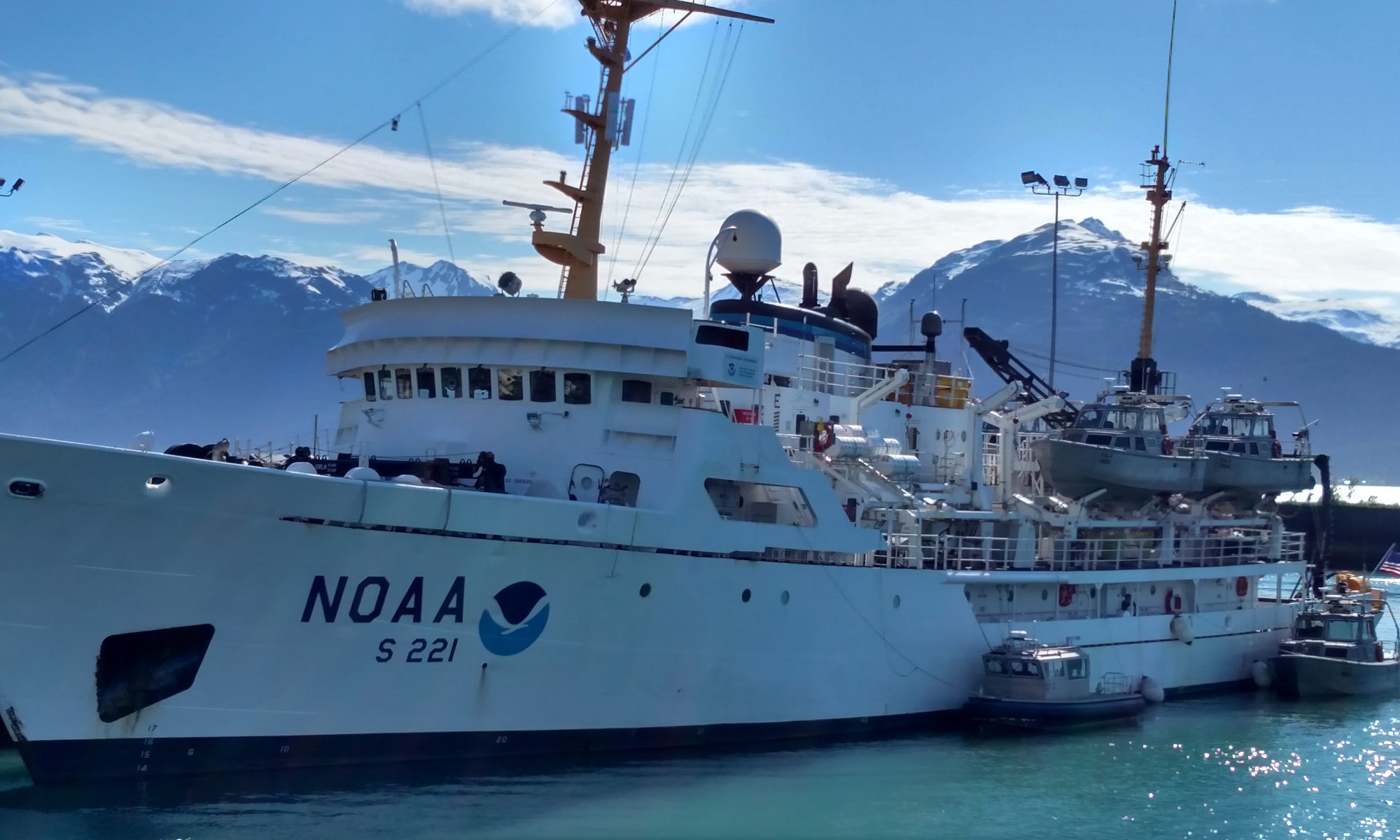
Onboard NOAA Ship Oregon II
June 15 – 30, 2006

Mission: Summer Groundfish Survey
Geographical Area: Gulf of Mexico
Date: June 16, 2006

Weather Data from Bridge 
Visibility: nautical miles  8-10 (nm)
Wind direction: 205.5 ◦
Wind speed: 11.3
Sea wave height: 0-1
Sea swell height: 1-2
Seawater temperature: 28.7
Sea level pressure: 1016.6
Cloud cover: 5/8 Altostratus and cirus

Science and Technology Log 

Tonight we began with a Neuston. Now I know that a Neuston is a rectangular frame to which has been attached a “sock” style net with a round portion at the bottom known as the “cod end.” The Neuston drags at the surface and catches sargassum (sea weed) and also plankton. Why? I’ll need to find out.

Next we pulled in the Bongos. These are round shaped “sock” nets with cod ends. In the cod ends, plankton and other sea life are collected from either the bottom or a maximum depth of 200 feet. The “catch” from both the Neustons and the Bongos are placed into jars with formaldehyde as a preservative. Forty-eight (48) hours later they are transferred to alcohol. They are then shipped out for processing.

The CTD was performed to capture water samples and hydrological data. All of the information is assembled and accompanies the samples to the lab for processing. Finally, we weighed and sorted the catch. Each species is identified by its scientific nomenclature which means we hear a great deal of latin in the wet lab.

Personal Log 

OK, I’m not quite as confused now. I had a great night’s sleep. I am beginning to learn some of the scientific names and I have gotten my fingers onto the computers that record the data regarding the organisms we classify. I’ve started having intelligent conversations with people and I am beginning to make sense of the activities aboard the ship.

Question of the Day 

What is the purpose of collecting the organisms in the Neuston and the Bongos? Answer: Plankton data is part of a long-term study regarding trends in fish populations.

Susan Just, June 15, 2006

NOAA Teacher at Sea
Susan Just
Onboard NOAA Ship Oregon II
June 15 – 30, 2006

Mission: Summer Groundfish Survey
Geographical Area: Gulf of Mexico
Date: June 15, 2006

Weather Data from Bridge 
Visibility: 8-10 nautical miles (nm)
Wind direction: 147◦
Wind speed: 0.1
Sea wave height: 0
Swell wave height: 1
Seawater temperature: 28.6◦
Sea level pressure: 1015.9
Cloud cover: Light Haze

Science and Technology Log 

Our watch began at midnight.  When we arrived in the lab there were fish awaiting processing. All commercial quality shrimp were separated from the catch and a representative sample of the whole was reserved for sorting. The sort included many species which were identified, counted, and weighed.  Individual members of each species were measured and counted, up to twenty (20) per species.  Finally, Two hundred (200) brown shrimp were counted out, separated according to sex and then measured and weighed, individually. Bongo, Neuston and CTD samples were drawn but I was occupied with the fish catches. These catches were repeated constantly throughout the watch until noon at which time we were relieved. Bongo, Neuston and CTD samples were drawn but I was occupied with the fish catches.

Personal Log 

What have I gotten myself into?  I am on the night watch.  This means that my sleeping hours have changed, literally overnight, to between noon and midnight.  Dinnertime has disappeared. Lunch has become the big meal of the day.  I can best describe myself as confused.

So far my impression is that all members of the ship’s crew and the scientific party are professional, helpful and “nice.”  It is easy to recognize the ship’s officers because they are dressed in uniforms.  Everyone else is arrayed in their personal gear and, generally, there is a state of designed “disarray.”

Question of the Day 

What is the most important skill to be learned before becoming a field scientist? Common courtesy/etiquette (be polite!).