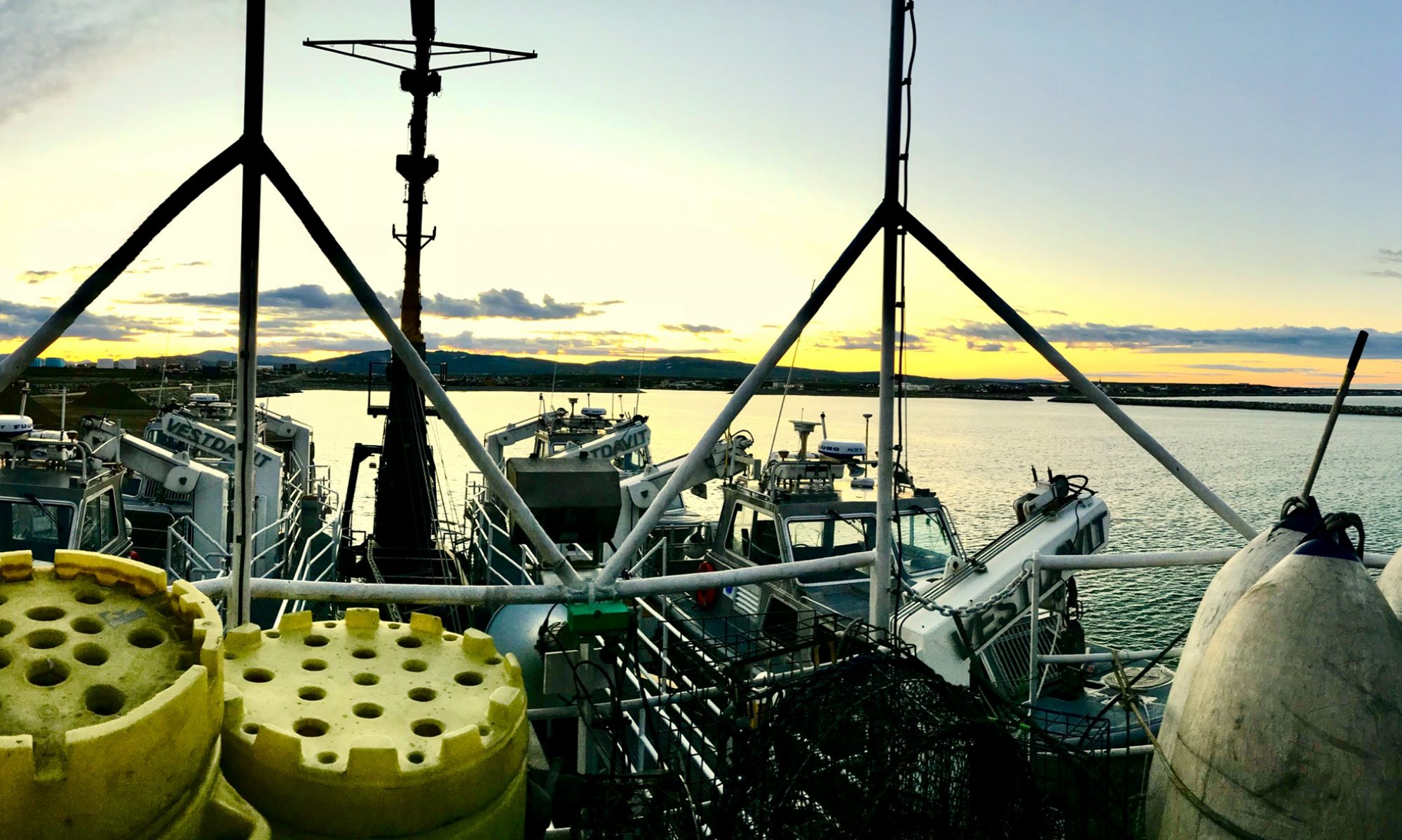
Jillian Worssam, July 17, 2008

NOAA Teacher at Sea
Jillian Worssam
Onboard U.S. Coast Guard Vessel Healy
July 1 – 30, 2008

Mission: Bering Sea Ecosystem Survey
Geographic Region: Bering Sea, Alaska
Date: July 17, 2008

To fully understand the today I need to go back two nights. I had been up for over 20 hours and was ready for bed. The educational team and I had been working fiendishly ( love that word) on a power point presentation with fun activities for the students. I was also working on putting together the slides for next Monday’s webinar. Anyway, after dinner, I went to bed. The next I knew my clock said eight thirty, and I had slept 13 hours! Frantically I got up got, dressed, and went to “Aft Con” to check on the retrieval of a floating sediment trap. MST Rich Layman told me that the pick-up would be the next day. I of course disputed his time analysis; it had been 24 hours why weren’t we picking up the trap? Rich of course replied, “We just set the trap this morning, we have to wait 24 hours.” My rebuttal was fun and sassy. There was discussion about a quarter and well to make a long story short. Here it is, I had slept for, you got it, an hour. It was still Tuesday night, I was really confused and a great laugh for many people, including myself. The moral of this story; there really is a purpose for military time!But now it is Thursday, and time to take our traveling science show to St. George. The day did not turn out as we had planned, and with the advent of really thick fog well our adventure was different than what we had planned.

Thus today’s journal will be a photo montage, a sequence of eleven shots highlighting (for me) the pleasure in the day!

"Bridge, do we have permission to launch the small boat?"
“Bridge, do we have permission to launch the small boat?”
As the HEALY fades into the background I really get a good glimpse of how huge she really is.
The ride was cloaked in fog, a bit choppy and a blast.
I bet John James Audubon knows who these little beauties are.
A brief glimpse at the coast as the surf pounded.
BM2 Gaines Huneycutt patiently waits to return us to the ship.
The small boats are ready to leave while getting last minute advice on the change in weather.
The swells at over eight feet provided a wonderfully exciting ride, for most!
Both Tasha and I were loving the ride as we crested each swell.
At one point we stopped and listened for the fog horn, a muffled sound to the left.

Today’s quote is from one of my most favorite individuals, and has summed up the day gloriously!

Quote of the Day: The purpose of life is to live it, to taste experience to the utmost, to reach out eagerly and without fear for newer and richer experiences. -Eleanor Roosevelt

MY STUDENTS: DO you have a hero, someone you look up to as a role model?

From beginning to end an amazing day.

Jillian Worssam, July 14, 2008

NOAA Teacher at Sea
Jillian Worssam
Onboard U.S. Coast Guard Vessel Healy
July 1 – 30, 2008

Mission: Bering Sea Ecosystem Survey
Geographic Region: Bering Sea, Alaska
Date: July 14, 2008

Prior to sailing on the U.S. Coast Guard Cutter HEALY I had no idea what it took to run such a huge floating, moving, science sampling community. Everyone that works aboard appears to be constantly busy not only with their formally assigned duties, but also with collateral duties, so that each one of the 15 separate divisions is constantly hopping. This was the case yesterday for the deck division, the largest aboard the HEALY with 17 crew members.

The deck department working with the scientists to retrieve an optical array.

The ship was working with scientists to retrieve an optical array, thus the need for small boats and the deck crew. It was through the guidance of Chief Boatswain’s Mate Kidd that not only were two boats launched with appropriate crew, but that they had the equipment necessary to try and accomplish their task.

Always prepared Chief Kidd always keeps a sharp lookout while operations are underway.

Chief Kidd is a career military man who started as a combat photo journalist. It was while I was listening to his account of the past that I learned even more about the history of the Coast Guard and how technology has really changed their world. Chief Kidd used to be a quartermaster, a traditional navigator aboard a sailing vessel. For twelve years he worked on the bridge of ships using tools such as a compass and sextant to plot and record courses. Then came the GPS. Thus the Chief’s “Legacy skills” became obsolete. Now he runs the deck division, responsible for: Having his crew stand bridge watches. Providing bridge lookouts. All small boat operations. Crane operations (not related to science). Armed bear watch when working in the ice. Rescue swimmer when scientists are on the ice. Line tending/deck work…the list is endless.

Working for Chief Kidd is enlisted crew Chelsey Rheyann Kaleoalohalanimalamalama Fernandez. Chelsey works on the Bridge for four hours a day, her primary duty is to record all ship operations while the HEALY is underway. The rest of her time is spent in, of course, collateral duties: maintaining and checking all float coats, checking the weapons locker, checking immersion suits, regular PMS (Preventative Maintenance Systems) checks of small boats and again the list is endless.

Working on the Bridge using the computer to record all ships operations during her four hour watch.
Working on the Bridge using the computer to record all ships operations during her watch.

Chelsey is new to the U.S. Coast Guard and will have her three year anniversary this winter when she hopes to get accepted into “A School,” to start her training to become a Health Services Technician/Corpsman. There are many opportunities for enlisted personnel within the Coast Guard, and this one will be Chelsey’s path.

The deck department retrieving a mooring.


Quote of the Day: The survival of the human species is inescapably linked with the survival of all other forms of life. Michael Frome

**FOR MY STUDENTS: **How many different careers do you think there are within the U.S. Coast Guard?

Everyone works hard on the U.S. Coast Guard Cutter HEALY!

Patricia Kassis, June 10, 2008

NOAA Teacher at Sea
Patricia Kassis
Onboard Research Vessel Kilo Moana
May 23 – June 10, 2009

Mission: Woods Hole and Hawaii Ocean Time Series
Geographic Region: Hawaiian Islands
Date: June 10, 2008

Science Log

We have remained at the buoy site today. We continue to do the meteorological measurements from the bow (sea surface temperature and humidity), we did a single CTD cast just to test that the instruments were working right for the next cruise, and we’ve been monitoring the data from the new buoy and comparing them to data the ship is collecting.

The mooring data we’ve been watching especially closely is the wind direction, which was off before we replaced the anemometer yesterday. And it turns out… the wind direction is still off. The two anemometers still record a difference of about 30 degrees. Although it took a few hours to get the first readings, we were immediately skeptical that the fix had worked because the old “broken” anemometer seemed to be in good working condition when it was brought back on board. The trouble is directional (the instrument’s speed measurements are consistent), and it turns out that the compass in each anemometer is influenced by the magnetic field created by the bird wire. Why didn’t they think of this? Well, they did, but the bird wire was not supposed to be magnetic. It turns out that we can deflect a compass by bringing it close to some bird wire. This also means that the other anemometer is probably reading an erroneous direction too, as it is surrounded by bird wire also. So the big wigs are bustling around now trying to make an algorithm to correct the wind direction data. In short, we hope the wind direction readings are always deflected by some predictable amount, so we should be able to adjust the data before using it. Shipboard wind measurements will help calculate the errors.

By request, here’s a close-up of the meteorological instruments on top of the buoy.

met_closeup

From left to right, they are:
Temp and Humidity sensor (white cylinder with horizontal stripes)
Rain Gauge (white cylinder with opening at the top, black inside; also associated metal cylinder)
Anemometer (with propellers, in the back)
GPS unit for location data (orange)
GPS unit that transmits via Iridium connection (while cylinder)
Barometer for measuring atmospheric pressure (metal cylinder)
A light that flashes orange at night – in the back, here it is covered with black plastic
Four sunlight radiation detectors in the middle (two long-wave, two short-wave)
Second Barometer (metal cylinder)
Second anemometer
Iridium antenna (cylinder with larger diameter)
battery pack (metal cylinder)
second rain gauge
second temp/humidity sensor

The data that these instruments collect are available in nearly real time for the public to see. Right now, the website is still picking up info from the old buoy, which is sitting on deck and, therefore, not making sense. But if you check this WHOI website later on, you should be able to see graphs of barometric pressure (BPR), air temperature (ATMP), water temperature (STMP), wind speed (WSPD), wind direction (WDIR), relative humidity (RH) and so on. Each quantity is measured by two instruments, so each graph has two lines – hopefully they are close; often they are so close it looks like one curve. But let’s keep an eye on that WDIR – a good algorithm will place the two curves close together.

Personal Log
Tonight will be our last night at sea. We’ll leave the buoy area around sunset tonight and head toward Honolulu. We’ll enter the harbor around daybreak and spend the day unloading equipment.

Patricia Kassis, June 8, 2008

NOAA Teacher at Sea
Patricia Kassis
Onboard Research Vessel Kilo Moana
May 23 – June 10, 2009

Mission: Woods Hole and Hawaii Ocean Time Series
Geographic Region: Hawaiian Islands
Date: June 8, 2008

Buoy alongside the ship

Science Log

These couple of days have been relatively calm science-wise, but the seas are the biggest we’ve seen. It’s not stormy or choppy, but big swells rock the ship with a low frequency, especially yesterday. Accordingly, the small boat mission to fix a wind instrument (anemometer, not flute) on the buoy was postponed until today, and it went pretty smoothly despite, in my opinion, pretty big swells. Here are a couple of shots of the mission. The first shows the launch. After the occupants pile in, the boat is lowered from a height of 15 or 20 feet. You can see the buoy (a speck just above the green arm of the crane), and the captain above – in a t-shirt and jeans.

The second photo shows Sean (only his legs are visible) climbing on the buoy while the boat circles. I don’t think these stills convey how the seas are moving, which I’d estimate as 7 foot high faces and wavelengths of about 300 feet. Even tough guy Sean quietly requested some food to help settle his stomach afterwards. The last CTD cast wrapped up yesterday.

We continue to collect more science data. We’re constantly monitoring data from the new buoy; a job powered mainly by computers and overseen by capable experts. Additionally, all along we’ve been doing some low-tech data collection. I’m actually surprised that this data is even taken, and I’m not sure of the extent to which these numbers influence science findings. Here is the psychrometer, a gadget with a fan (on the right, encased in metal) to rush air over two thermometers, one bare “dry” one, and a “wet” one with a thin wet sock covering its bulb (hidden by a metal sleeve). We record the two temperatures, and then use an equation or table to compute the relative humidity.

Here's a picture of some helpers like me "tagging" the lines - that is, steadying the rosette on its way back on board.
Here’s a picture of some helpers like me “tagging” the lines – that is, steadying the rosette on its way back on board.

The whole contraption is lowered into the upper ocean using a rope, brought back up without spilling (luckily, the geometry makes this easy), and the sea surface temperature is read off of the thermometer before the water is dumped out. This is pretty unsophisticated stuff, but it is the most reliable method we have for measuring the sea surface temperature. (CTD’s are too deep and satellites can be fooled by a slightly different temperature in a skin atop the surface.)

Here is the thermometer we use to measure sea surface temperature. It is a small PVC bucket with a fixed thermometer suspended in it.

Personal Log

I am on watch from 7 to 11 in the morning, and again from 19 to 23 at night. So I’ve had a lot of free time in the middle of the day. I bug some scientists and technicians to show me the data they were playing with, but I also got laundry done and have enjoyed some ice water and a good book. I actually picked up a little sunburn – was my sunscreen too little, too late or too infrequent?

SST_bucket

Patricia Kassis, June 6, 2008

NOAA Teacher at Sea
Patricia Kassis
Onboard Research Vessel Kilo Moana
May 23 – June 10, 2009

Mission: Woods Hole and Hawaii Ocean Time Series
Geographic Region: Hawaiian Islands
Date: June 6, 2008

Downloading data from the CTDs

Science Log

Science efforts today seem to be split between removing things from the recovered buoy and collecting more data with CTD’s. Part of what we’re getting off of the buoy is that data stored in the CTD’s that hung beneath it. Here’s Jeff (with a corny look on his face) downloading this data. He’s got 6 CTD’s going at once, and the process takes hours.

Also coming off the buoy are the atmospheric instruments on top. Here’s a shot of Sean working on that while Jim moves cable from the winch that pulled it on board onto the spools where it is stored. My roommate Tenley is operating the winch.

The CTD casts have started back up (we took a break from that to recover the buoy), which means I’m on a work shift – about 4 hours on and 8 hours off. I start tonight at 7 pm. I’ve done 2 casts so far, and I’m already getting to be more helpful, successfully steadying the CTD rosette from the deck.

tenleyWinch

Personal Log

Buoy on deck
Buoy on deck

I got to do laundry yesterday. This was a real treat since I arrived at this cruise directly from another trip, already with a sack of dirty clothes. There are two washers and two dryers on the ship and about 35 people on board, so there’s a restriction on when someone can use the machines. For the science party, of which I’m a member, the laundry is available Friday, Saturday and Sunday. That means tomorrow will be my last chance before jetting off on another trip, so I’ll be visiting the laundry room again. We had filet mignon for supper last night and I’m not even kidding.
Hey Parker ‘Ohana, is anyone reading this? When people on the ship find out what I’m doing here, they keep asking what feedback I’m getting from my students and my school. I’m sad to report “none!” So if you’re reading this, and you’re a Parker person, drop me a comment or a line (mrskassis@hotmail.com) so I know I’m not just talking to myself (or typing to myself, I guess.) If you have any questions, or if there’s anything you want me to photograph, I’m happy to accommodate.