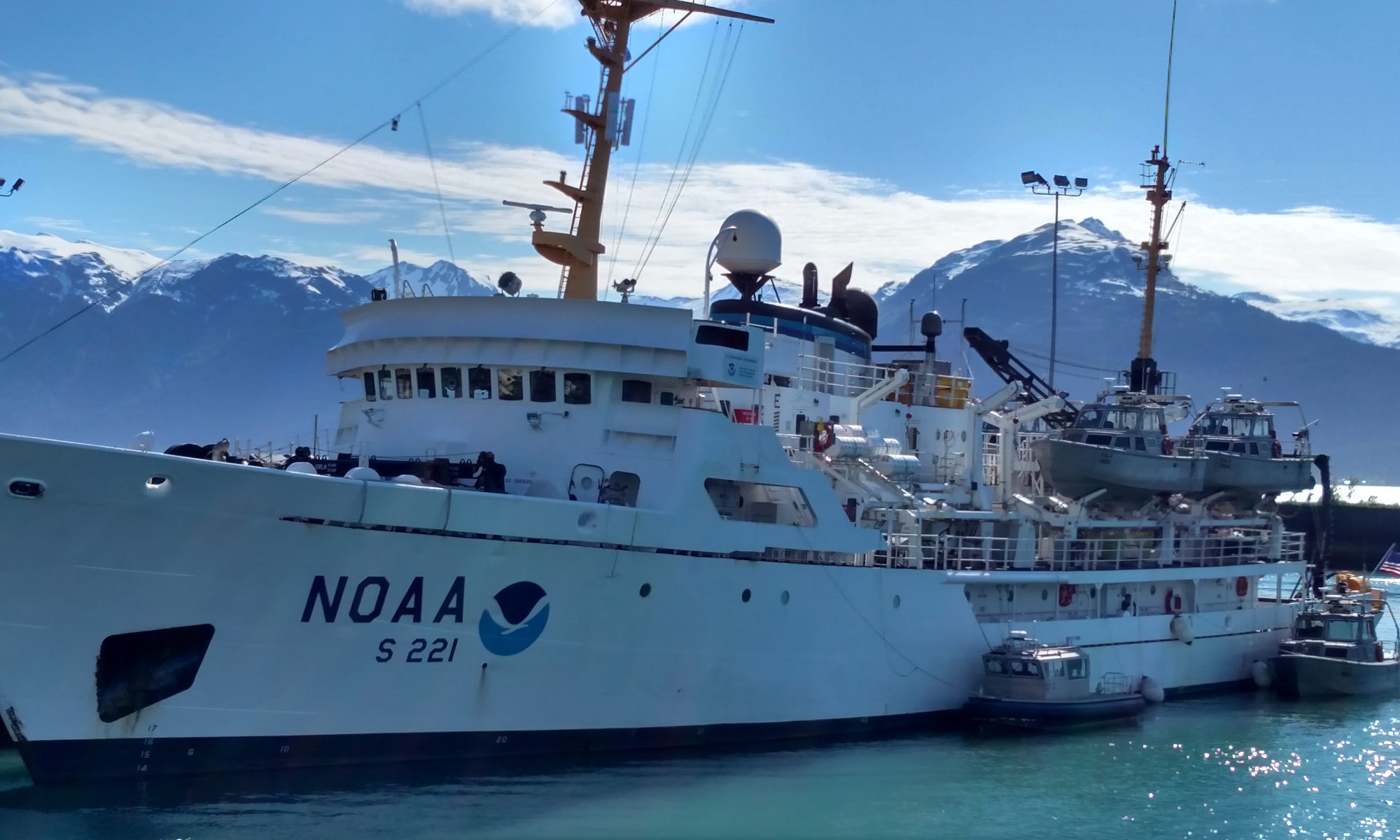
NOAA Ship Pisces will conduct a survey of reef fish located on the U.S. continental shelf and shelf-edge of the Gulf of Mexico (GOM) from April 19 through June 22, 2022 (we are doing the last leg of the survey). 536 sites have been selected to be sampled with Spherical/Satellite array, bandit reels, and CTD during daylight hours and mapping at night.
CTD Operations
CTD casts will be conducted twice a day. CTD stands for conductivity (ability to pass an electrical current), temperature, and depth and it is an instrument that measures just that. The CTD is the key to understanding the physics, chemistry, and biology of the water column. The CTD will also collect water for eDNA (Environmental DNA) sampling. Organisms leave traces of their DNA in their environment (e.g. hair, skin, feces) and from that, scientists can run genetic tests to determine what species are present in a given area.
CTD instruments to measure conductivity, temperature, and depth, as well as other water quality parameters.
Camera Operations
Camera operations will utilize three Spherical/Satellite camera arrays. The cameras are baited and sit on the seafloor for 30 minutes. During the soak, the cameras capture footage of the biodiversity. Scientists use the footage to complete a stock assessment analysis. That data combined with other research helps scientists estimate the abundance of fish populations.
Spherical/Satellite Camera Arrays to capture video at the seafloor.
Fishing Operations
Bandit reels (basically industrial fishing poles) are deployed after cameras are retrieved. The bandit reels are set up like longlines. The line sits vertically in the water column. When the weighed end of the line reaches the bottom, a surface float is attached to the line. Ten baited hooks are evenly spaced on the bottom 20-30 ft. of the line. All fish captured on the bandit reels are identified, measured, weighed, and have the sex and maturity determined. Select species will have otoliths (ear bones) and gonads collected for age and reproductive research.
Bandit reels used for fishing.
Mapping Operations
Bathymetric mapping (basically 3D mapping of the seafloor) will be conducted in and around selected sites at night with the EM 2040 sonar. Sonar emits sound pulses and detects their return after being reflected. Science is cool. A CTD cast will be conducted to obtain speed-of-sound for proper processing of data.
Bathymetry of the Northern Gulf of Mexico and the Atlantic Ocean East of Florida. Photo courtesy of NOAA Geophysical Data Center.
Personal Log
I was dropped off at my hotel at around 8 PM on Tuesday and could see the ship from the road. It sinks in. (NOT THE SHIP! – This had me laughing out loud.) This is actually happening. Suddenly there’s no time for checking in; I headed straight to the wharf, luggage in tow. Completely awestruck, like a giddy school girl, I proceed to walk up and down the length of the boat numerous times taking an embarrassing number of photos. The crew is just staring at me, I’m sure getting a kick out of this crazy tourist. A lovely gentleman (also geeked about the boat) leaned in, “cool boat, huh?”… I’M GOING ON THAT BOAT THURSDAY. Good lord, Jordan, be cool. I basically screamed in his face. He was the sweetest, and a teacher himself. “I know the trip is going to be everything you wanted.” I melt. Gee thanks, Pat.
Our departure was delayed a few hours, which gave me some time settle in and awkwardly roam the ship. This thing is massive (compared to what I know). I believe it has seven levels. My attempts to open and close doors quickly became a comedy act for any spectators. I was introduced to my roommates at 6 AM. Ain’t nobody trying to chit-chat at 6 AM. I share a stateroom with Amanda Ravas, NOAA Fisheries Biologist, and Caroline Hornfeck, graduate student at the University of West Florida. Caroline is collecting water for eDNA sampling. They are around my age (or at least I’d like to think so), and have been so kind and helpful. It is their first time on Pisces as well, but each are experienced and very knowledgeable. They’ve made me feel right at home, and I feel are going to be a major part of my experience out at sea. Women in science – go team!
Operations Officer (NOAA Corps), LT Christopher Duffy, was so kind as to take me under his wing and invite me to the bridge (control room) to observe departure. This was so cool. Navigation is quite the operation. I guess now that I’ve seen it, duh, this boat is massive and the port was so busy with vessels of all sizes. Seven NOAA officers worked together to get us underway safely. Lots of standing on watch and communication involved. They were constantly shouting commands and numbers, and repeating. All confirmed communication was acknowledged with a “very well.” I found this amusing. One of my favorite lines heard while observing was, “There’s a pleasure boat on the port quarter.” “Very well.”
I will now start saying “very well” in my everyday life.
Last mention for now – I haven’t been seasick (so far)! Those that know me well know that is a major accomplishment for me. (As if I had say in the matter).
I am so happy to be here and to have the opportunity to learn from all of the crew (in every department). I am already so impressed by each of them.
NOAA Ship PiscesBridge operationsDoor from the dry lab to the wet labOne day before departure
Did You Know?
Well most of us do know that water and electricity make a dangerous pair; but, did you know that it’s not water itself that conducts the electricity? It’s the minerals and such dissolved in it. The saltier the water, the more electricity it conducts. Pure water is actually an excellent insulator and does not conduct electricity, but you will never find pure water in nature. Whoa. I went down a rabbit hole with conductivity.
Also random, but kind of fun, the NOAA Teacher at Sea Program started in 1990, the year I was born. NOAA Ship Pisces was commissioned in 2009, the year I graduated high school.
Mission: Northern Gulf of Alaska (NGA) Long-Term Ecological Research (LTER)
Geographic Area of Cruise:
Northern Gulf of Alaska
Date: July 11, 2019
Weather Data from the Bridge
Latitude: 59° 00.823 N Longitude: 148° 40.079 W Wave Height: 1 ft, ground swell 3-4 ft Wind Speed: 5.4 knots Wind Direction: 241 degrees Visibility: 5 nm Air Temperature: 13.3 °C Barometric Pressure: 1014.6 mb Sky: Overcast
Science and Technology Log
At home, I regularly check information from
the buoys that literally surround our islands.
They give me real time, relevant data on ocean conditions and weather so
that I am informed about storm or surf events.
We also have buoys that track tsunami data, and the accuracy and
timeliness of their data can save lives.
Deploying and monitoring these buoys is a job that requires knowledge of
ocean conditions, electronics, rigging and computer programming.
Pete (foreground) and Seth set up the buoy system in preparation for deployment
The anchors for the buoys were made of train wheels
Pete Shipton is onboard as the mooring technician from UAF’s Seward Marine Center. This morning, he, Dr. Danielson and the crew deployed three moorings near oceanographic station GAK6i (about 60 miles offshore in the Northern Gulf of Alaska) at a depth of 230 meters. The search for the right depth required that R/V Sikuliaq do an acoustic survey of the area last night to find a kilometer-long area of the right depth and bottom slope. The three moorings will be situated close enough to each other that for all purposes they are collecting a co-located set of readings representative of this site, yet far enough apart, with small watch circles, that they don’t overlap and foul each other. The set of three is designed to have one surface buoy on either side with sensors at the surface and through the water column and a third buoy in the middle with sensors also distributed across all depths.
The first buoy, GEO-1, gives information on physics, optics, nutrient chemistry and has a profiling instrument that will “walk” up and down the mooring wire from about 25 m above the seafloor to 25 m below the surface, collecting profiles four times a day. The mooring has many of the sensors that the ship’s CTD has, including an ADCP (Acoustic Doppler Current Profiler), a weather station with a GPS that measures wind speed, relative humidity, sea level pressure, and air temperature. The buoy system was designed to withstand and operate in 8 m waves; in larger waves the surface buoy is expected to become submerged. At one meter of depth, GEO-1 measures the temperature, salinity, chlorophyll fluorescence and photosynthetically available radiation.
On GEO-2 (the center buoy), similar data is recorded at 22 m below the surface. There will also be a sediment trap, mammal acoustics recorder, particle camera, and an AZFP (acoustic zooplankton fish profiler), which has four frequencies that can detect sea life from the size of fish down to the size of zooplankton. It records sound reflections from all sizes of creatures and can see fish migrations during day or night within a range of 100m (from 100m depth to the surface).
Buoy GEO-3 is the primary “guard” buoy, or marker for the whole set. It also has a real-time transmitting weather station and near-surface measurements.
Linking the mooring lines and the anchors are acoustic releases, which are remotely controlled tethers whole sole function to listen for a “release” command that will tell them to let go of the anchor. Since the limiting factor on the instruments is the life of the batteries, they will be picked up in a year and the acoustic release will allow the instruments to be brought back aboard Sikuliaq. These buoys will be providing real time information for groups such as the Alaska Ocean Observing System (www.aoos.org) about weather and ocean conditions, while also collecting information about sea life in the area.
Pete (left) and Seth (right) test the stability of the buoy
Deploying the buoys was a lengthy process that required careful coordination of parts, lines, chains and personnel. Luckily everything went off perfectly! As the anchor weights for the two surface buoys deployed, they briefly pulled the buoys under, causing a bit of joking about whether the line length was calculated correctly. The brief “dunk test” was an excellent first trial for submergence during this coming winter’s storm conditions.
The second buoy briefly scares us by going under!
MarTechs:
There are opportunities for careers at sea in
a wide variety of positions on board a research vessel. One of the most interesting is the MarTech
(Marine Technician), because of their dual role during a scientific
cruise.
The Marine Technicians are technically assigned to the science team although they are a part of the ship’s crew. Bern and Ethan are the MarTechs on this cruise and both work specifically with R/V Sikuliaq. They are considered a part of whatever science team is on board at the time. The MarTechs are on 12-hour shifts, from 8:00 to 8:00. Ethan is on at night, and Bern is on during the day, although there is some overlap. The two men help to deploy and recover instruments for the science team and as well as helping the crew with any deck operations. They also are responsible for the computer lab and overseeing the data displays and production from the various sensors, as well as maintaining the instruments on the ship that provide information. Although they are always at hand to help when we need it, you will often find them also repairing and upgrading ship’s equipment and helping with engineering tasks.
Bern setting up one of his cameras.
Bern has been a MarTech on R/V Sikuliaq since 2013, and had previous experience on other research vessels, both American and international. Bern is also the ship’s unofficial documentation guy; he has a number of small cameras that he regularly uses to capture the action on board, whether from the vantage point of one of the cranes or on top of his own helmet. You can find examples of Bern’s camera work on R/V Sikuliaq’s Instagram site (@rvsikuliaq).
Ethan helps Ana with the iron fish.
Like Bern, Ethan has also worked on other research vessels but has been on R/V Sikuliaq since it was built. This is the only ship he’s been a MarTech on. His interest in oceanography, especially marine acoustics, led him to this career. Marine acoustics is more than just listening for large species such as whales. There are acoustic sensors that “listen” to the ship and help ensure that it is functioning normally. Other acoustic sensors, such as the ones based in the open keel of the ship use sound technology to map the ocean floor as we progress on our path. Ethan was kind enough to show me the keel and explain the instrumentation. In addition, there are instruments that constantly record salinity, temperature, current strength, solar radiation and other measurements along the path we travel to provide a more complete picture of the environmental conditions existing at every point.
The ship’s acoustic instruments are mounted in the open keel; it’s open to the sea!
The marine technicians manage the computer lab when they are not needed for operations. This lab is the nerve center of the ship and allows the science team to work closely with the bridge to coordinate the movement of instruments and the speed of the vessel through the water to achieve optimum results. You can find information on meteorology, navigation, engine performance, depth sounders, closed circuit monitors, ship acoustics and deck winch statistics by looking at specific screens. In addition, the staterooms have monitors that also allow viewing of certain screens.
The screens in the computer lab provide all the information needed to make decisions about how and when to deploy data-gathering instruments.
By far the two displays that are followed most closely are the CTD cast screens and the AIS screen. The AIS screen gives our course on a map, and shows our progress as well as future waypoints. It also shows our speed and bearing to our next point as well as ocean depth and wind speed and direction. The CTD screen shows real-time results in a number of categories such as salinity, oxygen, chlorophyll, temperature, nitrates and light as the CTD descends and ascends through the water column. Based on the results of the down cast, the teams determine the depths from which they’d like water samples collected as the CTD rises.
The OLEX or AIS screen shows our path as well as navigational information.
The CTD screen looks like spaghetti until you understand the color code for each line.
The Bridge:
The equipment on the bridge represents the pinnacle of technology as far as ship operations go. The captain’s chair has been described by some members of the science team as the “Battlestar Galactica” or “Star Trek” chair, and it really does look like it fits in a science fiction movie. Displays on the bridge show performance of the engines, radar returns and our bearing and range from them, and any other pertinent information to vessel performance. Ship movement and waypoints are hand plotted by the second mate, who also oversees ship movement along with the captain, chief mate and third mate. The ship’s officers work the bridge on a rotating watch schedule. One of the cool features of this ship is that it operates two Z-drives, similar to what is used on tugboats. These are propellers that can move independently of each other and turn in any direction. They allow the ship to be maneuvered precisely, which is a great help when we need to stay on a station through multiple operations. Various views of the bridge and the navigational instruments used by the ship’s crew are shown in the gallery below.
View of the bridge
View of the bridge
View out the bridge
The Captain’s Chair
Captain Eric Piper shows off his new jacket
Personal Log
Happy Mooring Day! It’s our self-declared “national holiday”! Because the process of deploying the moorings and buoys took up all of the morning and a part of the afternoon, most of the rest of the science team took the morning off and slept in. So many of them ran on the treadmill that running might become a part of our “holiday” tradition. My roommate even took bacon back to her room to eat in bed. Gwenn brought out her Twizzlers…somewhat appropriate because they look like steel cable (even though the moorings did not use cable). It was a nice breather for the science team, who have been working very hard to collect samples and run experiments. Somewhere along the line, the idea of making Mooring Day a “holiday” caught on, and it’s become a bit of a joke amongst the team. We’re down to a week to go, and everyone is beginning to think about what happens when we get in and when we all go home. But… we’re not quite there yet, and there’s a lot of work left to do.
Animals Seen Today
Our stowaway came to inspect today’s deployment.
We apparently have a stowaway…a small finch-like bird that flits about the ship. It must have joined us when we were near land, and now we ARE the land.
Latitude: 57º 9.61 N Longitude: 152º 20.99W Wind Speed: 15 knots Wind Direction: 210 º Air Temperature: 12º Celsius Barometric Pressure: 1013 mb Depth of water column 84 m Surface Sea Temperature: 12º Celsius
Welcome to a tour of the NOAA Ship Oscar Dyson.
Your tour guide today is the Room
11 Bear.
Allow me to explain.
When I am not a Teacher at Sea on the NOAA Ship Oscar Dyson, I am the special education preschool teacher in Room 11 at Nevada Avenue Elementary School in Canoga Park, California. My classroom has a classroom bear (made of construction paper) that “hides” every night when the students go home. In the beginning of the year, he is sort of easy to find, but as the year progresses, he is harder and harder to find. By the end of the year, only a paw or an ear might be showing!
The first
thing my students want to do every morning is look for the bear. When they find it, they excitedly explain where
it is. Speech and language are things we work on in class all the time, and the
bear gives us something fun to talk about! For some students, a single word might
be the goal. Other students may be working on putting a few words together, or
even enough to make a sentence. It’s
also a great time for them to learn prepositional words or phrases to describe
where the bear is hiding, such as next to, under, beneath, or on top of.
Now it’s YOUR turn. I hope you have fun touring the NOAA Ship Oscar Dyson with the Room 11 Bear and finding him in the photos where he decided to hide in a tricky spot. He is in EVERY picture.
Commanding Officer Bear up on the Bridge (the part of the ship above the weather deck which houses the command center).
I also spy a snack that is a favorite of some students in Room 11.
Bear charting our course on the Bridge
Steering the NOAA Ship Oscar Dyson (up on the Bridge)
Binoculars are used to check for whales or other boats before the trawl nets are put out.
Food is cooked in the galley (the nautical term for kitchen)
This is the mess (the nautical term for eating place) where all of the delicious meals are served.
The laundry room
One of the two gyms onboard the NOAA Ship Oscar Dyson
The engine room
There are “fire stations” onboard
in case of an emergency
This is where we put on our waterproof rain gear and high boots before entering the fish lab
High rubber gloves are worn so that we stay somewhat clean and to protect our hands as we use sharp tools and touch jellyfish or pointy quills
Lastly, a visit to the acoustics lab, where the scientists read and analyze the data from the echo sounders and determine when and where to drop the trawl nets.
Mission: Hydrographic Survey- Approaches to Houston
Geographic Area of Cruise: Gulf of Mexico
Date: July 3, 2018
Weather Data from the Bridge
Latitude: 29° 17.5’ N
Longitude: 094° 27.7’ W
Visibility: 10+ NM
Sky Condition: 3/8
Wind: 10 kts
Temperature:
Sea Water: 29.5° C
Air: 31.1° C
Science and Technology Log
The ship is equipped with AIS or automatic identification system. AIS is the primary method of collision avoidance for water transport. It provides unique identification, position, course, and speed of ships equipped with AIS. All vessels with 300 or more gross tonnage and all passenger ships must be equipped with AIS.
In the beginning, it took me a little while to realize that we were passing by some of the same oil platforms and seeing the same ships on the radar screen (above). For example, today the Thomas Jefferson covered many nautical miles within the same 2.5 NM area. This is characteristic of a hydrographic survey. A sheet (area to be surveyed) is split into sections and a plan is devised for the ship to cover (using sonar) the area in a “mow the lawn” approach. In the photo below, you can see the blue lines clustered together. These are the main scheme lines and provide the majority of data. The lines going perpendicular in a loose “zig-zag” to the main scheme lines are called crosslines. While main scheme provides the majority of sonar data, crosslines provide validation. For every 100 nautical miles of main scheme, 4 NM of cross lines (4%) must be completed.
You can see the main scheme and cross lines in this image using the Coastal Explorer program.
You can also see the main scheme and crossline(s) in the Hypack viewer below. Hypack is a software program controlled from the Plot (Survey) Room and is duplicated on a screen on the Bridge (steering deck). This allows Bridge watch standers to see track lines and the desired line azimuth (direction). In this case the line azimuth is around 314°. Additionally, the bottom portion showing -0.0 means that the ship is precisely on track (no cross-track errors). Typically, during a survey from the main ship, there is room for up to 10 meters of error in either direction and the sonar data coverage will still be complete. Once the course is set, the ship can be driven in autopilot and manually steered when making a turn. The high-tech equipment allows the rudder to correct and maintain the desired course and minimize cross-track error. Still, at least two people are always on the bridge: an officer who makes the steering orders and maintains watch and a helmsman who steers the ship. I was fortunate to be able to make two cross line turns after a ship steering lesson from AB (able seaman) Tom Bascom who has been on ships his whole life.
Hypack software is one point of communication between Survey and the Bridge Watch.
Communication between Survey and the Bridge Watch is critical. Every time the ship makes a turn, the side scan towfish and MVP must be taken in. The Bridge also notifies Survey if there are any hazards or reasons to pull in survey equipment.
At night, the ship is put into “night mode” and all lights are switched to red. The windows are covered with a protective tinted sheet and all computer screens switch over. The CO leaves a journal with posted Night Orders. These include important summary points from the day and things to look out for at night It also includes a reminder to complete hourly security rounds since most shipmates are asleep. A “Rules of the Road” section is included which serves as a daily quiz for officers. My favorite part of CO’s Night Orders are the riddles, but they are quite difficult and easy to over think. So far, I have guessed one out of five correctly.
ENS Sydney Catoire explains how important it is to preserve your night vision while maintaining watch, thus the dimming and/or use of red lighting. Her favorite watch time is from 0800-1200.
CO Night Orders from June 28, 2018
With a lot of my time spent looking at computer screens in survey, I was happy to spend an afternoon outside with the Deck Crew. Their job is highly diverse. Rob Bayliss, boatswain group leader, explained that the crew is responsible for maintaining the deck and ship. This includes an ongoing battle with rust, priming, painting, and refinishing surfaces. Rob wiped his hand along the rail and showed the massive amount of salt crystals collected throughout the day. The crew has a PR event and will give public tours the day we arrive in port, so the ship is in full preparation!
I was introduced to the needle gun- a high powered tool used for pounding paint and rust off surfaces to prepare them for the wire wheel and paint primer. CO thanked me for my contribution at maintaining the preservation of the TJ.
One of the Thomas Jefferson wooden plaques sanded and receiving a fresh coat of varnish.
I also spoke with Chief Boatswain, Bernard Pooser. He (along with many crew members) have extensive experience in the navy. Pooser enjoys life on the ship but says, “It’s not for everyone; you have to make it work for you.” He claims that the trick is to find a work and recreation balance while on the ship. He gave me some examples like being sure to take breaks and have fun. Pooser even pulled out a corn hole set that we may use one of these evenings.
Chief Boatswain Bernard Pooser
Peaks
+ It’s been fun being on the bridge at night because all of the ships and platforms light up.
+ I was given my own stateroom which was nicely furnished by its usual occupant. She has even installed a hammock chair!
+I hadn’t realized how responsive the ship would be when steering. At 208 feet, I thought it would be a bit more delayed. The maximum turn angle is 35 degrees and we have usually been making turns around between 5-15 degrees.
+We saw two sea turtles and dolphins while taking bottom samples! (See future post.)
Mission: Conduct ROV and multibeam sonar surveys inside and outside six marine protected areas (MPAs) and the Oculina Experimental Closed Area (OECA) to assess the efficacy of this management tool to protect species of the snapper grouper complex and Oculina coral
Geographic Area of Cruise: Continental shelf edge of the South Atlantic Bight between Port Canaveral, FL and Cape Hatteras, NC
Date: May 19, 2018
Weather from the Bridge Latitude: 29°55.8590’ N Longitude: 80°16.9468’ W Sea Wave Height: 2-4 feet Wind Speed: 18.1 knots Wind Direction: 210.6° Visibility: 1 nautical mile Air Temperature: 25.3°C Sky: Overcast
Science and Technology Log
Extra Operations- Zodiac Hurricane Fast Rescue Boat:
Occasionally these Fast Rescue Boats are used for more than real emergencies and drills, practicing the pick-up of a man-overboard and rescue diver missions, in the case of day 2 of my trip on NOAA Ship Pisces, a camera replacement part became necessary. When a small crew change is needed or to pick up a repair part for an essential item, instead of bringing the ship to dock, the FRB (Fast Rescue Boat) is sent in.
Lead Fishermen, Farron “Junior” Cornell was the FRB coxswain (driver/operator of a ship’s boat
The LF or Lead Fishermen, Farron “Junior” Cornell was the FRB coxswain (driver/operator of a ship’s boat). His navigation skills were developed by working in the hydrographic division that performs regular bathymetry readings using these vessels on NOAA Ship Thomas Jefferson, making him a very capable pilot of this small watercraft in the NOAA fleet. The FRB has seating for 6, with 2 aft of console, 1 forward of engine cover, 2 sitting on foredeck on engine cover and 1 prone on deck by stretcher.
Some other specs on the boat includes the following: Length overall=6.81 meters including jet Beam overall=2.59 meters Fuel capacity=182 litres (48 US Gal) Bollard Pull ~600 kg/5884 N Endurance (hours @ 20 knots)~6.75 hours Max Horse Power=235kW, 315 hp At Light Load Operation Displacement = 2150 kg/4750 lbs Full Speed ~32 knots Fuel System =48 US gallon tank
Zodiac Hurricane H638 DJ, USCG Approved Fast Rescue Boat (FRB) with Miranda Hoist System
Zodiac Hurricane H638 DJ, USCG Approved Fast Rescue Boat (FRB) with Miranda Hoist System
Zodiac Hurricane H638 DJ, USCG Approved Fast Rescue Boat (FRB) with Miranda Hoist System
Engine Room Tour Pictures and Learnings:
Daily Duties: Freshwater Needs– Reverse Osmosis and Evaporators
Freshwater is necessary for a variety of reasons beyond drinking water for the crew. It is used for laundry, cooking, showers and on NOAA Ship Pisces, to fill the ballast water tanks. Approximately 31 gallons of freshwater is used on average per person per day, with 29 people on board for 12 days, totaling nearly 11,000 gallons by the end of the trip. One method to supply this freshwater supply is through reverse osmosis. Osmosis is the diffusion of water across a membrane.
Normally water moves, without an energy input from high to low concentrations. In reverse osmosis, water is moved in the opposite direction of its natural tendency to find equilibrium. The force at which water wants to move through the membrane is called its osmotic pressure. To get water to move against the osmotic pressure another force must be applied to counteract and overcome this tendency. Sea water is found in abundance and can be forced across a semi-permeable membrane leaving the ions on one-side and the freshwater to be collected into containment chambers on the other side. Technology has impacted this process by discoveries of better semi-permeable membranes that allow for faster and larger amounts of sea-water to be moved through the system. Pisces uses reverse osmosis and a back-up freshwater system of 2 evaporators. When the temperatures are high (as they were in the first few days of the cruise) the evaporators are the go-to system and make for tasty drinking water.
Evaporators take in sea water and distill the liquid water using waste heat collected from the engines that raises the temperature of water in the pipes. This temperature provides the energy that forces the liquid freshwater to vaporize and enter its gaseous phase, then under pressure this vapor is condensed and can be collected and separated from the brine that is removed and discharged.
Wastewater:There are different types of water that can be used for different tasks aboard a ship. Typically gray water (which is relatively clean wastewater from showers and sinks but may contain soaps, oils, and human hair/skin) is placed in the MSD (Marine Sanitation Device), which is similar to a septic system. Black water is wastewater from toilets, or any water that has come into contact with fecal matter and may carry potential disease carrying pathogens. Black water is also treated in the MSD. This black water sewage is first subjected to a macerator pump that breaks the fecal matter into smaller pieces, enzymes are added to further decompose and before disposal a bit of chlorine is added to ensure no bacteria remain alive. This water can be disposed of into the ocean if the ship is over 12 miles offshore. If the ship is within 12 miles the sewage must be either stored in containment system on board the vessel or taken to dock and disposed of by an in-shore treatment facility. For more information on the regulations for wastewater disposal while at sea see the Ocean Dumping Act.
Valves for ballast water tanks on NOAA Ship Pisces that are filled with freshwater to prevent the spread of nonnative species
Ballast Water and New Regulations: Ballast water tanks are compartments used to hold water to provide stability for the ship. This balance is necessary for better maneuverability and improved propulsion through the water. It can allow the crew to compensate and adjusts for changes in the ships cargo load or fuel/water weight changes over the course of a trip. Historically this water has been drawn up from the surrounding sea water to fill the tanks. Unfortunately, in the not so distant past, the ballast water from one location on the globe has been deposited into another area along with it, all of it foreign plants, animals and microbiota. This act led to the introduction of a host of exotic and non-native species to this new area, some of which became invasive and wreaked havoc on the existing ecosystems. Today there are a host of case studies in my students’ textbook like the Zebra Mussels (Dreissena polymorpha) and the European Green Crabs (Carcinus maenas) that were introduced in this way that resulted in devastating impacts both environmentally and economically to the invaded area.
The International Maritime Organization (IMO) passed new regulations in September of 2017 calling for better management of this ballast water exchange. Ballast Water Management Convention 2017.
Another high tech approach to this problem has been the development of a sea-water filtration systems, but these carry a heavy price tag that can range anywhere from $750,000 to $5 million.
The engine room area is staffed by 7 crew members. Back-up systems and the amount of en route repair necessary to keep the ship running and safe was apparent in the engine room. There were redundancies in the engines, HVAC, hydraulics, and fuel systems. Spare parts are stored for unexpected breaks or other trouble-shooting needs. The control panels throughout the tour had screens that not only allowed a check of every level of function on every system on the ship, there was another screen that demonstrated the electrical connections on how all these monitoring sensors were wired, in case a reading needed to be checked back to its source.
One of the 4 NOAA Ship Pisces CAT engines
Pictured here is a diesel engine on NOAA Ship Pisces. Pisces has 4 of these on board: 2 bigger engines that are CAT model 3512 vs. 2 smaller engines that are CAT 3508. When the ship is going at full steam they use 3 of 4 to provide power to turn the shaft, and when they need less power, they can modify their engine choices and power, therefore using less fuel. CAT engines are models 3512 and 3508 diesel driven at provide 1360 KW and 910 KW, respectively. There is also an emergency engine (CAT model 3306) on board as well providing 170 kw of power.
Control panel of screens for monitoring and controlling all mechanical and tank/fluid functions
Steven Clement, first assistant engineer, is showing me some of the hydraulics in the engine room.
The pressurized fluid in these pipes are used to move devices. Pisces is in the process of converting certain hydraulic systems to an organic andbiodegradable “green” oilcalled Environmentally Acceptable Lubricants (EALs).
The Bridge
NOAA Ship Pisces’ Bridge
This area is command central. I decided to focus on only a few features for this blog from a handful of screens found in this room that monitor a variety of sensors and systems about both the ships conditions and the environmental factors surrounding the ship. Commanding Officer CDR Nicholas Chrobak, NOAA demonstrated how to determine the difference on the radar screen of rain scatter vs. another vessel. In the image the rain gives a similar color pattern and directionality, yet the ship appeared more angular and to have a different heading then those directed by wind patterns. When clicking on the object or vessel another set of calculations began and within minutes a pop-up reading would indicate characteristics such as CPA (closest point of approach) and TCPA (Time of Closest Point Approach) as seen in the image.
Scanned Maps and monitors help to prevent collisions
ECDIS (Electronic Chart Display and Information System)
These safety features let vessels avoid collisions and are constantly being calculated as the ship navigates. GPS transponders on the ships send signals that allow for these readings to be monitored. ECDIS (Electronic Chart Display and Information System) charts provide a layered vector chart with information about the surrounding waters and hazards to navigation. One screen image displayed information about the dynamic positioning system.
ECDIS (Electronic Chart Display and Information System)
Paths and positions can be typed in that the software then can essentially take the wheel, controlling main propulsion, the bow thruster and rudder to keep the ship on a set heading, and either moving on a desired course or hold in a stationary position. These computer-based navigation systems integrate GPS (Global Positioning System) information along with electronic navigational charts, radar and other sailing sensors to ensure the ship can navigate safely while effectively carrying out the mission at hand.
The Mess Deck and Galley:
This location serves up delicious and nutritious meals. Not only do the stewards provide the essential food groups, they provide vegetarian options and make individual plates for those that may miss a meal during shift work.
The mess
Dana Reid, who I interviewed below, made me some amazing omelets on the trip and had a positive friendly greeting each time I saw him. I decided a few days into the cruise to start taking pictures of my meals as proof for the nature of how well fed the crew is on these adventures.
crab legs was one of my favorites- I went back for seconds
Breakfast of champions
Every day there was some sort of fish choice
chicken fried steak and the gumbo were especially tasty
Omelettes to order
There were occasional green things on my plate
Menu items for each day posted on NOAA Ship Pisces
Menu Screen on the Mess Deck
Steward CS Ray Mabanta and 2C Dana Reid in the galley of NOAA Ship Pisces
Each day a new screen of menus appeared on the ship’s monitors, along with other rotating information from quotes, to weather to safety information.
Personal Log
Today a possible shipwreck is evident on the sonar maps from the previous night’s multibeam readings. If weather permits, the science team plans to check out the unknown structure en route to the next MPA. This scientific study reminds me of one of the reasons I fell in love with science. There is that sense of discovery. Unlike pirates and a search for sunken gold, the treasure to be found here is hopefully a diversity of fish species and thriving deep coral communities. I found myself a bit lost during the discussions of fishing regulations for these areas designated as MPAs (Marine Protected Areas). I had always thought ‘protected’ would mean prohibitive to fishing. So I did a little research and will share a little of the basics learned. And I hope someday these regulations will become more restrictive in these fragile habitats.
The MPA , “marine protected area” definition according to the implementation of an Executive Order 13158 is “…any area of the marine environment that has been reserved by federal, state, territorial, tribal, or local laws or regulations to provide lasting protection for part or all of the natural and cultural resources therein.” But what that actually means in terms of the size of the area and approach to conservation, or the level protection and the fishing regulations seems to vary from location to location. The regulations are governed by a variety of factors from the stakeholders, agencies and scientists to the population numbers and resilience of the habitat to distances offshore.
For more information on MPAs visit https://oceanservice.noaa.gov/facts/mpa.html
Did You Know? Some species of coral, like Ivory Tree Coral,Oculina varicosa, can live without their zooxanthellae.
Oculina varicosa
Very little is known about how they do this or how their zooxanthellae symbiotic partners return to their coral home after expulsion.
Fact or Fiction? Oculina varicosa can grow to up to 10 feet high and have a growth rate of ½ inch per year. Check out the scientific validity of this statement at one of the following links:
What’s My Story? Dana Reid The following section of the blog is dedicated to explaining the story of one crew member on Pisces.
Dana Reid pictured here in the scullery, the ship’s kitchen area for cleaning dishes
What is your specific title and job description on this mission? Second Cook. His job description includes assisting the Chief Steward in preparing meals and maintaining cleanliness of the galley (kitchen), mess deck (tables picture where crew eats), scullery (part of the kitchen where dishes get washed) fridge/freezer and storage areas.
How long have you worked for NOAA? 5th year
What is your favorite and least favorite part of your job? His favorite part of this job is getting a chance to take care of people, putting a smile on people’s faces and making them happy. His least favorites are tasks that involve standing in the freezer for extended periods of time to stock and rotate foods. In addition he mentioned that he isn’t too fond of waking up very early in the morning.
When did you first become interested in this career and why? His initial food as a career-interest started when he was in high school working for Pizza Hut. He later found himself working for 2 years cooking fried chicken for Popeyes. His interest in the maritime portion of his career also began right after high school when he joined the Navy. In the Navy he worked in everything from the galley to a plane captain and jet mechanic. During his time in the Navy he worked on 5 different carriers and went on 9 different detachments including Desert Storm. After hurricane Katrina in 2006 he found himself interested in finding another job through government service and began working on a variety of NOAA’s vessels.
What is one of the most interesting places you have visited? He found the culture and terrain of Oahu one of his most interesting. He enjoys hiking and Hawaii, Alaska and Seattle have been amazing places to visit.
Do you have a typical day? Or tasks and skills that you perform routinely in this job? He spends the majority of his time prepping (washing and chopping) vegetables and a majority of his time washing dishes. In addition he is responsible for keeping beverages and dry goods stocked.
Questions from students in Environmental Science at Camas High School
How is cooking at sea different from cooking on land? He said that he needs to spend more effort to keep his balance and if in rough weather the ship rocks. This impacts his meal making if he is trying to cook an omelet and if mixing something in keeping the bowl from sliding across the prep table. He mentioned that occasionally when baking a cake that it might come out lopsided depending upon the angle of the ship and timing of placement in the oven.
What do you have to consider when planning and cooking a meal? He plans according to what meal of the day it is, breakfast, lunch or dinner. The number of people to cook for, number of vegetarians and the part of the world the cruise is happening in are all factored in when planning and making meals. For example, when he has been in Hawaii he’d consider cooking something more tropical – cooking with fish, coconut and pineapple; if in the Southeast they tend to make more southern style cooking, sausage/steak lots of greens; if in the Northeast more food items like lobster and clam chowder make their way onto the menu.
What is the best meal you can make on the ship, and what is the worst? He said he makes a pretty good Gumbo. He said one of his weakness is cooking with curry and said that the Chief Steward is more skilled with dishes of that flavor.
How many meals do you make in a day? 3; In addition he hosts occasional special events like ice cream socials, banana splits or grilling party with smoker cooking steaks to hamburgers on the back deck.