Tammy Orilio, Trawl Gear, June 24, 2011

NOAA Teacher at Sea: Tammy Orilio
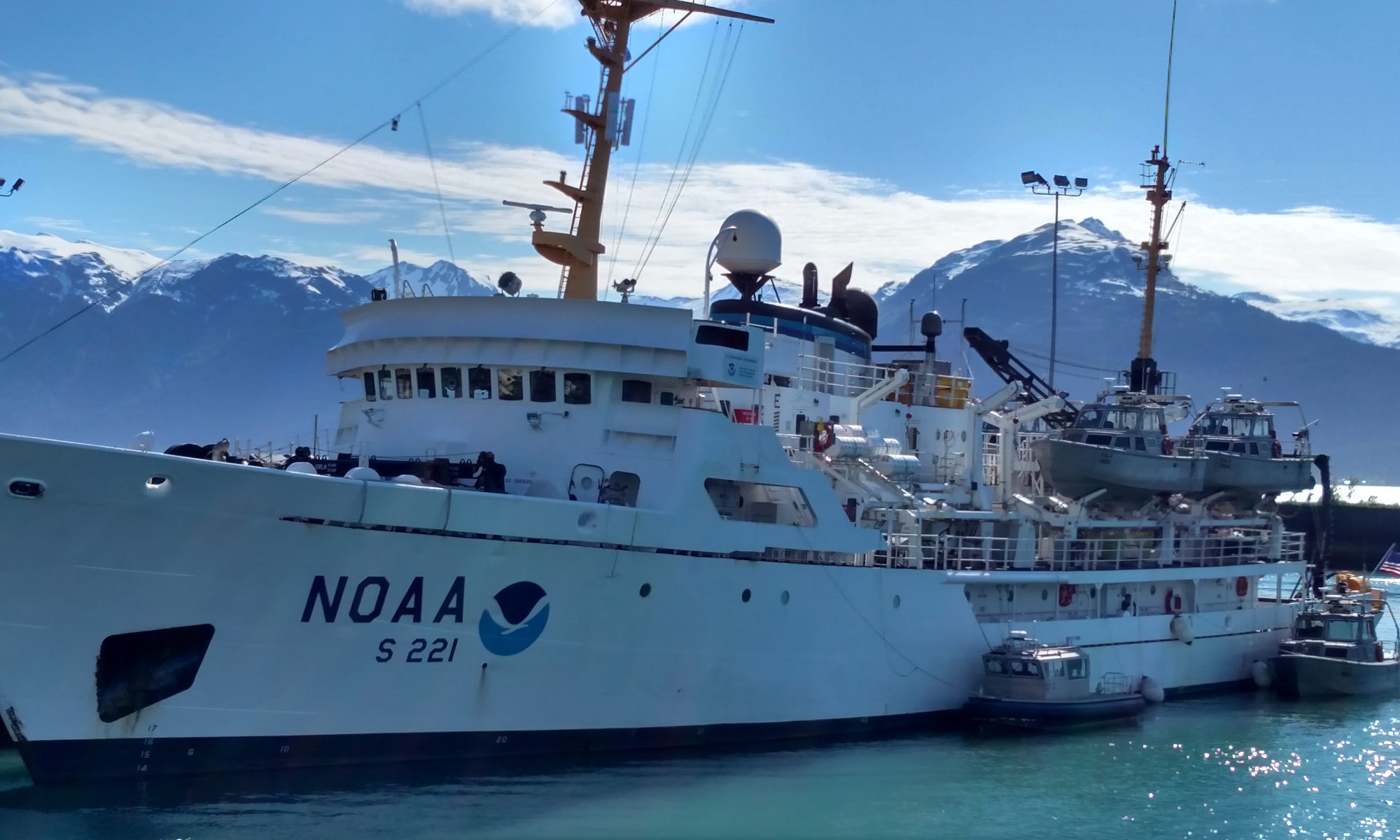
NOAA Ship Oscar Dyson
Mission: Pollock Survey
Geographical Area of Cruise: Gulf of Alaska
Date: 24 June 2011


Weather Data from the Bridge:
Latitude: 54.14 N
Longitude: -164.16
Wind Speed: 9.73 knots
Surface Water Temp: 7.0 degrees C
Water Depth: 92.75 m
Air Temp: 7.2 degrees C
Relative Humidity: 101%

Science & Technology Log:
I’ve been talking a lot about trawling for fish, and I realize that some of you may not know exactly what I’m talking about, so let me explain. Trawling is a fishing method that pulls a long mesh net behind a boat in order to collect fish. Trawling is used to collect fish for both scientific purposes (like we’re doing) and also in commercial fishing operations. We have two types of fish trawls onboard the NOAA Ship Oscar Dyson– a mid-water trawl net and a bottom trawl net. We’ve used both types throughout our cruise, so let me tell you a little about each.

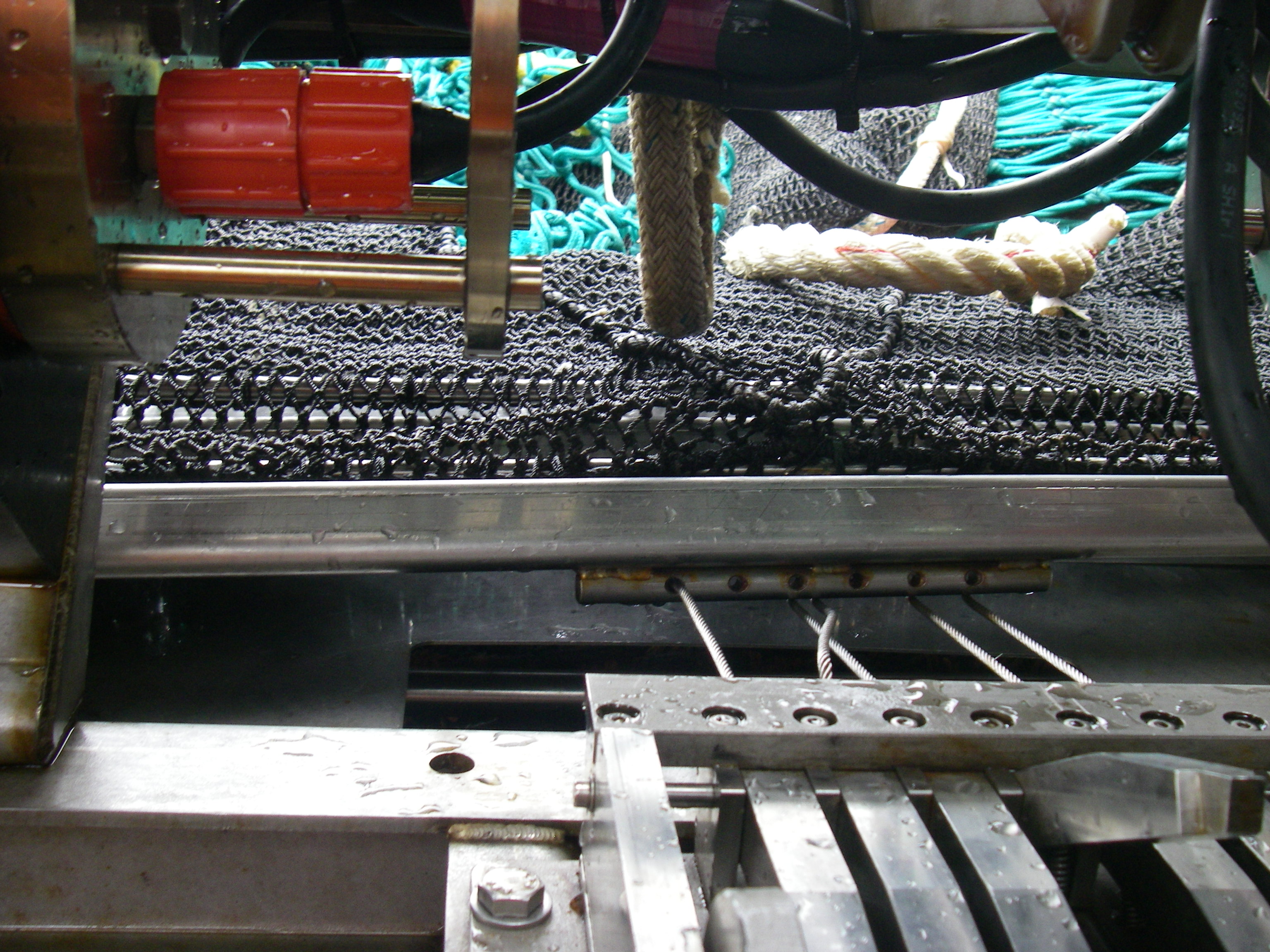
The mid-water trawl net is just as it sounds- it collects fish from the middle of the water column- not those that live on the seafloor, not those that live at the surface. The technical name for the net we have is an Aleutian Wing Trawl (AWT)- it’s commonly used by the commercial fishing industry. The end of the net where the fish first enter has very large mesh, which is used to corral the fish and push them towards the bag at the end. The mesh gets progressively smaller and smaller the further into it you go, and at the very end (where the collecting bag is), the mesh size is 0.5 inches. The end (where the bag is, or where the fish are actually collected) is called the codend. This is the kind of net we use when we want to collect a pollock sample, because pollock are found in the water column, as opposed to right on the seafloor (in other words, pollock aren’tbenthic animals). Our particular net is also modified a little from a “normal” AWT. Our trawl has three codends (collecting bags) on it- each of which can be opened and closed with a switch that is controlled onboard the ship. The mechanism that opens and closes each of the 3 codends is called the Multiple Opening and Closing Codend (MOCC) device. Using the MOCC gives us the ability to obtain 3 discrete samples of fish, which can then be processed in the fish lab. One other modification we have on our mid-water trawl net is the attachment of a video camera to the net, so we can actually see the fish that are going into the codends.

The MOCC apparatus, with the 3 nets extending off.
Part of the mid-water trawl net as it's being deployed.
Part of the mid-water trawl net as it’s being deployed.
The camera apparatus hooked up to the trawl.

When we spot a school of fish on the acoustic displays, we then radio the bridge (where the captain is) and the deck (where the fishermen are) to let them know that we’d like to fish in a certain spot. The fishermen that are in charge of deploying the net can mechanically control how deep the net goes using hydraulic gears, and the depth that we fish at varies at each sampling location. Once the gear is deployed, it stays in the water for an amount of time determined by the amount of fish in the area, and then the fishermen begin to reel in the net. See the videos below to get an idea of how long the trawl nets are- they’re being reeled in in the videos. Once all of the net (it’s VERY long- over 500 ft) is reeled back in, the fish in the codends are unloaded onto a big table on the deck using a crane. From there, the fish move into the lab and we begin processing them.

The end of the trawl net. These are the lines that basically hold on to the net!
The mid-water trawl net all reeled in.
One of the codends before being opened up.

The other type of trawl gear that we use is a bottom trawl, and again, it’s just as it sounds. The bottom trawl is outfitted with roller-type wheels that sort of roll and/or bounce over the seafloor. We use this trawl to collect benthic organisms like rockfish, Pacific ocean perch, and invertebrates. There’s usually a random pollock or cod in there, too. As I mentioned in my last post (“Today’s Catch”), the net can sometimes get snagged on rocks on the bottom, resulting in a hole being ripped in the net. Obviously, we try to avoid bottom trawling in rocky areas, but we can never be 100% sure that there aren’t any rogue rocks sitting on the bottom 🙂

The mesh and the wheels of the bottom trawl.
More of the bottom trawl.
The bottom trawl all reeled in.

Personal Log:
It’s been a quiet couple of days. On Wednesday, we didn’t see any fish until late in my shift, then we did a mid-water trawl. We ended up actually busting the bag- that’s how many fish we ended up collecting!! Once the codends were opened, we immediately began processing- first separating the pollock from everything else we caught. After sorting, I got to work on sexing the fish- it’s a kind of gruesome job, because you have to take a scalpel and cut them open (while they’re still alive!), exposing their innards- definitely NOT like the preserved organisms we dissect in class. I’m not a huge fan of cutting them open, so I moved on to measuring the length of the male fish- there were so many males in our catch, I was the last one working! After I cleaned up, that was the end of my shift. We were near some islands at the end of my shift, and the bridge called down to the lab to tell us that there some whales off the starboard side of the ship. I grabbed my camera and ran up to the deck, scanning the water for whales. Finally, I spotted a pod waaaay off the starboard side- they were too far off to get a good picture, and I couldn’t even tell what kind they were, but I was able to see them spouting water out of their blowholes, and it looked like one of them breached. The officers up on the bridge said they thought they were minke whales.

Thursday we didn’t see any fish (well, not enough to put our gear in the water) all day, so no fishing for me. Right now, it’s about 9:30 a.m. on Friday, and we’re just cruising to begin our next set of transects. I just read that there was an earthquake in the western Aleutian Islands last night- magnitude 7.2! Holy moly, I was just there! Apparently, people felt the earthquake as far east as Dutch Harbor on the island of Unalaska, and they had a tsunami warning go off. It’s crazy to think that I was in that area a couple days ago!

Question of the Day:

  • Speaking of tsunamis…What would cause the East Coast of the U.S. to be hit by a megatsunami?

Tammy Orilio, Today’s Catch, June 21, 2011

NOAA Teacher at Sea: Tammy Orilio
NOAA Ship Oscar Dyson
Mission: Pollock Survey
Geographical Area of Cruise: Gulf of Alaska
Date: 21 June 2011

Weather Data from the Bridge:
Latitude: 54.25 N
Longitude: -163.31 W
Wind Speed: 13.56 knots
Surface Water Temp: 7.5 degrees C
Water Depth: 69.38 m
Air Temp: 6.8 degrees C
Relative Humidity: 95%

Personal Log:
We did our (well, my) first bottom trawl today. The trawl net is outfitted with rollers/wheels that ride over the seafloor while the net collects benthic (bottom-dwelling) organisms. One thing I talk about in Marine 2 is how bottom trawling is damaging to the environment, and we definitely saw that firsthand today- there were quite a few rocks brought up in the net along with the animals. The seafloor was not as flat as we had hoped- in fact, the net ended up with a 4-foot hole ripped in it, which the deckhands/lead fishermen sewed for us later on in the day. Now, in the case of bottom trawling to collect scientific data, I don’t have a problem…but in the case of doing it for profit, as in the case of commercial fishing operations, I can’t abide by that. I would probably feel a little different if ALL we were doing was bottom trawls, but we’ve only done 2 so far, so…that’s how I’m rationalizing it. What’s your take on this? Should scientists damage an environment and/or kill organisms just to collect scientific data? And just so you know, the data we’re collecting on this survey is not just sitting around, completely useless- we are using it to actually help manage fish populations and regulate commercial fishing. The limits that all commercial fishermen have- how much they can legally take- are determined by knowing the current population status, and we can only learn that by seeing what’s out there, where things are, their age, what they’ve been eating, etc etc.
Following are some pictures of the animals from today’s bottom trawl.

Black Rockfish- we had some fried rockfish for dinner tonight!
Cushion star- also called Slime Star b/c it secretes slime when it's disturbed...which I discovered today!
Cushion star- also called Slime Star b/c it secretes slime when it’s disturbed…which I discovered today!
Fanellia compressa- a soft coral- it's pinkish/peachish in color
Fanellia compressa- a soft coral- it’s pinkish/peachish in color
Atka mackerel
Atka mackerel

One last thing…we went by Unimak Island today- it’s the easternmost of the Aleutians, which means that we will soon be re-entering the Alaskan peninsula- but we’re still a long way from Kodiak 🙂 Unimak Island has an active volcano on it called Shishaldin, and we were able to see it today. Pretty awesome!

Megan Woodward, July 10, 2009

NOAA Teacher at Sea
Megan Woodward 
Onboard NOAA Ship Oscar Dyson
July 1 – 18, 2009

Mission: Bering Sea Acoustic Trawl Survey
Geographical Area: Bering Sea/Dutch Harbor
Date: Tuesday, July 10, 2009

The pollock are carefully loaded onto the table.

Weather/Location 
Position: N 56.30.202; W 172.34.37
Air Temp: 7.4 (deg C)
Water Temp: 7.4 (deg C)
Wind Speed: 19 knots
Weather: Overcast

Science and Technology 

Once the fish are onboard a rigorous data collection process begins.  All of the data collected are recorded via instruments linked to a computer network in the fish lab.  Below is a series of photos showing the process used in the fish lab to collect valuable data.

Once the fish are on the table, we carefully look through the fish for any species other than pollock caught in the trawl.  These non-pollock species are sorted into bins and accounted for. The fish are weighed one basket full at a time as they reach the end of the conveyor belt.  Initially, we take a count of how many fish fill one basket.  There is a scale connected to a computer program that records the basket’s weight.

The sorting begins. The pollock are sorted between male and female.

After weighing the pollock, we move on to sorting a sample of approximately 300 fish by sex.  To find the sex of a fish we cut open its belly and look for either male or female reproductive organs. The sexed fish are then placed in the appropriate bin. Next, each pollock from the male/female sort is measured in centimeters.  We use a measuring board linked to a computer that records the size of each fish. There is a small tool in my hand that gets placed at the “v” of the fish tail.  Sensors on the board detect the placement of the measuring wand, and send a length measurement to the computer so it can be recorded.  This program also keeps track of how many fish we measure, so we get an accurate sample count.

The stomach of a pollock is prepared for preservation.

Several scientists have asked us to collect pollock for various research projects. One project, designed to study the diet of pollock, requires us to sex, measure, weigh and take the stomach of 20 pollock from each haul. A label with all of the information is placed in a bag with the stomach.  They are placed in a freezer for preservation purposes.

Here I am using the measuring board. The stomach of a pollock is prepared for preservation.
Here I am using the measuring board.

We also use a similar process for scientists examining one-year-old pollock. This study asks for the entire fish to be preserved, not a specific organ. In one 12-hour shift there is a maximum of 3 trawls if fish sign is identified in the acoustics lab. Each trawl takes 2 to 3 hours to process. It’s possible another trawl could happen while finishing up the data collection from the previous haul. This makes for a very busy, fish filled shift.

Personal Log 

I was in charge of weighing the fish!

Working in the fish lab has provided for a tremendous amount of new learning to take place. I’ve learned to identify species of fish that mix in with pollock (capelin, flatfish, skate and cod), and have seen several crustaceans and jellyfish, too.  All of the measuring technology has been straight forward and user friendly. Sexing the fish has been the most difficult job, but has become easier with practice. Examining the innards to identify male or female reproductive organs seems nearly impossible in the young fish, and it’s not always clear in the older fish.

Today I was in charge of weighing the fish as they came down the conveyor belt. I was certainly mistaken when I thought it would be a simple task. First off, I had to count the fish as they dropped into the basket at a speed faster than I could count. At the same time I had to control the speed of the belt and open the gate so more fish would move down the line.  When the basket was full, I stopped the belt and placed the full (semi-accurately counted) basket on the scale and waited for the scale’s “steady” signal to come on.  Since the boat is constantly in motion the steady light rapidly blinks on and off. It took me three tries before I managed to get the basket weighed.  Meanwhile the rest of the team patiently waited.  Maybe I’ll give it another try tomorrow.

This average sized skate was flapping his wings making him difficult to hold. Look closely at the fish on the conveyor belt and you will see hermit crabs and seastars.
Basketstars were brought up in a bottom trawl. Hermit crabs and snails were also caught in the bottom trawl.
Basketstars were brought up in a bottom trawl.
Hermit crabs and snails were also caught in the bottom trawl.
Hermit crabs and snails were also caught in the trawl.

Animals Seen 

  • Minke Whale
  • Skate
  • Pacific Cod
  • Tanner Crab
  • Snow Crab
  • Basketstar
  • Sturgeon Poacher
  • Snails
  • Hermit Crabs
  • Arrow Tooth Flounder

Ruth Meadows, July 5, 2009

NOAA Teacher at Sea
Ruth S. Meadows
Onboard NOAA Ship Henry B. Bigelow 
June 12 – July 18, 2009 

Mission: Census of Marine Life (MAR-Eco)
Geographical Area: Mid- Atlantic Ridge; Charlie- Gibbs Fracture Zone
Date: July 5, 2009

dumbo octopus
Dumbo octopus

Weather Data from the Bridge 
Temperature: 10.3o C
Humidity: 93%
Wind: 8.9 kts

Science and Technology Log 

Dr. Mike Vecchione holds a very large dumbo octopus from one of the deep sea trawls. This octopus got its name from the large fins that look like the ears of “Dumbo” the elephant. It is a benthic cephalopod (an ancient group in the phylum Mollusca) that lives above the floor of the ocean. It probably feed on copepods and other small crustaceans, but we don’t know much about its biology. This particular species (Cirrothauma magna) has only been caught a few times before.

a very large example of a slickhead
A very large example of a slickhead

John Galbraith and Tom Letessier hold a very large example of a slickhead. These fish are dark in color and their exterior is slippery. These soft-bodied soggy fish are common in waters greater than 1000m deep. They get their common name from the slimy look of their head. They lack a swim bladder and make themselves as light as possible by having weak bones and watery flesh. Chimeras are distantly related to sharks and rays and can be found at depths up to 2500m. These fish have cartilage instead of bones. We caught several of these in the benthic trawls, but this one was the largest.  Most of these fish have a venomous spine at the back of its dorsal fin.

This is a chimaera that weighed in at 12 kilograms.
Basti (from Germany) is holding another chimaera, Venda (from Portugal) has a slickhead and Meridith (from Boston) has a lizardfish from the last benthic trawl of the cruise.
Basti (from Germany) with a chimaera, Venda (from Portugal) has a slickhead and Meridith (from Boston) has a lizardfish.

Do You Know? 

What would happen between a shark and an octopus? Find out here.   

Mandi Gillespie, July 6, 2007

NOAA Teacher at Sea
Mandi Gillespie
Onboard NOAA Ship Oregon II
July 5 – 7, 2007

Mission: Summer Groundfish Survey
Geographical Area: Gulf of Mexico
Date: July 7, 2007

NOAA ship OREGON II at port waiting to set sail.

Weather Data from Bridge 
Visibility: n/a
Wind direction:243
Wind speed: 6.7 kts
Sea wave height n/a
Swell wave height: n/a
Seawater temperature: 26.8 C
Sea level pressure: 1016 mb
Cloud cover: n/a

Science and Technology Log 

This cruise’s mission is two fold: 1) stock assessment of fish and invertebrates and 2) mapping of the hypoxia zone. To assess the fish and invertebrate stock, a 40-foot bottom trawl net collects bottom samples from designated sites. The samples are gathered, identified, measured and weighed by the scientists on board the ship. Data collected is eventually used to set bag limits for fish and shrimp. To measure the hypoxic zone, equipment is deployed from the ship at specific sites. Dissolved oxygen level is collected. This data is used to map the Gulf of Mexico’s hypoxic zone.

Personal Log 

I arrived onboard the OREGON II on July 4th eager to set sail. However, we have been delayed because the auxiliary emergency generator onboard will not start. Once the generator functions properly, we will be able to set sail.

My position title is watch stander and am told training for my position is “on the job”. I am scheduled on the day shift which is 12:00 to 24:00. I look forward to fulfilling my duties as a watch stander to better understand how the samples are collected and processed.

Question of the Day 

What is a hypoxic zone?