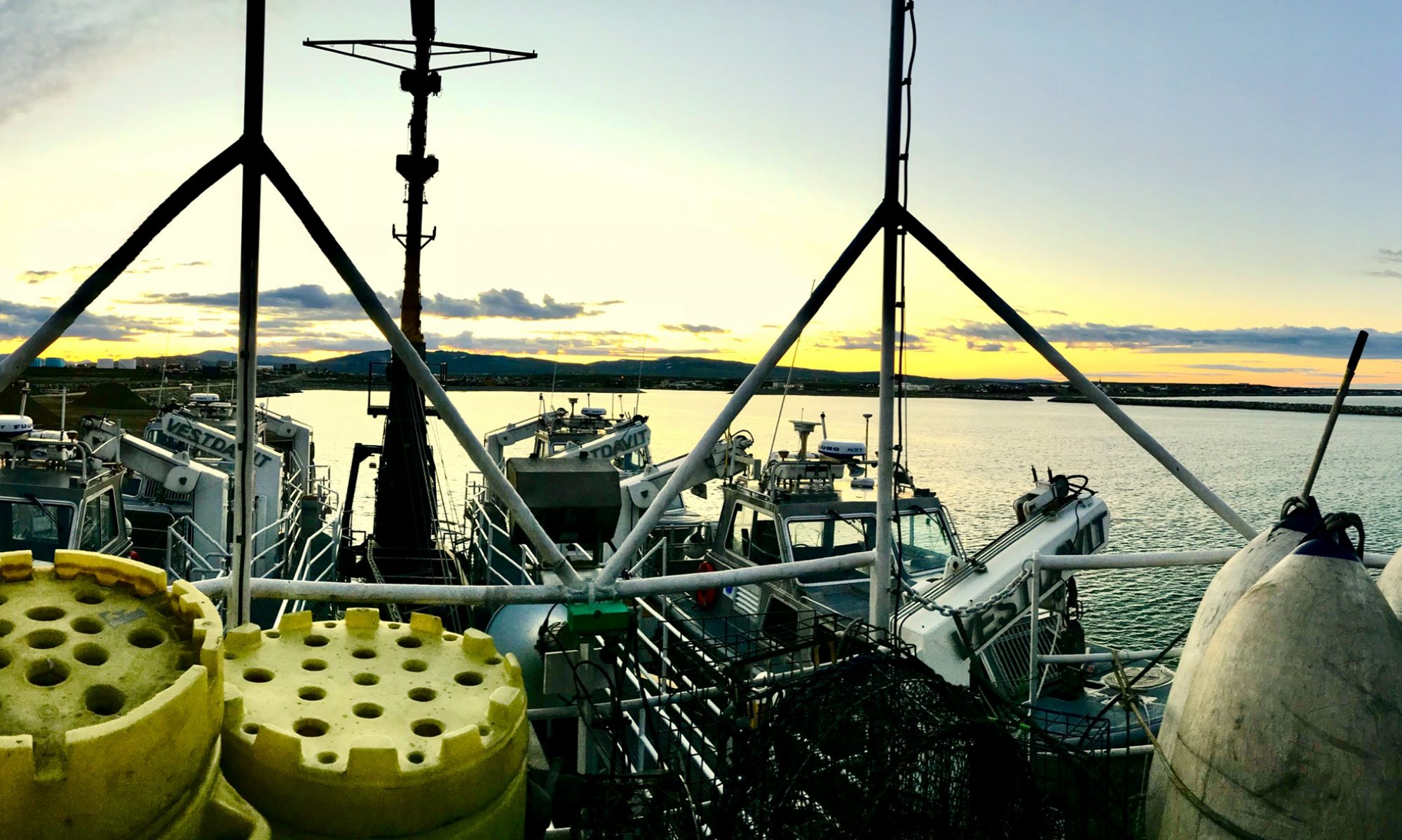
Nick Lee: Finding Fish, July 6, 2024

NOAA Teacher at Sea
Nick Lee
Aboard NOAA Ship Oscar Dyson
June 29 – July 20, 2024

Mission: Pollock Acoustic-Trawl Survey

Geographic Area of Cruise: Eastern Bering Sea

Date: July 6, 2024

Weather Data from the Bridge:

Latitude: 61° 15.0 N

Longitude: 174° 56.8 W

Wind Speed: 13 knots

Air Temperature: 5.3° Celsius (41.5° F)

Science and Technology Log:

On NOAA Ship Oscar Dyson, the science party’s mission is to understand the population of walleye pollock in the Eastern Bering Sea. To collect data, scientists rely on two main tools: acoustics and targeted trawling. Before any trawling can happen, scientists must first locate fish using acoustics, so I’ll be focusing on acoustics in this blog post – stay tuned for a post on trawling next time!

Scientists use two kinds of acoustics: active and passive. Many of my students are familiar with how bats use echolocation to navigate in the dark – active acoustics relies on the same principle. First, the echosounder on the ship emits a pulse of sound, or ping. This sound travels through the water and bounces off of objects that have different densities than water (such as fish, krill, or the ocean floor). The echosounder then “listens” for and records these echoes, also known as backscatter. Passive acoustics work similarly, except the echo sounder only listens for sound and doesn’t emit any itself.

illustration of a pulse of sound, depicted as a triangle, emanating from the bottom of a ship at the surface of the ocean. the triangle encompasses some of the sea creatures swimming by (depicted as simple white silhouettes) and ends at the ocean bottom.
The echosounder emits a pulse of sound, which gets reflected by objects of different densities, like pollock. Image Credit: Wieczorek, Schadeberg, Reid (2021) “How do Scientists Use Sound to Count Fish in The Deep Sea?” Frontiers for Young Minds. https://kids.frontiersin.org/articles/10.3389/frym.2021.598169

The greater the distance between the echo sounder and the object reflecting the pulse, the greater the amount of time between when the signal was emitted and backscatter. Based on this time, echosounder can determine the depth of the object producing the backscatter. This information is represented visually in an echogram:

Screenshot of an echogram. Backscatter is depicted as colored dots on a grid. in this case, the dots are densest and darkest at the shallowest depths (the ship bottom) and the deepest depths (the hard ocean botttom)
Screenshot of an echogram. The space between vertical grid lines represents 100 pings, and the space between horizontal grid lines represents 10 meters of depth.

The echogram shows depth on the y-axis and time on the x-axis. The intensity of backscatter is color-coded, where more intense backscatter is represented with red and brown, and less intense backscatter is represented with blue and green. The vertical grid lines represent all the backscatter from one ping, and the space between lines represent 100 pings.

On the cruise, pings are typically emitted at a rate of 1 Hz, or once every second. With every new ping, the echo sounder adds data to the right end of the echogram. This means that the horizontal grid lines represent the backscatter at one depth over time (or distance, if the ship is traveling at a constant speed).

At least one scientist monitors the backscatter throughout the duration of the transect. During the first day, the echogram was blank except for some lower-intensity backscatter near the surface and high-intensity reflection from the ocean floor. Because the mission of this cruise is to survey pollock, which tend to live at greater depths, we don’t pay much attention to the backscatter near the surface which is comprised of smaller organisms like krill. However, when scientists notice backscatter consistent with scattering from pollock, they may trawl to collect a sample for more detailed biological information.

Screenshot of two echograms showing low-intensity backscatter and high-intensity backscatter.
Echograms from two different locations showing low-intensity backscatter (left) and high-intensity backscatter (right). When the backscatter looks as it does on the right, the science team may decide to fish in that area.

As we traveled along the first transect line, there was very little backscatter that the science team thought represented pollock. Our CTD (conductivity, temperature, depth) measurements also showed that the water temperature was cold, right around freezing. This may suggest that we were traveling through the Bering Sea cold pool, a mass of cold water that forms from melting ice. This water tends to be too cold for pollock and other fishes, however, other animals, such as snow crabs, can still survive the lower temperatures. Fish like cod prey on snow crab, so the cold pool offers these crab an important refuge from predators. Read more about the importance of the cold pool for crab here!

GIF showing historical bottom temperatures in the Bering Sea from 1983 to 2018. The years 2015, 2016, and 2018 are notably warm.
Historical bottom temperature showing cold pool in blue / purple (Image Credit: NOAA Fisheries)

Personal Log:

The start of the cruise has been busy learning new faces, maritime practices, and scientific terms. However, in the past few days, with the help of meclizine (seasickness medication), I’ve begun to feel more settled and like I have some sense of routine.

When I’m on shift, I bounce around between a few different places. The science team tends to be in the acoustics lab, where we monitor backscatter and make decisions on when to fish.

Photo of the acoustics lab. Computers and many computer screens mounted on the wall above a long desk.
Acoustics lab, also called “the cave” for its lack of windows.

Once the scientists decide to fish, we first go up to the bridge, where NOAA officers control the direction and speed of the ship. The bridge has windows on all sides, so we’re able to make sure there are no marine mammals before putting the net in the water.

From the bridge, you can also see the trawl deck, where the deck crew works in collaboration with NOAA officers to put the net in the water. Once the fish are caught and hauled back to the ship, the science team processes the catch in the fish lab.

When we’re not working, we’ll grab food from the galley / mess deck. The stewards on the ship serve three meals a day, but since I’m on the night shift, I often heat up leftovers or take advantage of the wide selection of snacks they leave out. There’s also a lounge, two gyms, and places to do laundry while at sea!

Photo of the galley, the ship's cafeteria. Tables and chairs, a refrigerator. Chair legs are capped with tennis balls to reduce sliding.
The galley, where food is available 24 hours a day!

Did you know?

NOAA Ship Oscar Dyson  has six onboard laboratories including a wet lab, dry lab, electronics lab, bio lab, acoustics lab, and hydrographics lab. Read more about the ship here!

Nick Lee: First Days at Sea, July 2, 2024

NOAA Teacher at Sea

Nick Lee

Aboard NOAA Ship Oscar Dyson

June 29 – July 20, 2024

Mission: Pollock Acoustic-Trawl Survey

Geographic Area of Cruise: Eastern Bering Sea

Date: July 2, 2024

Weather Data from the Bridge:

Latitude: 59° 54.8 N
Longitude: 171° 54.9 W
Wind Speed: 14 knots
Air Temperature: 5.0° Celsius (41° F)

Science and Technology Log:

We’ve been sailing for just under two days, and I’ve already had an opportunity to witness lots of science aboard NOAA Ship Oscar Dyson

We spent the first day transiting to the start of the survey – I am part of Leg 2 for this cruise, and so we are picking up where Leg 1 left off. Since we won’t be able to find every pollock in the Bering Sea, we will need to rely on a representative sample, and then our data will be used to estimate the total stock.

The map below shows the intended path of our cruise, and the vertical lines represent transects, or lines along which we will collect data, spaced 40 nautical miles (or 74 km) apart so that we can cover the entire region with the time we have. Since we just recently arrived at the start of our survey, I’m still learning about the different data the science team will be collecting – more on that in a future blog post!

nautical chart of the Bering Sea, showing the land of Alaska to the east and a portion of Russia in the northwest. The cruise trajectory is overlaid in bold blue or red lines, with north-south transects connected by shorter westward connections. The blue transects start in Dutch Harbor and head west; the red transects are farther west
Map of the survey with the portion that I’ll be participating in shown in red, and the portion that has already been completed in blue.

On our way to our survey site, I was able to launch a drifter buoy through NOAA’s Adopt-a-Drifter Program. Unlike some other buoys, a drifter buoy is not fixed to the ocean floor. Instead, they float and “drift” with the ocean currents. Importantly, drifters are equipped with some sort of drogue – an underwater anchor. This way, the surface float (and the drogue) will move with ocean currents, but won’t be influenced as much by wind.

illustrated diagram of a drifter buoy. a white ball floats at the water line; this is labeled "Surface float - designed for moving on the surface with currents." The float has an Antenna, labeled: "the drifters transmit the data they collect as well as their position via satellite." Data is depicted as a gray triangle extending up from the antenna to a satellite in the sky, which is communicating with a satellite dish on land. Beneath the float, down into the water, extends a black cable, thicker toward the float. It's labeled: "Sensors: Sea Surface Temperature sensor and various measuring systems." The cable connects to what appears to be gray cylindrical tube, waving in the water labeled "Drogue: The buoys have some form of subsurface drogue or sea anchor."
Drifter Buoy diagram (Image Credit: NOAA Adopt a Drifter Program)

Deploying a drifter is as simple as dropping it into the ocean! I was able to deploy our first drifter last night off the stern (back of the ship). Our drifter was wrapped in biodegradable packaging for a safe deployment, but once in the water it should have opened up and extended to its full length.

a repeating video clip of Nick starting to toss the drifter buoy over the rail of NOAA Ship Oscar Dyson. he is wearing a helmet and a life vest, and looking away from the camera.
Deploying an ocean drifter.

Once deployed, the drifter transmits its location via satellite, and scientists are able to use this data to better understand ocean currents. You can track my drifter’s trajectory here!

In addition to a GPS that tracks location, drifters are often equipped with sensors for temperature, pressure, salinity, and more. Below is the path my drifter took in its first day after deployment, and the sea temperatures it encountered.

a map of a small section of the ocean between 191.2 to 192.0 degrees W and 55.4 to 56.2 degrees N. A series of colored squares form a small spiral in the middle; the squares range in color from orange to purple. Beneath the map there's a key explaining that the colors indicate temperature, ranging from purple (6 degrees Celsius) to red (7 degrees Celsius.)
Drifter trajectory and sea surface temperature.

I also was able to observe the deployment of a CTD (conductivity, temperature, and depth) sensor. CTD measure some of the same properties as drifters, but CTDs are lowered down into the water and then raised back into the boat. This means that CTDs only collect data at one geographic location at a time, however, they collect data throughout the entire water column, from the surface down to the ocean floor (~80 meters at our last deployment). CTDs can also collect water samples at different depths, allowing scientists to study them further. NOAA has a great resource on CTDs here!

view of the conductivity, temperature, and depth probe (in the center of a cylindrical metal apparatus) suspended from a cable just beyond the railing of the ship; it is about 10 feet above the ocean's surface at this point. in the distance, the sky is gray and cloudy, and the ocean is gray and calm.
CTD being lowered to collect data.

Personal Log:

When I applied to NOAA’s Teacher at Sea Program, I was told that one thing that was required of all its participants was flexibility. This is especially true for cruises leaving from Dutch Harbor, where bad weather and flight cancellations are common. On this leg, a series of travel delays meant that we left port a day later than expected. However, this meant that I was able to spend some time exploring Dutch Harbor!

Dutch Harbor is one of the most remote and beautiful places I’ve ever visited. During my wanderings around the town, I spotted whales, a fox, and plenty of bald eagles. Alaska’s military history is also apparent in the hills surrounding Dutch Harbor, which are full of World War II bunkers.

Since we left port, there’s been a lot to adjust to about living on a ship. The ship is a bit of a maze – lots of narrow hallways and hidden staircases. After making a lot of wrong turns, I’m starting to get a sense of the layout.

Work happens on the ship at all hours of the day – I’ve been assigned the night shift (4 pm – 4 am), so as a natural morning person, I’ve completely changed my sleep schedule! Because someone is always working, that also means that someone is always trying to sleep, so I’ve learned to be careful about not letting doors slam behind me.

view of a stateroom: two berths (bunk beds), a chair, a window with curtains, a hiking backpack and a bag.
My stateroom for the next three weeks.

This morning, we practiced our first set of safety drills. To simulate what would happen if we needed to abandon ship, everyone was required to don a survival suit (also called a “Gumby suit”). It was quite a process to put on the suit – luckily one of the other scientists, Mike, gave me some pointers ahead of time!

Nick poses, thumbs up, for a photo in the survival suit; it covers his mouth and nose
Gumby suit

I’m looking forward to learning more about life at sea over the next few weeks!

Did You Know?

NOAA Ship Oscar Dyson was named after an Alaskan fisherman and activist who worked to improve the industry for other Alaskans (https://www.omao.noaa.gov/marine-operations/ships/oscar-dyson )

Joan Shea-Rogers: Do You See What We See, July 10, 2018

NOAA Teacher at Sea

Joan Shea-Rogers

Aboard NOAA Ship Oscar Dyson

July 1-22, 2018


Mission: Walleye Pollock Acoustic Trawl Survey

Geographic Area of Cruise: Eastern Bering Sea

Date: July 10, 2018


Weather Data from the Bridge

Latitude: 53ºN

Longitude: 166ºW

Sea Wave Height: 1.5 feet

Wind Speed: 25 knots

Wind Direction: SW

Visibility: 15 Miles

Air Temperature: 52º F

Barometric Pressure: 1010.61mb

Sky: Overcast

Biological Trawl Data:

Letting the Net Out to Sea

Trawl hauls are how fishing is conducted. A large net is dropped into the water for a specific amount of time. By catching exactly what is in the ocean, the acoustic backscatter can be identified (what the various colored pixels on the echograms represent). Below is an echogram on the screen, the black line is the path of the trawl through the backscatter, the little red circle indicated where the camera was, and the picture at left is pollock passing by the camera and into the back of the net at that point.

Echogram
Screenshot of an echogram. The black line is the path of the trawl through the backscatter, the little red circle indicates where the camera was, and the picture at left is pollock passing by the camera and into the back of the net at that point.

Samples of pollock and other organisms can be studied and other biological data collected. By counting, measuring, and weighing the pollock and other animals caught in each haul, calculations can estimate the amount of fish in a given area. Acoustic data can be used to determine the number of fish by dividing the measured backscatter by the backscattered energy from one fish (target strength, discussed in the last blog). That gives the number of fish:

To get the backscatter from one fish for the above calculation, we need to know the size and species of the fishes. The trawl provides that information. In the fish lab, species including pollock are identified, lengths are taken, and the number of fish at each length is entered in the computer. Also, the animals including pollock are weighed and a mean weight is determined. The number of fish computed from the acoustic and trawl data multiplied by the mean weight of a fish equals the biomass of the fish (total weight of the population in a given area).

The fisheries biologists developed the software used for all these calculations. This information coupled with the echograms can answer those earlier questions…Where are the pollock in the Bering Sea? How many are there? How big are they? How many adult pollock are there (fish that can be caught) and how many young pollock are present (providing information about future availability and how healthy the population is)?

When I first boarded the ship, I asked the fisheries biologists how they would describe what they do. They responded that they count fish, it’s not rocket science. But you know what? It kind of is!


At Work in the Fish Lab
TAS Joan Shea-Rogers at work in the Fish Lab


What is this information used for?

This information is used to manage the Pollock fishery. Numerical data is given to the entities that set the fishing quotas for the Bering Sea area. Quotas are then divided up between the commercial and individual fishing companies/boats. Once fishermen reach these quotas they must stop fishing. This protects the fishery to ensure that this food source will be healthy and strong for years to come. A similar example from my home state is that of the Illinois is the Department of Conservation. One of their responsibilities is to manage the deer population. Then they can determine how many deer can be harvested each season that still allows for the deer population to thrive.


Personal Blog:

In my last blog post, I talked about preparing for and “weathering the storm”. As with most things at sea and on land, things don’t always turn out as we plan. The stormy weather began with wave heights between 8-10 feet. The ship continually rocked back and forth making walking and everything else difficult. You can tell the experienced sailors because they were much more graceful than I was. I held on to every railing and bolted down piece of furniture that I could. And even then, I would forget and place a pen on the table, which immediately rolled off. While eating I held onto my glass and silverware because as I ate and placed my knife on my plate it rolled off. Dressing was a balancing act, which I was not good at. I finally figured out it was better if I sat in a chair. Luckily for me, my patch for seasickness worked.

While I was sitting in the mess hall (dining room) an alarm rang. The engineers got up read the screen and left. The decision was made by the acting CO (Commanding Officer) that we would have to go back to Dutch Harbor. And now, as I write this, we are docked in Dutch Harbor waiting for word about the status of our voyage. Out here in Dutch Harbor, everything must be shipped in. We wait until parts and people are flown in. The fisheries biologists also have to determine the validity of the data collected on such a short voyage. They also must decide in a timely matter, can this data collection continue after returning to port?

For me, I am holding out hope that all these factors are resolved so that we can go back out to sea. Since November when I turned in my application, this voyage has been such a focal point of my life. If it doesn’t work out (I’ll try not to cry), I will still have had the adventure and learning experience of a lifetime. So here’s hoping……

NOAA Ship Oscar Dyson at Port in Dutch Harbor, AK


Joan Shea-Rogers: Do You Hear What They Hear, July 8, 2018

NOAA Teacher at Sea

Joan Shea-Rogers

Aboard NOAA Ship Oscar Dyson

July 1-22, 2018

Mission: Walleye Pollock Acoustic Trawl Survey

Geographic Area of Cruise: Eastern Bering Sea

Date: July 8, 2018

Weather Data from the Bridge

Latitude: 53º N

Longitude: 166ºW

Sea Wave Height: 1.5 feet

Wind Speed: 25 Knots

Wind Direction: SW

Visibility: 15 miles

Air Temperature: 52ºF

Water Temperature: 46º F

Barometric Pressure: 1010.61mb

Sky: Overcast

Science and Technology Log

What kinds of fish live in the Bering Sea? How many pollock are in the Bering Sea? Where are the pollock in the Bering Sea? How big are the pollock in the Bering Sea?

Those are just a few of the questions that the fisheries biologists on NOAA Ship Oscar Dyson work to answer during each voyage. In my last blog, I talked about the need to manage the pollock fishery in order to protect this important ocean resource because it provides food for people all over the world. It is important, then, to be able to answer the above questions, in order to make sure that this food source is available each year.

How do they do it? There are two main sources of information used in the Acoustics-Trawl (or Echo Integration Trawl) survey to determine the abundance and distribution of pollock in a targeted area of the Bering Sea. One is acoustics data, and the other is biological-trawl data.

Acoustics:

Acoustic data is continuously collected along a series of parallel transects with a Simrad EK60 scientific echo integration system incorporating five centerboard-mounted transducers (18-, 38-, 70-, 120-, and 200- kHz). In other words: There are 5 sound wave producers (transducers) attached to the bottom of the ship, each one emitting sound waves at different frequencies. This allows scientists to look at different organisms in the water column. Different types of organisms reflect different amounts of energy at different frequencies. The amount of acoustic energy reflected by an individual animal is called the target strength, and is related to the size and anatomy of the species. For example, a fish with a swimbladder (like pollock) reflects more energy than a fish without a swimbladder because its properties are very different from the surrounding water. Some ocean dwelling organisms don’t have swim bladders. Flatfish stay on the bottom so they don’t need the buoyancy. Floating organisms like jellyfish don’t have them. These organisms will look differently than pollock on an echogram because they have a smaller target strength.

Transducer
Transducer

Transducers convert mechanical waves (sound waves) into an electrical signal and vice versa (like both a loudspeaker and a microphone combined). They contain piezoelectric materials sensitive to electricity and pressure: if a voltage is applied to them, they make a pressure or sound wave (transmit), and when a sound wave passes over them, it produces a voltage (receive). When a sound wave (echo from a fish) is received, electoral signal is sent to a computer, which displays the signals as pixels of varying colors as the ship moves along (depth changes up and down on the left of the image, and time and location changes along the bottom of the image). This datum is used to estimate the number and type of fish in the water column, and to determine where the ship should fish next.

The size and colors on the images (called echograms) represent the backscatter at different depths and is related to the density of fish and their target strength. But, since they are dots on a screen, specific identification is not possible. The scientists assume certain strong signals are pollock based on the information they have but, those dots could be other fish. To determine what kind of fish are in the water column at this location, how many are there, and how big they are, other data must be obtained. Biological Trawl Data provides that additional information. More about that in my next blog post……I bet you can’t wait!

Personal Log

The Calm Before the Storm:

So far my trip has been smooth sailing, literally. As NOAA Ship Oscar Dyson sails across the Bering Sea there is a bit of rocking the ship experiences at all times. This is easy enough for one to get used to and sometimes it even becomes comforting, like being rocked to sleep as a child. You adjust to the motion. Over the past couple of days I have been hearing talk of a storm coming our way. On a ship, there are many preparations that occur in order to get ready for a storm. Many items are always secured, such as shelves that have a wall in front so that things don’t fall off. There are “handle bars” in showers and next to toilets (think about that). Along hallways and stairways there are handrails on each side. Mini refrigerators in staterooms are bolted to walls. In fact most things are bolted to walls or stored in containers that are bolted to the wall. In the mess hall (dining room) condiments on tables are in a box so they can’t slide off.

Why do you think this coffee mug is shaped like this (wider at the bottom than the top)?


At-Sea Coffee Mug
At-Sea Coffee Mug

Ans. The wider bottom of the mug above prevents it from sliding as the ship rocks.

Our bulletin board reminds us to secure for bad weather. This morning, I put small items in drawers, stowed books on shelves and packed my equipment (phone, laptop, camera, chargers and small items in a backpack that can be safely secured in my locker (the “closet” in my stateroom).

In talking to my shipmates with at sea experience, I am getting lots of helpful hints about storm preparations and strategies to use during the storm. Here are some of those suggestions:

*always hold on to railings with both hands when walking or going up steps. At all other times, remember to keep one hand for you (to do whatever you are doing) and one hand for the ship (to hold on).

*keep something in your stomach at all times, even if you are not feeling well

*eat saltines

*drink lots of water

*when sleeping in your bunk, place pillows between you and the edge so as not to roll off (I will definitely follow this one, as I am on the top bunk) It also depends upon which direction the ship is rolling. Pillows may need to be put between your head and the wall to prevent head bumps

*go to the lower parts of the ship because the top part will sway more with the waves

I also have been wearing patches to prevent seasickness. Hopefully they will continue to help. Only time will tell how we weather the storm (pun intended). Let’s hope it moves through quickly.


Victoria Obenchain: Launching Boats, July 9, 2018

Teacher at Sea Blog

Victoria Obenchain

Aboard NOAA Ship Fairweather

June 25 – July 6, 2018

Mission: Arctic Access Hydrographic Survey

Geographic Area of Cruise: Northwest, Alaska

Date: July 9, 2018

Science and Technology Log

My last few days at sea were rather exciting.  Wednesday, I got to attend some medical training necessary at sea in the morning, and then in the afternoon we practiced safety drills. The whole crew ran through what to do in the case of three different ship emergencies: Fire, Abandon Ship and Man Overboard.  These drills were pretty life-like, they had a fog machine which they use to simulate smoke for the fire drill. Once the alarm was triggered people gather in their assigned areas; roll was taken, firemen and women suited up and headed to the location where smoke was detected, and from there teams are sent out to assess damage or spreading of the fire, while medical personnel stood prepared for any assistance needed. The abandon ship drill required all men and women on board to acquire their life preserver and full immersion suit, and head to their lifeboat loading locations. Roll is then taken and an appointed recorder jots down the last location of the ship. Once this is done, men and women would have deployed the life rafts and boarded (luckily we did not have to). And for the man overboard drill they threw their beloved mannequin Oscar overboard in a life vest and had everyone aboard practice getting in their look out positions. Once Oscar was spotted, they turned the ship around, deployed an emergency boat and had a rescue swimmer retrieve him.

Fast Rescue Boat
Deployed emergency boat for rescue of the beloved mannequin, Oscar.

These drills are necessary so that everyone on board knows what to do in these situations. While no one hopes these emergencies will happen, knowing what to do is incredibly important for everyone’s safety.

Thursday was maybe my favorite day on board. Due to the fact that there are a handful of new personnel on board, practice launching and recovering the survey launch boats was necessary. There are 4 launch boats on top of NOAA Ship Fairweather, each equipped with their own sonar equipment. These boats sit in cradles and can be lowered and raised from the sea using davits (recall the video from the “Safety First blog a few days ago). These four boats can be deployed in an area to allow for faster mapping of a region and to allow for shallower areas to be mapped, which the NOAA Ship Fairweather may not be able to access.  Since this is a big operation, and one which is done frequently, practice is needed so everyone can do this safely and efficiently.


With the aid of Ali Johnson as my line coach, I got to help launch and recover two of the survey launch boats from the davits on the top of the ship into the Bering Sea. This is an important job for all personnel to learn, as it is a key part of most survey missions. Learning line handling helps to make sure the survey launches are securely held close to the ship to prevent damage and to safely allow people on and off the launch boats as they are placed in the sea.  From learning how to handle the bow and aft lines, to releasing and attaching the davit hooks, and throwing lines from the launches to the ship (which I do poorly with my left hand), all is done in a specific manner. While the practice was done for the new staff on board, it was fun to be involved for the day and I got to see the beauty of the NOAA Ship Fairweather from the Bering Sea.

And I truly enjoyed being on the small launch boats. I then understood what many of the officers mentioned when they told me they enjoyed the small boat work. It’s just fun!


My trip ended in Nome, Alaska, which was in and of itself an experience. Students, you will see pictures later.  I am extremely thankful for the crew on board NOAA Ship Fairweather, they are a wonderful mix of passionate, fun professionals. I learned so much!

Personal Log

Being a Teacher at Sea is a strange, yet wonderful experience. Being a teacher, I normally spend the vast majority of my day at work being in charge of my classroom and beautiful students; leading lesson and activities, checking-in with those who need extra help and setting up/tearing down labs all day, as well as hopefully getting some papers graded. However during this experience, I was the student, learning from others about their expertise, experience and passions, as well as their challenges; being in charge of nothing.  And given that I had no prior knowledge of hydrography, other than its definition, I was increasingly impressed with the level of knowledge and enthusiasm those on board had for this type of work.  It drove my interest and desire to learn all I could from the crew. In fact, I often thought those on board were older than they were, as they are wiser beyond their years in many area of science, technology, maritime studies, NOAA Ship Fairweather specifics and Alaskan wildlife.

Crew of NOAA Ship Fairweather

NOAA offers teachers the opportunities to take part in different research done by their ships throughout the research season as a Teacher at Sea. The 3 main types of cruises offered to teachers include (taken from the NOAA Teacher at Sea website):

  • Fisheries research cruises perform biological and physical surveys to ensure sustainable fisheries and healthy marine habitats.
  • Oceanographic research cruises perform physical science studies to increase our understanding of the world’s oceans and climate.
  • Hydrographic survey cruises scan the coastal sea floor to locate submerged obstructions and navigational hazards for the creation and update of the nation’s nautical charts.

I was excited to be placed on a Hydrographic Survey boat, as this is an area in my curriculum I can develop with my students, and one which I think they are going to enjoy learning about!

While I was sad to leave, and half way through had a “I wish I would have known about this type of work when I was first looking at jobs” moment (which I realize was not the goal of this fellowship or of my schools for sending me), I am super excited to both teach my students about this important work and also be a representative of this awesome opportunity for teachers. I will wear my NOAA Teacher at Sea swag with pride!

Teacher at Sea gear!
Me in my awesome Teacher at Sea gear!