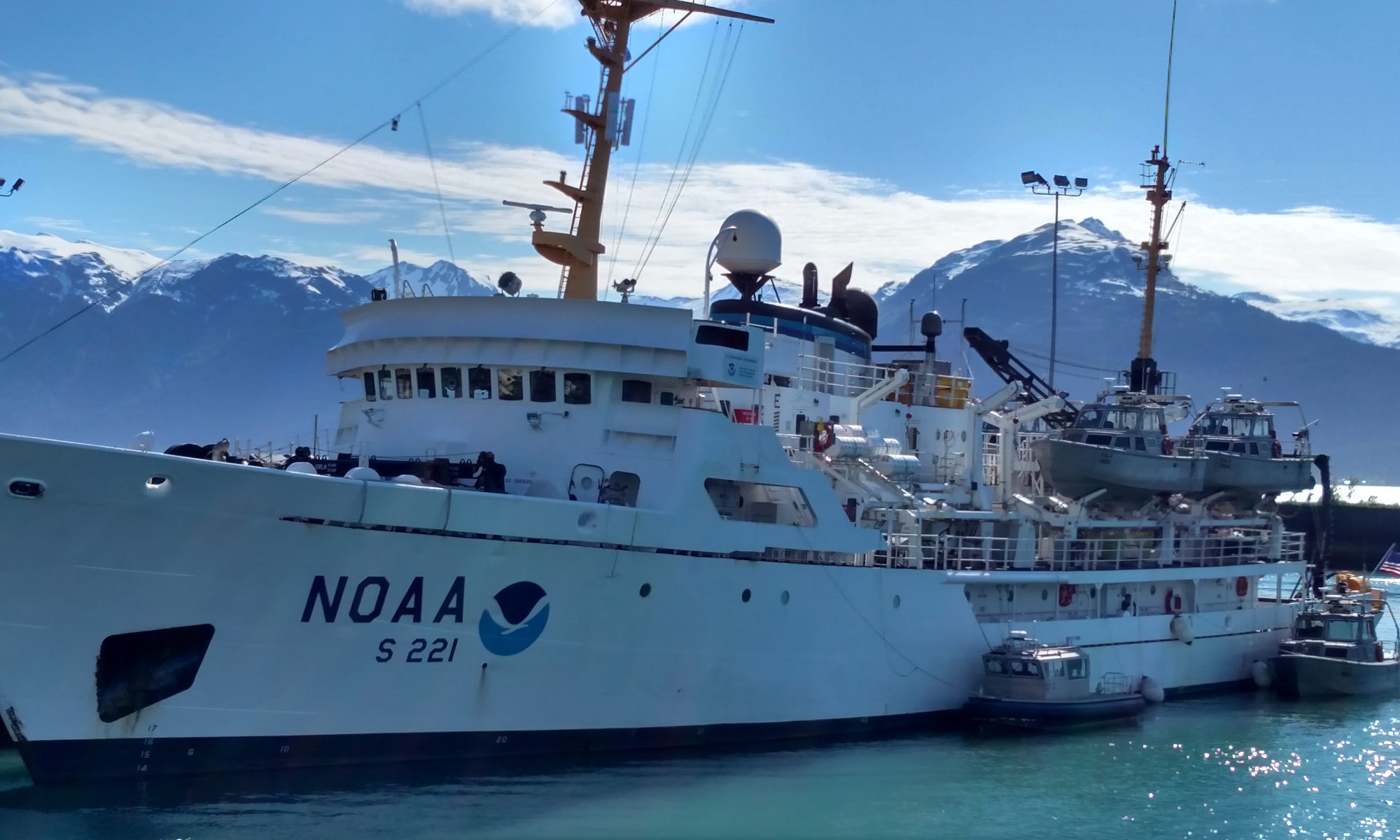
Caroline Singler, August 7-9, 2010

NOAA Teacher at Sea: Caroline Singler
Ship: USCGC Healy

Mission: Extended Continental Shelf Survey
Geographical area of cruise: Arctic Ocean 41 miles north of Alaska
Date: 9 August 2010

Seeing the Bottom — 7 August 2010

It’s taken me several days to write and post this entry. I wanted to learn more about the sonar technology that we are using for the bathymetric mapping, then we lost internet early on the morning of 8 August 2010 while heading north in the Beaufort Sea. This happened at about the same time as we started encountering heavy ice, but I do not believe that the two events were related. I am including location and weather data for several days to give you a sense of where we were and where we are heading as well as the physical changes in our environment.Thankfully, email works even when internet does not – it took my non-IT oriented mind a while to wrap itself around that concept. While I am out of range, my dear sister Rosemary has agreed to post for me as long as I can get emails to her. (Thanks, Ro!) You already have her to thank for the polar bear post. Please keep emailing and/or posting comments. I look forward to reading comments when I come home.
Location and Weather Data from the Bridge
Date: 7 August 2010 Time of Day: 1400 (2:00 p.m.) local time; 22:00 UTC
Latitude: 70º47.6’N Longitude: 142º42.3’W
Ship Speed: 15.1 knots Heading: 111º (southeast)
Air Temperature: 5.1ºC /41.6ºF
Barometric Pressure: 1005.3 millibars
Humidity: 87 .9%
Winds: 27.7 Knots NE
Sea Temperature: 2.3ºC
Salinity: 20.22 PSU (practical salinity units)
Water Depth:1270 .8 mDate: 8 August 2010
Time of Day: 1245 (12:45 local time); 20:45 UTC
Latitude: 72º12.72’N
Longitude: 138º28.7’W
Ship Speed: 7.7 knots
Heading: 36.2º (NE)
Air Temperature: 0.5ºC /32.9ºF
Barometric Pressure: 1012.7 millibars Humidity: 86.3%
Winds: 19.3 Knots NE
Wind Chill: -7.48ºC/18.53ºF
Sea Temperature: -1.2ºC Salinity: 25.5 PSU
Water Depth:2547.8 mDate: 9 August 2010
Time of Day: 1530 (3:30 local time); 22:30 UTC
Latitude: 72º 29.8’N
Longitude: 139º 40.9’W
Ship Speed: 6.3 knots
Heading: 183.5º (SSW)
Air Temperature: -0.03ºC /31.94ºF
Barometric Pressure: 1009.7 millibars Humidity: 92.2%
Winds: 17.7 Knots NE
Wind Chill: -6.02ºC /21.17ºF
Sea Temperature: -1.2ºC Salinity: 25.08 PSU
Water Depth:2969.0 mScience and Technology Log
The primary objectives of the science mission are to map the seafloor and image the underlying sediments. Bathymetry is the measurement of depth of water bodies, derived from the Greek bathos meaning deep and metria meaning measure. Early bathymetric surveys used the “lead-lining” method, in which depths are manually recorded using a weighted line. This method is slow and labor intensive, and it is not practical for depths greater than about 100 feet. (Ironically, I spent the summer of 2009 doing just such a survey of a small lake on Long Island, NY working with two other teachers as DOE-ACTSinterns at Brookhaven National Laboratory.) Modern bathymetric surveys use echo sounding, or SONAR (Sound Navigation and Ranging) to determine depth and shape of the seafloor. These systems make it possible to map large areas in extreme detail, leading NOAA to name the 20th Century advancements in hydrographic surveying techniques to its list of Top Ten Breakthroughs during the agency’s first 200 years.SONAR uses sound signals to locate objects beneath the sea surface. Passive systems use receivers such as hydrophones to detect signals transmitted by other sources, such as animals or submarines. Active systems transmit and receive signals. A transmitter mounted on the ship’s hull emits a signal. The signal travels through the water column and bounces off an object in its path. It returns as an echo to a transmitter on the ship that measures the strength of the return signal. The time between transmission and reception is used to determine range, where range equals (speed of sound in seawater) times (travel time divided by 2). When the object that reflects the signal is the seafloor, the range is the water depth.

There are single beam and multibeam sonar systems. Single beam systems measure along a single line beneath the ship and produce a line of depths. Multibeam systems send signals out along a line perpendicular to the ship and generate a “swath” of data for the area beneath the ship. The advantage of this system is that it creates a map that shows depth and shape of the seafloor. The diagram below shows a schematic comparison of three bottom survey methods.

Chart of three survey methods
Me on watch
Me on watch
Healy is equipped with a hull-mounted multibeam sonar system. It runs continuously whenever Healy is at sea, collecting bathymetric data to add to our knowledge of the seafloor at high latitudes. I serve as one of the watch standers in the geophysics lab each night from 8 p.m. to 12 a.m. We keep an eye on several computer monitors that display the data from the different geophysics tools and others that display water quality and geographic position data. The photo on the right shows me with my watch partner, USGS scientist Peter Triezenberg sitting at the watch station.
There are many variables that can influence the quality of the multibeam data. The speed of sound in water is influenced by many different variables, including temperature and salinity. Therefore, seawater samples are collected from the ship’s seawater intake system to generate a thermosalinograph (TSG) profile to keep the speed of sound accurately calibrated. Additionally, expendable probes (XBTs) are launched twice a day to update the sound speed profiles. Other instruments monitor the attitude (pitch, roll and heave) of the ship and feed that data to the multibeam system. Finally, the ship keeps extremely precise track of time of day and geographical position so that the data can be used for accurate bathymetric mapping of the seafloor. My job as a watch stander is basically to be sure that everything is running properly, and to notify one of the specialists if something is not right.
Multibeam monitors:
Multibeam Monitors
Multibeam Monitors
TSG display:

The end result is a detailed map of the seafloor in which different colors represent different depths. The picture below shows an image of the raw multibeam data superimposed on a seafloor map which we can see on the ship’s Map Server display. The red line shows the ship’s track, and the new multibeam data extends perpendicular to that line. Other data on the map are from transects mapped on earlier Healy cruises and other sources.

Map Server Display
Map Server Display
Personal Log

Breaking ice
Breaking ice
We experienced a range of sea and ice conditions over the last several days as we traveled east of Barrow Alaska and headed north into the Beaufort Sea. Our earliest ice encounters were a gentle preview of what was to come – mostly bumps and scrapes with small pieces as we headed eastward parallel to the Alaska coastline. By midday on Saturday, we began to cross larger floes, and at times the ship was really rocking. One science team member said it feels like riding the subway, that’s a pretty good analogy. Sitting in the Mess on the main deck of the ship – which is about one floor above water line – I hear the grinding of ice on steel and it feels like I’m sitting in a big tin can that’s being crushed in a trash compactor. Fortunately, the ship is tougher than the ice. At times we move so much that everything in the room shakes. Because we are on a ship, everything is bolted down, but I still look up to be sure there is no danger of anything falling on my head. Some team members from California say the sensation reminds them of an earthquake.

Late Saturday morning, we crossed out of ice and back into open water. As we approached the last pieces of ice before open water, I saw waves hitting the distant edges of the ice; it looked like waves breaking on the shore. At first, I did not grasp the significance of this observation – I thought it was pretty and snapped some pictures and marveled at how we could be in thick ice and then suddenly in open water.

Waves on ice
Waves on ice

In the next hour, I realized that these were the largest waves we had encountered so far on the trip, and while they looked pretty, they also made the ship roll considerably more than it had before. Over the next few hours, I began to sense the movement more than I had in a few days. By dinner time, I had difficulty walking straight across the mess deck, and I was becoming a little apprehensive. I took a motion sickness pill as a preventative measure, and I took a nap because it was far more pleasant to lie in my rack and be rocked by the ship’s motion than to try to remain vertical. We eventually moved into calmer waters, and soon after that, we were back in heavy ice, which I somehow do not find as unpleasant as the waves. Since then, our movement has been slow and steady along our transects through the ice, with an emphasis on slow.

We don’t get much darkness up here in the Arctic, but we do occasionally get treated to some great sunrises and sunsets, if one is awake to catch them. Here are some photos of the sunset on Saturday 7 August 2010. The first was taken about an hour before sunset from the port side of the ship. I was as captivated by the horsetail clouds as I was by the color of the sky. The second was taken just at sunset, right before my camera battery died!

Sunset
Sunset
Sunset from the port side

Anne Marie Wotkyns, July 8, 2010

NOAA Teacher at Sea
Anne Marie Wotkyns
Onboard NOAA Ship Pisces
July 7-13, 2010

NOAA Teacher at Sea: Anne Marie Wotkyns
NOAA Ship Pisces
Mission: Reef Fish Survey
Geographic Area: Gulf of Mexico
Date: Thursday, July 8, 2010

Weather Data from the Bridge

Wind: 7-9 mph
Other Weather Features:
Sunny, scattered light clouds
Waves 1’; Swells 3-4’
Location: 28.37.2 N
089.33 W

Science and Technology Log

Hello, my name is Anne Marie Wotkyns and I am participating in the NOAA Teacher at Sea program. I teach 4th grade at J.B. Monlux Magnet School in North Hollywood, California. I joined the NOAA ship Pisces on the evening of July 6 to begin a 6 day cruise in the Gulf of Mexico. I will be posting logs to share the information I learn and the experience of working aboard a scientific research vessel. We will be working on the SEAMAP Reef Fish Survey of Offshore Banks, a project which provides information about the relative abundance of fish species associated with geographic features such as banks and ledges on the continental shelf of the Gulf of Mexico. I’ll be explaining this project more in my next log entry.

Me in front of the Pisces

After meeting the other Teacher at Sea, Liz Warren and bird expert Scott Mills, at the Gulfport Mississippi Airport, we were driven to the NOAA docks in Pascagoula, Mississippi. It was quite late when we boarded the Pisces, so we found the cabin Liz and I would share, explored the ship a bit, and turned in for the night.

Wednesday, July 7 found us eager to get started on our TAS adventure. We started the day at the NOAA office and lab building, adjacent to the ship docks. There we met Kevin Rademacher, Chief Scientist for the SEAMAP (Southeast Area Monitoring and Assessment Program) offshore reef fish survey which we will be participating in on our cruise. He showed us around the NOAA facilities, which house the Southeast Marine Fisheries Offices, Seafood Inspection, and Documentation Approval and Supply Services. The fisheries division deals with resources surveys, harvesting, and engineering related to commercial fishing. The seafood inspection division deals with issues related to seafood safety and chemical and microbiological analysis of seafood. These labs can help determine if the “red snapper” your favorite restaurant serves is really red snapper or a different type of fish! This division will also be testing some of the fish we collect on our cruise for baseline data on fish from areas outside the oil spill for possible later comparison to fish collected within the spill zone.

Me in Front of the Southwest Fisheries Building

Now a little more about the Pisces, my home away from home for the next 6 days. The Pisces was commissioned in 2009 and is one of NOAA’s newest ships. She is 63.8 meters (209 feet) long, 15 meters (49.2 feet) wide, and has a draft of 6 meters (19.4 feet.) Her cruising speed is 14.5 knots and she can stay out to sea for 40 days if necessary. On this cruise there are 22 crew comprised of a commanding officer, deck officers, engineering officers, deck hands, engineers, stewards, and survey and electronic technicians. There are 6 on our science team and 2 bird observers conducting surveys of pelagic seabirds possibly affected by the oil spill.

NOAA Ship Pisces
NOAA Ship Pisces

After we set sail on Tuesday afternoon, we spent much of the late afternoon up on the flying bridge, the highest deck on the ship. We observed a wide variety of boats and ships in the channels around Pascagoula Bay. Scott and Ron, the bird observers, helped us identify the bird species we saw, including Brown Pelicans, Laughing Gulls, and Sandwich Terns. We also saw several Atlantic Bottlenose Dolphin swimming near the ship. Soon the seas grew rougher and after dinner and a short welcome meeting, we retired to our cabins for the night.

Wednesday morning brought calmer seas, and the start of “science “ on board the Pisces. Before we reached the areas selected for the SEAMAP fish surveys, Chief Scientist Kevin Rademacher wanted to conduct bathymetric mapping of an area called Sackett Bank, off the coast of Lousiana. This involves sailing the ship in a series of overlapping transects 1.6 miles long, .05 miles apart, similar to “mowing your lawn” at home. The ME70 multibeam acoustic system covers a swath of 120 degrees using 27 beams which can detect and map features on the sea floor down to .5 meters in size. This will allow NOAA to produce highly accurate nautical charts of the region. The charts will eventually be available to commercial and sport fishermen, sailors, shipping companies, and anyone else who is interested.

Mapping Sackett Bank

When a ship is conducting activities like this bathymetric mapping or other “Restricted Mobility and Manuevers” work, they hoist a nylon “Ball-Diamond-Ball” to notify other ships in the area that it is restricted in its movement so the other ships can change their course. This message is also sent electronically by VHF radio signal. I happened to be on the bridge while they prepared to start the first transect, so Commanding Officer (CO) Jeremy Adams let me hoist the ball-diamond-ball.

Hoisting the ball-diamond-ball
Ball-diamond-ball

    Hoisting the ball-diamond-ball
Hoisting the ball-diamond-ball

Transect Lines
Transect Lines

In this photo, the green boat indicates the position of the Pisces as we conduct the mapping transects.

Tomorrow the plans are to begin the SEAMAP reef fish surveys, “one hour after sunrise” – looks like we’ll be working from about 7 am to 7 pm with the fish! Bring it on!!

Personal Log

After submitting Teacher at Sea applications for 3 years (the first 2 years I was not selected) I am thrilled to be here! The opportunity to participate in a cruise like this on such an amazing ship is truly a once in a lifetime experience!

Here are a few more pictures of life aboard the Pisces.

Stateroom
Stateroom

Desk
Desk

Galley
Galley

Our cabin is a little small, but very clean and functional. Liz volunteered to take the top bunk, so I have the bottom. I love the little curtains that can enclose the bunk – makes a dark little “cave” for me! And the reading lamp lets me read late at night! We have a flatscreen TV, but so far we have only been able to watch the USA network – one channel only. But we don’t spend much time in the cabin anyway. The bathroom is very similar to a cruise ship bathroom, and the shower has great water pressure – however the ship is under water conservation so showers need to be quick. Notice we’re eating on paper plates with plastic utensils. No dishwashing either! After the ship moves farther from the oil spill they will able to use their salt water to fresh water conversion process and we’ll be able to use water more freely.

Pascy chooses his dinner in the “mess” – sorry – no fish!

In Pascagoula I purchased a small stuffed penguin and named him “Pascy” (for Pasacagoula.) Pascy has been exploring the Pisces so here are some shots of him around the ship!

Pascy helps check off each transect in the acoustics lab.
A little coffee is always good in the morning.
The cookies here are great!

Another big event today was the fire drill and abandon ship drill. We were assigned “muster stations”, places we would go to in event of an emergency. Part of the drill was to practice donning our “survival suits” – one piece insulated buoyant suits that would keep us afloat and warm if we ever had to abandon ship. The hardest part of the drill was getting the awkward suit on and off – they seem to be one-size-fits all and I seem to be smaller than most sailors!

Even Pascy got to participate in the drill! I don’t think he need to worry about staying afloat or warm in the water! Good thing, because that lifejacket looks a little big!

Immersion suit
Immersion suit

Me in my Gumby Suit
Me in my Gumby Suit

Christine Hedge, September 5, 2009

NOAA Teacher at Sea
Christine Hedge
Onboard USCGC Healy
August 7 – September 16, 2009 

Mission: U.S.-Canada 2009 Arctic Seafloor Continental Shelf Survey
Location: Beaufort Sea, north of the arctic circle
Date: September 5, 2009

Weather Data from the Bridge  
Latitude: 770 13’N
Longitude: 1370 41’W
Temperature: 290F

Science and Technology Log 

The two icebreakers are tying up side-by-side so that we can visit each other.

More Ways to Use Sound to See Beneath the Sea Floor 

Today we “rafted” with the Louis (the ships tied together side by side). I have been eager to see the science instruments that the Canadian ship is carrying. Once the ships were securely tied together we could just walk back and forth between them and tour the Canadian vessel.

The Healy has been breaking ice so that the Louis can have an easier time collecting data using seismic reflection profiling.  The goal is for the Canadian scientists to determine how deep the sediments are in this part of the Arctic Basin.  The sound waves their instrument sends out can penetrate about 1500 meters below the seafloor. Using sound they can “see” inside the earth – amazing!

FOR MY STUDENTS:  Remember your Latin/Greek word parts?  Look up “seism”. 

Seismic sled being hauled out of the water on the Louis. (Photo courtesy of Ethan Roth)

Here is how it works. The Louis steams forward at a low speed following in the path that the Healy has created through the ice. The Louis tows behind a weighted sled with 3 airguns suspended from the bottom.  This sinks about 10 meters below the water. Attached to the sled is a long tube filled with hydrophones (underwater microphones) called a streamer.  This streamer is about 400 meters long and stretches out behind the ship. It is best for the ship to move continuously so that the streamer will not sink or float to the surface.

FOR MY STUDENTS: Try to picture a 400-meter long “tail” on a ship. That is longer than 4 football fields. 

The airguns create a huge air bubble in the water.  When it collapses, it creates a sound pulse.  Two of the guns use a low frequency, which will penetrate deep into the sea floor but will create a low-resolution image.  The other gun uses a high frequency, which does not penetrate as deep but gives a high-resolution image.  The 16 sound recorders in the streamer record the echo created by these sounds reflecting from the sediment layers below the sea floor. The final product this instrument creates is an image of a cross section through the Earth. Scientists can look at these by observing this geologic history, the scientists are looking back in time. You can imagine that ice can cause lots of problems when a ship is towing a 400-meter long streamer behind it.  This is why we are working on collecting this data together.  One ship breaks, the other collects the seismic reflection data.

Steamer on deck of Louis. The blue steamer is out of the water and lying on deck when we visit the Louis.

Personal Log 

The crew has been looking forward to the two ships tying up together for the entire cruise.  Everyone is curious about the other ship. What are the staterooms like?  What is the food like? How is their bridge different from our bridge? And of course there is shopping!! Both of the ship stores had their best Louis and Healy gear ready for the eager shoppers.

After learning about the science instruments aboard the Louis, it was nice to finally see the seismic sled, streamers, and the computer nerve center where the seismic images are received. The ships are pretty different in their appearance.  The Louis is an older vessel and has wooden handrails, panels cover the wires in the ceiling, and there are some larger windows with actual curtains.  The Healy was built to be a science research icebreaker and so has many large spaces for science and looks generally more industrial. The Louis was an icebreaker first and some of their science spaces have been added later and are less spacious.

The bubble created by the airguns on the Louis. (Photo Courtesy Pat Kelley USCG)
The bubble created by the airguns on the Louis. (Photo Courtesy
Pat Kelley USCG)

Shopping and tours were fun but the most anticipated events of the day were the evening meal, contests and games.  The ship’s officers exchanged gifts in a formal presentation and then we had an amazing buffet together.  Personnel from both ships enjoyed scallops, halibut, salmon, shrimp, lobster, pork, beef, cheese, salads, and desserts. This was an exceptional meal and a great social event.  The idea of having Teachers at Sea (TAS) was a new one for most Canadians I spoke with and as we talked they seemed to think this TAS would be a great idea to stimulate interest in young Canadians about maritime careers.  The evening concluded with some friendly competitions between the crews and the science parties.  This entire event was a lot of work for the Coast Guard crews.  The science party really appreciates all the hours they put into planning this event!

Behind the wheel on the bridge of the Louis S. St. Laurent.

Christine Hedge, September 4, 2009

NOAA Teacher at Sea
Christine Hedge
Onboard USCGC Healy
August 7 – September 16, 2009 

Mission: U.S.-Canada 2009 Arctic Seafloor Continental Shelf Survey
Location: Beaufort Sea, north of the arctic circle
Date: September 4, 2009

Sometimes kittiwakes follow the ship.  I caught this one as it passed by the Healy.
Sometimes kittiwakes follow the ship. I caught this one as it passed by the Healy.

Weather Data from the Bridge  
Latitude: 780 12’N
Longitude: 1360 33’W
Temperature: 290F

Science and Technology Log 

Part of NOAA’s mission is to conserve and manage marine resources. To this end, the Healy has a Marine Mammal Observer (MMO) on board. Our MMO is Justin Pudenz. He collects data on any interactions we might have with marine mammals during our voyage.  Both the Louis and the Healy have observers on board.

Using a field guide to identify the Yellow Wagtail

Justin spends his time on the bridge of the Healy, binoculars in hand, notebook near by, always on the lookout for life on the ice or in the air. He lives in southern Minnesota when he is not on a ship. Justin tries to spend 6 months at sea and 6 months at home. He has been a fisheries or marine mammal observer since 2001. The company he works for is MRAG Americas.  NOAA hires observers from this company when they are needed. While on board the Healy, Justin spends hours each day watching for marine mammals and recording his observations.  The data he collects goes back to NOAA.

Justin has traveled to many bodies of water as an observer including the Pacific near Hawaii and the Bering Sea for fisheries observation.  His next mission will be on a crabbing vessel in mid-October. If you can picture the television show “DEADLIEST CATCH” – that is the type of vessel he will sail on. On a fisheries trip Justin will collect data on the species of fish caught, their sex, weight, length and other information NOAA needs, to understand the health of ocean ecosystems.  Justin grew up enjoying the outdoors and always knew a desk job was not for him.  He has a degree in Wildlife and Fisheries Science and has been lucky enough to find a job that gets him outdoors and is ever changing. 

A yellow wagtail has been seen from the ship in the past few days.  I wonder what this bird is doing so far out to sea - ideas?
A yellow wagtail has been seen from the ship in the past few days. I wonder what this bird is doing so far out to sea – ideas?

FOR MY STUDENTS: How are your observation skills?  Would a job at sea be a good match for you? 

I asked Justin what he has seen from the Healy. Our “trip list” follows. The farther away from land we get, the fewer species of birds we see. Most of these bird species were spotted before we hit the heavy ice.

The Marine Mammal Observer has seen these birds since we departed Barrow, AK: Pacific loon, Northern fulmar, red phalarope, long-tailed jaeger, Ross’ gull, Arctic tern, spectacled eider, pelagic cormorant, parasitic jaeger, glaucous gull, black-legged kittiwake, yellow wagtail.

The Marine Mammal Observer has seen these mammals since we departed Barrow, AK: bearded seal, ringed seal, Arctic fox, polar bear.

Personal Log

Many people have asked about the living spaces inside this ship.  It is an amazing vessel when you think about all that happens here.  The Healy is truly a floating city with 120 people on board.  Any function that your town does – this ship needs to do.  A city needs to clean water, sewage treatment, trash pick up, recycling, electrical power, food, shelter, and recreation.  All of these are provided for on the Healy. I have attached a few pictures of life on the Healy below.

Our bunk beds have curtains to keep out the 24-We each have our own desk and filing cabinet and hour sun. Note the stuffed polar bear. This was most important a porthole window! Notice the color a gift from Mrs. Campbell and Mrs. Taylor. outside – we are getting a few hours of twilight in the early morning hours.
This is the place where the science party relaxes,  plays cards, and watches movies.
This is the place where the science party relaxes, plays cards, and watches movies.
We each have our own desk and filing cabinet and most important a porthole window! Notice the color outside – we are getting a few hours of twilight in the early morning hours.
 The main library has computers for the crew to email friends and family and plenty of reading material.
The main library has computers for the crew to email friends and family and plenty of reading material.

Christine Hedge, September 3, 2009

NOAA Teacher at Sea
Christine Hedge
Onboard USCGC Healy
August 7 – September 16, 2009 

Mission: U.S.-Canada 2009 Arctic Seafloor Continental Shelf Survey
Location: Beaufort Sea, north of the arctic circle
Date: September 3, 2009

Weather Data from the Bridge   
Latitude: 780 34’N
Longitude: 1360 59’W
Temperature: 290F

Science and Technology Log 

Ethan Roth shows me the inner workings of a sonobuoy.

Low-Impact Exploring 

Some of my previous logs have talked about sound in the Arctic Ocean.  Sounds made by seals, whales, ice cracking and ridges forming, bubbles popping, wind, waves – these are the normal or ambient noises that have always occurred. As governments, scientists, and corporations explore the Arctic their presence will have an impact. Ships breaking ice and the seismic instruments they use to explore, add noise to the environment.  We call this man-made noise, anthropogenic noise.  Will these additional sounds impact the organisms that live here? Can we explore in a way that minimizes our impact on the environment?  The marine wildlife of the Arctic has evolved in an ocean covered by ice. But the ice is changing and the human presence is increasing.

Studies of other oceans have shown that more ship traffic means more background noise. In most regions of the Pacific Ocean the background noise has increased 3 decibels every 10 years since the 1960’s. The scientists on the Healy and the Louis are interested in minimizing their impact as they explore the Arctic Ocean.

Do No Harm – Step 1 Collect Data 

I am tossing the sonobuoy off the fantail of the Healy.

One of the ways we are listening to the noise that our own instruments make is with sonobuoys. These are devices that help us listen to how sound propagates through the ocean.  While the Louis is using airguns to collect seismic data – scientists on the Healy are throwing sonobuoys into the ocean to listen to the sound waves created by the airguns. Knowing how the sound waves from airguns travel through the water will help us to understand their impact on the environment. Sonobuoys are self-contained floating units. They consist of a salt-water battery that activates when it hits the water, a bag that inflates with CO2 on impact, a 400-foot cable with an amplifier and hydrophone (underwater microphone).

The data acquired through the sonobuoy are relayed to the ship via radio link. A receiving antenna had to be placed high up on the Louis in order to collect this data. Like many of the devices we are using to collect information, the sonobuoys are single use instruments and we do not pick them up after their batteries run out. After 8 hours of data collection, the float bag burns and the instrument sinks to the bottom. They are known as self-scuttling (self-destructing) instruments. The more we know about the sounds we make and how these sounds are interacting with the animals that call the Arctic home, the better we will be at low impact exploring.

Personal Log 

The float inflates as the sonobuoy floats away.

I’ve had lots of questions from students about the weather. For most of our trip, the air temperature has been around 270F and the visibility has been poor. A log fog has prevented us from seeing the horizon. We have also had quite a few days with snow and freezing rain.  Some of our snow flurries have coated the decks with enough snow to make a few snowballs and prompted the crew to get out the salt to melt the slippery spots. 

This past week we had some seriously cold days.  On September 1st, the air temperature was 160F with a wind chill of -250F. These cold days brought blue skies, sparkling snow, and beautiful crystals forming on the handrails, ropes and many other surfaces on the deck.

Ice crystals on a valve

FOR MY STUDENTS: Why do you think it is foggier on warmer days? 

As we travel south we are starting to get some sunsets and sunrises.  There are a few hours of twilight between the times that the sun dips below the horizon – but no true night sky.  One of the things I miss the most is seeing stars.  I look forward to seeing the Indiana night sky in a few weeks. But until then, the gorgeous sun over the Arctic will have to do.

As the seasons change and we travel south, the sun gets lower in the sky

Arctic snowball
Arctic snowball