Jason Moeller: June 29-30, 2011

NOAA TEACHER AT SEA
JASON MOELLER
ONBOARD OSCAR DYSON
JUNE 11-JUNE 30

NOAA Teacher at Sea: Jason Moeller
Ship: Oscar Dyson
Mission: Walleye Pollock Survey
Geographic Location: Kodiak Harbor
Date: June 29-30

Ship Data
Latitude: 57.78 N
Longitude: -152.42 W
Wind: 4.9 knots
Surface Water Temperature: 8.5 degrees C
Air Temperature: 9.1 degrees C
Relative Humidity: 69%
Depth: 18.99

Personal Log

For the last time, welcome aboard!

We are now back in Kodiak, and I fly out on Thursday, June 30th. We got in late on the 28th, and so that gave us some time to explore! Once again, it was back to the trail to try and look for some bears!

eagle
We had a nice start when this bald eagle flew right above our heads and landed on a light!
eagle2
Another photo of the eagle.

On June 29th, after stopping for some Mexican food, Paul, Jake, Jodi and I hopped in a car and drove out to Anton Larsen Bay in hopes of some great photo opportunities and wildlife. Below are some of the best photographs that I took of the trip.

The first place we stopped the car had this beautiful view of rolling hills and mountains in the background.
road
The road we took to get here. In the middle of the image is a lake, and if you look hard enough we could see all the way to the ocean.
yoga
Jodi has fun demonstrating a yoga pose!
bay
Our next stop was to explore the actual bay. This mountain overlooked the spot where the water ended and land began.
boat
An empty boat was randomly just drifting in the bay. It made for a nice photo though.
After looking at the bay, we began to explore a trail that led into the woods. There was supposed to be a waterfall at the end of the trail, but the trail just ended with no falls in sight. Oh well! This stream ran alongside of the trail the entire way.
stream 2
Another photo of the stream.
sun
It was nice and sunny yesterday, making it the first time I had seen sun in Kodiak! It made for some picturesque moments while walking through the woods.
fox
In the end, once again, I didn't see a bear. However, as we were driving back, we did see this fox catch a mouse!

Science and Technology Log

As the survey is now over, there is no science and technology log.

Species Seen

Gulls
Arctic Tern
Bald Eagle
Red Fox
Mouse

Reader Question(s) of the Day!

There are no questions of the day for this last log. However, I would like to extend some thank yous!

First, I would like to thank the NOAA organization for allowing me the wonderful opportunity to travel aboard the Oscar Dyson for the past three weeks. I learned an incredible amount, and will be able to bring that back to my students. I had a great time!

Second, I would like to thank the crew of the ship for letting me come onboard and participate in the survey. Thanks for answering all of my questions, no matter how naive and silly, teaching me about how research aboard this vessel really works, editing these blogs, and for giving me the experience of a lifetime.

Third, I would like to thank Tammy, the other NOAA Teacher at Sea, for all of the help and effort that she put into working with me on the science and technology section of the blog. Tammy, I could not have done it without you!

Next, a huge thank you to the staff of Knoxville Zoo for their support of the trip and granting me the time off! A special thanks especially needs to go to Tina Rolen, who helped edit the blogs and worked with the media while I was at sea. She helped keep me from making a complete fool of myself to the press. Another special thanks goes out to Dr. John, who loaned me the computer that I used to post the first several logs.

Thanks also go out to Olivia, my wonderful and beautiful wife, for supplying the camera that I used for the first half of the trip.

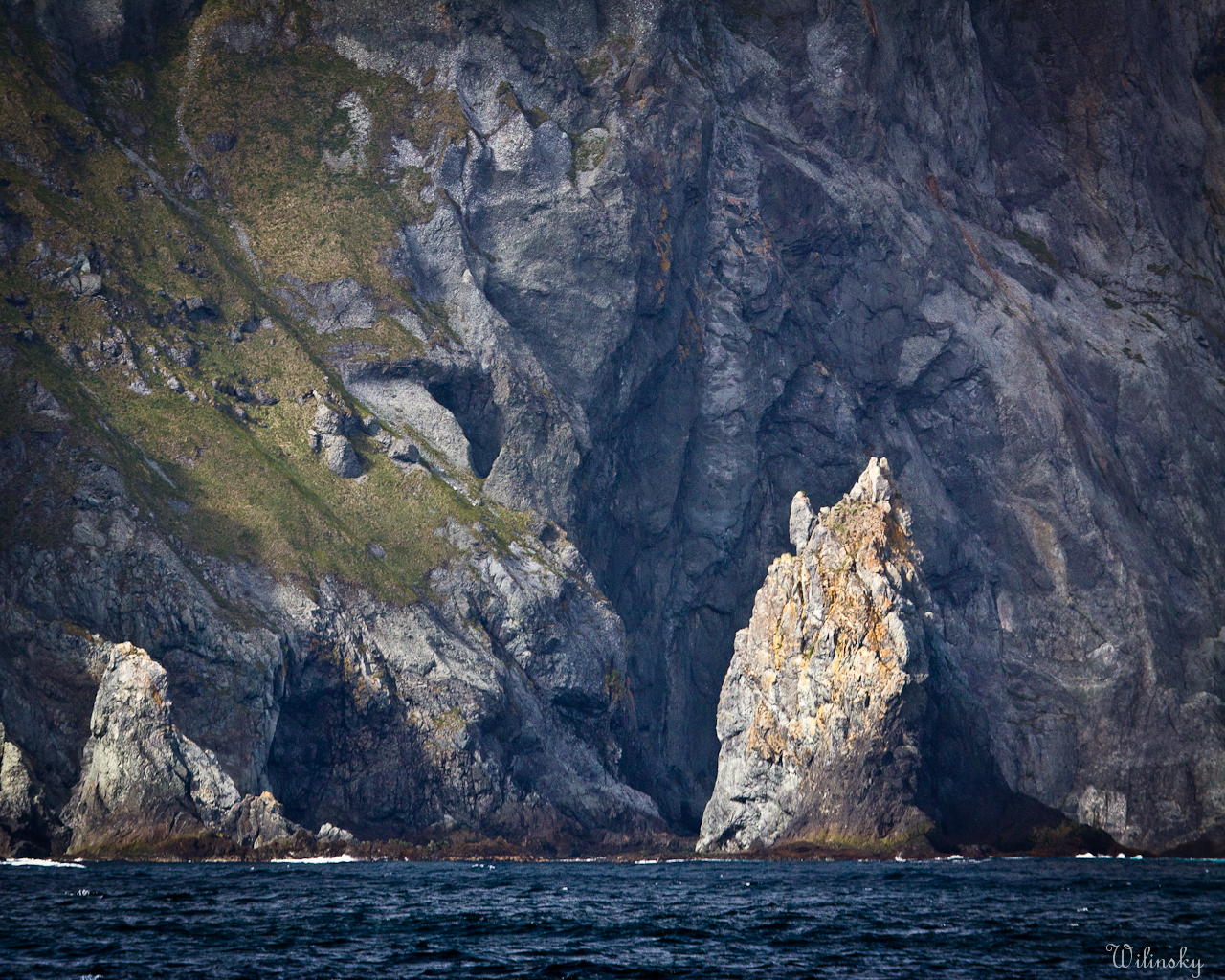
Finally, I would like to thank everyone who read the log and sent comments! I received many positive comments on the photography in this blog, although I must confess that I laughed a bit at those. Paul, our chief scientist, is the expert photographer on board, and his photos expose me for the amateur that I actually am. I would like to end this blog by posting some of the incredible images he gave me at the end of the trip.

cliffs
Cliffs rise sharply out of the ocean in the Gulf of Alaska
waterfall
A waterfall plummets into the Gulf of Alaska
clouds
Clouds cover the top of an island.
cliffs
Fog rolls down the cliffs toward the ocean.
Twin Pillars
The Twin Pillars
Cliffs
A closeup of the cliffs that make up the Alaskan shoreline.
fog
Since we saw so much of it, it seems appropriate to end this blog with a photo of fog over the Gulf of Alaska. Bye everyone, and thanks again!

Jason Moeller: June 13-14, 2011

NOAA TEACHER AT SEA
JASON MOELLER
ONBOARD NOAA SHIP OSCAR DYSON
JUNE 11 – JUNE 30, 2011

NOAA Teacher at Sea: Jason Moeller
Ship: Oscar Dyson
Mission: Walleye Pollock Survey
Geographic Location: Gulf of Alaska
Dates: June 13-14, 2011

Personal Log

Welcome back explorers!

June 13th

Kodiak Dock
A view of the dock as we finally leave!

We are finally underway! The weather cleared up on the 12th, so the rest of our scientific party was finally able to make it in from Anchorage. The scientists did not arrive until later in the day, but at 9:00 in the morning, the Oscar Dyson finally left port in order to run some tests, including a practice cast of the fishing net!

island in harbor
An island in Kodiak Harbor. Kodiak is hidden by the island in this photograph.
Open Ocean
Open ocean, straight ahead!
Net spool
Casting the net was a tricky process that took about 30-45 minutes. (I did not time the process.) The casting started by unhooking the edge of the net from this giant spool. The net was wrapped tightly around this spool when not in use.
net caster
Next, the net was hooked to the mechanism that would lower the net in the water. (The mechanism is the yellow object that looks like an upside-down field goal post)
net hooked up
This is a photo of the net being hooked up to the casting mechanism
net being unwound
Once attached, the mechanism then pulled up on the net to start unwinding the net from the spool. Once the net was properly unwinding, the net was lowered into the water to begin fishing!

Once the tests were completed, we headed back towards the harbor to pick up the rest of the scientists. Once we were all on the vessel, we held a quick briefing on the ship rules. This was followed by a meeting among the scientists where shifts were handed out. I am on the 4 PM to 4 AM shift, also known as the night shift! Hopefully, I will see some northern lights during the few hours that we actually have darkness. After the meeting and a fast guided tour, I went to bed, as I was extremely seasick. Hopefully, that is a temporary issue.

June 14

I woke up to discover that the ship has anchored in a protected cove for the day in order to calibrate the acoustic devices on board that are used for fishing. This is a time consuming but necessary process as we will need the baseline data that the scientists receive by calibrating the device. However, that means that there is not much to do except for eating, sleeping, watching movies (we have over 1,000 aboard) and enjoying the beautiful scenery. As we are in a quiet cove with no waves, I am not currently sick and decided to enjoy the scenery.

cove 1
The next four images are from the back of the ship. If printed, you can go from left to right and get a panoramic view.

cove 2

cove 3

cove 4

Jellyfish
I know the image is bad, but can you see the white blob in the middle of the water? That is a jellyfish!
mountain
Here is a photograph from the side of the boat of a snow-capped mountain. Even though it is summer here, there is still quite a bit of snow.
waterfall
This is another image off the side of the boat. A waterfall falls off into the ocean.
waterfall 2
A closer shot of the waterfall. This place is just gorgeous!

Science and Technology

The Science and technology segment of the blog will be written at the start of the Walleye Pollock survey, which should begin in the next day or so.

Species Seen

Jellyfish!

Arctic Tern

Gulls

Reader Question(s) of the Day

I received a few questions from Kaci, who will be a TAS here in September!

1. What is the temperature here?

A. The temperature has been in the mid to upper 40s, so much cooler then back home in Knoxville, Tennessee, where we were getting 90 degree days! It’s actually been pleasant, and I have not been cold so far on this trip.

2. What did you bring?

A. The temperature affected what I brought in terms of clothing. I started with a weeks worth of shorts and t-shirts, which I stuffed in my check in bag, and then two days worth of clothes in my backpack just in case my checked bag didn’t get it. Our other TAS, Tammy, got stuck here with only the clothes on her back, so a backup set of clothes was necessary. In addition, I have several pairs of jeans, 2-3 sweatshirts, a heavy coat, and under armor to round out the clothing. The under armor and heavy coat have been great, it’s why I haven’t been cold. I also packed  all of my toiletries (though I forgot shampoo and had to buy it here.

In terms of electronics, I have my iPod, computer, and my wife’s camera with me. (A special shout out to Olivia is in order here, thanks for letting me use the camera! I am being VERY careful with it!). I have a lot of batteries for the camera, which I have needed since I’ve already gone through a pair!

Just for fun, I brought my hockey goalie glove and ball to use in working out. We have weight rooms aboard the ship, which I will definitely need since the food is fantastic!

I hope that answers those questions, and I will answer more in the next post!

Jason Moeller: June 12, 2011

NOAA TEACHER AT SEA
JASON MOELLER
ONBOARD NOAA SHIP OSCAR DYSON
JUNE 11 – JUNE 30, 2011

NOAA Teacher at Sea: Jason Moeller
Ship: Oscar Dyson
Mission: Walleye Pollock Survey
Geographic Location: Gulf of Alaska
Date: June 12th, 2011

Personal Log

Welcome back explorers!

fog over Kodiak
Fog over Kodiak

Once again, I woke up this morning to a thick, heavy fog and drizzling rain that enveloped Kodiak like a wet, soggy blanket. While Tammy, who will be the other Teacher at Sea with me, was able to make it into Kodiak, the majority of our science party is still stuck in Anchorage, trying to get aboard a flight. Even though Tammy was able to make it in, her suitcase and clothes did not follow suit, and she was forced to make a Wal-mart run. The result of the weather has been a delay on the cruise, and we hope to set sail for equipment trials tomorrow.

As usual, I had a great day regardless of the rain. I started by helping our steward (cook) stock up on supplies for the ship’s galley. For 40 people on a 19 day cruise, we have $25,000 worth of food stashed away on board. It takes quite a bit of money to stock up a ship!

A river to the ocean
This is a photo of the river I explored weaving its way to the ocean.

After helping shop for the fresh produce, I had the rest of the day off, so I turned to my favorite Kodiak past time, and decided to embark on another bear photo hunt. In addition to bears, I was also on the lookout for salmon (I do not count eating salmon as seeing it) and bald eagles, both of which should be common. Today’s location was the same river that I explored on my first day, but I was much further south. My starting point was where the river met the ocean, and then I walked inland. I will let the photos and captions talk from this point on.

The Beach
I turned left to explore the beach first. It is a black sand beach, the first I have ever seen.
The Beach pic 2
This photo is of the same beach, and better shows the fog cover we had today.
Waterfall 1
While walking down the beach, I noticed a freshwater stream coming out of the woods and winding down to the ocean. I ducked under a pine tree at the edge of the beach and saw this waterfall.
Waterfall 2
Another photo of the waterfall.
Waterfall 3
The same waterfall, falling away towards the ocean.
Bald Eagle
After I left the waterfall, I continued to walk down the beach, and just happened to look up at the right moment to capture this bald eagle, high above the trees. They are so common here that the eagles are jokingly called roaches of the north.
2 eagles
I saw a total of 8 bald eagles, including this pair in the trees. The fog makes them a bit difficult to pick out.
River 1
After exploring the beach, I headed upstream to look for salmon and bears. This is what the river looked like by the ocean.
path
The path by the river was difficult, if it was there at all. Most of the time, I just trudged my way through it. There was not a dry spot on me by the time I finished the hike. It was worth it though.
Marsh
For the first half mile, the river was in a marshland, which the photo shows accurately. However, the marshland quickly gave way to pine forests, which can be seen in the next image.
River in the woods
The river running through the woods.
woods
A photo of the woods running alongside of the river.
Lichen
In the end, I didn't see any bears or salmon in the river, and the vegetation became too thick to go on without a trail. As I was leaving, however, to head back to the ocean and catch my ride home, I ran across this piece of white lichen which contrasted with the darkened woods surrounding it. For me, the photo was worth the trip.

Science and Technology Log

The Science and Technology log will begin at the start of the Walleye Pollock survey.

Species Seen

Bald Eagles!!!

Arctic Tern

Gulls

Magpie

Reader Question(s) of the Day!

Reader questions of the day will start at the beginning of the Walleye Pollock survey! At the moment, I have not received any questions yet, so please send them in! I can take questions at jmoeller@knoxville-zoo.org.

Caroline Singler, July,28 – August 1, 2010

NOAA Teacher at Sea: Caroline Singler
Ship: USCGC Healy

Mission: Extended Continental Shelf Survey
Geographical area of cruise: Arctic Ocean

Date of Post: 2 September 2010

The Journey Begins – 28 July to 1 August 2010

Approaching Dutch Harbor

I left home at 5:30 a.m. on Thursday 28 July for what ended up being nearly 20 hours of travel. At the end of the day, I was exhausted but relieved to have successfully reached my destination, Dutch Harbor, Alaska. The trip from Anchorage to Dutch is 790 miles but required 2 refueling stops along the way and took more than 3 hours. It’s never a sure bet that a plane will be able to land, so we were fortunate to make a safe landing in the rain and wind.

View from Unisea Inn
While in Dutch Harbor, I stayed at the Unisea Inn. It’s not exactly luxury accomodations,and I couldn’t believe there was actually a hotel there when the shuttle driver dropped me off, but it was clean and there was lots of hot water, and my room looked out over the small boat harbor, which was much nicer than the nearby fish processing plants! I spent the last few days wandering around Dutch Harbor and Unalaska. The cool weather was a welcome relief after the hot, humid summer we’ve had back home. I did have to pull out the rain gear, but while it’s often cloudy, it rarely rains for long. The sky is constantly changing, and as the sky changes, everything around looks different as well. It’s been great to just be out walking around since I will be on a ship for the next 5 weeks. Here’s a view of Dutch Harbor from a hill near town.
View of Dutch Harbor
Bald Eagles
Bald Eagles
Puffins
Puffins
When I woke up this morning, I realized it was the last time I’d wake up on land for a while. That was a strange feeling. Late this afternoon we boarded the Healy. I unpacked my bags and I’m ready to go, but we don’t leave port until tomorrow afternoon. I’ll post more after I’ve learned more about the ship’s computer system.Caroline

Kathy Schroeder, May 5, 2010

Dutch Harbor 5/5

Bald Eagle
Bald Eagle

Made it safely to Dutch Harbor yesterday. I have seen so many bald eagles I have lost count. They are so beautiful. Also saw an Arctic Fox today. We are leaving here tonight (a day early) at 9pm. There has been a lot of ice up north so we are hoping the ice has moved so the scientists can do their work. Saw a couple ships from the show “The Deadliest Catch.” There are so many crab traps everywhere you look. They are stacked and ready to go for next crab season. I spent the early afternoon tying down everything in the labs. Bill said there is a storm out there and we should have 30 foot waves. Still getting to know the ship. My room is on the lower deck. There are bunk beds that I am sharing with Amber. Her’s is the top! 🙂 I will spend a lot of time on my laptop on the desk in my room and in the science labs. I look forward to bringing back samples for everyone to see. Once we depart in 6 hours I will be at sea until May 18th. Thanks for all the messages! Happy Cinco de Mayo!