Philip Hertzog, July 27, 2005

NOAA Teacher at Sea
Philip Hertzog
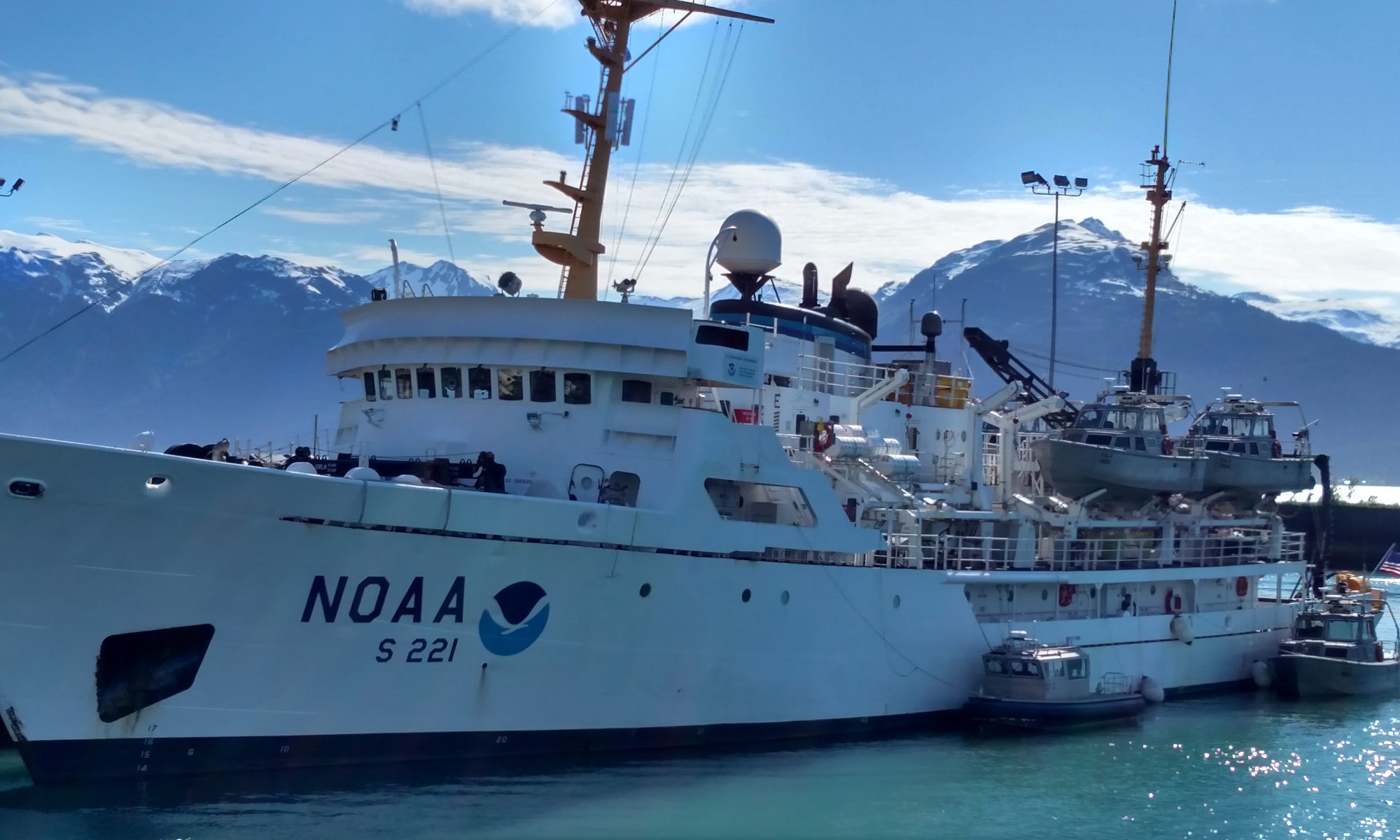
Onboard NOAA Ship Rainier
July 25 – August 13, 2005

Mission: Hydrographic Survey
Geographical Area: Aleutian Islands, AK
Date: July 27, 2005

Securing the launch
Securing the launch

Weather Data from Bridge

Latitude: 55˚ 53.3’ N
Longitude: 158˚ 58.4’ W
Visibility:  10 nm
Wind Direction: light
Wind Speed: airs
Sea Wave Height: 0 feet
Sea Water Temperature:  12.2˚ C
Sea Level Pressure: 1012 mb
Cloud Cover: 2, cumulus

Science and Technology Log 

The RAINIER is now anchored for the next several days in Cushman Bay on the north side of Mitrofania Island. Today the ship’s crew began their first full day of mapping the bottom of the waters surrounding the island.  The Captain assigned me to observe operations on board one of the RAINIER’s six survey launches.  The launches are small craft equipped with sonar and computer equipment to collect bottom data as seen in the following photographs:

Each launch has a crew of three and four launches go out at a time.  On my launch, Ensign Brianna Welton serves as the hydrographer in charge with Matt Boles as the Assistant Survey Technician. Able Body Seaman Corey Mussey drives the launch and makes sure it stays on course using a computer screen directs him where to go.

A winch lowered our launch into the water. We jumped about two feet from the side of the ship to get into the launch. We carried no equipment in our hands or on our backs and wore life jackets to ensure we safely crossed the deep water.

Screen shot 2013-04-09 at 9.42.37 AM

Once underway, Ensign Welton turned on the Differential Global Positioning System (DGPS). The DGPS uses satellite signals to determine our location and even can tell our direction and speed. Unfortunately, our DGPS did not work correctly and Ensign Welton and Matt Boles struggled over the next 2 hours to trouble shoot the problem.  When out at sea and hundreds of miles from the nearest repair shop, the crew of the RAINIER has to become creative to solve problems in order to achieve their mapping mission.  The DGPS problem finally got fixed after the antenna was taken apart and the connecting cables cleaned. Matt told me that whenever one starts a new field survey, you commonly find problems that must be fixed due to the difficulties of working in the harsh environments found at sea and in Alaska.

Screen shot 2013-04-12 at 9.05.01 PMWith the DGPS fixed, the crew sent a SEACAT probe through the water column to the bottom to collect temperature, salinity and pressure data.  Sonar mapping works by bouncing sound waves off the bottom and measuring how fast the waves return to the ship. Sound travels through salt water at 1435 meters per second, but its speed can be changed by temperature, salinity or pressure.  The computer takes the data from the SEACAT and makes corrections to the sonar data so we have a better measurement of the bottom depth.

Sunset over the bow
Sunset over the bow

We spent the rest of the day running transects to map the bottom. Transects are long, parallel lines that are spaced to ensure we cover the entire bottom of the area being mapped with some overlap. To better understand what “running a transect” means, think about mowing your lawn.  When you mow the lawn, you run the mower in parallel lines, but you always go over part of the path you mowed before in the previous line. Just like mowing, the sonar is able to map the entire bottom of the map area by using a transect pattern.

Around 4:30 pm we returned to the RAINIER and the deck crew winched the launch back on board. I handled the stern line and threw it to a deck hand on the ship. I also attached the hook from the winch onto the launch, but I didn’t do it correctly on my first try. You have to be careful because the launch weighs 14,000 pounds and the seas can bounce it around. I got too close to the block and tackle on the winch, but Ensign Welton pulled me back and showed me how to properly connect the cables.  To the right here is a picture of Ensign Welton correctly hooking up the launch.

Once the launch returned to the RAINIER, the mapping crew’s duties were not f inished. After supper, the crew down loaded the launch’s computers onto the ship’s main frame and “cleaned up” the data.  Clean up consisted of looking at the data and matching it with maps on the main frame computer.  The survey technician also had to correct the data with tidal information and look for false sonar signals to remove from the data set. Upon finishing clean up, an officer checked the work for quality.  Here is a picture of Dan Boles, Matt’s older brother, cleaning up some data.

Personal Log 

I had a great time today going out on the launch and learning what the survey crews do.  The landscape overwhelms one with large open areas of water surrounded by mountains covered in green, low lying vegetation.  Mount Veniaminof dominates the background with its glacier covered dome that rises 7,075 feet above sea level.

As we traveled in the launch, I could see whales blowing spray out their blow holes in the distance and pink salmon jumping out of the water.  At the end of work, we took 10 minutes to fish off the launch and Matt caught a ling cod while I had one on the hook that got away.

I enjoyed talking to Matt Boles and learning about how he ended up on the RAINIER with his brother Dan. Matt has a two year college degree in computers and Dan has a Bachelors degree in geology and French. I see a lot of potential for my own students to get jobs aboard ships like the RAINIER and to have a great time exploring wild places like Matt and Dan.

Question of the Day 

Why do temperature, salinity and pressure change the speed of sound in water?

Philip Hertzog, July 26, 2005

NOAA Teacher at Sea
Philip Hertzog
Onboard NOAA Ship Rainier
July 25 – August 13, 2005

Mission: Hydrographic Survey
Geographical Area: Aleutian Islands, AK
Date: July 26, 2005

Fin whales
Fin whales

Weather Data from Bridge

Latitude: 55˚ 44.95’ N
Longitude: 158˚ 47.42’ W
Visibility:  10 nm
Wind Direction: 065˚
Wind Speed: 7 kts
Sea Wave Height: 2 feet
Sea Water Temperature:  13.3˚C
Sea Level Pressure: 1011 mb
Cloud Cover: 8, stratus, cirrocumulus

Science and Technology Log 

Today the RAINIER continues its journey from Kodiak Island to Mitrofania Island where our mapping work will start.  I awoke and found the ship off the coast of Kodiak Island in the Shelikof Strait that separates Kodiak Island with the southwestern Alaskan peninsula. A straight is a long stretch of water where the wind can travel great distances without being blocked and build up large waves. The waves in the Strait are between 1 and 2 feet high, but it is enough to rock the ship back and forth. I have to be careful not to spill any food or drinks in the cafeteria and it takes a while to get use to the rocking back and forth.

Breathing fin whales

Though we are traveling today, our ship’s crew is already working and mapping the bottom of the Shelikof Strait.  I attended a meeting lead by Lt. Ben Evans and listened to him explain our plan for the next several days.  Today we are using the ship’s sonar to map the main portion of the Shelikof Strait and to look for anything that could harm ship traffic. The sonar sends beams of energy in the form of sound waves to the bottom which then bounce back to the ship. By measuring how long it takes for the sound to return to the ship, a computer can determine how deep the channel is. Behind the bridge is the plot room where the mapping action takes place.  The plot room has a big table in the middle to lay out charts and several computer stations line the walls around the table. Each computer station has two monitors hooked together so the hydrographer (a person who maps the ocean bottom) can put up sonar images and compare it to maps and other information.  Today we had one of the computer stations working to show the data being collected for the Shelikof Strait.  The bottom is around 400 meters deep and relatively flat.  The computer monitor shows us a colorful image of the bottom depths as we move along the straight.

In the late afternoon, we enter into a large bay and circle around to the back side of Mitrofania Island. Suddenly, I see four sprays of water in the air, one right after another, about half a mile from the ship.  As we move farther into the bay, we see more sprays and soon see curved, dark backs surface and then glide along the surface in an arch before disappearing below the surface. As we move closer we can make out a tiny fin on these large creatures toward the rear of their backs and realize these are fin whales.

Fin whales are one of the largest whales found in the world and can reach 24 meters in size. All around us we see spray being blown out by the fin whales as they surface and mill about with each other.  One whale surfaces right in front of the RAINIER and the Captain had to back off on the engine to avoid a collision.  The whale moved to the side of our ship as we slowed down and I could see it staying in the same place for 3-5 seconds looking up at us before moving away below the surface.

After our greeting by the fin whales, the Captain anchored the RAINIER in a quiet bay off Mitrofania and the crew prepared for a busy day of mapping tomorrow.

Personal Log 

Though I find I am excited to be on the RAINIER, I found myself dizzy with a little bit of motion sickness from the rocking of the ship in Shelikof Strait.  Taking the advice from books and several of the crew members, I kept myself from becoming sicker by getting fresh air on the deck and looking at the horizon.  I also drank plenty of fluids and ate all of my meals. After a couple of hours and a nap, I felt much better.

The high point of the day came when we entered Mitrofania Bay and saw the fin whales. We also saw salmon jumping throughout the bay and several of the crewmembers fished off the back of the RAINIER after they had finished their duties for the day.

Question of the Day 

What do fin whales eat and where do they spend the winter?

Philip Hertzog, July 25, 2005

NOAA Teacher at Sea
Philip Hertzog
Onboard NOAA Ship Rainier
July 25 – August 13, 2005

Mission: Hydrographic Survey
Geographical Area: Aleutian Islands, AK
Date: July 25, 2005

Weather Data from Bridge

TAS Philip Hertzog in his safety gear

Visibility: 10 nm (nautical miles)
Wind Direction: 127˚
Wind Speed: 12 kts
Sea Wave Height: 1-2 feet
Sea Water Temperature: 12.8˚ C
Sea Level Pressure: 1009.5 mb
Cloud Cover: 8

Introduction 

Welcome to my Teacher at Sea Log.  Over the next three weeks, I will document my experiences on board the NOAA Vessel RAINIER as part of the Teacher at Sea (TAS) program.  NOAA established the TAS program about 15 years ago as a means to educate the public about its mission through the use of classroom teachers.  Over 400 teachers have participated in the TAS program and have used their NOAA experience to bring marine research and mapping into the classroom for thousands of students.

I currently teach 7th Grade Science to students at Hunt Middle School located in Tacoma, Washington. Hunt Middle School is located about a mile and a half from Puget Sound and many of our students play in parks next to estuarine waters.  I hope to use my experience with NOAA to enhance my classroom curriculum and to provide other teachers in my school district with enhancements to our adopted program.

I have taught for six years and prior to that I worked for government in the field of natural resources management.  Some of my work included hazardous waste cleanup in the aquatic environment and near shore aquatic habitat mapping.

Science and Technology Log 

Today we begin our journey from Kodiak, Alaska to Mitrofania Island on board the NOAA vessel RAINIER. Kodiak is an island located in southwestern Alaska about 250 miles by air plane from Anchorage.  Mitrofania Island is located along the southwestern Alaskan peninsula about half way between Kodiak and Dutch Harbor.  Our trip will take a day and a half to reach Mitrofania.

The RAINIER is a hydrographic ship that measures 231 feet long and displaces 1800 tons of water. Hydrography is the science of using sonar and other complicated devices to bounce sound waves off the bottom of the ocean that can be used to identify hazards (like rocks) that could sink passing ships. The information gathered by the RAINIER is used to update maps of the ocean bottoms and coastlines.  Ships’ captains call these special maps charts.  The charts help keep ships safe and away from shallow waters, lurking rocks and jagged coastlines.

The waters around Mitrofania are remote and have not been mapped in years.  Fisherman, large ships and the Alaska State Ferry use these waters and pass the island on occasion.  Our job will be to gather information to update the charts for the waters around Mitrofania Island to help increase the safety of passing ships.

I spent the morning watching the ships’ crew prepare the RAINIER for its three-week journey. The crew made repairs on small cracks, moved mooring lines and loaded supplies onto the ship. Two trucks full of food drove up to the ship and I helped carry boxes of milk, fruit and vegetables up the gangway and into the narrow passages of the ship for storage.

Prior to our 2:00 pm departure, the ship’s safety officer gathered me and other new members of the crew for safety training.  Working and living on a ship can be exciting, but one needs to be extremely careful to avoid accidents and learn how to live with 49 other people. I spent most of today attending safety classes.

My first class was to learn how to stay afloat in water that is 56 º F.  The answer is simple, wear a life vest!  However, the answer isn’t really that simple.  I got issued 4 different types of life vests. If I work inside a small boat, I get to wear a vest that blows up with a carbon dioxide cartridge. If I work outside on the deck of a small boat or handle lines at the pier, I have to wear a “Mustang” float jacket that doesn’t need to be blown up. If I have to abandon ship, I must put on a survival suit that consists of thick foam and covers my body entirely.  The survival suit makes a person look like the cartoon character “Gumby” and hence gets the nickname “Gumby Suit.”  To make matters more interesting, I am also issued a standard life vest that most people are familiar with.  I am now ready to float for any occasion, formal or informal!

After my floatation class, I learned where to go in the event of an emergency on the ship.  We have three main types of emergencies: fire/general emergency, man overboard, and abandon ship. For each type, I am assigned a different station to report to and given specific duties.  For example, I will serve as a look out in the event someone should fall off the ship and if we need to abandon our vessel I need to bring extra blankets for the life raft. Each type of emergency has its own signal on the ship’s whistle.  Three long blasts means a person fell overboard, six short blasts followed by a long one means we need to abandon ship, and a continuous ringing means fire.  Everybody on board the RAINIER is well trained and given a job to do during an emergency.

After the emergency training, we got to watch the RAINIER “film festival” in the ship’s Wardroom, which is like a lounge on land.  The “film festival” consisted of a series of three safety videos on how to use an air respirator, avoid hazardous materials and general safety on board a ship. I then finished the day by taking two more safety classes through the ship’s computer that also gave me a test.  Luckily I passed the tests and now feel ready to go forward in safety.

Though it may seem like a lot of time, all of the training is important and will help me to save myself and help others around me in the event of an emergency.  Students should be aware that learning doesn’t stop when you graduate from school, but continues for a lifetime as one meets new challenges and experiences.

Personal Log 

Despite a full day of safety training, I managed to spend several hours on the flying bridge to watch the Alaskan scenery pass by as we made our way out of Port.  The flying bridge is the deck above the Captain’s bridge and is the highest point on the ship. You can look out from the flying bridge in all directions and see for miles.

We passed through a narrow passage between Kodiak and Afognak Island where the mountains rose out of the water as the RAINIER carefully made its way with a series of turns and maneuvers.  At one point, we passed 10 sea otters floating by the ship on their backs that looked at us and seemed to wonder what we were up to. We constantly saw puffins vigorously flapping their wings in a struggle to avoid hitting the ship.  Often the fat puffins could not take flight, but always avoided our ship at the last minute

A real highlight of today was seeing several Minke whales blow spray and surface gracefully near the ship.  You first spot a spray of water at the surface followed by a sleek, dark back arching over the water that finishes with the appearance of a small fin that then disappears below the surface.

Question of the Day 

How is safety training on the RAINIER like safety training at school? How is it different?

Christy Garvin, June 8, 2005

NOAA Teacher at Sea
Christy Garvin
Onboard NOAA Ship Rainier
June 1 – 8, 2005

Mission: Hydrographic Survey
Geographical Area: Aleutian Islands, AK
Date: June 8, 2005

Weather from the Bridge

Latitude:56 deg 44 min N
Longitude: 135 deg 43 min W
Visibility:10 nautical miles
Wind Direction: 160 deg
Wind Speed:14 kts
Sea Wave Height1-2 ft
Swell Wave Height:4-5ft
Sea Water Temperature: 53deg F
Sea Level Pressure:1011.5 mb

Humpback whales
Humpback whales

Science and Technology Log 

Since we were doing ship’s hydro again today, I decided to take the opportunity to interview some of the NOAA junior officers to learn more about what their job entails and what long-term life at sea is like. The two officers on watch were Briana Welton and Jay Lomnicky.

Briana attended Smith College in western Massachusetts; she majored in math, but learned about NOAA through the science department at Smith.  While in college, she interned for NOAA and enjoyed the experience.  She graduated from college and found that her job working in a cubicle was boring and tedious; looking for adventure and a different style of life, she applied with NOAA and became a junior officer.  She has been onboard the RAINIER for almost two years, and while onboard she has worked in the survey department, been in charge of tide information for the ship, and stood anchor watch on the bridge.  Briana will be leaving the ship in December for her three-year shore duty. Her shore assignment will be with a Navigation Response team that will do surveys in the mid-Atlantic region.

Breaching
Breaching

Jay learned of NOAA from a friend who was working for a fish and wildlife agency in Florida. He has a degree in biology and has been on the ship for two and a half years.  His collateral duty is dive master, and he is in charge of all dive operations on the ship.  There are eight certified divers onboard who set up tide gauges, complete hull inspections, and use lift bags to recover items from the ocean floor.  It is Jay’s job to plan all dives, ensure that the nearest decompression chamber is operational, check to make sure the equipment is working properly, and assess diver’s skills.  When Jay leaves the RAINIER in about a month for his shore duty, he will be working with side scan sonar looking for fish habitats. Jay really enjoys ship life; he likes steering the ship, the adrenaline rush of rough weather, and managing and coordinating the activities of those on board.

Both Jay and Briana had advice for those seeking a career with NOAA.  First, they encouraged a math or science degree and suggested that basic seamanship (tying knots, navigation, life at sea) and knowledge of the ocean would be helpful.  They also suggested that individuals should understand that working on a ship is not a job, it is a lifestyle.  Sometimes it is difficult to have relationships or hobbies, and many conveniences like radio, television, and private quarters are often not available.

Personal Log 

While the ship was doing hydro today, I saw two humpback whales breaching.  They would bring their large pectoral fins high in the air and slap them down on the water, then they would do a tail lob, which is when they bring the fluke up in the air and flip it around. It was definitely an amazing sight.

Christy Garvin, June 7, 2005

NOAA Teacher at Sea
Christy Garvin
Onboard NOAA Ship Rainier
June 1 – 8, 2005

Mission: Hydrographic Survey
Geographical Area: Aleutian Islands, AK
Date: June 7, 2005

Weather from the Bridge

Latitude:56 deg 59 min N
Longitude: 135 deg 17 min W
Visibility: 11 nautical miles
Wind Direction: 290 deg
Wind Speed: 10 kts
Sea Wave Height: 0-1 ft
Sea Water Temperature: 50deg F
Sea Level Pressure: 1011.7 mb

Science and Technology Log 

Although we have been parked in protected Aleutkina Bay for most of the leg, yesterday afternoon we pulled anchor and the ship was underway.  Because of weather conditions, it was determined that the ship would run hydro in deep water, while the launches continued protected shoreline work.

The ship is equipped with a Seabeam 1050 MKII; it is a dual frequency echosounder with 50KHz and 180KHz operating frequency. When operating at the 180 KHz frequency a maximum depth of 620 meters can be surveyed.  This depth can be increased by switching to the 50 KHz frequency, which can reach depths of 3,100 meters.  The Seabeam 1050 has a wide horizontal scan area that is covered by 126 adjacent beams and a 150-degree swath width; it has high resolution due to the narrow beams it uses.

While the ship is doing hydro, the crew transitions into 24-7 watches.  The ship runs survey lines all night, so people are needed to steer the ship, serve as lookouts, and run the survey equipment.  The watches are four hours each, and crewmembers work two watches a day. The three shifts are 12:00-4:00, 4:00-8:00, and 8:00-12:00; people are sleeping at different times, so everyone makes an effort to be quiet during the day.

One of the highlights of today was an in-depth tour of the ship by the CO, John Humphrey.  I was able to see the engine room with the two main engines, the after steerage (where the rudder and emergency steering are located), and the evaporator unit that processes salt water into potable fresh water.  We also went into the large refrigerators and freezers that hold the ship’s stores and climbed down into the bowels of the ship to see the fire prevention carbon dioxide system.

Personal Log 

It is interesting trying to sleep while the ship is underway. Although the seas aren’t very rough, the ship still moves quite a bit.  I haven’t been seasick (I’m very thankful for that), but I rolled all over my bunk last night.  It felt like I was trying to hold myself in the bed as I slept.