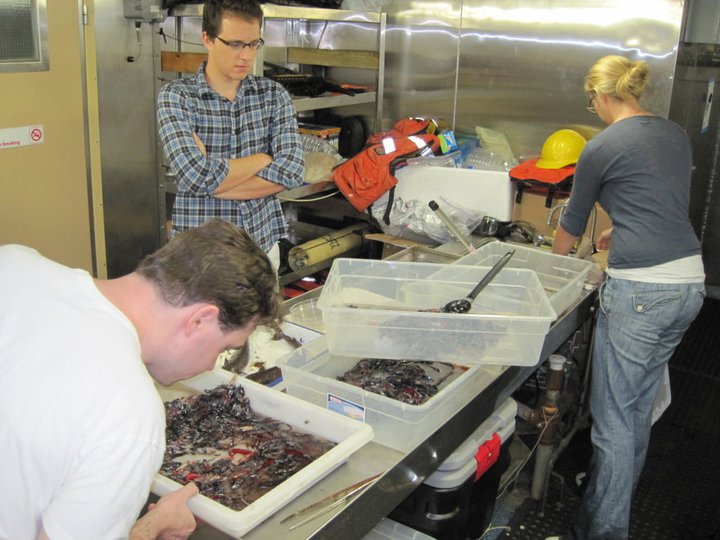
Kathleen Harrison: Finding Fish, July 12, 2011

NOAA Teacher at Sea
Kathleen Harrison
Aboard NOAA Ship  Oscar Dyson
July 4 — 22, 2011

Location:  Gulf of Alaska
Mission:  Walleye Pollock Survey
Date: July 12, 2011

Weather Data from the Bridge
Air Temperature:  10.15° C, Sea Water Temperature:  7.6° C
True Wind Speed:  12.26 knots, True Wind Direction:  191.38°
Very foggy, visibility < 1/4 mile
Door open on bridge to hear other fog horns
Latitude:  56.07° N, Longitude:  158.08° W
Ship Heading:  24°, Ship Speed:  11.7 knots

Science and Technology Log:  Finding Fish

In a previous log, I talked about using nautical charts and trawling as 2 methods used in calculating the biomass of Walleye Pollock in the Gulf of Alaska.  Finding the fish to catch is tricky business in the ocean, they don’t usually come up to the surface and say hi.  The NOAA scientists working on the Walleye Pollock Survey spend a lot of time looking for fish, so that their trawling efforts won’t be wasted (that is the general idea, anyway).  How do you look for fish in the ocean?  With acoustics, of course, another method used in calculating biomass.

Acoustics is the use of sound, which will travel through the water, and bounce off of objects that it hits.  There is Simrad ER60 echosounder  that operates 5 transducers mounted on the center board under the ship, and it continuously sends out sound waves.

multibeam sonar mapping the ocean floor
The Simrad ER60 echosounder sends sound directly under the ship, finding fish anywhere in the water column.

In the Acoustics Lab of the Oscar Dyson, the data from the multi-beam echosounder is being studied all of the time.  The sound waves leave the device, travel down, hit the swim bladder in a fish (the fish doesn’t even know), and reflect back to the ship.  The time it takes for the sound to return is used to calculate the distance down, and a computer generated picture called an echogram is produced.

echogram shows surface, fish, and bottom
The echogram shows plankton at the surface in blue/green, fish near the bottom as red/brown spots, and the ocean floor as a red/brown line.

The echogram tells the scientists several things.  The surface of the water is shown, with surface dwelling organisms such as krill, phytoplankton, zooplankton, and juvenile fish.  The fish that are mid-water are shown as well, showing up as red or blue dashes or blobs.  This is where the Pollock usually are.  Some fish are bottom feeders, and the red and blue dashes on the bottom represent those.  The ocean floor is also shown, which is very important when choosing which type of trawl to use.   If the bottom is flat, the Poly Nor’Easter could be used to capture to fish on the bottom.  The Aleutian Wing Trawl might be used in mid water if the bottom is rocky and irregular.

Now, looking at the fish from the surface is nice, but wouldn’t it be better to see them close up?  Of course!  The scientists have another tool at their disposal, and no, it isn’t me diving down to the fish (brrr).  This tool is called a Drop Target Strength, or DTS.

echosounder can be dropped into water
The Drop Target Strength (DTS) can be lowered into the water, and get closer to the fish. The information is fed into the computer by a water proof cable.

About once a day, or every other day, the DTS is lowered over the side, and it starts sending out sound waves (3 pings/second), just like the echosounder mounted on the ship.  The advantage with the DTS, though, is that it is closer to the fish, giving a more detailed and accurate picture.  Individual fish can be sighted.  Taking a picture of a fish is kind of like taking a picture of a toddler, they don’t hold still very well.  So, a count of the fish on the echogram might not be exact.  Also, they might change the angle of their body, making the sound wave reflect off their swim bladder at a different angle.  The colors on the echogram are significant:  brown and red mean a strong signal, yellow is medium, and green and blue indicate a weak signal.

echogram shows individual fish
Studying the echogram from the DTS gives scientists a better picture of where the fish are. Each individual wavy line is probably a separate fish.

The scientists will study the echograms to determine where the fish are, and make a decision to fish or not.  Once fishing begins, they will move from the acoustics lab to the bridge, and study the echograms there.  An estimate of how many fish are in the net is made, and then the scientists will ask the crew to “haul back” the net.   (I am learning a whole new language!)  Then, things get very busy as we head to the fish lab to process the fish.

scientists at their desks in the acoustics lab
Here are the NOAA scientists that I am privileged to work with on the Oscar Dyson: (left to right) Darin Jones, Fish Biologist, Denise McKelvey, Fish Biologist, Neal Williamson, Chief Scientist.

New species seen:

Giant Pacific Octopus (juvenile, 1 cm)

Opalescent Squid

Chinook (King) Salmon

Egg yolk jelly fish

Sculpin (juvenile)

North Pacific sea nettle

Spud sponge

tiny squid, only 2 cm long
These are juvenile squid, about 2 cm long. They are nearly transparent.
giant pacific octopus, juvenile, only 1 cm
This is a juvenile Giant Pacific Octopus, only 1 cm wide, complete with 2 huge eyes, and 8 perfect legs.

Personal Log

My days have developed a routine now:  wake at 3:30 am (ugh), start my shift in the acoustics lab about 4:00, breakfast at 7:30, lunch at 11:30, end my shift at 4:00 pm, dinner at 5:30, shower, in bed by 8:00.

my window and life boats
See the orange life saving ring? My window is just to the right of the ring. The 3 white canisters on the back wall hold life rafts that inflate upon release of the canister.

In between these times, I work on my Teacher at Sea log, post pictures on Facebook, read and answer e-mail, visit the bridge and ask lots of questions, and of course, process fish whenever there is a trawl (very fun).  Today marks the halfway point of our cruise!  The ship is quieter than I thought, even though there are 35 people on board, the most that I ever see might be 10 during mealtimes.  There is constant background noise of the ship’s engines, waves hitting the bow of the ship, creaks and groans of the furniture as the ship rolls, but I am used to it now, and hardly notice it.  I am thankful for the calm weather that we have had so far.

Anne Mortimer: Fishing, July 7, 2011

NOAA Teacher at Sea
Anne Mortimer
Onboard NOAA Ship Oscar Dyson
July 4 — 22, 2011 

Mission: Pollock Survey
Geographical area of cruise: Gulf of Alaska
Date: July 7, 2011

Weather Data from the Bridge
Air temperature: 9.53 C, Foggy
Sea temperature: 8.19 C
Wind direction: 145
Wind Speed: 18.73 knots
Barometric pressure: 1013.22 mbar

Science and Technology Log

Last night, we attempted a bottom trawl for walleye pollock. The way scientists know that fish are present is by using acoustic sampling. The centerboard of the ship is set-up with sound emitting and recording devices. When a sound wave is emitted toward the bottom, it will eventually be returned when it hits a fish or the ocean bottom. This is called echo-sounding and has been used by sport & commercial fisherman and researchers for many decades. The sound waves are sent down in pulses every 1.35 seconds and each returned wave is recorded. Each data point shows up in one pixel of color that is dependent on the density of the object hit. So a tightly packed group of fish will show as a red or red & yellow blob on the screen. When scientists see this, they fish!

This echogram shows scientists where fish can be found.

The scientists use this acoustic technology to identify when to put the net in the water, so they can collect data from the fish that are caught. The researchers that I am working with are specifically looking at pollock, a mid-water fish. The entire catch will be weighed, and then each species will be weighed separately. The pollock will all be individually weighed, measured, sexed, and the otolith removed to determine the age of the fish. Similar to the rings on a tree, the otolith can show the age of a fish, as well as the species.

pollock otolith
A pollock otolith.
Pollock otolith in my hand

These scientists aren’t the only ones that rely on technology, the ships navigation systems is computerized and always monitored by the ship’s crew. For scientific survey’s like these, there are designated routes the ship must follow called transects.

globe chart
This chart shows the transects, or route, that the ship will follow.
This chart shows the route (white line) of the ship once fish were spotted. When scientists find a spot that they want to fish (green fish symbol), they call up to the bridge and the ship returns to that area. As the ship is returning, the deckhands are preparing the net and gear for a trawl.

Personal Log

I think that I must have good sea legs. So far, I haven’t felt sick at all, although it is very challenging to walk straight most times! I’ve enjoyed talking with lots of different folks working on the ship, of all ages and from all different places. Without all of the crew on board, the scientists couldn’t do their research. I’ve been working the night shift and although we’ve completed a bottom trawl and Methot trawl, we haven’t had a lot of fish to sort through. My biggest challenge is staying awake until 3 or 4 am!

Did you know?

That nautical charts show depths in fathoms.  A fathom is a unit of measurement that originated from the distance from tip to tip of a man’s outstretched arms. A fathom is 2 yards, or 6 feet.

Species list for today:

Humpback Whale

Northern Fulmar

Tufted Puffin

Stormy Petrel

petrel
Fish biologist Kresimir found this petrel in the fish lab; attracted to the lights it flew inside by accident. The petrel is in the group of birds called the tube-nosed sea birds. They have one or two "tubes" on their beak that helps them excrete the excess salt in their bodies that they accumulate from a life spent at sea.

In the Methot net:

Multiple crab species including tanner crabs

Multiple sea star species, including rose star

Sanddollars

Juvenile fish

Brittle stars

Sponge

Multiple shrimp species including candy striped shrimp

shrimp variety
These are some of the shrimp types that we found in our Methot net tow.

Becky Moylan: Acoustics and Trawling, July 5, 2011

NOAA Teacher at Sea
Becky Moylan
Onboard NOAA Ship Oscar Elton Sette
July 1 — 14, 2011


Mission: IEA (Integrated Ecosystem Assessment)
Geographical Area: Kona Region of Hawaii
Captain: Kurt Dreflak
Science Director: Samuel G. Pooley, Ph.D.
Chief Scientist: Evan A. Howell
Date: July 5, 2011

Ship Data

Latitude 1940.29N
Longitude 15602.84W
Speed 5 knots
Course 228.2
Wind Speed 9.5 knots
Wind Dir. 180.30
Surf. Water Temp. 25.5C
Surf. Water Sal. 34.85
Air Temperature 24.8 C
Relative Humidity 76.00 %
Barometric Pres. 1013.73 mb
 Water Depth 791.50 Meters

July 5, 2011

Science and Technology Log

Work is going on 24 hours here on the ship. The crew have different shifts, so nothing ever stops. It may be 3:00 in the morning, and you’ll see people sorting fish, filtering water, or working the acoustics table.


Acoustics Computer Screen

To improve the accuracy of identifying what organisms are seen on the acoustic system, Sette researchers collect samples from the scattering layers at night using a large trawl net towed from the ship.One important part of the research here is using the acoustic system to find where groups of fish and other organisms are located. This is done with a “ping”, or noise, sent down in the ocean. The sound waves bounce back when they find something, letting scientists know where, and sometimes what, is swimming underneath. Computers keep data on all the different sound waves showing patterns of fish movement. They have found that some groups move upward during the nighttime, and then move back down during the day.

Cookie Cutter Shark
Cookie Cutter Shark
Trawl Net
Trawl Net

Every night on the ship, there is at least one trawl. The method of trawling started back in the 1400’s. Some people use these nets to catch large amounts of fish to sell, and that has been an environmental concern. NOAA is using this method as a scientific sampling, or survey, method to try and help the environment. They are trawling in the Epipalagic Zone (mid to shallow) which is around 200 meters deep, depending on the total depth at location and where the acoustics pick up signals.

Scientists want to find out the status of the smaller life in order to try and predict the outcome of the larger life. Only a small amount is caught for sampling. They weigh, sort, count, and study them. The goal is to be aware of what is happening in this area of the ocean. Some of the species they have found are different types of shrimp, squid, Myctopids, small crabs, and jellies. Last night they wound up with two Cookie Cutter Sharks. These results will then be combined with the measured acoustic data in order to improve the accuracy and effectiveness of acoustic monitoring.

Examining a Trawl Catch
Puffer Fish
Puffer Fish

One scientist from New York, Johnathan, is looking for specific species of Myctopids. He studies them under the microscope and records detailed data found. The Myctopids are sometimes called Lantern Fish. This is because they have organs that produce light. The lights are thought to be a way of communicating with other fish and also as a camouflage. As mentioned earlier, some fish rise to shallower waters at night and the Myctopid is one of these. The reason might be to avoid predators, yet also to follow zooplankton which they feed upon.


Personal Log

Abandon Ship Suits
Abandon Ship Suits

Last night some of us went out on deck to watch the Kona fireworks. I didn’t realize how far out we were until I saw how tiny the little ball of colors appeared. You could see three different areas along the coast where they were shooting off fireworks. As a fourth of July treat, the cooks barbecued on deck and made special deserts. I especially liked the sweet potato pie.

This morning I was out at 6am preparing the CTD for deployment. It is getting easier each time. There are many precautions and steps to make sure the procedure is done correctly and safely. We could only drop it to 200 meters today because this area is shallower here. I watched and learned how to control the computer from the inside. Very impressive!

CTD Screens
CTD Screens

I’m wondering when the ship is going to have another “abandon ship drill”. That’s when we all carry our floatation suits to the upstairs deck and put them on, and it is not easy to do. You lay the suit down, sit on it, and put your legs in first. Then you stand up, pull the suit hood on, then lastly the arms. This is because the hands don’t have fingers. It is quite a funny sight.

I found out today that the 3am trawl ended up with only one fish because a Cookie Cutter Shark had eaten a round hole in the net. This is where they get their name. They always bite a round hole. Some have even eaten a hole out of humans!

Jason Moeller: June 25-27, 2011

NOAA TEACHER AT SEA
JASON MOELLER
ONBOARD NOAA SHIP OSCAR DYSON
JUNE 11 – JUNE 30, 2011

NOAA Teacher at Sea: Jason Moeller
Ship: Oscar Dyson
Mission: Walleye Pollock Survey
Geographic Location: Gulf of Alaska
Dates: June 25-27, 2011

Ship Data
Latitude: 55.58 N
Longitude: -159.16 W
Wind: 14.11
Surface Water Temperature: 7.2 degrees C
Air Temperature: 9.0 degrees C
Relative Humidity: 90%
Depth: 85.61

Personal Log
Anyone who has seen the show Deadliest Catchknows how dangerous crab fishing can be. Fishing for pollock, however, also has its dangers. Unfortunately, we found out the hard way. One of our deck hands caught his hand between a cable and the roller used to pull up the trawl net and hurt himself badly.

Cable
The cable and the roller.

Fortunately, the injuries are not life threatening and he will be fine. The injuries did require a hospital visit, and so we stopped at Sand Point to treat him.

Town
This is the town of Sand Point.
airstrip
Clouds hang over the hills at Sand Point. The airstrip is in the left edge of the photo.

We stayed at Sand Point for nearly 48 hours. What did we do? We fished, of course! We used long lines and hooks, and had a great time!

lines
Bill and Alex cast fishing lines in the harbor. We tied the lines off on the boat and hauled them up from time to time to check the bait.
Alex
Alex with a flounder that he caught! He also caught several cod and a 32-lb Pacific halibut!
cod
Cod and the flounder in a bucket!
Tammy
As with every fishing trip, we also managed to catch things that we didn't mean too! Tammy (the other NOAA Teacher at Sea) especially liked the kelp!
urchin
A few visitors always hitched a ride on the kelp we caught. Here is a tiny sea urchin.
crab
This crab was another hitchhiker on the kelp.
starfish
We were bottom fishing for Halibut, and a starfish, the largest one I've ever seen, went after the bait!

A one-day fishing license in Alaska costs $20.00. We had internet, so five of us went online and bought the fishing passes. Was it worth it?

Halibut
You bet it was! This is the 25-lb halibut I caught! It was AWESOME!!!

We filleted it and had the cooks make it for dinner. With the halibut, we also cut out the fleshy “cheeks” and ate them as sushi right on the spot! It doesn’t get any fresher (or tastier!) than that!

Science and Technology Log
Today we will look at the acoustic system of the Oscar Dyson! Acoustics is the science that studies how waves (including vibrations & sound waves) move through solids, liquids, and gases. The Oscar Dyson uses its acoustic system to find the pollock that we process.

The process begins when a piece of equipment called a transducer converts an electrical pulse into a sound wave. The transducers are located on the underside of the ship (in the water). The sound travels away from the vessel at roughly 1500 feet per minute, and continues to do so until the sound wave hits another object such as a bubble, plankton, a fish, or the bottom. When the sound wave hits an object, it reflects the sound wave, sending the sound wave back to the Oscar Dyson as an echo. Equipment onboard listens to the echo.

The computers look at two critical pieces of information from the returning sound wave. First, it measures the time that it took the echo to travel back to the ship. This piece of information gives the scientists onboard the distance the sound wave traveled. Remember that sound travels at roughly 1500 feet per minute. If the sound came back in one minute, then the object that the sound wave hit is 750 feet away (the sound traveled 750 feet to the object, hit the object, and then traveled 750 feet back to the boat).

The second critical piece of information is the intensity of the echo. The intensity of the echo tells the scientists how small or how large an object is, and this gives us an idea of what the sound wave hit. Tiny echos near the surface are almost certainly plankton, but larger objects in the midwater might be a school of fish.

good fishing
An image of the computer screen that shows a great number of fish. This was taken underneath the boat as we were line fishing in Sand Point.
poor fishing
The same spot as above, but with practically no fish.
fishing
An image of the screen during a trawl. You can actually see the net--it is the two brown lines that are running from left to right towards the top of the screen.

One of the things that surprised me the most was that fish and bubbles often look similar enough under water that it can fool the acoustics team into thinking that the bubbles are actually fish. This is because many species of fish have gas pockets inside of them, and so the readout looks very similar. The gas pockets are technically called “swim bladders” and they are used to help the fish control buoyancy in the water.

swimbladder
Swim bladder of a fish.

Species Seen
Northern Fulmar
Gulls
Cod
Pacific Halibut
Flounder
Sea Urchin
Crab
Kelp

Reader Question(s) of the Day
Today’s questions come from Kevin Hils, the Director of Chehaw Wild Animal Park in Chehaw, Georgia!

Q. Where does the ship name come from?
A. Oscar Dyson was an Alaska fisheries industry leader from Kodiak, Alaska. He is best known for pioneering research and development of Alaska’s groundfish, shrimp, and crab industry. Dyson was a founding partner of All Alaskan Seafoods, which was the first company actually controlled by the fishermen who owned the vessel. He also served on the North Pacific Fisheries Management council for nine years. He is in the United Fishermen of Alaska’s hall of fame for his work. The ship was christened by his wife, Mrs. Peggy Dyson-Malson, and launched on October 17, 2003.

Dyson
Oscar Dyson
launch
The launching of the Oscar Dyson

Q. How do you see this helping you teach at Knoxville Zoo, not an aquarium?
A. This will be a long answer. This experience will improve environmental education at the zoo in a variety of different ways.

First, this will better allow me to teach the Oceanography portion of my homeschool class that comes to the zoo every Tuesday. For example, I am in the process of creating a hands on fishing trip that will teach students about the research I have done aboard the Oscar Dyson and why that research is important. Homeschool students will not just benefit from this experience in Oceanography, but also in physics (when we look at sound and sonar) and other subjects as well from the technical aspects that I have learned during the course of the trip.

Scouts are another group that will greatly benefit from this experience as well. The Girl Scout council wishes to see a greater emphasis in the future on having the girls do science and getting real world experiences. While the girls are still going to desire the animal knowledge that the zoo can bring, they will also expect to do the science as well as learn about it. My experience aboard the Dyson will allow me to create workshops that can mimic a real world animal research experience, as I can now explain and show how research is done in the field.

The same can be said of the boy scouts.

In addition, one of the most common badges that is taught to boy scout groups that come in is the fish and wildlife merit badge. In the past, the badge has primarily focused on the wildlife aspect of this topic. However, I now have the knowledge to write and teach a fisheries portion for that merit badge, as opposed to quickly covering it and moving on. This will enrich future scouts who visit the zoo for this program.

A major focus for all scouts is the concept of Leave No Trace, where scouts are supposed to leave an area the way they found it. The fisheries research being done aboard the Dyson is focused toward that same goal in the ocean, where we are attempting to keep the pollock population as we found it, creating a sustainable fishery. The goal aboard the Dyson is similar to the goal in scouting. We need to be sustainable, we need to be environmentally friendly, and we need to leave no trace behind.

School children on field trips will greatly benefit, especially students in the adaptations section. There are some bizarre adaptations that I never knew about! For example, sleeper sharks slow, deliberate movement coupled with their fin and body shape basically make them the stealth fighter of the fish world. They can catch fish twice as fast as they are! Lumpsuckers are neat critters too! This knowledge will enhance their experience at the zoo during field trip programs.

Finally, I can pass the knowledge from this experience on to my coworkers. This will not only better the experience of my students, but it will also improve the outreach programs, the bedtime programs, the camps, and other programming done at the zoo.

Q. Are you old enough to be on a ship? You look like you’re 13???!!!!
A. SHHHHHHH!!!! You weren’t supposed to tell them my real age! They think I’m 24!

Tammy Orilio, Fisheries Acoustics, June 28, 2011

NOAA Teacher at Sea: Tammy Orilio
NOAA Ship Oscar Dyson
Mission: Pollock SurveyGeographical
Area of Cruise: Gulf of Alaska
Date: 28 June 2011


Weather Data from the Bridge:
Latitude: 57.11 N
Longitude:  -155.58 W
Wind Speed:  3.61 knots
Surface Water Temp:  9.0 degrees C
Water Depth:  271.10 m
Air Temp:  8.3 degrees C
Relative Humidity: 84%

Science & Technology Log
Today we will look at the acoustic system of the NOAA Ship Oscar Dyson! Acoustics is the science that studies how waves (including vibrations & sound waves)  move through solids, liquids, and gases.  The Oscar Dyson uses an acoustic system to find the pollock that we process.

The process begins when a piece of equipment called a transducer converts an electrical pulse into a sound wave.  The transducers are located on the underside of the ship (in the water).   The sound travels away from the vessel at roughly1500 feet per minute, and continues to do so until the sound wave hits another object such as a bubble, plankton, a fish, or the bottom. When the sound wave hits an object, it reflects the sound wave, sending the sound wave back to the Oscar Dyson as an echo. Equipment onboard listens to the echo.

good fishing
An image of the computer screen that shows a great number of fish. This was taken underneath the boat as we were line fishing in Sand Point.

The computers look at two critical pieces of information from the returning sound wave. First,  it measures the time that it took the echo to travel back to the ship. This piece of information gives the scientists onboard the distance the sound wave traveled. Remember that sound travels at roughly 1500 feet per minute. If the sound came back in one minute, then the object that the sound wave hit is 750 feet away (the sound traveled 750 feet to the object, hit the object, and then traveled 750 feet back to the boat).
The second critical piece of information is the intensity of the echo. The intensity of the echo tells the scientists how small or how large an object is, and this gives us an idea of what the sound wave hit. Tiny echos near the surface are almost certainly plankton, but larger objects in the midwater might be a school of fish.

poor fishing
The same spot as above, but with practically no fish. 

One of the things that surprised me the most was that fish and bubbles often look similar enough under water that it can fool the acoustics team into thinking that the bubbles are actually fish. This is because many species of fish have gas pockets inside of them, and so the readout looks very similar.  The gas pockets are technically called “swim bladders” and they are used to help the fish control buoyancy in the water.

Personal Log:

Well, it’s now Tuesday morning, and we are making excellent time on our way back to Kodiak.  The water has not been as rough as expected, thank goodness!  Yesterday’s forecast said we’d encounter winds up to 35 knots and seas up to 18 feet, but I have definitely not felt anything like that.  It’s not quite over yet, though, so I’m not getting my hopes up too much.

We’re scheduled to arrive in Kodiak sometime tomorrow (I don’t know the approximate time yet), or maybe even later tonight, which means I’ll have a day to kill there.  I’m looking forward to it because I didn’t get a chance to explore when I first arrived.  When I made it to Kodiak, I only had the clothes on my back, and it was raining for nearly the entire two days I was there, so I didn’t want to go outside and explore because if my clothes got wet, I had nothing else to change into!  One animal I haven’t seen on this trip is an eagle, and I hear they’re very easy to spot in Kodiak, so hopefully I’ll get a chance to look around tomorrow!

Question of the Day:

  • What is one way that bony fishes can control the amount of gas in their swim bladder?