Mission: Oceanographic and Biological Monitoring of Davidson Seamount Geographic Area of Cruise: Monterey Bay National Marine Sanctuary Departure Port: Alameda, CA Arrival Port: Alameda, CA
Date: July 9, 2025
Yes, I am back for a second chance! Last year, after a wonderful orientation at the Coral Lab in Galveston, I unexpectedly came down with Covid just days before my cruise on Thomas Jefferson. Thanks to the Teacher at Sea Program and specifically the support of Emily Susko, I was placed on a new cruise on Reuben Lasker in the Monterey Bay National Marine Sanctuary. I am so grateful for this chance to sail and learn in my local marine sanctuary. Easier yet, the port of departure- Alameda- is just a 20 minute drive from my home in Berkeley!
In this cruise, the Monterey Bay National Marine Sanctuary (MBNMS) will be working with Point Blue Conservation Science and the Monterey Bay Aquarium Research Institute to study the Davidson Seamount. The Davidson Seamount is an undersea mountain that rises 8,000 feet above the sea floor and hosts a unique ecosystem due to the nutrient rich waters that are pushed to the surface. It is located 50 miles offshore of central California. I am very excited to learn more about seamounts!
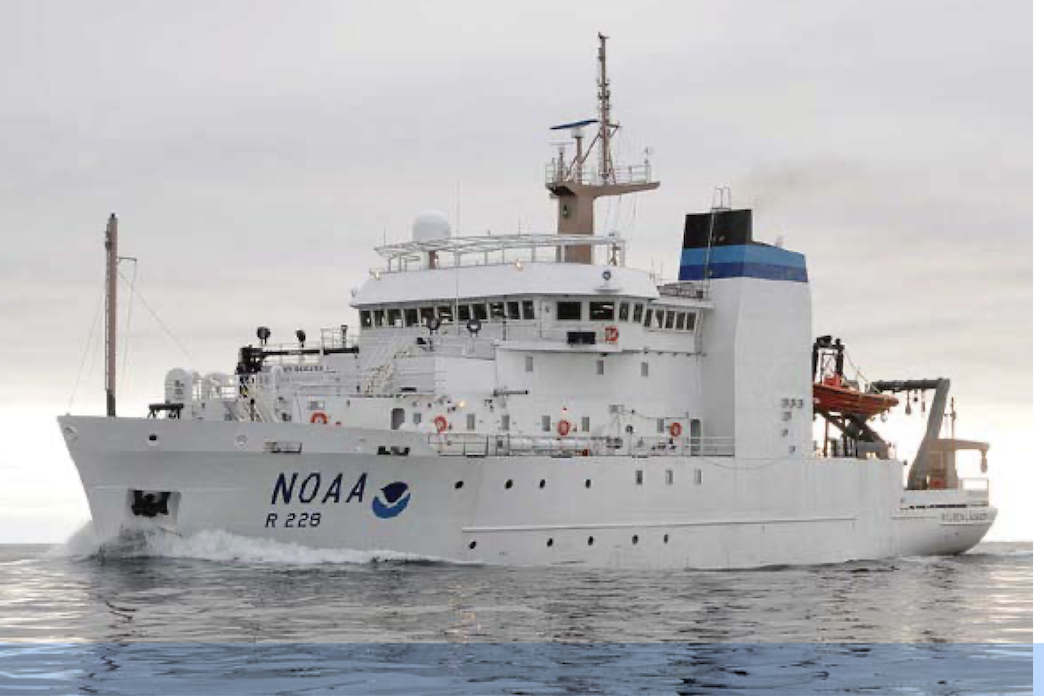
In our survey, we will sample the water above and adjacent to the seamount. We will also be surveying marine mammals and seabirds and their prey and collecting environmental DNA (eDNA) to understand animals that we are not able to observe. This data will help give a more complete picture of oceanography and biology of the entire seamount from its base to the ocean surface and help us to understand connections between climate, ocean conditions and marine life. One goal is to use this data to inform the shipping industry so that ships crossing the Davidson Seamount lower their speed to avoid hitting whales. This work is of great importance to me as I have been saddened by the many whale strikes in the Bay over the recent months. All of our work will be done on board Reuben Lasker, a 208 ft research vessel equipped for both fishery and oceanographic research.
NOAA Ship Reuben Lasker, Photo courtesy of NOAA
While I shared my background in my introductory blog last summer, there have been some new developments. First is the great news that after 9 years of leading student activism to end single use plastics in school meals, we began reusable dishware for school lunch. The change is not just for my school, but will be rolled out in all schools across the district, impacting 9,000 students daily and vastly reducing the plastic waste our schools generate. I am really happy that students will be able to experience more sustainable meals at school — since lunch is school too.
Traditional single-use disposable materialsNew reusable lunch dishes
This school year, I also had the opportunity to travel for 12 days to Antarctica as a Grosvenor Teacher Fellow with National Geographic on the polar expedition ship Endurance. This life-changing experience of exploring the Southern Ocean deeply impacted both myself and my class. We spent the school year diving into a study of Antarctica, interacting with polar scientists and learning of the critical role Antarctica has for the health of our water planet. We discovered how our local actions impact the environment and affect places as far away as Antarctica.
Though I couldn’t take my students on the voyage with me, I did instill in them the curiosity and joy I experienced exploring. Thus, my class became explorers of our local environment — the Berkeley Marina and the San Francisco Bay. In a series of 10 field trips, we learned to identify local birds, trawled and studied plankton and charted and sailed a course on the schooner Pegasus, engaged in multiple beach clean-ups (with data sheets) and camped on the cliffs in Marin overlooking the Pacific Ocean. I hope that through these joyful experiences of learning in nature, my students will be inspired to continue to grow their connection, curiosity and sense of caring for our planet — and especially for our ocean.
The following photos are included courtesy of Oxford Elementary.
Bay scientist studies Trawling as Bay Scientists Beach Clean / Waste Audit Birding at the Berkeley Marina
Sailing on Pegasus (a youth sailing project)
Charting a course to Angel IslandSailing our course to Angel Island
Finally, I am especially excited for my Teacher at Sea experience because Monterey Bay is close to my heart. In 2019, my students and I participated in the Monterey Bay Aquarium’s Ocean Plastic Pollution Summit; it was a life changing 2-day experience where we explored the aquarium at night, slept next to the tanks, listened to inspirational youth ocean activists and connected with students from all over California who were also working to solve the plastic pollution crisis. Many of the students pictured below are still active in working to protect our ocean by volunteering at the Marine Mammal Rescue Center or serving as youth representatives on our city’s Climate Commission.
Ocean Plastic Pollution Youth Summit. Photo courtesy of Monterey Bay Aquarium
As I embark on this voyage of discovery, learning and adventure, these words of the great oceanographer and ocean activist Sylvia Earle, whom I deeply admire, come to mind:
“The ocean is the cornerstone of Earth’s life support system, it shapes climate and weather. It holds most of life on Earth. 97% of Earth’s water is there. It’s the blue heart of the planet — we should take care of our heart. It’s what makes life possible for us.”
With Sylvia Earle and my students (not pictured) in Alameda, CA
Thank you to the scientists and crew of Reuben Lasker for the opportunity to join you in this most important work!
I’ve been home from my voyage for almost two weeks, and I have been avoiding this last blog post because I don’t want the adventure to truly be over. (I have avoided unpacking my suitcase for the same reason!) But alas, all good things must come to an end. After cruising beneath the Golden Gate Bridge and making our way to port in San Francisco on June 26th, I immediately hopped on a flight back to Atlanta and was in my own bed by 2:00 a.m. the next morning.
Photo taken from NOAA Ship Bell M. Shimada as we passed beneath the Golden Gate Bridge into San Francisco.
Saying goodbye to everyone aboard NOAA ship Bell M. Shimada was bittersweet, because I honestly don’t know if I’ll ever see those people ever again. (Thank goodness for modern technology, though, which will keep us connected.) Being at sea is an experience unlike anything I have ever done, and I am filled with so much gratitude for everyone who made this trip happen.
Classroom Connections
So, what’s next for me? Well, teachers in my area return to school on July 21st, and so my summer is slowly slipping away. That means that very soon, I will have six new classes of oceanography students walking into my classroom, ready to learn about the ocean. But first, as with any classroom, we will spend some time getting to know each other before we dive into the curriculum. I plan on introducing myself with a slideshow of pictures and stories from my time at sea, because I want my students to see that an average teacher from a landlocked city without any special college degree can still explore the ocean. I went to school in this same district and was raised in this same town; I want my students to see themselves in me. I want my students to see that it is okay to be scared of something new and to try it anyway. I want my students to see that science is messy and can be unpredictable at times, but it’s all part of the process. I want my students to see science as a verb; as something that is experienced, not only something that is studied in school.
In addition, as part of my agreement with the NOAA Teacher at Sea program, I will be creating lesson plans for my classroom that incorporate some of the research conducted during my time at sea. I will also be creating curriculum content around oceanography careers for my students to explore. I also want to include social-emotional learning about skills such as collaboration, communication, and self-awareness.
I want my students to learn that it’s not always about what you know, but what you can accomplish alongside others. Learning in the classroom does not take place in isolation, and neither does working in the field. I want my students to leave high school and enter adult society as functional humans who can work with a team to achieve a common goal, even if they feel uncomfortable at first. I want my students to understand concepts such as comradery and morale, and to understand how their actions can affect others. And I want my students to feel confident in their ability to problem-solve and communicate with others in times of uncertainty. These are all skills that I witnessed firsthand aboard the ship, and I feel that these lessons are just as important as the science content that I teach every day.
This is goodbye for now, but as part of the NOAA Teacher at Sea alumni association, I hope there will be more opportunities for me to partner with NOAA to explore the big blue world. And in the meantime, I’ll do what the character Dory from Finding Nemo does – just keep swimming.
NOAA Ship Bell M. Shimada, docked in San Francisco.
Mission: Integrated West Coast Pelagics Survey (Leg 2)
Geographic Area of Cruise: Pacific Ocean, California Coast
Date: July 6, 2025
Weather Data from the Bridge
At 4:00 p.m., the temperature was 57.2°F (14°C). Our boat position was 35/17.2 North Latitude and 121/30.2 West Longitude. The sky was OVC 8 oktas, which indicates that all eight sections of the sky were filled with clouds.
Career Log: NOAA stands for National Oceanic and Atmospheric Administration
Onboard NOAA Ship Bell M. Shimada are nine officers serving in the NOAA corps. This is one of the eight uniformed services of the United States government. NOAA Corps is a non-military branch that works to assist with ocean and atmospheric research. There is an application process to join NOAA Corps, and once selected, training is facilitated at the U.S. Coast Guard Academy in New London, Connecticut. According to the Commanding Officer Jeff Pereira, NOAA Corps’ job on this mission is to keep the crew and ship safe on the open waters at sea and to navigate the boat, ensuring success in both research and operations.
Sanam, NOAA Corps EnsignAras, Senior Watch OfficerMegan, NOAA Corps Ensign
Additionally, onboard there are many amazing deckhands who help with the challenging and somewhat dangerous operation of bringing the fishing nets in and out of the ocean.
One particularly notable (and somewhat cinematic) event during our time at sea was the mid-cruise transfer of an additional crew member by small boat. Due to an unexpected medical emergency, one of the originally scheduled crew members critical to deck operations was unable to join the expedition, leaving the ship shorthanded for round-the-clock fishing and research duties.
To remedy this, a coordinated transfer was executed involving a small Coast Guard vessel and the NOAA Ship Bell M. Shimada. The NOAA Corps officers navigated the maneuver with impressive precision, transforming what could have been a logistical headache into what felt like a scene straight out of Mission: Impossible. The transfer was successful: the new crew member leaped—quite literally—onto the Shimada. With his arrival, we were once again fully staffed for 24/7 scientific operations.
Mammal Watch
The flying bridge is at the very top of the boat, so we get to see some interesting things up there. One fantastic and rare sighting happened when we spotted several humpback whales united in coming up to the surface to feed. According to fish biologist Sabrina Beyer, whales will make a circle around the fish and then travel up through the circle for an awesome meal.
Around the world, humpback whales (Megaptera novaeangliae) use bubble-nets to trap certain prey such as krill, herring, and young salmon, sometimes in coordinated groups and at times alone. The whales dive down below their prey and swim in circles while releasing bubbles from their blowholes to create a rising curtain. The curtain creates a visual barrier that tricks the prey into thinking there’s no escape. Once the prey is tightly corralled, the whales lunge through the bubble-net with open mouths to swallow their meal.
Additionally, one important part of the scientist’s job is called “mammal watch.” This is usually done from the bridge before fishing nets are placed into the water. Watching the ocean helps reduce the chance that a mammal like a dolphin or a whale gets stuck in the fishing nets. Last night, we had many dolphin sightings and had to move the boat to another location. This delayed fishing for several hours.
Did You Know?
Did you know that there are 15 NOAA ships in operation? Being from Hawaii, I’m particularly interested in the vessels stationed there. Hopefully, once back in Hawaii, I can arrange a tour for my students of the NOAA Oscar Elton Sette. The ship’s home port is Honolulu, Hawaii.
Animals Seen Today:Butterfish, Storm Petrel, Hake, Octopus, Market Squid, Anchovies.
Today’s catch brought in a small batch of our target fish – hake – along with other ocean creatures, including the adorable butterfish. But the real scene-stealer wasn’t a fish at all. A small storm petrel has unofficially joined the crew, making himself quite at home aboard NOAA ship Bell M. Shimada. With his sleek webbed feet built for water paddling, he’s more sea-worthy than the rest of us. We haven’t caught him in flight yet, but his dinner situation is well taken care of.
At mealtime, scientist, Amanda Vitale, casually announced, “I’ve got a squid in my pocket.” This nice little gourmet offering was for Mr. Storm Petrel, named Jeff, after our Commanding Officer. Only an oceanographer would stroll into dinner toting a cephalopod takeout menu. How funny!
Mission: Integrated West Coast Pelagics Survey (Leg 2)
Geographic Area of Cruise: Pacific Ocean, California Coast
Date: July 3, 2025
Weather Data from the Bridge
7 a.m. Pacific Daylight Time
Currently, the air temperature is 14.3°C (57.7°F). The wind speed is 8.2 knots.
Science and Technology Log
These are some of the people in my new neighborhood! There are many different jobs and career titles on board NOAA Ship Bell M. Shimada. It is an interesting learning experience investigating the human work that goes on at sea. The ship occupations are broken down into the following categories: science, engineering, ship management, NOAA Corps, survey technology, electronics, and stewarding. Today, I will be writing about the scientists.
Science
On the science side, many different scientists are doing fascinating work on board. Here I will review just a few. Many of the scientists have PhDs and work in the exact field they researched in their graduate studies. Sabrina, Zach, and Melissa are fish biologists. They work directly in the lab, counting, dissecting, and investigating the health, population, and biology of the fish.
Sabrina, Fish BiologistZach, BiologistMelissa, Fish Biologist and Project Coordinator
Most of their work on this voyage is focused on two different types of fish populations: hake, and coastal pelagic species (CPS) (which include Pacific sardine, Pacific mackerel, Jack Mackerel, Northern Anchovy, Market Squid, and Krill.)
In addition to the biologists, we have a research economist, a software engineer, and a satellite oceanographer on board. These three scientists have volunteered to be on the ship for both the adventure and to get a better understanding of how their work combines with other NOAA research.
Phoebe, Research EconomistCara, Satellite OceanographerMelina, Software Engineer
For example, Melina helped expand, adapt, and add functionality to a computer program called CLAMS: Catch Logger for Acoustic Midwater Surveys. The scientists work with this program in the wet lab to capture and record important data about the fish populations they are studying.
Homescreen for the CLAMS computer program
Personal Log
On the first day at sea, we practiced safety drills for fire/emergency and for the unusual occurrence of having to abandon ship. Being able to put on a survival suit is critical to an individual’s safety in the event of having to enter the water because it will protect them from hypothermia. In these photos, our crew is on deck and practicing drills to get into the survival suit. It is a bit like trying to put a chicken into a prom dress, but I managed to get it on with a little help and instructions from my crewmates.
Jojo works on getting her left arm into the survival suit
Next step is the hood…
Ta da!
Did You Know?
On board the NOAA ship Bell M. Shimada, there is a specialized acoustics lab that plays a vital role in scientific research. Currently, this lab is actively collecting meteorological, geophysical, and biological data from along the bottom of the Pacific Ocean. Meteorological data includes information about weather conditions, such as wind patterns, temperature, and atmospheric pressure. Geophysical data refers to the physical characteristics of the seafloor, including its composition, structure, and topography. Meanwhile, biological data focuses on the living organisms found in this underwater environment—particularly the fish species being studied. Together, this data provides crucial information concerning the ocean’s dynamic systems that propel scientific work.
Biological data is especially essential for the scientists aboard the NOAA ship Bell M. Shimada. To collect this information, the ship uses sound waves that are sent down into the water to detect fish. When these sound waves encounter schools of fish, they bounce back and generate an image on a monitor. Chief Scientist Rebecca Thomas explains that this process is similar to the echolocation used by dolphins to navigate and locate food in the ocean.
Expanding on this, research fish scientist Steve De Blois describes how the resulting acoustic map helps identify different species. For example, hake appear as a green, wavy snake deep in the epipelagic, or sunlight zone; rockfish resemble haystacks near the seafloor; and coastal pelagic species (CPS) show up as a red ball closer to the surface.
Since the Shimada is focused on fish research, the scientists rely heavily on this acoustic technology to locate and study their target species with precision.
Weather Data Snapshot: 9:16am, Pacific Daylight Time
Currently, the air temperature is 57°F (14°C) with a wind speed of 15 knots and a wave height of 6 feet. I have just completed my first daytime marine mammal watch (mentioned in a previous blog post), where I spotted several dolphins and sea lions. The bright sunlight and clear blue skies made it easy to spot mammals during the day, as opposed to the nighttime when I am normally on marine mammal watch. As with every marine mammal watch, if marine mammals are spotted, fishing operations are paused until marine mammals are no longer within a certain distance of our vessel. If marine mammals persist in the area, fishing operations may be suspended entirely. In today’s case, we called off our fishing operations after seeing several marine mammals over the course of an hour.
Photo of me using a pair of binoculars to watch for marine mammals.
Science and Technology Log
In other news, I finally got to experience my first and only hake trawl! Pacific hake, otherwise known as Pacific whiting, are another species of fish that are being assessed on this integrated survey. They are fished during the daytime hours at the midwater level as opposed to the nighttime hours at the surface level, as we do for coastal pelagic species (CPS) like mackerel, anchovies, and sardines. Scientists use real-time acoustic data to determine the best places to fish for hake as well as CPS, and up until this point in our survey, a hake trawl never quite lined up with my waking hours. After becoming an expert on CPS, I had to learn how to identify hake as well. (And in my completely biased opinion, I enjoyed trawling for CPS more than hake, but that’s just me!)
Young hake fish, otherwise known as Pacific whiting.
However, when asked if I wanted to “jump in there” for a photo with the hake, I couldn’t say no! As I’ve said, one of the best parts of this whole experience has been how much fun I am having with my team. They have been my personal photographers so that I have plenty of excellent pictures for this blog!
Photo of me holding a hake fish in a basket of hake, squid, and pyrosomes from our trawl.
The following night, we caught around a dozen jack mackerel that were the largest I had ever seen! We normally see smaller individuals in our trawls, but these big guys were the highlight of the night. And just like we do with the smaller specimens, we measured their lengths and weights and extracted otoliths (mentioned in a previous blog post). As you can see in the picture below, these fish were so large that they barely fit into our “taco trays” that we use for organizing fish for dissection.
Photo of me holding several large jack mackerel fish in dissection trays.
Personal Log
I am nearing the end of this adventure at sea, and I must say, I have a lot of mixed feelings about it. Am I excited to go home and see my family? Of course. Will I miss my newfound family aboard NOAA ship Bell M. Shimada? Definitely. As a teacher, I get to go home and relax for the rest of the summer, while everyone else on board this vessel will continue their work in some form or fashion, whether that’s on the ship or in an office somewhere on land. I will miss the sense of discovery that every new day brings, and I will miss the comradery of the ship. I have had such a positive experience with everyone, whether they are part of the science team, the deck crew, the NOAA Corps., etc. and it’s something that I wish everyone had the chance to experience. It’s not every day that you meet a group of people who are genuinely kind and cooperative with one another as they work toward a common goal.
Did You Know?
For today’s Did You Know? section, I have decided to highlight some information about two members of the science team who are sailing on NOAA ship Bell M. Shimada with me for Leg 1. I chose to interview John Pohl and Julia Clemons because their backgrounds are in oceanography, which is the subject that I teach. I hope to use the summaries of these interviews to help my students gain insight into the life and career of an oceanographer.
Interview with an Oceanographer: John Pohl
John Pohl, a research oceanographer with NOAA, has been captivated by the ocean since childhood and now dedicates his career to exploring and understanding the marine world. He believes the scientific method is a powerful tool to satisfy curiosity and make meaningful contributions to both human society and the natural world. Pohl emphasizes the importance of recognizing how deeply our lives depend on ecological systems, such as those that produce oxygen, food, and clean water. He enjoys the variety and adventure of fieldwork, whether on research vessels or diving underwater, as well as the creativity involved in developing new scientific ideas. While much of his time is spent analyzing data at a computer, it’s the blend of discovery and imagination that keeps his work fulfilling. He wishes more people would realize that scientists are not emotionless or robotic, but rather are fueled by curiosity and wonder. To students interested in marine science, Pohl advises taking charge of their own learning, using available free resources, and seeking out mentors and collaborators who inspire and support their growth. He believes that nurturing a sense of wonder and building strong, positive networks are key to both personal and professional development.
Interview with an Oceanographer: Julia Clemons
Julia Clemons, team lead of NOAA’s Fisheries Engineering and Acoustic Technologies (FEAT) team and co-lead of the Integrated West Coast Pelagics Survey (IWCPS), has a background in geological oceanography and brings her lifelong passion for the ocean to work with her every day. Her team collects fishery-independent data, which is important because it helps scientists understand fish distribution and population trends beyond just areas that are easy to fish. This information is essential for tracking how fish grow and migrate, and for supporting sustainable fisheries management. Julia finds joy at work in collaborating with others, especially during large-scale surveys that inform stock assessments of important species like Pacific hake. Although much of her work is done in the office, she also spends one to two months at sea each year during intense fieldwork periods. She’s loved the beach since she was a toddler and turned that early fascination into a career. Julia wishes more people knew how much effort, planning, and dedication go into each research survey and how deeply scientists care about getting things right. Her advice to students is to follow their passion boldly, stay open to learning, ask for help when needed, and not let discouragement from others define their future. Passion and persistence, she believes, matter more than having all the answers at the start.