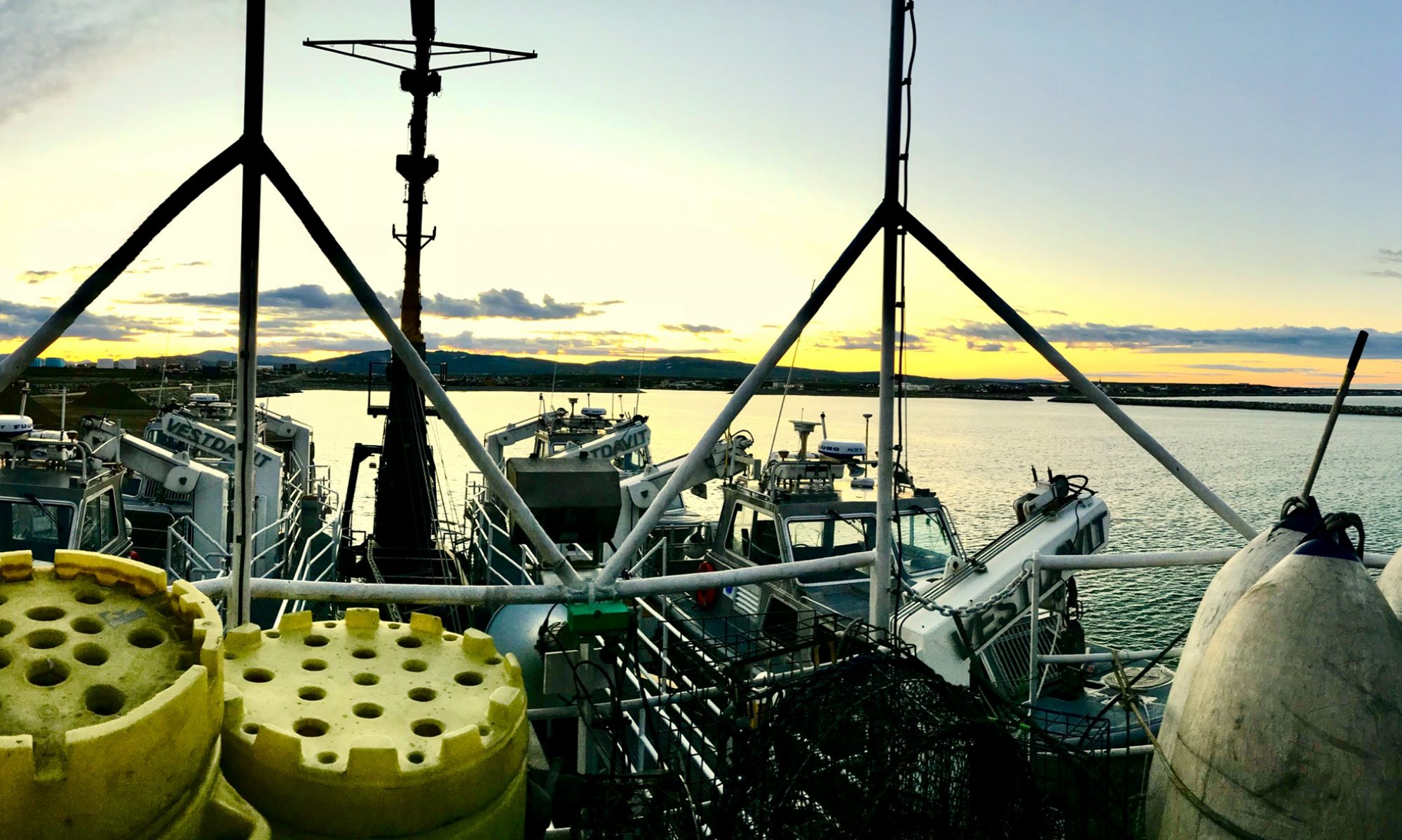
This was a day when we were never able to catch up with the fish. There were constantly fish on the deck waiting to be sorted. The trawls were frequent and close together. Throughout the night and into the morning, the catch was mostly shrimp. We had a wide assortment of shrimp. All the commercial varieties—brown, white and pink—were well represented, as well as the several types of non-desirable species.
Personal Log
Today was the day I “hit the wall.” I worked myself as hard as I could throughout the shift. The only time that I relaxed at all was when I was watching the dolphin that had followed the net and that was attracting the attention of Brittany. Otherwise, I was working as fast as my brain and body would allow.
Question of the Day
What kind of shrimp do they use to make “popcorn shrimp?”
Answer: Trachypeneus similes! I know that’s a “trachy” question. Trachypeneus shrimp are not considered “commercially viable” at this time. Previously, brown shrimp were not considered to be marketable. As the demand for a product increases, so does its marketability.
NOAA Teacher at Sea
Chris Harvey
Onboard NOAA Ship Oscar Elton Sette June 5 – July 4, 2006
Mission: Lobster Survey Geographical Area: Central Pacific Ocean, Hawaii Date: June 23, 2006
Science and Technology Log
“When both feet are planted firmly, you are stuck”
I can only think of one thing to write about today- or yesterday, or the day before, for that matter. That is, what day is today? Piglet would tell me that today is the day after yesterday, which does not help since I do not know what day yesterday is. And Pooh would tell me that today is the day before tomorrow, which makes more sense, but not enough. Eeyore would tell me that today is a bad day, while Rabbit would tell me that today is however many days past the first of the year it so happens to be (as he calculates how many days have passed since then!). Owl would tell me that today is just a state of pondering what today really means. And Christopher Robin would tell me that today is today, of course! I was thinking that today must be close to July. Days just seem to pass out here. And it seems we are much closer to being back in port than to being out to sea. And yet a container of milk said June 14 for the expiration date. So I think to myself, are we in some kind of time warp, or am I drinking milk that is two weeks past expiration? Pooh says expiration dates don’t matter anyway, as long as you put some honey in the milk. (Is it the sun, or salty air, or both that are getting to me?)
But low and behold, as I poured the crunchy ice-milk into my cup I realized that my rationality, what the sun and sea have not taken from me, had been undermined by a piece of modern technology called a freezer! God bless the freezer! We have been eating “fresh” fruit and vegetables for over twenty days now, and I have had no complaint on the freshness of the food. Scurvy has stayed clear of the Oscar Elton Sette!
Presently we are anchored off of Maro Reef, far enough out not to do damage to the reef, yet close enough that- with my mega ultra 17 X super zoom lens (it’s not really that great!)- I can see waves breaking on the reef. Our friendly albatross has multiplied during the day, and all but disappeared during the evening. Have I mentioned how amazing these creatures are?
In terms of work, yesterday we averaged nearly six lobsters per trap, which was a substantial increase over past days in the NWHI. However today was back to normal. We are in our last rotation of jobs this week, which is bittersweet in that by the end of the week we get another break. Only this time the break is for good. I can tell you that without a shadow of a doubt, I will not miss hauling and setting lobster traps.
However, having just observed the Pacific sunset (behind a big nasty storm, beautiful nonetheless) I am reminded of my joys while being here. And yes I still coo like a schoolgirl over her first crush when I see the stars at night. I’ve made it a point to spend several hours a night lying underneath them. I have come up with my own constellations, since the other ones seem to be rather old and archaic. There is the Hippopotamus, the Wishbone, the Giraffe, the Arrow, the Sun to name a few (Yes, I know the Sun already exists. But I have found another one, much brighter than our own, but further away…Have I told you of the sun and salty air and what it does to the mind?)
As for the quote of the day. When both feet are planted firmly, one would think they would be on stable ground. This is good for some, and bad for others. I am of the kind that likes to think that two feet planted implies immobility. Although it does not quite rule out two feet firmly planted while running in some direction. Still, I always think of my life- the few times I think of my life in terms of footsteps- as having one foot on the ground, and one foot in the clouds. But that might also be because the more I think about planting myself anywhere, the more I want to get up and go somewhere else. In fact, I think that at this very moment I shall quit my teaching job and find a job as a deckhand in Honolulu! (That is the foot in the clouds speaking!) Of course this is not sensible, but can you imagine the stories I would be able to tell you then!
My friends Pooh, Eeyore, Piglet, Rabbit, Owl, and Christopher Robin want me to mention that, if you get the chance, you should read The Tao of Pooh. For those of you who know me, you will find that the cover of the book somewhat resembles a piece of artwork tattooed to my right leg (or rather, the artwork on my right leg somewhat resembles the cover of the book). Either way, the book is wonderful in that it brings about a simpler perspective of life. I have been reading it in the time I have been out here, savoring the pages for the perspective that I gain from them.
Other than that, life goes on like Groundhog Day. Did I mention the effect of the sun and the salty air on the mind? Oh, thanks Pooh, I see that I have. Well it makes one love the sea and all of the Beautiful experiences that one experiences out here. Absolutely amazing!
Dr. Lukas, aboard the REVELLE collecting water samples from the CTD.
Dr. Roger B. Lukas Professor of Oceanography Dept. of Oceanography and Joint Institute for Marine and Atmospheric Research University of Hawaii at Manoa.
After taking a CTD sample earlier this afternoon, I spoke with Dr. Lukas, the research scientist on this cruise who is leading the recovery and replacement of the mooring components below the WHOTS-3 buoy. The following is a summary of our discussion.
Dr. Lukas encouraged to me to communicate to my students how imperative it is to set up means of continually confirming the accuracy of scientific data. The data from the mooring, for example, is compared with six or seven different profiles in order to verify the accuracy of its data and to determine when an abnormal reading has occurred (i.e. a sensor breaks or fishing lines are caught in an instrument).
Organisms both in the sample and in the surrounding water can shift the conductivity calibration in a CTD (Conductivity Temperature Depth) instrument. Therefore, the calibration of these instruments must be constantly checked and monitored. Throughout the day today at two-hour intervals, Dr. Lukas has been sending down CTD’s that provide a continuous profile of the salinity and temperature of the ocean from the surface to the maximum depth of the cast. There are sampling bottles on the rosette of the CTD that close at a depth of 10 and 200 meters. The water from these samples is brought to the surface and is used to calibrate the conductivity of the CTD. The conductivity readings (which are used to determine salinity measurements) are compared to readings taken from the sampled water via an analytical instrument called an Autosal. The Autosal is located in a lab on the ship near the main science lab. This instrument is contained in a water bath for stabilization and is kept in a temperature-controlled room. Any atmospheric pressure variations that might occur during the Autosal conductivity tests do not have enough of an effect on the conductivity determinations to create inaccuracies in salinity readings. The Autosal itself is calibrated against standard seawater which is quite expensive ($55 for a small vial) but whose salinity is known to the nearest part per million (ppm).
Salinity, or the number of grams of dissolved salts in a kg of seawater, is detected in one part per million (ppm) and is not taken as a direct measurement. Instead, both the temperature of the sample and its conductivity are measured. This is because the conductivity of seawater is affected by three variables: temperature, pressure, and salinity. Temperature affects conductivity ten times more than does salinity. Basically this means that temperature measurements must be extremely accurate in order to obtain precise salinity measurements. If a temperature reading were to be off by 1°C this would produce an error in the salinity determination by a factor of ten. This would render the salinity measurement entirely useless. Salinity measurements are related to a scale known as the Practical Salinity Scale where, for example, a reading of 35 units would be equivalent to the conductivity of 35 grams of salt in 1 kg of water. The scale is practical because the ratio of ionic chemical compounds in the ocean remains relatively constant.
Ultimately, the salinity readings produced by the instruments contained in the MicroCATs in the mooring are being compared to numerous measurements taken off of the ship via the CTD’s profiles. The CTD’s readings are being calibrated against water samples taken by closing bottles on the CTD frame at different depths, which are then measured in the Autosal, which is, in turn, calibrated against standard seawater samples. The multiple checks on the temperature measurements taken at sea are not a stringent as those of the salinity readings because the temperature instruments do not have nearly the same rate of calibration drift. Unless they are broken, they will only drift approximately one millidegree per year.
There are different types of oceanographers who study various parameters of the ocean. Dr. Lukas is a physical oceanographer as opposed to one who studies the biological or chemical aspects of the ocean. Physical oceanographers study such factors as current, waves, wind, heat content, temperature, and salinity. However, there is overlap amongst the different areas of science. A chemical determination, such as salinity, can actually be quite pertinent to the physical study of the ocean. Alterations in salinity correlate with changes in density. Variations in density gradients across the ocean cause flow or ocean currents. Other factors that affect the ocean currents include the depth of the water; wind, which drags water along; and the rotational motion of the earth. For example, if a current is moving northward, the rotation of the earth causes an apparent force to affect the water thus drawing it eastward and changing the direction of the current. Additional smaller factors that affect the current include turbulence in both the air and the sea. Turbulence is chaotic eddying motions that cause mixing amongst masses of water at different temperatures and salinities.
Dr. Lukas has a Bachelor’s degree in Mathematics, and a Master’s and PhD in oceanography. The work that he has done in earning his PhD gives him the ability to lead a research project, such as the Hawaii Ocean Time-series (www.soest.hawaii.edu/HOT_WOCE). However, Dr. Lukas noted that one does not need a PhD to be a vital part of a research team. We have people working as part of the science team on this cruise who are at the Master’s, Bachelor’s and Associate’s degree levels.
When asked about what he likes about his work, Dr. Lukas told me that he enjoys several aspects of his job. He enjoys going to sea and the fact that his work leads him to discover new things. He also values the freedom that his occupation affords him. If he is successful in obtaining funding for a proposal, he has the freedom to carry out a project of his own design. His work has taken him to a variety of places including Papua New Guinea, the Philippines and the Bay of Bengal!
It became very evident in talking with Dr. Lukas that he is devoted to this work that he so enjoys. He puts many hours into his profession. As he stated, he and Dr. Weller have continual “time and a half” jobs. His occupation involves many different aspects including being at sea, gathering data and preparing for such science cruises. He spends large chunks of time working with his research group of eight members. This work involves managing and training the members of the group as well as dealing with various personnel issues. Approximately 20% of his time is spent teaching at the graduate level. This is a smaller percentage than many of his colleagues. Dr. Lukas spends time developing projects and proposals and a significant amount of time completing the science for those that are funded. This science includes analyzing data, writing papers, attending meetings, etc. Finally, another large aspect of his job is of a more global, community nature. Like many of his colleagues, he reviews the work of other scientists. He is a member of various committees including those that make recommendations to funding agencies. He has numerous meetings each year, some of which require extensive travel. He travels to Washington D.C. several times a year, and has worked to raise awareness in congress concerning global issues relating to the ocean and our environment.
Finally, I asked Dr. Lukas if he had any advice for students interested in oceanography. He replied that, “There is no such thing as too much math or science!” One of his team members was nearby and commented that although math might seem boring in high school it becomes so important later on. Dr. Lukas confirmed that it is a tool that allows scientists to accomplish a lot. This is clearly evidenced by the work that he is able to complete.
NOAA Teacher at Sea Lisa Kercher Onboard NOAA Ship Fairweather June 11 – 24, 2006
My title for the day was “Gadget Girl.” I assisted the survey team by finding the bearing and horizontal distance to the feature in question.
Mission: Hydrographic and Fish Habitat Survey Geographic Area: Alaska Date: June 23, 2006
Science and Technology Log
This trip is just so amazing! It blows my mind that I keep having more and more exciting days and great adventures! What if work really was like this?!?! These people have great jobs! Boats left at 6:30 this morning, but we were back just in time for lunch. ENS Jon French, survey technicians Stephanie Mills and Grant Froelich, and I boarded the Ambar 2302, which is a small open craft and headed to a location called The Haystacks and Whaleback: two interesting islands. We were doing shoreline survey, which is basically going in to verify or disprove what an airplane has already surveyed from above. This is called LIDAR (laser imaging detection and range). There are areas marked that might have a feature such as a rock that we have to check out and basically make sure it is there! I got to be gadget girl and when we found something, we had to log it by tracking it on a DGPS (differential global positioning system) satellite system, taking a picture, determining the bearing and finding the horizontal distance with a laser. The DGPS system is much more accurate than a standard GPS system. As the other survey techs manned the computer and DGPS system I had to quickly do the other three things. I had all three gadgets hanging from my neck and had to use them to give the techs the precise readings. Talk about nervous!
Jon and Stephanie work on the data from the cabin of the Ambar boat.
Personal Log
Stellar Sea Lions sun and play on Whaleback.
I saw two bald eagles on the top of one of the Haystacks and two more on Whaleback. They were so pretty. I captured some short video of them flying. Video on the boat is a little tricky though as I learned today…too much up and down motion! Then I saw a cute little seal quickly scurry for the water as we scared him from his spot on the rocks and also a sea otter and one big behemoth sea lion! He barked and smiled at us as we passed. Then on Whaleback, which was a sea lions heaven, just a small short island that looked like the top of a whale’s back surfacing out of the water (hence the name), I saw about 40 more sea lions! They were noisy and smelly, but so cool. I watched them move like they were doing the worm. And they fought with each other and barked and splashed in the water. We watched them for 30 minutes as we were finishing our work, taking a break and snacking, before we headed back. On the way back, like I said, the waves were fierce.
One behemoth sea lion smiles at us as we drive by!
After getting lifted off the boat and getting nailed back down and slamming my back and tailbone! I decided to ride the rest out in the cabin. As I made my way back there Grant, my tour guide of spotting whales, pointed out some HUMPBACKS! Yippee. We idled and watched them surface and resurface. They were very, very far away, but looked so huge, so I can’t image what they would have looked like close up! They jumped so high and straight out of the water and splashed so hard back down. There might have been three or four! Soooooo awesome! So that was my day. Again, so amazing! I loved it! I then took a long hot shower when we returned, followed by a yummy lunch and a long nap! This stuff is tiring! Working over the summer and teachers just don’t go together!
Question of the Day
The tides determined our window for collecting shoreline data today. We were given the time window of 5:30 to 10:30 am. This is the time during the day when there is a negative tide. This makes it much easier for boats to see features in the water that would not normally be exposed during a high tide situation. The west coast experiences semidiurnal tides. This is different from the tides on the east coast, which are called diurnal. Can you describe the differences between the two types of tides?
NOAA Teacher at Sea
Jessica Schwarz
Onboard NOAA Ship Rainier June 19 – July 1, 2006
Mission: Hydrographic Survey Geographical Area: Alaska Date: June 23, 2006
Assistant Engineer Kelly Baughman, checking gages in Central Engine Room Control.
Crew Interview Day!
Today was another excellent day onboard the mighty RAINIER. I awoke and made my way to the galley for an English muffin and some coffee before I made it to Central Engine Room Control to chat with Third Assistant Engineer Kelly Baughman. Before Kelly made her way down to talk with me, Engineering Electronics Technician (EET) Joe Gallo took me beyond the center console and into the engine room. I was able to see for myself the machinery that is powering the ship. I checked out the main engines, the generators, the boiler, the evaporators, and all kinds of other noisy machines. After my tour I sat down to find out what got Kelly into being an engineer in the first place. Kelly started out as a young girl with aspirations of becoming a naval pilot. This was interesting news to me because I didn’t realize the Navy had pilots in the first place. I thought the Navy aircraft carriers were carriers for Air Force planes. In actuality, the Air Force is only land based, and all Navy carriers support naval aircraft.
Photo of the port main engine. The starboard main engine is not shown but looks exactly the same and is directly across from the port engine.
As she grew up she changed her mind, deciding to pursue a Bachelors of Science in Marine Engineering Systems Design from the U.S. Merchant Marine Academy in Kings Point, NY. Along with a BS, Kelly also received a minor in nuclear engineering.
The United States Merchant Marine Academy (known simply as “Kings Point”) is one of the five federal military training academies. It is the only academy that allows its graduates to be hired as civilians with the expectation of completing their military service requirements. Kelly is completing her requirements by working for the Navy Reserve. Kelly has traveled all over the world on various ships. Before she even finished college she was onboard US Naval Ship LARAMIE during the time the United Nations decided to go into Kosovo. LARAMIE was a Navy support ship that replenished the battle ships with fuel, food, and other consumables. She mentioned these ships are the only military ships that will employ civilians and they follow the battle fleet for the sole purpose of providing support and supplies to the vessels.
While onboard Kelly was getting hands-on training as an engineer. Students at Kings Point are required to have at least one year of hands-on training on a ship before graduating. While she was getting her training she was traveling to Japan, Australia, Spain, Alaska, Hawaii…and plenty of other places (I just can’t remember them all…there were so many).
Ordinary Seamen (OS) Megan Guberski fully suited in her turnout gear onboard NOAA ship RAINIER.
Now Kelly is an employee of the Maritime Engineers Beneficiary Association, which is the largest maritime union for engineers. She was originally placed on NOAA ship RAINIER to work for 45 days beginning in April 2006, but after arrival, due to her level of experience as an engineer she was offered to stay onboard until August 2006.
I was just so impressed talking with Kelly. She’s traveled all over the world working as an engineer on many different kinds of ships. I really appreciated the time she took to explain how all the machines work to power the RAINIER!! She is obviously doing what she enjoys and life at sea comes very natural to her. After talking with Kelly, I spent some time responding to e-mails and chatting with the crew. Today is Friday, so in my normal routine that means…DAYS OFF!!! Not for the crew of RAINIER…their schedule continues to rotate regardless of what day of the week it is. Ordinary Seaman (OS) Megan Guberski put it simply, saying “yeah, every day is a Tuesday.” They are working so hard out here…all the time. I think when we come into port I’ll get to see what it’s like for the crew to get a break. That’ll be nice.
OS Megan Guberski showed me a little bit of what it’s like to work on maintaining the quality of the ship. She spends her days cleaning, painting, scraping, scrubbing, fixing, etc and gets to use really cool power tools (she mentioned that’s why she enjoys her job so much). When she had a little time, I asked Megan if she would put on her fire suit for a picture, or as it is supposed to be called, “turnout gear.” Turnout gear is the protective gear Megan has to wear to fight a fire onboard.
She went through Coast Guard Advanced Fire Fighting Training and is now one of five people responsible for putting out a fire onboard! I noticed the suit during our fire drill earlier in the week and I SO badly wanted to get pictures, but knew it probably wasn’t the best time. I was still trying to figure out where I was supposed to go in case of a fire. As I mentioned earlier…I get lost easily so stopping for photos during a fire drill would be a bad idea.
Anyway, it’s supposed to take them around a minute to get the suit on. That seems impossible to me because there are a lot of things Megan had to put on. The turnout gear was even more difficult to get into than the Gumby suit and that took some serious effort.
Megan, as well as all the crew on the RAINIER, has been excellent at taking time to explain how things work on the ship. She has been on the RAINIER for about a year and a half now and is working her way up to be an AB, Able-Bodied Seamen. By September 3rd of this year she will have enough days at sea to qualify as an AB onboard. Megan is very ambitious and has already completed all the training necessary to qualify as an AB. She will need to take a Coast Guard test before she will earn the title, but she said she’s not concerned about that. It’s just a matter of getting in her sea time.
It’s been so nice to have the opportunity to learn about the different job opportunities onboard a NOAA ship. Many of the positions require little to no training prior to employment and therefore training is provided onboard the vessel. I think that’s awesome!
Showing off her air tank, OS Megan Guberski is dressed to fight a fire!
Personal Log
Tonight I had halibut for dinner. The CO caught a 15-lb halibut off the stern of the ship and we all were able to enjoy! There are hot springs on shore and rumor has it we’ll be visiting them soon. I’m looking forward to that.
I’m getting more used to the noises of the ship and am sleeping soundly. My bunk is surprisingly cushy and very comfortable. It wasn’t exactly easy getting out of it this morning.
I saw a sea otter today!!! He was swimming on his back. We don’t have otters in Hawaii so I’m having my first otter encounters here in Alaska. I guess some of the crew saw whales this morning as well, but I missed it!
Life is good out here on the RAINIER! A little rainy today, but good!