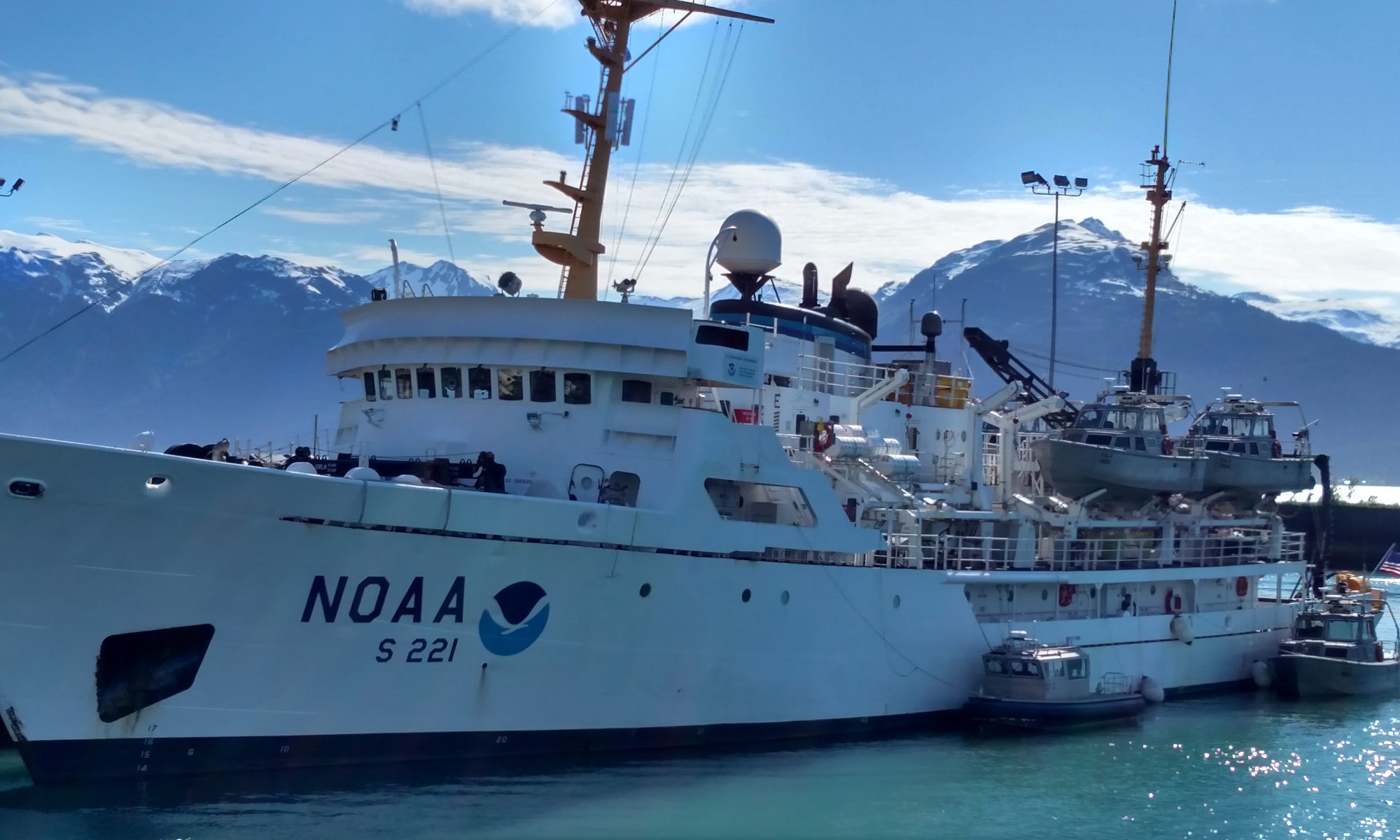
Heather Diaz, July 15, 2006

NOAA Teacher at Sea
Heather Diaz
Onboard NOAA Ship David Starr Jordan
July 6 – 15, 2006

Mission: Juvenile Shark Abundance Survey
Geographical Area: U.S. West Coast
Date: July 15, 2006

Science and Technology Log 

They did a swordfish set last night around midnight.  We hauled in the set around 5:30am. We caught 4 blues and 2 makos.  We also caught one pelagic ray.  They set a shark line out around 7:45. We were hoping to be able to finish one last set before going into port. We were scheduled to be in port around 3.

Teacher at Sea, Heather Diaz, holds up a Blue shark.

Dr. Russ Vetter explained what the different computers are used for in the aft lab.  There is one called at EK500/EQ50 which uses a split beam transponder to create a “map” of the ocean floor, so the scientists can use the data to find high spots, which sometimes are better for fishing. It also works as a sort of “fish finder” and the different things in the water show up in scale and color, so that you can see the approximate size of the animal/plant in the water.  He also explained the Navigation computer, which digitally shows the charts (with soundings), topographical features (like islands and coastline), and our course. It also provides information on other vessels that are nearby, and when available, that vessel’s name and number…the same navigation computer they also use on the Bridge. The Nav. Comp. also provides information like our latitude and longitude and our speed.

There is another computer which monitors wind speed and direction, temperature of the water (under the boat), barometric pressure, and salinity of the water.  All of these are real-time, and provide important information to the scientists.  There is also an ADCP (Acoustic Doppler Current Profiler) computer which displays a constantly changing graph of current velocity relative to the ref layer.

The very last set of this leg was a bit slower than most, which may have been a good thing, since most people were starting to get a bit tired.  We had 2 blues and 2 makos. We were very pleased to find out that we had, during the entire leg, managed to capture 80 blue sharks (78 were measured, sexed, and released), 63 mako sharks (61 were tagged and released), 23 pelagic rays (23 were released, none were tagged), 3 molas (3 were tagged and released), and 1 lancetfish (which was released but not tagged).  Everyone seemed very pleased with the results, and now Dr. Suzy Kohin (Chief Scientist) and Dr. Heidi Dewar will head back to their lab at Southwest Fisheries to analyze the data.

Personal Log 

Last night the sky was very clear, so we were able to see a lot of stars, including the Milky Way, which was very easy to see last night.  The view from the Flying Bridge (the very top of the ship) is amazing, and we felt like we could see every star in the universe, even though we know we couldn’t. We could also see the far away glow of Los Angeles, a reminder that we will soon be back in port and that our trip is nearly over.  Nearby, there was a large tanker and a container ship, which also looked neat in the dark.  The container ship was still nearby this morning when we woke up.

The sunset this morning was amazing.  There were a few wispy Cirrus clouds in the sky, which reflected the glow of the sun long before the sun made its first appearance in the sky. It was truly a beautiful sunrise, and a great way to start off our last day!  This morning after the set, everyone was a bit disappointed that we have not caught a swordfish this trip.  But, Dr. Heidi Dewar said she would consider doing another swordfish study in the future.

Everyone is busy packing and getting their gear ready to go home.  Everyone, including me, is excited to be going home to see family and friends, but I think most people will be a little sad, too. For me, this has been an absolutely amazing experience!  I have learned so much, and I have seen more in the past week than I ever could have from reading books or watching documentaries.  There is just something so special about being able to feed a sea lion, touch a shark, or come within inches of a mola to feel the power of nature and the beauty of the ocean. I am awe struck in so many ways.  The people aboard the DAVID STARR JORDAN could not have been kinder, and everyone has gone far out of their way to make me feel like part of the DSJ family.  Everyone from the captain and the officers, the boatswains, the stewards, and everyone in engineering has been friendly and helpful. I will surely miss everyone on board.  As for the scientists, they did an outstanding job of helping me to learn things and to make me feel like I was a real part of their crew. I will miss the lapping of the waves, the rolling of the ship, the camaraderie, the food, the animals, the scenery, the sunsets, and the sunsets.  And, although I cannot take any of them with me, I will have the memories of them all forever.

I want to sincerely thank Lieutenant Commander Von Saunder, the amazing crew of the DAVID STARR JORDAN, Dr. Suzy Kohin, and her wonderful team of scientists for a fantastic experience!  I never imagined it would be this incredible!  I will be grateful to you all for a long, long, long time!  Thank you for allowing me to share these past 10 days with you, and I wish you all safe travels and many more beautiful sunsets at sea to come!

David Riddle, July 15, 2006

NOAA Teacher at Sea
David Riddle
Onboard NOAA Ship Albatross IV
July 13 – 28, 2006

Mission: Sea scallop survey
Geographical Area: New England
Date: July 15, 2006

Not all scallop shells are pretty, but these were outstanding!

Science and Technology Log

We’re in an area now with an abundance of scallops, and most of them are large. When the catch is emptied from the net onto the deck, it takes 6 to 8 people working steadily, on hands and knees, to separate the scallops from the rest of the catch.  We’ve gotten up to 16 bushels so far in one 15 minute tow, using an 8 foot dredge. If the next station is nearby, we just have time to get the measurements completed and clean up before it’s time to start again.  But it’s not always that busy.  If the next station is several miles away, we get time to sit for a few minutes and relax.

During one of my relaxing moments, I photographed some of the fish that were caught along with scallops and starfish and everything else.  We catch small skates, which are shaped like stingrays, with a broad, diamond-shaped body and an elongated narrow tail.  We also catch goosefish, sometimes called angler fish, with mouths agape, showing rows of needle-like teeth. We catch flounder too.  All of these are bottom-dwellers, probably too slow to swim away from the net, or else when they feel the net coming they just hunker down in their standard defensive posture, which unfortunately is no help when the thing that’s coming after you weighs nearly a ton and is being dragged at between 3 and 4 knots.

Scallop eyes are visible as rows of dots inside the shell margin.

As we have moved farther south today, I’ve begun noticing scallops with different patterns on their shells. Some look like sunbursts; some are striped.  I’ve collected a few to take home.  I want to get some photos of live scallops also. When they open their shells you can see the row of eyes along the margin of the gills.  Scallops can swim, which is unusual for a bivalve. The powerful muscle (the part we eat) which holds the shells together, opens and closes the shell in rapid succession. This draws water in between the shells and forces it out the back near the hinge in little concentrated jets. Scallops swim by jet propulsion!  Prior to sailing, we saw a brief film clip showing a group of scallops swimming, in a jerky, erratic motion.

Sightings: An osprey landed on the mast about 11:00am.  The fishermen say we’re about 20 miles offshore, so I imagine he/she is pretty tired.  Maybe it will hang around for a while. Later…It’s 9:00 pm now and the osprey is still perched on the mast.  I expect it will still be here in the morning.  Another small songbird showed up later in the afternoon. I didn’t see it, so I don’t know the species.  The fishermen offered it some fresh water, but it didn’t drink.  They say it probably won’t survive this far out, if it won’t drink. Even so, some birds seem quite at home this far out.

Personal Log 

Midnight notes: We did 18 stations in 12 hours; several were back to back.  Do you think I’m ready for a shower and bed?  Does a scallop live in the ocean?

Heather Diaz, July 14, 2006

NOAA Teacher at Sea
Heather Diaz
Onboard NOAA Ship David Starr Jordan
July 6 – 15, 2006

Mission: Juvenile Shark Abundance Survey
Geographical Area: U.S. West Coast
Date: July 14, 2006

The Seabird Temperature/Depth Profiler is hooked up to a computer so that the information can be converted into a graph.  The information is used to identify the thermoclines, and to determine where most of the animals will be found in the water near the ship.
The Seabird Temperature/Depth Profiler is hooked up to a computer so that the information can be converted into a graph and then used to identify the thermoclines, and to determine where most of the animals will be found in the water near the ship.

Science and Technology Log 

I had the opportunity to interview Jason Larese who is aboard for this cruise.  He works for the Southwest Fisheries Science Center in La Jolla, which is part of NOAA Fisheries Program.  For the past 5 years he has been working with marine mammal studies, especially with dolphins.  Recently, he has been working on an albacore tuna tagging project. He analyses data from special tags that record light, depth, and temperature variations which help them to track where the tuna migrate and where/what they eat.  Since they know at what depths the tuna feed, they can narrow down the possibilities of what they are eating (since things tend to stay in predictable positions relative to the thermocline in the ocean).  He has enjoyed working with the Shark Abundance Survey, but he hopes to return to marine mammal research soon.

They did a swordfish set last night around midnight.  We hauled in the set around 6am. We caught 4 makos, 14 blues, and 6 pelagic rays.  We did our first shark set around 8am.  We hauled in the set around noon. We caught 3 makos and 2 blues.  During our first shark set today, a small blue shark died on the line. When they did the dissection of his stomach, they found the vertebrae and jaws of a Lizardfish, and several squid beaks. It was very interesting to see what this shark had for breakfast before we caught him. I was able to keep them to share with my class.

We did our second shark set around 2pm.  Dr. Heidi Dewar showed me how to take a temperature reading using the Seabird Temperature/Depth Profiler. It is a small processor in the water-tight tube, which lowered over the side of the boat very slowly, to a depth of about 150 meters.  Then, it is raised very slowly. The water-tight tube is then opened in the lab and connected to a computer.  The information is then downloaded and imported into Excel, where it is translated into a graph.  They use this information to locate the thermocline, since many sea animals are restricted to the thermocline and above where there is a mix of warm and cold water (usually as a result of wind and waves). And, there are fewer animals in the colder temperatures below.

We hauled in the set around 6pm.  During this haul, we caught 3 blues and 9 makos.  One mako was badly tangled in the line, and he was not going to survive.  So, the shark (now that he has died) will be taken back to a lab at SCRIPPS Institute of Oceanography where an MRI study will be conducted to examine the shark’s anatomy and physiology.  (This is not Russ’ study but one of some scientists at SCRIPPS and UCSD Medical school.)

Personal Log 

One interesting thing that happened during the first shark set, as we were setting the line, we saw loads of dolphins in the area. They appeared to be circling up fish and then eating them.  Several of them were quite close to the ship.  We estimated that there were at least 30 dolphins in the area surrounding our ship.  We were concerned that they would try to eat our bait and end up getting hooked, but none of them did.  It is extremely rare for dolphins to get hooked since they can detect the hook in the bait and avoid it.

We discovered a large mola floating near the ship, and several people tried to catch him with a fishing rod in order to try to tag it with a satellite tag.  They weren’t able to catch him.  Everyone is very interested in the molas, and the scientists here are collaborating on a research study to monitor their behavior and movements.  I found out that the mola (an ocean sunfish) actually eat jellyfish.  They don’t actually eat our bait, so when we catch one, it’s always been because the hook got caught in their fin by accident.  They are fascinating creatures, and it’s amazing to see a fish that is that huge!

I helped wrangle a few sharks this afternoon, but the last one that I did was very strong and I had a hard time holding on to him.  At one point, he whipped his head to the side and he yanked on my arm so hard I thought he would break free.  It was truly awesome to see just how strong these sharks are, without really even trying.  I also spent some time with Natalie Spear who was doing data recording during the second set.  I’m amazed at how many pieces of data have to be recorded, and how many things the data recorder has to do at once. It is definitely a more difficult job to do, and with all the commotion of the scientists who are processing the animal and are requesting different things all the time, it takes a very level-head to keep everything straight, especially since accuracy in recording all the different tag numbers is essential.  I have been very impressed with all my fellow scientists and their ability to keep up with all the demands of that position.  And, they manage to still have fun while doing it!

David Riddle, July 14, 2006

NOAA Teacher at Sea
David Riddle
Onboard NOAA Ship Albatross IV
July 13 – 28, 2006

Mission: Sea scallop survey
Geographical Area: New England
Date: July 14, 2006

NOAA Teacher at Sea David Riddle holds a medium-size goosefish.

Science and Technology Log

My first shift involved getting accustomed to the job. It seems like an incredible amount of detailed instructions and procedures at first, but over time, the routine emerges.  The dredge goes out and tows for 15 minutes.  Then it comes back in and the inclinometer data is downloaded. The inclinometer is attached to the frame of the dredge and measures the angle of the dredge in relation to the bottom. This data allows verification that the dredge was towing at the proper angle. Then the dredge frame is moved, the net is dumped, and I take a photo of the catch with Amanda holding a sign telling which tow and which location. Then we dig through the pile, on hands and knees, sorting out scallops, clappers (recently dead scallops with the shell halves still hinged), all fish species, and every third station we save and count crabs and do a random sample count to estimate the number of starfish.  Starfish are scallop predators. Also, at every third station before we do a tow the CTD measuring device is lowered over the side. CTD stands for Conductivity, Temperature, and Density, and these numbers are used to calculate salinity. The temperature data from the CTD helps establish the conditions which scallops may or may not prefer.  CTD data is not only related to the Scallop Survey, but NOAA ships regularly collect data that is used by scientists working on other projects.

The location of each tow is selected randomly by computer within various strata which vary by depth. There’s a navigational chart posted on the wall that shows the precise location of all the areas being sampled.  Some samples are taken from areas that are closed to commercial fishing, for resource management purposes.  Some areas may be closed indefinitely while others are rotated or allow fishing on a “restricted access” program.

Sightings: In the afternoon, whales were blowing on the horizon, too far away to see any more than that.  I counted five spouts together in one place, then two more a little farther behind. Hammerhead shark, reported from the bridge.  I saw the fin. Dolphins alongside in the dark: they look silver-gray, in the reflection of the ship’s lights.

Personal Log 

I awoke feeling fine, and went around taking some video of fishing operations.  But I felt uneasy from late morning on.  Twelve hours is a long time to work when feeling queasy, but interestingly, when I was focused on a specific task, even something as simple as shucking scallops and talking, I was less aware of my discomfort.  I was tired toward the end of my 12-hour shift, tired of feeling queasy, tired of the half-asleep feeling that comes from the anti-nausea medication.  A shower and bed were most welcome!

Heather Diaz, July 13, 2006

NOAA Teacher at Sea
Heather Diaz
Onboard NOAA Ship David Starr Jordan
July 6 – 15, 2006

Mission: Juvenile Shark Abundance Survey
Geographical Area: U.S. West Coast
Date: July 13, 2006

Science and Technology Log 

They did a swordfish set last night around midnight.  We hauled in the set around 6am.  We caught 4 makos, 9 blues, and 3 pelagic rays.  One of the mako sharks that we caught during this set actually was brought up to the side of the ship and tied off with a leader rope. But, while we had him waiting at the back of the boat to be processed, he chewed through the monofilament line and disappeared.  Another interesting thing about this set was that at some point during the night, our line was severed.  We hauled in most of the line, but our flag was about ••• mile away from where the first part of the line ended.  We steamed ahead and caught up with it, then hauled the flag over.  João Alves, Lead Fisherman, was able to reattach the line so that we could use it again.  We aren’t sure why the line was severed, but there were several boats in the area, so one of them may have run it over in the dark.

We did our first shark set around 8am.  We hauled in the set around noon. We caught 1 mako shark and 1 blue shark. We did our second shark set around 2pm.  We hauled in the set around 6pm.  We caught 3 mako sharks and 8 blue sharks.

I asked permission to go to the Bridge, and there I met up with Commanding Officer (CO) Alexandra Von Saunder as she was beginning her watch. She has been an officer in the NOAA Corps for 14 years, and she has been a captain for the past year.  The DAVID STARR JORDAN is the only ship for which she has been Captain. She actually resides in Seattle, but most of the year (sometimes up to 300 days out of 360 days) she spends most of her time at sea and away from the ship’s homeport.  She said that the things that she loves best about being at sea are being able to see the sights (animals, sunsets, scenery) and the uniqueness of every day, since it is much more interesting than being at a desk all day.  She said that the ship’s crew is like a family and that they are all very close, especially since they all eat together and spend most of the year together.  I have observed while aboard the DSJ that everyone is very friendly and on a first name basis with each other.  I have yet to see anyone who was unhappy with their job. Like Lieutenant Commander Von Saunder, everyone I have spoken with says they love being aboard the DAVID STARR JORDAN and that they would rather be here than on land.

David Starr Jordan from the skiff.  Lieutenant Commander Alexandra Von up with Commanding Officer Saunder explained that the black shapes hanging from the forward mast are called dayshapes, which signal that the ship is “restricted in her ability to maneuver”.  This means that DSJ has gear in the water, such as when we are setting or hauling the longline, and that we have the right of way over vessels that are not restricted.  At night, a series of different colored lights on the mast alerts other boats in much the same way
David Starr Jordan from the skiff. Lieutenant Commander Alexandra Von up with CO Saunder explained that the black shapes on the forward mast are called dayshapes, which signal that the ship is “restricted in her ability to maneuver”. This means that DSJ has gear in the water and that we have the right of way over vessels that are not restricted. At night, a series of different colored lights on the mast alerts other boats in much the same way

While on the bridge, CO Von Saunder also showed me all of the instruments and the charts that they use on the Bridge to run the ship.  It was very interesting to see how they can monitor everything from that one room, even how much oil is in the engines!  They have a neat computer system that plots where they are and radars that keep track of every other vessel in the area.  Lead Electronics Technician Kim Belveal explained to me that even small sailboats show up on their computer, and if they have been registered, their boat registration number and even the boat’s name will come up on their computer.  That way, if they need to hail the vessel, they can actually call them by name over the radio.

There are also many cameras around the ship, so that safety and security can be monitored at all times.  CO Von Saunder also showed me how they steer the ship, and control the speed.  She said that the ship will go about 10 knots at its fastest, but that when we are setting or hauling lines, the ship is only going a few knots.  She also said that the DAVID STARR JORDAN was launched in 1965, so it is due to be replaced in 2009. She wasn’t sure what the name of the new ship would be yet, but I can only hope it will be DAVID STARR JORDAN II. She said that a ship like this would probably be sold once it is retired, and that “She has a lot of life left in her.”  It is clear that when Lieutenant Commander Von Saunder speaks about her ship and her crew, she is talking about her very own family.

I also had the opportunity to speak with Junior Officer David Gothan.  He is fairly new to the NOAA Corps, but he hopes to retire from the NOAA Corps in 20 years.  He echoed Lieutenant Commander Von Saunder’s reasons for loving his work on the DSJ, as he said that what he enjoys the most about being at sea are seeing all the animals/scenery, meeting different people, and being able to go to different places all the time.  I get the impression that all of the NOAA officers on board truly love their job, and they are dedicated to being stewards of our oceans.

Personal Log 

I saw many different animals today, including dolphins and a few whales off in the distance. We also saw a few a sea lions who were basking in the sun.  When they do this, they kind of lie on their back and stick their flippers up out of the water.  They are so cute. One of them came quite close to our ship while we were de-baiting the second set, and people tried to throw him fish.  We nicknamed him “Eddie”.  He hung around for a while, but got bored and left the area after about 10 minutes.

It was truly a pleasure to speak with Lieutenant Von Saunder, Ensign David Gothan, and Lead Electronics Technician Kim Belveal.  And, I am excited to be able to share more of their insights about being a part of the NOAA Corps with my class!