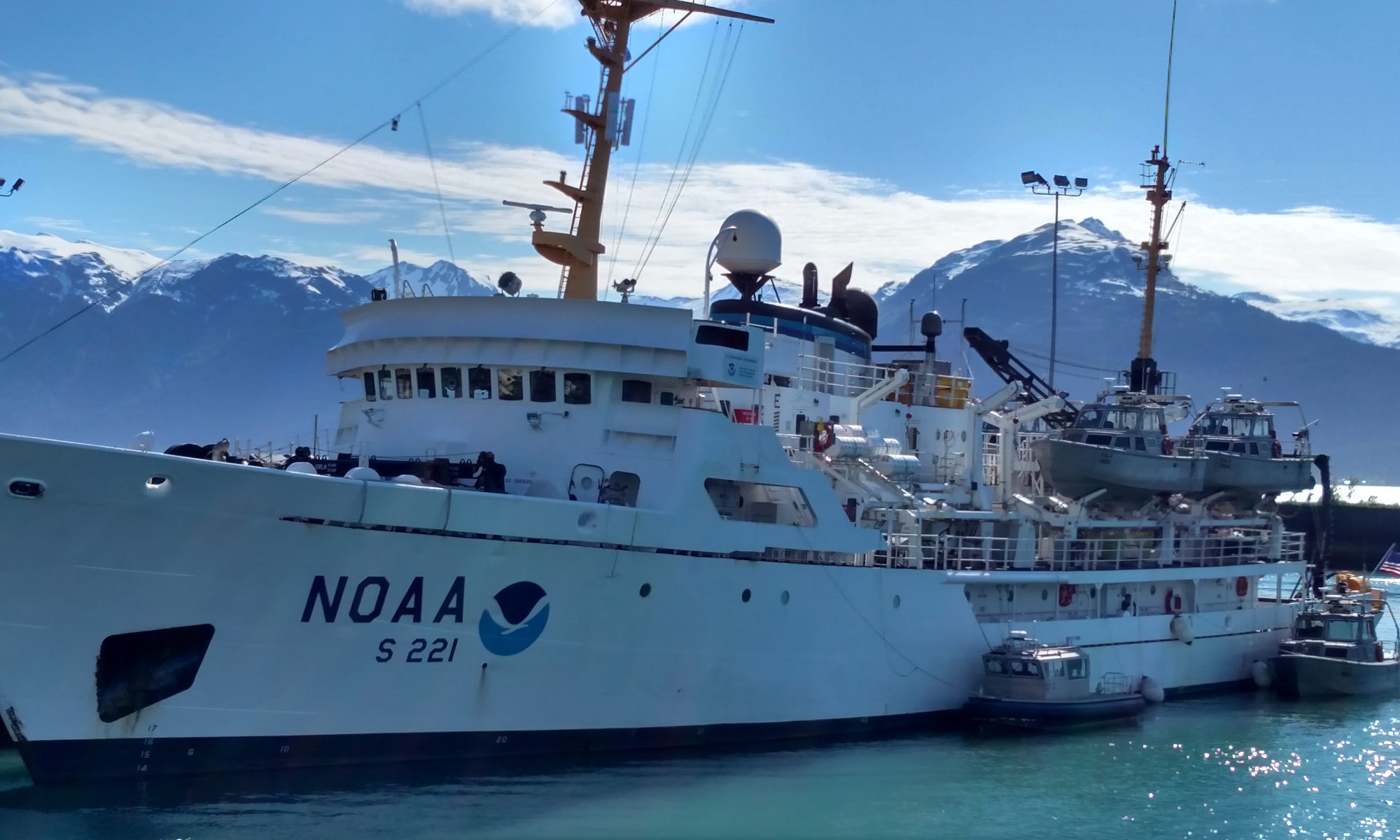
Leah Johnson: Trap Recovery, July 27, 2015

NOAA Teacher at Sea
Leah Johnson
Aboard NOAA Ship Pisces
July 21 – August 3, 2015

Mission: Southeast Fishery – Independent Survey
Geographical Area of Cruise: Atlantic Ocean, Southeastern U.S. Coast
Date: Monday, July 27, 2015

Weather Data from the Bridge:
Time 12:38 PM
Latitude 034.384490
Longitude -076.576130
Water Temperature 23.75 °C
Salinity -No Data-
Air Temperature 30.8 °C
Relative Humidity 62 %
Wind Speed 10.15 knots
Wind Direction 88.23 degrees
Air Pressure 1014.8 mbar

 Science and Technology Log:
As I mentioned in an earlier post, flexibility is key. Things don’t always go according to plan. Originally, we were going to head northeast from Morehead City Port, but the weather did not cooperate with us. We headed south to avoid a large storm, and then moved closer inshore. This forced us to choose some different areas to sample. Most of our sample sites are situated over the continental shelf between Cape Fear and Cape Hatteras. Tomorrow we hope to move to deeper waters beyond the shelf break.

Pisces cruise pathway so far. Image from Shiptracker.

Map of Pisces route so far. Image from Shiptracker.

On July 23, we lost a trap. After one of the deckhands threw the hook out to catch the buoy rope and started the winch, the rope went taut and then snapped. Occasionally this happens because the traps can shift and become wedged under or hooked onto a rocky ledge on the seafloor. We do our best to avoid this, but it happens. This is why it is important to have extra traps, cameras, and camera housings on board.

Map showing locations of the two lost traps. Image from Shiptracker.

Map showing positions of two lost traps. Water depth is shown in feet.

We planned to retrieve our trap the following day, but the storm chased us out of the area. Two days later, we lost a second trap! Unfortunately, this one was too deep to recover on a dive. The traps we deploy have zinc clasps that dissolve after ~24 hours, so fish can eventually exit the traps on the off chance that we are unable to retrieve them. Still, we don’t want to simply abandon traps on the seafloor or run short on gear, so we made plans to retrieve the first trap. We just had to remain patient and hope for calmer seas. Finally, our window of opportunity opened up today.

Zodiac dive boat

The small boat is on a davit on the 01 deck.

A small boat is located on 01 deck near the stern of NOAA ship Pisces. The deck chief oversees operations as it is lowered for the divers, the dive master, and deckhands to board. They take an inflatable buoy and rope with them, and then head out to the coordinates of the trap. The divers descended ~20 meters to the shelf where the trap was indeed wedged on a rocky ledge. First, the divers removed the two GoPro cameras that were attached to the trap. Next, they secured a rope attached to a buoy on the trap. The ship will then be able to use this buoy to retrieve the trap as typically done. The divers ascended the line and were picked up with the small boat.

dive boat returns after successfully locating the trap

The small boat returns after successfully finding the trap.

The deckhands then attached our standard buoys to the rope, and returned to the Pisces. The divers climbed up a rope ladder on the starboard side of the ship, and the small boat was hoisted up. We then hauled up the missing trap like we would any other. The trap was empty, and all of the bait was gone – not surprising after a 4-day soak!

Personal Log:

I make a point to stand near the bow of the ship and watch the sea and sky for a while every day. I usually see some flying fish, which are fun to watch. They zip out of the water, dart across the waves, and then dive back under. One of them landed on deck after a storm, so I had a chance to see one up close.

flying fish found on deck

Flying fish

The skies are beautiful, too. I have seen some impressive clouds and gorgeous sunrises and sunsets. The view is completely unobstructed, so I can just take it all in without distraction. I find it all very peaceful.

The skies at sea are stunning.

Did You Know?

After otoliths and tissue samples are collected from the fish we keep, the fish are filleted, frozen, and donated to local food banks.

removing tissue samples from a fish

Collecting tissues from a fish.

Leah Johnson: Physical and Chemical Properties of Ocean Water (There’s More Here Than Just Fish!) , July 26, 2015

NOAA Teacher at Sea
Leah Johnson
Aboard NOAA Ship Pisces
July 21 – August 3, 2015

Mission: Southeast Fishery – Independent Survey
Geographical Area of Cruise: Atlantic Ocean, Southeastern U.S. Coast
Date: Sunday, July 26, 2015

Weather Data from the Bridge:
Time 12:38 PM
Latitude 34.24389
Longitude -76.6625
Water Temperature 23.75 °C
Salinity –No Data-
Air Temperature 28.6 °C
Relative Humidity 68 %
Wind Speed 12.6 knots
Wind Direction 67.01 degrees
Air Pressure 1014.8 mbar

Science and Technology Log:
The primary purpose of this cruise is to survey reef fish. Our main task is to collect data pertaining to presence and number of fish species, species length frequency, and sample materials for fish age and growth. However, other types of measurements are being made as well. For example, the CTD is an instrument that measures different properties of ocean water with depth. It is deployed every time the fish traps are dropped.

CTD instrument

The CTD sits on the starboard side of the deck of NOAA Ship Pisces.

The acronym “CTD” stand for conductivity, temperature, and depth. The instruments that measure these properties are affixed to a metal cylinder called a rosette. A range of sensors can be attached depending on what needs to be measured. Additionally, containers can be attached to the frame in order to collect sea water samples at different depths. When the ship reaches the designated coordinates, the survey technician calls to the deckhands and instructs them to use the winch to lower the CTD to a designated depth, and then haul it back up.

Deckhands assist with lowering the CTD

Deckhands assist with lowering the CTD.

Below you can see a graph of the data collected earlier in the week:

CTD Data

CTD Data

The y-axis represents depth in meters. The CTD actually measures water pressure, which is then converted to depth. Pressure and depth are directly related: as depth increases, pressure increases.

There are several different properties represented on the x-axes, shown in different colors:

light green = oxygen (mg/l)
orange = conductivity (S/m)
dark green = temperature (°C)
purple = salinity (PSU, or ppt)

What do these measurements mean? As depth increases, temperature decreases. Sunlight warms the sea surface, and wind and ocean currents distribute this heat energy throughout the upper waters. Beneath this mixed layer, temperature decreases steadily with depth. In deeper water (not at this location), this rate of change decreases and the temperature of deep ocean water is nearly a constant 3 °C. Salinity refers to the concentration of dissolved salts in the water. Average ocean salinity is 35 ppt (parts per thousand), though this varies by a few parts per thousand near the surface. Increased precipitation, runoff, or melting of sea ice can decrease salinity, and evaporation and ice formation can increase salinity. Conductivity (measured in Siemens per meter) is a measure of how much current can travel through the water, and this is affected by both salinity and temperature. Finally, fish and other marine organisms require dissolved oxygen to breathe. By measuring the amount of oxygen at different levels in the water column, we can determine how much sea life can be supported in a given area. Dissolved oxygen in the ocean comes from mixing at the surface, and is also produced by photosynthetic organisms. As temperature and salinity increase, dissolved oxygen levels decrease. Additionally, temperature and salinity data can be used to determine the water density, or the mass of water per unit volume. Different fish can tolerate certain ranges of all of these chemical and physical parameters.

With respect to the fish survey, this information is important because we can monitor the conditions of the water near the ocean floor where the traps are located. For scientists who are interested in characterizing reef fish habitat, this data is a critical component of their research.

There are other ways in which this data can be used. The depth profiles of each of the chemical and physical properties at a given site can be compared to other local sites in order to identify any spatial anomalies. This is of great interest for seafloor mapping and ocean exploration cruises. For example, a change in conductivity and temperature at a site in the middle of the ocean could indicate the presence of a hydrothermal vent. Or, a decrease in salinity in a region along a coastline could indicate freshwater runoff.

Additionally, as measurements are made at similar locations over a period of time, temporal changes may be observed. This could reveal seasonal changes, or a long-term trend. Because we are observing an increase in average global temperatures and experiencing global climate change, it is critical to collect data that can be used to assess changing ocean conditions.

Personal Log:
“Will you be eating a lot of fish on the ship?” I heard this question a lot before I left for this cruise. I wondered myself. It seemed reasonable that fish would be prepared for meals because, well, we will be living at sea! On the other hand, I wondered if everyone on board would be sick to death of fish because we would be looking at them all day. As it turns out, fish is prepared for nearly every meal; however, there is often another meat option, as well as a variety of other non-meat dishes. Now we know!

ship mess

Ship mess

Did You Know?
There are many fish that make a grunting sound. When we have tubs full of tomtates in the wet lab, it sounds like a bunch of miniature pigs making snorting noises!

tomtates and nurse shark

Still from video of tomtates near a trap. A nurse shark can be seen in the background.

Kathleen Gibson, Sailing Away, July 27, 2015

NOAA Teacher at Sea
Kathleen Gibson
Aboard NOAA Ship Oregon II
July 25 – August 8, 2015

Mission: Shark/Red Snapper Longline Survey
Geographic Area of the Cruise: Atlantic Ocean off the Florida and Carolina Coasts
Date: July 27, 2015
Coordinates:  25o   30.755 N
                       O79o   55.736W

Weather Data from the Bridge:
Wind speed (knots): 9
Sea Temp (deg C): 31.3
Air Temp (deg C):  31.2

View from the Bow - Gulf of Mexico
View from the bow – Gulf of Mexico

Just before we left Pascagoula last Saturday, we learned that the V-Sat system was not operational and that in all likelihood we wouldn’t have internet access during the trip.  So far this prediction has been accurate.  I’ll continue to write these blogs as we go and post them all after we get to port if it doesn’t get fixed.

In my first post I wrote a bit about the area we would be surveying. I’ve since learned that during this cruise we will only be working in the Atlantic Ocean. Another change is that our final destination will be Cape Canaveral, FL rather than Jacksonville, FL.

Motoring through the Florida Keys

Since we aren’t doing any fishing in the Gulf, we are currently following a straight track from Pascagoula to the Florida Keys. We’ve been sailing for two days and are currently off the coast of Key Biscayne, FL.  There has been one rain event that went by quickly, and otherwise it has been fair weather. While land isn’t visible, there are a good number of recreational motorboats, so land must not be too far off.


Science and Technology

This cruise is the first of four legs of a long-term (longitudinal) study of the distribution and abundance of shark and red snapper populations. The study began in 1995 and the research area includes U.S. waters of the Atlantic Ocean and Gulf of Mexico. The Atlantic Ocean sampling stations on this first leg are positioned at various distances offshore from Miami, FL to Cape Hatteras, NC and at different depths. Later legs will complete the survey in the Gulf of Mexico.  While this type of study can be resource and labor intensive and also time consuming, a well-designed longitudinal study can provide valuable data that tracks trends and patterns over an extended period of time. As with any investigation, numerous potential variables must be controlled, including time of year sampling occurs, sampling equipment (line and hooks) and sampling locations.

We’ve prepared three barrels of gangions (50 hooks in each). When we start fishing we will bait the hooks with mackerel and hook them on the long line.

Kristin Hannan ( left) and science volunteers preparing gangions. These will be baited and attached to the main line.
Kristin Hannan ( left) and science volunteers preparing gangions.
These will be baited and attached to the main line.
The circular hooks are designed to minimize harm.

NOAA Careers

A successful cruise requires a significant amount of preparation as well as committed participants. Those aboard include NOAA scientists, NOAA Corps Officers, an experienced deck crew, engineers, stewards, and science team volunteers. From the moment I arrived on board it has been apparent that everyone is fully invested in this project.  They’ve been willing to share their stories of how they made their way on to this cruise of the Oregon II;  I’ll share some of their stories with you in this and future blog entries.

Career Spotlight: Kristin Hannan – Field Party Chief, NOAA Shark Unit

As Field Party Chief, Kristin is responsible for all of the scientific work done during the cruise.  She is also the watch leader for the day shift.  While Kristin was fascinated with marine science at an early age, she followed some sage academic advice for her undergraduate program: “focus on being a scientist first, include rigorous coursework, and then do marine work.”  She graduated from Virginia Tech with a degree in Biology and a minor in Chemistry and she remains a loyal Hokie fan.

Kristin Hannan taking measurements

She has been involved in a number of challenging marine-related projects all around the United States and has been open to unusual opportunities when they arose. One such opportunity, over 10 years ago,  was to be a volunteer with NOAA Fisheries in Pascagoula, MS.  She joined the Shark Longline cruise as a volunteer one summer, and returned in subsequent summers to participate. Kristin eventually joined NOAA permanently as a Field Biologist with the Shark Unit, and is now the Chief Scientist/Field Party Chief for this cruise–the very same one she volunteered for some years ago.

In addition to her work with NOAA, Kristin is pursuing a Master’s Degree from the University of South Alabama, where she is studying chimeras and methods used to determine their age.

Kristin’s advice to students looking to work in Marine Sciences –or any field- is to:

  1. Be open to unusual opportunities
  2. Try to make a good impression every day
  3. Work hard

Personal Log

Flying Fish Photo Credit: NOAA
Flying Fish
Photo Credit: NOAA

We’re still sailing to the sampling area, so there is plenty of free time to meet others on board, read and walk around the deck.  This will definitely change when sampling begins. Today I went out to the bow and saw flying fish for the first time and dolphins were swimming off the bow.

The science team is made up of 4 NOAA scientists and 7 volunteers with a variety of experience. Our volunteers include 2 university professors, one graduate student, three undergraduate students, and one Teacher at Sea!  The group is split into two 12-hour shifts.  I’m on the day shift which begins at noon each day and ends at midnight.  It’s likely that we will begin fishing tomorrow morning, and the night crew has begun adjusting their sleep pattern to be prepared.  I’m going to have to work at sleeping in.

Survival Suit - Perfect Fit  Photo Credit: Lecia Salerno
Survival Suit – Perfect Fit  Photo Credit: Lecia Salerno


The Executive Officer (XO) LT Lecia Salerno, has graciously allowed me to share her quarters, which includes her office. The cabin is on an upper level so I definitely get rocked to sleep.

A fire drill and abandon-ship drill were called on the first full day at sea.  Lecia helped me get into my survival suit and, more importantly, out of it as well.

Questions of the day for my students:

What additional variables do you think should be considered and kept constant in this study?

What is a nautical mile and how many nautical miles is it from Pascagoula, MS, to Miami, FL?

How do chimeras differ from sharks?

Tomorrow we fish!
Tomorrow we fish!

Up next… Time to Fish.


Jeanne Muzi: Ready to become a Teacher (and Learner) At Sea! July 25, 2015

NOAA Teacher at Sea
Jeanne Muzi
(Almost) Aboard NOAA Ship Thomas Jefferson
August 2 – 13, 2015

Mission: Hydrographic Survey
Geographical area of cruise: North Atlantic
Date: July 25, 2015

Introduction

Hello everyone! Greetings from New Jersey!

My name is Jeanne Muzi. I am an elementary teacher, Gifted & Talented/Enrichment Specialist at Lawrence Township Public Schools in Lawrenceville, NJ.

I am very excited and truly honored to be a part of NOAA’s Teacher at Sea program and look forward to working hard and learning a lot! I will be boarding NOAA Ship Thomas Jefferson in early August! I can’t wait!

The Thomas Jefferson

If you would like to find out more about the Thomas Jefferson, check out this website: http://www.moc.noaa.gov/tj/index.html

I will be writing this blog for the next few weeks to share stories about all the different people I meet, the things I see and what I am doing. This blog will be written especially for my students, so if you are a kindergarten through third grade learner you might want to check back to see different questions I post or interesting observations I may share.

Quick! Where is your favorite place? Where do you go to think, dream, wonder, play, relax and have fun? For me there is only one place—The beach!

Stormy Day at the Jersey Shore

Growing up on Long Island, NY, we were surrounded by water, so heading to the beach was easy. I attended summer camp on the east end of the island and loved to swim, canoe, sail and collect shells. This picture was taken when I was eight years old. My family was visiting the South Street Seaport in New York City and I was fascinated with the Lightship Ambrose. Its job was to keep other ships out of danger. I always wondered what it would be like to sail on her…

South Street Seaport, NYC


The Lightship Ambrose at the South Street Seaport, NYC today.

Years later the Lightship Ambrose is still at the Seaport…And I am getting a chance to sail on a much larger ship!

As a member of the Teacher at Sea program, I figured I should find out some information about NOAA. NOAA stands for National Oceanic and Atmospheric Administration. NOAA is an Operating Unit of the United States Department of Commerce. The National Weather Service is a component of NOAA and there are many areas that NOAA scientists are involved in including coastal restoration, fisheries management, satellite systems, climate studies and research into biodiversity. You can find out more at http://www.noaa.gov

NOAA’s Teacher at Sea Program, celebrating its 25th year, provides an opportunity for teachers from kindergarten through 12 grade and college, to participate with scientists working on oceanographic research projects aboard a NOAA vessel. There are three categories of missions: fishery surveys, hydrographic work or physical oceanography studies. Teachers at Sea use their hands-on, real-world learning opportunities to develop classroom-learning experiences for their students. They also share their new knowledge and skills with other teachers, schools and communities. The mission of the Teacher at Sea Program is “Science, Service and Stewardship.”

NOAA's Mission
NOAA’s Mission

Find out more at http://teacheratsea.noaa.gov/#/home/

My mission aboard the Thomas Jefferson is a Hydrographic Survey. When I received my assignment, the first question that came to mind was: What is hydrography?

According to NOAA: “Hydrography is the science that measures and describes the physical features of bodies of water and the land areas near those bodies of water. NOAA conducts hydrographic surveys to measure the depth and bottom configuration of water bodies. The data is used to update nautical charts and develop hydrographic models. During a hydrographic survey, NOAA scientists use sonar to develop charts, locate underwater hazards to navigation, search for and map objects on the sea floor such as shipwrecks, and map the sea floor itself.”

That sounds really amazing! Now I have lots of questions about sonar, mapping and why this work is so important! As I learn new things about hydrography, I will post the information. I know that the more questions I ask, the more I will learn! I also keep thinking about the connections I can make with what I am already doing with my students…

As someone who teaches younger students, I strive to help them strengthen their problem-solving skills and develop a strong sense of wonder and curiosity. Each year I develop a range of cross-curricular projects that build creativity and critical thinking. This past school year, we designed and built effective water filters, created solar ovens, mapped waterways and designed board games. We worked on engineering tasks like marble roller coasters, egg protectors and balancing puzzles.

Designing an effective water filter
Mapping
Mapping Waterways


One of my students’ favorite lessons each year is called “Think like a Scientist” and we try to figure out all the things scientists need to do in order to discover new things. I am looking forward to adding lots of new ideas to what it means to “Think Like Scientist” while aboard the Thomas Jefferson.


Streamkeepers reporting
Streamkeepers sharing data Photo credit: Alan Chausse

A highlight for me every year as a teacher is my involvement in an environmental education program called Streamkeepers, which focuses on monitoring and observing the ecosystem of a local waterway. The Streamkeepers work as citizen scientists and it is always incredible to see young students understand how the streams, rivers and oceans of our world connect us. Learning about hydrographic surveying aboard the Thomas Jefferson will provide me with another way to teach about water and our oceans.

Student Citizen Scientists participate in the Streamkeeper Project
Streamkeepers at work
Here I am presenting about the Streamkeeper Project during a visit to our sister school in Taiwan.
Here I am presenting about the Streamkeeper Project during a visit to our sister school in Taiwan. Photo credit: Jennifer Dowd

As I get ready to head out on my Teacher at Sea adventure, I keep thinking about three important things I stress as I teach:

  1. Do not be afraid to take risks.
  2. It is very important to step out of your comfort zone.
  3. There is great value in looking at things through other people’s eyes.

As a Teacher at Sea, I will be able to put these ideas into action!

Ready to learn aboard the Thomas Jefferson!


Each blog entry I post will have a Question of the Day and a Picture of the Day! Here are the first ones:

Question: Think about what you know about President Thomas Jefferson…What does he have to do with the Atlantic Ocean?

Picture: What is this?

Question of the Day: What is this?

Thanks for reading! I look forward to sharing much more from the Thomas Jefferson!

Andrea Schmuttermair: Farewell, Kodiak, July 25, 2015

NOAA Teacher at Sea
Andrea Schmuttermair
Aboard NOAA Ship Oscar Dyson
July 6 – 25, 2015

Mission: Walleye Pollock Survey
Geographical area of cruise: Gulf of Alaska
Date: July 25, 2015

Science and Technology Log

It is hard to believe we are wrapping up this leg of the journey. While our focus has been on the walleye pollock for this survey, we have encountered some other critters in our midwater and bottom trawls, and on our nightly DropCam excursions. We’ve even had some neat finds in our Methot net. There is quite a diverse ecosystem both in and out of water around Kodiak, and I’d like to take a moment to highlight some of the critters we’ve caught in our trawls and on camera.

This slideshow requires JavaScript.

One other neat thing happened on one of our final trawls of the leg. We caught several Dusky rockfish in our bottom trawl, and they were easy to spot as we sorted the trawl because of the large size and dark color. Several of these rockfish had bloated bellies as well. Being the curious scientists we were, we decided to dissect a couple of the rockfish to find out why. Some of them had very inflated swim bladders, while others turned out to be very pregnant females. We pulled out the ovaries, and they were about the size of a water balloon! Millions of tiny eggs poured out of one that we accidentally nicked with the scalpel. We took some of those and looked at them under the microscope. Rockfish are actually viviparous, which means they give birth to live young.


Did you know? The Arctic lamprey’s life cycle is similar to salmon. They are born in freshwater, leave for the ocean, and return to the same freshwater they were born in to spawn.

Personal Log

Once again, my experience as a Teacher at Sea has amazed me, and I have taken away so many great experiences I can’t wait to share with my students. While the science was quite different on the Oscar Dyson  in comparison with the Groundfish Survey on the Oregon II, there are many similarities in the experiences themselves which make this a valuable program for educators. I formed relationships and made connections with people I may never have encountered, and these relationships have been (and will continue to be) invaluable to my teaching.

The fearless navigators of the Oscar Dyson and I on our final day.
The fearless navigators of the Oscar Dyson and me on our final day.

Here are just a few of the things I learned while out at sea:

  • Science is everywhere! From the lab, to the bridge, to the engineering rooms, there is science in everything we do!
  • Push-ups are a little more difficult in 4ft swells.
  • Even in the field, scientists are making (and verbalizing) hypotheses, and they are always asking questions about the work they are doing, even in the middle of an experiment or project.
  • Alaska has an abundance of jellyfish in all colors and sizes.
  • The shape of an otolith is unique for every species of fish.
  • Everyone looks funny when they are trying to walk during rough seas, even the experienced sea folk.
  • Different types of scientists work together toward a common goal, each bringing their unique backgrounds to the work they are doing.
  • Trust is crucial when you live and work on a ship, as each person on board is a member of a team; that team is like your family.
  • Everyone has a story. Take a moment, and find it out.

I want to thank everyone that works on the Oscar Dyson for making this experience a memorable one. I enjoyed working with everyone on board, and will cherish the relationships I formed.

This final post wouldn’t be complete without Wilson, our infamous shark who had fun on his trip too. Here he is highlighting his adventures with all the people and places on board the Oscar Dyson!

This slideshow requires JavaScript.