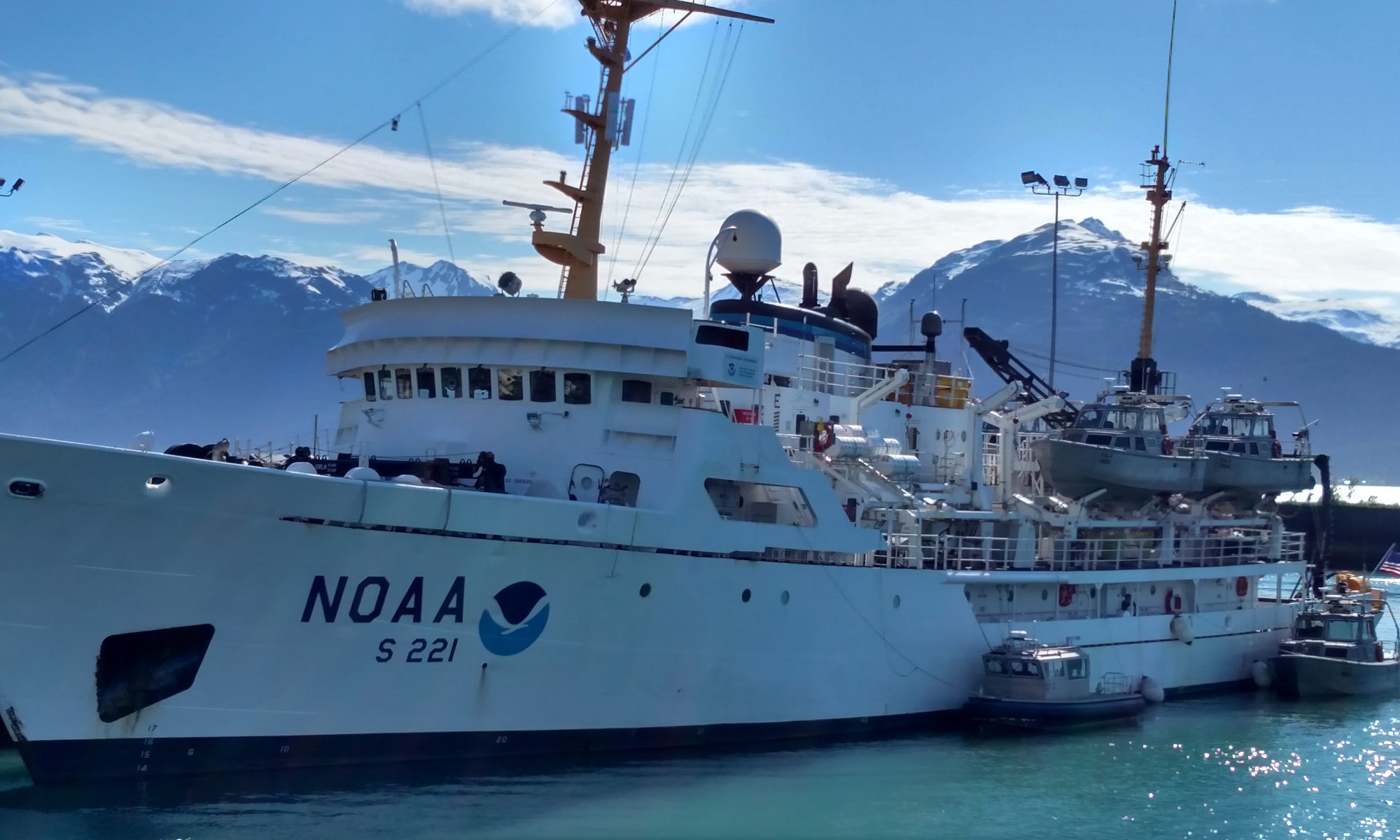
Vickie Obenchain: Safety First! June 26, 2018

NOAA Teacher at Sea

Victoria Obenchain

Aboard NOAA Ship Fairweather

June 25th-July 6th, 2018

Mission: Arctic Access Hydrographic Survey

Geographic Area of Cruise: Northwest, Alaska

Date: June 26th, 2018

Weather Data from the Bridge:

  • Latitude: 58o 11.3’ N
  • Longitude: 134o 23.2’ W
  • Wind Speed: 6 knots
  • Wind Direction: East
  • Visibility: 7 nautical miles
  • Air Temperature: 12.5o C
  • Current Sky Conditions: 99% Cloud over made up of mainly stratus clouds, with a consistent drizzle
(Picture taken before consistent drizzle started.)

Science and Technology Log

I joined the NOAA Ship Fairweather in Juneau where it has been undergoing upgrades to its propulsion control. Due to these upgrades, yesterday and today the ship has been conducting sea trials to learn how the new upgrades work, train their crew on them and to make sure everything is calibrated accurately before we head out to sea and continue on the ship’s mission.

NOAA Ship Fairweather is a 231 foot long hydrographic (hydro meaning “water”, graphic meaning “drawing”) survey ship which helps map the sea floor and update nautical maps using sonar. A communications specialist contracting for NOAA, Gina Digiantonio, said it best (I will paraphrase her here): Would you jump into a body of water not knowing how deep it was? Or would you want to know you weren’t going to get hurt? This is the same thing ships and vessels have to plan for; will they run aground, hit rocks, is it safe enough for them to get through? By knowing the depth of the sea floor, mariners can avoid dangerous and expensive accidents to both their vessels and the environment.

This research is done not only with NOAA Ship Fairweather, but with the help of 4 smaller boats, or launches, on board. Each launch is equipped with its own sonar equipment which when all in use, help get large areas of the sea floor mapped at once.  Below you can watch one of these 8 ton launches being lowered into the Juneau harbor.

This work is incredibly important. Some nautical charts in the area date back to before the 1900’s with lesser bottom coverage and some areas in use are not mapped at all. With the forecast of complete loss of summer sea ice by 2050 in the Northwestern Alaska area, and with that the increase in commercial vessel traffic; the need for accurate maps to ensure safety of all vessels and the surrounding environment is important work.


Since I am a visitor on the NOAA Ship Fairweather; I, along with a few other visitors and new employees, took part in a safety orientation in case of emergencies. We learned where life vests and life boats are located, where to go in case of an emergency and what calls are used to notify those on the ship, as well as the procedures associated with each situation. Additionally, we had to practice getting into an immersion suit in case we had to abandon ship. These are full body wet suits which are waterproof and help prevent hypothermia.  Mine was a bit big, so I was given a smaller one. You can see me modeling a larger one here:

(Picture of me in immersion suit kindly taken by ENS Lawler)

Personal Log:

I got to Juneau a day before the ship was set to start sea trials so I was able to visit Mendenhall Glacier which is about 12 miles outside of Juneau with two other visitors of NOAA Ship Fairweather.   As many glaciers are retreating around the globe, I felt lucky to go visit this one!

Mendenhall Lake inside a fairly large valley which the glacier has helped to carve over the last 3,000 years

The 13 mile glacier stops at the Mendenhall Lake inside a fairly large valley which the glacier has helped to carve over the last 3,000 years.  Evidence of the glaciers movement is seen on the rocks, as they are polished from where miles of heavy ice has slid over them, over time.   This glacier has been retreating for the last 500 years and in doing so it has made new ecosystems around Juneau. These ecosystems include: a wetland for migrating birds, Mendenhall Lake which provides a wildlife habitat for native animals such as beavers and bears, not to mention a recreation area to kayak in, and a beautiful conifer rain forest I got to hike through (pictured below). The glacier’s retreat is noticeable from pictures taken over time at the visitor center.

Mendenhall Lake which provides a wildlife habitat for native animals such as beavers and bears, not to mention a recreation area to kayak in, and a beautiful conifer rain forest I got to hike through


Angela Hung: Flexibility, June 22, 2018

NOAA Teacher at Sea

Angela Hung

Aboard NOAA Ship Oregon II

June 22-July 5, 2018

June 19-July 5, 2018

June 23-July 5, 2018

Mission: SEAMAP Summer Groundfish Survey

Geographic Area of Cruise: Gulf of Mexico

Date: June 22, 2018

Weather Data from the Bridge

(Actually from weather.gov, the program in the bridge is off)

Conditions at 1454

Latitude: 30.46° N

Longitude: 88.53° W

Temperature: 34° C

Wind Speed: SW 12 mph

Science and Technology Log

Taniya Wallace-Chief Scientist, Fisheries Biologist

If you enjoy a good seafood steam pot or boil—overflowing with shrimp, crabs, clams and corn and potatoes mixed in, rounded out with fish filets blackened/broiled/fried to your preference—then you have to thank hardworking scientists like Taniya Wallace. Taniya is a fisheries biologist and is the Chief Scientist aboard Oregon II for this leg of the 2018 SEAMAP Summer Groundfish Survey. On top of assessing the health of the Gulf fisheries that feeds Americans across the country, she is busy coordinating the group of scientists that form the research party on the boat. The specifics of the research will follow in upcoming posts, but today, I’d like you to meet a scientist.

Taniya Wallace
Taniya entering data into the computer.

Taniya was certain of becoming a nurse. Her high school offered vocational coursework in nursing to give students an early start into college degree programs. She was on track, until it came to clinicals. Nursing clinicals are the part of the program where students begin their training in real work settings to apply what is learned in the classroom. More importantly, clinicals introduces students to the realities of the job.

Nurses are among the ranks of hard working, underappreciated sectors of the health field because much of what they do goes unseen. For many in pre-nursing and nursing programs, clinicals ensures that students are experiencing what they are signing up for. For Taniya Wallace, her experience during this class compelled her to make the difficult decision to pursue a different program of study.

Taniya was accepted in Mississippi Valley State University, a historically black university, where she earned her bachelor’s degree in biology with a minor in chemistry. She began a position as a laboratory scientist until the 2010 explosion on the Deepwater Horizon oil drilling rig that caused 11 deaths and the largest oil spill in history. Four million barrels of oil flowed into the Gulf of Mexico over three months before the underwater well was finally capped.

Taniya has always loved the water, and had previously shadowed her cousin who is also a marine scientist. Her aunt builds boats for Austal Shipyard in Alabama and her father works at Ingalls Shipbuilding in Pascagoula, MS, the very company that built Oregon II. With an urgent need to study the critical impacts of crude petroleum oil on the Gulf ecosystems, an opportunity on Oregon II was a natural fit. Taniya signed a three month contract–she’s been here ever since.

Plaque aboard Oregon II

What has kept her going for eight years? As a scientist on a ship, she sees “something new every day” on the boat and on land when they stop at different ports. With a love of water, working in a lab at sea is a win-win.

Personal Log

The Teacher at Sea Program emphasizes to applicants that “flexibility and the ability to cope with the uncertain is crucial to the character of those who go to sea.” Taniya Wallace demonstrates this quality by shifting to a research program in college, joining NOAA Ship Oregon II, and by working at sea.

It is no exaggeration that flexibility is a requirement for working on a boat. In fact, I was scheduled to participate in the second leg of the SEAMAP summer groundfish survey on June 21, departing from Galveston, TX on the 22nd. Unfortunately, the trawl winch broke during the first leg (the first time ever for Oregon II which has been sailing for 50 years!), cutting their trip short. To try to make up the time, it was decided that the second leg would get an early start from Mississippi as soon as repairs were completed in Pascagoula, MS.

What originally was a week to get packed, find a plant sitter and cuddle with my cats became a last minute scramble to find rain boots and mow the lawn in the middle of a heat wave—I boarded a plane to Gulfport, MS on June 18 instead. (It was explained that this was not the typical direction in scheduling shifts.) I got to meet some of the fantastic crew members of Oregon II, as well as from neighboring Gordon Gunter, who invited me to play corn hole for the first time. This is the game where you are trying to throw bean bags through a hole cut in a plywood board that’s set on an incline.  I spent the night on the boat in port.


The boat bustled the next morning as everyone arrived: crew, scientists and a couple of interns. [Find your internship here! https://coastalscience.noaa.gov/about/internship/  ] At 1400, we were off!

There’s the requisite training and safety information for the ship in general. Taniya took over the interns and me for science brief. I learn that I’m assigned to the day shift which begins at 1200 noon the next day. Night shift starts at 2400 midnight that same day. The operations of the ship are 24 hours. It’s a long wait to get started and I’m looking forward to it.

We spend a night out at sea and I’m up and ready to sort some fish and shrimp. When I get to the galley, I find out that we are in fact, returning to Pascagoula because the trawl winch wasn’t fully repaired.

While issues like this are rare on Oregon II, a vessel that is widely regarded as extremely reliable, the process of science frequently hits stumbling blocks. TV shows like CSI and Bones and movies like Jurassic Park feature futuristic laboratories with state-of-the-art, if wildly impractical, equipment with colorful liquids, holograms, and scientists in lab coats and goggles who complete experiments in mere minutes. In reality, science is a lot messier and SLOWER. While wiling away the time today, I learned about a new hashtag for scientists full of internet examples: #badstockphotosofmyjob.

Real labs tend to have old equipment, space is limited so rooms are often crowded with large machines and many computers, and most liquids are colorless, stored in small, like the size of your pinky, tubes in a refrigerator or freezer. Particularly if you work outside, aka “the field”, and even if you don’t, a lot of equipment might be jerry-rigged from things picked up at Wal-Mart or Home Depot. Not to say that science is unreliable or not credible, but that projects are unique and a lot of times, you have to be creative and build what you specifically need. Then modify it until it works.


So here we are in a typical day of a scientist. A piece of equipment isn’t working, we’re losing data collection by the minute, but remember, we’re going to be flexible.

Did You Know?

The National Oceanic and Atmospheric Administration (NOAA) is operated by the U.S. Department of Commerce, which is tasked with promoting job creation and economic growth by providing tools and programs for the scientific collection and analysis of data. NOAA is one of these scientific research agencies employing scientists to study the atmosphere to provide us with weather and climate data, and the oceans, providing information for the operation of fisheries, for example. Good policies are informed by basic research, making the work of these agencies invaluable to the US economy.

Taylor Planz: Welcome to my Adventure! June 27, 2018

NOAA Teacher at Sea

Taylor Planz

Aboard NOAA Ship Fairweather

July 9 – 20, 2018

Mission: Arctic Access Hydrographic Survey

Geographic Area of Cruise: Point Hope, Alaska

Date: June 27, 2018

Weather Data from the House

Lat: 33.4146° N Long: 82.3126° W
Air Temperature: 23.3° C
Wind Speed: 6.1 Knots
Wind Direction: West
Conditions: Mostly Cloudy, 69% humidity

Personal Log

Welcome to my blog! My name is Taylor Planz, and I am so honored to be a Teacher at Sea this season! My passions in life besides education are my family, my cats, the mountains, and, of course, the ocean! In college I studied Oceanography and conducted undergraduate research in Chemical Oceanography where I explored phosphate dynamics in estuarine sediments. I went on multiple afternoon research cruises as part of my undergraduate degree, but I have never been on a ship overnight before now. I married my husband Derrick in 2014 on the beach, a childhood dream of mine. We got married on the Gulf of Mexico in Destin, Florida.

My husband Derrick and I got married on the Gulf of Mexico in 2014.

In the fall I will be teaching Physical Science and Forensic Science to juniors and seniors at Harlem High School in rural Harlem, GA. In the past, I taught middle school science and this year will be my first year in a high school classroom. I am excited to teach a new age group this fall as there are many big decisions students must make during these critical high school years. I hope that my experience with NOAA Teacher at Sea will inspire at least one student to pursue science, and maybe even ocean science, as a career! There is so much out there to be explored in the ocean, atmosphere, landscape, and even space!

Alaska is about to be the 34th state I have visited in my life! I never really understood how far away it was until my flights for this trip were booked. After departing Atlanta, Georgia, I will land briefly in Portland, Oregon and then Anchorage, Alaska before arriving in Nome, Alaska. From there, I will board NOAA Ship Fairweather for Point Hope. The flights and layovers alone will take 16 hours! It is quite amazing how far the United States stretches!

Flight Map
My trip from Atlanta, Georgia to Nome, Alaska will span 3 flights and 16 hours.

NOAA Ship Fairweather will be my home for 12 days next month where I will help conduct a hydrographic survey of the Point Hope region in northwestern Alaska. We will be so far north that we may cross the Arctic Circle! Only 30% of this region’s ocean floor has ever been surveyed, and those surveys need updating because they took place in the 1960s. Updated and new surveys will be vital for the continued safe navigation of the ever-increasing maritime traffic, especially because the size of the vessels navigating the local waters continues to grow.

NOAA Ship Fairweather
NOAA Ship Fairweather – Photo Courtesy NOAA

Science and Technology Log

Most of the blog posts I write onboard NOAA Ship Fairweather will tie back to physical science, so today I would like to discuss some earth science! Point Hope, AK is located at 68.3478° N  latitude and 166.8081° W longitude. As you may know, Earth is divided into 90° of latitude per hemisphere, so 68° is pretty far north! In comparison, Harlem, GA is located at 33.4146° N latitude and 82.3126° W longitude.

What is significant about a region’s latitude? Latitude affects many things including sunlight distribution, seasons, and climate. For most of us in the United States, we know that summer days are long and winter days are short (in reference to hours of sunlight per 24 hour day). In Alaska the effect is much more dramatic! Parts of Alaska experience 24 hours of daylight around the summer solstice in June and 24 hours of darkness around the winter solstice in December. Not only are the daylight hours much different than what most of us experience, the concentration of sunlight that reaches Alaska is different too.

No matter which hemisphere you live in, as your latitude increases away from the equator (0° latitude) the amount of sunlight that reaches you decreases. The sun has to travel a longer distance through more of Earth’s atmosphere to reach you. As the light travels, it becomes more diffuse and less of it reaches its final destination: the Earth’s surface. The less direct sunlight makes those places feel cooler throughout the year than places like Ecuador, which is close to the equator and gets direct sunlight year round. Regions closer to the equator also do not get the long summer days and long winter nights because their daylight hours average around 12 hours per day year round.

It’s a common misconception to think that Earth is closer to the Sun in the summer and farther in the winter. If this were true, summer would start in June all over the world! Instead, the Earth’s tilt (at 23.5°) determines which hemisphere is pointing towards the Sun and that hemisphere experiences summer while the other experiences winter. As latitude increases, the seasonal effect becomes more dramatic. In other words, the difference between summer and winter is more and more noticeable. That is why warm, tropical places near the equator stay warm and tropical year round.

With all of this important science to consider, my 12 days in Alaska will definitely be an adjustment! I purchased an eye mask to help me to get restful sleep while the sun shines around me close to 24 hours per day. In addition, I will be packing plenty of layers to stay warm during the cool days and cold nights. In Georgia, most summer days reach temperatures in the mid-90s with high humidity. In contrast, Alaskan days on the water will reach 50s-60s on average.

Did You Know?

NOAA Ship Fairweather was built in Jacksonville, Florida in the mid-1960s, and its home port today is on the opposite side of the country in Ketchikan, Alaska.

Question of the Day

How many hours of daylight did you experience in your home state during the summer solstice on June 21? Nome, Alaska had 21 hours and 21 minutes of daylight!


Brandy Hill: Warm Initiation to Life at Sea: June 26, 2018


NOAA Teacher at Sea

Brandy Hill

Aboard NOAA Ship Thomas Jefferson

June 25 – July 6, 2018


Mission: Hydrographic Survey- Approaches to Houston

Geographic Area of Cruise: Gulf of Mexico

Date: June 26, 2018


Weather Data from the Bridge

Latitude: 28° 59.9′ N

Longitude: 093° 50.4′ W

Visibility: 10+ nm

Sky Condition: 2/8 (2 out of 8 parts have cloud cover)

Wind: 170°, 8 knots (kts)

Temperature: Sea water: 29.8 ° C, Air: 28.8 ° C


Science and Technology Log


Upon early evening arrival to Corpus Christi, TX, I was greeted by ENS Taylor Krabiel with a friendly sign at the airport arrival gate. We made a short drive to the port in Corpus Christi and boarded NOAA Ship Thomas Jefferson.


TJ Starboard View
Starboard view of the Thomas Jefferson while docked in Corpus Christi.


ENS Krabiel provided a quick and thorough tour of the Thomas Jefferson including the well-stocked mess (including a fresh salad and fruit bar, ice cream freezer and espresso machine), gym, complementary laundry facilities, all offices and staterooms, the plot (survey) room, and multiple outdoor decks. He was also patient as I repeatedly lost direction of the stairwell, multiple decks (floors) and doors. It is evident that ENS Krabiel has experience as a teacher because his enthusiasm about the ship, projects, personnel, and patience with newcomers seems to come naturally.

One fact he shared about the ship is that the Thomas Jefferson makes its own water through reverse osmosis. This means that all hands (everyone aboard the ship) generally do not need to worry about water rationing. I hope to take a tour and find out more about this process during the next couple of weeks.


2012-2018 Puretec Industrial Water
Reverse osmosis diagram. (Puretech Industrial Water 2012-2018)


He also mentioned that the U.S. via NOAA is one of the only countries that provide nautical chart data at no cost to the public. Private parties may use these accessible charts and make their own modifications.

The CO, Commanding Officer, of the ship and I discussed various careers aboard the Thomas Jefferson. CO explained that ship personnel in blue uniforms are hired through NOAA Corps and follow military rankings while professional mariners include the survey team, engineers, stewards, and deck department. There are also electronics technicians who are hired as civil servants. I found it astonishing that some crew members have been with the Thomas Jefferson since NOAA acquired the ship in 2003. I was able to have my first breakfast aboard the ship with Puddin’ Gilliam, Junior Engineer, who has been with the ship since then.

It was interesting observing the plans for departure from Corpus Christi come together. I sat in on a safety brief discussing the strict plan of navigation. It takes roughly two hours to navigate through a narrow, 21-mile long channel out of the port. Coming too close to the sides of the channel could cause the ship to run aground, while coming too close to oncoming ships could cause additional damage. There are also several points of crossways where ships could be coming from a different direction. All of these variables require critical communication and a concise plan. Junior Officer, ENS Jacquelyn Putnam, lead the brief and displayed digital Mercator projections of the navigation plan. She claims that navigation is her favorite part of her job. In addition, it was decided that the assistance of a pilot (someone who boards the ship while docked and departs at the jetty) would provide ideal support in navigating the ship.

General Alarm
Several checks are completed prior to departure. This includes sounding all alarms (above), checking the ship whistle, and steering (not pictured).


During a project brief lead by FOO (Field Operations Officer) Lt. Anthony Klemm, I learned that the primary mission is to accurately complete the survey of a section of the Gulf of Mexico. The area was last surveyed in the 1930s. Already, the survey team has submitted updates including the removal of two wrecks or obstructions previously documented in the narrow fairway leading to Galveston. This inaccurate documentation of obstructions that were no longer present could have been causing ships to deviate from the fairway or move unnecessarily into the oncoming lane of traffic. In addition, the surveys done by NOAA Ship Thomas Jefferson allow for validation of surveys completed by other organizations such as BOEM (Bureau of Ocean Energy Management).


           ENS Taylor Krabiel launches a towfish sonar device. 

       Basics of the survey process include launching two types of sonar which work together to provide in-depth views of the ocean floor. Sonar sends a sound wave at a speed around 1500 meters per second in salt water. Using this information and the time it takes for the sonar wave to return to the device, the distance can be calculated using Distance = Speed x Time. The sonar images generated are then processed, saved, and analyzed by the survey team. ENS Putnam mentioned that it is important to validate the data by using multiple scans, “buttoning-up” or finalizing, and re-surveying areas that generated poor data. At times, areas of interest (like a wreck) or areas of safety concern are further investigated by completing another scan on the main ship or by sending a launch (smaller boat).


Personal Log

While Tom Loftin, Chief Electronics Technician, was getting my computer set-up on the ship’s wifi, we heard a call for “All Hands on deck.” I looked at him and asked if that meant us. He replied, “Yep, let’s go!” We joined everyone on the ship to form an assembly line to assist with unpacking crates and passing food down into the mess. The crew would get excited about certain items like the ice cream and blueberries while questioning other generic items with nondescript labels.

Starting at the very beginning before we even left port, there has been no end to teamwork, positive morale, and camaraderie presented on the ship. I have discussed this with multiple crew members and all have said that teamwork and constant communication is critical. Several examples include: the departure from Corpus Christi, observing the survey and bridge communication while sonar is in the water, and the timely “Plan of the Day” email sent out by Lt. Charles Wisotzkey. ENS Putnam mentioned that nothing can be accomplished without a well-functioning team. She further stated that clearly defined roles and the importance of everyone’s job makes the team function well.

It has been a lot of fun to be around this crew. Everyone is kind and highly accommodating thus far. Outside the XO’s (executive officer) office is a sign that says, “Work hard and be nice to others.” I am excited to be here and to witness such a well-functioning team.


Bridge Departure View
Officers, crew, and pilot on the bridge while navigating the narrow channel to Galveston.


Peaks and Valleys


+ I enjoyed observing the departure process and launching the sonar devices.

+ I’ve seen over 30 dolphins scattered around the Gulf.

+I enjoy catching up with people during meal times. The food isn’t bad!


– I experienced my first bought of sea sickness immediately upon leaving the jetty. Seas were a bit rough (an estimated 8 feet) and I retired to my stateroom (bedroom) early without eating dinner.

– I accidentally locked myself out of the shared head (bathroom).

Eric Koser: Getting Underway! June 25, 2018

NOAA Teacher at Sea

Eric Koser

Aboard NOAA Ship Rainier

June 22 – July 9, 2018


Mission: Lisianski Strait Survey

Geographic Region: Southeast Alaska

Date: June 25, 2018, 1500 HRS

Weather Data From the Bridge
Lat: 56°59.4’, Long:135°53.9’
Skies: Broken
Wind 19 kts at 340°
Visibility 10+ miles
Seas: 3-4’ with swells of 2-3’
Water temp: 9.4°C

Science and Technology Log

Rainier and her sister ship Fairweather celebrated their 50th anniversary together this past March. The bell on the bow of each ship is now plated in gold to celebrate the event.

This vessel has quite a physical plant below deck maintained by the competent team in the Engineering Department. For propulsion, there are two V-12 Diesel Locomotive Engines. After bathing the valves in fresh oil, each engine is started with compressed air at the press of a button. Once up and running, the Rainier’s engines often run for several days at a time. There is no “transmission” on this vessel. Instead, the two propellers utilize what is called ‘variable pitch’. When the pitch is set to zero, the props spin but push water neither back or forward – and thus don’t force the ship to move. When the prop pitched is increased in a forward direction – up to a pitch of 10, the ship is pushed forward. Of course, this is really the water pushing the ship forward as the propellers push the water backward. A pitch of “10” means that for each single rotation of the prop, the blades will move water ten feet back. When reverse is desired, the props can each pitch back to a maximum of ‘6’. Now the water is pushed forwards by the prop so the water can push the ship backward.

Prop Pitch Control
This is the variable prop pitch control system. Notice the silver digital actuator at the top which provides an electronic signal back to the bridge.
Push to Start
This is how the Engineering Department can start the engines.

As there are two engines and two propellers, the Rainier’s crew can run one prop forwards and the other backward to turn the vessel around nearly in place. This could be called a ‘split 6’ – where one prop is pitched forward 6 to match the other prop’s pitch backward of 6.

Rainier Engines
This is one side of one of Rainier’s two V-12 Diesel locomotive engines.

Another device the crew can use to manipulate the ship in the water is called a ‘bow thruster’.   This is an open tube from port (left) to starboard (right) near the bow of the ship underwater. There is a propeller mounted in this open tube which is powered by a separate engine. The engineering team can have the bow thruster system up and running in just a matter of minutes when called on by the bridge to prepare for its use! By pushing water to one side, the water pushes the bow the other way. This is a great tool to maneuver this large vessel in tight spaces.

In addition to the two engines plus the bow thruster, there are several other important systems maintained on The Rainier. There are a pair of 4000 Watt diesel electric generators to provide electricity. There is a water purification system – to isolate salt from seawater and make clean drinking water and a wastewater treatment plant to process waste. There are air compressors to supply the ship’s systems.

There are 45 individuals on board this ship – and they pull together into five teams to make operations happen on board. The NOAA Corps is responsible for the administration and navigation of the ship. The Deck crew handles all things on the surface of the ship including handling all lines, cranes, and davits (to manipulate the launches—small boats). The Engineering Crew is responsible for all the mechanical systems on board.  The Electronics Department handles all instrumentation and wiring on the ship. The Stewards run the ever important galley – keeping the entire group well fed. All of this supports the work of the survey team of Hydrographers, the team of scientists that are mapping the sea floor.


Personal Log

I’ve enjoyed both finding my way around the ship and getting to know the crew. These people work as a team!

I came in early enough to enjoy a few days exploring Sitka, Alaska. This is a small port town that is really the first city in Alaska. Russians originally settled here in 1799 and eventually sold the city to the US in 1867. Sitka is a beautiful place to explore – being primarily a port for commercial and private fishing operations.

Sitka Bridge
This bridge spans the main channel in Sitka.
Sitka Harbor
This is one of Sitka’s many harbors.

We’ve just left port this afternoon [Monday] as we transit to Lisianski Strait to being the hydrographic mission of this leg. We’ll arrive there late tonight/early Tuesday morning to collect data first from the Rainier itself. The experience on the ocean has been great thus far, and I look forward to much more!

departing Sitka
Here we are departing Sitka Monday afternoon – headed to the open Pacific to transit north.

Did You Know?

Sitka is the largest city, by area, in the United States in terms of land area! It occupies 2870 square miles yet has only a population of about 9,000 people—located mostly on the port location of Sitka.

The Rainier holds about 80,000 gallons of diesel fuel that is located in several tanks below deck. The weight of the fuel serves as ballast to help keep the ship stable while at sea! Fuel can be shifted between tanks to adjust the trim [front or back tilt] and list [port or starboard tilt] of the ship.  Typically Rainier refuels when the tanks reach about half full.