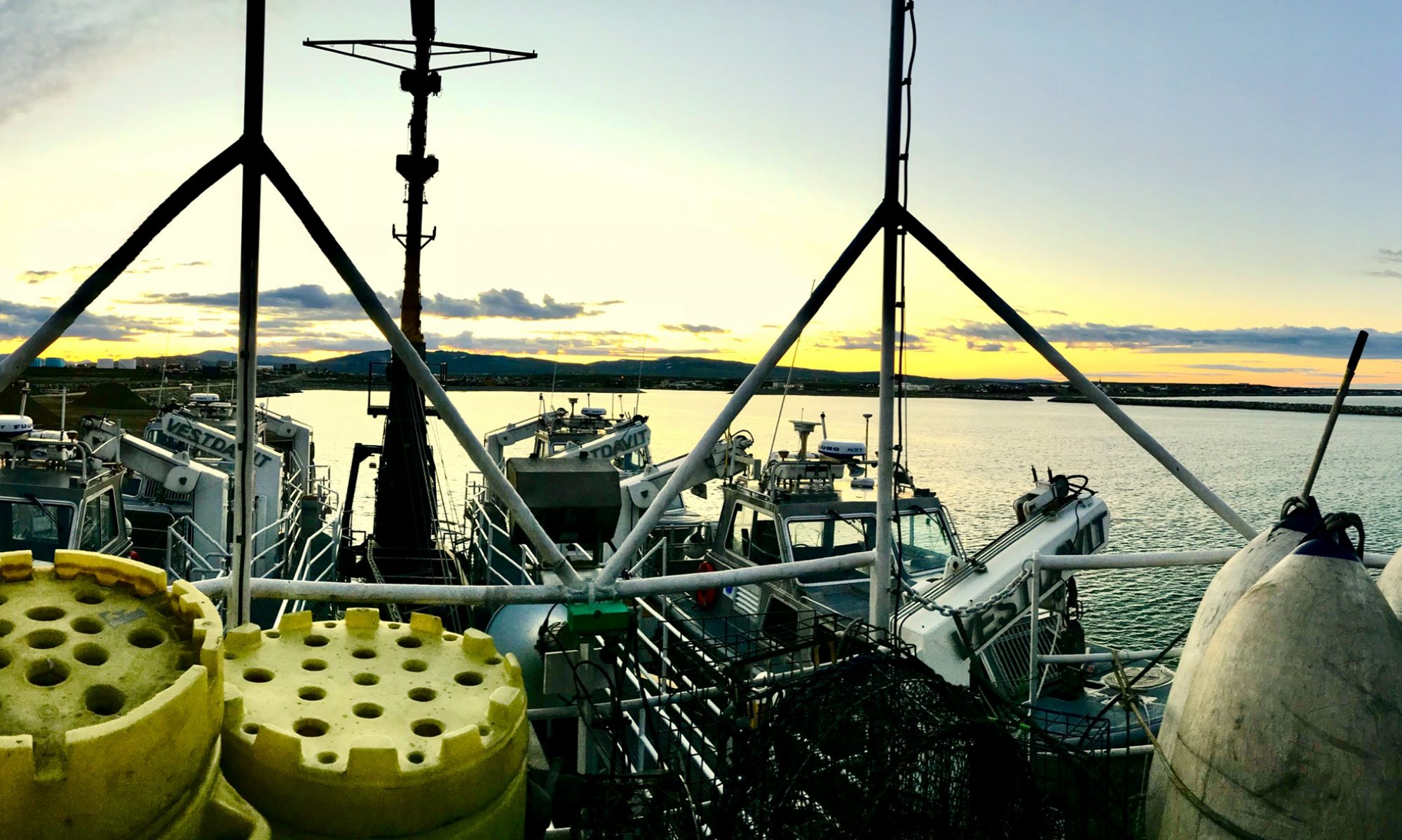
Mission: Acoustic Trawl Survey (Leg 3 of 3) Geographic Area of Cruise: Pacific Ocean/ Gulf of Alaska Date: Wednesday, August 9, 2023
Weather Data Lat 58.16 N, Lon 148.97 W Sky condition: Cloudy Wind Speed: 2.88 knots Wind Direction: 301.28° Air Temp: 12.44 °C
Personal Log
School will soon be starting in Anchorage at Bettye Davis East High School. I will not be in school for the first three days because I am having fun on a teacher’s field trip. Good things come to those who apply for it. I applied and got accepted on this cruise before the pandemic, but life and safety concerns made my journey about three years longer. Finally, I am living the dream and out in the Gulf of Alaska surrounded by pure ocean, whales, seabirds and catching lots of fish.
Kayaking in Prince William Sound with Loki the dog. My family commercial fishes for Sockeye Salmon in Main Bay.
My name is Germaine Myerchin Thomas. I was born and raised in Ketchikan Alaska. I am the daughter of a fishermen and a teacher. I, myself, am a teacher, and I commercial fish in Prince William Sound. So far I have spent most of my summer fishing in the Eshamy district about 45 miles outside of Whittier. It has been a cold dark wet summer( the word “summer” is debatable). Recently, I jumped from Set Net fishing for Sockeye (Red) Salmon, in small open skiffs, to the fabulous NOAAS Oscar Dyson.
Just visualize the ice sculptures, swimming pool and yoga studio on the Lido Deck… nope! The NOAAS Oscar Dyson is a research vessel that you can find more about by clicking the link above. Currently there are 24 crew members and 8 scientists. The ship is outfitted to conduct an acoustic trawl survey, but there are other scientific projects going on during this leg of the cruise. It, also has great food and two gyms. The waves rolling under the hull of the boat make the feel of gravity extra strong while trying to do push ups.
Already I have discovered that working out in the ocean requires being very flexible and adaptable. Sometimes the weather or wildlife can delay setting out the trawl net. Last night the boat was surrounded by whales (Fin and Sei), marine birds (Fulmars, Shearwaters and Black footed Albatross) all enjoying the abundant fish that we wanted to catch in our trawl net. Naturally we just let the animals enjoy the abundance while the scientist patiently waited for their turn in another area.
When the cruise ends I will head back to Anchorage and teach high school, chemistry, oceanography, and marine biology. I am really looking forward to meeting my students for the first time. I hope that I might be able to Zoom into my classroom and share what I am doing while I am out here.
Mission: Acoustic Trawl Survey (Leg 3 of 3) Geographic Area of Cruise: Pacific Ocean/ Gulf of Alaska Date: Monday August 7, 2023
Weather Data Lat 58.31 N, Lon 151.58 W Sky condition: cloudy Wind Speed: 12.43 knots Wind Direction: 357.55° Sea Wave height: 1 ft | Swell: 340°, 1-2 ft Air Temp: 12.35 °C
Science log
The purpose of this trip is acoustic trawl sampling for pollock (Gadus chalchogrammus). There are other projects that people are working on during this leg that I will report on in other upcoming blogs.
Today, at about 5:30 pm we deployed a CTD (Conductivity, Temperature and Depth – Probe). This probe measures the salinity using conductivity, the temperature with a digital thermometer, and records the data all at different depths in the water column. This CTD also records fluorescence which is an easy way to determine the amount of plankton present. The plankton at the surface are producers and have chlorophyll, which reacts to fluorescence and can be recorded. This information will be important when we start taking trawl samples, so the ships crew will routinely send out the CTD while we cover our transects.
Watch the videos below of the crew members deploying and recovering the CTD.
Crew members deploying the CTD
Recapturing the CTD
The data from the CTD collection are shown on the picture of the computer screen below:
CTD Data: Fluorescence, or Chlorophyll (green) and Turbidity (orange) v. Depth on the first graph, and Salinity (yellow) and Temperature (blue) v. Depth on the third graph.
The data from the CTD are presented in graphical form. The first frame shows chlorophyll, which is the green line. The second frame is percent oxygen (which they were not measuring so it remains zero). The third frame shows salinity (yellow line) and water temperature (blue line).
Personal log
Currently we are cruising out to our transect destinations over the continental shelf. The seas are a little rough (6-8 foot waves) and I am enjoying some saltine crackers that help with mild sea sickness. It has been a while since I have been in a large boat in rolling seas.
Three days ago, I flew from Anchorage to Kodiak Island on an a sunny afternoon and met the science team for the cruise. The whole team was extremely welcoming, sharing stories of past cruises, colorful characters and the science behind acoustic trawl sampling. Later, they invited me to go surfing the next day at a beach on the far side of the island.
Through the camaraderie of playing in the waves I was introduced to these amazing people and their knowledge and love of the ocean. They are very professional and willing to share what they are studying. They also have a deep concern for the changes occurring in the ocean and honestly hope that their information can be shared and understood in order to mitigate the impact of change. Sitting on my surfboard I quickly learned I was the beginner, and they were the experts. With the experience of time, they would effortlessly snap up and slice through the waves. Smiles and whoops encouraged each other as the sea crashed into the beach.
Surfing off of Kodiak Island. Photo credit: Mathew Phillips
Surfing off of Kodiak Island. Photo credit: Mathew Phillips
Surf photos courtesy of Mathew Phillips
The next day was spent with the science crew getting ready to bring aboard equipment they will be using, accessing and streamlining the information they need for the data collection, and also a little bit more shore time with fishing and hiking. I hiked up a local mountain called Pyramid.
Overall this has been a great start for a wonderful trip. I love to get my students outside experiencing the real world. After a year of taking both Oceanography and Marine Biology my students get to touch, see and smell the ocean through a field trip. They get to see marine birds and mammals, touch and taste icebergs and smell the brine scent of the ocean. They also get a chance to apply the knowledge and skills that they have learned in my class. The NOAA as Teacher at Sea Program is my field trip. I get to see the science and technology in action and share it with my students, friends and family. Thanks so much for letting me play!
Navigating NOAA Ship Oregon II is at once one of the most important and complex tasks on board. It is in motion 24 hours a day and must have skilled individuals to keep the crew safe and accomplish the mission of the survey. I spoke with Commander Adam Reed, Acting Commanding Officer, and Lieutenant Commander Rachel Pryor, Executive Officer, about this task.
Oregon II operates on two engines with one propeller (prop). It has a controllable pitch prop. This means that the pitch of the blades can be changed in order to change speed or even reverse the direction of the ship. The rudder turns the ship to port or starboard. There are also bow thrusters that turn the bow one way or the other.
There are a variety of devices that the navigator uses to know where the ship is, and to stay on course. They have two different GPS devices, in case one goes out. Additionally, they have a magnetic compass as well as a gyrocompass.
A storm and cruise ship off near Jacksonville, FL.
There are two radar units to see where other ships are and to get detailed weather information. One unit is more precise than the other but may pick up rain storms which may interfere with spotting ships. The other unit will still work in that situation.
When navigating, it is important to not just maintain the correct heading but also monitor course over ground. Even though the ship is heading in the right direction it can be pulled off course by the water currents and winds. This is very important to keep in mind not only across long distances but also when approaching the high flyer to pick up the longline. They must approach at a 90° angle and then turn to follow the longline. This is a fairly precise maneuver that is affected by both wind and current.
The bridge. This is where NOAA Corps officers navigate Oregon II.
One important factor affecting the operation of the ship is the weather. Careful consideration of any weather conditions must be factored into any decisions made. No one is allowed on the deck if there are winds of 25 knots or more, waves of 4-5 feet, or lightning within 25 miles. Weather information is always monitored through five different sources. Decisions must be made while consulting and comparing different sources of data.
Executive Officer Rachel Pryor explained that there are two types of weather patterns to keep in mind when considering operations. The first are small squalls, which can be fast moving and may have lightning. These squalls may keep moving in the same direction and you can calculate when they will arrive. But they can sometimes dissipate, change course, or stay where they are. There are also larger weather systems to consider. These tend to be slower moving but can have seas “kicking up,” increased wind speeds, and lightning. These may require seeking some sort of shelter or even docking at a port.
Radar showing an approaching storm system.
Weather has impacted the survey several times during this cruise. One of the most memorable was when I was working my shift and we were told to expect a long delay due to the weather. After about 30-45 minutes we were told to go ahead and bait the hooks and lay the longline. It takes about 2 ½ hours to run a station from putting the first hook in, to pulling the last one out of the water. The weather was beautiful and the seas were relatively calm during the station. Within a few minutes of finishing, the winds began to kick up as a system approached. In my estimation, these were pretty amazing calculations by Lieutenant Commander Pryor who was Officer of the Deck (OOD) for the haul.
The other incident to include here was a larger storm system that we were told on a Tuesday would arrive on Friday. Sure enough, it did. We headed in for cover near Cape Fear, NC. In this case, all fishing stopped and we sailed in an oval pattern keeping the waves to the bow or stern as much as possible. This led to a work stoppage of about 36 hours. In both cases careful calculations were made to keep the crew safe and maximize mission success.
Meet the Crew: Taniya Wallace, Fish Biologist
Fish biologist Taniya Wallace unhooks a small shark
Taniya Wallace is a fish biologist contractor on the science team here on Oregon II. Taniya hails from Ocean Springs, Mississippi, where she grew up and still lives. Her mother is a teacher and her father works in naval ship design. Taniya credits her 6th grade teacher with first inspiring her interest in science. She says, “Science challenged my mind and made me wonder how things worked.”
After graduating high school, she got a summer internship at the Gulf Coast Research Laboratory where she developed an interest in marine biology. Taniya attended Mississippi Valley State University in Itta Bena, Mississippi. She played softball for her university and they won the Southwestern Athletic Conference championship three years in a row! At Mississippi Valley State, she earned a degree in biology with a minor in chemistry.
Taniya works on a computer
After college she was hired as a contractor during the Deepwater Horizon disaster working on small boats trawling for fish and crustaceans to gather samples for NOAA Fisheries Seafood Inspection program. This was a three month contract.
Next, she was contracted to work with NOAA for the Plankton Unit for the next four years. On the surveys, she worked with the team to collect plankton (microscopic organisms) in three different sized nets. Then, back in the lab, she sorted and identified decapods (crabs, lobster, shrimp) and red snapper.
In 2014, she moved to the trawl survey. In this survey, they pulled a large net behind the boat and caught a variety of marine animals. They sort, identify and record measurements on what they find on the boat. Back at the lab, they would identify unknown species. This included different kinds of fish as well as invertebrates. She explained to me that the science team uses only scientific names so, often, she may not know the common name of species she is cataloging.
Here on the shark and red snapper survey her computer and data entry skills are evident. She catalogs otoliths (ear bones) and other parts quickly and easily. I am not sure if patience, kindness and equanimity are requirements of her job but she, like the other members of the science crew, excels in these qualities. And, her shark handling skills are really impressive.
Personal Log: A very exciting haul!
Every day continues to be full of new experiences and animals. Yesterday, there was a haul which on paper would look pretty boring but it proved to be anything but. First, we brought up a royal sea star ( Astropecten articulatus), a beautiful hand sized star with cream colored feet, with orange edges filled by a deep purple band. I half expected Trey, our lead on the science team, to claim it for Clemson. (Go tigers! Or, is that LSU? Yes, there is a school rivalry playing out among the science team.)
Royal sea star
Hook number 33 had a feisty seven foot nurse shark. The next shark, a nearly seven foot sandbar shark, was on hook number 43.
Hook number 49 had a baby tiger shark that was being pursued by a great hammerhead. The hammerhead was closing in on its prey when the gangion tightened and the tiger shark was hauled out of the water. I cannot say what was in the hammerhead’s brain, but it was certainly animated. For the next few minutes, it searched in vain for the tiger shark, circling and making several passes on the starboard side of the ship and showing its dorsal fin.
Hammerhead, thwarted in pursuit
Confusion? Anger? We can only speculate but I can imagine how strange the situation was from the hammerhead’s point of view. “Just another second and then, yum. Wait… where did it go?” I know this is purely unscientific and I am anthropomorphising (giving human characteristics to animals) but it really was a sight to witness.
Now where did that darn fish go? I know its here somewhere.
Later on that same haul, we hooked into a large tiger shark. It is not unusual to see a shark sucker or cobia, maybe two, hanging out around the shark as we bring it in. We have even caught a shark sucker on a hook. But this tiger had at least 10 cobia following it in.
A group of cobia following a tiger shark. Photo credit: NOAA Corps Lieutenant Junior Grade Cassidy Ring
She was big and had no intention of getting tagged.
She broke the line, and we were not able to measure and tag her. In this haul, only one fish was landed, but each of those events excited all involved and will be remembered and shared long into the future.
Enjoying some time off shift.
Animals seen: Shark sucker, royal sea star, brittle star, sea fan, nurse shark, cobia, royal tern
Did you know? Sometimes hammerhead sharks swim on their sides.
Mission: Pacific hake (Merluccius productus) Survey (Leg 3 of 5) Geographic Area of Cruise: Pacific Ocean off the Northern California Coast working north back toward coastal waters off Oregon. Date: Friday, August 4, 2023
Weather Data from the Bridge Sunrise 0614 | Sunset 2037 Current Time: 0700 (7am Pacific Daylight Time) Lat 43 16.7 N, Lon 124 38.0 W Visibility: 10 nm (nautical miles) Sky condition: partly cloudy Wind Speed: 5 knots Wind Direction: 030° Barometer: 1020.3 mb Sea Wave height: 1 ft | Swell: 340°, 1-2 ft Sea temp: 13.7°C | Air Temp: 16.2°C
Science and Technology Log
On Wednesday night I stayed up to participate in the first CTD cast of the evening. What is a CTD? The short version: a water sample collection to measure conductivity, temperature, and depth. eDNA information is also collected during the CTD casts.
The longer version: As is true of all operations, all departments collaborate to get the science done. The bridge delayed casting due to erratic behavior from marine traffic in the area. When that vessel moved away, the deck crew got busy operating the crane that lowered the CTD unit to 500 meters. The Survey Technicians, along with the Electronics Technician, had just rebuilt the CTD unit days before, due to some hardware failures at sea. The eDNA scientist prepared the Chem Lab for receiving samples that would confirm the presence of hake as well as other species.
When I arrived, Senior Survey Technician Elysha Agne was watching a live feed of the sensors on the CTD unit. Agne explained what was happening on the feed: There are two sensors per item being tested, then both sensors are compared for reliability of the data. There is one exception: A dual channel fluorometer, which gauges turbidity and fluorescence (which measures chlorophyll). Turbidity spikes toward the bottom in shallow areas due to wave action. Salinity is calculated by temperature and conductivity. Sometimes there are salinity spikes at the surface, but it’s not usually “real data” if just one sensor spikes. The CTD unit is sent down to 500 meters as requested by scientists. Measurements and water collection occur at 500, 300, 150 and 50 meters. The number of CTDs allocated to a transect line varies according to how many nautical miles the line is. For example, multiple readings at the 500 meter mark may be taken on a line. CTD casts west of the one done at the 500m depth contour are spaced every 5 nm apart. Scientists are not currently taking CTD samples beyond the ocean bottom’s 1500m contour line.
The main “fish,” called an SBE 9plus, has calibrated internal pressure. As it descends you can tell the depth the “fish” is at. Sea-Bird Electronics (the origin of the SBE acronym) manufactures the majority of scientific sensors used on board, with the exception of meteorological sensors. The Seabird deck box (computer) is connected to the winch wire. The winch wire is terminated to a plug that is plugged into the main “fish.”
The other day, the termination failed. Termination means the winch wire is cut, threaded out, and the computer wire plugged into the winch wire. The spot it’s terminated can be exposed to damage if internal wires aren’t laid flat. Tension and tears may occur anyway because it’s a weak point. The plug on the main “fish” where the winch wire cable connects broke too, so the whole CTD had to be rebuilt. The “Chinese finger,” the metal spiral that pulls the load of the CTD on the winch wire, was also defective, so modifications were made.
Broken plug on the “fish.”What you need for a moisture proof seal (electrical insulating compound).Niskin bottles in a pile while CTD unit is rebuilt.Termination failure.The main “fish” that the sensors are attached to..
When the CTD is at the target depth, Agne presses a button in the chem lab that logs a bunch of meteorological and location data. She remotely “fires” a bottle which sends a signal to the “cake” that sits on top of the CTD. The signal is an electric pulse to release a magnet that holds the niskin bottle open. If it pops correctly, water is sealed inside. Since two bottles of water were requested at each depth, a second signal is sent to the second bottle. There are 12 niskin bottles on the CTD “carousel.” After two were done at 500 m, the winch operator takes the CTD unit up to 300 m; Agne fires two more bottles there, then two more bottles at 200 m, 150 m, and 50 m. About two and a half liters of water are taken per bottle.
Samantha Engster, eDNA Scientist
Once the CTD unit returned to the surface, I got to help “pop the nipples” on the bottles to release the water into plastic bags. Back in the Chem Lab, eDNA Scientist, Samantha Engster, pours the water through a filter 1 micron thin. The filter is then folded in half and placed in a vial of Longmire’s solution until the eDNA can be analyzed in a lab back on land. Microscopes are not used for DNA analysis. Phenol-chloroform is used to remove proteins from nucleic acids. Quantitative polymerase chain reaction (qPCR) technique is then used to perform gene expression. This is the third hake survey that has been done in conjunction with eDNA analysis.
While the CTD “fish” and all its sensors are collecting oceanographic data, Engster collects environmental data from the water samples. Surface water samples are also taken at the underway seawater station courtesy of a pump hooked up near one of the chem lab sinks. The eDNA verifies abundance and distribution of hake. When information from these water samples is partnered with data from the echo sounders, and “ground-truthed” with physical hake bodies in the net, the data set is strengthened by the diverse tests.
The CTD unit fixed and ready for the next deployment. Sensors reattached to the “fish.”The “cake” that sits on top of the unit that seals off the water samples.
Career Feature
Note: A handful of the people I have met aboard are experienced “Observers.” NOAA contracts with companies that deploy observers trained as biological technicians. Find out more here.
Engineers Evan McNeil (Right), and Evan Thomas (Left).
Evan McNeil & Evan Thomas, Engineers
Give us a brief job description of what you do on NOAA Ship Bell M. Shimada.
Evan M. I’m a manager over our engineers. Below me is the second engineer. We have three third engineers, a junior engineer, and an oiler, also called a GVA (General Vessel Assistant), or wiper. I set the pace of work everyday. I assign all the jobs. Traditionally the Engine Department is under the First Engineer, but technically the Engine Room is mine. The Chief Engineer and the Captain (NOAA Corps Commanding Officer in this case) are in charge of the safety of the whole ship. The Chief Engineer also directs jobs to me that need to get done and I’ll delegate those jobs out.
Evan T. Third Assistant Engineer, soon to be Second. I mostly fix stuff that is broken.
What’s your educational background?
Evan M. I have a Bachelor’s of Science in Marine Engineering Technology with a minor in marine science from California Maritime Academy. I grew up near Bodega Bay, so my background is oriented toward the ocean. I really enjoy it.
Evan T. Graduated from Cal Maritime, 2019. I grew up in Southern California, Redlands, a desert that somehow grows oranges. I applied to all the engineering schools in California, and Cal Maritime was one of the few that replied back. I said “Yeah, I could see myself doing this.” And here I am! What do you enjoy most about your work?
Evan M. I enjoy who I work with. It makes work go by quickly. I enjoy our schedule and our time off. This is what I enjoy about my NOAA job and about sailing jobs in general. Shore leave is a type of leave. There’s also annual leave and sick leave. We call it going on rotation or off rotation. Off rotation is usually for a month, and on rotation is usually two months. Every ship is different but that’s how it is for the Shimada, a two-on, one-off schedule. If you talk to other sailors they’ll tell you ratios for time on and time off. For example, I did Leg 2 of the hake survey, I’m on Leg 3, and then I’m off.
Evan T. Learning new equipment, new ways to do things.
What advice do you have for a young person interested in ocean-related careers?
Evan M. If you are interested in going straight to being an officer, I would go straight to a maritime academy. It’s a very niche thing to know about. No one knows what they want to do at 19. NOAA’s always hiring. If you are interested in being an engineer, you start out as a wiper, then you can work your way up in the engineering department pretty easily.
Evan T. Imagine being stuck in an office and you can’t go home for a month. Find something that will distract you when you are out on the ocean for weeks at a time. Hang out with people, play games, read a book. You have to be ready to fight fires, flooding, that sort of thing.
If you could invent a tool to make your work more efficient—cost is no concern, and the tool wouldn’t eliminate your job—what would it be and why?
Evan M. A slide that goes from the bridge to the engineering operations deck.
Evan T. I would go for an elevator on the ship.
Do you have a favorite book?
Evan M. Modern Marine Engineering volume 1
Evan T. My 5th grade teacher wrote their own book that I found entertaining. I also liked Huckleberry Finn, by Mark Twain.
Vince Welton, Electronics Technician
Vince Welton
Give us a brief job description of what you do on NOAA Ship Bell M. Shimada.
I’m an electronic technician. I deal with everything that has to do with electronics, which includes: weather, navigation, radars, satellite communications, phone systems, computers, networking, and science equipment. All the ancillary stuff that doesn’t have to do with power or steering. Power and steering belongs to the engineers. What’s your educational background?
When I was in high school my father had an electronics shop and I worked with him. He was career Air Force and an electronics technician as well. My senior year of high school I was also taking night classes at a college in Roseburg, Oregon in electronics. I joined the U.S. Air Force and was sent off to tech school and a year’s worth of education in electronics. Then there was a lot of learning on the job in electronic warfare. I worked on B52s. I was a jammer. In order to learn that you had to learn everybody else’s job. That’s what makes mine so unique. You had to learn radio, satellite, early warning radar, site-to-site radar, learning what other people did so I could fix what was wrong with their electronic tools. I went from preparing for war to saving the whales, so to speak. Saving the whales is better!
What do you enjoy most about your work?
I enjoy the difficulty of the problems. We’re problem solvers.
What are the challenges of your work?
Problems you can’t fix! That’s what disturbs a technician the most, not being able to solve a problem.
What advice do you have for a young person interested in ocean-related careers?
The sciences are important no matter what you do. Having curiosity is the biggest thing. My hope is that education systems are realizing the importance of teaching kids how to think. Young people need to grow the ability to ask questions, instead of just providing answers.
If you could invent a tool to make your work more efficient—cost is no concern, and the tool wouldn’t eliminate your job—what would it be and why?
I think AI has phenomenal potential, but it’s a double-edged sword because there’s a dark side to it as well.
Do you have a favorite book?
The Infinity Concerto, by Greg Bear The Little Book of String Theory, by Steven S. Gubser
What’s the coolest thing you’ve seen at sea?
Actually seeing a whale come out of the water is probably the coolest thing. Watching that enormous tonnage jumping completely out of the ocean. If you look out the window long enough and you’ll see quite a few things.
Markee Meggs, Able Bodied Seaman
Markee Meggs
Give us a brief job description of what you do on NOAA Ship Bell M. Shimada.
I’m an AB, or Able Bodied Seaman. The job looks different on different ships. On the Shimada I stand watch and look for things that don’t show up on radar. Most ships you drive—only NOAA Corps Officers drive on the Shimada—I can drive rescue boats, tie up the ship, and do maintenance on the outside. I’m a crane operator. On a container ship you make sure the refrigerated containers are fully plugged in. On a refueling ship (tanker) you hookup fuel hoses. Crowley is a major tanker company. On RoRo ships (roll on, roll off) you work with ramps for the vehicle decks, transporting cars from overseas.
AB is a big job on a cruise ship. I did one trip per year for three years, then got stuck on one during the pandemic in 2020. On the cruise ship you stand watch, do maintenance, paint, tie up the ship, drive the ship. There’s even “pool watch” where you do swimming pool maintenance. You also assist with driving small boats and help guests on and off during a port call.
I’m a member of SIU (Seafarers International Union) and work as an independent contractor for NOAA. I like the freedom of choosing where I go.
What’s your educational background?
I’m from Mobile, Alabama. I spent four years in the Navy (my grandad served on submarines during World War Two), one year in active Navy Reserves, then eight years as a contractor supporting the Navy with the Military Sealift Command. I spent a year as a crane operator in an oceaneering oil field, and have an Associate’s Degree in electrical engineering. On the oil field job we used an ROV to scope out the ocean floor first. After identifying a stable location I laid pipe with the crane, and took care not to tip over the boat in the process! My first NOAA ship was the Rainier, sailing in American Samoa.
What do you enjoy most about your work?
I most enjoy meeting different types of people. Once you’ve been to a place you have friends everywhere. I also love to travel—seeing different places. It’s a two-for-one deal because once you’ve finished with the work you are in an amazing vacation place.
What advice do you have for a young person interested in ocean-related careers?
If ships interest you, do the Navy first. They pay for training, and your job is convertible. Becoming a merchant mariner is easier with Navy experience than coming straight off the street. There is a shortcut to becoming a merchant mariner, but you’ll have to pay for classes. Finally, always ask questions! Yes, even ask questions of your superiors in the Navy.
What’s the coolest thing you’ve seen at sea?
The coolest things I’ve seen at sea have been the northern lights in Alaska, whales, volcanic activity, and rainbow-wearing waterfalls in Hawaii.
Do you have a favorite book?
Some of my favorite books are Gifted Hands, and Think Big, both by Ben Carson. Gifted Hands: The Ben Carson Story was turned into a film with Cuba Gooding Jr in 2009. Another book that made an impression was Mastery, by Robert Greene. Its overarching message is “whatever you do, do well.”
Julia Clemons, FEAT Team Lead
Julia Clemons
Give us a brief job description of what you do on NOAA Ship Bell M. Shimada.
I am the Team Lead of the FEAT (Fisheries Engineering and Acoustic Technologies) Team with the NWFSC (Northwest Fisheries Science Center). The primary mission of our team is to conduct a Pacific hake biomass survey in the California Current ecosystem and the FEAT team was born specifically to take on that mission from another science center. The results of this survey go into the stock assessment for managing the fishery. Fisheries and Oceans Canada are partners in this survey. Hake takes you down many paths because their diet and habitat are tied to other species. For example, krill are a major prey item in the diet of hake, so understanding krill biomass and distribution is important to the hake story as well. Rockfish also have an affinity for a similar habitat to hake in rockier areas near the shelf break, so we use acoustics and trawling to distinguish between the two.
What’s your educational background?
My undergraduate degree from University of Washington was in geological oceanography. I began with NOAA in 1993 and worked for the Pacific Marine Environmental Laboratory’s Vents program to study hydrothermal systems. This involved a diverse team of scientists: chemical and physical oceanographers, biologists, and geologists. I got my Master’s in Geology at Vanderbilt but shifted to NOAA Fisheries in 2000 working in the Habitat Conservation and Engineering (HCE) Program where we looked at habitat associations of rockfish. We looked at ROV and submersible video of the rocky banks off Oregon to identify fish and their geological surroundings. The HCE program shifted its focus to reducing bycatch by experimenting with net modifications and I moved to the FEAT team.
What do you enjoy most about your work?
I think one of the most important components of Team Lead is to be a supporter—supporting the facilitation of good science, supporting people. I also think about what I can do to support the overall mission of NOAA Fisheries. That’s my favorite thing, supporting others. I love when the focus is not on me!
What advice do you have for a young person interested in ocean-related careers?
Think about ways you can put yourself in the right place at the right time. Ask about volunteer opportunities. Ask questions, explore, think about what you want to do and look at people who are doing that—ask them how they got to that position.
What’s the coolest thing you’ve seen at sea?
When I was with the NOAA Vents group in 1994 I got to go to the bottom of the seafloor in the submersible Alvin. I was in there for nine hours with one other scientist and Alvin’s pilot. You think you’re going to know what it looks like, because you’ve seen video, and you think you’re going to understand how it feels, but then you get down there and everything is bigger, more beautiful, in all its variation and glory. We navigated to a mid-ocean ridge system that had an eruption the year previously. There was bright yellow sulfur discharge on black basalt rocks… after all those hours looking at ROV video, to see it in person through the porthole was incredible.
Do you have a favorite book?
The 5 AM Club, by Robin Sharma. I’m a morning person, and this book lays out how to structure those early hours and set you up for a successful day. When I was little I loved The Little Mermaid story by Hans Christian Anderson—the original, not the Disney version. I grew up in Vancouver, Washington and was always asking my parents, “Can we go to the beach?”
Taxonomy of Sights
Day 11. Three lampreys in the bycatch! Risso’s Dolphin (Grampus griseus). Day 12. Blue Whales! I guess they read my blog post about the Gordon Lightfoot song. What may have been a blue shark came up near the surface, next to the ship. Strange creatures from the deep in the bycatch: gremlin looking grenadier fish. Day 13. Pod of porpoises seen during marine mammal watch.
Blue Whale. Photo by Nick Metheny, marine mammal and bird observerGrenadier Fish
You Might Be Wondering…
How often are safety drills?
Weekly drills keep all aboard well-practiced on what to do in case of fire, man overboard, or abandon ship. Daily meetings of department heads also address safety. One activity of monthly safety meetings is to review stories of safety failures on other ships to learn from those mistakes. Each time a member of NOAA Corps is assigned a new tour at sea they must complete a Survival-at-Sea course. The Fishery Resource Analysis and Monitoring division (FRAM) also requires yearly Sea Safety Training for the scientists. “Ditch Kits,” found throughout the ship, contain: a rescue whistle, leatherman, food rations & water, and emergency blankets. Additionally, there are multiple navigation and communication tools in the ditch kit: a traditional compass, a handheld Garmin GPS, a boat-assigned PLB (personal locator beacon) registered with the Coast Guard, and a VHF radio with battery backup providing access to marine channel 16.
After a tour of the engine rooms, I learned that the diesel engines also have built in Emergency Diesel Generators (EDG). If you look up at the lights on the mess deck you’ll see some of the light fixtures have a red and white “E” next to them. This label indicates which would be powered by the generators, and which would not.
An individual Personal Locator Beacon is also assigned–in addition to ditch kit and lifeboat supplies. Teacher at Sea Gapp, trying on an immersion suit.
Floating Facts
The NOAA Corps is not a part of a union, however there are unions that advocate for other NOAA employees. Licensed engineers are a part of MEBA, The Marine Engineers’ Beneficial Association. Non-licensed positions are represented by SIU, Seafarers International Union. Both of these unions are a part of AFL-CIO, the largest federation of unions in the U.S.
I had been curious whether there was a database that housed an inclusive list of NOAA Fisheries field research, and NOAA did not disappoint. You can find the Fishery-Independent Surveys System (FINNS) here, and browse as a guest. I’m now brainstorming how I might use the database with students—perhaps as a scavenger hunt—to have them practice their search skills. You can search by: fiscal year, fiscal quarter, science center, survey status, and platform type.
Which Cook Inlet species is the subject of Alaska Fisheries Science Center (AFSC) 2023 research, which is underway in a small boat? Hint: Raffi
Another tool I’m looking forward to using in the classroom is NOAA’s Species Directory, which can serve as a scientifically sound encyclopedia for ocean animal reports conducted by students.
Librarian at Sea
“The sea is a desert of waves, A wilderness of water.”― Langston Hughes, Selected Poems
This quote from Hughes’ poem, Long Trip, had me thinking about the surface of the ocean. I have seen the surface in many states over the past days: soft folds, jagged white-tipped peaks, teal, turquoise, indigo. Sometimes there are long snaking paths of water that have an entirely different surface than water adjacent. Whether it is due to currents colliding, chemical process, biological process, temperature difference—I cannot say. If I were to anthropomorphize the phenomena, I’d say these lines are wrinkles, as the ocean creases into different expressions. A hint of what lies within and beneath.
It also has me thinking about the interviews I’ve conducted with the people on NOAA Ship Bell M. Shimada. I started with a superficial name and title, a face on a board near the Acoustics Lab depicting all hands on Leg 3. When I sat down to talk with people representing Scientists, Engineers, Deck Crew, Electronics, Officers, Survey, and Steward, I began to unspool colorful stories from a broad spectrum of life experiences, many from divergent habitats, all who have converged here to do in essence what the concierge at my Newport hotel said to me as I walked out the door, “Keep our oceans safe!” A tall order in so few words. From shore we’re a small white blip on the horizon; up close there’s a frenzy of activity, a range of expertise, a conviction that our actions can improve living for humans, for hake, and for all the species in Earth’s collective ecosystem.
A wilderness of blue water.
Hook, Line, and Thinker
We opened up a hake in the Wet Lab today to find it had a green liver. Why? Parasites? A bacterial infection? An allergy to krill? There’s always more beneath the surface, more stories to suss out. This is what makes science exciting, what makes living with 30+ strangers exciting. It’s what I enjoy about teaching.
How do the albatross know when we’re hauling back a net full of hake? They seem to appear out of nowhere. First a couple, then maybe 40 of them materialize around the net, squabbling over fish bits.
Have you ever discovered something unexpected and wondered about its origins? How could the scientific method support you in finding out an answer… or to at least develop a theory?
A Bobbing Bibliography
Known as “charts” at sea and “maps” on land, NOAA Ship Bell M. Shimada has a small library of charts. Find out more at NOAA’s Office of Coast Survey. Paper charts are actually being phased out. “NOAA has already started to cancel individual charts and will shut down all production and maintenance of traditional paper nautical charts and the associated raster chart products and services by January 2025.”
Mission: Pacific hake (Merluccius productus) Survey (Leg 3 of 5) Geographic Area of Cruise: Pacific Ocean off the Northern California Coast working north back toward coastal waters off Oregon. Date: Tuesday, August 1, 2023
Weather Data from the Bridge Sunrise 0613 | Sunset 2034 Current Time: 0900 (9:00 am Pacific Daylight Time) Lat 42 32.8 N, Lon 125 00.9 W Visibility: <1 nm (nautical miles) Sky condition: Overcast Present weather: Fog Wind Speed: 15 knots Wind Direction: 350° Barometer: 1017.9 mb Sea Wave height: 2 ft | Swell: 340°, 3 ft Sea temp: 16.6°C | Air Temp: 16°C Course Over Ground (COG): 090.2° Speed Over Ground (SOG): 9.9 knots
Science and Technology Log
Second Engineer Justin Halle provided a tour yesterday of the engine room and associated machinery kept running smoothly by the Engineering Department. Four Caterpillar brand diesel engines use about 1,800 gallons of fuel per day, although that number fluctuates depending on operations and weather. There are multiple fuel tanks in reserve that hold 5 – 15,000 gallons. A fuel manifold regulates fluid intake and a camera is fixed on fuel levels so the engineers can monitor them. Two valves per tank allow for filling or suction. Water evaporators separate sludge and water to keep fuel clean and bacteria free. We also looked up the exhaust shaft which vents out the top of the ship above the level of the flying bridge.
We viewed the propellor shaft that drives the main propulsion of the ship. A secondary means of propulsion is the bow thruster, but it is primarily used in close quarters situations such as docking and undocking. We did not view the bow thruster on our tour.
Two of the four diesel engines. OWS – oil & water separatorThe fuel manifold.The vacuum system that sucks our fluids down the drain. Second Engineer Justin Halle at the control panel.A tidy workbench.
There’s a whole water treatment system. The sewage part has a macerator that blends up, er, things just like the Ninja blender in your kitchen. Treated wastewater is vented to the ocean every few days, but cannot be pumped within three miles offshore or within marine sanctuaries. We consume approximately 1,400 gallons of water per day, and the ship can make potable water from seawater through reverse osmosis, evaporators, and water brought aboard from port. Water is treated with bromine, which is often used as an alternative to chlorine in swimming pools.
Workbenches and tools are kept tidy, with some tools and parts kept in a veritable library of large metal cabinets. An impressive control panel allows the engineers to look at the status of various systems at a glance. Performance logic controllers enable engineers to turn things on or off in the engine room from the control panel. Additional screens show a camera feed of potable water levels, the propulsion system, and the fire pump (only accessible down a hatch in the bow thruster space), which are all prone to flooding. Additional specifications for NOAA Ship Bell M. Shimada can be viewed here.
Career feature
Matt fillets rockfish caught in the bycatch for a special lunchtime treat.
Matt McFarland, Chief Bosun
Give us a brief job description of what you do on NOAA Ship Bell M. Shimada.
We do a lot of fishing operations and I run all the gear. I run the nets and the winches. I put the nets out wherever the scientists are seeing the fish and we’ll go down to that depth. I’m responsible for the efficiency of the operation and safety of the six deck hands I have underneath me.
Note: Matt is also a “plank owner” meaning he was a member of the ship’s crew prior to the vessel being placed in commission. So, he has been with the Shimada before it was owned by NOAA and still belonged to the shipyard. The ship was built in Moss Point, Mississippi and Matt was a part of the crew when it was taken through the Panama Canal to serve in research operations on the West Coast.
What’s your educational background?
I grew up commercial fishing. After high school I went to a technical college for marine technology. So I can work at marinas, on boats and motors and this and that. After school I went back to commercial fishing for a while along with carpentry to supplement. Then about 2008 I decided I wanted to be a professional mariner and get my U.S. Coast Guard license. From there I found out about NOAA, joined in 2009 and have been here ever since. The Coast Guard license is about a three-week course; they teach you basic seamanship. In order to be in my position out on the ocean you need an AB, meaning able bodied seaman. The Ordinary Seaman (OS) is entry-level and I worked my way up over the years. So on the fishing boats we have different levels: general vessel assistant (OS), fisherman (the equivalent of an AB), the next step is skilled fisherman, then lead fisherman, then Chief Bosun is the leader of the Deck Department.
What do you enjoy most about your work?
I enjoy the ocean. I love being out here. Growing up in commercial fishing, you work really hard and there’s no guarantee you’re going to get paid: if you don’t catch fish you don’t get a paycheck. So being here with NOAA means I get to continue to do what I love and if we don’t catch fish I still get paid. It’s a secure job. I have a passion for getting the science right and making sure things are getting done the way they should be done. We’re making regulations for the commercial industry and if our science is faulty, if we aren’t being efficient, then that’s not fair to them. I have family in commercial fishing, so it’s important to me. A lot of these guys are new to sailing and have never fished, so I’m passing on that knowledge. This isn’t as grueling as commercial fishing. It’s important to me to keep the industry going and get the science right.
What advice do you have for a young person interested in ocean-related careers?
Start with small trips. Make sure you like it. It’s not always beautiful out here. Some days there are rough seas, some people get sick, and for some people it’s just not for them. I would encourage youth to pursue it though. It’s a good way to get away from the news–you’re in your own little world out here. It’s a nice alternative lifestyle.
Do you have a favorite book?
I’d say Captains Courageous, by Rudyard Kipling. The 1937 film version was actually done in my hometown of Gloucester, Massachusetts. Gloucester is the oldest commercial fishing seaport in the United States. (The link will take you to some oral histories of Gloucester residents.)
XO Gibson considers a route using the nautical charts.
Laura Gibson, XO
Give us a brief job description of what you do on NOAA Ship Bell M. Shimada.
My job is the administrative side of the ship which includes staffing, budget, and spending a lot of time at my desk.
What’s your educational background?
I went to college in Myrtle Beach, South Carolina. I have a Bachelor’s in Science with a Geology focus.
What do you enjoy most about your work?
I enjoy the camaraderie of the crew. Sometimes we’ll play games. I have a good time and feel like I’m doing a fine job when they are having a good time.
What advice do you have for a young person interested in ocean-related careers?
If you’re not opposed to sailing, check it out; there’s a high demand. It’s not the easiest lifestyle for everyone. You could be very successful at a young age in a maritime career. There’s a clear path forward. I was a merchant mariner before sailing with NOAA. They call it coming up the hawse pipe when you learn on deck how a ship works. I didn’t go to an academy but learned on the job. I accepted a commission with NOAA as a junior officer and started on NOAA Ship Pisces in Mississippi 14 years ago. While on the Pisces I helped with the cleanup of the Deepwater Horizon oil rig disaster. I was proud to be a part of the fleet of vessels that supported the aftermath of that event.
Do you have a favorite book?
The Gunslinger or Misery, by Steven King. I’m a King fan.
Taxonomy of Sights
Apparently there are more marine mammal sightings in Southern California and fewer as you head north. However, there have been whale spouts sighted every day. Our Chief Scientist says the humpback sightings pick up near Vancouver Island and waters north–although Leg 3 doesn’t extend that far..
Day 8. Bycatch highlights: splitnose rockfish, a 43-lb squid, the egg case of a skate, and a single lamprey. In the evening: whale spouts from the flying deck, and an aerial show from a brown booby (a seabird not normally seen this far north; it may have been a sub-species called Brewster’s brown booby) attempting to land on the jack staff and then on the bow–with limited success in a 24 knot wind Day 9. Saw Humpback flukes as they dove. Day 10. Beautiful shades of ocean blue…
Brewster’s brown booby photo taken by Nick, OSU Marine Mammal & Bird Observer
You Might Be Wondering…
How’s the food?
I am told our Chief Steward, Ronnie Pimentel, is one of the best in the NOAA fleet. Ronnie and Rich Lynch (Second Cook) tirelessly serve up breakfast, lunch and dinner every day. Creamy breakfast grits, blueberry pancakes, pulled pork sandwiches, soups, peanut butter cookies, lamb chops, taco Tuesdays, pizza night, yuuuum. Ronnie has been with NOAA for a year, and prior to that served the Navy 21 years as a Steward. Ronnie spends about $15,000 a month on food, which varies depending on the length of the voyage. Food is stored in two freezers (one large, one small) and two chill boxes (one large, one small). He typically uses about 300lbs of frozen vegetables, and has about one case of each type of food, like one of apples, one of bananas, etc. Depending on the size and tastes of the crew he’ll pack 60lbs of bacon, and various cakes for tempting treats.
tasty dinner
tasty breakfast
Floating Facts
NOAA Corps is the eighth uniformed service in the United States, although it is not an armed force—Army, Navy, Air Force, Marines, Coast Guard, Space Force—and falls under the Department of Commerce, not the Department of Defense (DOD). Interestingly, the U.S. Coast Guard is not under the DOD either, but acts as a military branch and federal law enforcement agency within the Department of Homeland Security. The Public Health Service is the other unarmed, but uniformed service.
NOAA Corps has the same benefits and rank system as the military. Currently NOAA Corps has three admirals. Read more about one of the admirals here. Officers are “active duty” meaning they have full-time employment and may be directed to go where they are needed. The term “billet” refers to the current job in which an officer is placed. Members of the Corps do a rotation of two years at sea and three years on land.
Personal Log
I have clean clothes! While using the washer and dryer machines on Sunday I saw why cleaning the lint traps is taken so seriously.
Clean the lint trap, save lives
Washing machines and dryers
Humor is the best medicine, and a great way to reckon with being cooped up on a ship for two weeks with 33 people. While reading through some posted protocols in the acoustics lab I came across this gem in the last row of “Shimada Sonar Frequencies.”
Shimada Sonar Frequencies
Another bit of humor comes from the bridge, where there used to be eight camera buttons. For the record, there are NO torpedo tubes aboard NOAA Ship Bell M. Shimada.
Repurposed camera buttons
I am attempting to collect permissible items from the catch, such as hake young-of-the-year, to take back to my classroom and incorporate in lessons for students. In doing so, I’m getting a crash course in properly preparing wet specimens. My first lesson was that freezing is the best route until items can be processed. This site was helpful to me in figuring out what additional tools I needed to do it properly. While I brought several glass vials for collecting, I did not bring formalin, isopropyl alcohol, or needles. So, for the duration of the research cruise my specimens are in the freezer. I live close to my port of return and so have a personal vehicle to transport items home. For future Teachers at Sea: If you are flying, there are limits in checked baggage. There are also strict rules for shipping. Start your research about shipping hazardous fluids here with FedEx, or here in a publication from Oregon State University.
Librarian at Sea
Librarians specialize in acquiring, organizing, and disseminating information for their target populations. The NOAA Central Library provides access to seminars, journals, NOAA publications, and daily weather maps to name a few. Then there’s NOAA’s Photo Library, which has over 80,000 searchable images in its online database. If you type in “hake” there are 114 results. I anticipate incorporating both databases into future lessons for my students.
A squid and I contemplate life in the Wet Lab.
LampreyPorbeagle shark photo taken by Nick, OSU Marine Mammal & Bird Observer
Hook, Line and Thinker
The title of today’s post comes from Siletz Nee-Di, an endangered language spoken by some of Oregon’s First People. In 1977, The Confederated Tribes of Siletz were second in the nation and first in Oregon to regain federal recognition. What is now Newport, Oregon was originally home to villages and family groups of the confederation—whose descendants still live in the area.
NOAA Fisheries includes tribal, indigenous, and underserved communities in their strategic priorities for 2023. (See strategy 1.5 in the document available here.) Oregon’s Senate Bill 13 (Tribal History/Shared History) directs educators to include curriculum about contemporary indigenous communities. I am interested in knowing more how NOAA Fisheries partners with local stakeholders in Oregon.
If access to your family’s traditional fishing grounds—a primary source of food and revenue—were suddenly cut off, what would you do to regain entry to those waters?
Read about a Washington state tribal leader who fought for fishing rights and will soon have a U.S. Navy ship named after him.
“What’s good for the fish is what’s good for the people.”
Map of Ancestral Tribal Homelands along the Oregon Coast
Flag of the Confederated Tribes of Siletz Indians
A Bobbing Bibliography Favorite books among the science crew:
Nick – The Earthsea Saga, by Ursula K. LeGuin Ethan – The Snowball: Warren Buffett and the Business of Life, by Alice Schroeder Liz – A Sand County Almanac, by Aldo Leopold Jake – In the Name of the Wind, by Patrick Rothfuss Sam – Where the Crawdads Sing, by Delia Owens