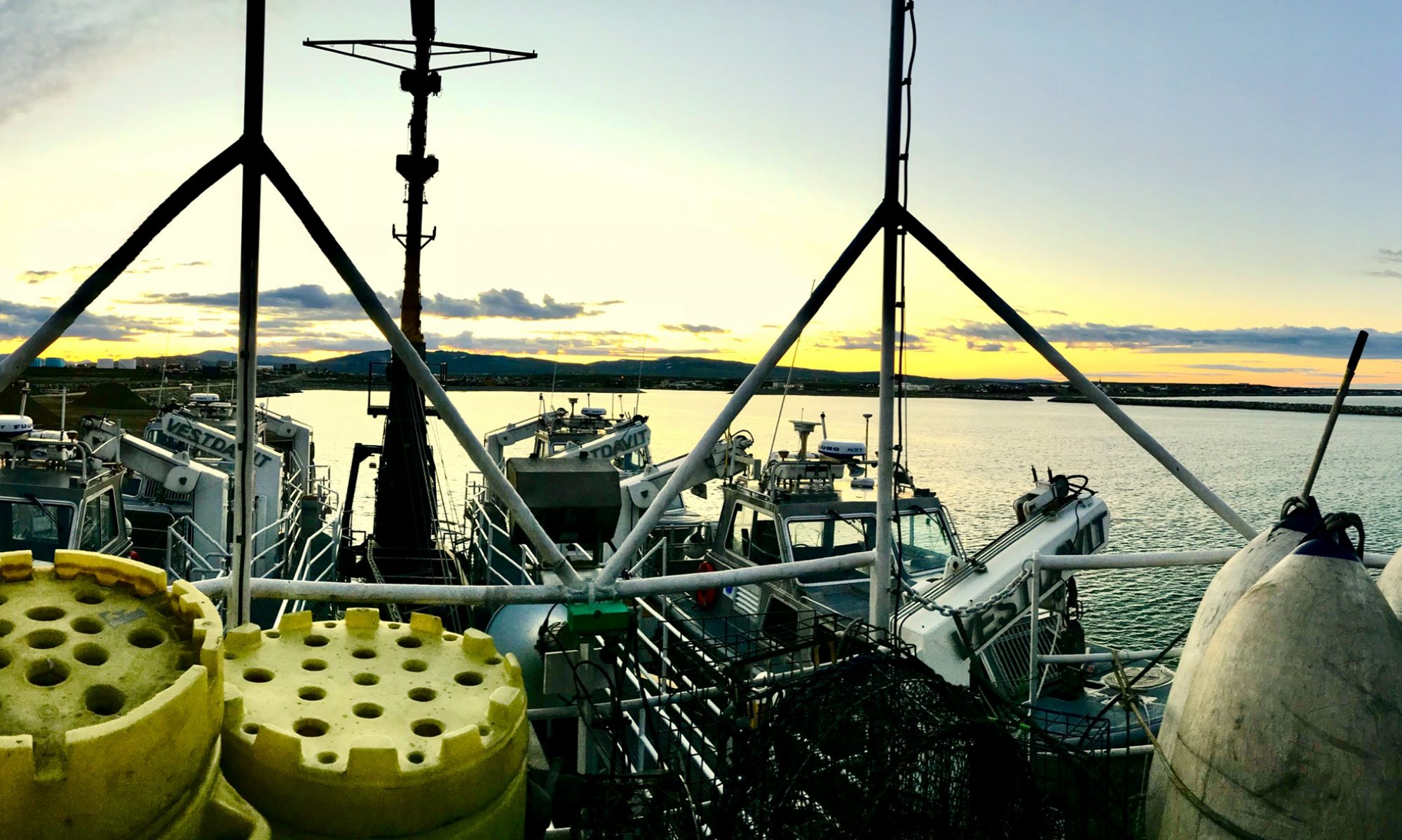
Evening of August 19 – Edge of the Barrow Canyons in the Beaufort Sea
Air temp 32F, sea depth 185m , surface sea water temp 32F
Measuring Ocean Properties with the CTD
Scientists have a tendency to use acronyms to refer to select processes and measures. The acronym heard the most, if not constant, on this trip has been CTD. So here is my best attempt to give you a brief overview of what that “CTD” means and some of the measurements scientists are taking.
Deploying the CTD (Conductivity, Temperature, and Depth) probe, which is suspended in a metal “package” with Niskin water bottles
The acronym CTD stands for conductivity, temperature, and depth of the ocean water. This instrument, which takes a measurement 24 times a second, is attached to a large frame that includes big plastic bottles know as Niskin bottles. Nearly every time we stop the ship the CTD package (shown in the image above) is slowly lowered to just above the sea floor (or less depending upon the scientific interest at the site). On the way back up, the Niskin bottles are filled with seawater from different pre-determined depths. An electronic switch is triggered for each bottle at different depths so that the containers are sealed closed trapping water from that depth. Once the package is back on board the scientists measure various properties of the water, including its salinity and oxygen content which will be used to verify and calibrate the electronic sensors on the CTD.
The three main measurements of the CTD represent fundamental characteristics of seawater. Conductivity (C) determines the salinity or the amount of salt in the water. Electrical conductivity or how well an electric current can flow through the water gives an instant real time measurement of water salinity. When combined with temperature (T) and depth (D) this gives a measure of the density of the water, and even tells us something about how the water is moving.
In addition to these physical properties, other sensors attached to the CTD provide information on the underwater marine life. Phytoplankton is the base of the underwater food web and is an important indicator for the overall health of the local marine environment. Phytoplankton is too small to be seen individually without the aid of a microscope; however, scientists have found a way to test for its presence in water. Phytoplankton gets its energy, as all plants do, from the sun using the process of photosynthesis. One of the sensors on the CTD tests for chlorophyll fluorescence, a light re-emitted during the process of photosynthesis. The amount of fluorescence measured can be used to determine the amount of living phytoplankton at different depths in the ocean. Another sensor measures the levels of sunlight in the water.
The water samples from the Niskin bottles are used to determine many other properties of the water. One such property is dissolved carbon dioxide. Just like the atmosphere, the ocean has its own carbon cycle. We might hear of increased atmosphere CO2 levels associated with global warming. Some of this CO2 is absorbed from the atmosphere at the surface of the ocean and some of the carbon from the ocean is also exchanged into the atmosphere. This carbon exchange rate between the air and sea helps regulate the pH of the ocean. Tracking dissolved carbon dioxide measurements over time gives scientists additional physical measurements to track the overall health of the marine environment. Scientists have been seeing increasing amounts of dissolved carbon dioxide in the ocean which can decrease pH levels making the ocean more acidic. Small changes in the ocean pH can affect some marine life more than others upsetting the balance in the marine ecosystems.
The Exiting Pacific Ocean
At the moment scientists are doing even more CTD casts with a focus on ocean currents. We are at the edge of the Chukchi Sea where the Pacific-origin water exits the shelf into the deep Arctic Ocean. Much of this happens at Barrow Canyon, which acts as a drain for the water to flow northward. Scientists are still uncertain what happens to the water after it leaves the canyon, so the survey we are doing now is designed to track water as it spreads seaward into the interior Arctic.
The Pressure of the Deep Sea
Most of the CTD casts during our time on the Healy have not exceeded 300 meters. Lowering and raising the CTD from deeper depths takes a lot of precious time, and on this cruise the emphasis is on the upper part of the water column. However, on August 18, we completed a cast 1000 meters deep. In addition to collecting data, we were able to demonstrate the crushing effects of the deep ocean pressure by placing a net of styrofoam cups on the CTD to the depth of 1000 meters. Styrofoam cups contain significant amounts of air. This is why the styrofoam cup is such a good insulator for a hot drink. At 1000 meters deep, much of the air is crushed out of the cup. Since the pressure is equivalent around the cup, it is crushed in a uniform way causing the cup to shrink. Here are some images demonstrating the crushing power of the sea. *Note: The big cup with no drawing is the original size. This will be a great visual tool to bring back to the classroom.
Styrofoam cups shrunken by the increased pressure of the deep ocean
Today’s Wildlife Sightings
A highlight today was not seeing but hearing. I was able to listen in live on Beluga whales with the help of deployed sonobuoys. The sonobuoys are floating hydrophones that transmit back what they hear with their underwater microphones. Today they picked up the Beluga whales and their short songs. I thought their calls sound like the songbirds from home and little did I know, this is why they are called the canaries of the sea!
Now and Looking forward
Tonight we saw 100s of Walruses mostly on the ice. On Monday we will have a presentation about walrus from one of the scientists on board. I look forward to sharing pictures and what I learned in the next blog.
Geographic Area of Cruise: Point Hope, northwest Alaska
Date: August 22, 2018
Weather Data from the Bridge
Latitude 55 44 N
Longitude – 165 23.04 W
Air temperature: 8 C
Dry bulb 8 C
Wet bulb 8 C
Visibility: 0 Nautical Miles
Wind speed: 9 knots
Wind direction: east
Barometer: 1008.4 millibars
Cloud Height: 0 K feet
Waves: 1 feet
Sunrise: 7:10 am
Sunset: 11:01 pm
Science and Technology
There are other data being collected besides ocean floor mapping using the Bottom sampler. Ocean floor samples are collected at many positions along the track line.
This is quite a gizmo, at the end is a metal scoop that collects soil samples once it hits the ocean floor. On both sides of the pole near my right hand, there is two underwater lights that is activated prior to deployment and a GoPro placed in a waterproof compartment. The camera is operated from a wireless connection and the remote control device is attached by Velcro to your wrist, just like a watch. The device weighs around 35 pounds.
Bottom Sampler – photo by Megan Shapiro
Once the sample is retracted and emptied on the deck, the size of the aggregate is measured using a scale and recorded. Why is this information useful ? This data will be used used by mariners when assessing the best place to deploy an anchor. An ocean bottom containing a muddy composition is preferred as it helps to keep in place both the anchor and chain. Below is a sample we retrieved off of Point Hope, Alaska. Using the bottom sample below, what are your thoughts, is this an ideal located to drop anchor?
Bottom sample compared to Ocean Sample Scale ~ photo by Tom
Dropping an anchor for a ship is not a 5 minute job. I recall fishing with my cousin in his small boat when I was in elementary school; we would arrive at an ideal location to catch lake bass and toss our anchor overboard. It was nothing fancy, a large plastic bucket filled with sand. With the rope attached, we lowered the bucket “anchor” tie it off with some slack and for the most part it kept us from moving. Anchoring a large 1,500 ton ship requires around 30 minutes to secure and the ocean depth would determine the amount of chain to use. The anchor weighs 3,000 lbs and 400 – 700 feet of chain is deployed; this depends on the ocean depth. This brings the total weight of anchor and chain to around 48,000 pounds. The anchor itself does not secure the ship, it is the combined weight of the chain and anchor. After the chain is deployed, officers monitor the ships movement to ensure the anchor is not dragging using ECDIS, which uses a GPS feed that tracks the ship’s movement. Interesting fact, the Fairweather can hold 100,000 gallons of fuel, for ship stability purposes the fuel supply never gets below 40,000 gallons.
Personal Log
During the past few days, the sea has been a bit rough, but I love it especially at night, falling asleep is so much easier. It looks like Wednesday, I will be deploying the drifter buoy, stay tuned there will be an entire blog dedicated to it, including how to login and track its movement!. So far on this cruise I have not been able to view the constellations at night, the big obstacle is the fog. Remember, the sun sets at around 11:30 pm and because of our latitude, it does not get very dark at night. The other big issue has been the weather the past few days, mostly overcast and fog. As we transit to Kodiak Island, the weather forecast does not mention much about the sun, though we are in Alaska on the water!
Something else interesting to note; recall a few blogs ago I discussed relative humidity as a comfort gauge? It is the dew point temperature that meteorologist use for predicting rainfall, if the dew point temperature is 75 and the air temp is 76 F near the surface rain is almost guaranteed. Cruising in the Unga Strait within the Aleutian Islands today, the cloud deck is roughly currently at 1,000 feet. It is at that location where the dew point and air temperature match and cloud formation begins. This is what we call the LCL, lifting condensation level.
Last night I was talked into played the bass guitar for the first time, playing with the band on board. They brought me up to par quickly, it was fun! I left the singing to the professionals, our deck hand Kyle and the XO (Executive Officer) Mike!
Weather Data for Claremont, CA from National Weather Service:
Latitude: 34.1368º N
Longitude: 117.7076º W
Wind Speed: 12 mph
Wind Direction: SSW
Air Temperature: 29.4º Celsius
Humidity: 36%
Personal Log
Well, NOAA Ship Oscar Dyson docked in Dutch Harbor on August 11th from the 19-day journey in the Eastern Bering Sea. During our time at sea, I learned so much and got to know both the NOAA scientists and the crew and officers on the ship. When I applied for the Teacher at Sea program, I knew that it would be an invaluable experience, but it far exceeded my expectations. I learned about the work of the NOAA scientists pretty much non-stop and any question I had was answered in detail, which allowed me to have a robust picture of the work the NOAA scientists do, the different types of scientific instruments they use and the underlying principles behind them as well as the day-to-day operations of a scientific vessel such as NOAA Ship Oscar Dyson. Additionally, I also ate the best food of my life made by the stewards; there was always amazing entrees and dessert at every meal!
NOAA Ship Oscar Dyson in Dutch Harbor, Alaska
After we came into port, I was able to explore the town of Dutch Harbor as well. Along with other NOAA Scientists and the ship’s medic, I explored the Museum of the Aleutians in town and learned about the native people of the island and their traditions as well as the military encampments that were built on Unalaska (the island where Dutch Harbor is) during WWII. The next day we went up Ballyhoo mountain and saw the ruins of one of the WWII bases. The view from there was amazing and we saw all around Unalaska. I was surprised in Dutch Harbor to see so many bald eagles everywhere! The next day I said goodbye to the many people I got to know aboard the Oscar Dyson, many of whom were staying aboard for the next leg or for a long time thereafter. I was surprised how easily I transitioned to life aboard the boat and it still feels a bit weird to not be moving all the time!
I had a chance to interview the chief scientist aboard NOAA Ship Oscar Dyson, Taina Honkalehto, and ask her about her career path to working at NOAA as well as recommendations she has for anyone interested in an ocean career.
Taina knew that she wanted to pursue a career in science ever since she was a child as she has always been interested in the outdoors and collecting and observing things. During college, she took an oceanography course as a junior and knew she wanted to work with the ocean. Her college advisor recommended that if she wanted to pursue science she needed to do a field program. As a junior, she was able to secure participation at a marine lab in the U.S. Virgin Islands, which inspired her choice to go to graduate school and study invertebrate zoology.
At NOAA, Taina really enjoys her colleagues and the field work, which includes the pollock counting work she is currently doing on NOAA Ship Oscar Dyson. She feels that her work at NOAA is an opportunity to contribute to the preservation of our planet. Additionally, she enjoys doing outreach at NOAA and talking to people about her work and answering questions about the ocean. Often, discussions with the public involve balancing what they have heard about fisheries and overfishing in the news versus the reality and experiences Taina has had in the field counting pollock in the Bering Sea and Gulf of Alaska.
The advice that Taina has for those wanting to work for NOAA is to get an internship. Students can find internship opportunities through the NOAA website and there are avenues into NOAA experience for students at the middle and high school level as well as college students. These internships are a great way to get hands-on experience (as I can attest!) and some of them are even paid if students apply for the Hollings scholarship. Taina also recommends reading some of the following books to get an idea about what it is like on a field placement: “The Log from the Sea of Cortez” by John Steinbeck, “Moby Duck” by Donovan Hohn, and “Cod” by Mark Kurlansky.
Chief Scientist aboard NOAA Ship Oscar Dyson, Taina Honkalehto
Personal Log
The wet lab aboard NOAA Ship Oscar Dyson is where most of the action happens during my shift. When a haul comes in, we are responsible for processing the catch and obtaining the needed measurements so that the MACE team can put together their report on the health of the pollock population. The catch is released from the trawling net onto a hydraulic table that can be dumped onto a conveyor belt. The first job to be done is to sort the catch, where all species that are not adult pollock are separated out.
Adult pollock from a haul on the sorting belt
The next task is to measure the length of a subsample of about 300 of the adult pollock in the catch. This helps the NOAA scientists to create histograms of pollock lengths to compare between hauls. Finally, about 30 pollock are separated to measure length, weight and to determine gender and maturity and another 30 have length and weight measured, otoliths taken, and ovaries weighed and collected if the pollock is a spawning female. During my shift, there are six of us in the fish lab and we are working like a well-oiled machine!
Length distributions from several hauls
Determining if a pollock is male or female
TAS Emily Cilli-Turner collecting otoliths from a pollock
Today we are starting the long transit back to Dutch Harbor. It is bittersweet since I feel like we have a nice routine down in the fish lab and I finally feel used to the motions of the ship. However, I am grateful for this opportunity and for all the great people that I have gotten to know during my time on NOAA Ship Oscar Dyson. Also, we finally saw some blue sky again and a rainbow even came out for a moment!
A small rainbow over the Bering Sea
Did You Know?
The NOAA Ship Oscar Dyson was launched on October 17, 2003. It is named after Alaskan fisherman Oscar Dyson and there is a smaller boat on board named after his wife, Peggy Dyson.
Geographic Area of Cruise: Western North Atlantic Ocean/Gulf of Mexico
Date: August 16, 2018
Weather Data from the Bridge
Conditions at 1106
Latitude: 25° 17.10’ N
Longitude: 82° 53.58’ W
Barometric Pressure: 1020.17 mbar
Air Temperature: 29.5° C
Sea Temperature: 30.8° C
Wind Speed: 12.98 knots
Relative Humidity: 76%
Science and Technology Log
Before getting into the technology that allows the scientific work to be completed, it’s important to mention the science and technology that make daily life on the ship safer, easier, and more convenient. Electricity powers everything from the powerful deck lights used for working at night to the vital navigation equipment on the bridge (main control and navigation center). Whether it makes things safer or more efficient, the work we’re doing would not be possible without power. Just in case, several digital devices have an analog (non-electronic) counterpart as a back-up, particularly those used for navigation, such as the magnetic compass.
This slideshow requires JavaScript.
To keep things cool, large freezers are used for storing bait, preserving scientific samples, and even storing ice cream (no chumsicles for dessert—they’re not all stored in the same freezer!). After one particularly sweltering shift, I was able to cool off with some frozen coffee milk (I improvised with cold coffee, ice cream, and milk). More importantly, without the freezers, the scientific samples we’re collecting wouldn’t last long enough to be studied further back at the lab on land.
Electricity also makes life at sea more convenient, comfortable, and even entertaining. We have access to many of the same devices, conveniences, and appliances we have at home: laundry machines, warm showers, air conditioning, home cooked meals, a coffee maker, TVs, computers with Wi-Fi, and special phones that allow calls to and from sea. A large collection of current movies is available in the lounge. During my downtime, I’ve been writing, exploring, enjoying the water, and learning more about the various NOAA careers on board.
To use my computer, I first needed to meet with Roy Toliver, Chief Electronics Technician, and connect to the ship’s Wi-Fi. While meeting with him, I asked about some of the devices I’d seen up on the flying bridge, the top deck of the ship. The modern conveniences on board are connected to several antennae, and Roy explained that I was looking at important navigation and communication equipment such as the ship’s GPS (Global Positioning System), radar, satellite, and weather instrumentation.
The weather devices on top are called anemometers, and they measure true wind speed and direction relative to the ship’s speed and direction. The term comes from the Greek word ‘anemos,’ which means wind. On the right is the fishing day shape, indicating to nearby ships that the Oregon II is using fishing gear.
These satellites help to provide the television and internet on the ship.
I was also intrigued by the net-like item (called a Day Shape) that communicates to other ships that we are deploying fishing equipment. This lets nearby ships know that the Oregon II has restricted maneuverability when the gear is in the water. At night, lights are used to communicate to other ships. Communication is crucial for safety at sea.
When I stopped by, Roy had just finished replacing some oxygen sensors for the CTD (that stands for Conductivity, Temperature, and Depth). For more information about CTDs click here: https://oceanexplorer.noaa.gov/facts/ctd.html
A dissolved oxygen sensor to be mounted on the environmental profiler, which collects environmental data through the water column.
A CTD refers to several electronic instruments that measure conductivity, temperature, depth, and other properties in the water column. Scientists are interested in changes in these properties relative to depth.
Without accurate sensors, it’s very difficult for the scientists to get the data they need. If the sensors are not working or calibrated correctly, the information collected could be inaccurate or not register at all. The combination of salt water and electronics poses many interesting problems and solutions. I noticed that several electronic devices, such as computers and cameras, are built for outdoor use or housed in durable plastic cases.
On this particular day, the ship sailed closer to an algal bloom (a large collection of tiny organisms in the water) responsible for red tide. Red tide can produce harmful toxins, and the most visible effect was the presence of dead fish drifting by. As I moved throughout the ship, the red tide was a red hot topic of conversation among both the scientists and the deck department. Everyone seemed to be discussing it. One scientist explained that dissolved oxygen levels in the Gulf of Mexico can vary based on temperature and depth, with average readings being higher than about 5 milligrams per milliliter. The algal bloom seemed to impact the readings by depleting the oxygen level, and I was able to see how that algal bloom registered and affected the dissolved oxygen readings on the electronics Roy was working on. It was fascinating to witness a real life example of cause and effect. For more information about red tide in Florida, click here: https://oceanservice.noaa.gov/news/redtide-florida/
Chief Electronics Technician Roy Toliver in his office on the Oregon II. The office is like the ship’s computer lab. When he’s not working on the ship’s electronics, Roy enjoys reading out on the stern. It’s a great place for fresh air, beautiful views, and a good book!
Personal Log
Preparing and packing for my time on the Oregon II reminded me of TheOregon Trail video game. How to pack for a lengthy journey to the unfamiliar and unknown?
I had a hard time finding bib overalls and deck boots at the general store.
I didn’t want to run out of toiletries or over pack, so before leaving home, I tracked how many uses I could get out of a travel-sized tube of toothpaste, shampoo bottle, and bar of soap, and that helped me to ration out how much to bring for fifteen days (with a few extras, just in case). The scientists and crew of the Oregon II also have to plan, prepare, and pack all of their food, clothing, supplies, tools, and equipment carefully. Unlike The Oregon Trail game, I didn’t need oxen for my journey, but I needed some special gear: deck boots, foul weather gear (rain jacket with a hood and bib overalls), polarized sunglasses (to protect my eyes by reducing the sun’s glare on the water), lots of potent sunscreen, and other items to make my time at sea safe and comfortable.
I was able to anticipate what I might need to make this a more efficient, comfortable experience, and my maritime instincts were accurate. Mesh packing cubes and small plastic baskets help to organize my drawers and shower items, making it easier to find things quickly in an unfamiliar setting.
This is where we sleep in the stateroom. The blue curtains can be closed to darken the room when sleeping during the day. On the left is a sink.Reading and dreaming about sharks!
Dirt, guts, slime, and grime are part of the job. A bar of scrubby lemon soap takes off any leftover sunscreen, grime, or oceanic odors that leaked through my gloves. Little things like that make ship life pleasant. Not worrying about how I look is freeing, and I enjoy moving about the ship, being physically active. It reminds me of the summers I spent as a camp counselor working in the woods. The grubbier and more worn out I was, the more fun we were having.
The NOAA Corps is a uniformed service, so the officers wear their uniforms while on duty. For everyone else, old clothes are the uniform around here because the work is often messy, dirty, and sweaty. With tiny holes, frayed seams, mystery stains, cutoff sleeves, and nautical imagery, I am intrigued by the faded t-shirts from long-ago surveys and previous sailing adventures. Some of the shirts date back several years. The well-worn, faded fabric reveals the owner’s experience at sea and history with the ship. The shirts almost seem to have sea stories to tell of their own.
As we sail, the view is always changing and always interesting!
Being at sea is a very natural feeling for me, and I haven’t experienced any seasickness. One thing I didn’t fully expect: being cold at night. The inside of the ship is air-conditioned, which provides refreshing relief from the scorching sun outside. I expected cooler temperatures at night, so I brought some lightweight sweatshirts and an extra wool blanket from home. On my first night, I didn’t realize that I could control the temperature in my stateroom, so I shivered all night long.
It’s heavy, tough, and grey, but it’s not a shark!
My preparing and packing didn’t end once I embarked (got on) on the ship. Every day, I have to think ahead, plan, and make sure I have everything I need before I start my day. This may seem like the least interesting aspect of my day, but it was the biggest adjustment at first.
To put yourself in my shoes (well, my deck boots), imagine this:
Get a backpack. Transport yourself to completely new and unfamiliar surroundings. Try to adapt to strange new routines and procedures. Prepare to spend the next 12+ hours working, learning, exploring, and conducting daily routines, such as eating meals. Fill your backpack with anything you might possibly need or want for those twelve hours. Plan for the outdoor heat and the indoor chill, as well as rain. If you forgot something, you can’t just go back to your room or run to the store to get it because
Your roommate is sleeping while you’re working (and vice versa), so you need to be quiet and respectful of their sleep schedule. That means you need to gather anything you may need for the day (or night, if you’re assigned to the night watch), and bring it with you. No going back into the room while your roommate is getting some much-needed rest.
Land is not in sight, so everything you need must be on the ship. Going to the store is not an option.
Just some of the items in my backpack: sunscreen, sunglasses, a hat, sweatshirt, a water bottle, my camera, my phone, my computer, chargers for my electronics, an extra shirt, extra socks, snacks, etc.
I am assigned to the day watch, so my work shift is from noon-midnight. During those hours, I am a member of the science team. While on the day watch, the five of us rotate roles and responsibilities, and we work closely with the deck crew to complete our tasks. The deck department is responsible for rigging and handling the heavier equipment needed for fishing and sampling the water: the monofilament (thick, strong fishing line made from plastic), cranes and winches for lifting the CTD, and the cradle used for safely bringing up larger, heavier sharks. In addition to keeping the ship running smoothly and safely, they also deploy and retrieve the longline gear.
Pulleys, winches, and cranes are found throughout the boat.
Another adjustment has been learning the routines, procedures, and equipment. For the first week, it’s been a daily game of What-Am-I-Looking-At? as I try to decipher and comprehend the various monitors displayed throughout the ship. I follow this with a regular round of Now-What-Did-I-Forget? as I attempt to finesse my daily hygiene routine. The showers and bathroom (on a ship, it’s called the head) are down the hall from my shared stateroom, and so far, I’ve managed to forget my socks (day one), towel (day two), and an entire change of clothes (day four). With the unfamiliar setting and routine, it’s easy to forget something, and I’m often showering very late at night after a long day of work.
I’m more than ready to cool off and clean up after my shift.
One thing I never forget? Water. I am surrounded by glittering, glistening water or pitch-black water; water that churns and swells and soothingly rocks the ship. Swirling water that sometimes looks like ink or teal or indigo or navy, depending on the conditions and time of day.
Another thing I’ll never forget? This experience.
In case I forget, the heat of the sun reminds me to drink water all day long.
Did You Know?
The Gulf of Mexico is home to five species, or types, or sea turtles: Leatherback, Loggerhead, Green, Hawksbill, and Kemp’s Ridley.
Recommended Reading
Many of my students have never seen or experienced the ocean. To make the ocean more relevant and relatable to their environment, I recommend the picture book Skyfishing written by Gideon Sterer and illustrated by Poly Bernatene. A young girl’s grandfather moves to the city and notices there’s nowhere to fish. She and her grandfather imagine fishing from their high-rise apartment fire escape. The “fish” they catch are inspired by the vibrant ecosystem around them: the citizens and bustling activity in an urban environment. The catch of the day: “Flying Litterfish,” “Laundry Eels,” a “Constructionfish,” and many others, all inspired by the sights and sounds of the busy city around them.
The book could be used to make abstract, geographically far away concepts, such as coral ecosystems, more relatable for students in urban, suburban, and rural settings, or as a way for students in rural settings to learn more about urban communities. The young girl’s observations and imagination could spark a discussion about how prominent traits influence species’ common names, identification, and scientific naming conventions.
Skyfishing written by Gideon Sterer and illustrated by Poly Bernatene (Abrams Books for Young Readers, 2017)