Most of day one was spent loading, sorting, unpacking, and storing gear. Scientists do not travel light. There were more action packers on board than I have ever seen in once place. At midday, we had a safety training, which consisted of learning how to put on a survival suit and how to use the coffee machine without flooding the galley. For night work, I was assigned a mustang float coat, a water activated flash light, and satellite locator, so that they could find my body if I went overboard.
After dinner, work shifted to putting together various nets and the CTD which I will describe in more detail later. We got underway at about 8:00 PM, just as the sun was setting. I slept for an hour and was woken at 10:30 to begin my shift doing zooplankton tows.
The first tow uses a Methot net, which is a large square steel frame attached by d-rings to a heavy mesh net, ten meters long. The net ends in a plastic sieve tube called a “cod end” that keeps any jellies from escaping. The net is quite heavy, and it takes four of us to guide it as a crane raises it off of the deck and then lowers it over the side. The net is dragged at the surface for twenty minutes. In the darkness of night, it glows slightly green as ctenophores and other bioluminescent jellies smash into it.
Dave demonstrating the proper technique for putting on a survival suit
After the Methot net is retrieved and secured on deck, we leave the collected jellies for a few minutes to go deploy the next net, called a Multi-net. The Multi-net is a steel box about the size of a dishwasher with a funnel entrance and five separate fine-mesh nets hanging off of the back. The net also has a heavy “fish fin” that acts to drag it down and keep it moving straight. The four of us work the net to the edge of the boat, open the back gate, and use two winches to lower it overboard. Once in the water and if the bottom depth allows it, the Multi-net gets dropped to a depth of two hundred meters and the first net is opened. The Multi-net allows you to “carve up the water column.” Each net can be triggered remotely to open and collect a horizontal sample of zooplankton at a specific depth. The electronics also allow you to measure how much water volume flows through the net. Each net is about two meters long, made of a fine mesh that funnels plankton into a soft sieve or “cod end”. While the Multi-net is “fishing,” we sort, classify, and measure the jellies collected in the Methot net tow.
A Methot Net Tow
The Seward Line Transect is made up of fifteen stops or stations. Each one designated as GAK1, GAK2, etc. Once we finish sampling a station, the boat speeds up and drives us ten nautical miles to the next station. Last night we managed to sample four stations, finishing the last one just as the sun rose around 7:00 AM. When daylight comes, the Tiglax makes its way back to the place the night shift began. All of the day-time sampling has to be done at each of the stations we sampled the night before. The day-time sampling uses different tools, the main tool being the CTD Rosette Sampler. The Rosette is a steel cage with water collecting “Niskin Bottles” and lots of other instrumentation strapped into the cage. There are fifteen bottles and each is triggered by computer to close at a specific depth. This allows the scientists on board to measure a variety of physical and chemical properties of the water at depth.
Personal Log
The night shift was surprisingly dark. That may sound obvious, but after a long Alaskan summer, with campfires and hikes that often went past midnight in perfect daylight, dark is an adjustment. The night was beautiful and warm, but the work of deploying and retrieving nets was tedious and physical. By morning I was exhausted, but I was reminded repeatedly that there are no cutting corners. No matter how tired you get, each sample needs to be meticulously cared for.
After the sun came up, I forced myself to eat some breakfast and then I fell in bed for a hard sleep. I could only stay there for a couple hours before my well-trained, morning-self wanted to greet the day. The day was flawless, picture-perfect, sunny and calm, the kind of days you don’t often seen in the stormy Gulf of Alaska.
Animals Seen Today
Dall Porpoise
Lots of seabirds, including black-legged kittiwakes, pelagic cormorants, and sooty and flesh-footed shearwaters.
In addition to collecting data on the many species of sharks in the Gulf of Mexico, this survey also collects data that will go towards assessing the population of red snapper (Lutjanus campechanus). One piece of evidence that is collected from the red snapper is their two distinct otoliths. Otoliths are structures that are used for balance and orientation in bony fish. One fascinating characteristic of the otolith is that they contain natural growth rings that researchers can count in order to determine the age of the fish. This information is important for stock assessment of the red snapper in the Gulf of Mexico.
Otoliths from a red snapper (Lutjanus campechanus)
Personal Log:
I would have to say that the hardest part about being out at sea is not being able to see Coral and Kai. I miss them so much and think about them nonstop. Coral is at a very curious stage in her life (I hope the curiosity stays with her forever) and I cannot wait to get home and tell her about all the animals that I have been lucky enough to witness on this adventure. Kai is just the sweetest little boy and I can only imagine the way he will react when I get home.
Bearing Down on the Oregon II
I am very busy on the boat and when there is down time my team and I are getting shark lessons from the incredibly intelligent Chief NOAA Scientist, Kristin Hannan, or we are in the movie room catching up on all the Annabelle movies. It is almost impossible to get scared while aboard a ship. It may seem that many things could go wrong, but the lights are always on and someone is always awake. It is the perfect environment to watch any horror film because this atmosphere makes it much less scary.
Probably the scariest thing that is happening on this boat is the amount of weight I have gained. All of the meals are delicious and they come with dessert. It is kind of nice to not have to worry about going to the gym or staying on a normal routine. Life is always so hectic day to day when I am at home, but being out here on the water gives me time to relax and reflect on the amazing people I have in my life that made this opportunity possible.
I am sad to report that the Chicago Bears lost tonight to Greenbay, but I did show support for my team! I think the best part of the day was when I was on the bow of the boat and Kristin announced over the radio that the Bears were winning 7 to 0. It is exciting being out here seeing everyone cheer for their fantasy team, as well as their home town team.
Geographical area of cruise: Seattle, Washington to Newport, Oregon
Date: September 9-11, 2018: Day 7-9
Location: West of the Columbia River and Astoria, Oregon
Where Are We?After fishing off of the Straits of Juan de Fuca on Friday and Saturday, we headed south. We ended up west of the Columbia River off the coast of Astoria, Oregon and continued to fish for a few days.
Heather and I with a large hake
A canary rock fish
Hello Sunday morning!
A chilly morning aboard the Shimada outside the Oregon coast
Beautiful cloudy evening
Cruise ship
Lots of krill
The fishing and sampling continues:A typical day consists of the scientists waking up before sunrise to begin scouting for fish. We use the information from the acoustic transducer to find fish.
Chief Scientist Rebecca Thomas spots signs of fish on the sonarThe sonar from the acoustic transducer showing signs of fish
Paired Trawling: Last week I wrote about our goals of the cruise. One of them was to perform paired trawls to determine net size impact to evaluate the differences between the US 32mm net liners and the Canadian 7mm net liners. A paired trawl is when we fish approximately the same location and depth two times using two different size liners. Data is collected on the size, characteristics, and species of fish being caught to eliminate the possibility that there is bias in the data between the two liners. Below are pictures of the nets being sent in and brought back based on information from the sonars. This typically happened 2-4 times per day (1-2 paired trawls).
The net out
The net getting pulled back in
The catch
The catch being dumped in the hopper
The catch being dumped in the hopper
The catch in the hopper
Sorting the Fish Aboard:
The fish coming down from the hopper
The fish coming down from the hopper
The fish coming down the conveyor belt
Rebecca sorting the fish by species
A yellow rock fish is sorted
The hake continues down the belt
Dr. Dezhang Chu inspects the different species
A rockfish covered with krill
Jellyfish covered in krill
A small squid
Sorting the rockfish
One of numerous hake baskets
Lampreys
Rockfish
Charlie and Heather sorting the catch
A rockfish photo shoot 🙂
How We Collect Data:
When fish come aboard we follow this flow chart to determine what analysis needs to be done on the catch.
Our instructional chart for how we analyze the hake and other species
Hake is the majority of the fish we catch. It is also the main species we are researching this cruise.
A random sample of 250 are set aside and the rest are sent back in to the ocean. Of the approximately 250 random hake, 30 are dissected for enhanced sampling (length, weight, sex, maturity, and other projects).
220 are set aside for sex/length analysis. All other species of fish must be logged into the computer and some are kept for special research projects. See pictures below:
Male vs. female hake distinction:
A Pacific hake
Determining the sex of the hake
A male hake
A female hake
Determining the length of the hake:
Determining the length of rockfish
Determining the length of each hake
Determining the length of hake
Enhanced sampling (length, weight, sex, maturity, and other projects):
Dr. Melanie Johnson dissects a hake
Scientist Steve de Blois measuring hake
Scientist Steve de Blois plus in data from his station
Dissecting the hake to enhance sample
Special Projects:There are also a number of special projects going on aboard:
Fish X-ray: Scientist Dezhang Chu x-rays samples of fish occasionally. The x-ray is used to determine the volume of the swim bladders in certain species of fish (see picture below). The volume of different species’ swim bladders affects the observed acoustics. I spoke to him about the purpose of this study. He said that the present acoustic transducers are great to capture whether fish are present below the ship’s surface but are still not able to classify the type of species being observed. He is working on a team that is trying to use x-ray’s from multiple species to solve that problem. When asked how long he thought it may take for there to be an acoustic system advanced enough to better predict the species onscreen, he said, “People have and will continue to spend their entire careers on improving the system.” If we have more scientists like Dr. Chu on this project, I predict it will be much sooner than he leads on.
X-ray of a rock fish
Dr. Dezhang Chu teaching me about the x-ray project
Dr. Dezhang Chu x-raying a rockfish
Dr. Dezhang Chu x-raying another rockfish
“Super Chu” and I with his new apron I made him for x-raying
Filming the Catch: Melanie Johnson leads the science team’s visual analysis. During each trawl a camera is placed securely on the net. The purpose of the net is to analyze approximately which depth and time certain fish enter the net.
Cameras being detached from the net for analysis
Scientist Melanie Johnson collects data from the camera that was in the fishing net
Camera footage of fish entering the net
———————————————————————
Getting to know the crew: As promised in other blog posts, here is another interview from the incredible crew aboard NOAA Ship Bell M. Shimada who continue to make my journey such a rich experience:
Mr. Arnold Dones, Head Chef
Arnold Dones is our head chef or what I like to call him, “Master Chef.” Since the minute I’ve been aboard I quickly noticed the incredible work ethic and talent of our chef. To be clear, every meal has incredible! When I spoke to my mom a few days into the cruise my exact words were, “The food aboard is better than a buffet on a cruise ship. I expected to come aboard for two weeks and lose a few pounds. Well that’s not going to happen!”
Chef Arnold and his incredible food artwork
Arnold was born in the Philippinesand his family migrated here when he was twenty. When he first got here he knew very little English and worked hard to learn the language and the American culture. He worked a few odd and end jobs until he joined the United States military as a chef. During his first years in the military, he showed so much promise as a chef that he enrolled in “A School” which allowed him to learn how to be a master chef in the military. He spent more than a decade working on military vessels. His last ship placement was aboard the USS Ronald Reagan where he and his team prepared meals for 6,000 soldiers per meal. Two months ago he joined the NOAA Ship Bell M. Shimada family as head chef. Arnold has two children and a wife who live back in San Diego.
After a tour of the galley with Arnold, I learned how much work it takes to pull 42 meals in 14 days for over 40 crew members without a supermarket nearby. A few weeks out, Arnold has to create his menu for the next cruise leg (typically two weeks). He then has to order the food required to make the meals and do so by staying under a strict budget. When the ship ends a leg and pulls in to port, a large truck pulls up and unloads all his ordered food in large boxes. He then organizes it in the order he plans to prepare it in his large freezer, refrigerator, and store rooms. The trick is to be sure his menu is organized so nothing spoils before it is used. Arnold’s day begins at 05:00 (5am) and goes until 19:00 (7pm) with a short break after lunch. The only days off he has is a day or two once every two weeks when the boat is in port.
Master Chef Arnold showing me his organized refrigerator
The mess hall
The menu is posted for every meal
An amazing buffet is served three times a day at 7am, 11am, and 5pm.
Salad is available 24 hours a day
Arnold’s art work
Lunch one day
Dinner one night
Here is a sample menu for the day:
Breakfast (7-8am)- Eggs benedict, blueberry pancakes, french toast, hash browns, scrambled eggs, oat meal, cut fresh fruit, and breakfast danish.
Lunch (11-12pm)- Bacon wrapped rockfish, chicken wings, Chinese noodles, brussel sprouts, bread, a large salad bar, homemade salads, avocado, bean salad, homemade cookies, and ice cream.
Dinner (5-6pm)- Stuffed pork chops with spinach and cheese, fine braised chicken thigh, baked salmon, Spanish rice, oven potatoes, peas, dinner rolls, a large salad bar, homemade salads, homemade apple pie, and ice cream.
Snack (24/7)- Soup, crackers, ice cream, and salad/fruit bar
King crab legs!
Crab legs and t-bones at sea 🙂
We dock in Newport, Oregon on Friday, September 14, 2018. My final post will be on Friday. Thank you for continuing to follow along in this journey. I am grateful for your support and for the amazing people I have met aboard.
NOAA Teacher at Sea Justin Garritt NOAA Ship Bell M. Shimada September 1-14, 2018
Mission: Hake Research
Geographical area of cruise: Seattle, Washington to Newport, Oregon
Date: September 7, 2018
Location: Just South of the Straits of Juan de Fuca, Pacific Ocean
Back at Home: To the KIPP Baltimore community. . . I got this picture from Madison and Anaiyah Alexander the other morning from the first day of school and thought of you all. I hope you are all surviving the heat wave sweeping across the east coast. I hope the first few weeks started off strong! I miss you all!
Where Are We? Our ship left the Seattle dock on Monday afternoon and calibrated in Elliott Bay for two days. Before leaving the bay, one of our Survey Technicians had a medical issue. He needed to be taken off the ship to get the treatment he needed. Before pulling up anchor to depart, we were able to bring him off the ship and over to the mainland using one of the small tender boats. Once the tender returned, we left the bay on Wednesday at 16:00 (4pm) and started to sail out of Puget Sound and Admiralty Inlet. On Thursday morning we stopped at Port Angeles to pick up Scott, our new Survey Technician. At 11:00am, we departed through the Strait of Juan de Fuca and into the Pacific Ocean. Once we got out of the Strait and into the ocean, the sea got rougher and fog appeared. Throughout the journey, we sailed at about 11 knots until we got to the area Chief Scientist, Rebecca Thomas, gave orders to sail to.
It was impressive how quick NOAA acted in order to get a new survey technician aboard. In less than 24 hours they notified someone from the NOAA augmenting pool (like a substitute teacher pool) and we had Scott aboard. Scott got a call yesterday mid-day and had to drive all the way from Portland, Oregon to a smaller city on the coast of the Pacific Ocean called Port Angeles to meet the ship. The ship pulled close to port, sent in a small tender boat to pick Scott up, and then he came aboard. It was remarkable how quick NOAA had to act to replace our survey technician and impressive how flexible people like Scott (who are in the augmenting pool) have to be to make sure the mission continues.
This slideshow requires JavaScript.
How and What We Fish? NOAA Ship Bell M. Shimada was delivered to NOAA in 2010. The ship is the fourth Fisheries Survey Vessels (FSV) built by NOAA starting in 2003. FSV’s were built to introduce a low level of sound and vibration in their surrounding waters. The acoustics detect and measure the distribution of fish and other living marine life and describe their habitat. The transducer transmits a sound pulse (ping) which bounces off of different things beneath the ocean.
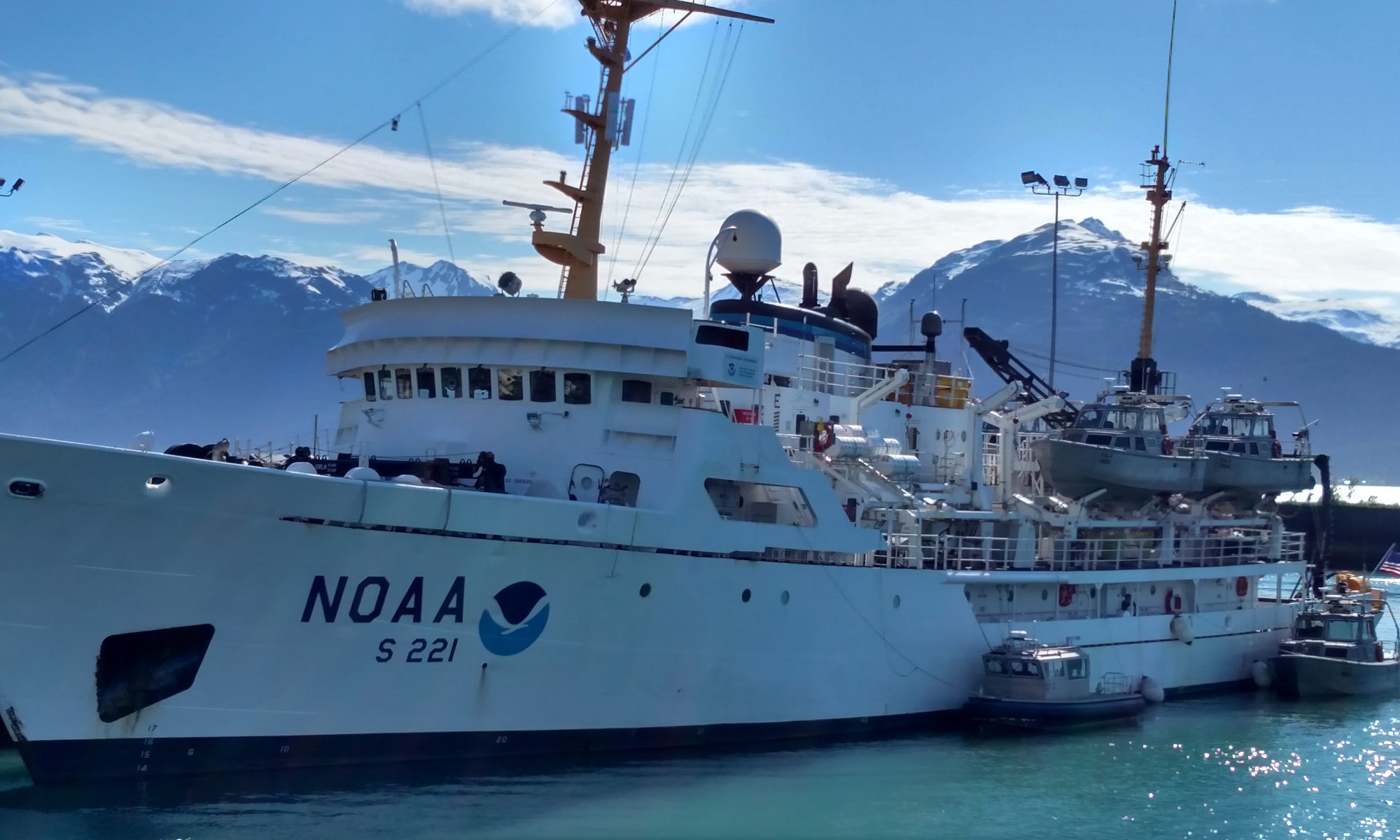
The NOAA Bell A. Shimada
Description of how an acoustic transducer works
Description of how an acoustic transducer works
Description of how an acoustic transducer works
Depending on the ship’s mission, acoustic transducers help determine the abundance of fish and invertebrate species. These readings help derive population estimates of marine life to set harvest rates for commercial fisherman. The acoustic transducer also provides the chance to study the spatial and temporal patterns of the fish so we can analyze their habitat choice, predator-prey interactions and food web dynamics. This technology offers our incredible scientists aboard the ability to monitor fish populations without altering their behavior. It also gives biologists and oceanographers the ability to provide analyses to better assist marine resource managers in making more informed decisions without actually catching the fish. This technology could save an abundance of time, energy, and resources.
A picture of the acoustic transducer below the ship.
Hydroacoustics also has limitations and is not the solution to all sampling problems. The technique has difficulty differentiating between species, and limited ability to measure fish close to the surface and close to the bottom. Therefore, hydroacoustics is mostly used alongside traditional trawling.
The main organism we are looking at is the Pacific hake. It is the largest single-species fishery on the west coast (not including Alaska). The United States has made over $40 million annually from Pacific hake since 2008. They prey upon euphasuiids, pandalid shrimp, and many fish such as herring. Hake are prey for predators such as tuna, sharks, and marine mammals. Hake are an essential part of the Pacific Northwest ecosystem as shown by this food web.
In the United States hake is most commonly used to make imitation crab, fish sticks, and cat food. It sells for a very low amount per pound. When I searched “hake” on the Walmart app, no hake filet came up in the United States. However, when I looked at the ingredients label on their seafood salad, hake was listed. Most Pacific hake are exported to Asia and Russia and bring in excellent revenue for our citizens who live on the North Pacific northwest. The scientific work done by people aboard ships like NOAA Ship Bell M. Shimada helps to ensure that the population of Pacific hake and other species thrive and can provide food and revenue for future generations to come.
Here is the process the NOAA Ship Bell M. Shimada goes through when “fishing” and analyzing the catch (pictures of all the steps are below).
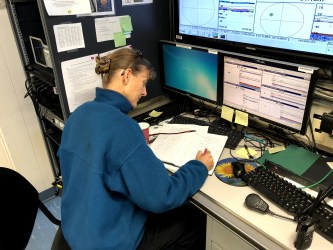
The science team, led by the Chief Scientist, analyzes the data being recorded by the acoustic transducers.
They communicate where they want to drop the fishing nets to the captain and officers standing by at the bridge.
The officers communicate to the deck hands to drop the net.
The science team carefully stands by and watches the computer monitors. They give orders to the officers on how far down the net should go and when to pick up the net based on their computer screens.
The deck hands reel in the net.
The deck hands drop the catch in the hopper.
The fish is sorted by species (Pacific Hake, Rock fish, Pollock, etc) on a conveyor belt by four scientists and scientific volunteers.
Assessments are taken on the hake using the chart below. Some fish are weighed and sent back, ~250 random hake in the batch are assessed by weight and sex, and ~30 hakes receive an enhanced assessment for length, weight, sex, and maturity.
Chief Scientist Rebecca Thomas analyzes the picture from the acoustic transmitter to give the bridge a location to fish.
Here is a picture of all 5 transmitters where the science team looks for signs of hake.
Here is a picture of what a school of hake would look like. If this is seen, orders are given to the bridge to drop the net.
The Captain and crew are told locations to where to steer the boat and drop the fishing nets.
Looking on as the nets are dropped
Lowering the fishing net
Scientist John Pohl analyzes the depth of the net vs. the acoustic picture on his screen
Fishing nets are being dropped
Our survey tech prepares to drop the catch in to the hopper for analyzing
Checking out the hopper to see the catch
A look inside the hopper. Mostly hake with a few Pollock and Rock fish
Sorting the hake down the conveyor belt
Hake photo shoot
Volunteer Scientist Heather Rippman sorts the catch
Charlie and Heather sorting the catch
Separating different species. This is Pollock
The hake is sorted male and femail
Our instructional chart for how we analyze the hake and other species
Scientist Steve de Blois measuring hake
Scientist Steve de Blois plus in data from his station
A beautiful rockfish. These will get measured and counted but then thrown back since this species is not the focus of the cruise.
Scientist Melanie Johnson plus in data from here hake station
It’s 10pm and we are done for the night. Time to shower!
Getting to Know the Crew: I have been overwhelmed by the kindness, sense of community, and sense of service the crew have had aboard theNOAA Ship Bell M. Shimada. Every professional on board has been willing to answer all the questions I ask and seem eager to share information about their lives with me. Every crew member has welcomed me aboard their home with a smile and willingness to do anything to make my experience the best it can be. I have and will continue to interview a few members of the crew or science team over the next few blog posts. Here are the first two:
Dr. Rebecca Thomas, Chief Scientist
Rebecca is the leader of all the scientific efforts aboard. Her, alongside our ship’s captain help to ensure the primary goals set by NOAA are carried out to the best of their ability. Rebecca is married and has two young girls at home. She graduated from Duke University and then went on to MIT for her doctorate in Biological Oceanography. She works for NOAA half-time at the Northwest Fisheries Science Center in Seattle and she loves her job. She can even bike to work when she is not researching on a ship. Her first NOAA mission was in 2002 and she has worked mostly with hake during her time out to sea.
Chief Scientist Rebecca Thomas
While many contemplate for years to figure out what career path they want to head in, Rebecca knew what she wanted to do when she was seven. It is obvious that the most difficult part of her role with NOAA is leaving her kids when she is out at sea researching. I got to witness her having to say goodbye to her kids in port and her kids were devastated and wouldn’t let go. They just love their mom.
Her love for science is obvious and contagious. I asked her what advice she would give middle school science enthusiasts back in Baltimore and she said, “Take lots of math classes. You need that strong foundation, especially statistics.” As a mathematics teacher, this of course made me smile:-)
As my direct supervisor aboard, Rebecca has been an asset to my experience thus far. When I first got aboard her only instruction to me was, “Just ask as many questions as you can.” Even during hectic times aboard she always takes her time to explain to me what is happening. She leads through expertise and she looks out for her team’s safety. She makes sure everyone sleeps and eats despite the long hours and she delegates her team’s strengths well. She has made me feel like a valuable member of the science team, despite my lack of science knowledge, and will stay up a few extra minutes in the evening to proofread my blog. She does all this while keeping her eyes on the goals of the research cruise.
Charlie Donahue, Volunteer Scientist and my Roommate
Charlie is a volunteer from Oregon State University. He is a junior biology major with a marine focus. It is Charlie’s first time on a ship.
Both of Charlie’s parents are biologists and teach at Central Washington University. Charlie’s first interest in science began when he was a kid. He loved dinosaurs and thought he would become a paleontologist. As he got older he realized he was most interested in the biological side of science. A few years back, Charlie and his family took a trip to Alaska and visited Kenai Fjords National Park. He described a moment aboard a boat with an abundance of marine wildlife surrounding him. He mentioned the noise and scene of hundreds of birds surrounding him. This is when he realized he wanted to narrow his scientific studies to marine life.
As a current college student, Charlie gave some great advice to future scientists to my class back in Baltimore who may be reading this. He said, “If you know you love science but are unsure of what specific type of science you want to study, then majoring in chemistry, biology, mathematics, or physics are all good bases for which you can explore and then specialize after.” He also said that his father gave him great employment advice which was to get some real life experience under his belt after earning a bachelor’s degree. He suggested to Charlie to get real-life experience before moving on with higher education because it will make him more marketable to future employers.
Charlie is still exploring what type of career path he want to move towards, which is one of the main reason’s he volunteered as a scientist aboard the ship. This is Charlie’s first time on a research vessel and he loves the food aboard and appreciates the structure of the day. Wake up, breakfast, lunch, and dinner are very set every day.
On a side note, Charlie has been a great roommate and is extremely clean and tidy, for a college student 🙂 He is keeping busy on his off time writing a story, writing comics, and working on his artistic side making designs with his latch-hook kit.
Thank you for continuing to follow along in this journey. I am grateful for your support. My next blog should be posted on Tuesday, September 11, 2018.
Primary longline stations are indicated in purple. The red line represents the path the Oregon II.
Weather Data from the Bridge:
Latitude: 28 30.4N
Longitude: 95 07.0W
Wind speed: 9 Knots
Wind direction: 130 (from Southeast)
Sky cover: Scattered
Visibility: 10 miles
Barometric pressure: 1016.0 atm
Sea wave height: 1-2 feet
Sea Water Temp: 30.4°C
Dry Bulb: 27.8°C
Wet Bulb: 25.7°C
Science and Technology Log:
Each piece of equipment is pulled back aboard the boat in the same order that it was deployed into the water. The numbered gangions are pulled up one by one and if there is a shark attached to the hook it is brought aboard for data collection. Larger sharks are brought up to the side of the vessel using a cradle.
Tiger Shark (Galeocerdo cuvier) on the cradle
Scalloped Hammerhead (Sphyrna lewini) on the cradle
Data that is collected for the sharks caught include the following:
#1 Length:
Precaudal Length: The length of the shark from the nose to the beginning of the caudal fin.
Fork Length: The length of the shark from the nose to the fork of the caudal fin.
Natural Length: The length of the shark from the nose to the end of the caudal fin as it naturally lies.
Total Length: The length of the shark from the nose to the end of the caudal fin when stretched to its greatest length.
Measurements taken for an Atlantic Sharpnose Shark (Rhizoprionodon terraenovae)
Great Hammerhead Shark (Sphyrna mokarran) being weighed
#2 Weight: The weight of the shark is measured in kilograms.
M-tag being inserted on a Great Hammerhead Shark (Sphyrna mokarran)
#3 M-Tag Number: An M-tag is inserted at the base of the dorsal fin, and it contains a specific number to identify the shark.
Roto tag being attached to a Gulf Smooth-hound Shark (Mustelus sinusmexicanus)
#4 Roto Tag Number: Roto tags are used on smaller shark individuals, and are clipped to the center of the dorsal fin.
Once all measurements are taken, and the shark has been tagged, it is released back into the water.
Gulf Smooth-hound Shark (Mustelus sinusmexicanus) ready for release.
Personal Log:
I couldn’t have been placed on a better Teacher at Sea assignment. The entire NOAA team has been patient with me and willing to go out of their way to make sure I am enjoying my experience. It is evident that the NOAA scientists are passionate about their work, as they are so eager to share every interesting detail no matter how small.


 In the United States hake is most commonly used to make imitation crab, fish sticks, and cat food. It sells for a very low amount per pound. When I searched “hake” on the Walmart app, no hake filet came up in the United States. However, when I looked at the ingredients label on their seafood salad, hake was listed. Most Pacific hake are exported to Asia and Russia and bring in excellent revenue for our citizens who live on the North Pacific northwest. The scientific work done by people aboard ships like NOAA Ship Bell M. Shimada helps to ensure that the population of Pacific hake and other species thrive and can provide food and revenue for future generations to come.


![IMG_1085[1]](https://i0.wp.com/noaateacheratsea.blog/wp-content/uploads/2018/09/img_10851.jpg?w=258&h=258&crop=1&ssl=1 "IMG_1085[1]")
![IMG_1081[1]](https://i0.wp.com/noaateacheratsea.blog/wp-content/uploads/2018/09/img_10811.jpg?w=258&h=258&crop=1&ssl=1 "IMG_1081[1]")


![IMG_1104[1]](https://i0.wp.com/noaateacheratsea.blog/wp-content/uploads/2018/09/img_11041.jpg?w=258&h=258&crop=1&ssl=1 "IMG_1104[1]")
![IMG_1056[1].JPG](https://i0.wp.com/noaateacheratsea.blog/wp-content/uploads/2018/09/img_10561.jpg?resize=348%2C261&ssl=1)


