DJ Kast, Interview with Jessica Lueders-Dumont, May 22, 2015

NOAA Teacher at Sea
Dieuwertje “DJ” Kast
Aboard NOAA Ship Henry B. Bigelow
May 19 – June 3, 2015

Mission: Ecosystem Monitoring Survey
Geographical area of cruise: East Coast

Date: May 22, 2015, Day 4 of Voyage


Interview with Jessica Lueders-Dumont

Who are you as a scientist?

Jessica Lueders-Dumont is a graduate student at Princeton University and has two primary components of her PhD — nitrogen biogeochemistry and historical ecology of the Gulf of Maine.

Jessica Lueders- Dumont, graduate student at Princeton cleaning a mini bongo plankton net for her sample.
Jessica Lueders- Dumont, graduate student at Princeton cleaning a mini bongo plankton net for her sample. Photo by: DJ Kast

 What research are you doing?

Her two projects are, respectively,

A) Nitrogen cycling in the North Atlantic (specifically focused on the Gulf of Maine and on Georges Bank but interested in gradients along the entire eastern seaboard)

B) Changes in trophic level of Atlantic cod in the Gulf of Maine and on Georges Bank over the history of fishing in the region. The surprising way in which these two seemingly disparate projects are related is that part A effectively sets the baseline for understanding part B!

She is co-advised by Danny Sigman and Bess Ward. Danny’s research group focuses on investigating climate change through deep time, primarily by assessing changes in the global nitrogen cycle which are inextricably tied to the strength of the biological pump (i.e. biological-mediated carbon export and storage in the ocean). Bess’s lab focuses on the functional diversity of marine phytoplankton and bacteria and the contributions of these groups to various nitrogen cycling processes in the modern ocean, specifically as pertains to oxygen minimum zones (OMZs). She is also advised by a Olaf Jensen, a fisheries scientist at Rutgers University.

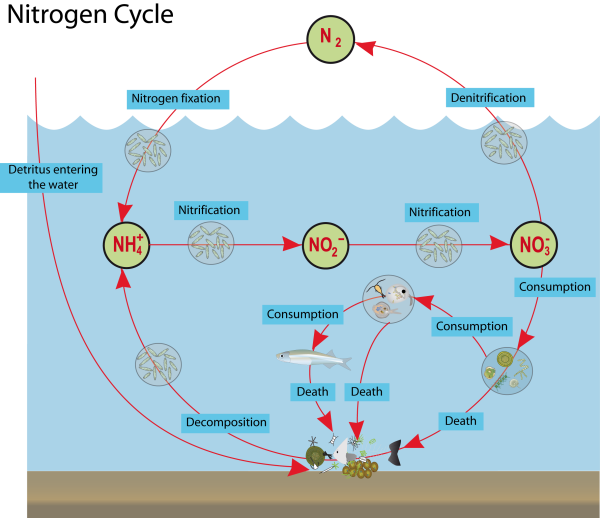
In both of these biogeochemistry labs,  nitrogen isotopes (referred to as d15N, the ratio of the heavy 15N nuclide to the lighter 14N nuclide in a sample compared to that of a known standard) are used to track nitrogen cycling processes. The d15N of a water mass is a result of the relative proportions of different nitrogen cycling processes — nitrogen fixation, nitrogen assimilation, the rate of supply, the extent of nutrient utilization, etc. These can either be constrained directly via 15N tracer studies or can be inferred from “natural abundance” nitrogen isotopic composition, the latter of which will be used as a tool for this project.

Nitrogen Cycle in the Ocean. Photo credit to: https://wordsinmocean.files.wordpress.com/2012/02/n-cycle.png

On this cruise she has 3 sample types — phytoplankton, zooplankton, and seawater nitrate — and two overarching questions that these samples will address: How variable is “baseline d15N” along the entire eastern seaboard, and does this isotopic signal propagate to higher trophic levels? Each sample type gives us a different “timescale” of N cycling on the U.S. continental shelf. She will be filtering phytoplankton from various depths onto filters, she will be collecting seawater for subsequent analysis in the lab, and she will be collecting zooplankton samples — all of which will be analyzed for nitrogen isotopic composition (d15N).

Biogeochemistry background: 

Biogeochemists look at everything on an integrated scale. We like to look at the box model, which looks at the surface ocean and the deep ocean and the things that exchange between the two.

The surface layer of the ocean: euphotic zone (approximately 0-150 m-but this range depends on depth and location and is essentially the sunlit layer); nutrients are scarce here.

When the top zone animals die they sink below the euphotic zone and into the aphotic zone (150 m-4000m), and the bacteria break down the organic matter into inorganic matter (nitrate (NO3), phosphate (PO4) and silicate (Si(OH)3.). In terms of climate, an important nutrient that gets cycled is carbon dioxide.We look at the nitrate, phosphate, and silicate as limiting factors for biological activity for carbon dioxide, we are essentially calculating these three nutrients to see how much carbon dioxide is being removed from the atmosphere and “pumped” into the deep sea.  This is called the biological pump. Additionally, the particulate matter that falls to the deep sea is called Marine Snow, which is tiny organic matter from the euphotic zone that fuels the deep sea environments; it is orders of magnitude less at the bottom compared to the top.

Cycling
Visual Representation of the aphotic and euphotic zones and the nutrients that cycle through them. Photo by: Patricia Sharpley


Did you know that the “Deep sea is really acidic, holds a lot of CO2 and is the biggest reservoir of C02 in the world?” – From Jessica Lueders- Demont, graduate student at Princeton.

One of the most important limiting factors for phytoplankton is nitrogen, which is not readily available in many parts of the global ocean. “A limiting nutrient is a chemical necessary for plant growth, but available in quantities smaller than needed for algae and other primary producers to increase their abundance. Organisms can grow and reproduce only when they have sufficient nutrients. For algae, the carbon source is CO2and this, at least in the surface water, has a constant value and is not limiting their growth. The limiting nutrients are minerals (such as Fe+2), nitrogen, and phosphorus compounds” (Patricia Sharpley 2010).

Conversely, phosphorus is the limiting factor on land. The most common nitrogen is molecular nitrogen or N2, which has a strong bond to break and biologically it is very expensive to fix from the atmosphere. 

Biological, chemical, and physical oceanography all work together in this biogeochemistry world and are needed to have a productive ocean. For example, we need the physical oceanography to upwell them to the surface so that the life in the euphotic zone can use them.

Activities on the ship that I am assisting Jessica with:

  • Zooplankton collected using mini bongos with a 165 micron mesh and then further filtered at meshes: 1000, 500, and ends with 250 microns, this takes out all of the big plankton that she is not studying and leaves only her own in her size range which is 165-200 microns.
  • She is collecting zooplankton water samples because it puts the phytoplankton that she is focusing on into perspective.
The last of the mesh buckets that's filtering for phytoplankton. Photo by: DJ Kast
The last of the mesh buckets that’s filtering for phytoplankton. Photo by: DJ Kast
    • Aspirator pump sucks out all of the water so that the zooplankton are left on a glass fiber filter (GFFs) on the filtration rack.


  • Aspirator pump that is on the side sucks out all of the air so that the plankton get stuck on the filters at the bottom of the cups seen here. Photo by: DJ Kast
    Aspirator pump that is on the side sucks out all of the air so that the plankton get stuck on the filters at the bottom of the cups seen here. Photo by: DJ Kast
  • Bottom of the cup after all the water has been sucked through. Photo by: DJ Kast
    Bottom of the cup after all the water has been sucked through. Photo by: DJ Kast
  • Jessica removing the filter with sterilized tweezers to place into a labeled petridish. Photo by: DJ Kast
    Jessica removing the filter with sterilized tweezers to place into a labeled petri dish. Photo by: DJ Kast

    Labeled petri dish with GFF of phytoplankton on it. Photo by: DJ Kast
    Labeled petri dish with GFF of phytoplankton on it. Photo by: DJ Kast

Video of this happening:

Phytoplankton filtering:

Jessica collecting her water sample from the Niskin bottle in the Rosette. Photo by DJ Kast
Up close shot of the spigot that releases water from Niskin bottle in the Rosette. Photo by DJ Kast
DJ Kast helping Jessica collect her 4 L of seawater from the Niskin bottle in the Rosette. Photo by Jerry P.
DJ and Jessica collect her 4 L of seawater from the Niskin bottle in the Rosette. Photo by Jerry P.
Chief Scientist Jerry Prezioso and Megan Switzer next to the CTD and Rosette
Chief Scientist Jerry Prezioso and Megan Switzer next to the CTD and Rosette Photo by: DJ Kast


May 21, 14:00 hours: Phytoplankton filtering with Jessica.

In addition to the small bottles Jessica needs, we filled 4 L bottles with water at the 6 different depths (100, 50, 30, 20, 10, 3 m) as well.

We then brought all the 4 L jugs into the chemistry lab to process them. The setup includes water draining through the tubing coming from the 4 L jugs into the filters with the GFFs in it. Each 4 L jug is filtered by 2 of these filter setups preferably at an equal rate. The deepest depth 100 m was finished the quickest because it had the least amount of phytoplankton that would block the GFF and then a second jug was collected to try and increase the concentration of phytoplankton on the GFF.

Phytoplankton filtration setup. Photo by DJ Kast
The filter and pump setup up close. Photo by DJ Kast
Up close shot of the GFF within the filtration unit.
Up close shot of the GFF within the filtration unit. Photo by DJ Kast
Jessica keeping an eye on her filtration system to make sure nothing is leaking and that there are no air bubbles restricting water flow
Jessica keeping an eye on her filtration system to make sure nothing is leaking and that there are no air bubbles restricting water flow. Photo by DJ Kast
Here I am helping Jessica setup the filtration unit.
Here I am helping Jessica setup the filtration unit.Photo by Jessica Lueders- Dumont
The GFF with the phytoplankton (green stuff) on it.
The GFF with the phytoplankton (green stuff) on it. Photo by: DJ Kast

There are 2 filters for each depth, and since she has 12 filtration bottles total, then she would be collecting data from 6 depths. She collects 2 filters so that she has replicates for each depth.

Here they are all laid out to show the differences in phytoplankton concentration.

The 6 depths worth of GFFs. See how the 30 m is the darkest. Thats evidence for the chlorophyll max. Photo by: DJ Kast

She will fold the GFF in half in aluminum foil and store it at -80C until back in the lab at Princeton. There, the GFF’s are combusted in an elemental analyzer and the resulting gases run through a mass spectrometer looking for concentrations of N2 and CO2. The 30 m GFF was the most concentrated and that was because of a chlorophyll maximum at this depth.

Chlorophyll maximum layers are common features of vertically stratified water columns. There is a subsurface maximum or layer of chlorophyll concentration. These are found throughout oceans, lakes, and estuaries around the world at varying depths, thicknesses, intensities, composition, and time of year.

DJ Kast, Interview with the Marine Mammal Observers, May 21, 2015

NOAA Teacher at Sea
Dieuwertje “DJ” Kast
Aboard NOAA Ship Henry B. Bigelow
May 19 – June 3, 2015

Mission: Ecosystem Monitoring Survey
Geographical area of cruise: East Coast

Date: May 21, 2015, Day 3 of Voyage


Interview with the Marine Mammal Observers

Marine Mammal Observers Marjorie and Brigid Photo by: DJ Kast
Marine Mammal Observers Marjorie and Brigid
Photo by: DJ Kast

Marjorie and Brigid on the Flying Bridge.

Whale Observer Station on the Flying Bridge. Photo by: DJ Kast

These two marine mammal observers are on the Flying Bridge of the ship.

I asked them what they were looking for and they said blows. I thought I spotted one at 11 o’clock and asked if it was supposed to look like a puff of smoke. They turned their cameras and binoculars to that direction and there were two whales right there. Marjorie turned to me and said, “you make our job look very easy”.

I spent some time interviewing the two of them today on May 21st, 2015.

Tell me a little bit about your background:

Marjorie Foster:

“I went to Stetson University and majored in biological sciences and concurrently worked with aquariums and sea turtle and bird rehab. Started flying aerial surveys for right whales, and was pulled into the world of NOAA in 2010. I’ve worked on small boats for bottlenose dolphin surveys as well.”

Brigid McKenna:

“I went to the University of Massachusetts in Amherst and received my degree in biology, because I originally wanted to go into veterinary school, and worked in the aquarium medical center as an internship. Afterwards, I realized that veterinary school was not for me and I started an internship with the whale watch, and worked with spinner dolphins. Then I worked with scientists for Humpback Whales in Provincetown. Afterwards, I became a Right whale vessel observer and pursued my masters in Marine Mammal Science at St. Andrews. Afterwards, I became an aerial observer for right whales. This means I got to be in planes above the ocean looking for whales.”

Shoutout to Jen Jakush for keeping up with my blog in Florida.

What is your exact job on this research cruise?

Marine Mammal Observers are contracted by NOAA. We keep an eye out for whales and dolphins from the top of the ship and collect information about what we see.

How do you get trained to be Marine mammal observer?

Field experience is vital. The more you have seen, the more you can easily narrow down behavioral and visual cues to define a species. Also, conversations with other scientists in the field can really help expand your knowledge base.

For me:

Bridget- internship on a whale watch boat

Majorie- working with right whales

What do you enjoy about your job?

Marjorie: Being outside, and getting the opportunity to see things that people don’t normally get to see. Every day is exciting because there are endless possibilities of amazing things to witness. I feel very lucky to collect data that will be used in larger conversation efforts to help preserve these animals.

Brigid: Everything is dynamic, every project is new, I love being outside on the ocean. We can do aerial and vessel observations. We get to travel a lot. It’s a small world in the marine mammal community, so you get to know a lot of cool people.

What are the most common mammals you have seen on this cruise?

Common dolphins: white patch on sides and dark gray on top, and v shaped saddle.

Dolphin spotted by the observers on the side of the boat. Photo by: DJ Kast

Bottlenose dolphins: light gray and dark gray on top

Common Bottlenose Dolphin. Photo taken by DJ Kast from the Marine Mammals of the World book.

Couple of mola mola – largest of the bony fish

Whales:

Fin whales

Pilot whales.

Sei Whale

Humpback in the distance.

Marjorie: On the ledge and on the shelf there should be much more life than we have been seeing. And that will be in about an hour or two.

Up North- in the Gulf of Maine.

Northern waters are more abundant with the small marine life large whales like to eat. We are expecting to see a lot of baleen whales in the Gulf of Maine later on in this project. Further south we will see more dolphins and other toothed whales. We expect to see bottlenose dolphins, pilot whales, and possibly Risso’s dolphins.

Did you know?

Right Whale’s favorite copepod is Calanus finmarchicus, which bloom in Cape Cod waters. The Right whales know when the copepods are in a fatty stage and will only open their mouths if the calorie intake is worth it.

Did you know?

Different humpbacks have different hunting techniques.

The hunting technique specific to the Gulf of Maine is bubble-net feeding with lob-tailing. This means that they make bubbles around a school of fish and then hit the water with their tail to stun them.

Did you know?

Sad Fact: 72% of right whales have been entangled at least once, which we can tell from the scars that remain on their body.

What do you do when you site a marine mammal?

  1. One of us points
  2. Keep track of it. Both of our eyes on it
  3. Take pictures and look through binoculars for a positive identification of the species of marine mammal.
  4. How far they are, what direction they are swimming in, and what behaviors they are exhibiting.
  5. We have a system on our Toughbook computer called Vissurv. The data we input into this system includes:
    • Which side of the boat, and how many meters, and what direction are the animals are swimming to help us keep track of them
    • Our main objective is to ID them to species and count how many of them there are, which is called the pod size.
    • Some example behaviors include: swimming, breaching, porpoising, bow riding
    • Our computer is constantly recording GPS and environmental conditions. This information will ultimately be tied to the sightings. Environmental conditions include: swell, glare, wind, sea state etc.

DJ Kast, Day 1 of Voyage, May 19, 2015

NOAA Teacher at Sea
Dieuwertje “DJ” Kast
Aboard NOAA Ship Henry B. Bigelow
May 19 – June 3, 2015

Mission: Ecosystem Monitoring Survey
Geographical area of cruise: East Coast

Date: May 19, 2015, Day 1 of Voyage

Weather Data:

  • FOGGY
  • Air Temperature: 13.5 °C
  • Water Temperature: 12.6°C
  • Barometer: 1005 mb
  • TSG (Sound-Velocity): 1496.852 meters/sec
  • TSG- Conductivity: 3.90427 s/m
  • TSG- Salinity: 33.25 PSU
  • Wind: 13 knots SouthWest
Weather Data from the Acoustic Lab. Photo by DJ Kast

Personal Log

7 am- 8 am breakfast. Oatmeal with fresh fruit! I also met Jeremy and Dennis our chefs and mess hall stewards for the voyage. They are so nice and their food is so delicious.

I also met two mammals researchers named Marjorie and Bridget who will be spotting marine mammals and documenting what we see. I hope they can spot the three belugas that have been in the news here in Narragansett Bay. I heard that researchers took a biopsy of one of the whales with a small dart that takes epidermis and blood samples from the whale itself.


Science and Technology Log

I decorated my drifter buoy with stickers from all of my current programs (USC Dornsife, JEP, YSP, Wonderkids and NAI) and the programs that inspired me to be here (USC Seagrant, USC Wrigley Institute for Environmental Studies, USC Catalina Hyperbaric Chamber). A drifter buoy looks like a ball with a cap on it and is gray on the bottom of the ball structure and blue on the top.

Thank you Laura (Operations Officer) for coming up with the idea to print out logos and photos of my programs and laminate them and place them on the buoy because I forgot mine.

IMG_1942_2

11:00-11:30- Laura the operations officer gave us a welcome aboard speech talking about all the safety components of the ship including fire drills, man overboard drills, and how to use a EEBD (emergency exit breathing device) that provides air for 10 minutes when a compartment floods with smoke.)

11:30: Lunch was delicious! Spaghetti with meatballs! I met a Canadian man named Bradley Toms, who will be monitoring and observing for marine birds.

12:30- DEPARTURE!

I learned from Jeff and Jerry what the markings on our chart are! The square boxes are for bongo net deployments and the purple dots are for rosette and CTD deployments. The dive flags are locations where we deploy both bongo net and rosettes.


Chart of our course.  Photo by: Jerry P.
Chart of our course.
Photo by: Jerry P.

Met with Christina, Tamara and Megan (three amazing women scientists) in the lab space to see how they were setting up all of their research for the trip. This included putting together CTDs, turning on all their sensors and computers and all the flow-through systems and data collectors.

Christina, Tamara, and Megan prepare their instruments for the research cruise in the Wetlab. Photo by DJ Kast

Our survey technician, Jeff, also opened up the shop for me to buy a NOAA Ship Henry B. Bigelow mug. LOVE it and now I don’t need to waste the paper cups in the mess hall (Kitchen/ cafeteria area). He even offered up some free stickers from NOAA and the ship itself to place on the buoy. The goat with Henry B. Bigelow had a cute story of the Bigelow being on a previous boat called the Albatross and its mascot was Buck the goat, which was why they had that sticker in the boat shop. Henry Bigelow is a scientist who used to study the Gulf of Maine on a schooner.

My new NOAA Henry B. Bigelow Mug! Photo by DJ Kast
The Survey Technician Jeff provided these great stickers for my drifter buoy. Photo by DJ Kast

I got to put on my foul weather gear for the first time. Everything must be waterproof (I wonder why?) and my foul weather gear includes boots, pants and a jacket. To work on the deck space where the bongos are thrown overboard or deployed I must were a PFD (Personal Flotation device) and a hard hat.

Foul Weather Gear model!  Fight on! Photo by DJ Kast
Foul Weather Gear model!
Fight on! Photo by DJ Kast

I definitely needed those boots and pants when Jerry and Chris taught me how to clean the bongo nets to actually collect the plankton. There are two deckhands (Roger and Paul) on our watch (12 PM- 12 AM) that assisted the person driving the winch or crane that holds the main and mini bongos in the water. They are towed at various depths (within 5 meters of the seafloor) to measure plankton for different researchers at various sample sites along the way. There was a little rocket ship (flowmeter) looking device in the middle of the large bongos that came with a propeller that was used as a way of measuring flow through the plankton net which helped in plankton counts (per cubic meter) sampling at depth.

Main Bongo setup for both zooplankton and ichthyoplankton. Photo by DJ Kast
Zooplankton Net.  Photo by DJ Kast
Zooplankton Net.
Photo by DJ Kast
This Measures Flow through the plankton net itself at depth

First, we took a hose to the net causing all of the organisms in our plankton tow to wash down to the end where they could be taken out and put into a sieve. They said to focus on the seams because lots of plankton can get stuck there.

Take off the strings here to let the plankton fall into the sieve. Photo by DJ Kast


The dark brown spots here indicate thousands of reddish brown zooplankton, mostly copepods that were caught. Photo by: DJ Kast
Washing down the Plankton Net. Photo by DJ Kast
Baby Bongos and Main Bongos coming up after deployment. Photo by DJ Kast
Action shot of washing the net! Photo by Jerry P.
I'm going to wash down some baby bongo plankton nets. Photo by Jerry P.
I’m going to wash down some baby bongo plankton nets. Photo by Jerry P.
My first plankton Sample! Photo by DJ Kast
My first plankton Sample!
Photo by DJ Kast

There are two main types of plankton tows out here, one with mini bongos that are processed with ethanol and are used for genetic analysis. The ethanol dehydrates the plankton releasing water so the ethanol needs to be replaced after 24 hours or else it will be too diluted from the plankton water.


Using ethanol to collect the plankton for preservation for genetic analysis. Photo by DJ Kast
The jar of primarily copepods that will be sent off for genetic analysis. Photo by DJ Kast

They are labeled on top of the jar and inside the jar with waterproof labels that indicate:

Cruise: Henry Biglow 2015, cruise # 2; and the gear 2B3 indicate baby bongo nets. Date, station number, haul event, type of ethanol used etc. The plankton collected by the big bongo is labeled the same except instead of the Ot (other) on the side it says I or Z (ichthyoplankton and zooplankton).

Jar Labels. Photo by DJ Kast


The second type is the big bongos. There are two types of nets on the bongo setup (called bongo because the 2 types of nets are placed side by side); there is one that is labeled green for zooplankton and the second that is labeled red for the ichthyoplankton. After the sieve has filtered out all the plankton from the seawater, all of the organisms are put into a jar and formalin is added to kill and preserve them for taxonomic purposes. The coolest thing so far I have seen are fish larvae because they look like little eyeballs sticking out of on top of the thousands of reddish brown plankton or copepods, a ctenophore (or comb jelly, a tiny little see-through blob), and two lion’s mane jellyfish.


Lion's Mane Jellyfish surrounded by copepods in the sieve. Photo by DJ Kast
Lion’s Mane Jellyfish surrounded by copepods in the sieve. Photo by DJ Kast


DJ Kast, Pre-Cruise, May 18, 2015

NOAA Teacher at Sea
Dieuwertje “DJ” Kast
Aboard NOAA Ship Henry B. Bigelow
May 19 – June 3, 2015

Mission: Ecosystem Monitoring Survey
Geographical area of cruise: East Coast

Date: May 18, 2015 (Pre-cruise)

Personal Log

Chris Melrose picked me up from the hotel and really helped me get a grasp of life aboard a research vessel. I learned all about Narragansett Bay and the lab here in Rhode Island.

I then met Jerry Prezioso, the Chief Scientist for the voyage, who gave me a great tour of the Narragansett Bay Lab. I learned what an XBT (expendable bathythermograph) was and how it measures temperature at various depths.

XBT  Photo by: DJ Kast
XBT
Photo by: DJ Kast


I learned how a Niskin bottle works and how many Niskin bottles lined up in a circle to make a piece of equipment called a rosette. The Niskin bottle is like a hollow tube with a mechanism that closes the tube at a specific depth that will then bring a water sample indicative of that depth. They apparently cost $400 each.  I am already making plans on how to make a DYI one for the classroom.

Niskin Bottle Photo by: DJ Kast
Niskin Bottle
Photo by: DJ Kast
This is a Rosette with 12 niskin bottles. Photo by: DJ Kast

With Jerry, I also met Ruth Briggs who works for the Narragansett Bay Apex Predators division and she showed me the shark tags that she has citizen scientists put onto sharks on the base of their dorsal (top) fin that they catch. When the sharks are caught again, the information she requests is sent back to her and includes species, size, sex, location to shore, and weight. She even let me borrow a decommissioned tag to show to my students in California.

Decommissioned shark tag from the Narragansett Bay Apex Predators Division Photo by: DJ Kast
Decommissioned shark tag from the Narragansett Bay Apex Predators Division
Photo by: DJ Kast


I saw a drifter buoy that I will be decorating with all of my programs (USC, JEP, YSP and NAI) logos.

Jerry also sent me the map of all the stations that we will be visiting on our ship and at each station we are projected to measure salinity, depth, temperature, nutrients and plankton! I am so excited! We are expected to go as far south as North Carolina and as far north as the Bay of Fundy in Canada (International Waters!!!).

TAS and the NOAA Ship Arrival

My stateroom is amazing! My roommate and I even have our own head (bathroom) in our room with sink, shower and all. There are two beds in a bunk bed format, and since I showed up about 6 hours before the other scientists I chose the bottom bunk and the cabinet I wanted for my stuff. I unpacked (and gladly didn’t over pack) and managed to fit it all in the closet that was given to us. I feel so fortunate to have such amazing accommodations like this.

Important People who Keep the Ship Afloat and on Course

Today I met the Operations Officer, Laura, who showed me the ropes and introduced me to people on the ship at dinner at the bowling alley on the naval base here in Newport, RI. She also showed me the buoy yard filled with lots of different buoys that indicate different paths of travel and safe/unsafe waters for ships coming into port.

I entered a yard of buoys on the Newport Naval Base and here I am for a size comparison. They are HUGE!
Here is a look at what happens when  a buoy is freshly painted and when its being fouled by marine organisms and algae (RUST!) Photo by: DJ Kast
Here is a look at what happens when a buoy is freshly painted and when its being fouled by marine organisms and algae (RUST!) Photo by: DJ Kast


Important Ship Personnel
CO: Commanding Officer
XO: Executive Officer
CME: Chief Marine Officer
OO or Ops: Operations Officer= Laura
NO: Navigational Officer or Nav= Eric
CB: Chief Boson or Deck Boss= Adrian
AB: Able Seaman or a Deckhand = Roger

Meal Schedule
I also learned about food times (Very important).
7AM- 8 AM or 0700-0800 hours= Breakfast
11- 12 PM or 1100-1200 hours= Lunch
5- 6 PM or 1700-1800 hours = Dinner

Roommate in Stateroom 2-22


DJ Kast on the Gateway Photo by: DJ Kast
DJ Kast on the Gangway
Photo by: DJ Kast
Here I am boarding the NOAA Henry B. Bigelow Photo by: DJ Kast
Here I am boarding the NOAA Henry B. Bigelow
Photo by: DJ Kast


I met my amazing roommate Megan and she is a master’s student at the University of Maine. We will sadly have opposite schedules for most of the trip because I will be on the 12 PM- 12 AM shift and she will be on the 12 AM- 12 PM shift. We have a lot of things in common including our love of the ocean, geology and Harry Potter. She will be looking at dissolved nutrients in the water and she will be monitoring the instruments that measure conductivity, temperature and depth or (CTD) and requesting water samples while at various stations.

Dieuwertje “DJ” Kast, Introductions, May 7, 2015

NOAA Teacher at Sea
Dieuwertje Kast
(Almost) Onboard NOAA Ship Henry B. Bigelow
May 19 – June 3, 2015

Mission: Ecosystem Monitoring Survey
Geographical area of cruise: Northeast Atlantic Ocean
Date: May 7, 2015

Personal Log

Greetings from Southern California! My name is Dieuwertje or “DJ” Kast and I am currently the  STEM Program Manager (K-12) for the University of Southern California (USC) Joint Educational Project (JEP) and Director of Young Scientists Program (YSP) and the USC Wonderkids Program. I am also assisting with the USC JEP Boeing project which does Teacher Professional development in Water and Sustainability. All of which are located at the JEP House on the USC Campus in Los Angeles California (seen here about 47 miles one way commute from my husband Roee and my home in Chino, CA).

Screen Shot 2015-05-07 at 9.20.46 AM

I received my masters in Education and my biology teaching credential at the Rossier School of Education. A native of the Netherlands, I received my undergraduate and graduate education at USC through the progressive masters programs obtaining my BS in Biology and MS in Marine Environmental Biology. I have a passion for Science Education, have written curriculum and held leadership roles for both Wonderkids, The Young Scientist Program, the USC QuikSCience program, the USC Wrigley Institute for Environmental Science on Catalina Island, USC Seagrant and the USC Neighborhood Academic Initiative (NAI) program (rigorous, seven-year pre-college enrichment program designed to prepare low-income neighborhood students for admission to a college or university). In my spare time I enjoy writing science books, photography, helping students with science fairs, SCUBA diving and working with marine science labs across California.

I wanted to tell other TAS Teachers about the programs that I manage or have been a part of in hopes that they may also be inspired to learn more about what I do and how their students can be involved, and the potential for teacher professional development and partnerships in the future. I am looking forward to going on my voyage and using what I learn to write curriculum and communicating it to the thousands of students in my programs.

The Young Scientists Program works in partnership with 5 USC community schools, from the  greater ‘USC 10 Family of Schools’ to engage more than 1400 elementary school students, 45 LAUSD teachers, and 5 principals through a broad repertoire of science curriculum.  YSP TAs are placed at each school presenting hands-on science labs to fourth and fifth grade classrooms. YSP brings scientific laboratory experiences directly to students and their teachers with the goal of supplementing current science instruction, complimenting LAUSD and state grade level science learning standards, strengthening science literacy and promoting interest in scientific careers. One of YSP’s primary objectives is to increase science activities for a larger number of our neighborhood children as a means to encourage them to consider careers in the Science, Technology, Engineering and Mathematics (STEM) and to apply what they are learning in the classroom to the real world. Additional outcomes are that our USC undergraduate students learn how to become successful mentors, gain valuable teaching experience, and learn how to directly respond to the needs of the schools, communities and families.

USC JEP Wonderkids is first-third grade after-school science program in the USC Family of Schools. It is currently in 6 schools: Foshay, Weemes, Vermont, Norwood, Mack, Norwood, and 32nd street. The program focuses on different areas of science through hands-on lesson plans and books. The program also has professional scientists from different science fields as rotating speakers come into the classroom to encourage students to pursue careers in STEM. Science fields pursued so far: neuroscience, environmental science, paleontology, deep sea, marine biology, botany, robotics, space, chemistry, DNA, animal behavior, microbiology, physics, computer science, biomedical engineering and medicine.

I will be doing Ecosystem Monitoring Survey (Fisheries) on NOAA Ship Henry B. Bigelow Ship from May 19 – June 3, 2015. I am so excited! I will be embarking on my research cruise in Newport, Rhode Island and disembarking there as well.

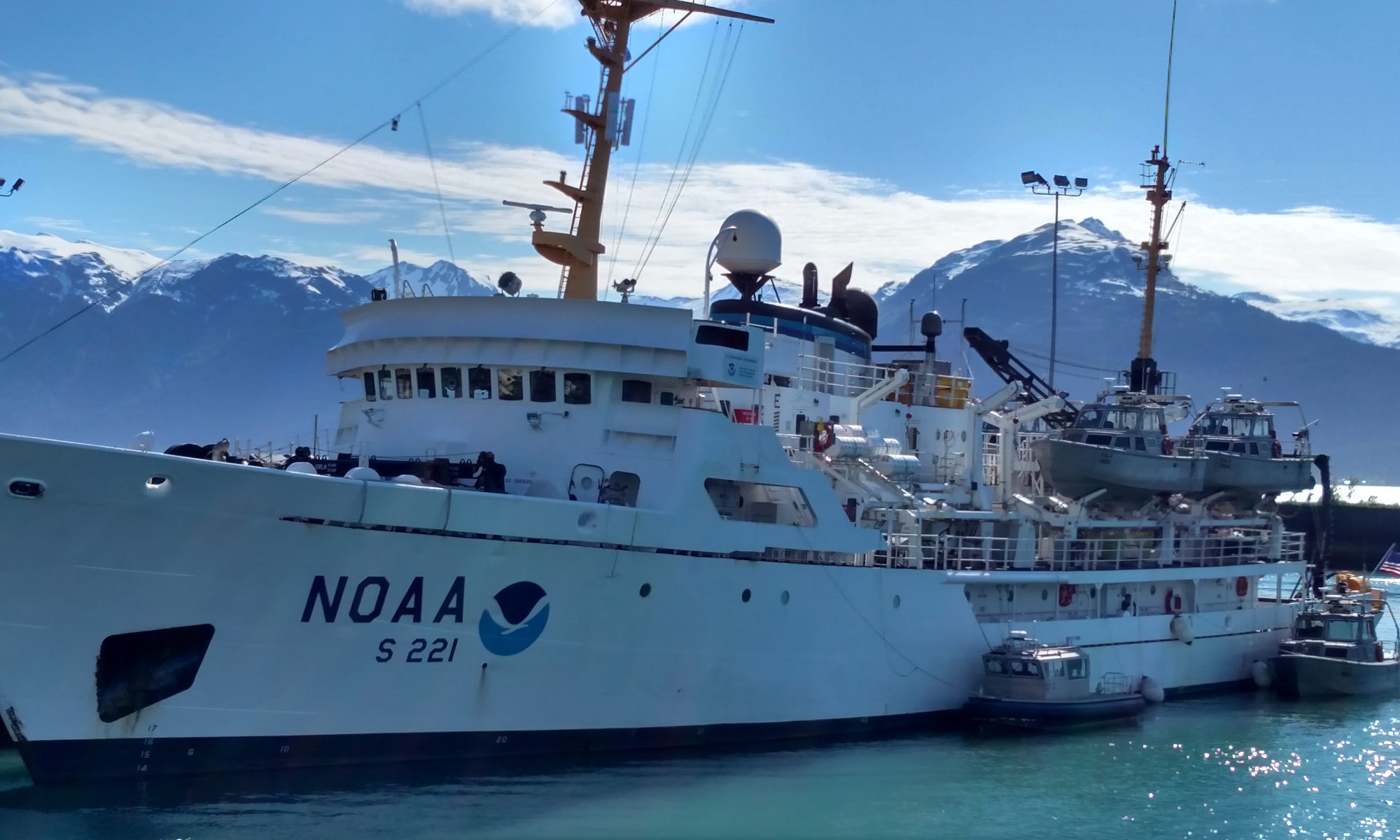
This is a photo of the NOAA Henry B. Bigelow Ship.  Credit to: http://www.moc.noaa.gov/hb/HB-June07.JPG
This is a photo of the NOAA Henry B. Bigelow Ship.
Credit to: http://www.moc.noaa.gov/hb/HB-June07.JPG
Newport, Rhode Island

I will be working with the Narragansett Laboratory and the objectives of the investigation are:

  1. to monitor the fishery-relevant components of the Northeast Shelf ecosystem, to characterize the baseline conditions and their variability, and to index the seasonal, annual, and decadal changes in the conditions of the ecosystem, and
  2. to determine the effects of biological and physical processes on the recruitment of Northeast shelf fishes, especially gadoids.

The Investigation utilizes three survey approaches to gather data on planktonic organisms and environmental parameters:

  1. shelf-wide Research Vessel Surveys;
  2. Ship of Opportunity (SOOP) Transect Surveys;
  3. sampling using a variety of environmental satellites and buoys (termed Remote Sensing Surveys).